Just back from another visit to Tasmania – our third in just over a year.
In The Pink. Salamanca Market, Hobart Tasmania. Olympus EM-10 with 17mm f2.8 lens. 1/250, f4 at ISO 400.Pink and Yellow, Salamanca Market, Hobart, Tasmania. Olympus EM-10 with 17mm f2.8 lens. 1/400 sec, f4, ISO 400.
Despite being cold and wet Salamanca Markets was its usual funky self and pink fairy floss and strange fury hats were the order of the day.
Clothes Tree. Salamanca Markets, Hobart, Tasmania. Olympus EM-10 with 17mm f2.8 lens. 1/160, f4, ISO 400.
As usual the scenery didn’t fail to disappoint, and like always I just wish that I’d had more time and better range of equipment than I had on hand.
Baranjay, Franklin, Tasmania. Olympus EM-10 with 40-150mm F4.0-5.6 lens.
Sea Shells By The Sea Shore, Primrose Sands, Tasmania. Olympus EM-10 with 17mm F2.8 lens. 1/50 sec, f22, ISO 200.No One Home, Randalls Bay. Olympus EM-10 with 12-50mm F3.5-6.3 lens. 1/100 sec, f6.3, ISO 400.
Then there was the usual close encounter of the animal kind. The wildlife in Tassie is amazing and thankfully not all of it lies dead on the side of the road.
The eastern quoll (Dasyurus viverrinus), also known as the eastern native cat, is a medium-sized carnivorous marsupial native to Australia. Olympus EM-10 with 40-150mm F4.0-5.6 lens. 1/15 sec, f5.1 at ISO 12800!!
Well I guess there’s only one thing for it – the global photographic juggernaut that is Paul Amyes Photography (PAP) is now relocating to the southern beaches of Tasmania. We apologise profusely in advance for the break in our regular programming schedule and hope to get everything back online Telstra permitting.
Well in my last entry I said that it was raining and a week or so later it still is. The talk in the vast wheat belt metropolis that is York is all about rain gauges and how much has fallen in the last 24 hours. Serious stuff round these parts are rain gauges. We at Paul Amyes Photography (PAP) Towers don’t have a rain gauge as Frida, my bull terrier, ate it and so we’re now no longer able to participate in conversations about precipitation but just have to listen and nod sagely.
Lady Baron Falls in Mount Field National Park, Tasmania. Olympus EP-2 with OLYMPUS M.12-50mm F3.5-6.3 lens.
Speaking of things rain, this neatly segues into rain forests – notably the temperate rain forests of Tasmania. Before I went to Tasmania the only experience I’d had of rain forest was of the tropical variety which have voracious thirsty insects the size of small helicopters making you anaemic and the heat and humidity has you drowning in your own sweat. So the temperate rainforest came as quite a nice surprise. Cool temperate rainforest is characterised by an open and verdant, cathedral-like quality; a silent, cool, dark and damp place where both the trunks of trees and the forest floor are festooned with a luxuriant carpet of mosses and lichens. The first of these forests we encountered was at St Columba Falls, which is really just a short walk to the base of the waterfall which is quite impressive. But the best bit for me was walking along the creek amongst the myrtle (Nothofagus cunninghamii) and tree ferns (Dicksonia antarctica) and rock hoping on the boulders in the stream. The creek is home to duck-billed platypuses (platypi?) and they make their burrows in the banks but we didn’t see any. This heavily forested area was once home to the thylacines, commonly called the Tasmanian Tigers, which was once Australia’s largest carnivorous marsupial and has been listed as “presumed extinct” since 1986, fifty years after the last documented thylacine died at Hobart Zoo in 1936. There have been some 4,000 reported sightings of thylacines over the past 50 years, many in the north-east region and St Columba Falls was the scene of one famous 1995 sighting, when a local ranger reported spotting a tiger sitting on a rock ledge near the falls. It is very easy to imagine that this incredibly primeval environment could be home to the last of almost mythological creatures.
Russell Falls in Mount Field National Park. Tasmania. Olympus EP-2 with OLYMPUS M.12-50mm F3.5-6.3 lens.
The next place we experienced the rain forest was in Mount Field National Park. The park is one of Tasmania’s oldest national parks and within its boundaries has a number of different ecosystems ranging from temperate rain forest, eucalyptus forest and alpine heath. The rain forest is located in the lower reaches of the park and probably the most visited area as there are a series of short easy walks that take you to such features as Russell falls, Horseshoe Falls, Lady Baron Falls and Pandani Grove. There is an excellent campsite within the park which allows visitors the opportunity to stay for a few days to really explore. True to its name – rainforest it was raining and my gore-tex was completely overwhelmed by the rain and I was soaked through to the skin. The sights and sounds were overwhelming. The sound of flowing water was never far away and this quickly turned into a roar as we approached the water falls. The tree ferns towered above us, I had always associated ferns with being pot plants and seeing these altered my perception. The tree trunks are so covered in lichens and mosses it is like they have a green fur coat on. These forests are the last remnants of those found the supercontinent of Gondwana and date back an incredible 110 million years. Again like Columba Falls this area was home to the thylacine and the last known wild one was captured in the park in 1933.
A particularly moth-eaten stuffed thylacine, or Tasmanian Tiger, in the Tasmanian state museum.
St Columba Falls State Reserve
Photographically speaking these were quite challenging conditions. Firstly under the tree canopy not a lot of light reaches the forest floor so high ISO and or tripods are the order of the day. Occasionally you’ll frame up a scene that has a small clearing which allows sunlight to shine through and this plays havoc with your metering as the highlights in the clearing to shadow can exceed 13 or 14 stops far beyond what any camera sensor or film (if you’re old school) can record. If you meter for the shadow the highlights are lost forever, and if you meter for the highlights the shadows block up. I’m quite addicted to HDR photography at the moment (as if you hadn’t noticed!) so I was easily able to overcome those problems. The other problem is that there is a fair amount of moisture in the air especially near the waterfalls. I don’t baby my equipment at all, and have never cocooned my equipment in plastic and have never had a problem. The was beads of water forming or condensation on the front element of the lens. The only solution is to keep wiping this off with a lens cloth. I was wearing shirts by Rohan and one of the ingenious features of these shirts is that on the shirt tail on the button edge they have sewn in a lens cloth. They market the feature for glasses wearers but I reckon it is great for photographers. It means I can never lose my lens cloth as nearly every shirt I have has one built in. Brilliant!
St Columba Falls State Reserve (295 ha), where the cascading waters of St Columba Falls plunge nearly 90 m from the Mt Victoria foothills to the valley of the South George River.A short walking track through a forest of tree ferns, sassafras and myrtle takes you to the falls. Olympus EP-2 with OLYMPUS M.17mm F2.8 lens.
On the last weekend of our trip to Tasmania we got the weekend paper and saw they were running a video competition on the theme “Why I Love Tasmania”. Bugger! If I’d known I would have taken a lot more kit, recorded in 1080, used an external recorder with better microphones and written a proper story board and script. Why didn’t I find out about this at the beginning of the trip. Ah well I thought you’ve got to be in it to win it and I put together a short video with what I had shot on my Olympus EP-2 with the SEMA-1 mic which is only marginally better than the built in camera mic, and the four lenses that I always carry when on holiday – the Olympus 17mm f2.8, the 12-50mm f3.5-6.3, the 40-150mm f4-5.6 and the 60mm f2.8 macro. This trip was the first trip I’d taken my tripod, thankfully with a fluid head, and my video monopod (which I happen to think is one of the best accessories I have bought for doing run and gun video). In my wildest dreams I don’t expect to do well in the competition let alone win it, but it was a bit of a larff doing it and it was good experience to work to a deadline on a project.
“Fun? Ah yes, the employment of time in a profitless and non-practical way.”
– Arnold J Rimmer, The Last Day, Red Dwarf, Series 3
I absolutely adore photographing Tasmania. It is not just the gob smacking beauty of the natural environment, although that is a huge plus, it is also the quirky sense of fun that is often displayed in the everyday mundane things.Take traffic light control boxes for instance. In most places they are boring grey metal boxes about 1.5m tall, a metre wide and 0.5 metre deep that sit on pavements by intersections controlled by traffic lights. You’ve probably not noticed them, they just sit there being dull, boring, and virtually invisible. In the state capital of Tasmania, Hobart, they are individual works of art. Some are satirical political commentary, some just abstract designs, but the thing is someone made a decision to allow these boring items to be made into something fun. Does it make them more efficient? No. What it does do is allow the community to express its humanity on a bit of space that otherwise wouldn’t be doing anything other than being a grey metal box. Our present day prime minister ever on the drive to improve the efficiency and profitability of the nation would see them as a frivolous waste of time. Time that could have spent making multi-millionaires even richer. But then he sees people as mere economic units rather than as human beings, and economic units don’t express themselves creatively nor have fun.
Safe With Us Now. A control box for traffic lights painted with Tasmanian Tigers the extinct emblem of the state.
Dreamtime Fish Traffic light control box, Hobart, Tasmania.
Movies Traffic light control box, Hobart, Tasmania.
On our last trip to Tassie just a few weeks ago we encountered another example of this expression of fun or “joie de vivre” as the French would say. We drove from Coles Bay on the north-east coast up to St Mary’s via Elephants Pass. It was a hair-raising drive with steep drops at the roads edge, warnings signs about rock falls and logging trucks, the switch back corners and narrowness of the road. Often our speed drop down to 25 Km per hour which on one particular corner seemed excessively fast. Our camper van certainly felt ponderously elephantine as it awkwardly worked its way to the top and to St Mary’s. St Mary’s is an attractive little town of just over 500 people and it sits beneath St Patrick’s Head, an impressive rocky outcrop standing at 694 metres or 2277 feet in the old money. We had the obligatory coffee stop at the Purple Possum and then took a stroll up and down the two main streets. It was in many ways nothing remarkable, just a small Australian country town. Then I noticed that one of the businesses had a small windmill attached to the facade that depicted what it did, and as I continued to walk my eye was now in so to speak and I noticed that virtually all the shop fronts had a small custom-built windmill. Apparently talking to one of the shop owners a local artist had been making them. They serve no function, they are just a small piece of gratuitous fun.
Australia Post. The Windmills Of St Mary’s
The Windmills Of St Mary’s
Laundromat. The Windmills Of St Mary’s.
The Windmills Of St Mary’s
The Pharmacy. The Windmills Of St Mary’s.
The Windmills Of St Mary’s
As an aside I like doing this type of dead pan photography, because it allows me to become a collector without actually buying or physically owning something. It allows me to group things together and organise them. In the field of archaeology this known as a typography which is where you group things according to their physical characteristics. Photography embraced the term in the early Twentieth Century when the German Photographer August Sander shot a series of portraits of people called “People of the 20th Century” a monumental work that looked to document every profession, trade and social start of the German people living in the Weimar Republic. Sander’s photographs however were shot in such a way as to express the individuality of each subject. Bernd and Hilla Becher’s typography of the industrial landscape looked to capture each subject in the same dead pan manner and the photos were often displayed in grids like scientific specimens. I’m not that anally retentive, but I do enjoy the process and have applied to things that take my fancy as I travel about – sign posts, mail boxes, shop fronts. I’d been doing this sort of stuff long before I’d heard of the term typography. I also like the work of Stephen Shore who combined this methodology with colour and road trips. Shore endlessly catalogues the things he sees. Both the Bechers and Shore were grouped together in an exhibition with some other photographers called “New Topographics: Photographs of a Man-Altered Landscape” in 1975. Although no longer ‘new’, after all 1975 was a long time ago, the exhibition has had a far-reaching impact upon photography and as late as 2011 it was still being shown in venues. The resulting book from the exhibition was recently republished by Steidl and is definitely worth looking at if you are interested in landscape photography that falls outside the typical tree and rock photos most people think of when they hear the word landscape.
Bad Parking Or Work Of Art.Swiss artist Roman Signer slammed a car into converging concrete walls in the MONA Car Park.
Hello everyone, I’ve just got back from a very enjoyable trip to “The Apple Isle” or Tasmania as it is properly known. The trip wasn’t all beer and skittles as we had some business to attend to in Hobart, but while we were there we did manage to slip in some fine eating and a visit to MONA.
Gothic Truck. Wim Delvoye creates oversized laser-cut steel sculptures of objects typically found in construction in seventeenth-century Flemish Baroque style. MONA, Hobart, Tasmania.
The Museum of Old and New Art, to give it its full name is the largest privately funded museum in Australia and houses David Walsh’s art collection. Like MONA, Walsh is a polarizing figure – you either like him or you don’t there is no middle ground. Even his bio on the MONA website describes as being “a prick because he like it”. According to The Age he is Hobart’s most infamous son making his fortune off of gambling systems and card counting in casinos, and then apart from the paltry $32 million AUD owed to the Australia Tax Office used it to build the museum ($75 million) and buy his art collection ($100 million). To get an idea of what he is about Walsh recently MC’d his own wedding and out dressed the bride and his parking space at MONA is labelled “God’s”. The words vanity and control certainly spring to mind.
Heading towards the entrance of MONA. Hobart, Tasmania.
MONA is much hyped in Tasmania and indeed Australia, in fact so much so you’d be forgiven for thinking that there is nothing else. When you arrive there you realise that it is much, much more than just an art museum. It is a vineyard, a micro brewery (I’m very partial to the Moo Brew Pils so I’m not all anti Walsh), an upmarket resort, restaurant, event space and gallery. As you go through the mirrored entrance and descend into its deep dark depths it feels like you are entering a Bond villain’s secret lair. When I got to the bottom I fully expected to be met by a pudgy bald man in a grey Mao suit sitting in a swivel chair and fondling a siamese cat. It was a bit of an anti-climax not to be. There are some nice pieces of art in Walsh’s collection, I’m particularly drawn to the works by Australian artist Tracy Moffatt and South African Roger Ballen, but (and there always is a BUT) the overall the impression given is that a huge wedge of cash was given to an adolescent with which to indulge his puerile imagination. The central theme is that of sex and death and the collection relies heavily on shock value rather than other form of merit. Walsh obviously sees himself as a provocateur and impresario in the mould of Malcolm McLaren, but all that was done over thirty years ago and so Walsh’s attempt seems like a limp lettuce sitting in a supermarket cool shelf after a long hot day – in other words past its expiry date.
Interacting with the exhibits. MONA, Hobart, Tasmania.
Perhaps I’m being a little disingenuous and a tad cynical, but I came away thinking that perhaps the real art at MONA is the marketing and relieving the punters of their cash, which would make all rather ingenious. Maybe Walsh is a Bond villain after all. For me the most enjoyable part of the whole MONA experience was watching how the visitors interacted with the exhibits.
Sand Buddha.
Hold That Pose. Wim Delvoye’s gothic chapel, MONA, Hobart, Tasmania.
Looking Up. Interacting with the exhibits. Wim Delvoye’s gothic chapel, MONA, Hobart, Tasmania.
In my last entry I mentioned that I would be going to Esperance, on the the south coast of Western Australia (next stop Antarctica!) and I’ve now returned home and have chance to process the pictures and reflect on the experience.
Twilight Beach, Esperance, Western Australia. Olympus EP2 and OLYMPUS M.12-50mm F3.5-6.3 lens.
Firstly I would like to say that this was not a photographic expedition, it was a holiday with a major focus on bush walking. Walking has been a big part of my life since my mid teens and I feel it is an excellent way to explore, to reconnect with myself and nature, and see things I might otherwise not see. Generally my long suffering partner is encouraging in my photographic endeavours but the one area which is an exception is when bushwalking as she hates hanging around while I fiddle around taking pictures. Fair enough. In 1986 we went to the Greek Island of Thira, more popularly known as Santorini. I took two SLRs, flash, filter system and a swag of lenses and fifty rolls of film in a shoulder bag. We decided to walk round the island, it is only small, but very quickly I wished that I had not got that stupid bag with me. It was a salutary lesson and ever since I’ve explored light weight alternatives and different ways of carrying. So my camera of choice was my Olympus EP-2. The EP-2 packs into a small bag (20cm x 18cm x 10 cm) and in that I can fit the camera, six batteries, 72GB of SD cards, two polarising filters, two variable neutral density filters, a SEMA-1 microphone and two zoom lenses that gives me the full frame equivalent of 24 – 300 mm coverage. I’ve found that I can shoot multiple exposure panoramics handheld and get reasonable results. The big let down for this trip was that I took no camera support so the handheld video footage I shot has been filed in the bin.
Lake Warden Wetlands Reserve, Esperance, Western Australia. Olympus EP-2 with OLYMPUS M.12-50mm F3.5-6.3 lens. Image created in Lightroom 3 with Niksoft HDR Efx Pro 2 and Silver Efx Pro 2.
Who, What, Where, When and Why
Esperance is a medium sized Aussie country town and is blessed with 16 beaches that are picture perfect and excellent for all manner of beach pursuits and are widely reputed to be the best in Australia. All but one of them are dog friendly. It is quite an isolated place and it is therefore very likely that you’ll able to get a beach to yourself. We didn’t go for the beaches but for Cape Le Grand National Park.
A bit of history about the area. Twenty thousand years ago the indigenous people of the south west of what is now Western Australia, the Wudjari group of the Nyoongar, inhabited the land they called “Kepakurl” or the place where the sea lies like a boomerang. It was a region blessed with a good climate, plenty of water and an abundance of wildlife and consequently they did not feel the need to roam very far. In 1627 a Dutch ship, the Gulden Zeepaerdt, captained by François Thijssen, sailed through the islands off the coast and so began the colonial era. In 1792 the next European visitors were two French ships, the Recherche and l’Esperance, under the command of Admiral Antoine Bruni d’Entrecasteaux, took shelter from a storm which nearly wrecked both ships. One of the crew, an officer by the name of Le Grand had spotted the anchorage and so it was named after him. In 1802 Matthew Flinders on HMS Investigator was charting the southern coastline of Australia and sailed through the Bay of Isles claiming it for King and country before those “Johnny foreigner” types could claim it for themselves. While sheltering from a storm he and his crew explored the area and named Lucky Bay, because they found safe anchorage there, and Thistle Cove after a Mr Thistle who was one of the crew. In the 1870’s the townsite of Esperance was established and the rest as they say is history.
Thistle Cove, Cape Le Grand National Park, Western Australia. Olympus EP-2 with OLYMPUS M.12-50mm F3.5-6.3 lens. HDR panorama of 12 shots blended using a combination of Photoshop CS5 and Niksoft HDR Efex Pro 2.
Cape Le Grand National Park is 631 km (392 miles) south-east of Perth and 56 km (35 miles) east of Esperance. Established in 1966 the park covers an area of 31,801 hectares (78,600 acres) and is made up of coastal heathland made up of dense thickets of showy banksia (Banksia speciosa) on the sand flats and scrub banksia (Banksia pulchella) on the gravel outcrops. This is punctuated by granite and gneiss peaks. There are beautiful bays with the most amazing white beaches where the sand squeaks underfoot, and the sea is the most breathtaking turquoise blue in colour. The most spectacular scenery is found in the south eastern corner of the park where is a chain of peaks that includes Mount Le Grand, Frenchman Peak and Mississippi Hill.
A mother and Joey from the famous mob of kangaroos that frequent the beach at Lucky Bay in Cape Le Grand National Park. Olympus EP-2 with OLYMPUS M.40-150mm F4.0-5.6 R lens. Exposure 1/4000 s at f/5.6 ISO 200.
All up the park is home to 1169 different species of animal and plant. The native mammals include western pygmy-possum, quenda, black flanked wallaby, bush rats, and honey possums. The park is a bit of a twitcher’s paradise with 110 species of birds and while there we saw a white-bellied sea-eagle, numerous types of wattlebirds, a wedged tailed eagle, emu, cuckoo shrikes, crested pigeon, and bronze wings.
Lucky Bay, Cape Le Grand National Park, Western Australia. Olympus E-P2, OLYMPUS M.12-50mm F3.5-6.3 lens, and circular polarising filter. Exposure 1/200 s at f/8.0 ISO 100.
There are a number of walks to do. The Coastal Trail is a 15Km (9.3 miles) one way trail that takes about 8 hours to complete. It has also been divided up into four sections. We chose to walk from Lucky Bay to Thistle Cove. Lucky Bay is famed as having the most beautiful beaches in Australia and somewhat incongruously you can as we did see kangaroos on the sandy beach. There is a campsite there with gas barbecues, toilets, picnic areas, water, and shade shelters. We chose to stay in Esperance rather than camp this time. The walk trail is clearly marked out and takes you round the headland giving views over the bays and inlets. I saw a pod of six dolphins playing in on of the inlets and I stayed and watched them until they decided to swim back out to sea. As you get to Thistle Cove there is a picnic table in the lee of a large rock that looks like an enormous mitten standing on end which provides a bit of necessary shade while you sit and take in your surroundings. Matthew Flinders thought that Thistle Cove was even better than Lucky Bay, I’m not sure I would agree but it is a very beautiful spot.
Frenchman Peak is a 262 metre granite outcrop that is part of a chain in the south-west of Cape Le Grand National Park. Olympus EP-2 with OLYMPUS M.12-50mm F3.5-6.3 lens. 15 exposure HDR panoramic created with a combination of Photoshop CS5 and Niksoft HDR Efx Pro2.
As mentioned earlier there are several peaks to bag; Mount Le Grand at 345 metres (1132 feet), Mississippi Hill 180 metres (590 feet), and Frenchman Peak at 262 metres(860 feet). Frenchman Peak was our choice as it has a clearly marked track to the top which is 3km or 1.8 miles return which is graded as hard and not recommended on wet and/or windy day. The peak did not get its name from the early French explorers but rather from explorer and prominent colonist John Forrest who passed through the area in 1870, in search of good country for pasture. The peak got its name because his brother, surveyor Alexander Forrest, thought its profile resembled a man wearing a Frenchman’s cap. The Aboriginal name for the peak was Mandooboornup and was a significant site for them. The Department of Parks and Wildlife who administer the park describe the route as being up the easy angled east slope. A better description to my mind would be up the not as hard east slope. At times the pitch of the slope is very steep, but thankfully the rock surface is very grippy in the dry and given a good pair of shoes and plenty of time it is very doable. The result is worth it as you’ll be rewarded with be rewarded with magnificent panoramic views of the park and islands in the Recherche Archipelago. The top of the peak has been eroded to form deep arch or cave which is not immediately obvious from looking up from the base and swallows make their nests in its walls and can be seen chasing insects as you climb up. The cave was formed 40 million years ago in the Eocene when sea levels were 300 metres (984 feet) higher than they are now and the top of the peak was under water. I don’t know about you but the geologic timescale just boggles my mind.
The walktrail up Frenchman Peak is a hard steep 3Km return walk. Cape Le Grand National Park.Views of the park and islands in the Recherche Archipelago from the top of Frenchman Peak. Cape Le Grand National Park, Western Australia. Olympus EP-2 with OLYMPUS M.12-50mm F3.5-6.3 lens.The cave on top of Frenchman Peak, Cape Le Grand National Park.
Did we enjoy our visits? Are the Kennedy’s gun shy? We will certainly visit again and aim to spend more time in the park, but we will go earlier in the spring so we can see more of the wildflowers and maybe even see some whales.
One of the famous kangaroos that frequent the beach at Lucky Bay in Cape Le Grand National Park. Olympus EP-2 with OLYMPUS M.40-150mm F4.0-5.6 R lens. Exposure: 1/2500 s at f/5.6 at ISO 200.
As always clicking on an image will take you through to my gallery for print purchases.
South Brunny Lighthouse situated on Cape Bruny overlooking Lighthouse Bay. South Brunny National Park, Brunny Island, Tasmania. Olympus Pen EP-2 with 12-50mm lens. HDR panorama made up of 6 images processed in Nik Software HDR pro 2 and Photoshop CS5.
As regular readers will know I went to Tasmania earlier this year and out of all the places visited there Bruny Island really captivated me. I like the whole idea of islands, when things get a stressful with family I often tongue in cheek suggest that perhaps we should emigrate to the Falkland Islands, or even better South Georgia Island. I was brought up in a series of English villages and small country towns so I’m quite drawn to small communities and one of my favourite TV programs as a kid was the French series The Adventures of Robinson Crusoe which was re-aired every summer holidays. You’d watch Robinson at about 10am do something daring or solve some conundrum and then that would be the inspiration to go out all day playing the woods making camps or tree houses. His life was simple and my life at that age was very simple. The theme tune for the show is a classic and it takes me right back to those happy carefree times.
Since then I’ve visited a number of islands some like Santorini and Rottnest are idyllic holiday destinations where you go to relax and unwind. Others like Hayling Island are naff miserable places and I’d never want to visit again. Bruny Island is in a category of its own. It is not beautiful but rather is ruggedly handsome, a robust island off of the coast of Tasmania and only a hop, skip and a jump from Hobart the capital of Tassie. There are towering sea cliffs, rolling hills, rainforest, seemingly an endless number of paradisal beaches and abundant wildlife. I would love one day to spend an extended period of time there – say three to six months – just walking and photographing. I could become a later day photographic Robinson Crusoe.
Alonnah BeachEast Cove JettyBennet’s Wallaby, Adventure Bay, Bruny Island, Tasmania
I suppose that all this a long-winded way of spruiking my latest calendar. So if you happen to know someone who wistfully daydreams about getting away from it all on a small island the this could be the ideal Christmas present for them. Just click on the image and you’ll be taken to my online store.
2014 Bruny Island Calendar
My book Tasmanian Tales is also still available through Blurb.
York Town Hall and the Imperial Hotel on Avon Terrace.
The pearl in the Avon Valley, York is approximately 100 Km east of Perth. First settled in 1831 it is WA’s oldest inland town and it prospered as an important agricultural centre. The Gold Rush saw York become an important commercial centre and fueled its rapid growth. Many of York’s historic buildings date from this era and it is the number of intact Colonial and Federation buildings that has earned the town its National Trust classification of historic town. The main focus of activity is Avon Terrace and walking along it is like stepping back in time. The town hall was built in 1897 and was renovated in 1911 to give it the large and grandiose Romanesque entrance hall that is seen today. Next door is the Imperial Hotel opened in 1886 and is a particularly fine example of a railway hotel. It was the first two storey commercial building in York to be made out of local stone.
The historic streetscape of York’s Avon Terrace, Western Australia’s oldest inland town. The old Saregent’s Pharmacy building, and the Castle Hotel are fine examples of Gold Rush era colonial architecture.
The Castle Hotel , just a little further up Avon Terrace, has the distinction of being the oldest inland hotel in WA and was built by ticket of leave men from the York Convict Hiring Depot in 1853. Other significant buildings on Avon Terrace are the Courthouse and Gaol Museum and Settlers House .
York Motor Museum on Avon Terrace in York.
Also on the terrace is the York Motor Museum which houses the Peter Briggs collection of one hundred and fifty vehicles that range from an 1894 Peugeot to a Williams FW07 which Alan Jones drove on his way to becoming the 1980 World Grand Prix Champion. The Residency museum on Brook Street ((08) 9641 1751) is all that remains of the original Convict Hiring Depot which was built in 1852. In 1867 the building became the residence of the colonial governor and now houses an interesting museum. Close by is the old hospital building which opened in 1896 in response to a cholera outbreak in the Goldfields.
An old farmhouse sits derelict on a hill just outside York in Western Australia.Parts of Mount Brown, in York Western australia, are covered in a carpet of pink everlastings.White spider orchid, caladenia longicauda, is one of Western Australia’s most well-known orchids. Mokine, Western Australia.
In spring the surrounding areas of York become festooned with a huge variety of wildflowers, many of which can be found on the roadside verges. If you wish to see more prolific displays the main wildflower sites are:
Mokine Reserve has great many different species of wildflower with silky blue orchids, white spider orchids, donkey orchids, leschenaultia, and fringed lily being just a few.
St Ronan’s Reserve just off the Great Southern Highway does not have the density or variety of Mokine Reserve, but if you have time to walk around it will not disappoint.
Wallaby Hills Reserve off the Goldfields Road also puts on an impressive display including climbing fringed lilly, calytrix, yellow hibertia, rosy cheeked donkey orchids, paperlilly, peabush, cowslip orchids, and dryandra.
Mt Brown in York itself is also a great spot for everlastings and donkey orchids.
The roadside verges along Wambyn Road, which is a turn off from the Great Southern Highway, have blue leschenaultia, blue/purple dampiera, yellow/orange pea flowers, cowslip orchids, Donkey orchids, everlastings, white candle flowers, kangaroo paws, fringed lily flowers, and running postman creeper.
Beverley
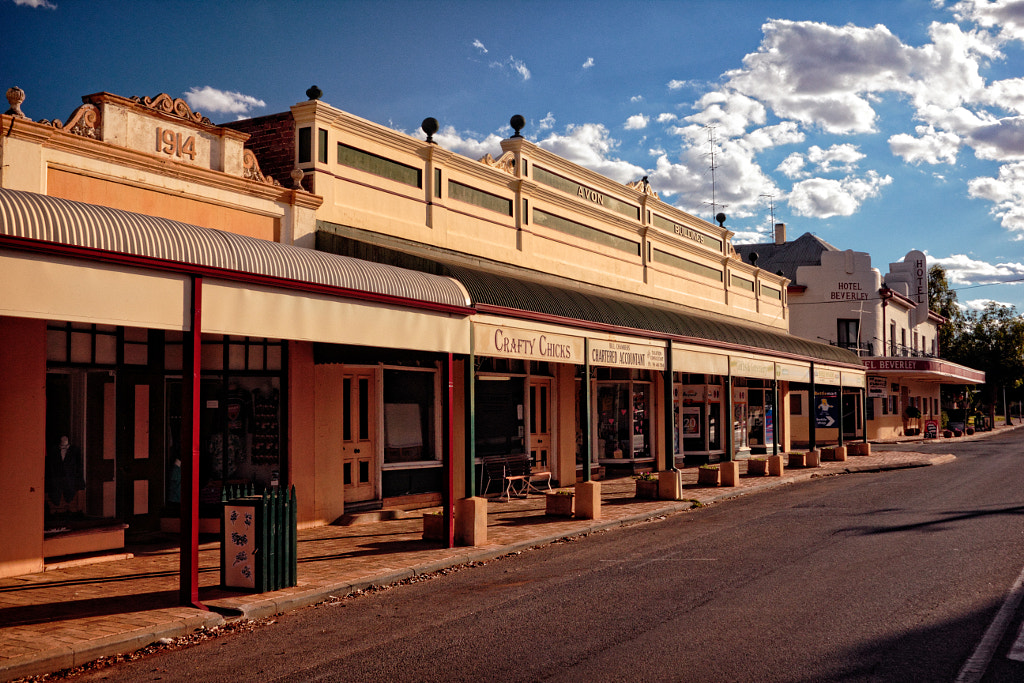
Beverley is 130Km east of Perth in the historic Avon Valley. It is a quiet agricultural town with a unique blend of architectural styles that gives its characterful appearance.
Beverley is 130 Km east of Perth and is a quiet agricultural town with its own distinct character which has been created by the wide range of architectural styles used to build it. A walk down Vincent Street will take you from Colonial, to Federation, to art deco to a 1960’s geodesic dome. It all sounds a bit of a hodge podge but it really hangs together well. There is a collection of farm machinery at Ferguson’s Machinery Shed on Hunt Road that recalls Beverley’s by-gone years as an important agricultural hub.
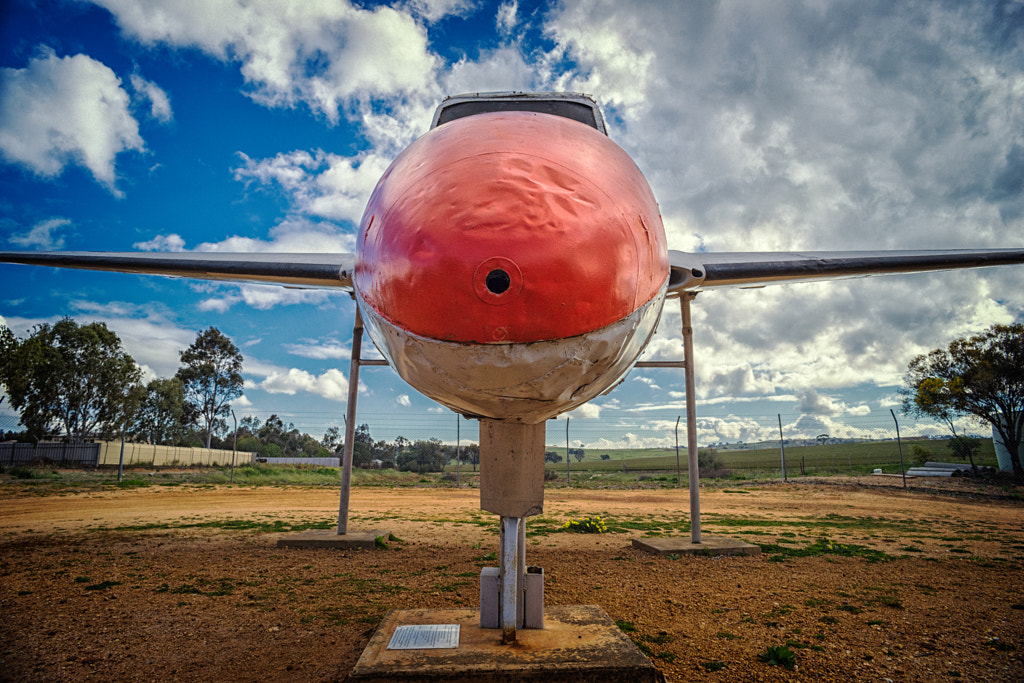
A Vampire jet on the Beverley-York Road
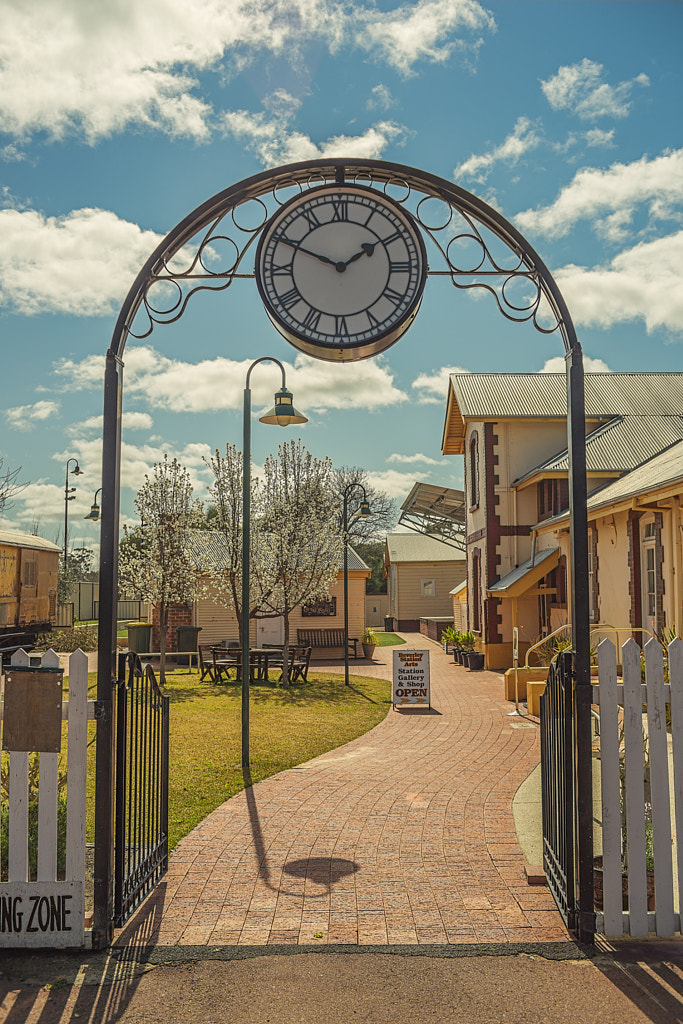
The entrance to Beverley Station Arts in the Western Australian town of Beverley.
The Railway Station was designed by George Temple-Poole and built in the Victorian Tudor style in 1886. It ceased to be a working station some years ago and has been renovated and converted into an arts centre. The Beverley Art Collection is on permanent display, there are resident artists, workshops and an outdoor theatre. The Dead Finish Museum was originally a hotel of the same name, its displays give an insight into what life was like in the early days of the district.
Dead trees ring Lake Yenyenning which became a salt lake after the land surrounding it was cleared for agricultural use. Beverley, Western Australia.
Outside of town are the Yenyenning Lakes which are a haven for birdlife and used for water sports, for directions ask at the Visitor Centre. Also out-of-town is Avondale Discovery Farm which has an 1850’s era homestead and is a working farm run by the National Trust using historic agricultural machinery and techniques.
Beverley Ester Art Exhibition – a very popular event which attracts lots of visitors to the town.
Beverley Clydesdale and Vintage Day has demonstrations of horse-drawn ploughing and vintage tractors and is held at the Avondale Discovery Farm in June.
The Great Southern Working Sheepdog Society Finals coincide with the above event and are also held at Avondale.
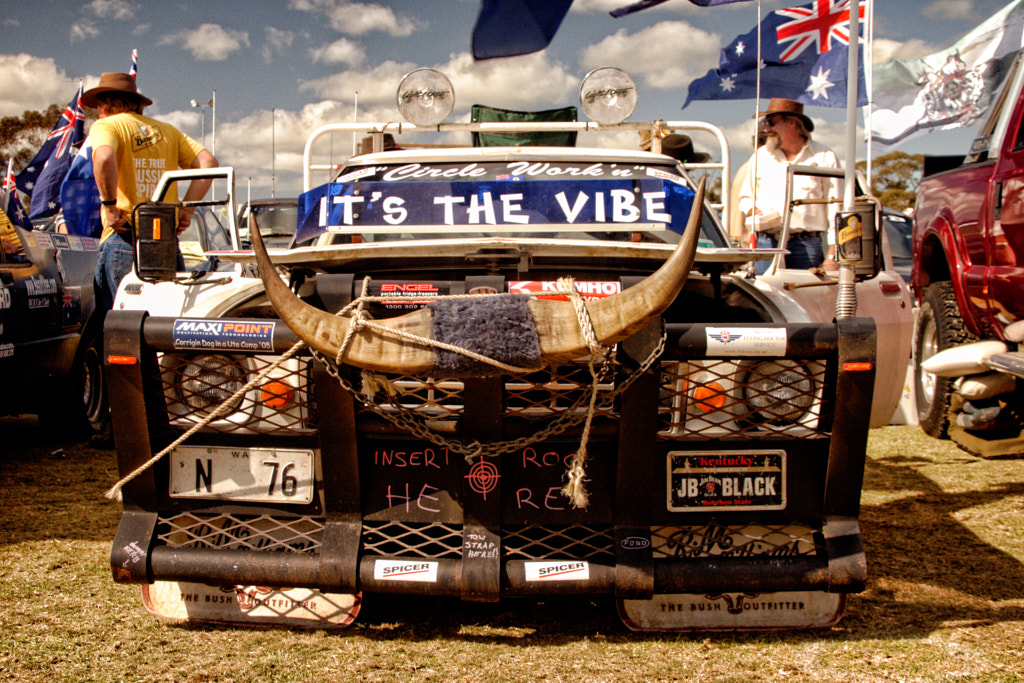
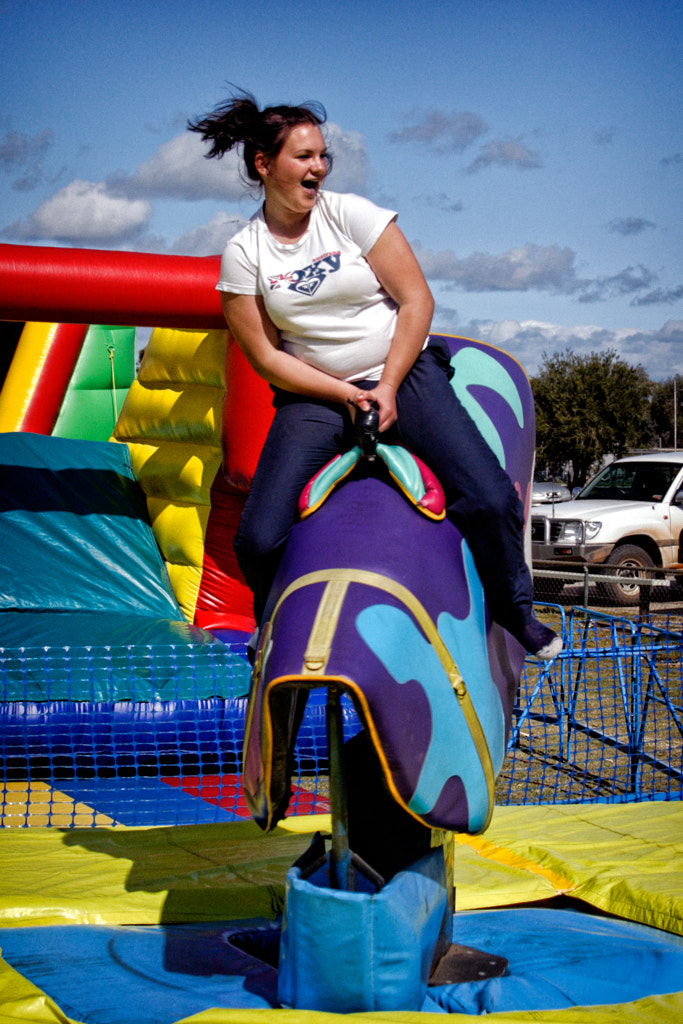
Beverley Agricultural Show is a real agricultural show. There are jam and cake competitions, pony events, tug of war, competitions for the best poultry, sheep, and cattle, and displays of country crafts. It is held in August of every year.
Beverley Harvest Festival at Avondale has displays of historic harvesting methods, working dogs, local produce to taste all capped off with music and dancing.
Riding the mechanical bull at the Beverley Agricultural Show.




You must be logged in to post a comment.