The Australian bush is a dangerous place for the intrepid orchid hunter. Poisonous snakes and spiders are the least of your worry. Nope the thing to worry about is the Kangaroo tick. Size is not an indication of dangerousness. At 4mm in length one of these horrid little beasties can cause a lot of pain and suffering. A lot! When we were away on our little jaunt to Nannup the other week unknowingly I picked up a couple of hitchhikers. Shortly after getting home they began to make their presence felt – quite literally. I woke up to find that my love spuds felt like they had been trapped in a vice and then set on fire. Very quickly it felt like I was walking around with a space hopper stuffed in me jocks.
My happy sack now resemble a space hopper thanks to kangaroo ticks.
Not for nothing are ticks referred to as “the dirty needles of the bush“. Each tick is like a little syringe loaded with all sorts of nasty toxic bacteria and unfortunately the process of removing them can inject even more of that horribleness into your bloodstream. Now after a few days of antibiotics and ibuprofen things are starting to improve. So if you are an orchid hunter let this be a salutary warning and please take precautions.
Funnily the word orchid comes from the Ancient Greek ὄρχις (órkhis), literally meaning “testicle”, because of the shape of the twin tubers in some species of Orchis. In England between the 11th and 15th century orchids were called bollockwort with bollock meaning testicle and wort meaning plant. In medical lingo inflammation of the testicles is orchitis.
The tuber of the Red Beak Orchid (Pyrorchis nigricans) showing its testicular shape. Photo by Ken Macintyre 2010.
Here are some recent pics from the suffering artist.
Lemon Scented Sun Orchid, Thelymitra antennifera, also known as the vanilla orchid. Wambyn, Western Australia.
Wandoo Beard Orchid, Calochilus stramenicola. Wambyn, Western Australia.
Custard Orchid, Thelymitra villosa. Wambyn, Western Australia
* Today’s song reference seemed very appropriate. It is of course Jerry Lee Lewis’ “Great Balls of Fire”
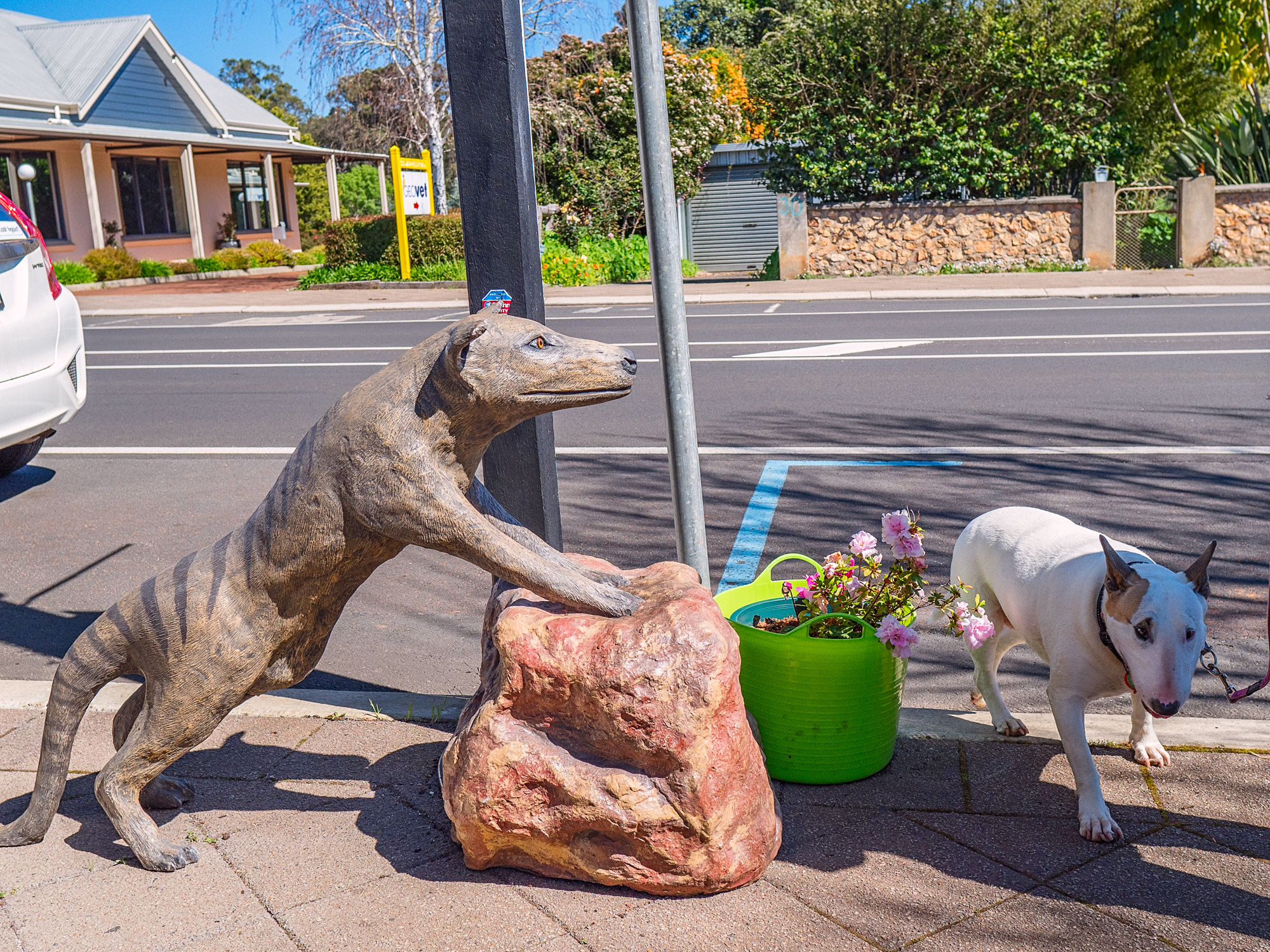
Tasmania does not have a monopoly on the thylacine. Many people believe they can be seen in Western Australia’s Blackwood Valley. Nannup is the focus of Thylacine tourism in Western Australia.
William Blake when he wrote his famous poem was thinking of the Bengal Tiger. We have/had tigers in Australia. Well kind of – hmmmm not really. The Tasmanian tiger or to give it its proper name the thylacine (Thylacinus cynocephalus) once roamed all over Australia. But by the time the island continent was colonised it was restricted to the rain forests of Tasmania. I wrote a blog post about them a while ago. The thylacine is a tourist draw card in Tassie and it has become an icon for the tourist industry, but they don’t have a monopoly on it. Down in the South West corner of Western Australia, in the Blackwood Valley is the sleepy town of Nannup. Many of the locals are convinced that the Thylacine roams the forests in the valley and consequently it is now part of Nannup’s tourism campaign.
As it would happen we found ourselves in Nannup the other week. We weren’t looking for the tiger, but we certainly found them as we walked up and down the main street. Again like in Tassie the thylacine has been “gnomified” and can be found in front gardens all over the shop.
Frida was none too pleased with her thylacine encounter in Nannup.
It’s not the first time we’d visited the town, but we’d not been for a while and it had changed quite a bit. With the winding down of the forestry industry Nannup is seriously chasing the tourist dollar and the place has been titivated to reflect that. Once you were hard pushed to get a decent coffee now it seems that every other building is a cafe. It presents as a nice up beat place with a friendly vibe.
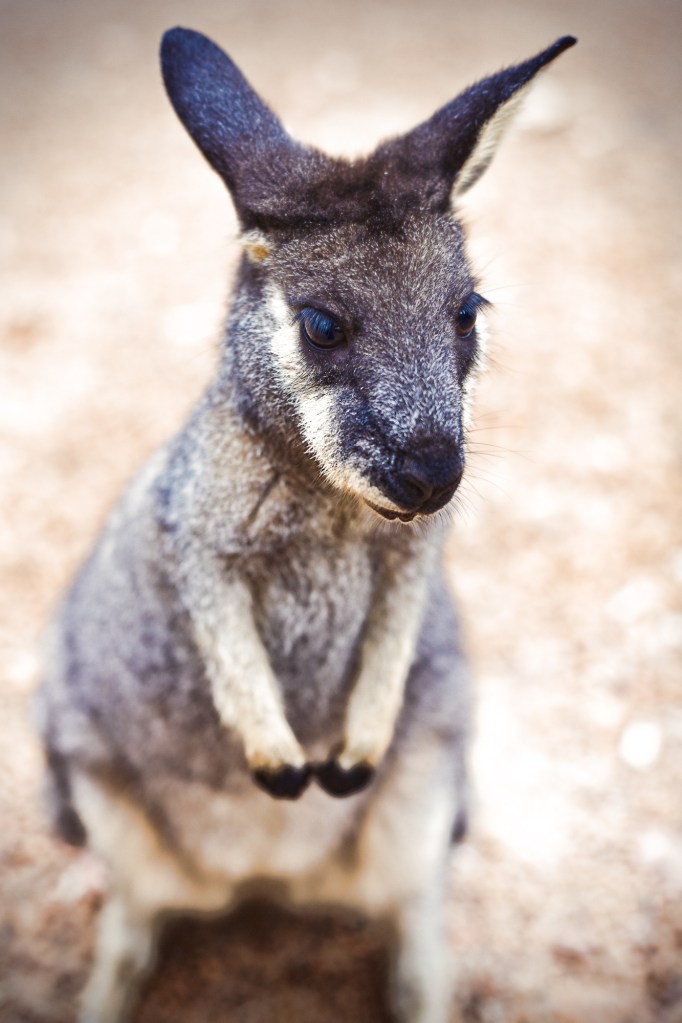
One of the Nannup locals, a Western Brush Wallaby (Macropus irma) also known as the black-gloved wallaby. Nannup, Western Australia.
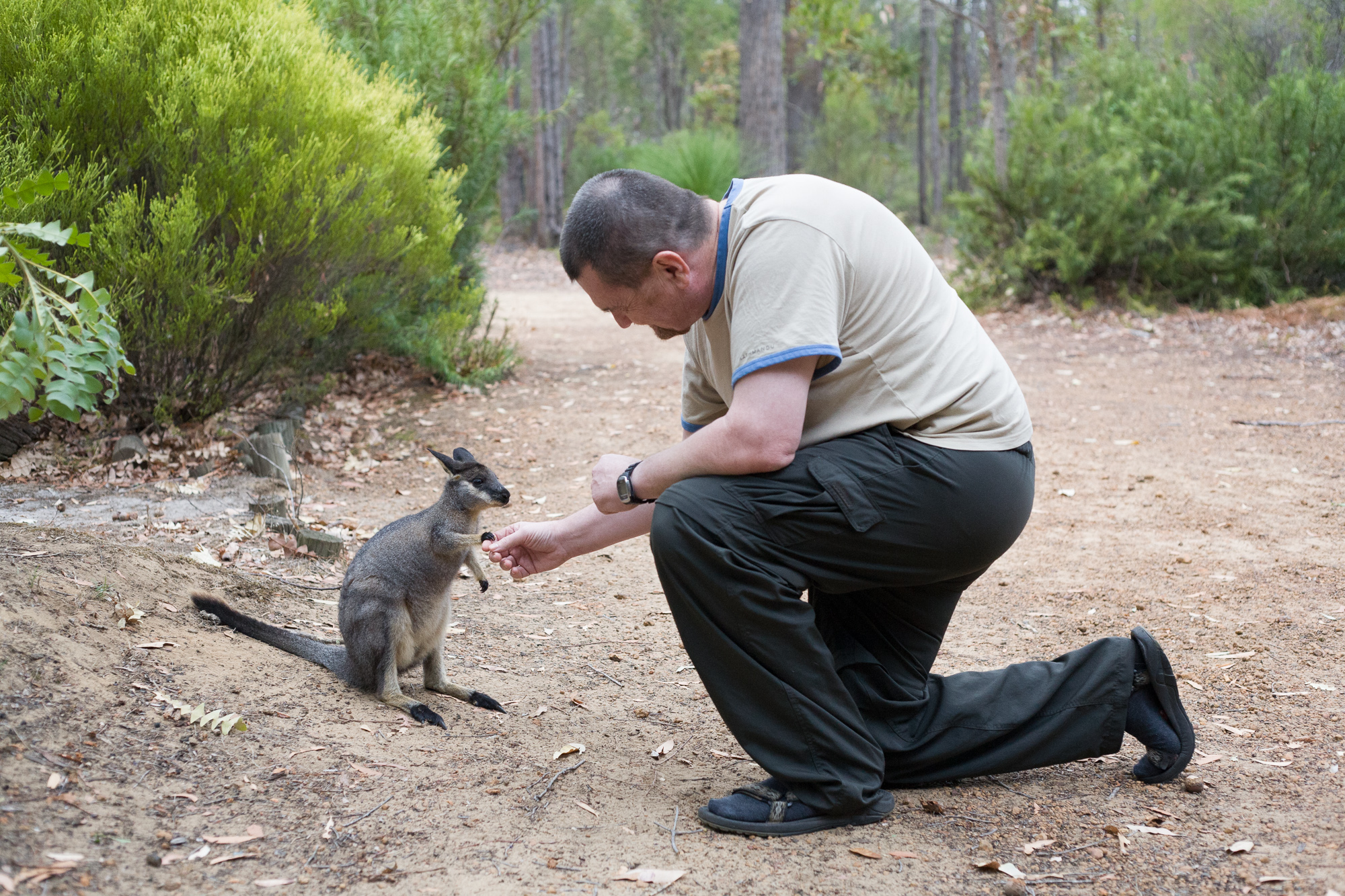
… and they proved to be very friendly.
Our accommodation was ideally located in the forest and only a stone’s throw from Kondil Wildflower Park. The park consists of new growth forest which contains an incredible diversity of flora. There are three walking trails within the park and I walked two of them. The Woody Pear Walk which is a 1 Km easy walk trail and the the Wildflower Wander which according to the information board is 3.5 Km but according to my GPS is 4.9 Km – either way it’s an easy walk on well sign posted trails.
Below are some of the orchids I found while walking around.
Bird Orchid, Pterostylis barbata. Nannup, Western Australia. Olympus OMD EM 1 mk ii with Olympus m.Zuiko 60mm f2.8 macro lens. Exposure: 1/125 sec, f4 at ISO 1000.
Leaping spider orchid, Caladenia macrostylis. Nannup, Western Australia. Olympus OMD EM 1 mk ii with Olympus m.Zuiko 60mm macro lens. Exposure: 1/60 sec, f8, ISO 3200.
Albino Silky Blue Orchid, Cyanicula sericea. Nannup, Western Australia. Olympus OMD EM 1 mk ii with Olympus m.Zuiko 60mm macro lens. Exposure: 1/125 sec, f4 at ISO 200.
Silky Blue Orchid, Cyanicula sericea. Nannup, Western Australia. Olympus OMD EM 1 mk ii with Olympus m.Zuiko 60mm f2.8 macro lens. Exposure: 1/100, f5.6 at ISO 1000.
Warty Hammer Orchid, Drakaea livida. Nannup, Western Australia. Olympus OMD EM 1 mk ii with m.Zuiko 60mm f2.8 macro lens. Exposure: 1/30 sec, f8 at ISO 64.
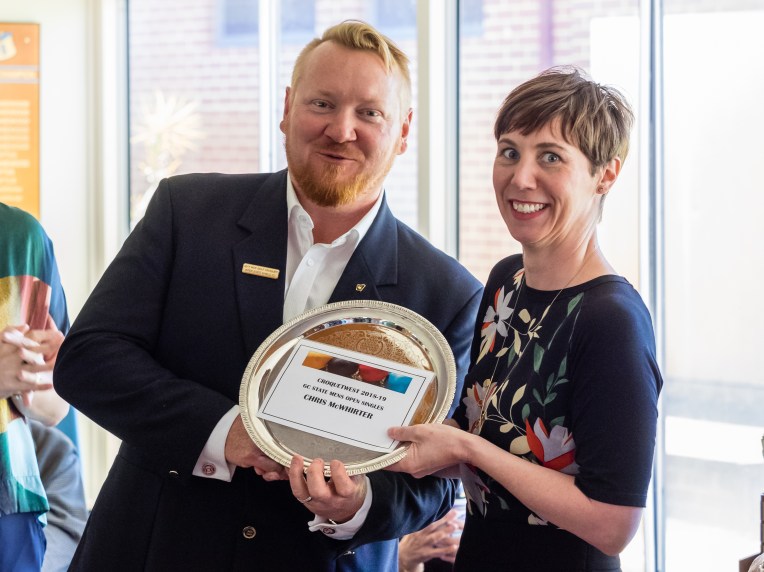
Beloved Significant Other collecting an armful of trophies from Emma Cole, mayor of the City of Vincent, at the recent Croqetwest awards presentation for 2018-9.
Well Beloved Significant Other (BSO) Helen Amyes had a stonker of a year on the croquet front and was invited to attend the Croquetwest 2018-9 trophy presentation. Yours truly was tagging along as the +1 with aim of taking just a couple of photos for her clubs Facebook page. The inevitable happened. Turn up with a camera, couple of lenses and a flash and suddenly you are the “official” photographer and taking the photos for the press and social media. As I’ve said before grip and grin is not my favourite form of photography. There wasn’t a lot of wriggle room for an alternative approach this time so it was pretty basic event photography. At least it was helped along in the form of a jolly jape where fake awards were interspersed with the real ones. Even the recipients were left wondering what they’d actually just won.
Brett McHardy and his partner Janine were winners of Golf Croquet Under Age Doubles. Brett is trying to work out what he’s just won.
Chris McWhirtter receiving the prize for being the winner of the Golf Croquet open singles from Emma Cole.
Red Capped Robin, Petroica goodenovi, Avon Walk Trail, York, Western Australia. Panasonic G85 with Panasonic Leica 100-400mm f4-6.3 lens. Exposure: 1/500 sec, f6.3 at ISO 1000 with -2/3 stop exposure compensation.
Tomorrow here in Western Australia is the first day of spring. I don’t think Mother Nature got the memo as the bush around York sprung into life a couple of weeks ago. Flowers are bursting into bloom and the birds are in a frenzy of nest building and dancing around trying to attract mates. This means that I have also sprung into action trying to document as much of thais activity as possible. The cameras are working over time.
The unusual lutea or “yellow” form of the common donkey orchid (Diuris corymbosa). Talbot Hall, Western Australia. Canon EOS 6d with Canon EF 100mm f2.8 IS L macro lens. Exposure: 1/800 sec, f8 at ISO 400.
Green Spider Orchid, also known as the Fringed Mantis Orchid (Caladenia falcata). Talbot Hall, Western Australia. Canon EOS 6d with Canon EF100mm f/2.8L Macro IS USM lens. Exposure: 1/160 sec, f5.6 at ISO 400.
White Spider Orchids, Caladenia longicauda, Wambyn Reserve, Western Australia. Canon EOS 6D with Canon EF100mm f/2.8L Macro IS USM lens. Exposure: aperture priority with off camera flash 1/50 sec, f11 at ISO 100 with -1 stop exposure compensation.
Winter Donkey Orchid, Diuris brumalis, Wambyn Reserve, Western Australia. Canon EOS 6d with Canon EF100mm f/2.8L Macro IS USM lens. Exposure: 1/25 sec, f8 at ISO 100.
Brown Honeyeater, Lichmera indistincta, Avon Walk Trail, York, Western Australia. Panasonic G85 with Panasonic LEICA DG 100-400/F4.0-6.3 lens. Exposure: 1/500 sec, f13 at ISO 200 with -2/3 stop exposure compensation.
Female Western Whistler, Pachycephala occidentalis,, Avon Walk Trail, York, Western Australia. Panasonic G85 with Panasonic LEICA DG 100-400/F4.0-6.3 lens. Exposure: 1/500 sec, f11 at ISO 200.
This could have been titled Hyden – the return. Hyden is a small town in the middle of the Wheatbelt in Western Australia some 292Km east of Perth. Regular readers will remember that we’ve been before and maybe somewhat perplexed as to why we’d bother to visit again. Well Hyden’s claim to fame is Wave Rock which is a large granite rock face that has been eroded in the shape of a perfect breaking wave. More than 100,000 tourists make their way there very year. Most just stay about an hour before zooming off to another destination to get the perfect instagram shot without taking any time to see what else is there. A great shame really as there is so much more to offer. When I wrote about our previous visit I concentrated more on other sites and the Aboriginal heritage of the area. This time I’ll look at what Hyden has to offer in terms of the natural world.
We decided to make a three day trip and on our way we’d stop off in Corrigin whose main claim to fame is the being the holder of the world record for the number of dogs in a ute and being the home to a dog cemetery. You’d be forgiven for thinking that Corrigin is a bit obsessed with dogs. Anyway it was a nice spot to break the journey, stretch the legs, make the bladder gladder etc. Corrigin does have a pretty impressive wildflower drive which begins just opposite the dog cemetery just on the outskirts of town. Most people just pull up in their car, jump out and walk a couple of metres. They then declare that there’s nothing to see and rush off in a cloud of red dust. Just take your time and have a poke about and you’d be amazed at what you can find. Here are a few examples.
Sugar Candy Orchid, Caladenia hirta subsp. hirta. Wildflower Drive, Corrigin, Western Australia. Panasonic Lumix G85 with Olympus mZuiko 60mm f2.8 macro lens and Metz 15MS-1 flash. Exposure: AE priority 1/200 sec, f4 at ISO 400 with -1 stop exposure compensation.
Chameleon Spider Orchid, Caladenia dimidia. Wildflower Drive, Corrigin, Western Australia. Panasonic Lumix G85 with Olympus mZuiko 60mm f2.8 macro lens and Metz 15MS-1 flash. Exposure: AE priority 1/100 sec, f4 at ISO 400 with -1 stop exposure compensation.
Blood Spider Orchid, Caladenia filifera. Wildflower Drive, Corrigin, Western Australia.
Slender Spider Orchid, Caladenia pulchra. Wildflower Drive, Corrigin, Western Australia.
Sugar Orchid, Ericksonella saccharata. Wildflower Drive, Corrigin, Western Australia.
When we got to Hyden we drove out to the Wave Rock Resort on the shore of Magic Lake which is where we were staying. The lake is quite startling. It’s not very big but is comprised of crystal clear salt water with a gypsum base. That pale coloured lake bed combined with the water makes a giant reflector that takes on the colours of the sky so as the day progresses the lake changes colour. To add to it’s other worldly qualities is that it lies in the middle of a salt plain which is fairly uniform in colour and is covered in mainly scrubby bush and a smattering of trees. It all made me want to get the tripod and graduated neutral density filters out.
Magical Magic Lake. A canoe on Magic Lake beach at sunset. Western Australia. Panasonic G85 with Panasonic Leica 8-18mm f2.8-4 lens and +3 stop graduated neutral density filter. Exposure: AE priority 1/8 sec, f11 at ISO 200 with +1 stop exposure compensation.
Magical Sunset. Magic Lake at sunset. Hyden Western Australia.
The next day we decided to combine the Wave Rock Walk Circuit with the Hippo’s Yawn Loop and the Breakers Trail to create a loop that would take us from the resort up to the Hippo’s Yawn then along the bottom of the rock out to the Breakers picnic area and then back to our accommodation at the resort. The best part of it was that we could take the dog as it is all very pet friendly. Along the way we hoped to see more orchids and birds as we passed through the salt plain and into the bush at the base of the rock.
Old fence posts march across the salt flats at Magic Lake near Hyden in Western Australia. Panasonic Lumix G85 with Panasonic Leica 100-400mm f4-6.3 lens. Exposure: 1/250 sec, f8 at ISO 200.
Crested pigeon, Ocyphaps lophotes, Magic Lake, Hyden, Western Australia. Panasonic G85 with LEICA DG 100-400/F4.0-6.3 lens. Exposure: Shutter priority 1/500 sec, f6.3 at ISO 200 with -1/3 stop exposure compensation.
Known to the Nyoongar as Kayibort the Black-faced woodswallow, Artamus cinerus, can be seen on the shores of Magic Lake, Hyden, Western Australia. Panasonic G85 with LEICA DG 100-400/F4.0-6.3 lens. Exposure: shutter priority 1/500 sec f6.3 at ISO 200.
Salt Lake Spider Orchid, Caladenia exilis subsp. exilis. Magic Lake, Hyden, Western Australia. Panasonic g85 with OLYMPUS M.60mm F2.8 Macro lens. Exposure: aperture priority 1/640 sec, f4 at ISO 200 with +2/3 stop exposure compensation.
Yellow Spider Orchid, Caladenia denticulata subsp. denticulata. Magic Lake, Hyden, Western Australia. Panasonic G85 with OLYMPUS M.60mm F2.8 Macro lens. Exposure: aperture priority 1/125 sec, f8 at ISO 1000 with -1/3 stop exposure compensation.
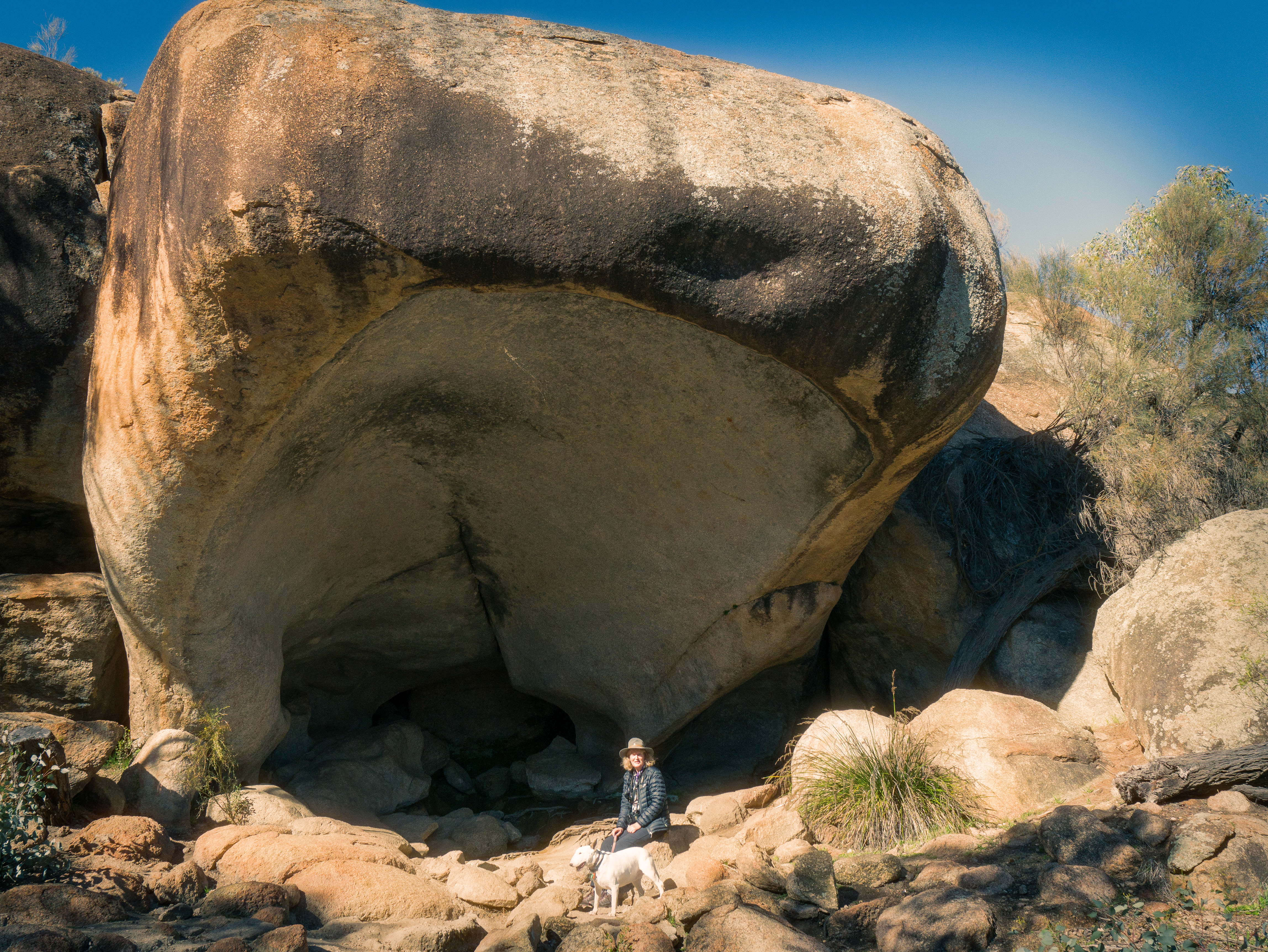
When we got to the base of the rock the vegetation changed from the scrub of the salt plain to thick bush fed by the water run off from the rock. We both enjoyed pocking around in the undergrowth looking for flowers, taking photos of each other and trying to dissuade Frida, our dog, from trying to climb up the rock face in search of interesting holes. It was amazing to see so many orchids – the blue beards were like a carpet in places. It was absolutely wonderful to see.
Helen and Frida at Hippo’s Yawn near Hyden in Western Australia.
Jug orchid, or recurved shell orchid (Pterostylis recurva). Wave Rock, Western Australia.
Blue beard or blue fairy orchid (Pheladenia deformis),. Wave Rock, Western Australia.
All in all we had a great time. There is so much to see and do that we’re already talking about going again. If you are planning a trip to Wave Rock there is a whole lot more to it than posing for a selfie for Facebook on the rock.
The Emu Fence at Wave Rock Resort. Hyden, Western Australia. iPhone SE in panorama mode. Exposure: 1/1400 sec, f2.2 at ISO 25.
The Sigma 150-600mm f5-6.3 DG OS Contemporary lens is part of Sigma’s Global Vision line of lenses. It offers an inexpensive way of getting into wildlife photography.
Not so long ago I looked at the the Panasonic Leica DG Vario-Elmar 100-400 f4-6.3 ASPH Power OIS lens for micro four thirds, well today I’m looking at an alternative lens for APS and full frame cameras – the Sigma 150-600mm f5-6.3 DG OS Contemporary lens. Now confusingly Sigma make two versions of the 150-600 and they are labelled the Sport and Contemporary. The-Digital-Picture.com has put up a good article explaining the difference between the two. The main ones are price and weight with the Contemporary being a 1Kg lighter and $1200 AUD cheaper. This is quite a significant difference and I for one prefer a lighter lens and a heavier wallet. The Contemporary is part of Sigma’s Global Vision line of lenses and is thus compatible with the Sigma TC-1401 1.4x Teleconverter which allows auto focus to work to a maximum of f8 while wide open if your camera supports this feature. This is an interesting option as it allows a reach of 860mm on full frame and a humongous 1376mm on an APSC sensor which is impressive reach for a lens and converter costing less than $2000 AUD. I didn’t happen to look at this option because none of my Canon DSLRs allow f8 auto focusing. shuttermuse.com has an article on f8 focusing with extenders or teleconverters and a list of compatible Canon DSLRs. This does not apply to the mirrorless R and RP which have f11 auto focusing.
Lens mounts available
Canon EF
Nikon F
Sigma SA
Focal length
150-600mm
Angle of view
4.1° – 16.4°
Aperture range
f5/6.3 to f22/27
Filter size
95mm
Minimum focusing distance
2.8 metres
Maximum magnification
1:4.9
Focusing
Silent HSM with internal focusing and manual override
Aperture blades
9
Lens construction
20 elements in 14 groups with 1 FLD and 3 SLD elements
Image stabilisation
Yes – 3 stops equivalent
Length
26cm
Diameter
10.5cm
Weight
1.93Kg without lens hood and tripod collar.
Fully extended to the 600mm focal length the lens is a beast. There is no sign of any wobble in the zoom extension.
Physically this is a large lens, it stands head and shoulders above my Canon 70-200mm f2.8 IS L lens which in itself quite a large lens. The 150-600 is also 500g heavier. At 2.1 Kg with lens hood and tripod collar attached it definitely has heft to it. Interestingly Sigma refer to it as a lightweight lens, I suppose it’s all a matter of perspective as the Panasonic Leica 100-400 is 0.985 Kg so the Sigma feels gargantuan compared to it while the Canon EF 600 mm f4L IS is over 3Kg so the Sigma then seems svelte and compact. The lens body is made out of what Sigma calls a Thermally Stable Composite (TSC) which is substantially stronger than conventional polycarbonates while having similar thermal expansion properties to aluminium. The lens mount is made of chromium plated brass which should ensure a long life. All in all it feels a well made and rugged lens, it may feel like plastic but the TSC body feels substantial and gives the impression of being very durable with no creaking or flexing. The Sigma 150-600 is advertised as being dust and splash proof but on closer reading of Sigma’s spec sheet there is only one seal and that is at the lens mount. If you want better then you’ll have to spring for the Sports version.
The Canon EF lens mount is made of chromium plated brass.
When looking at the lens from the front there is a large ribbed rubber zoom ring that has a long throw of about 160º. The action is smooth and feels not too tight nor too loose. As you rotate the zoom ring the lens barrel extends by 8cm. The extension feels secure with no slop or wobble. Just behind the zoom ring on the lefthand side is a zoom lock switch which can lock the zoom ring at the 150mm focal length to prevent zoom creep while carrying the lens. The focusing ring is narrow ribbed rubber and allows you to manually adjust focus while the lens is in the autofocus mode. There are no hard stops which might concern you if you were to use the lens for video. Behind the focusing ring is a panel of four switches and they are:
An AF switch allowing to choose between AF, MF and MO (Manual Override)
A focus limiter switch allowing a choice of full range, 10m to ∞, and 2.8 to 10m.
An optical stabilisation switch that gives a choice of off, on and a panning mode.
A custom switch that allows you to select two custom modes that can be programmed using the Sigma FD-11 USB Dock
There are three switches on the lens barrel. One fotr focus modes, the second a focus limiter and the third is for the optical stabilisation.
The focus distance scale is behind a window just below the the focus ring.
Above the switches is a window showing the focusing scale and then behind that is the lens collar. The lens collar allows you to turn the camera from horizontal to vertical while mounted on a tripod, but, unfortunately there are no detents to allow you to do this while looking through the viewfinder of the camera, you have to align the marks on the collar with those on the lens body. The tripod collar can be detached and thoughtfully Sigma provide a cosmetic rubber ring to slide over the lugs that hold the collar in place. The lens comes with a large plastic lens hood the size of a flower pot, it seems sturdy enough and bayonets into place and a nice touch is that is ribbed internally to prevent reflections. The 150-600 has a 95mm filter thread which means filters will be expensive and potentially hard to get. In terms of accessories Sigma provide a nice well padded lens case, a shoulder strap for it and a Sigma branded camera strap. Like all Sigma lenses you get a lot for the money you spend. Nice one Sigma!
The 150-600 has a 95mm filter thread which means filters will be the size of dinner plates, be expensive and potentially hard to get.
I tested the lens on a Canon EOS 6d and an EOS 550d to see how it would perform on both crop and full frame cameras. In terms of AF performance as neither of those cameras have what can be considered state of the art AF systems, in fact it is over twelve years old, the lens did very well. The single point AF using the centre point was fast and precise and well capable of fixing on small birds amongst foliage. In terms of continuous AF on the EOS 550d the camera was the limitation being only able to shoot 6 frame bursts in RAW, but out of my six shots when tracking my dog trotting five of the six would be in focus. The 6d is able to shoot 4.5 frames per second for 15 frames and on the trotting bull terrier test it managed 12 frames in focus.
This slideshow requires JavaScript.
When it came to BIF (birds in flight not fisticuffs) the AF was more than capable of focusing on and tracking medium to large birds. It really struggled with small birds especially swallows. Put it on a better camera and I’m sure you’d get better results.
Australian white ibis, Threskiornis molucca, Herdsman Lake, Western Australia.
My primary use for a lens like this is handheld bird photography, and as such I didn’t really give the image stabilisation a workout as I seldom use a shutter speed below 1/500 sec. But messing around at home in the house and garden I figured it was good for three stops. Mind you I do have steady hands so your experience may differ from mine.
The optical construction of the lens is twenty elements in fourteen groups with 1 FLD and 3 SLD elements. The FLD (“F” Low Dispersion) glass element, which offers performance equivalent to fluorite. Canon and other manufacturers have used synthetically grown crystals of calcium fluoride components in lenses to aid apochromatic design, and to reduce light dispersion so lenses made from it exhibit less chromatic aberration. What Sigma has done is use newer glasses and computer-aided design to render the use of fluorite crystals unnecessary. Sigma claim that the FLD element is “highly transparent, its refractive index and dispersion are extremely low as compared to conventional types of glass. It offers characteristics very similar to those of fluorite, which is valued for its anomalous dispersion. These characteristics minimize residual chromatic aberration (secondary spectrum), which cannot be corrected by ordinary optical glass, while helping to produce sharp, high-contrast images.” (https://sigmaphoto.com.au). The three SLD (Special Low Dispersion) glass elements also help to minimize chromatic aberration. To help achieve attractive out of focus transitions there are nine rounded aperture blades which should help achieve nice round bokeh balls when shooting specular highlights.
In terms of optical performance well I’ll deal with full frame and crop separately. First up using the lens on the crop framed 550d. At 150mm the centre of the lens wide open was sharp and contrasty and stayed A as such until f22 when it softened due to the effects of diffraction. At the edges the peak performance was attained at f11 and remained until f22 when it softened again. At 600mm the centre wide open was a little soft and lacking in contrast. This improved by f8 and then deteriorated at f22. The edges weren’t so good – wide open they were soft and lacking contrast and remained so until f22 when they got worse. As for vignetting well at the short end wide open it was apparent, about 1/2 to 1 stop and this disappeared by f8. It was the same story at the long end. Throughout the focal range there is slight pin cushion distortion and some chromatic aberration can also be seen. Open the files up in Lightroom and apply the lens profile and things improve nicely. On the full frame 6d the story is the same except for the vignetting which is naturally worse at around 1-1 1/2 stops which is totally understandable as you are using the whole frame rather than just the central part of the lens coverage.
100 % crop from the centre of a New Holland Honeyeater to show how detail is rendered by the Sigma 150-600mm f5-6.3 Contemporary lens.
What’s all this mean in real life. Well if we look at the image for the New Holland Honeyeater which I took at a distance of around 3.5 to 4 metres and then enlarge the section around the head you can see that there is nice feather detail and that the eye is sharper than a very sharp thing. To get much better you’d have to spend an awful lot of money and if we look at the Canon 600mm f4 lens I mentioned earlier that has an eye watering price of $18,500 AUD which is over 11 times the cost of the Sigma. Personally I know that if I plonked $18 K down on a lens I’d be heading for the divorce court which would make the Canon a doubly expensive lens. So for what it costs the Sigma is amazing value.
Below are some examples of bird photography shot with the lens on both a Canon EOS 6d and 550d.
Welcome Swallow, Hirundo neoxxena, Herdsman Lake, Western Australia. Canon 6d with Sigma 150-600mm Contemporary. Exposure: 1/500 sec, f7.1 at ISO 250.
Red capped robin, Petroica goodenovi, Avon Walk Trail, York, Western Australia. Canon 550d with Sigma 150-600mm Contemporary lens. Exposure: 1/500, f6.3 at ISO 160.
Chestnut-rumped Thornbill (Acanthiza uropygialis), York, Western Australia. canon 550d with Sigma 150-600mm Contemporary lens. Exposure: 1/1000 sec, f6.3 at ISO 320.
Mistletoebird, Dicaeum hirundinaceum. The Nyoongar name is Minnijit. York, Western Australia. Canon 6d with Sigma 150-600mm Contemporary lens. Exposure: 1/1000 sec, f8 at ISO 1600.
So would I recommend the lens? Yes without hesitation. It performs very well and is sold at a very good price and you can’t argue with that.
Been playing with a new lens – and so far I’ve been very impressed and it’s made me reconsider my camera system. I’ll put up a full report in the next week or two. Here are a couple of photos to whet your appetite.
Back lit bully. Frida modelling for a lens test.
Bully blast off! Frida helping test the auto focus capabilities of a new lens.
Both shots were taken with the Canon 6d, which continues to amaze me with its picture quality, and converted to monochrome in AlienSkin’s Exposure 4.
Stand Here. Forest Place, Perth, Western Australia. Panasonic G85 with Sigma 16mm f1.4 lens. Exposure: 1/2000 sec, f2.8 at ISO 200.
Yup – you’ve guessed it. Spent another day loitering in the alleyways of Perth. Saw it as a good excuse to give the Sigma 16mm f1.4 DC DN lens in micro four thirds mount a good workout.
Coloured Cats. Waiting for the CAT Bus on Wellington Street in Perth. Panasonic G85 with Sigma 16mm f1.4 lens. Exposure: 1/6400 sec, f2.8 at ISO 200.
Patterns. Globe Lane, Perth, Western Australia. Panasonic G85 with Sigma 16mm f1.4 lens. Exposure: 1/60 sec, f4 at ISO 800.
Pink Accents. Globe Lane, Perth, Western Australia. Panasonic G85 with Sigma 16mm f1.4 lens. Exposure: 1/60 sec, f4 at ISO 200.
Graffiti in Prince Lane, Perth, Western Australia. Panasonic G85 with Sigma 16mm f1.4 lens. Exposure: 1/60 sec, f8, at ISO 320.
No sitting on the edge of this building. Prince Lane Bar on the corner of Murray Street and Prince Lane in Perth. Panasonic G85 with Sigma 16mm f1.4 lens. Exposure: 1/250 sec, f4, ISO 200.
* Today’s musical reference is a bit obscure. It is the theme tune for the 1972-3 British TV series “The Protectors” and was sung by Yorkshire lad Tony Christie. It was produced by Gerry Anderson of Thunderbirds fame and was only his second production using real people as opposed to the puppets he was famous for, and his only production that wasn’t scifi. It was sponsored by Brut the aftershave people which explains a lot looking back at it.
… which translates from Spanish as “Death and Taxes”, which is in itself a paraphrase of Christopher Bullock’s line from the The Cobbler of Preston written in 1716:
“’Tis impossible to be sure of any thing but Death and Taxes”.
Well all I can say is that Bullock had never been to Spain or he’d have added solicitors and notaries to the quote. By now regular readers will be well and truly confused. Well I shall try and explain.
Cóbdar is a small village of 140 situated in the Sierra de los Filabres in the Spanish province of Andalusia.
Nearly forty years ago my partner’s father moved to Spain, initially to Mallorca, but later he moved to the small Andalusian village of Cóbdar in the Sierra de los Filabres where he happily lived for about twenty four years before succumbing to old age just a few weeks ago. For my partner the news of his passing produced both visceral grief and a great sense of relief. The grief being a natural expression of sadness at loosing a parent and the relief that the anxieties of his predicament regarding Brexit were over and that he was able to pass away in his own home with his partner by his side. The feelings of grief were nothing compared to depths of despondency that ensued when trying to navigate the murky waters of the Spanish legal system. The long and the short of it is that in Spain everything bureaucratic in nature requires the use of umpteen solicitors, legions of notaries and of course taxation like you would not believe. Spanish solicitors charge like a wounded bull, being a Spanish notary is a licence to print money and the government has a tax for just about every eventuality. Just when you feel that navigated the system in it’s entirety then you find out that if your inheritance includes any property – no matter how small a share – then you have to write a Spanish will, whether you are resident or not, so you can inflict the whole process on your descendants. A Spanish inheritance is the gift that keeps on taking. It is not surprising that nearly 40% of Spanish inheritances are passed over.
Cóbdar is laid out more formally than other villages in the region. Although small and isolated it continues to be a working village.
Brooke and Helen walking along Río de los Molinos in Cobdar. Cóbdar is situated at the base of a mountain that is quarried for marble. The marble gleams white in the sunlight and can be seen in the background of the picture.
Helen taking a break in the shade under an olive tree. Cobdar, Spain.
The Rabit man’s house on the edge of the Andalusian village of Cobdar.
Every time I think of the situation I have the mental image of Basil Fawlty erupting in rage and frustration.








You must be logged in to post a comment.