Rainbow Bee Eaters (Merops ornatus) catching insects and taking them to their chicks in their burrows.
Walking down by the Avon this morning there was a lot of commotion. A steady “prrrp-prrrp” sound followed by a flash of bright colour. Scanning the trees I found what I was looking for in the branches of a big old dead gum tree. A male rainbow bee eater bashing a large insect on the branch till it was dead so it could take it to its young brood. On further inspection I noticed that there was a holding pattern going on with mum and dad taking it in turns to take food to their ever demanding young.
Mum taking off to make the delivery while dad waits patiently to be cleared for take off.
A further shufti and I find the burrow and settle myself in to watch the parents fly in the food supplies. It was non stop, no let up at all. First off we see dad make a trip.
Rainbow Bee Eaters (Merops ornatus) catching insects and taking them to their chicks in their burrows.
Rainbow Bee Eaters (Merops ornatus) catching insects and taking them to their chicks in their burrows.
Rainbow Bee Eaters (Merops ornatus) catching insects and taking them to their chicks in their burrows.
Rainbow Bee Eaters (Merops ornatus) catching insects and taking them to their chicks in their burrows.
Rainbow Bee Eaters (Merops ornatus) catching insects and taking them to their chicks in their burrows.
Rainbow Bee Eaters (Merops ornatus) catching insects and taking them to their chicks in their burrows.
Rainbow Bee Eaters (Merops ornatus) catching insects and taking them to their chicks in their burrows.
As soon as he is clear it’s mum turn.
Rainbow Bee Eaters (Merops ornatus) catching insects and taking them to their chicks in their burrows.
Rainbow Bee Eaters (Merops ornatus) catching insects and taking them to their chicks in their burrows.
Rainbow Bee Eaters (Merops ornatus) catching insects and taking them to their chicks in their burrows.
Rainbow Bee Eaters (Merops ornatus) catching insects and taking them to their chicks in their burrows.
Rainbow Bee Eaters (Merops ornatus) catching insects and taking them to their chicks in their burrows.
Rainbow Bee Eaters (Merops ornatus) catching insects and taking them to their chicks in their burrows.
Rainbow Bee Eaters (Merops ornatus) catching insects and taking them to their chicks in their burrows.
All pictures taken with a Panasonic Lumix G85 with Panasonic Leica Vario Elmar 100-400mm f4-6.3 lens.
Below is a short video clip containing footage of the birds and some more stills.
I’ve been missing in action over the last few weeks. Partly due to health reasons (which I won’t bore you with), partly due to computer meltdown when I upgraded to Mac OSX Catalina (what an unmitigated disaster that was and still isn’t solved) and partly because some chump cut through the telephone line while digging a hole. The whole experience has meant that I’ve been seriously considering going retro i.e. reading books, watching DVDs, listening to CDs and shooting film again. So I’ve ordered some books off of Booktopia, dug out the CD collection and loaded some film into an old camera. I’ve even found myself looking at kits to develop film at home. Scary stuff. Don’t know how far I’ll follow through with idea, and I don’t know if it’s still possible to get my favourite film and developer, but I’m certainly keen to give it a go. So I thought todays pic would be appropriate – a photo of a digital camera taken with a large format film 5×4 camera shooting Fuji Provia.
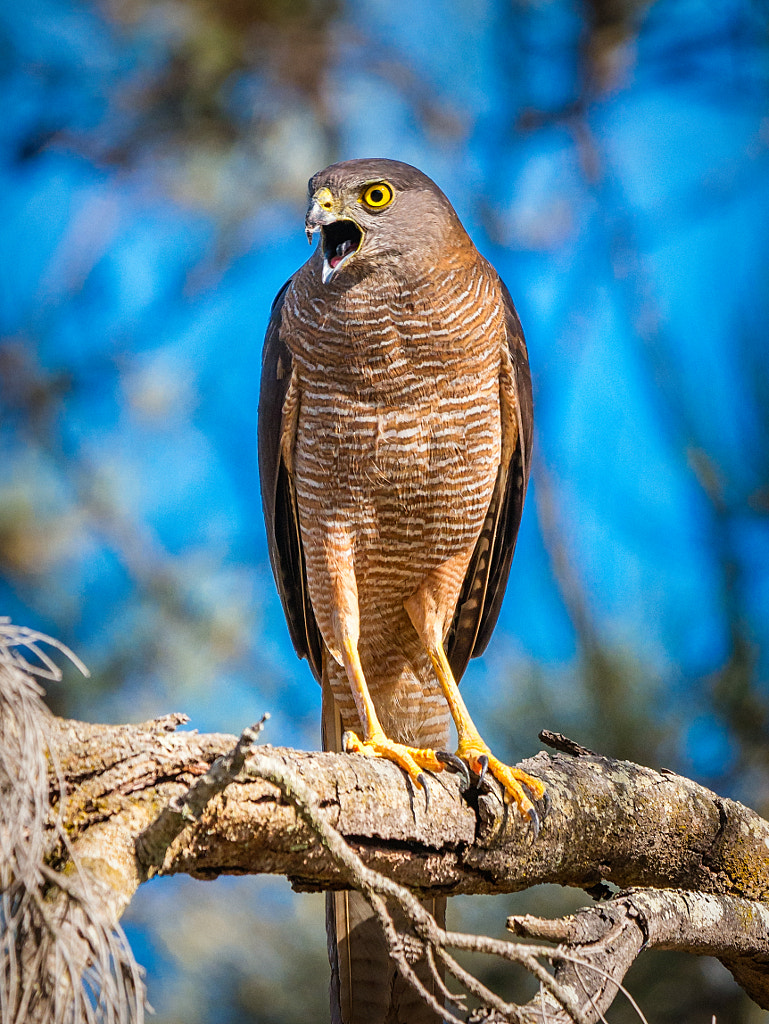
Brown goshawk, (Accipiterr fasciatus.) called Matwelitj, by the Nyoongar people of Western Australia. Avon River Walk, York, Western Australia. Panasonic Lumix G85 with LEICA DG 100-400/F4.0-6.3 lens. Exposure: 1/1000 sec, f6.3 at ISO 640 with + 1/3 stop exposure compensation.
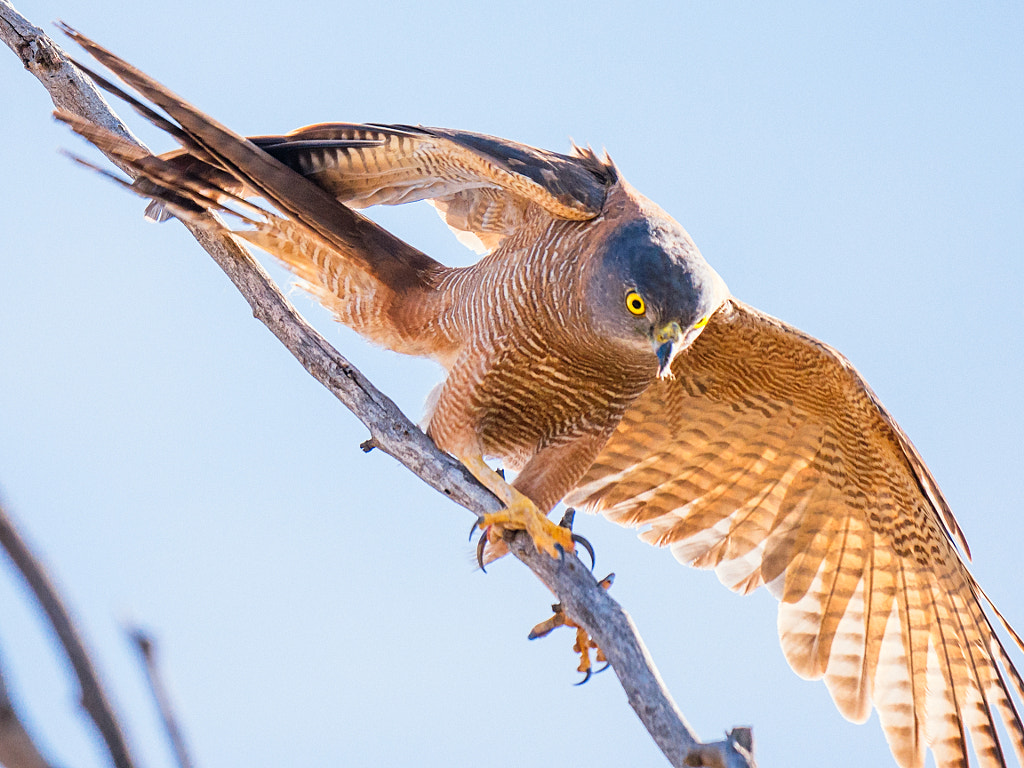
The last few mornings dog walks have been spiced up by some very territorial brown goshawks. As we walk along the river and then down onto the river bed we can hear them calling and chattering. It then goes quiet for a second or so and then there is a loud whoosh as you are buzzed from behind. As the bird passes overhead you can feel the air current generated by its wings. At first I thought the birds were objecting to the dog but I and this pattern persisted for about a week. But then something happened that disabused me of that notion – my hat suddenly became the victim of a bird of prey. The last time it happened they managed to knock it off my head. I’m beginning to think my bicycle helmet may be more appropriate headwear.
You know what they say “Any landing you can walk away from is a good landing”. Brown goshawk, (Accipiterr fasciatus.) Avon River Walk, York, Western Australia. Panasonic Lumix G85 with LEICA DG 100-400/F4.0-6.3 lens. Exposure: 1/1000 sec, f6.3 with +1 1/3 stops exposure compensation.
What you Looking At? Brown goshawk, (Accipiterr fasciatus.) called Matwelitj, by the Nyoongar people of Western Australia. Avon River Walk, York, Western Australia.
Get Lost! Brown goshawks, (Accipiterr fasciatus.) called Matwelitj, by the Nyoongar people of Western Australia. Avon River Walk, York, Western Australia.
The Murray Street Christmas Tree. Perth, Western Australia.
I find it hard to do the Christmas thing – firstly because now the decorations and the food appears so early (our local supermarket started at the end of September), and secondly because it is generally so hot here. Lately its been unseasonably hot here for the last ten days or so with temperatures hitting 40º C. Santa and his reindeer would just melt into a large red and white puddle. So when I went to get the car serviced the other day I went for a wander around Perth CBD and noticed that the City of Perth Council had been going around putting up the Chrimbo decorations. It seems that they’ve chosen a gold theme this year, not surprising really given that Western Australia produces 6% of the worlds production with 195 tonnes per annum, or 6.27 million troy ounces, or roughly $10 Billion AUD.There were some of the old favourites such as the Murray Street Mall Christmas Tree and the Santa’s Grotto but I wasn’t sure what was going on at the Perth Cultural Centre with the Christmas Tentacles of Doom, but hey it was colourful.
Santa’s grotto in the Perth Cultural Precinct, Northbridge.
The City of Perth Council decided to reference the Kangaroo Sculptures on St George’s Terrace side of Stirling Gardens by Joan Walsh-Smith and Charles Smith with their Christmas decorations on the lawn in front of their building.
Myers in Forest Place went for an enormous golden rocking horse as part of their Christmas decorations.
The ENEX arcade went with large golden reindeer with pyramidal Christmas Trees as their Christmas decorations.
Golden reindeer gate wishing people the seasons greetings as they walk between Perth Station and the Perth Cultural Precinct.
A golden Christmas fox in Murray Street Mall, Perth, Western Australia.
Not sure if these giant green and yellow tentacles were part of the Perth Christmas decorations but they were being put up with the decorations in Perth Cultural Centre.
The video is the short version of this article with a slide show of the best of this year’s orchids at the end.
It’s not for nothing that Western Australia is referred to as the “Wildflower State”. There are over 13,000 species of plant to be found, with new discoveries added every year. If we narrow it down to my particular area of interest – orchids – there are 394 species of terrestrial orchids in the South West Corner of the state. Some of these species are so specialised that are confined to very small areas and found nowhere else. Some species will not bloom unless there has been a bush fire the summer before, others if the winter rains are delayed or are insufficient will not put a show on either. This means that no two years are the same. An example of this is my favourite spot near where I live is prolific with the number of orchid species found there. When I first went I was simply amazed by the number of fringed mantis and white spider orchids that were flowering. Over the ensuing ten years I’ve seen such a display of those species since. This year there was a carpet of purple and pink enamels like I’ve never seen before. So this not knowing quite what you are going to find adds to the whole experience. On a few occasions I may be lucky enough to be able to access the flowers by car and a short walk, but most of the time I end up walking through the bush for anything up to four hours.
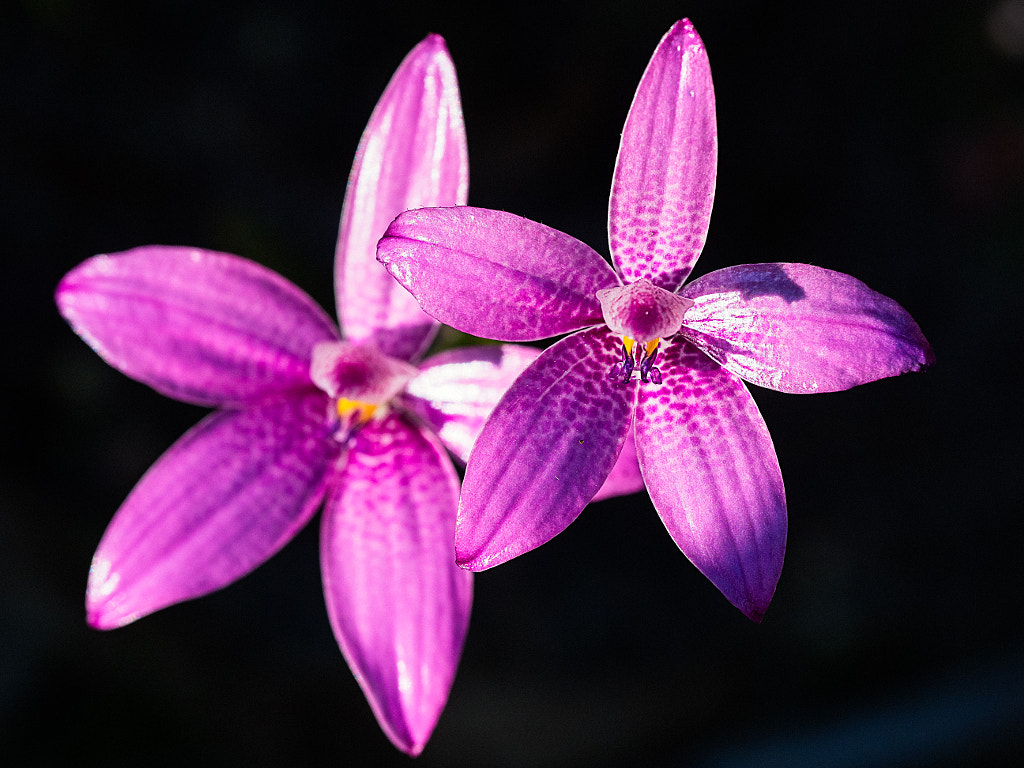
Pink enamel orchid, Elythranthera emarginata. Mokine, Western Australia. Olympus OMD EM 1 mk ii with Olympus 60mm f2.8 macro lens. Aperture priority, exposure: 1/800 sec, f5.6 at ISO 400.
Purple Enamel Orchid, Elythranthera brunonis. Mokine, Western Australia. Olympus OMD EM 1 mk ii with Olympus 60mm f2.8 macro lens and Metz 64AF-1 flash. Exposure: Aperture priority mode, 1/40 sec, f8 at ISO 200 with -1 stop exposure compensation.
The Canon EOS 6d camera with 100mm f2.8 macro lens that I used to use for photographing orchids alongside the Olympus EM 1 mk ii with 60mm f2.8 macro lens that I use now.
I approach photographing orchids as I would shooting a person’s portrait – using off camera flash and reflectors to fill shadows, separate from the background, bring out the shape and textures. Too many botanic studies show indistinct photos where the subject does not fill the frame and the background is intrusive. To that end I use a macro lens of around 100 -120mm (35mm equivalent). It’s not because I’m necessarily shooting at a 1:1 ratio, it’s just because I’ve found there are very few zoom lens that focus close enough and have a fast aperture to allow control of depth of field.I used to use a Canon DSLR with a Canon EF 100mm f2.8 IS L lens and carry around a Manfrotto 143 Magic Arm Kit to support the lights. I made a video about using that setup some 7 years ago and that can be seen just below. Since making that video I added a full frame 6d, the Canon macro lens, and extra light and a set of TTL wireless flash triggers and consequently found myself schlepping 10-12Kg of kit into the bush on longer and longer forays. Something had to give – and my back did! So fast forward 7 years and I’m now using an Olympus OMD EM1 mk ii with Olympus 60mm f2.8 macro lens. I’ve not given anything up in terms of image quality with this change because I’m generally working at a base ISO of 200 with lighting which means all the usual objections to m4/3 about excessive noise and poor dynamic range have been taken out of the equation. The Olympus 60mm f2.8 is easily the optical equal of Canon’s EF 100mm f2.8 IS macro L lens at less than 1/2 the price and about 1/3 of the weight. The Manfrotto Magic Arm got binned as it was very heavy at 2.7 Kg and replaced with a Manfrotto Table Top Tripod Kit 209, 492 Long which weighs 454g. As far as lighting goes I’m using a Metz 64AF – 1 and an Olympus FL-600R flash with small soft box, snoot and honeycomb grid. The only thing that I have given up is radio TTL triggers for the flash, I’m using a TTL flash sync cable at the moment. I prefer to use the Metz unit when doing a lot of high speed sync work as it is the more powerful of the two. This may change in the New Year, it may not.
Lighting diagram for my basic lighting of an orchid.
The FL-600R is a flash with a guide number of of 50 (ISO200/m). In addition, it comes with a LED lightt for use when shooting video.
Other things in the bag include an 80cm 5 in 1 reflector – I only use the white reflector as the silver is too strong, the gold too garish. Some times I use the diffuser over a plant to cut down on ambient light levels. A Vittorinox CyberTool L is there. It has a good selection of small screwdriver bits that can most screws on a camera body, a set of pliers, wood saw, metal saw and file and a host of other doodads. I once re-assembled my Voigtländer 35mm f2.5 Color-Skopar with it while in on holiday in Beijing. Water – this can be in a 1L bottle for shorter expeditions or a 3L water bladder for longer ones. Extra clothing if needed, sunscreen and insect repellent to avoid nasty encounters. Batteries for camera and flash. Wallet of memory cards. That’s it. The whole process is very simple.
Little Bob does brunch on our back patio. Panasonic Lumix G85 with LEICA DG 100-400/F4.0-6.3 lens. Exposure: 1/500 sec, f6.3 at ISO 320 with -1 stop exposure compensation.
We have at present three bob tailed lizards (Tiliqua rugosa) living in the back garden. There’s Big Bob – he’s big male who must be very old judging from the size of him. He’s been here the longest and when he got sick with bobtail lizard flu one winter a couple of years ago we had him inside the house to help him get over it and then tucked him up under a pile of leaves for the remainder of the winter. Just a couple of weeks ago I heard this thrashing about under the sofa on our back patio and when I went and looked it was Big Bob mating with a smaller sleeker female who I called Mrs Bob (hey I can’t be stunningly original all the time!). They are unlike other lizards monogamous and give birth to live young so we’re looking forward to the new arrivals. Little Bob made an appearance on the patio this morning, he’s significantly smaller than the other two so I guess he’s not very old. They are omnivores and very partial to fruit – strawberries being a favourite – so I sliced up a cherry tomato and he/she scoffed the lot very quickly. As they also eat snails and insects I’m hoping that having three of them will mean that they keep the garden pests down. There’s also a bit of an old wives tale that says if you have one in your garden it’ll keep snakes away. I dunno if it’s actually true or not, but having three has got to be good.
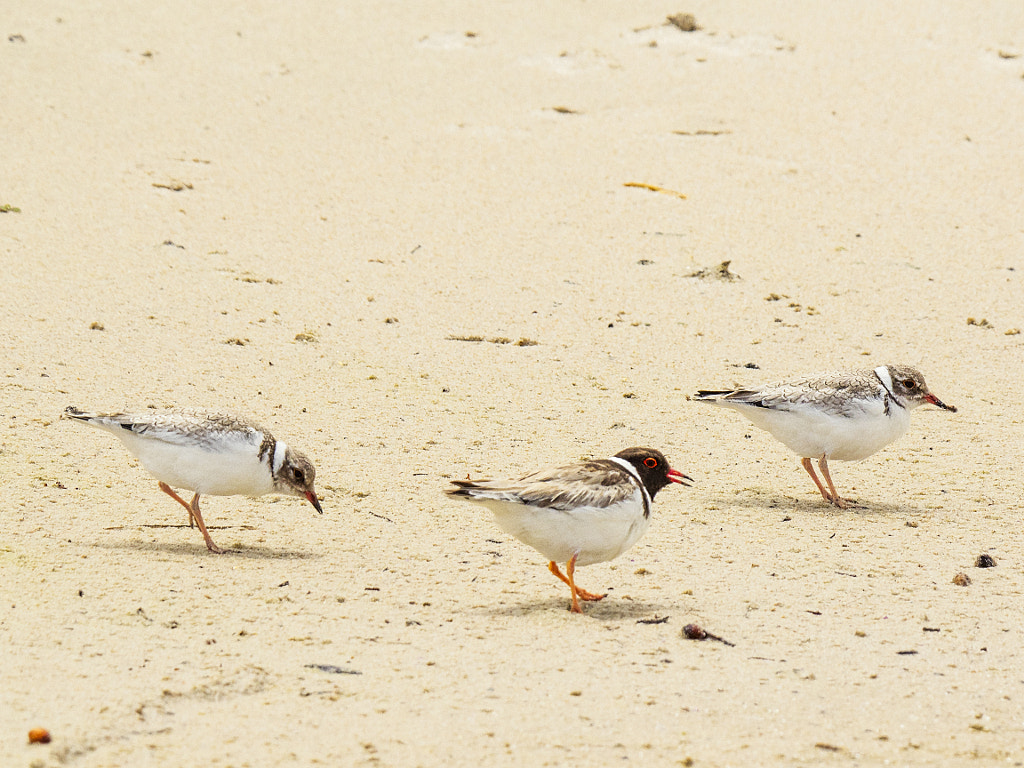
Three hooded dotterels or hooded plovers (Thinornis cucullatus). Lights Beach, Denmark, Western Australia
This week I read two articles that really made me stop and think not only about the looming climate crisis but my photography and what purpose it serves.
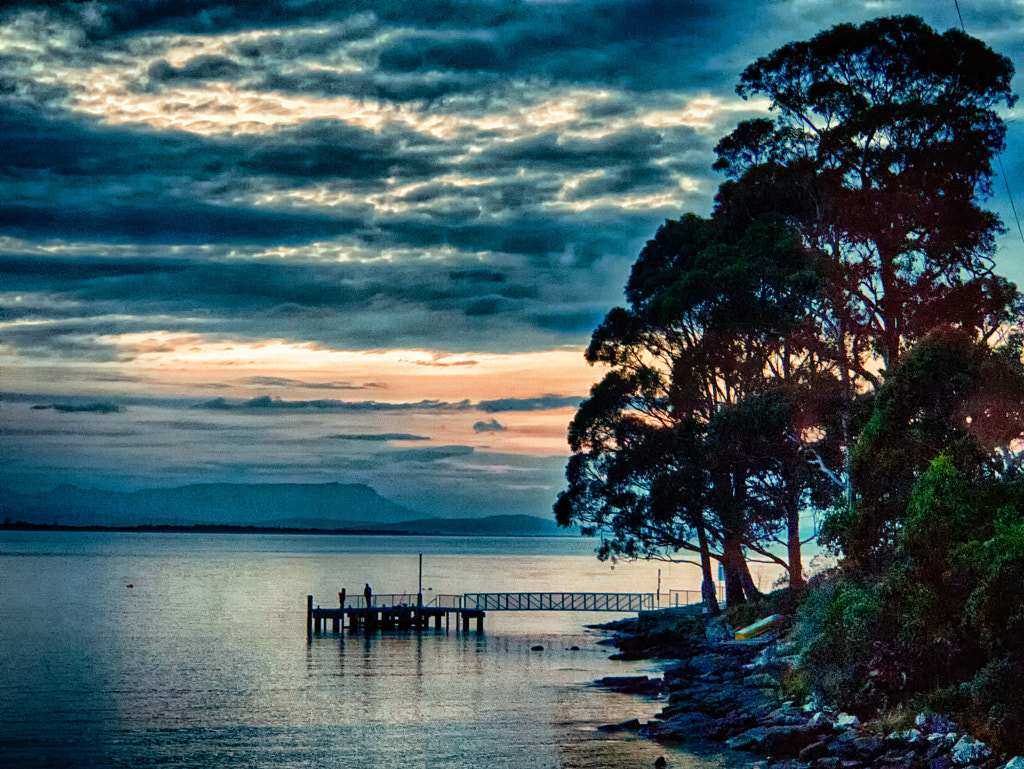
East Cove, Brunny Island.
Whether you believe in climate change or not, as Bob Dylan once sang “The Times Are A Changin’”. The first article I’ll reference was by the celebrated Australian author Richard Flanagan and he speaks of the joy he receives from observing birds around his home on Brunny Island in Tasmania. He also expresses the sorrow that the birds bring because of their diminishing numbers. For one reason or another bird populations are declining rapidlyand it’s not just in Tasmania, it is a global phenomena. In Perth, the capital of the state in which I live, the Swan Estuary is a highly important nesting and breeding site for migratory birds such as plovers, sandpipers, knots, stints, and curlews that travel from Siberia and North Asia. In the 1980’s it was estimated that 36 species and more than two million birds came to Australia each summer. The number of migrating waders on the Swan Estuary was around the ten thousand mark, but, by 2000 there were fewer than five hundred. The causes for this alarming decline are many and include feral foxes and cats preying on the birds, domestic dogs being walked through nesting sites, prawning parties , people digging on the mudflats for fishing bait. Here in York we had a sizeable colony of Rainbow Bee Eaters that migrate here from New Guinea and the tropical north of Australia to avoid the wet season there. They dig their burrows in banks above the Avon River and breed. Last summer the Shire of York Council put in gravel roads along the riverside to allow access for emergency vehicles. In the process of doing that they bulldozed the nesting sites killing the adults and the young they were rearing and then permanently destroyed the site by covering the area with rocks to make a retaining wall. It wasn’t malicious, it was pure ignorance as the council has no environmental protection policy and had not done any form of survey into the wildlife along the river. They were very apologetic when informed but the damage has been done. There should be a thriving colony of Rainbow Bee Eaters digging burrows and and rearing young at this time of year – I’ve just seen one solitary bird.
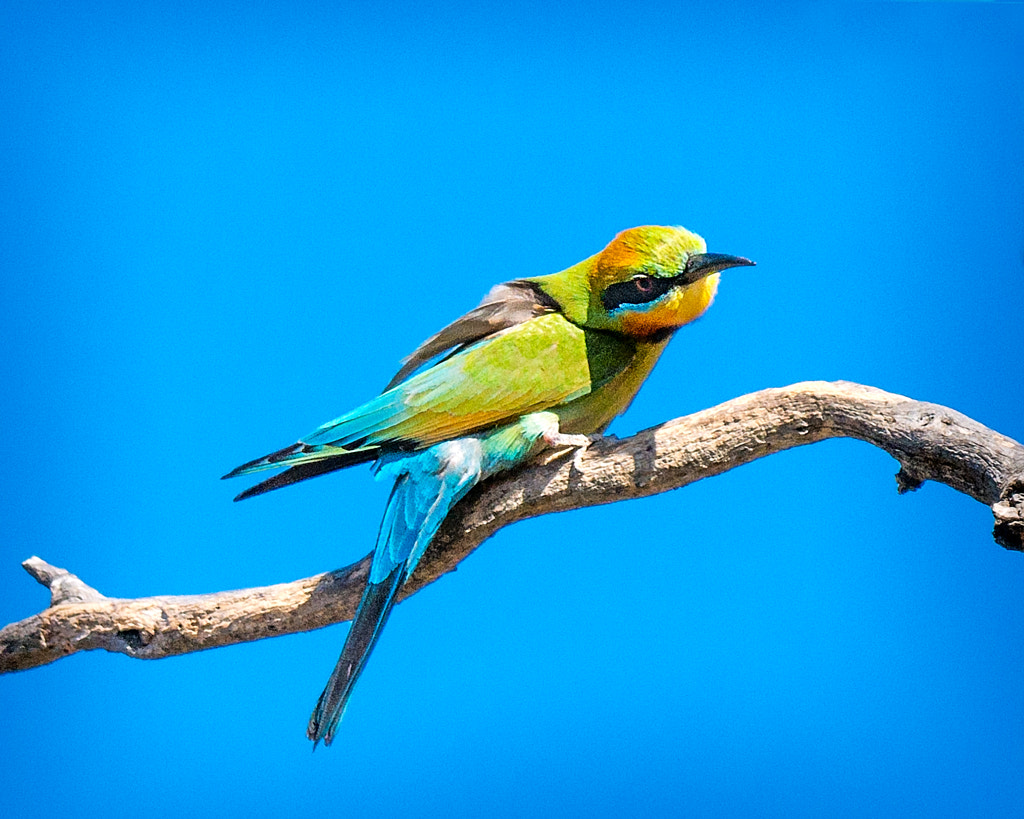
Rainbow Bee Eater, Merops ornatus. Avon Walk Trail, York, Western Australia.
The second article was also about Australia’s declining bird population and it talked about the phenomenaof ‘extinction of experience’ which is a phrase first coined by Robert M Pyle. Extinction experience has negative implications for people’s health and well being. The article referenced a research paper that basically says that if people are having less and less opportunities to interact with nature that will create an antipathy towards the natural world and consequently they will cease to care about it. So to get people to be more aware of environmental issues they must be encouraged to reconnect with nature. One of the reasons why I wrote my walking guide, and I articulate this in the introduction, is that I hope that the people who use it will develop a love for and an understanding of the environment.
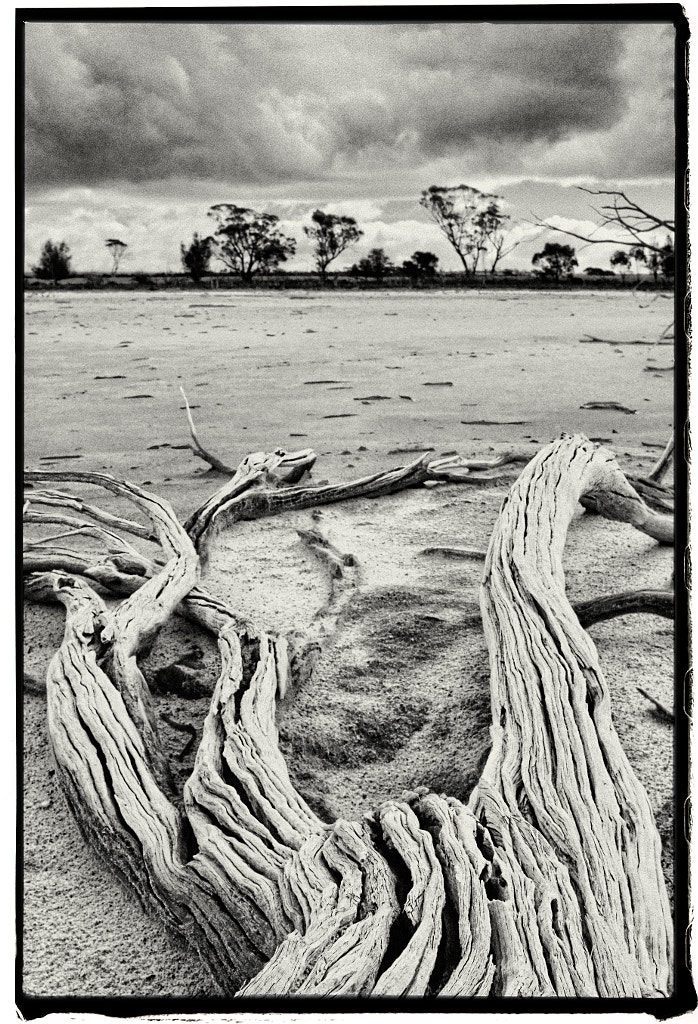
Dead trees ring Lake Yenyenning
So what’s all this got to do with photography? Simple really. One of the main ways that I interact with the environment is through photography. It doesn’t matter whether it is close ups of plants, photos of birds or other wild animals or landscapes. It all equates to being out in the environment and experiencing it in a first hand way. Bushwalking, cycling, dog walking all do this as well and I feel so much better for it.
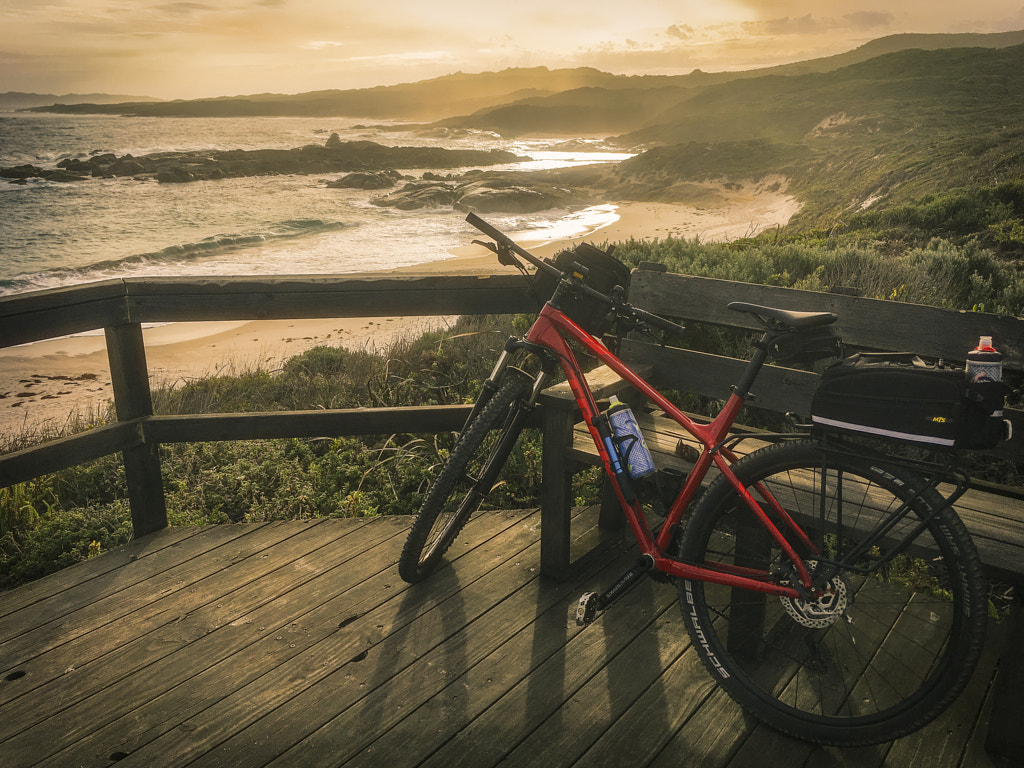
Denmark Nornalup Heritage Trail and Munda Bidi Trail loop ride. Denmark, Western Australia.
I started this post referencing Bob Dylan and I’d like to end with Cat Stevens or Yusuf Islam as he is now known. In his hit song “Morning Has Broken” the lyricist Eleanor Farjeon talks of the joy of walking through the Sussex village of Alfriston on a fresh morning. She talks of the joys of seeing the dawn, hearing blackbirds singing and experiencing the dew on the grass. Yesterday as I walked the dog along the river we were greeted by a territorial goshawk sitting on the branch of a dead tree. As we passed it swooped us while making plaintive calls. It was a totally sublime experience. Go out. Take pictures, walk, cycle, play. Enjoy the environment and revel in its beauty.
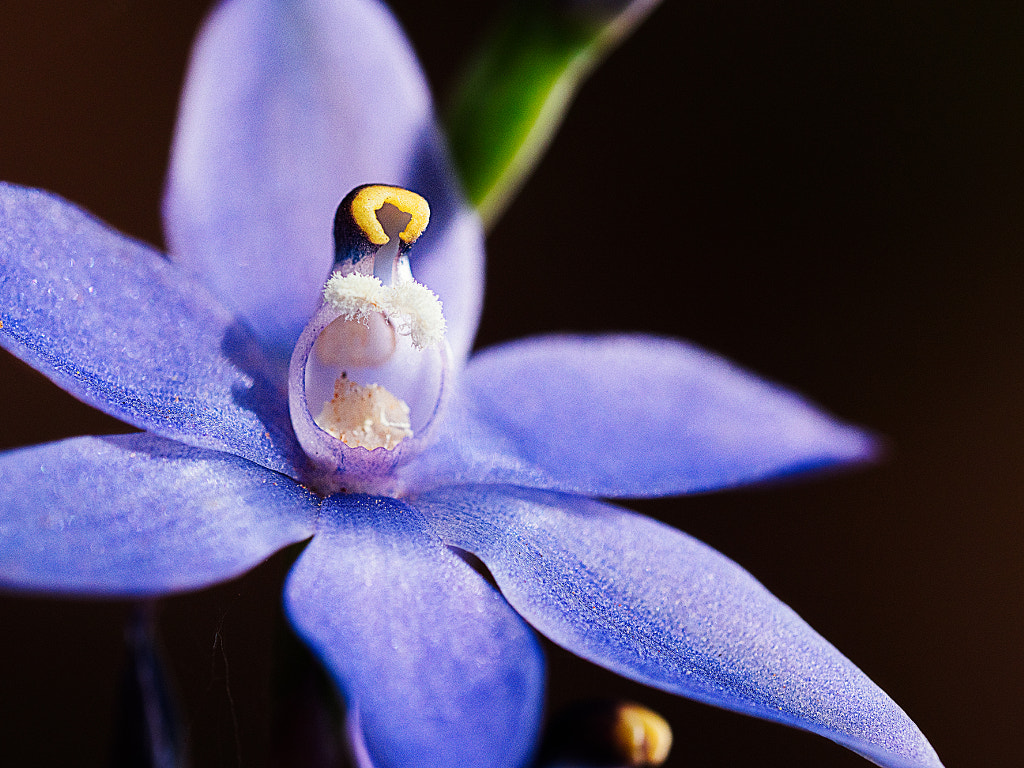
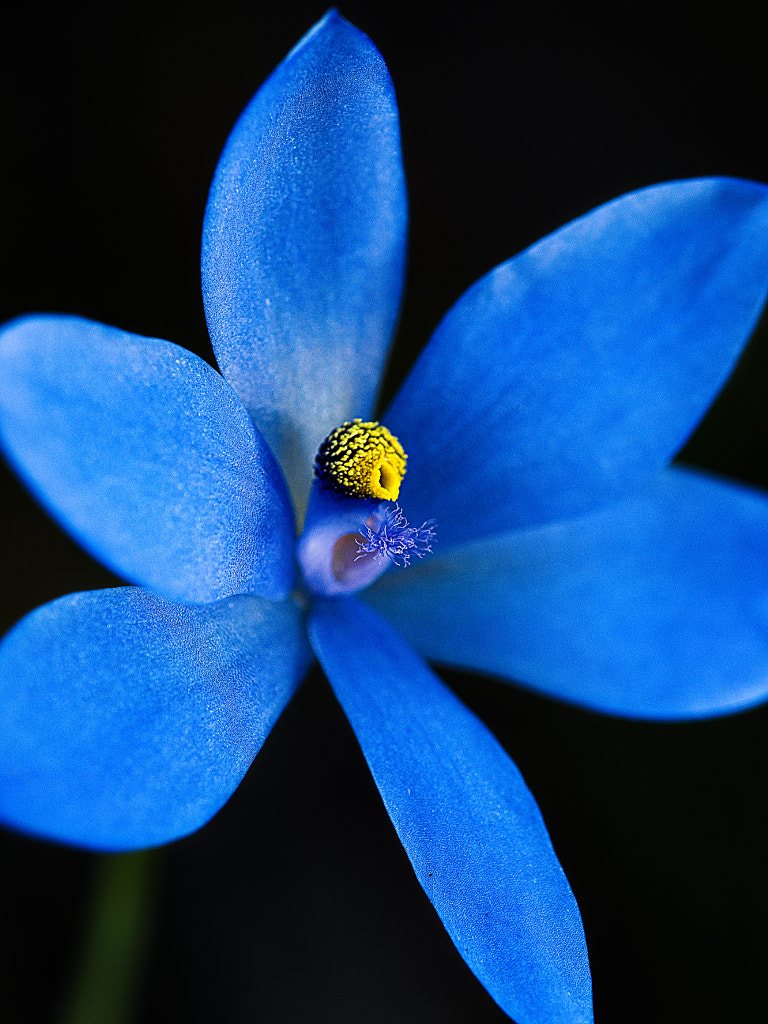
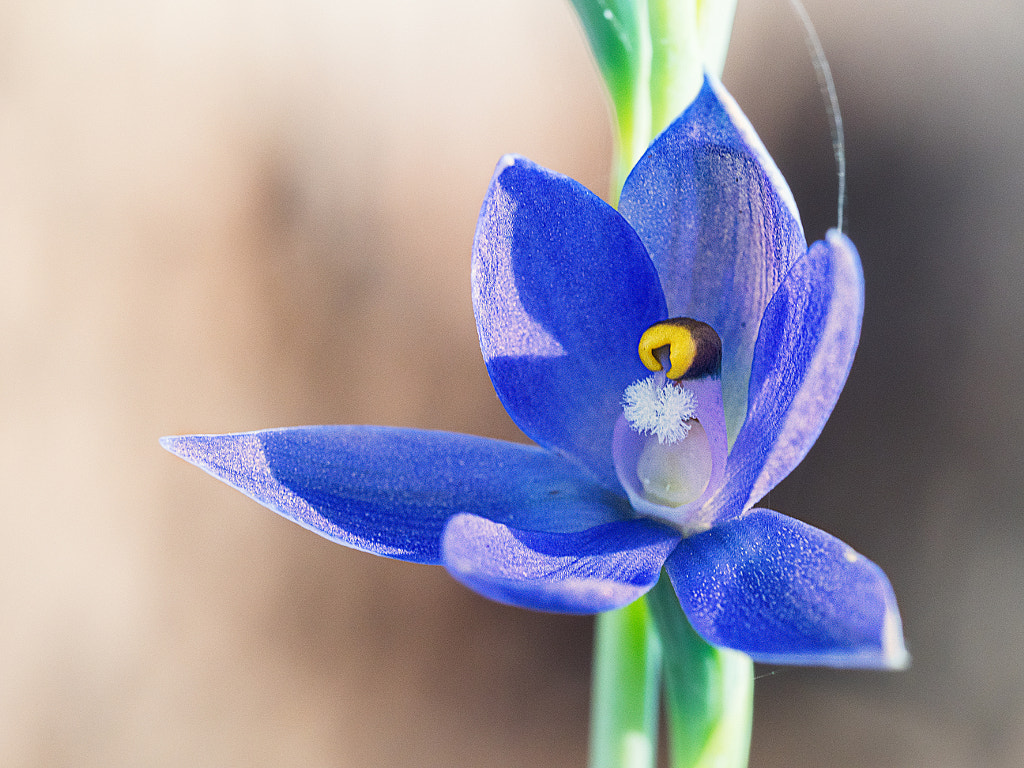
Going through a bit of a blue phase at the moment.
Scented Sun Orchid, Thelymitra macrophylla. Mount Ronan, Western Australia. Olympus OMD EM 1 mk ii with OLYMPUS M.60mm F2.8 Macro lens and Metz 64AF-1 flash. Exposure: aperture priority mode with high speed sync flash I/3200, f4 at ISO 200 with -2 stops exposure compensation.
Blue lady orchid, Thelymitra crinita, also known as the queen orchid and lily orchid. Mount Ronan, Western Australia. Olympus OMD EM1 mk ii with OLYMPUS M.60mm F2.8 Macro lens and Metz 64AF-1 flash. Exposure: Aperture priority mode 1/80 sec, f4 at ISO 200 with -1stop exposure compensation.
Granite Sun Orchid, Thelymitra petrophila. Mount Ronan, Western Australia. Olympus OMD EM1 mk ii with OLYMPUS M.60mm F2.8 Macro lens. Exposure: aperture priority 1125 sec, f5.6 at ISO 800.
* Todays musical reference is to Blondie‘s “Look Good In Blue” taken off their debut album “Blondie” released in December 1976. Some 43 years and eleven album later the band are still touring.
It’s not all beer and skittles at the huge multinational media empire that is Paul Amyes Photography (PAP), but it comes close when we get out to play crazy golf. Last week we managed to sneak off for a game at Wanneroo Botanic Gardens. The aim of the game is to have fun and I took along my Leica D-Lux Type 109 to record the proceedings. It was well suited being small and light and shooting 4K video meant I had some freedom to play around in the edit.







You must be logged in to post a comment.