
Leaving For Work


After Jesus was born in Bethlehem in Judea, during the time of King Herod, Magi from the east came to Jerusalem and asked, ‘Where is the one who has been born king of the Jews? We saw his star when it rose and have come to worship him.’
Matthew 2 v. 1-2 (NIVUK)


I’ve written about going to York Golf Course to photograph flowers, particularly orchids, before and today I’m going to do so again. This time was a little different. Firstly I was looking for pink everlasting daisies (Helipterum roseum) and secondly I went on a Saturday just after lunch instead of early on a weekday morning. It was a bad idea – a very bad idea. It was like something out of the movie Saving Private Ryan. The golf course was full. Here in the Wheatbelt when we say something was overcrowded it means there were three people, so to see roughly thirty people in one place was sensory over load – where had they all come from? To cap it all it was just after lunch the club bar been open and it seemed like everyone had been imbibing freely. Up to this point I thought it was the done thing to shout “Four” upon teeing off. Well at the York Club the word began with F and had four letters but it certainly wasn’t “Four” It was reminiscent of the opening scene from Four Weddings and a Funeral.
It went something like this. “Swish” went the sound of the club as the golfer made his swing, followed by a sharp “thwack”, followed almost immediately by a loud “F**k” as the ball was sliced into the rough. Unfortunately I was, along with the pink everlastings, in the rough. The late Spike Milligan once described an artillery barrage as being like Chinese water torture except with solids in his autobiography “Rommel?” “Gunner Who?”. Well the balls didn’t explode on impact, but they certainly had the effect of making me hit the deck and take cover. The only time I’ve moved faster was when the Rugby club president declared an open bar (my excuse being that I was an impoverished student at the time). After thirty minutes of cowering in the dirt wishing there was an air raid shelter nearby I decided to call it quits and I beat a hasty retreat back to the safety of the car. I did manage to get the two pictures of Everlastings shown on this page.

As I made my tactical withdrawal I hit the cover of some bushes where I found a small clump of green spider orchids (aka Fringed Mantis Orchid, Caladenia falcata) so I quickly stopped to grab a couple of photos.

All I can say is was a very traumatic experience. Every time I hear someone hitting a ball I develop a nervous twitch.
Clicking on a photo will take you through to my online gallery.
The other morning just as I was about to have my shower I heard a commotion on my front veranda. Quickly putting on my dressing gown (I don’t want to scare the neighbours) I went and looked out to see what was going on. To my delight a collared sparrowhawk had perched on the rail to eat its prey. I quickly ran to my office and grabbed a camera and long lens and started shooting.

The commotion was caused by the resident Willie Wagtails (Rhipidura leucophrys leucophrys). For the non Aussies among us the Willie Wagtail is a tiny insect-eating bird whose bossiness and boldness knows no bounds and they will often attempt to chase off larger animals from their territory. That was what happening here hence all the noise.

The Willie Wagtails made several sorties to no avail. Although the collared sparrowhawk’s feathers became a little ruffled at the constant harassment of the tiny feathered furies it did not move on and eventually the small birds gave up and left.

The raptor only left when I tried to move closer to get a better photo.


The other morning I took the dog for her usual perambulation along the river, as we were walking along deep in thought (well I was I can’t vouch for the dog) our tranquility was disrupted by the sound of thundering hooves and the odd sound of something being hit at high velocity. Getting closer I was met with a sight redolent of the medieval Eastern European steppes – not what you expect to see in Western Australia in Twenty First Century. But little did I realise that actually mounted archery or more specifically horse archery is quite a popular pastime. It is a new sport in WA, only 5 years old but is quickly attracting enthusiastic participants some of whom are jetting off to South Korea to represent Australia at the World Horseback Archery Championships. What I was seeing was a demonstration that was part of the 2017 York Medieval Fayre. If you are interested you can contact the fine people at the Western Australian Horse Archery Association via their Facebook page and they have regular events at the State Equestrian Centre in Brigadoon.

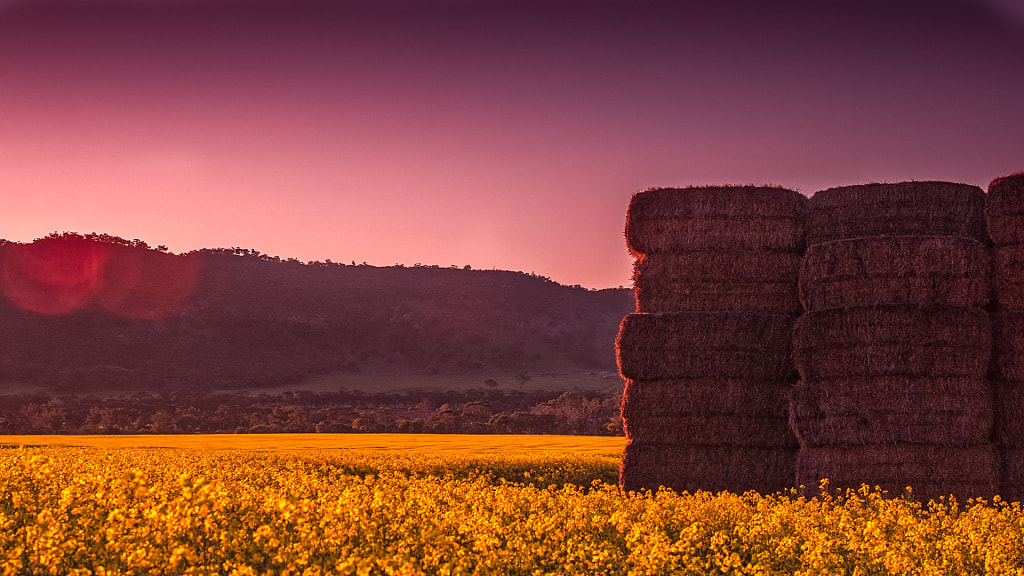
Photography and video are both media that allow the artist to play with the concept of time. Up until recently I primarily worked using still photography. With the advent of good quality video being added to most digital cameras I started playing tentatively with moving images and enjoying the whole idea of capturing movement in another way. Now I’m playing with time-lapse which is a way of using still photos to play with movement that the eye doesn’t normally perceive.
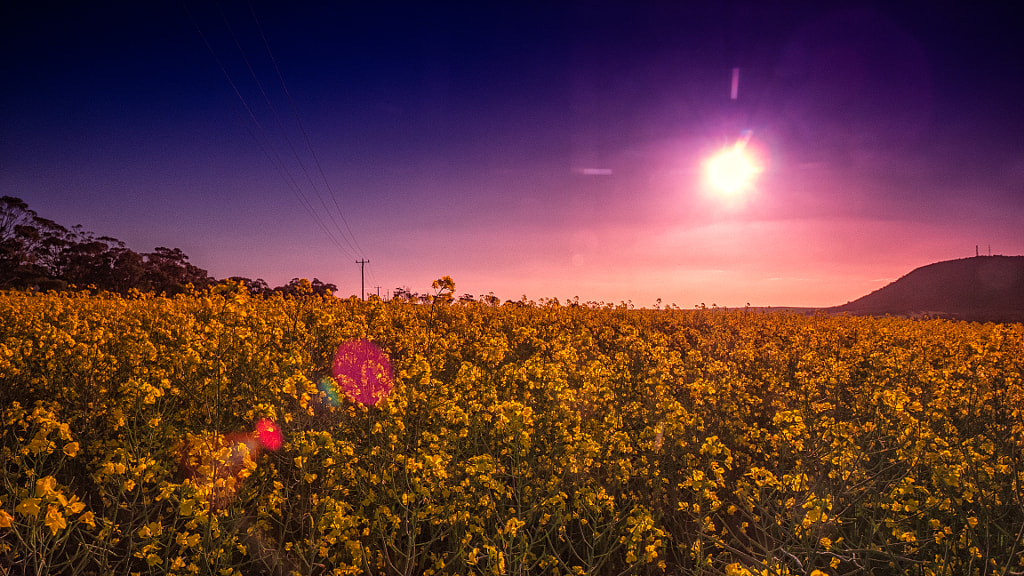
The last couple of weeks have seen me shooting the canola fields around York. I’ve yet to do anything with the resulting video footage, but the pictures illustrating today’s post are still out takes. It is just a matter a shooting hundreds of shots of the same scene over a defined time period. My normal landscape gear and technique are used. I’m also experimenting with adding my own movement in the form of pans, tilts and slider moves. Thankfully my camera has an electronic shutter so I’m not burning through the shutter life.

The thing with experiments is to allow ourselves to make mistakes. This can be difficult if you have, like I have, been practicing in a medium for many years because you tend to develop a certain competence/mastery (pick whichever is the most appropriate) and expect a certain result for your efforts. So when confronted with learning something new and seeing all the mistakes and failures it is tempting to run back to the security of our old established ways of working as it is more ego friendly. In our society the notion of mistakes and failure is seen as a negative, but they really should be embraced. We need to give ourselves freedom to explore and experiment in a nurturing environment so that we can learn and progress. At the moment I’ve got a couple of dozen time-lapse clips sitting on my hard drive, two of them are OK the rest suck big time. Looking at them objectively and looking at the work of people who are considered masters of this art form I can see where I have made my mistakes and so I can now work to avoid repeating them. Who knows in another couple of years I might actually get good at it.
Hell or high water is the new motto for the Avon Descent and was adopted because recent years have seen decreasing amounts of rainfall falling and competitors have had to carry their craft where there was insufficient water. This year, 2017 and the 45th occasion of the race, the water levels were high which meant potentially new records could be set. The Avon Descent was first held in 1973, and there were only forty-nine competitors. This year there were 370 competitors with many coming from interstate and overseas. In more ways than one it deserves the title the “world’s greatest white water event”. The 124 km or 77 mile two day event starts at Northam and finishes at the Riverside Garden in Bayswater with an over night stop at the Boral Campsite just outside Toodyay. For the majority of entrants the aim is just to complete the course, but for the elite athletes it is a chance of competing in a unique endurance race.
The beauty of this race is that you can pick out a few vantage points from a list put out by the race organisers on their website and follow the whole event documenting the whole story rather than just getting an isolated snap shot. In previous years I’d covered the race for magazines shooting stills and then writing the story. This year I had intended to cover the entire event from start to finish and it was to be first time I’d covered it shooting video. Having planned my weekend around the race it was time to check the maps and the approximate timings for each stage. For instance there was no point heading to the first stage after the start as I would not have had time to get there by car, park, and then walk along the river to find a good location to set up. Also I had to think about the weather conditions, because at some of the viewing points you are bussed in and that would mean I’d have to carry everything with me. As the forecast for the weekend was a cold start it was thermals, and fleece. he key was light layers that could be added or taken off as conditions permitted. Camera and lens choice was hard, and I found it difficult to make a decision. For the Friday shots I could work from the back of the car and it was all to be people shots around Northam and for the sake of mobility using either a monopod or a gimbal. In the end I decided to use the Sony A7r and with Olympus OM Zuiko lenses – the 20mm, 50mm and 135mm. This and the gimbal went in a belt pack. Saturday involved shooting at three sites and I wanted to shoot some time-lapse as well as video footage. So I chose the Olympus OMD EM 1 with 40-150mm f2.8 lens for the video work and the EM10 with 12-40mm f2.8 for the time-lapse. I couldn’t set up a tripod at the start as I was going to shoot on the swing bridge so I used a monopod for the video and for the time-lapse I clamped the Syrp Genie Mini to the bridge safety barrier with a Manfrotto super clamp. All this went into my photo back pack. Sunday was the biggest problem with no car access to Bells Rapids everything had to be carried. So I took the Canon EOS6d with 24-70mm, 70-200 and a x2 converter. I’d also need plenty of batteries and memory cards as there would be no nipping back to the car. I decided to carry all this in pouches on a belt as I needed to be able to scramble up some rocks to get a good vantage point. At Bells I mounted the camera on a tripod but at the finish line I shot just using a monopod.
The race happens on the first weekend of August every year. It kicked off on the Friday with the competitor registration at the Northam Swimming Pool and then their craft were taken down to the race marshalling area on the banks of the river. Late in afternoon and into the evening was the Avon River Festival with a huge fireworks display on the Avon River, stage shows featuring a variety of local talent, a family fun zone, rides for all the family, sideshow alley and roving entertainment, a community street parade, markets for avid shoppers, and food. On Saturday morning the event kicked off proper. As I arrived I could see hot air balloons drifting lazily above the river. The power craft were away quickly and smoothly and then it was the turn of the paddle craft. I was surprised to see that someone was competing for the first time on a Stand Up Paddleboard (SUP). Barely had half the paddle craft left than the news came through that the first power craft had reached Toodyay. It was going to be a very fast race with little hope of getting shots of the power craft. I spent a total of an hour and half standing on the swing bridge -it is a wire suspension bridge that bounces a lot, the police constable standing next to me complained of feeling seasick from the constant motion. It didn’t effect me but it really made me glad that I had the in body stabilisation activated on the cameras. After the start I went to Williamson Weir stayed there for an hour and a half. The Weir is man-made and its concrete lip and rock wall are hazardous to boat and paddler alike so around half the competitors choose to portage around it. Thankfully the other half run it and you get the thrills and spills with plenty of encouragement from the watching crowd. Finishing up in Toodyay for the day is great. There is always a great vibe with a tremendous crowd and a party like atmosphere. When I got there the town was packed and in full on carnival mode. It took an age to find some parking and get down to the river. Here there was a team change over area, and along the riverside were lots of anxious looking paddlers all staring up river for any sign of their team mates. As the first canoes started to come round the corner and pass under the timing gate they got their first sight of their team mates and their faces would burst into a huge grin of relief. The spectators would burst into rapturous cheers as the fresh team-mate paddled away heading for the Boral Campsite that marked the halfway point and the end of day one.
I couldn’t face getting up at 4;30am in the dark and freezing cold to get to the start at Boral Camp for day two so I just headed out a bit later and went straight to Bells Rapids in Walyunga National Park. You have to leave the car at the nearby state equestrian centre and then you taken in by bus. From there it was a quick walk to what I call the media rock. It’s a nice big rock that juts out into the river which gives a good view of the competitors coming under the bridge and through the rapids. I got there just as the TV crews were claiming their spots and setting up. I squeezed onto the end closest to the bank and put my tripod up to mark my territory. When the press photographers arrived they gave us a filthy look, but as they were shooting hand-held they didn’t need as much space. A little while later a hopeful photo enthusiast asked if could join us on the rock, one of the guys I know from the papers said it was OK if he didn’t talk about equipment – his or ours – and if he did he’d get thrown in the river. He decided that he couldn’t not talk about kit and took himself off somewhere else. After a couple of hours I knew that I’d have to get my skates on if I was to get to the finish line.
The finish line is in Bayswater a suburb of Perth. A huge screen had been put up and there was a live commentary being given. I positioned myself by the finish line as I find that the images taken as the paddlers beach their boats and walk ashore tells a very powerful story. It does not seem to matter whether they are newbie’s in their first race or veterans each face has a similar look etched upon it. It is a mixture of pain from the sheer physical effort, relief from finishing, and disbelief that it is all over. Some will swear that they will never do it again, but most know that even as they hit the finish line that they will be back next year.
So now a week later, I’ve edited the 50Gb of footage and made a 7 minute clip. As I write this I’m thinking about how things went and what I would change if I were to do it again. Well to start with I wouldn’t bother with the Sony. It produces very nice images, but the screen is terrible. It is winter here and the days aren’t as bright as they can be, but the Sony’s rear LCD panel is virtually unusable. The other thing that puts me off is that the user interface isn’t very intuitive and so adjusting some settings in a hurry is a pain in the nethers. The OMD EM1 mk i is constantly a surprise when shooting video. The touch screen is a pleasure to use and the phase detect auto focus does very well. It is tempting to run off and get a mk ii for the 4K and the improved focusing. The Canon EOS 6d was the surprise, the autofocus is crap, but Technicolor’s CineStyle Profile and Canon’s superb lenses produce gorgeous images. All it needs is a flippy flappy touch screen and dual pixel auto focus and it would be perfect. “The 6d mk ii has that!” I hear you say, but (and there is always a but) the mk ii’s video compression is worse than the mk i. What Canon give they take away! There is always the EOS 80d. I might try to hire one for the next project I shoot. I wish I’d used the gimbal more instead of the monopod, accepting the fact that I couldn’t use it for the long lens shots. Sound could be a lot better – it is the aspect of video I always struggle with. I’m also beginning to think that I’ve out grown iMovie – a better editor would give me some more options. I’ve downloaded DaVinci Resolve to give that a whirl on my next project. In many ways I’m no different to the competitors in the race – I’m already starting to plan for next year!

Mark Twain
I’ve been hanging around the York Golf Course. Not to play golf you understand – I’ve never understood the compulsion to dress up in silly sweaters and shoes and drag a bunch of sticks in a cart around a large field while trying intermittently to knock a ball into a hole. No the reason why I’ve taken to loitering at the York Golf Course is that is home to a significant number and variety of wildflowers. Not on the fairways off course – they are barren bits of grass with the occasional large hole filled with sand. No the interesting stuff lies in the rough between the fairways. It’s not without its hazards mind you. Those people in their funny clothes reckon they can hit a ball straight down the fairway to the flag in the hole – well most of ’em can’t, they slice the shot and the balls land like a barrage of misplaced shells in an American artillery strike. The ground is littered with balls in among the bushes. I thought the rules state that you have to play the ball from where it landed, well the number of “lost” balls in the rough at York plainly shows that this is not happening. It’s so bad that next time I visit I’m seriously contemplating wearing a helmet. You can never be too careful.
You must be logged in to post a comment.