Olympus OM Zuiko 21mm f3.5

Olympus OM Zuiko 21mm f3.5 lens


The Olympus OM Zuiko 21mm f3.5 was one of the original lenses released with the OM1 in 1972. It is fair to say that the lens has tended to be ignored somewhat since the release of the f2 version, this was true in the days of film and it is especially true today with the current trend of mounting legacy glass on cameras such as the Sony A7r. Demand for a product dictates the price and copies of the f2 change hands on eBay for over $1000 USD while the f3.5 goes for around $350 USD. Apart from the aperture what other differences are there between the two? Well asymmetrical-type ultra wide-angle lenses are designed for optimum performance at infinity and unfortunately when used at their closest focusing distance picture quality has a tendency to deteriorate. The 21mm f2 lens incorporates a floating element system for improved sharpness from its close 0.2 meter (0.7 ft) minimum focusing distance to infinity and ensuring its superlative optical performance be extended to its closest working range. So what are the advantages of the 21mm f3.5? Well it fits Yoshihisa Maitani’s design criteria for the OM system – being lightweight and very compact. This thing is
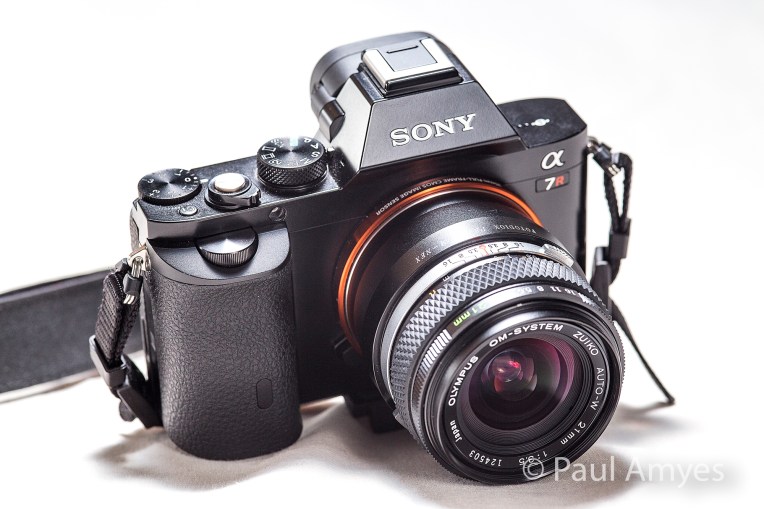
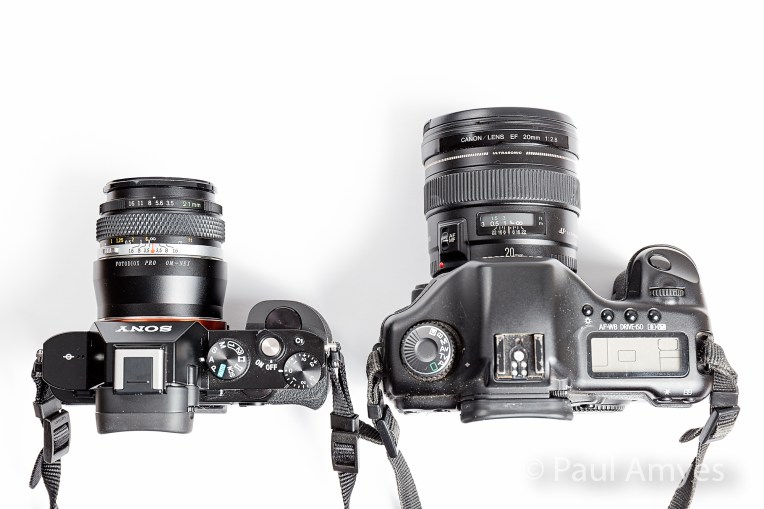
The Fotodiox OM to Nex adapter is bigger than the OM Zuiko 21mm f3.5 lens.

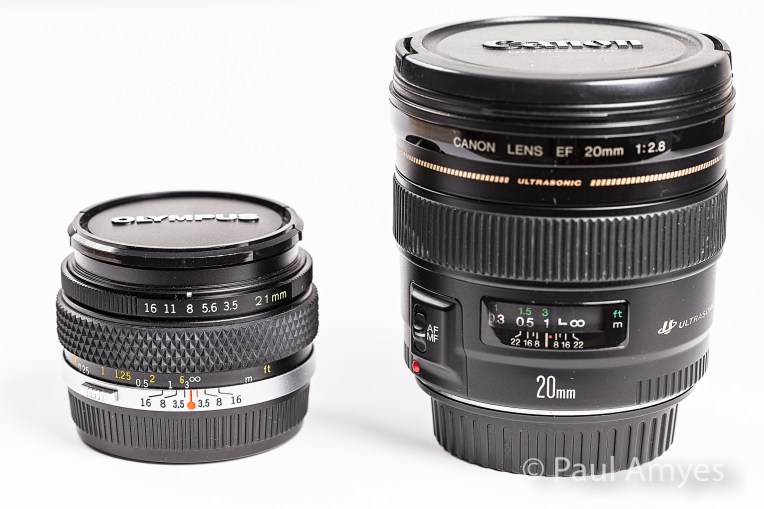
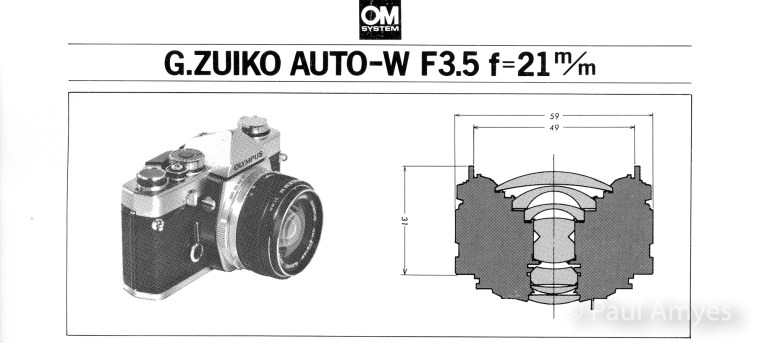
absolutely tiny. It is about the same size as the Fotodiox OM to NEX adapter. Most other camera systems would call this a pancake lens – it’s not, it’s just that most modern DSLR cameras are very bloated and unnecessarily large. Optically it has 7 elements in 7 groups, is 31mm (1.2 inches) long, 59mm (2.3 inches) in diameter and has a filter thread of 49mm. Like most Olympus OM lenses there are different versions of the lens – the original weighed in 185g (6.5 oz) while the newer MC (multi coated) one, which is tested here, is 180g (6.3 oz) while sharing the same optical construction and exterior dimensions. Although it does not have the floating rear element of the f2 version it still focuses down to 20cm (7.87 inches) and the quality is reasonable.
20160907-olympus21mm-0228

Test Results

The book shelf optical test. The camera is mounted on a tripod so as to get the whole shelf in the frame without causing loss of the parallel vertical lines.

Using my standard book shelf test it is immediately apparent that the lens has noticeable barrel distortion. This is not uncommon in wide-angle lenses and occurs where the image magnification decreases with distance from the optical axis and makes parallel straight lines look like the edges of a wooden barrel. These days this can be easily corrected in post. Looking more closely it is easy to see chromatic aberration on high contrast edges, again easily corrected in post. Wide open at f3.5 the centre of the image is sharp with what would now be construed as having low contrast but is actually quite good and can easily be improved on with a quick adjustment in curves. The edges are very soft and lacking in contrast – not mush but would be easily noticeable in architectural shots. At f8 the centre has improved and you can forget the thoughts of a contrast adjustment. The edges have improved but they are still not good. It is at f11 where things start to come very good, the centre is excellent and the edges are not far off. Any further stopping down and optical quality will drop off due to the effects of diffraction. Vignetting is very apparent when wide open – maybe 2 to 2 1/2 stops difference between the centre and the corners. Things improve significantly by f8. Flare is very well controlled considering the angle of view and the sun stars are quite nice considering there are only six aperture blades.

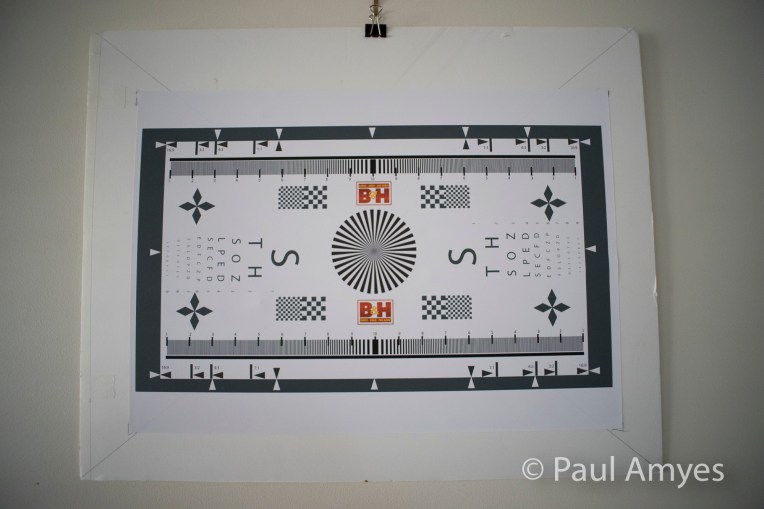
All images are SOOC with no sharpening or optical corrections. The sections are 100% views from the centre and top left corner of the image. This can be viewed larger by clicking on the image.


Wide open vignetting causes a light loss of 2-21/2 stops in the corners.


A comparison between the Olympus OM Zuiko 21mm f3.5 and the Canon EF 20mm f2.8.


A comparison between the Olympus OM Zuiko 21mm f3.5 and the Canon EF 20mm f2.8.

So keeping in mind this is a sample of just 1 and I have no idea if this is a good example or a bad what can I say about this lens. Well I happen to own a Canon EF 20mm f2.8 and while not one of Canon’s primo L lenses it is considered quite a respectable performer when stopped down. When we compare the two the first thing that comes to mind is the size difference. As I said before the Olympus is tiny, and it still looks small when attached to the lens adapter. Vignetting on the Canon is very well controlled, this is the big benefit of that large front element (72mm filter size compared with 49mm). Chromatic aberration is no better and no worse. It is the wide open corner sharpness where the Canon beats the little Olympus, but not hugely so and by f5.6 they are both pretty much the same. The big advantage the Olympus has over the Canon is filter use – the smaller size makes filters more affordable and I would hazard that is one of the few, if not only, ultra wide-angle lens that safely use the Cokin P system (84mm in width). My Canon still vignettes with the larger Cokin Z-Pro system (100mm in width).


Real World Examples
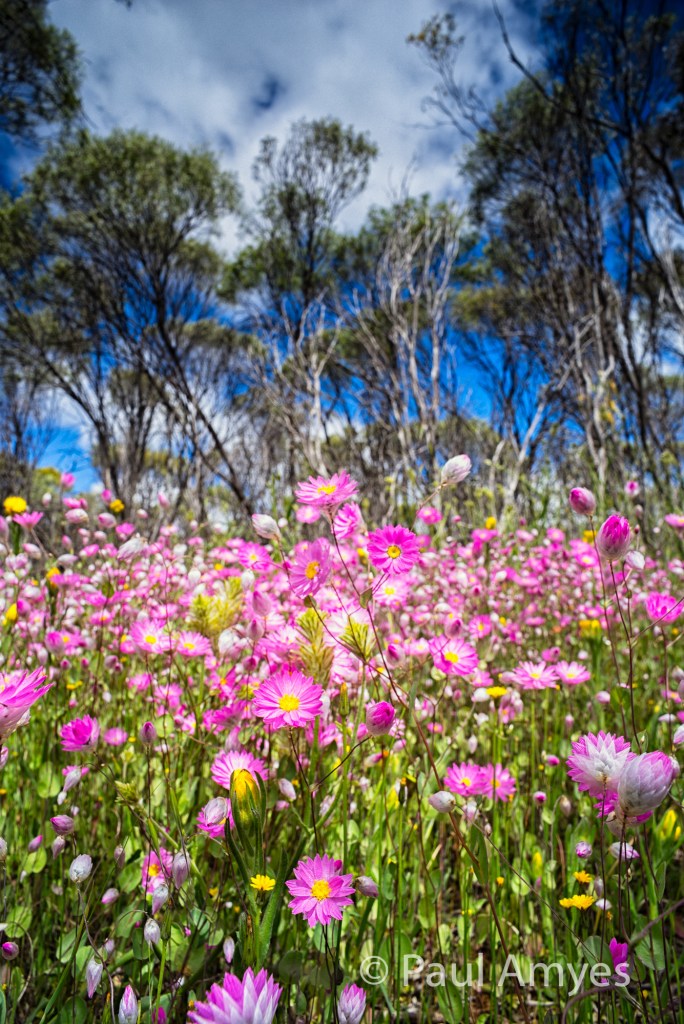
Stopping the lens down to f16 and then using the closest focusing distance of 0.2m I was able to to capture a wide angle close up of these flowers with plenty of DOF. Everlastings on Mount Brown in York, WA.
Stopping the lens down to f16 and then using the closest focusing distance of 0.2m I was able to capture a wide-angle close up of these flowers with plenty of DOF. Everlastings on Mount Brown in York, WA.


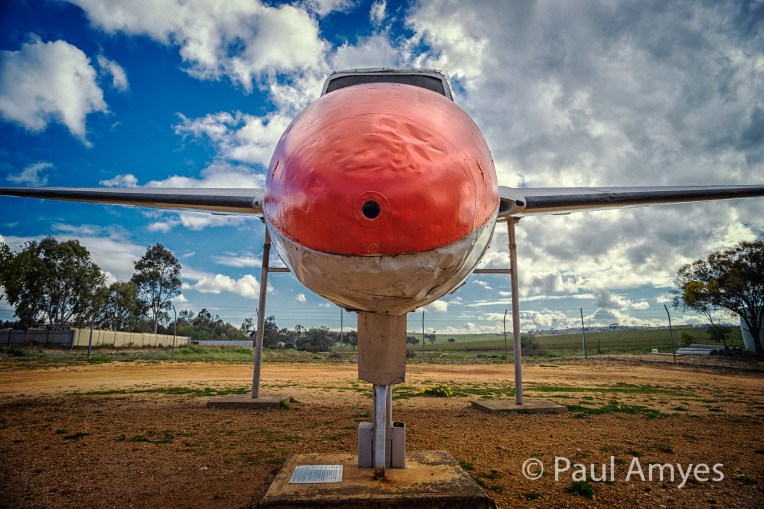
This lens encourages you to look for unusual points of view. A Vampire jet on the Beverley-York Road advertises the Beverley Aeronautical Museum.


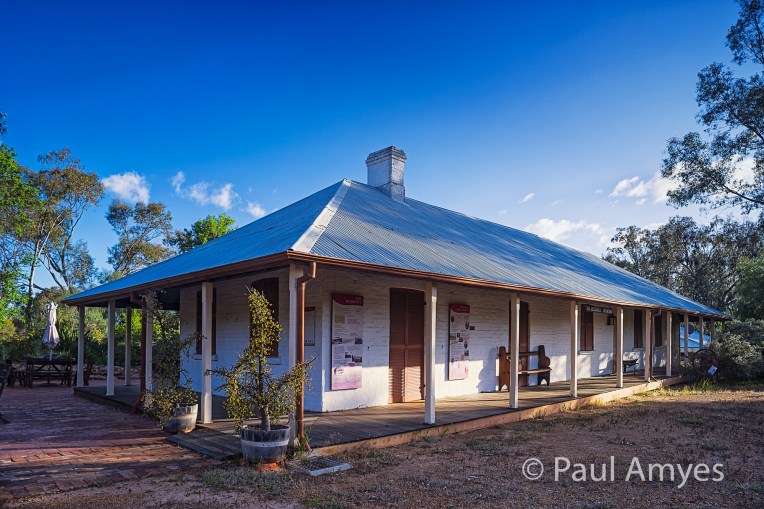
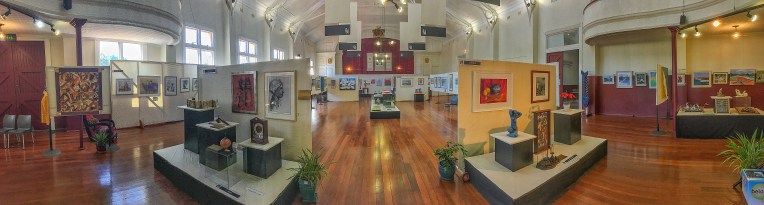
The OM 21mm f3.5 is well suited to architectural photography. The York Residency Museum. Built in the 1850's as the quarters for the superintendent of the York Convict Depot and is the last remaing building from the depot. Later it became the official residence of the magistrate, then it was used as part of the old York Hospital. It fell into disrepair and was saved by the work of the York Society. In 1972 it opened as a museum and has been used as such since.
The OM 21mm f3.5 is well suited to architectural photography. The York Residency Museum. Built in the 1850’s as the quarters for the superintendent of the York Convict Depot and is the last remaining building from the depot. Later it became the official residence of the magistrate, then it was used as part of the old York Hospital. It fell into disrepair and was saved by the work of the York Society. In 1972 it opened as a museum and has been used as such since.


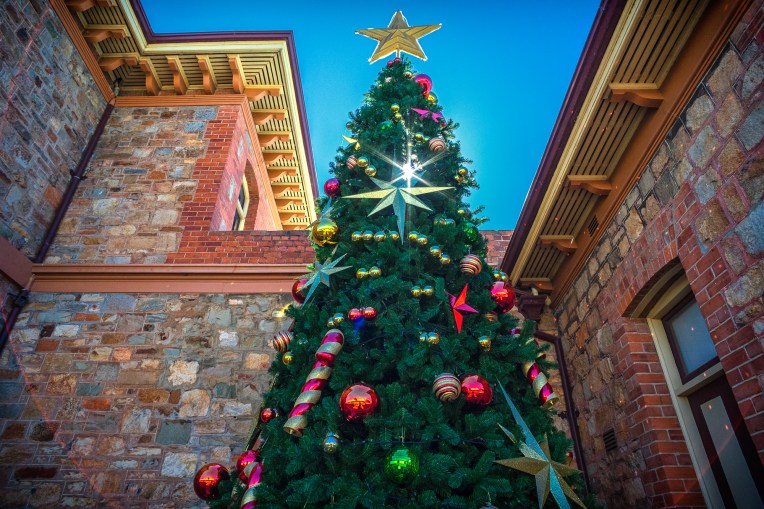
Shooting into the sun flare is very well controlled for such a wide lens. Note the sun star - the six aperture blades create a nice effect when stopped down to f16. The Shire of York Christmas tree for 2016 on Avon Terrace.
Shooting into the sun flare is very well controlled for such a wide lens. Note the sun star – the six aperture blades create a nice effect when stopped down to f16. The Shire of York Christmas tree for 2016 on Avon Terrace.

Conclusion

Well my only criticism of this lens is really nit-picking. It is just that aperture of f3.5 is a little dim and if I were to use it on an SLR (digital or analogue) it would make focusing using a split screen finder a little bit tricky. With the EVF of the A7r it makes no difference as the view can be made brighter and the focus peaking is easy to see. Probably this is not the lens to buy if you’re into astro, but if you shoot landscape and architecture as I do then it is a worthy addition to the camera bag.
The other OM lenses I’ve looked at are:

Olympus OM Zuiko 135mm f2.8
Olympus OM Zuiko MC 50mm f1.4
Olympus OM Zuiko 35-105mm f3.5-f4.5
Olympus OM Zuiko MC 35mm f2
Olympus OM Zuiko MC 24mm f2.8

Tales From The River Bank – part 2

Summer in Pioneer Park by Paul Amyes on 500px.com
Western Corellas (Cacatua pastinator). Pioneer Avon Park, York, Western Australia. Olympus OMD EM1 with OLYMPUS M.75-300mm F4.8-6.7 II lens. Exposure: 1/1250 sec f8 ISO 800.


Well we’re well and truly in summer now here in York. The mercury has hit 42℃ (107℉), the wheat crop is in and the water level in the River Avon is steadily dropping. This time of year brings the western corellas (Cacatua pastinator) in huge numbers. They migrate here to fatten up on the spilled wheat around the CBH grain handling facility and because of the water in the river. Being seed eaters they need quite large quantities of water to help digest their food. The corellas take up residence in the large gum trees that line

Summer in Pioneer Park by Paul Amyes on 500px.com
Summer in Pioneer Park. Western Corellas (Cacatua pastinator). Pioneer Avon Park, York, Western Australia. Olympus OMD EM-1 with OLYMPUS M.75-300mm F4.8-6.7 II lens. Exposure: 1/500 f7.1 ISO 200.


the banks of the river and that means lots of them can be found in the Pioneer Avon Park. Unfortunately for the corellas this all roughly coincides with Australia Day and this is a problem at the park because the town chooses to celebrate Australia Day there, lots of awards are handed out  and of course lots of speeches are made. Corellas are noisy – very noisy especially in their hundreds and they can easily drown out a PA system. One year our shire CEO had his wonderful speech (well he thought it was wonderful we the citizens of York thought otherwise) drowned out by raucous squawking and it made him more than a little cross to say the least. To prevent such a thing happening the next year he arranged for the birds to be culled just a few days before Australia Day. This is why York wakes up to the sound of gunfire in the days leading up to Australia Day.


Summer in Pioneer Park by Paul Amyes on 500px.com
Little black cormorants (Phalacrocorax sulcirostris) none too impressed with the antics of the corellas. Pioneer Avon Park, York, Western Australia. Exposure


Summer in Pioneer Park by Paul Amyes on 500px.com
Pink and Grey Galahs (Eolophus roseicapilla) wishing the noisy visitors would bugger off and leave them in peace and quiet. Avon Pioneer Park, York, Western Australia. Olympus OMD EM-1 with OLYMPUS M.75-300mm F4.8-6.7 II lens. Exposure: 1/800 sec, f6.7 ISO 800.


2016 In Review

Faversham
The Faversham vintage van in Avon Terrace, York, Western Australia. Olympus OMD EM-1 with Olympus OM Zuiko 35-105mm f3.5-4.5 lens. Exposure: 1/200 sec, f5.6 ISO 400.


If you have slightly geeky bent, and to be honest if you are reading a photography blog it’s pretty much a given that you have, then Adobe’s Lightroom has several useful tools. One of the ones I’ve been looking at is the ability to look at your photographic work for a specific time frame, and in this case it’s for the year 2016. You can also look at the cameras and lenses you used for that period which enables you to see what patterns of equipment usage emerge. It might ultimately save you money i.e. if you have a hankering for an expensive lens you can look back on your past year to see if that focal length/s you used and whether the objective lens of your desires is one you’d actually use or not. This has actually happened to me – a while back I was working on my project Broncos and Bulls and I felt that the Canon EF 75-300 f4-5.6 IS was costing me shots as it wasn’t the fastest lens to focus and the images at the long end were pretty soft. I wanted a Canon 100-400 L IS but my then preferred local dealer didn’t have one in stock and after waiting nearly 3 months they informed they couldn’t get one. I allowed them to talk me into buying the Canon 70-200 f2.8 L IS with the Canon x2 converter which they had in stock. Their logic was that I’d end up using the 70-200 much more and would hardly use it combined with the teleconverter. Now looking back through my Lightroom library I can see that I’ve hardly used the 70-200 at all on its own and virtually all the times I have used it was in conjunction with the teleconverter. I should have stuck to my guns and gone to another dealer and that way I’d have a lens that met my needs gave and gave good image quality rather than put up with a convenient compromise.


Gotcha!!! by Paul Amyes on 500px.com
Gotcha. Steer roping, Boddington Rodeo Western Australia. Canon EOS 5D with Canon 70-200 f2.8 IS L and x2 converter. Exposure: 1/800 s at f/5.6 ISO 200
 So what have I deduced about my photography for 2016? Well I’ll start with commenting on 2015 – for that year over half my photographic output was shot with a DSLR (50:50 split between full frame and APS-C). In 2016 that dropped to 10% the other 90% was shot on mirrorless. The DSLR was only used for some macro work (radio controlled TTL flash), some architecture (a specialised lens) and one event where I had a crisis of confidence and didn’t think the mirrorless cameras would cope with high ISOs and low light focussing. When I look at lens usage it comes as a big surprise that one-quarter of the images were taken using adapted lenses and these with a focal range of between 15-135mm in full frame terms. Hmmm well I knew I preferred shorter lenses than


Quairading Railway Station by Paul Amyes on 500px.com
Aboriginal art at Quairading Railway Station, Western Australia. Sony A7r with Olympus OM Zuiko 24mm f2.8 lens. Exposure: 1/4000, f8 at ISO 400.

longer already, the main thing is that I enjoyed using legacy lenses and was more than happy with them in terms of image quality. I don’t have to use legacy lenses at all as I have 20 to 600mm covered by modern dedicated AF lenses. For work where it is appropriate I will use the legacy lenses because they give a certain aesthetic that I like which is a less digital and clinical look.


York Mill by Paul Amyes on 500px.com
As you drive into York on the Great Southern Highway standing tall on your left is the historic York Flour Mill built in 1892, home to The York Mill. Sony A7r with Voigtlander 15mm f4.5 Super Wide – Heliar lens. Exposure: 1/25 sec, f16 at ISO 100.

Well what will 2017 bring. Well for 2016 I experimented with finding a certain look. For 2017 will be more project driven as I have found the style I wanted and now want to put it to practice. There will be at least one new book (work on that has already started) and there will be some multi media projects. So exciting times indeed.


Hillside Farmhouse by Paul Amyes on 500px.com
Hillside Farmhouse was designed by Sir Talbot Hobbs, a leading architect and built in 1911 for Morris Edwards in the historic Wheatbelt town of York in Western Australia. Sony A7r with Olympus OM Zuiko 35-105mm f3.5-4.5 lens mounted via a Fotodiox adapter, Cokin circular polarizing filter and +3 stop graduated neutral density filter. Exposure 4 seconds, f16, ISO 50.


I hope for my readers that 2017 will be all that you hope and that you’ll be healthy and happy.


Everlastings by Paul Amyes on 500px.com
Everlastings on Mount Brown in York, WA. Sony A7r with Olympus OM Zuiko 135mm f2.8 lens. Exposure: aperture priority with +1 stop exposure compensation, 1/1000th sec, f2.8 at ISO 100.


Merry Christmas

Christmas Tree by Paul Amyes on 500px.com
The Shire of York Christmas tree for 2016 on Avon Terrace. Sony A7r with Cosina Voigtlander 15mm f4.5 Super Wide – Heliar lens. Exposure: 1/125th sec, f16 ISO 800.


Reflected Glory

Reflected Glory by Paul Amyes on 500px.com
The colours of sunset reflected by the sun bleached grass on the Dyott Range. York, Western Australia. Olympus OMD E-M10 with an OLYMPUS M.75-300mm F4.8-6.7 II lens. Exposure: ƒ/8.0/1/1000s/ISO 1600


Back in August I posted a blog called Mellow Yellow showing the yellow canola on the hills opposite our house. Well Summer is well and truly here and the crop has been harvested just leaving the sun bleached stubble. When the sun sets the colours are reflected on those hills with quite impressive results.

FlatPack Hell

To visit and buy Ikea furniture is an experience that sears the psyche, but assembling it is a journey to the deepest and darkest levels of Hell itself and threatens your mortal soul.

Having fun with the time-lapse function of the Leica D-Lux. It is so much easier to use than the one in Olympus m4/3 cameras and will even generate the movie file for you at the end.

“Off To The Races”

“And we’re off to the races, places
Ready, set, the gate is down and now we’re goin’ in”

by Lana Del Rey and Tim Larcombe

York Cup Horse Races
York Cup Horse Races. In a small country town any event is an excuse to be seen and hang out. Olympus OMD EM-10 with OLYMPUS M.12-40mm F2.8 lens. Exposure: AE priority 1/2500th sec, f5.6 at ISO 200.


York Cup Horse Races
Place your bets at the TAB. Olympus OMD EM-10 with OLYMPUS M.12-40mm F2.8 lens. Exposure: AE priority 1/500th sec, f5.6 at ISO 200.


York Cup Horse Races
Getting ready for the race. Olympus OMD EM-1 with OLYMPUS M.40-150mm F2.8 lens. Exposure: AE priority 1/320th sec, f4.5 ISO 200.


York Cup Horse Races
Walking the horses so the punters can study the horses. Olympus OMD EM-1 with OLYMPUS M.40-150mm F2.8 lens. Exposure: AE priority 1/1000th sec, f4.5 at ISO 200.


York Cup Horse Races
Studying the form before the race. Olympus OMD EM-10 with OLYMPUS M.12-40mm F2.8 lens. Exposure: AE priority 1/1250th sec, f8 at ISO 200.


York Cup Horse Races
Warming up the horses before the start. Olympus OMD EM-1 with OLYMPUS M.40-150mm F2.8 lens. Exposure: 1/3200, f4 at ISO 200.


York Cup Horse Races
The horses come into the finishing straight for a last dash for the finish line. Olympus OMD EM-1 with OLYMPUS M.40-150mm F2.8 lens. Exposure: 1/4000th sec, f4 at ISO 200.


York Cup Horse Races
And they’re neck and neck. Olympus OMD EM-1 with OLYMPUS M.40-150mm F2.8 lens. Exposure: 1/2000th sec, f4 at ISO 200.


York Cup Horse Races
And the tic tac man holds onto the money. Olympus OMD EM-10 with OLYMPUS M.12-40mm F2.8 lens. Exposure: AE priority 1/60th sec, f4 at ISO 200.


Fantastic Spring Show

According to those that know it has been an amazing spring here in the Avon Valley. We’ve had rainfall that hasn’t been seen for decades and we’ve had a flush of wildflowers that hasn’t been equalled for fifty years. It has been frustrating as I’ve only managed to get out and photograph the orchids three times, but when I did get out it was beyond superlatives. Here are the highlights.


Dark Banded Greenhood by Paul Amyes on 500px.com
Pterostylis sanguinea, or , , Mount Observation, Western Australia. Canon EOS 6d, Sigma 105mm f2.8 macro lens and Canon 430 EX Speedlite. Exposure: AE priority 1/50th sec, f16, ISO 3200 with -1 stop exposure compensation.
 

Hairy-stemmed Snail Orchid by Paul Amyes on 500px.com
The Hairy-stemmed Snail Orchid (Pterostylis nana) most common and widespread of the Pterostylis species in Western Australia. Mt. Observation, Western Australia. Canon EOS 6d with Sigma 105mm f2.8 macro lens and Canon 430EX Speedlite. Exposure: Aperture priority with -1 stop exposure compensation 1/100th sec, f8 at ISO 400.
 

Wallflower Orchid by Paul Amyes on 500px.com
The wallflower orchid, aka the common donkey orchid (diuris corymbosa) lives up to it’s name and is commonly found in the south-west of Western Australia. Mount Observation, Western Australia. Canon EOS 6d with Sigma 105mm f2.8 macro lens and Canon 430 EX Speedlite. Exposure: aperture priority mode with -5 stops exposure compensation, high-speed flash sync 1/2000, f11 at ISO 200.


White Spider Orchid by Paul Amyes on 500px.com
White Spider Orchid (Caladenia longicaudia). Mokine, Western Australia. Olympus OMD EM-10 with Olympus m.Zuiko 60mm f2.8 macro and Metz ring flash. Exposure: ƒ/16.0 , 1/80s, at ISO 800, manual mode with -2 stops exposure.


Purple Enamel Orchid by Paul Amyes on 500px.com
Easily recognisable the Purple Enamel Orchid has glossy purple flowers which fade and become pink with age. Mokine, Western Australia. Olympus OMD EM-10 with Olympus m.Zuiko 60mm f2.8 macro lens and Metz ring flash.


Dancing Spider Orchid by Paul Amyes on 500px.com
The dancing spider orchid (Caladenia discoidea) is also known as the antelope orchid and the bee orchid. Mokine, Western Australia. Olympus OMD EM10 with Olympus m.Zuiko 60mm f2.8 macro lens, & Metz ring flash. Exposure:


Lemon Scented Sun Orchid by Paul Amyes on 500px.com
The lemon scented sun orchid, also known as the vanilla orchid,(Thelymitra antennifera) is named after its strong lemon scent. Mokine, Western Australia. Olympus OMD EM-10 with Olympus m.Zuiko 60mm f2.8 macro and Metz ring flash. Exposure: 1/160th sec, f8 ISO 200.


Blue China Orchid by Paul Amyes on 500px.com
Recognised by its intense blue colour, the Blue China Orchid is like the Thelymitra species in that it is heat sensitive and the flowers close at night on overcast days. Mokine, Western Australia. Olympus OMD EM-10 with Olympus M.Zuiko 60mm F2.8 Macro lens and Metz mecablitz 15 MS-1 ring flash. Exposure: manual mode, 1/100th sec, f8 at ISO 200.


Fringed Mantis Orchid by Paul Amyes on 500px.com
The Fringed Mantis Orchid (Caladenia falcata) is also known as the green spider orchid. Mokine, Western Australia. Olympus OMD EM-10 with Olympus m.Zuiko 60mm f2.8 macro lens and Metz ring flash.


Custard Orchid by Paul Amyes on 500px.com
Custard orchid (Thelymitra villas), York, Western Australia. Olympus OMD EM-10 with Olympus M.Zuiko 60mm F2.8 Macro lens. Exposure: AE priority 1/320th sec, f8 at ISO 200.

Clicking on an image will take you through to my online gallery.

Grip And Grin

The 2016 Act_Belong_Commit York Society Arts & Craft Awards held at the York Townhall.

Well it is that time of year again in the York arts calendar – the Act-Belong-Commit York Society Art & Craft Awards for 2016 are being held at the York Town Hall. Yours truly was asked to take the photos of the prize giving ceremony – the brief was to get the prize-winning artist accepting their prize. Classic grip and grin as it is known in the trade. I hate grip and grin with a vengeance – it is boring and conveys absolutely nothing. So 2pm on Saturday sees me parked in the front row at the award ceremony,  I’m there to take an endless procession of dull pictures. The photo below of Louise Gore Langton accepting her award from Dr Pamela Statham-Drew is one of seventeen similar pictures and is typical of the genre. It’s an OKish photo, but all it shows is a woman giving another woman a piece of paper. The photo does not tell you why Louise is being given a piece a paper, only the caption does.

Louise Gore Langton receiving her certificate and prize from Dr Pamela Statham-Drew

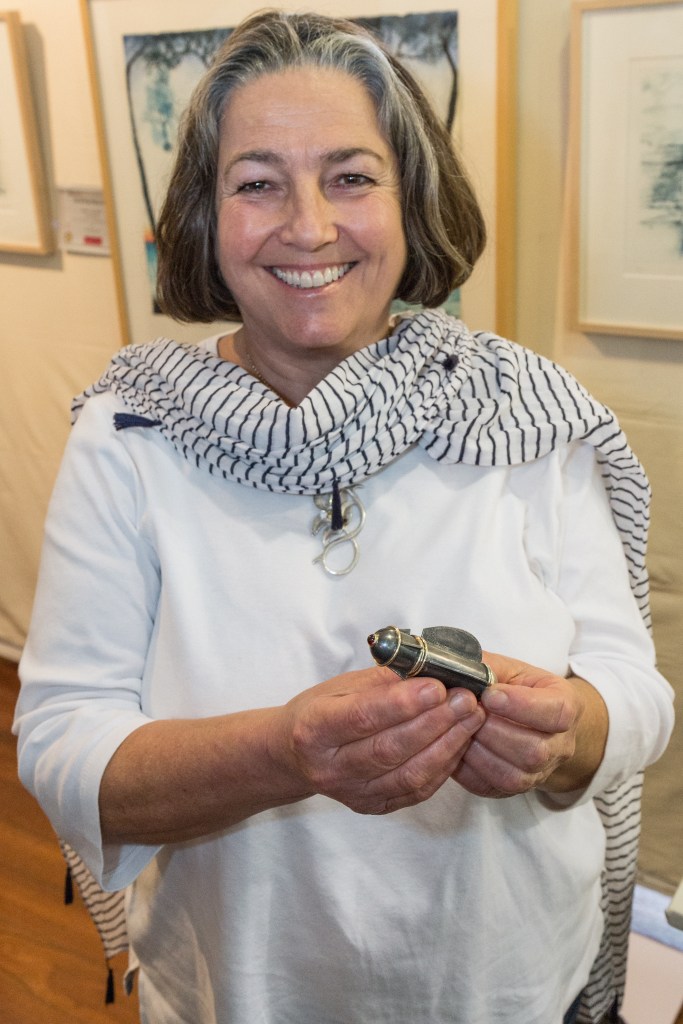
Louise won the Works in Fine Metals & Jewellery category with her work “Pocket Rocket“. So knowing that the pictures would be as dull as ditchwater I decided to take some alternatives after the ceremony. So the picture below shows the artist with her artwork looking very happy. So this tells the viewer something more than thefirst one. A big improvement, it is informative, happy and visually interesting.

A very happy Lousise Gore Langton with her prize winning entry in the 2016 Act-Belong-Commit Arts & Craft Awards.

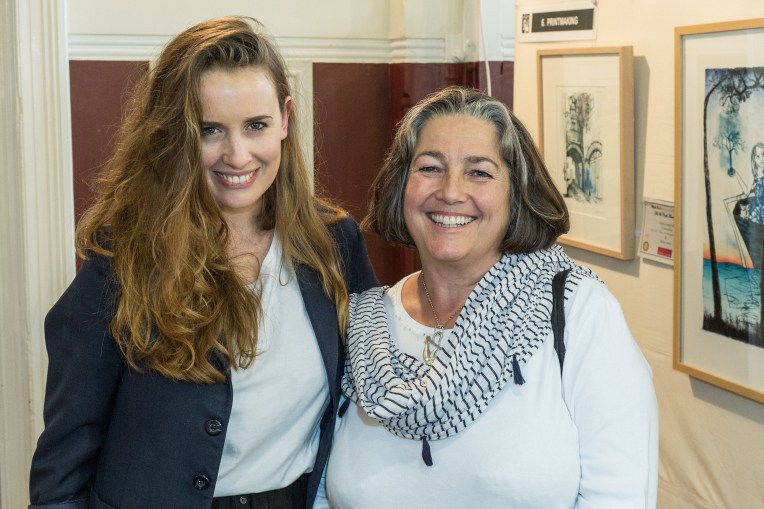
The picture below shows Louise with Kate Mullen who was one of the judges this year. The picture is lively, vibrant and happy and that conveys the atmosphere of the awards ceremony and opening. Thankfully the editor of the paper shared my view and didn’t run any of the grip and grin shots.


Kate Mullen, one of the judges, with prize winning entrant Louise Gore Langton.

The moral of the story here, if indeed there is one, is that you do what the person commissioning the work wants and then give them what you feel is the more suitable image.