Koordji-koordji or Australian Reed Warbler (Acrocephalus australis subspecies gouldi). Lake Leschenaultia, Western Australia.
Beating the heat is the name of the game here and so getting up early and heading out is the answer. Lake Leschenaultia in summer just as the sun comes up is blissful. The breeze coming off the water is deliciously cooling and walking under the shade is a pure delight. To cap it all off the wildlife is truly wonderful. To make the most of it I travel light – one camera (Olympus EM1x), one lens (Panasonic 100-400mm f4-6.3) some spare batteries and a water bottle.
Koordji-koordji or Australian Reed Warbler.
Djer-djer or Splendid Fairy-wren (Malarus splendens subs splendens). Lake Leschenaultia, Western Australia
When we first arrived I had a look for the Spotless Crake in the reed beds. I know it’s there – I’ve seen it and its footprints in the mud, and heard it – but taking a good photo is proving very difficult as it is extremely skittish and elusive. While stood there we could see the reeds twitching away and there was some strange staccato chucks, when suddenly a couple of birds break cover and sit on the tips of the reeds. I didn’t honestly know what they were – and assumed they were a new to me species. It was all quite exciting. Walking round the lake we were serenaded by the magpies. As the understory got denser we could hear Splendid Fairy Wrens chattering away in the undergrowth. When they broke cover we saw that they were very young – probably this summers fledglings. It was enchanting watching their antics as they chased one another around. As we headed back to where we started we passed another reed bed with some more of those unidentified birds in and they were very obliging and hung around in plain sight allowing me to get more photos. It was a great morning, worth getting up for.
What a poser! Koordji-koordji or Australian Reed Warbler (Acrocephalus australis subspecies gouldi).
On getting home and processing the images I found out that the birds were Australian Reed Warblers, a species that I’ve photographed before. What threw me was the sound – I’ve only ever heard them warble before. So it was a little disappointing that it wasn’t a new species, a bit embarrassing that I didn’t recognise them, but extremely satisfying as they are my best photos of Australian Reed Warblers.
* Early One Morning is a song by the great Elmore James.
The south east bank of Lake Gwelup in Western Australia.
The bird observation platform that forms part of the Lake Gwelup Reserve Broadwalk on the south eastern shore of Lake Gwelup.
Lake Gwelup and the reserve that surrounds it is one of the few areas of wetland that is still relatively intact. This means that it is home to a wide variety of flora and fauna which is all the more surprising considering it is just 12 Km north of Perth’s CBD in the City of Stirling which with a population of 210,000 (2016 Census) is the largest local government area by population in Western Australia. The bush around the lake is comprised of Marri, Jarrah, Flooded Gum, Tuart (, Swamp Paperbark and several species of Banksia. The bush and the lake provided a habitat for birds (according to eBird Australia 110 species of bird have been sighted there), frogs (notably Moaning Frogs), and reptile species (e.g. dugites, skinks and long necked turtles). One of the strange facts that has prevented the land from being developed is that the peaty soils around the lake if disturbed release arsenic and iron sulphates. In the areas nearby that have been drained and reclaimed they have the highest concentrations of dissolved arsenic in the world – some 25000 ug/L (some 400 times higher than that identified as safe levels for drinking water).
Bees feeding on the flowers of the Swamp Paperbark (Melaleuca rhaphiophylla). Lake Gwelup Reserve, Western Australia.
A male Blue-billed Duck (Oxyura australis) on Lake Gwelup in Western Australia.
So what is there to see and do? Well there is a networks of paths around the lake and through the surrounding bushland and you can bring your best canine friend with you. There are BBQ’s and picnic shelters, public bathrooms, sail-shaded playground, sporting grounds and cricket nets for those who don’t feel the need to connect with nature. For those wanting a nature fix on the southern side is a broad walk and viewing platform that allows you to get up lose and personal with the wildlife. An interesting development is that the bush northwest of the lake is a breeding ground for Rainbow Bee-eaters. These migratory birds come from Papua New Guinea and Tropical Australia and build their nesting burrows in our summer time.The City of Stirling has taken measures to protect the nesting sites and at the same time promote them as a feature of the reserve encouraging people to come and see them. Something that the City of Armadale could learn from with their management of Forrestdale Lake. Conservation and protection doesn’t mean you have to fence people out. So when I went the other week I put together a 3.75 Km walk around the lake that also took in the Rainbow Bee-eater nesting site. It was a loverly walk and it was great to see people out enjoying the sunshine in such beautiful surroundings.
The breeding colony of Rainbow Bee-eaters (Merops ornatus) is quite a feature of the Lake Gwelup Reserve in Western Australia.
The City of Stirling, who administer Lake Gwelup Reserve, place signage up warning people of the presence of Rainbow Bee-eaters’ underground nests.
Forrestdale Lake (originally Lake Jandakot, it was renamed in 1973) lies within the Forrestdale Lake Nature Reserve which is about 25 kilometres south of the Perth CBD on the southern fringes of the Perth metropolitan area. The lake is shallow and seasonal with a large area 220 to 245 hectares of open water when full. In June or July, Lake Forrestdale starts to fill, and about the end of September, it reaches its maximum depth which is somewhere between 200 and 500mm depending upon the winter rains and it usually dries out by mid-summer. That was not always the case as the lake used to hold a lot more water than it does now, and some years it did not dry up at all. Diminishing rainfall, and ground water extraction from government and private bores are some of the reasons for the lake’s decreasing water levels.
Before white fellas came Lake Forrestdale was a special place for the Whadjuk Nyoongar who camped around its shores and hunted long-necked turtles, waterfowl and their eggs; koonacs and gilgies, possums, kangaroos, quendas and many other animals that are now locally extinct. The first white settlers were William and Alfred Skeet in 1885 and they had a licence to fell and sell timber. Shortly after most of the land around the lake was cleared for farming and grazing despite that the lake continued to be a major breeding site, migration stop-over and semi-permanent drought refuge area for waterbirds so in 1957 the lake was gazetted as an “A” class nature reserve for the conservation of flora and fauna and to provide a location for recreational sailing. On 7 June 1990, along with Thomsons Lake 10 kilometres to the west, it designated under the Ramsar Convention as a wetland of international importance and both lakes form the Forrestdale and Thomsons Lakes Ramsar Site. It’s easy to see why. More than 20,000 waterbirds have been recorded on Forrestdale Lake. It regularly supports more than 1% of the national population of five shorebirds: red-capped plover (with up to 1,300 recorded at any one time), black-winged stilt (3,840), red-necked avocet (1,113), long-toed stint (up to 80), and curlew sandpiper (2,000). In some years it supports more than 10,000 ducks, including Australian shelduck (up to 1,650 counted), Pacific black duck (5,500), grey teal (9,000), Australasian shoveler (2,000), and hardhead (1,053). The lake is one of the few sites in Western Australia where little ringed plover and little stint have been recorded more than once, and it is the only location in the state where white-rumped sandpiper has been recorded. A comprehensive list of all the bird species seen at the reserve can be seen at eBird Australia.
The entyrance to the Forrestdale Lake Nature Reserve.
So when BSO (Beloved Significant Other) announced she was mounting a campaign to achieve croquet world domination I would use the opportunity of a weekend in Perth to have a gander at Forrestdale Lake Nature Reserve. So a quick peruse of the interwebs told me that the best place to start was was at the parking bay at the Skeet Memorial Park on Moore Street in Armadale. There I would find a comprehensive information board about the area and would also give me quick access to the bird observation platform. Having read all about all the different birds that use the lake I was expecting a birding nirvana. Unfortunately we’d had a dry winter and the water line was a good 600m from the platform which meant I had Buckley’s chance of seeing any water birds up close and personal.
The bird observation platform at Forrestdale Lake.
Fall back plan was to walk around the lake and just photograph what I found on the way. Once you leave the main entrance area there is little signage except for the keep out variety which is attached to the continuous fence designed to, funnily enough, keep people out. It was quite a frustrating experience – I could hear plenty of bird activity on the other side of the fence but I had no way of getting closer. For much of the walk you are in a narrow corridor of about 5 or 6 metres between two substantial fences with signs saying you are under surveillance – it’s hardly a nature experience. I’ve been to military bases which are more friendly. I feel this is a hugely wasted opportunity. Thomson’s Lake is much more accessible to visitors, and the Spectacles also makes much of it Aboriginal cultural significance. I’ve written previously that if people are having less and less opportunities to interact with nature that will create an antipathy towards the natural world and consequently they will cease to care about it. So to get people to be more aware of environmental issues they must be encouraged to reconnect with nature. There is very little opportunity for the casual visitor to interact with all that Forrestdale Lake offers so in many ways it defeats its stated purpose of raising public awareness about the importance of this chain of wetlands. Normally I am very positive about these types of reserves and have written about them in the past in glowing terms. I don’t like being negative or critical, but I really do feel that this is a waste of resources.
One of the many signs that warn you about unauthorised access.
The fence that rings the lake preventing unauthorised access.
Big brother is in full surveillance mode at Forrestdale Lake Nature Reserve.
Can I recommend the place as worth a visit? If you want a a bit of a walk with a nature experience then I would suggest that are better places and I’ve written about quite a few of them. If you are a die hard birder then I’d find out what the water levels are before visiting. There is little point in visiting if there is no water in the lake.
Red Wattlebird, Anthochaera carunculata subspecies woodwardi, at Forrestdale Lake Nature Reserve.
White-headed Stilt, Himantopus himantopus subsp. leucocephalus, Forrestdale Lake Nature Reserve.
Grey fantail, Rhipdiura albiscapa, Forrestdale Lake Nature Reserve.
Grey Butcherbird, Cracticus torquatus, Forrestdale Lake Nature Reserve.
Oh and BSO (Beloved Significant Other had a better time of it than I did and achieved world croquet domination – well she won the State Mixed Doubles for Golf Croquet.
2020 Croquetwest GC State Mixed Doubles. Forest Park Croquet Club, Mount Lawley, Western Australia.
2020 Croquetwest GC State Mixed Doubles. Forest Park Croquet Club, Mount Lawley, Western Australia.
Originally what is now Lake Claremont was a swamp with a series of small pools edged with reeds and then surrounded by paperbark trees. There was abundant plant an animal life and it was an important hunting and gathering place for the Mooro clan of the Nyoongar in the warmer months of the year.
The bird observation platform allows visitors to watch the birds in the grasses and reeds at Lake Claremont.
In 1831 European settlers began to clear the land for farming and by the 1890’s there were market gardens and a then state of the art dairy farm. Things looked good and the area prospered. However, this state of affairs was short lived as by the turn of the Twentieth Century the water level rose and the farms were flooded and a permanent lake which rises and falls with the seasons was formed. In the 1950’s Claremont Town Council reclaimed large areas for a rubbish tip and renamed it Lake Claremont in the process. In the 1960’s it was decided to beautify the lake and its surrounds. Sections were infilled to create a golf course and the school playing fields. In time two small bird sanctuary islands were created and there has been a move to manage the the lake in a more ecological manner. The Friends of Lake Claremont are an enthusiastic and very active bunch of local residents and volunteers who have undertaken to assist in the conservation and enhancement of Lake Claremont. There activities have been crucial in weed eradication programs and revegetation projects working in tandem with pupils fromScotch College and Graylands Primary School. They also have annual public events including Clean Up Australia Day, National Tree Day and Celebrate Lake Claremont Day (community fair). More details can be found on their website.
The infamous Lake Claremont crocodile. Lake Claremont, Western Australia.
So that was then and this is now. What does the lake offer today? Well the wetlands of the Swan Coastal Plain are internationally acknowledged as a bio-diversity hotspot having a greater number of endemic species than most other regions in Australia. Since colonisation three quarters of the wetlands have been drained for urban development. Those that remain are adversely effected by the introduction of feral animals and plants. In this context Lake Claremont is like a biosphere. In the past ten years or so eBird Australia has listed 116 species of bird that can be found on or around the lake which makes it somewhat of a birders paradise. The path around the lake and the bird observation platform make it easy to spot birds all year round. To make it so that you know what you are looking for you can down load an illustrated brochure listing the birds from the Town of Claremont website.
Lake Claremont has a dual use path around its edge which is popular with runners and cyclists.
In addition to the nature based activities there is a 3 Km dual use path that circumnavigates the lake which is very popular with walkers, runners and cyclists. Dogs are welcome on a lead. The walk is enjoyable all year round and if you start the car park and head off in a clockwise direction then you can stop at the TeeBox Cafe shortly before returning to the car park. For the youngsters who need to burn off some energy before looking at the ducks there are two playgrounds. If dad doesn’t care for looking at the ducks then he has the option of playing a quick nine holes of golf.
A juvenile pied stilt (Himantopus himantopus) at Lake Claremont, Western Australia.
A black swan (black ) gathering nesting material at Lake Claremont, Western Australia.
A pair of Australian Shovelers (Australian) at Lake Claremont, Western Australia.
A pair of grey teals (Anas gracilis) at Lake Claremont in Western Australia.
A purple swamp hen (Purple), Lake Claremont, Western Australia.
Rainbow lorikeets (Rain) were introduced to Western Australiafrom the eastern states of Australia. Lake Claremont, Western Australia.
Pink-eared ducks (Malacorhynchus membranaceus) at Lake Claremont in Western Australia.
Called Dit by the Nyoongar this juvenile pied stilt (Himantopus himantopus) feeds at Lake Claremont, Western Australia.
Bardoongooba called Australian Shovelers (Anas rhynchotis) by European settlers can be readily seen on Lake Claremont.
Black-fronted Dotterel (Elseyornis melanops), Avon River, Northam, Western Australia. Panasonic Lumix G85 with Panasonic Leica 100-400mm f4-6.3 lens. Exposure: 1/500 sec, f6.3 at ISO 250.
What do you do when you’ve got 2 hours to kill while in the Wheatbelt metropolis of Northam? Go looking for Black-fronted Dotterels that’s what! These busy little birds can be found on the muddy shoreline looking for insects and small molluscs.
Black-fronted Dotterel (Elseyornis melanops), Avon River, Northam, Western Australia. Panasonic Lumix G85 with Panasonic Leica 100-400mm f4-6.3 lens. Exposure: 1/500 sec, f6.3 at ISO 250.
The ubiquitous New Holland Honeyeater (Phylidonyris novaehollandiae), New Victoria Dam, Korung National Park, Western Australia.
Over the last few days my FaceBook feed has been seeing some seriously tasty bird photos from one of the groups that I belong to. The photos all come from one area– New Victoria Dam which is 30Km east of Perth on the Darling Range in Korung National Park. So when the Beloved Significant Other (BSO) announced she was competing in a croquet competition at a location just 20 minutes drive away I immediately volunteered myself as driver.
There are two starting points to the walk and which you choose will largely depend upon when you visit. If you visit outside of office hours Monday to Friday or anytime at the weekend then y ou have to use the upper carpark as your start point as the access road is shut. During office hours you can drive down to the lower carpark keeping in mind that if stay till after 5pm then you won’t be able to drive out. I started at the upper carpark which only adds 800m each way to the walk. The walk consists of a 7Km round trip down past the New Victoria Dam to the Old Victoria dam wall and the garden and picnic area. There used to be a path through the trees at the edge of the road but it has become quite overgrown and indistinct so you are best walking along the access road. As you walk down the road on your left is the gravesite of Francis Weston who died in 1876 aged two days, his parents lived in the timber workers settlement at Bickley. When you get to the lower carpark walk through it and then follow the trail markers. After walking through the forest you come to New Victoria Dam. Walk down the steps and at the bottom turn right onto the road and walk down to the remains of the Old Victoria Dam.
The gravesite of Francis Westson who died in 1876 aged two days. His parents lived in the timber workers settlement at Bickley.
The steps down to the New Victoria Dam.
The original dam was built in 1891 and pumped water via pipelines to Kings Park and a reservoir there on Mount Eliza. The dam became the first permanent water source for Perth and was operated by the private City of Perth Waterworks Company. As the water catchment area took in agricultural land and timber settlements there were fears that it would be polluted by raw sewage and excrement from livestock. Between 1895 and 1900 typhoid broke out in Perth and 425 people died. The water was tested and found to be contaminated so the government took control and made changes to prevent re-occurrence. By 1988 the concrete structure was beginning to degrade to such an extent it could no longer be repaired so in 1990 work on the new dam commenced and because of the use of roller compacted concrete it was completed by the following year. It can hold 9.5 million kilo-litres and is used to supply drinking water to Kalamunda and Lesmurdie.
The wall of the old Victoria dam and the garden beside it.
In the lee of the old dam there is a grassed picnic area and toilets. Thickets of ti-tree and one-sided bottlebrush or claw flower have been planted and the thick vegetation along the creek line provides dense cover for a number of bird species. On this trip I used the picnic gazebo as an impromptu bird hide and spent a couple of hours watching the various birds feed and drink. I sawred-eared firetails, mistletoe birds, splendid fairy wrens, western spinebills, new holland honeyeaters, white faced herons and rosellas. The dam spillway feeds water to the pond and creek that provides a year round water supply which means that the birds are always active all here. If you are there at dawn or dusk then kangaroos can be seen feeding on the grass. It is a great little spot and doesn’t require too much effort to get there.
Red-eared Firetail (Stagonopleura oculata), New Victoria Dam, Korung National Park, Western Australia.
White Faced Heron (Egretta novaehollandiae), New Victoria Dam, Korung National Park, Western Australia.
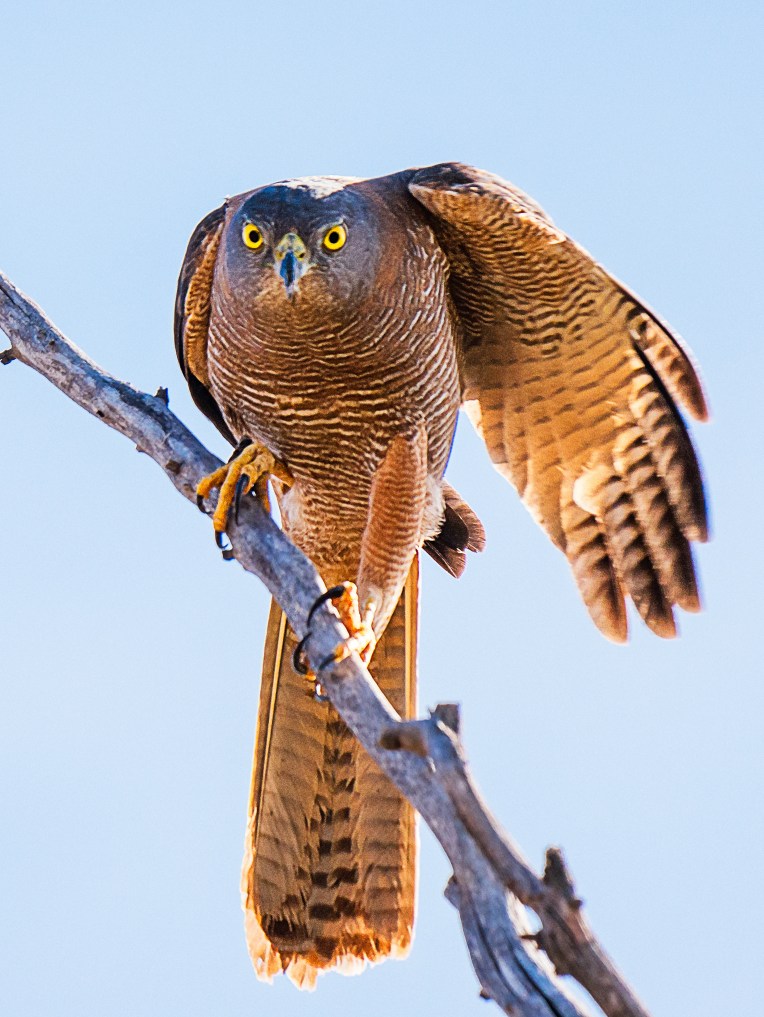
Brown goshawk, (Accipiterr fasciatus.) called Matwelitj, by the Nyoongar people of Western Australia. Avon River Walk, York, Western Australia. Panasonic Lumix G85 with LEICA DG 100-400/F4.0-6.3 lens. Exposure: 1/1000 sec, f6.3 at ISO 640 with + 1/3 stop exposure compensation.
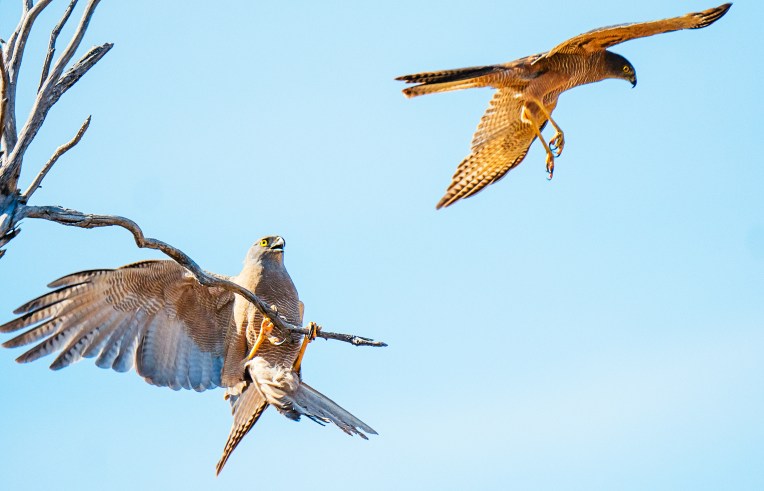
The last few mornings dog walks have been spiced up by some very territorial brown goshawks. As we walk along the river and then down onto the river bed we can hear them calling and chattering. It then goes quiet for a second or so and then there is a loud whoosh as you are buzzed from behind. As the bird passes overhead you can feel the air current generated by its wings. At first I thought the birds were objecting to the dog but I and this pattern persisted for about a week. But then something happened that disabused me of that notion – my hat suddenly became the victim of a bird of prey. The last time it happened they managed to knock it off my head. I’m beginning to think my bicycle helmet may be more appropriate headwear.
You know what they say “Any landing you can walk away from is a good landing”. Brown goshawk, (Accipiterr fasciatus.) Avon River Walk, York, Western Australia. Panasonic Lumix G85 with LEICA DG 100-400/F4.0-6.3 lens. Exposure: 1/1000 sec, f6.3 with +1 1/3 stops exposure compensation.
What you Looking At? Brown goshawk, (Accipiterr fasciatus.) called Matwelitj, by the Nyoongar people of Western Australia. Avon River Walk, York, Western Australia.
Get Lost! Brown goshawks, (Accipiterr fasciatus.) called Matwelitj, by the Nyoongar people of Western Australia. Avon River Walk, York, Western Australia.
South of the Swan River is a string of lakes known as the Beeliar Wetlands which are a chain of twenty six lakes stretching from Manning Lake in Hamilton Hill to Madura Swamp near Mandurah Wetlands. Nineteen of those lakes and associated wetlands have been incorporated into the Beeliar Regional Park. This extensive belt of wetlands that has been widely acknowledged as a biodiversity hot-spot having a greater number of endemic species than most other regions in Australia. Within this the Nyoongar with their hunter-gatherer life-style managed the land with their fire-stick farming and survived by hunting and trapping a variety of game, including kangaroos, possums and wallabies; by fishing using spears and fish traps; as well as by gathering an extensive range of edible wild plants, including wattle seeds. Since colonisation three-quarters of these wetlands have been drained for urban development. What remains has suffered untold damage through the introduction of feral animals and plants. Thankfully Australia is a signatory of the Ramsar Convention and several key wetlands on the Swan Coastal Plain have been set aside for conservation. Bibra Lake is the fourth lake (heading southwards) in that chain of lakes that makes up Beeliar Regional Park. Whitefellas believe that they discovered the lake in 1842 and named it after the bloke who bought the land in 1843, one Benedict von Bibra. The Nyoongar say they have known about the lake since time began and to them it known as Walubup.
I first went to Bibra Lake about thirty years ago and thought it was a bit boring and hadn’t been back until the other week. I was called upon for driving duties for the Beloved Significant Other (BSO) and I was left with a morning to kill. So I looked in my copy of Birding Sites around Perth by Ron Van Delft (sadly out of print and unavailable now) and saw that Bibra Lakes was nearby and rated as a good location for birding. The down side to this was that we were experiencing the first major cold front of winter and that meant it was bucketing down and blowing a gale. So suitably swathed in Gore-Tex and equipped with a suitably weather resistant camera I headed off to walk around the lake not expecting to see much.
A comforting warning painted on the cycle path that runs around Lake Bibra. It was cold and wet in winter so not much chance of a snakey encounter.
Initially I thought that with it raining I had more chance of photographing ducks as it was the perfect weather for them. There were quite a number of different species on the shore and the water. I was quite taken by the Shovelers and the Pink Eared Ducks. The Shovelers are quite a string looking duck with colouring and almost disproportionately large bills. They can often be seen foraging in shallow water where they filter water through their bills insects looking for insects, crustaceans and a variety of plants. Such a specialised mode of feeding means that they are limited to certain types of habitat such as freshwater swamps and lakes with large reed beds. Shovelers also tend to hang out with pink-eared ducks which are so called because of the patch of pink feathers on the sides of the drakes head. Like the Shovelers they too are filter feeders. As the walk moved through areas of paperbark and sheoak trees then smaller insect eating birds were seen such as Willie Wagtails, Grey Fantails, Silvereyes, and various types of wrens. Over all as I did the 8.5 Km walk I saw 18 different species of bird which I felt was a pretty good haul considering the weather conditions. So I’ve revised my opinion of Bibra Lakes and will not wait another 30 years before my next visit.
Australasian Shoevelers, Spatula rhynchotis. Bibra Lake, Western Australia. Panasonic Lumix G85 with Panasonic LEICA DG 100-400/F4.0-6.3 lens. Exposure: 1/400 sec, f6.3 at ISO 250.
A pink-eared duck (Malacorhynchus membranaceus) keeping a low profile while amongst Eurasian coots (Fulica atra). Bibra Lake, Western Australia. Panasonic Lumix G85 with Panasonic LEICA DG 100-400/F4.0-6.3 lens. Exposure: 1/500 sec, f6.3 at ISO 3200.
Brown Honeyeater, Lichmera indistincta. Bibra Lake, Western Australia. Panasonic Lumix G85 with Panasonic LEICA DG 100-400/F4.0-6.3 lens. Exposure: 1/500 sec, f6.3 at ISO 2500.
Varigated Fairy-wren, Malurus lamberti. Bibra Lake, western Australia. Panasonic Lumix G85 with Panasonic LEICA DG 100-400/F4.0-6.3 lens. Exposure: 1/500 sec, f6.3, ISO 320.
Willie Wagtail, Rhipidura leucophrys leucophrys, Bibra Lake. Panasonic Lumix G85 with Panasonic LEICA DG 100-400/F4.0-6.3 lens. Exposure: 1/500 sec, f6.3 at ISO 1600.
A female mistletoebird, Dicaeum hirundinaceum, at Bibra Lake in Western Australia. Panasonic Lumix G85 with Panasonic LEICA DG 100-400/F4.0-6.3 lens. Exposure: 1/500 sec, f6.3 at ISO 2000.
Bibra Lake is part of the Beeliar Wetlands which is an internationally recognised birding hotspot. This is one of two bird hides that have been buit at Bibra Lake.
Don’t feed the birds sign at Bibra Lake complete with Willie Wagtail, Rhipidura leucophrys leucophrys. Panasonic Lumix G85 with Panasonic LEICA DG 100-400/F4.0-6.3 lens. Exposure: 1/500, f4, ISO 250.
If you are interested in the birds that can be seen at Bibra Lakes, and indeed throughout the Beeliar Wetlands Birding WA has a useful webpage that gives info on the species that can be seen and where. Birdlife Australia put out a couple of useful brochures which can be got from regional visitors centres or downloaded as PDFs from their website. The brochures are:
Splendid Fairy-wren, Malarus splendens subs splendens, out of the breeding period. Lake Leschenaultia, Western Australia. Canon EOS 6D with Sigma 150-600mm f/5-6.3 DG OS HSM Contemporary lens. Exposure: 1/1000sec, f6.3 at ISO 6400.
Sometimes I think that have got to be easier ways to enjoy birding and bird photography than dragging 3.5Kg of camera and lens quietly through the bush and trying to get a picture of something that is literally so flighty that the slightest sound sees your subject leave at a tremendous rate of knots.
Western Thornbill, Acanthiza inornata. Lake Leschenaultia, Western Australia. Canon EOS 6D with Sigma 150-600mm f/5-6.3 DG OS HSM Contemporary lens. Exposure: 1/1000 sec, f6.3 at ISO 1000.
Case in point. Not so long ago Beloved Significant Other (BSO) went for a trip to Lake Leschenaultia in Chidlow. I spent an age crawling around in the bush looking for a cooperative subject. In that time every small twig that I inadvertently trod on sounded like a thunder clap that sent all the wildlife scurrying for cover in a 5Km radius.
Silvereye, Zosterops lateralis. Lake Leschenaultia, Western Australia. Canon EOS 6D with a Sigma 150-600mm f/5-6.3 DG OS HSM Contemporary lens. Exposure: 1/1250 sec, f6.3 ISO 2500.
Even if you manage to creep up on a suitable subject you then have the problem of photographing something that is 5-10cm and hoping and twitching around like a meth user suffering from St Vitus’ dance while you are trying to track it and keep it in focus as it darts in and out of the foliage. So I’ve come up with an easier method. The BBQ. If you have BBQ in Australia every animal in the neighbourhood will be trying to relieve you of your food. The little buggers will climb into your lap and pose for photos if food is involved.
A picnic feast with the birds of lake Leschenaultia by Helen Amyes (aka BSO). Panasonic Lumix LX5. Exposure: 1/160 sec, f2.8 at ISO 80.





You must be logged in to post a comment.