The morning mist on the Avon River. Western Australia. Panasonic G9 with Panasonic Leica 12-60mm f2.8-4 lens.
I like the pass of the seasons. I like how everything changes and provides different experiences. I like going out down the Avon River on a cold winters morning with thick mist. The experience is very different – vision is limited to around 5-10m and sounds are strangely muted. When looking for wildlife you think that nothing is near and then suddenly it looms out of mist. Sometimes I wonder who is more surprised at the encounter, me or the animal.
A femaleAustralian Wood Duck (Chenonetta jubata) and her twenty one ducklings swiming in the Avon River. Two weeks later I saw her and had just five remaining ducklings. Panasonic Lumix G9 mk ii with Panasonic Leica 100-400mm f4.5-6.3 lens.
Kakak or Little Pied Cormorant (Phalacrocorax melanoleucos). Panasonic Lumix G9 mk ii with PanaLeica 100-400mm lens.
A male Bambon or Rufous Whistler (Pachycephala rufiventris). Panasonic Lumix G9 mk ii with PanaLeica 100-400mm lens.
A female Bambon or Rufous Whistler (Pachycephala rufiventris). Panasonic Lumix G9 mk ii with PanaLeica 100-400mm lens.
The sun making an effort to break through the mist creates a warm haze. Doornart or Ring-necked Parrot (Barnardius zonarius subspecies semitorquatus). Panasonic Lumix G9 mk ii with PanaLeica 100-400mm lens.
Doolor or Silvereye (Zosterops lateralis) waiting for the sun to break through. Panasonic Lumix G9 mk ii with PanaLeica 100-400mm lens.
Living in a farming community the topic of conversation often turns to the weather. Right now people are talking about how little rain there has been, how cold it is, how they’re looking forward to summer, and how they’re worried about the forthcoming mother of all El Niño’s is coming with forecast temperatures for the Wheatbelt being in the mid to high 40sºC. The local farmers I’ve spoken with are all saying that crop yields will be severely impacted. Generally El Niños don’t effect us in Western Australia like they do in the Eastern States so hopefully this summer won’t too much of a feat of endurance.
One of the most common statements made on social media is “I’d like to photograph wildlife, but, there is none where I live”. In the next couple of posts I’d like to unpack this and suggest ways of finding wildlife in your location.
While Bertie can be pretty wild at times he is not wildlife.
Australia’s iconic Koala is an example of charismatic wildlife.
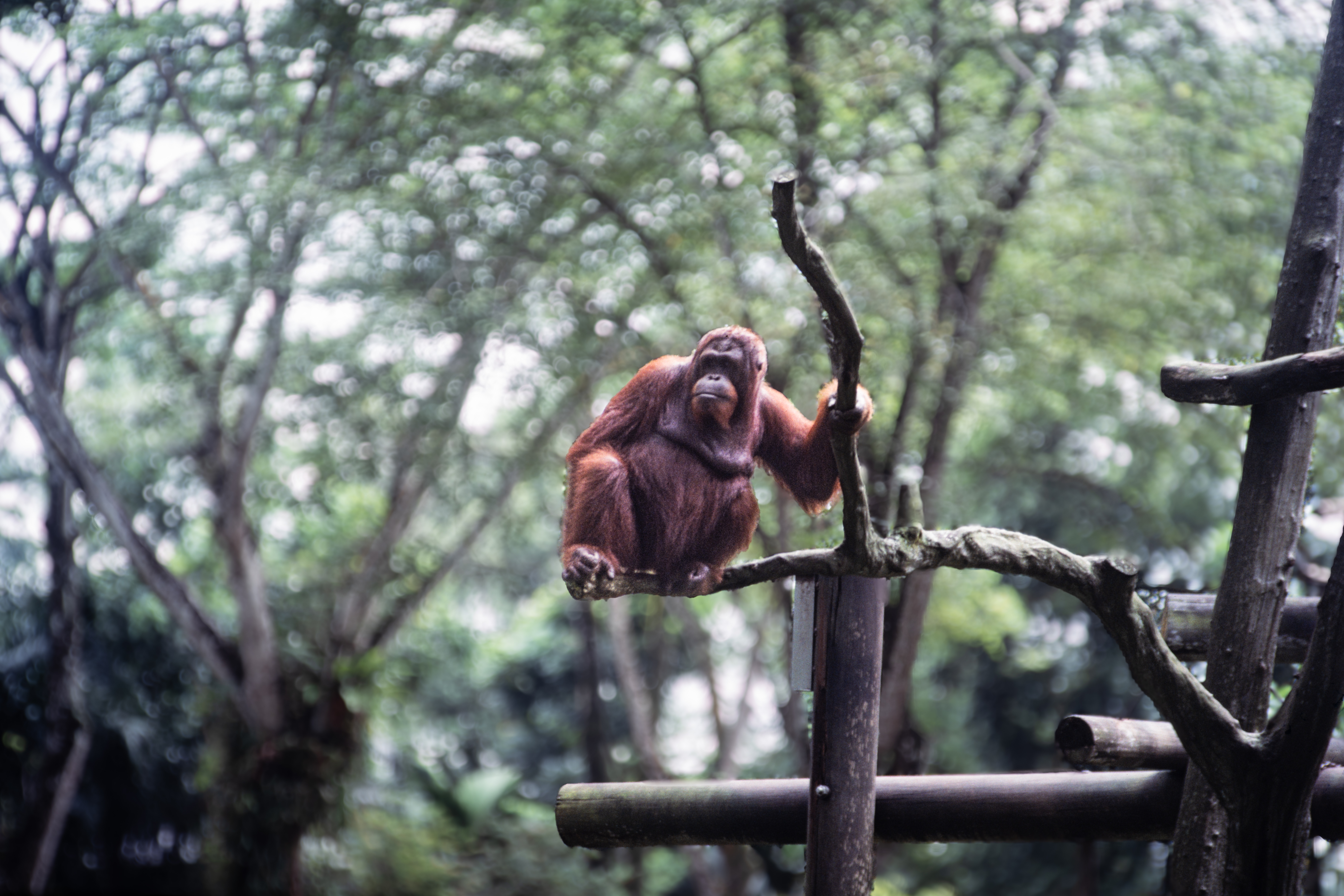
Orang-utans are another example.
Firstly we have to look at what people mean when they talk about wildlife. Wildlife is defined as undomesticated animals which can exist in their natural habitat, but has come to include all animals that live wild in an area without being introduced by humans. So that is a pretty broad definition and gives lots of scope. Having said that when most people talk of wildlife they tend to think only of certain charismatic species. Charismatic species are those animals which are visually appealing and generate public empathy to the extent that conservation groups and the media leverage those animals to the detriment of other species. The common features are that they are easily anthropomorphised, look cute, are large with big eyes, and they evoke strong positive emotions, making people want to protect them. Examples are giant pandas, gorillas, orang-utan, and koalas. The terms wildlife or wild animals cover a much broader range and includes animals rarely thought about.
Highly unlikely I’ll ever encounter a Polar Bear in the Wandoo National Park. Funnily enough I did photograph this one in Singapore which still seems highly unlikely.
We also have to take into account your location. In my case walking around my local national park expecting to photograph polar bears is delusional. To start any photographic project or endeavour you will have more success if you have accessibility, time, and certain equipment. The equipment side is the easy part of the equation and you don’t need vast sums of money and I’ve written about how to go about wildlife photography on a budget previously.
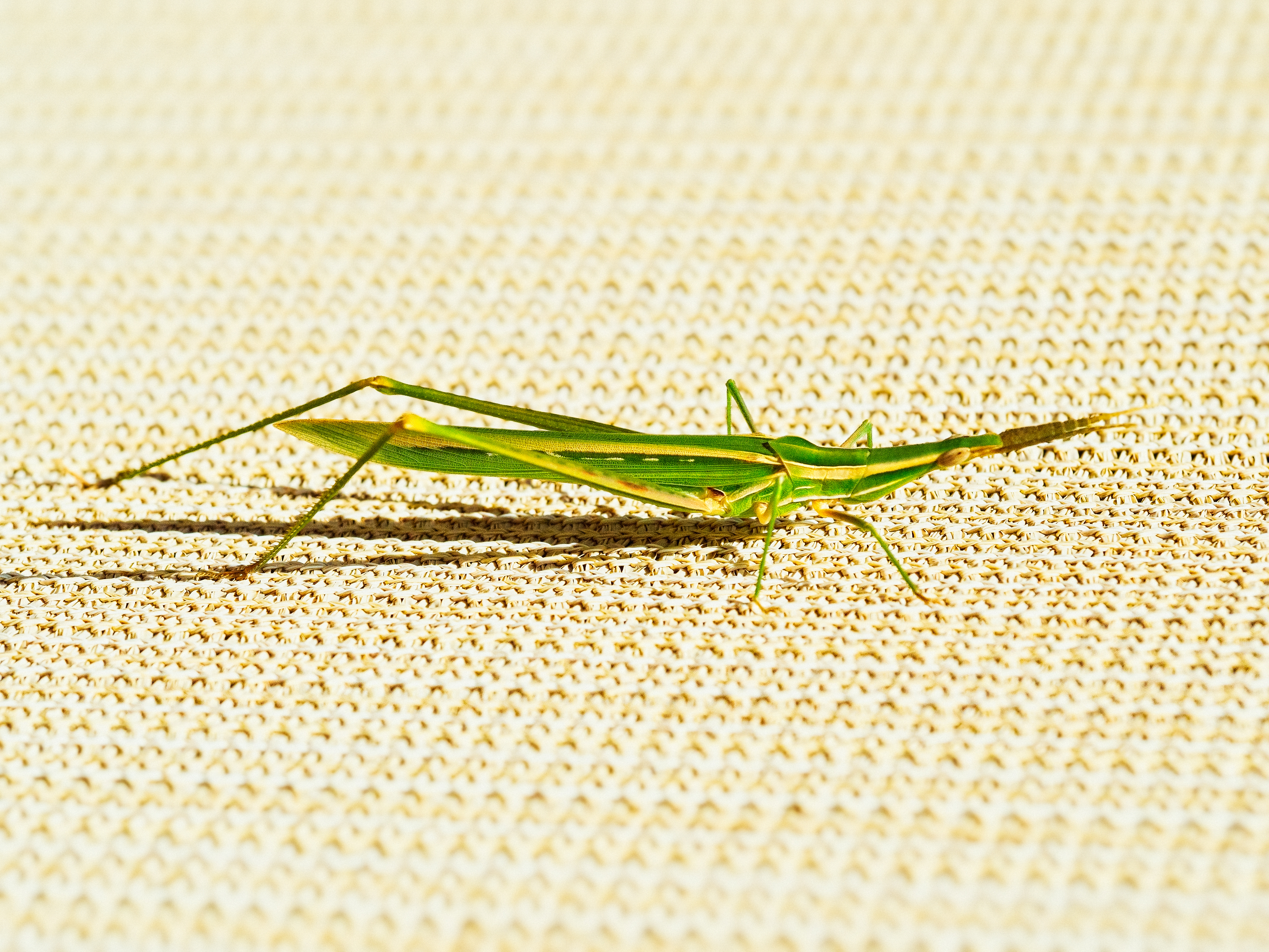
This Giant Green Slantface Grasshopper (Acrida conica) is not what comes to most people’s minds when thinking about wildlife.
The same could be said of this Blackbarred Mantis (Mantis octospilota).
At this stage it is time to think about what you want to photograph. Most people decide to photograph birds as that is what most comes to mind when talking about garden wildlife. I’ve known a couple of people who have decided to photograph in invertebrates they find in their garden. I’ve seen YouTube videos where people have hedgehogs or foxes come to their garden and they’ve gone out to take pictures of them as their main subject. We have resident frogs and bob tailed lizards in the garden and have had goannas and gwardars come visit. I think the neighbours chickens attract them.
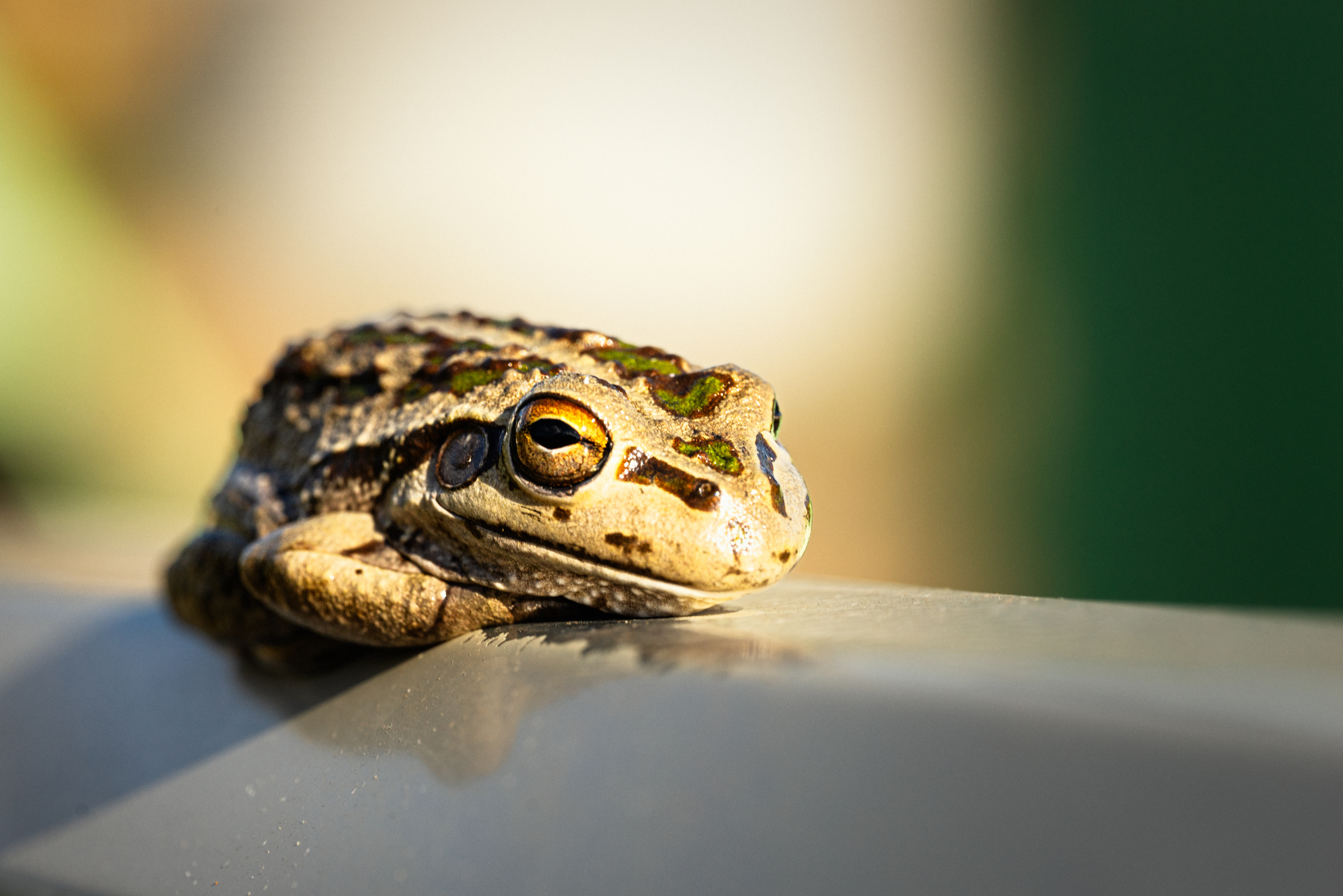
Motor Bike Frog [Litoria moorei (Copland 1957)]. Usually heard rather than seen.
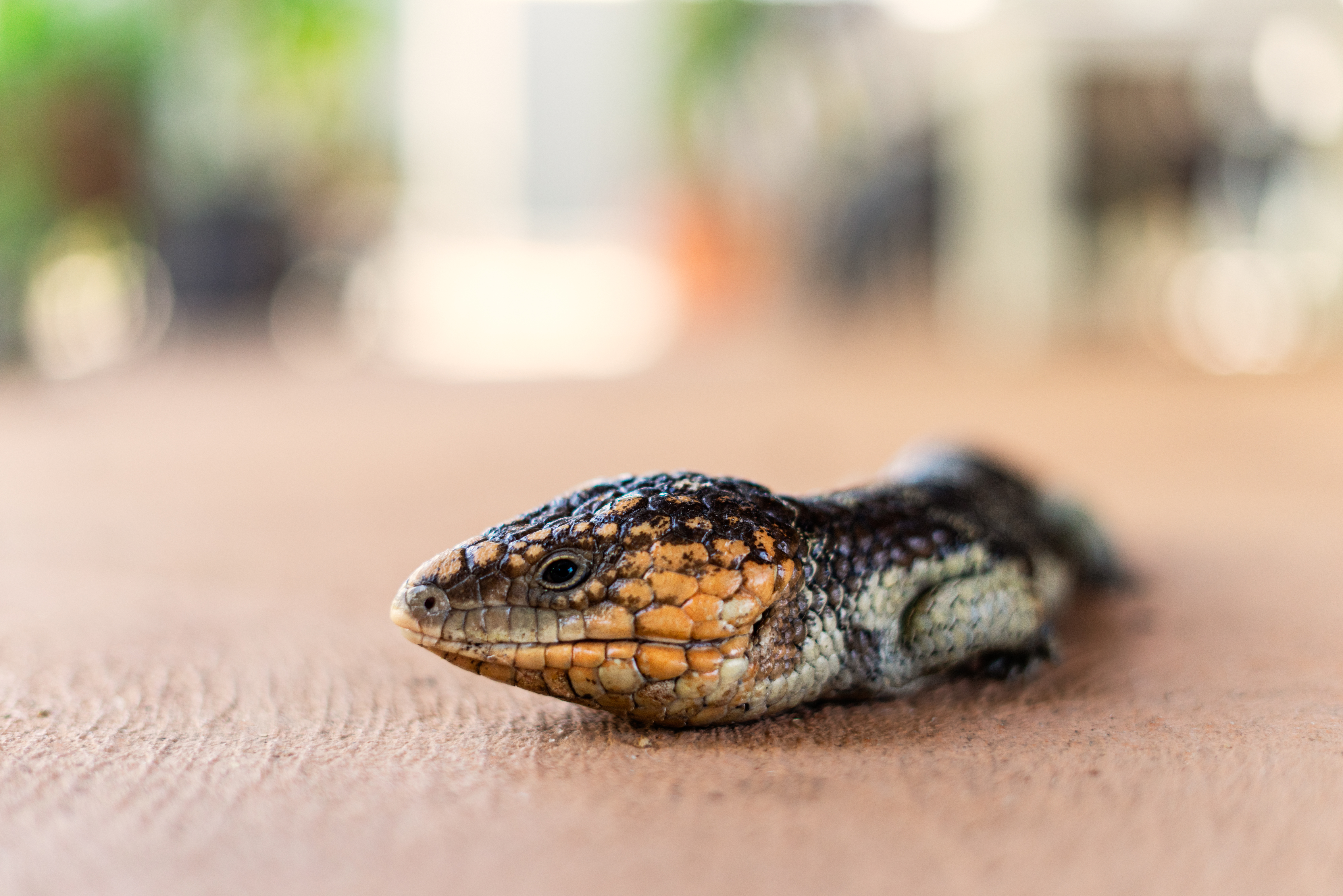
Big Bob the Bob Tailed Lizard (Tiliqua rugosa) on the prowl on the back patio.
My first forays into wildlife photography were in the garden and I think this is one of the best places to start because you have access and can observe what is happening through out the day and all through the seasons. Also if it is your garden to can modify or make alterations to attract more animals. I realise that not everyone has this luxury, but I do believe that with a bit of planning and a small amount of expenditure you can bring in animals. For those who don’t have the privilege then perhaps you have some access to some communal areas or have a friend or relative that would let you use theirs. So what do you need to do do? Well I can’t be very specific as my experience is in the Wheatbelt of Western Australia which is probably very different to where you live. But the basic principal is that all animals need three things. Food, water and shelter. So if can provide those you’ll get wildlife. For more detailed information the following links will help you:-
Inevitably the question of feeding wild birds comes up. Here in Western Australia it is illegal to feed native wildlife, including all native birds, without a license or lawful authority. Having said that around 30-50% of households do. The silly thing is you can walk into just about any supermarket and buy products for that explicit purpose. I suppose if you are going to do this do it so it benefits the animals in the long term. Give appropriate healthy food in small quantities so that they don’t become dependent on human handouts. In Western Australia with our long hot summers the best thing you can provide is water and plant native species that can provide food and shelter. Along with water we just put out seed which attracts Ring Necked Parrots, Galahs, Zebra Finches and laughing doves.
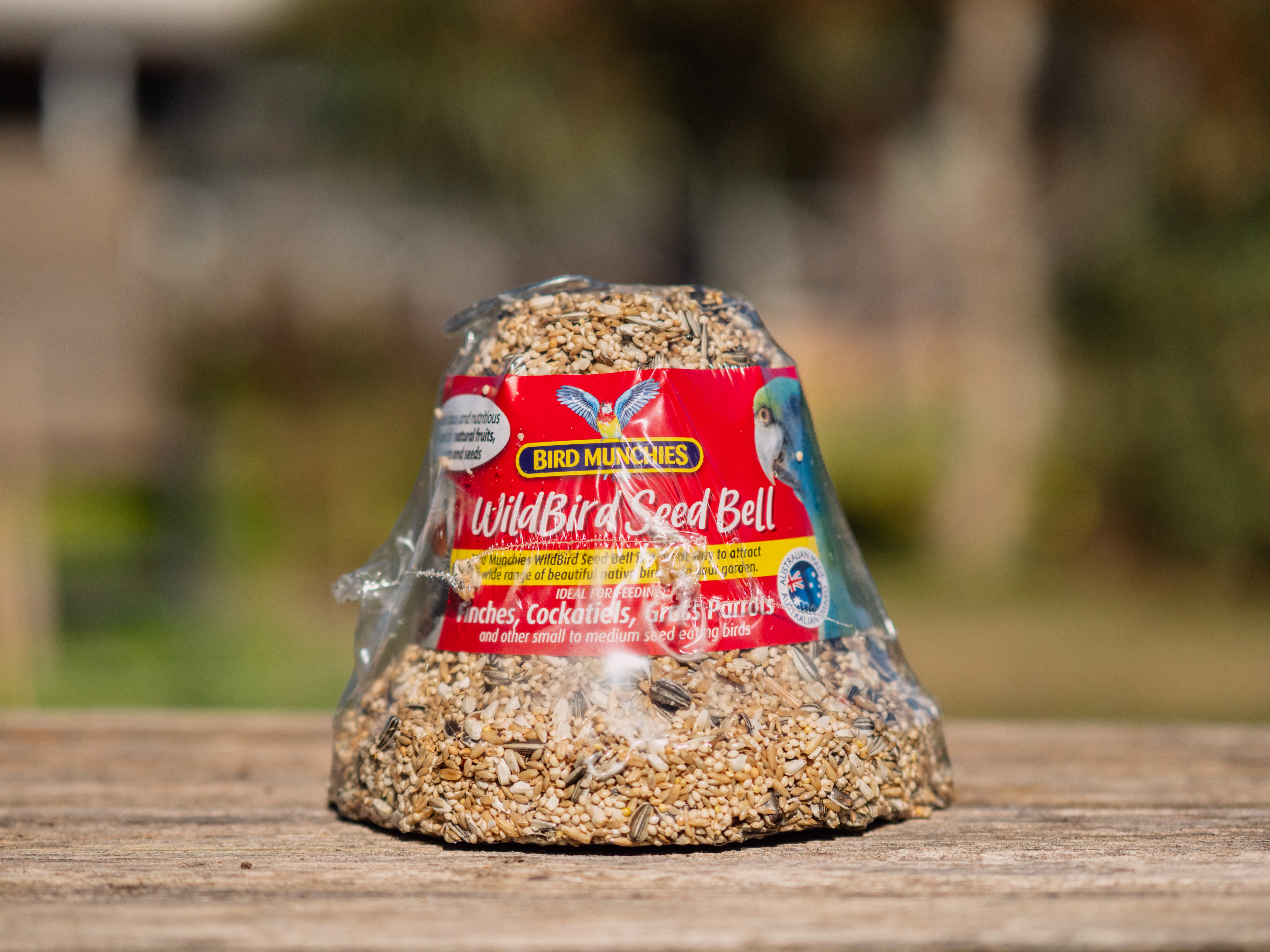
Although it is illegal to feed wildlife in Western Australia our local supermarket does a roaring trade in these seed bells.
Australian Ringneck or Ring-necked Parrot (Barnardius zonarius subspecies semitorquatus) making free use of the seed bell.
Don’t expect instant results. It can take a little time before the local wildlife population realises that you’ve put out food and water. Put the food and water out where there is cover not in the middle of a wide open space. Also think about what you’re trying to attract – it maybe necessary to provide sources at ground level if you want to see things like frogs and lizards.
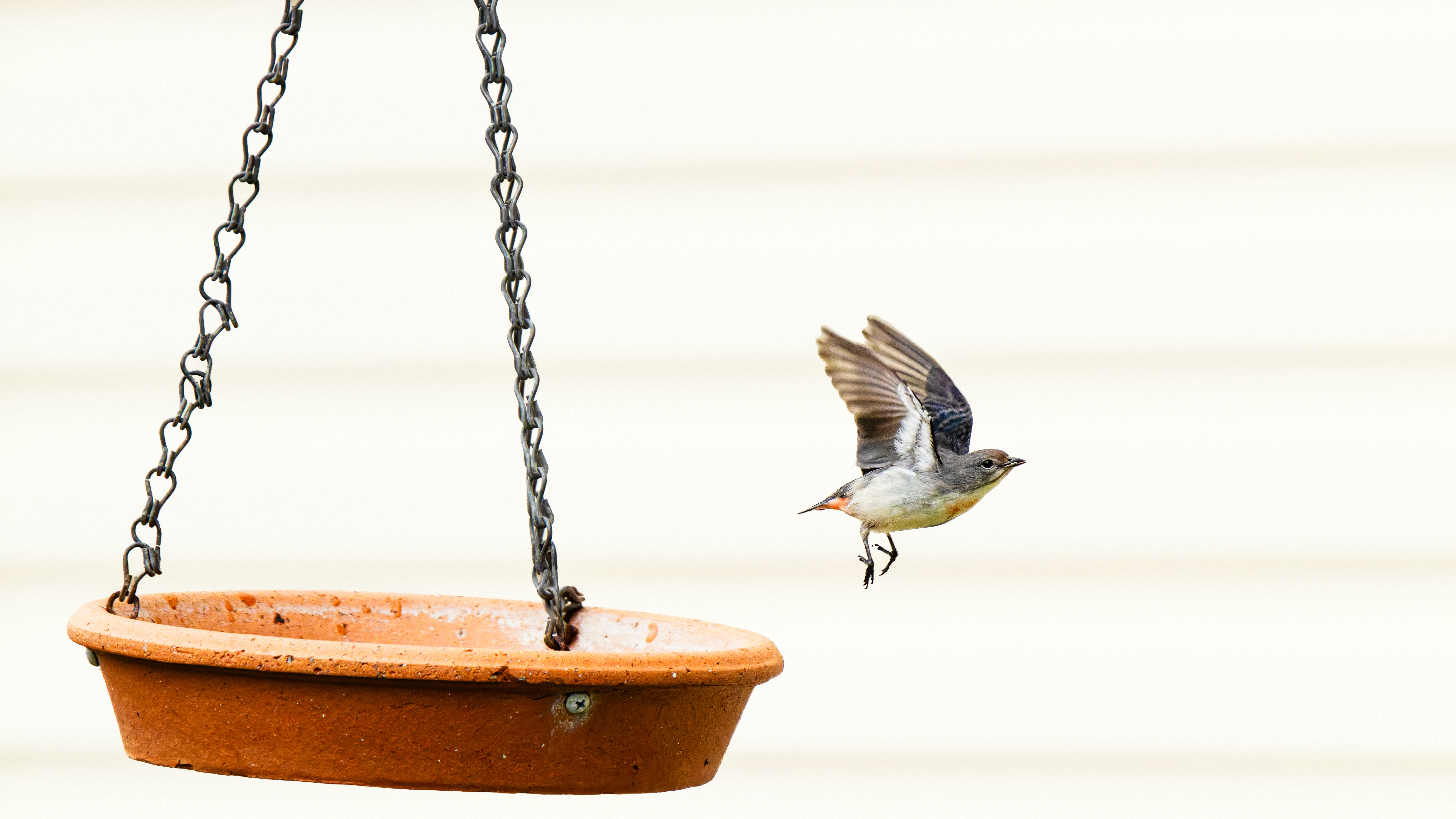
This photo of a Mistletoebird (Dicaeum hirundinaceum) leaving a bird bath was taken using a remote controlled camera.
Now that you’ve managed to attract animals to the garden how do you go about photographing them? Some people build a dedicated hide, other repurpose a shed or use a room in their house that faces onto the garden. Some use trail cameras. I don’t do any of those. I just wait quietly in the garden and photograph what turns up. A lot of the time I notice something interesting while doing something else and will just quietly slip into the house to retrieve my camera which is left permanently set up for birds. Lately I have been using my camera to photograph birds at the bird table and baths. I pre-set the focus and use a small aperture and trigger the camera via remote while I watch from a distance. All this is trial and error. You get a lot of duff photos, but occasionally you strike gold. As you find out what works and doesn’t you experiment with changing position and see how that effects things like the background.
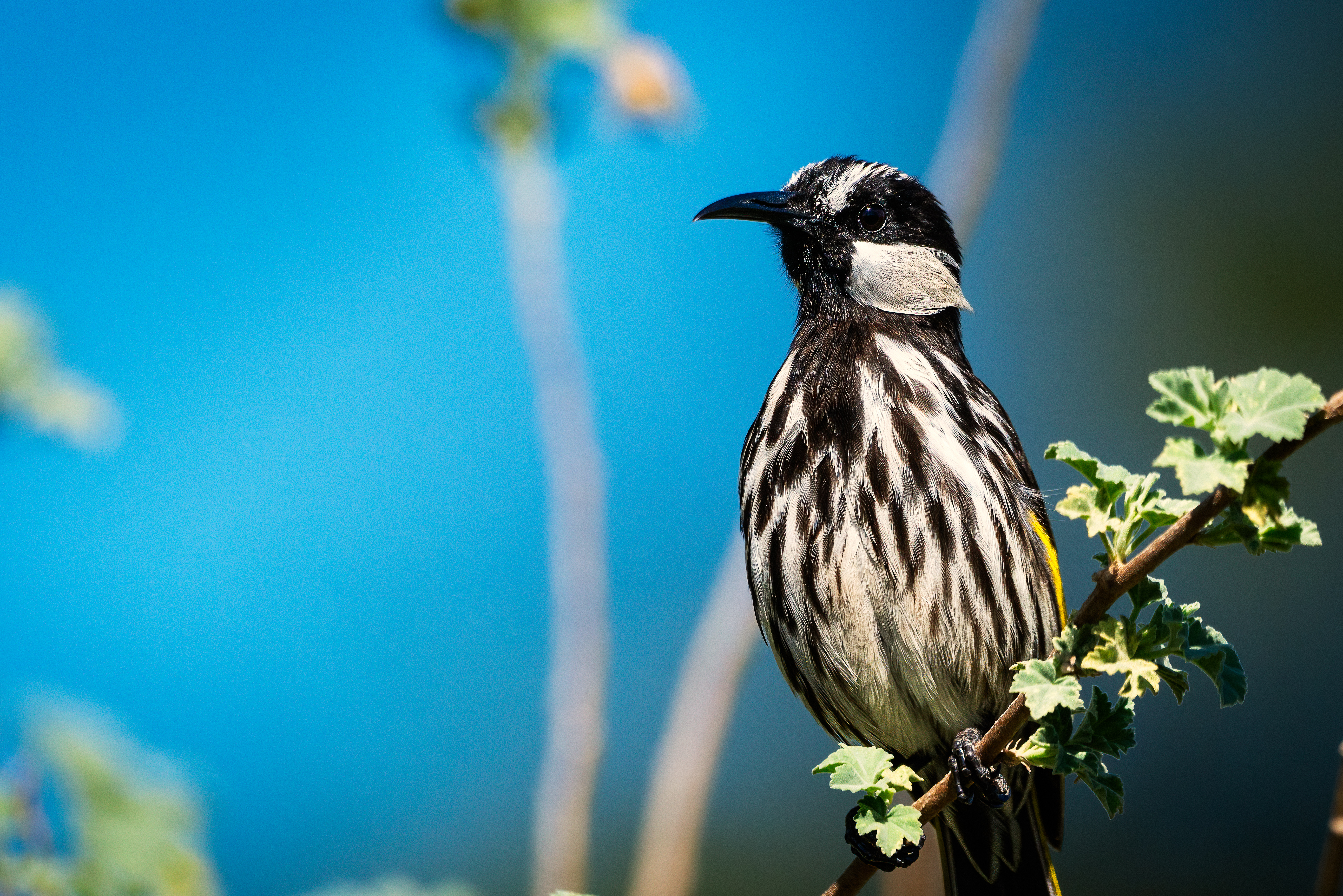
I saw this White-cheeked Honeyeater (Phylidonyris niger) while I was hanging out the washing. Luckily he obligingly stayed put while I got my camera.
I saw this Spiny-cheeked Honeyeater, Acanthagenys rufogularis while I was having a sundowner on the front veranda.
So why do I think the garden is a good place to start wildlife photography? Well it provides a readily available location where you can start to learn about animal behaviour. For example birds like to take off into the wind and many will defecate just before take off so if you see this happen you can time your shots to catch that moment.
If you know enough about bird behaviour photos such as this of a Zebra Finch (Taeniopygia guttata) become easier.
Djindjokoor or Brown Honeyeater (Lichmera indistincta) amongst grey saltbush.
It also gives you opportunity to fine hone your photographic skills. Learn how depth of field works with long and macro lenses. What shutter speeds you need to stop movement. How your cameras AF system works in different lighting conditions. At what level does the ISO have to get too before an image is unusable. This is important because it means that when you do go to a more “exotic” location you’ll have the skills to make the most of it.
The skills honed in my back garden allowed me to capture this photo of an Australian Hobby, Falco longipennis, feeding on a dragonfly at Gantheaume Point in Broome, Western Australia.
Another benefit is that when you need to be on location at dawn you can just fall out of bed and grab a coffee at just the right time rather than get up up a couple of hours before dawn and drive for ages while you’re still half asleep. Or you might be able to grab an hour or so after work.
I hope this helps to give you ideas and inspire you.
The pavillion at the Cairns Chinese Friendship Garden. Cairns Botanic Garden, Queensland.
The Moon Gate in the Cairns Chinese Friendship Garden.
No it’s the the Cairns Chinese Friendship Garden in the Cairns Botanic Garden actually.
Grand View Garden, its layout is based upon the book Dream of a Red Chamber by Cao Xue Qin. The garden reflects the style of the Yongzheng and Qianlong reigns during the Qing dynasty, although they are a modern creation. May 2007. Canon EOS 300d with Canon EF-s 18-55 f3.5-5.6.
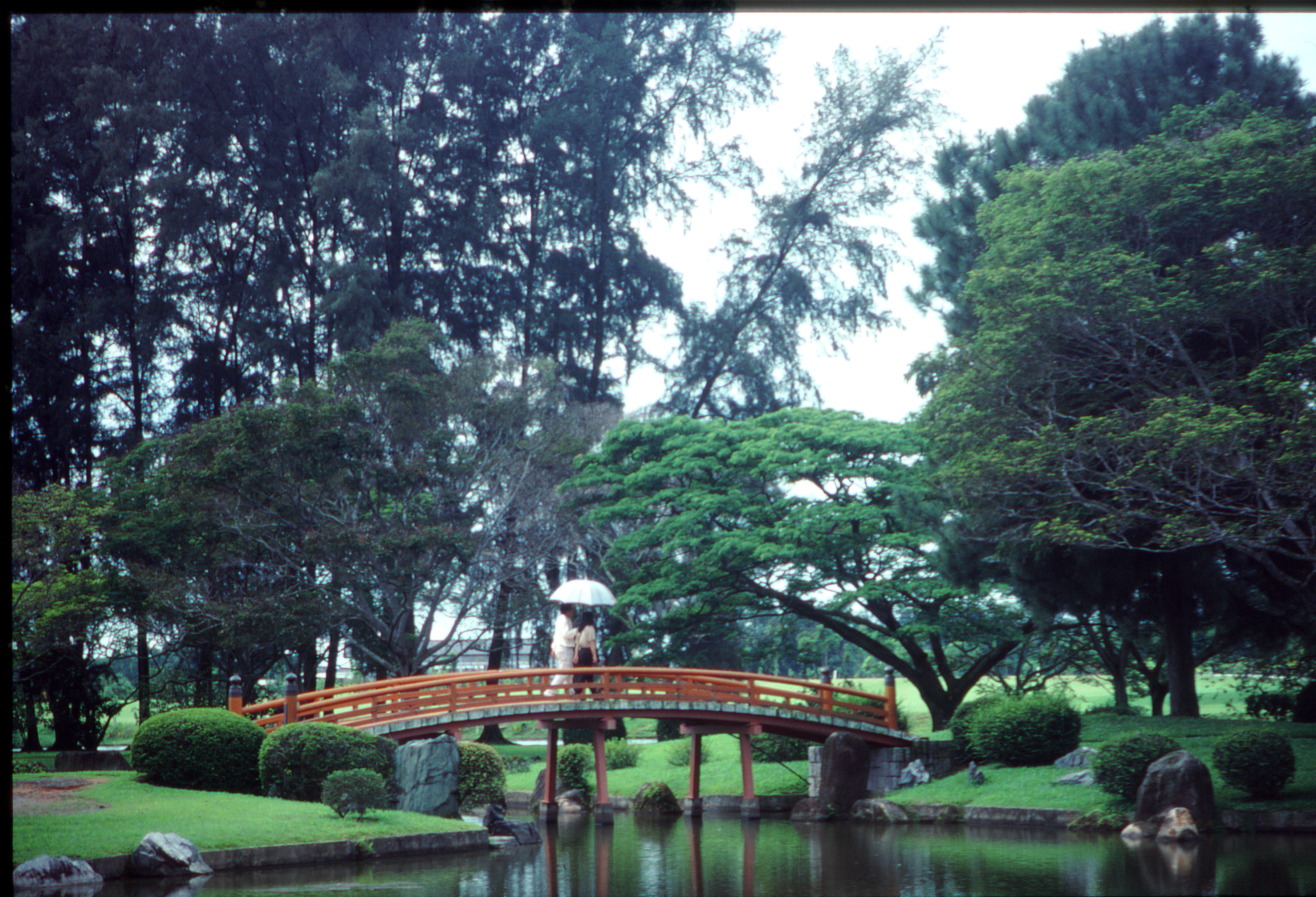
The Japanese Garden in Jurong Lake Gardens, Singapore. February 1994. Olympus OM4 with an Olympus 35-105mm lens on Fuji Velvia. Time has not been kind to the emulsion and the colours have started to shift.
Love a good botanic garden. I’ve been to some quite memorable ones over the years. The Grand View Garden in Beijing, the George Brown Darwin Botanic Gardens, Kings Park in Perth, Jurong Lake Gardens in Singapore, and the gardens and courtyards of the Alhambra in Granada, Spain. The Cairns Botanic Garden has a lot to offer from walking trails to an arts centre to walking tours exploring the animals and plants that are found there.
Yours truly at Jack Barnes Mangrove Boardwalk wondering where all the birds have gone while being feasted upon by mosquitoes. Courtesy of Helen Amyes.
Unfortunately we went to the Jack Barnes Mangrove Boardwalk first thing and that didn’t work out so when we got to the Botanic Gardens it was qute late on in the morning. It was aSaturday and the park was quite busy so there wasn’t as much wildlife around as we had hoped. But, having said that we went and walked the Rainforest Broadwalk and did a turn around the fresh and salt water lakes followed by a visit to the Chinese Friendship Gardens. It’s definitely a place I’d want to visit again should I find myself in Cairns again.
A Great Egret (Ardea alba modesta) having a bad feather moment. Cairns Botanic Garden.
All sorted. Now looking for something to eat.
Australian Brushturkey, Alectura lathami. Cairns Botanic Gardens.
Helen walking around Cattana Wetlands, Queensland.
When you first look at Cattana Wetlands it’s hard to get your head around the fact that it’s only been like this since 2009. The rainforest, the salt and fresh water lakes look like they have been there forever. It’s hard to believe that up to the 1990’s it was a sugar cane farm and up to 2005 there was a sand and gravel quarry there. Now the rehabilitated site has had over 200 bird species recorded, mammals include Sugar-gliders and Striped Possums, and there is the occasional saltwater crocodile. Crocodiles aren’t the largest predator to found in the Cattana Wetlands. That honour goes to the Australian Scrub Python (Simalia kinghorni) which can grow up to 5m long and weigh just short of 30Kg. They’e not poisonous, but I wouldn’t ask one for a cuddle. We didn’t see either pythons or crocodiles when we visited.
The Kingfisher Hide at Cattana Wetlands, Queensland.
“Where are the birds?” the Kingfisher Bird Hide at Cattana Wetlands.
The wetlands is comprised of 80ha of rainforest and five small pools or lakes. Some are freshwater others are saltwater. There are several walking tracks through the reserve which are graded and are accessible to those who have mobility issues. The trails are well signposted and there is a self guided tour that has information boards describing various features. There is a written guide to the tour which is worth reading, but, it is not necessary to have it. We enjoyed it so much that we visited it twice and we saw different things each time. To my mind it’s the best nature experience in Cairns. I’d love to be able to spend a week there just going at dusk and dawn. It’s definitely one of those places where the more hours you put in the more you’ll see.
An Azure Kingfisher (Ceyx azureus) at the aptly named Kingfisher Bird Hide in the Cattana Wetlands, Queensland.
We had some very co-operative visitors this week in the form of 6 Carnaby’s Cockatoos. They arrived in the garden while I was out with young Bertie our puppy. Normally when I dash back to the house and get a camera the birds disappear before I get back. This little group were very relaxed and hung around for ages letting me get quite close to take their picture. When I went to process the photos I thought the black and white birds would benefit from a monochrome treatment.
Carnaby’s Black-cockatoo, (Zanda latirostris). York, Western Australia.
Baron River at Lake Placid Recreation Park in Queensland.
FNQ is not some acronym from yoof culture or some obscure quango, it is the common geographical abbreviation for Far North Queensland, a vast, tropical region in Australia covering over 270,000 square kilometres. Cairns is the gateway hub for the region and that is where we went for our third tropical birding trip. The tropical rainforest and mountainous terrain provide a home for a huge variety of fauna – most of which is not seen anywhere else in the world. Cairns is also the gateway for the Great Barrier Reef which is the world’s largest coral reef system and according to CNN one of the Seven Natural Wonders Of The World. Reefs and fish aren’t our thing we were there primarily for the wildlife that could be seen from dry land.
The Bush Turkey Cafe at the Lake Placid Rainforest Retreat. Queensland.
We elected to stay well away from the tourist strip at the Lake Placid Rainforest Retreat. It was to my mind the best caravan park we’ve ever stayed at. The amenities, the accommodation, the staffand the overall friendliness made for a delightful stay. The icing on the cake was the sheer amount of wildlife at the park. I’d seen animals that I’d never seen before without stepping foot outside of the caravan park. Absolutely bloomin’ brilliant! Here in Western Australia Bush Stone Curlews are quite shy and although I’ve seen them I’ve not managed to get a “good” photograph of one. There were about half a dozen of them wandering around the campsite in the evening and it was possible to get close to them. Then there were the Australian Brushturkeys. They’ve got a face only a mother could love, but they are so full of character. These were wandering around all over the place. If you are interested in butterflies then it would be your idea of heaven. There were so many different types flitting around the bush.
Bush-Stone Curlew, Burhinus grallarius, wandered freely around the caravan park at dusk.
They would get quite close to you allowing good portrait opportunities.
Australian Brushturkey, Alectura lathami. Lake Placid, Queensland.
The Brushturkeys were everywhere.
Blue Tiger, Tirumala hamata. Lake Placid, Queensland.
The magnificent Ulysses Butterfly, Papilio ulysses. Try as I might this was the only half decent photo I managed to get and it doesn’t do it any justice at all.
Chocolate Argus, Junonia hedonia. Lake Placid, Queensland.
Orange Aeroplane, Pantoporia consimilis. Lake Placid,
White-lipped tree frog, Sandyrana infrafrenata, on our bathroom window. Lake Placid Rainforest Retreat, Queensland.
We were already talking of visiting again before the trip had finished.
Paul David Hewson / Adam Clayton / Larry Mullen / Dave Evans, 2000
Lake Leschenaultia on a misty winters morning
My first outing birding since getting back from Cairns. What a contrast. Instead of a nighttime temperature of 20℃ rising to 30℃ and humidity of 75% while walking through tropical rainforest the morning started at 0℃, with frost and mist as I walked through the jarrah forest that rings Lake Leschenaultia. As my dear old mum used to say I had more skins on than an onion. Honestly I looked like Bibendum the Michelin Man.
Kwirlam or Purple Swamphen (Porphyrio porphyrio).
I must say as I parked the car and started walking towards the lake I was a little apprehensive– the conditions were pretty rank and I wasn’t really expecting to find anything much. Sometimes going birding is like an act of faith, you set out early in the morning not knowing whether you’ll find anything. I’ve been out on mornings with much more favourable conditions than this and not seen a sausage. So you can understand my trepidation. It turned out I was worrying needlessly. As I drew closer to the lake I could hear all manner of bird activity. Regular readers may remember that three years ago I spotted a Spotless Crake (Porzana tabuensis) near the boat shed and ever since then I’ve been loitering there every time I visit in the hope of seeing it again to no no avail. I developed a kind of “Crake mania” and started obsessively trying to see one, or its cousin the Spotted Crake (Porzana fluminea). Now I was completely over it. I only paused to quickly take a landscape snap of the conditions and a grab shot of a Purple Swamphen (Porphyrio melanotus) and headed off walking anti clockwise rather than my usual clockwise.
Djer-djer or Splendid Fairy-wren (Malarus splendens subsp splendens).
Blimey the mist was thick and wet, a bit like members of the royal family, and I was glad that in a last minute decision I’d grabbed a waterproof as I left the house as the fog drip was making me pretty wet. As I crossed the dam wall I couldn’t see more than about 5m in front of me. I was quite surprised to see a small flock of Splendid Fairy Wrens (Malurus splendens) foraging on the path. Every now and again one would take a break and sit on the post and rail fence that stops people falling into the water. They were such a delightful sight that I stayed and photographed them for about 30 minutes. They were quite happy to let me get close and they only left when an angry Red Wattlebird (Anthochaera carunculata) chased them off. Carrying on walking I came to to a spot where the reed beds start on this side of the lake. The weak watery winter sun was starting to peak through the cloud and the scene looked so lovely that I stopped to take a photo. I was lapping up the bucolic setting and the warm sunlight when out of the corner of my eye I spotted something rummaging about in the shallow water at the base of the reeds. It was a Spotless Crake feeding on the fringes of the reeds. “Damn and blast!” or words to that effect, I’d altered the settings on my camera to take the landscape shot and now I was fumbling with the dials trying to switch it back again. My gloves weren’t helping matters here. The bird just carried on like it didn’t have a care in the world. I quietly got down onto my knees and fired off frames like there was no tomorrow.
Just a quick snap shot of the sun breaking through the mist.
At the base of those reeds was a Waradja or Spotless Crake (Porzana tabuensis).
For such a notoriously shy and secretive bird it was remarkably chilled about my presence.
After 20 minutes I decided to give the Spotless Crake a break and walked on only to see another two of them. To say that I was completely gobsmacked was a complete understatement. It was turning out to quite a wonderful morning. By now the sun was starting to burn off the morning mist and penetrate the woodland. It was a sublime feeling stopping in a little glade with the warmth of the sun invigorating my body. It made me feel so glad to be alive.
This Kadjinak or Grey Fantail (Rhipidura albiscapa) was flitting about in top of the reed bed while I was taking photos of the Spotless Crake.
Once the mist had burnt off the warm sunlight filtered through the trees.
…to be beside the seaside! I do like to be beside the sea! I do like to stroll along the Prom, Prom, Prom! Where the brass bands play, “Tiddely-om-pom-pom!”
So just let me be beside the seaside! I’ll be beside myself with glee And there’s lots of girls beside, I should like to be beside, Beside the seaside, Beside the sea!”
by
John H. Glover-Kind 1907
Cairns Esplanade is a sight to behold early in the morning. It seemed like the whole of Cairns is there clad in lycra leggings, shorts, and vests exercising in every conceivable form. I immediately felt slovenly, ill disciplined, and over dressed. It definitely felt as if this was an odd place to be looking for birds and I did feel surprisingly self conscious. But, having said that, the seafront at Cairns is not some luxurious tropical palm fringed sandy beach, but a mudflat with mangroves at the northern end and that means birds. Lots of birds. So many birds that Sue Taylor in her book “The 100 Best Birdwatching Sites In Australia” rates it as her number three destination. So that is what drew us to the Esplanade.
Cairns Esplanade, Queensland.
It is Australia.
As I settled in to get some photos a woman sidled up to me and said “You’re not from here are you? I know all the birders here and you’re not local. Where are you from?”. I politely told her I was from Western Australia and was over on a birding holiday thinking I could gain some valuable local information. “Oh I went to Western Australia once. There was nothing there.” At this point I could sense that the conversation was already starting to take a strange turn. She carried on. “You’re wasting your time coming here. They’ve all gone. There’s nothing left. Nothing to see.” I’d just seen 4 species I’d never seen before and told her so. “There’s no point,” she replied, “the light is too bad it makes it pointless to take photos.” . At this point I quietly and quickly moved in the general direction of away.
Apparently the light was so bad it was a waste of time trying to take photos of birds that weren’t there. Bar-tailed Godwit, Limosa lapponica.
A different species of non-existent birds – Great Knot, Calidris tenuirostris.
Masked Lapwing, Vanellus miles.
In hindsight Moaning Minnie was sort of right about the light. The rising sun meant that the birds were strongly backlit, but I never subscribed to the old school photographic technique of having the sun at your back. I’ve always liked contre-jour lighting and as long as you know how to meter and avoid lens flare there’s nothing to worry about. What was bothering me more was that I couldn’t get at eye level with the birds as the Esplanade was about 1m above the mud. The obvious answer to this was to get out onto the mud and lie down, but this is Australia and the mudflats were perfect for saltwater crocodiles and there were signs warning about their presence everywhere. Not wanting to be breakfast for a large ravenous reptile I decided to stay on the Esplanade.
Striated Heron, Butorides striata.
Nankeen Night Heron, Nycticorax caledonicus.
As I walked along the Esplanade I kept seeing this small brown bird flitting between the trees. I thought it was vaguely familiar but couldn’t place it in context. It was only when I looked at a photo of it I realised that I had see it before as it was a House Sparrow (Passer domesticus), another animal that some homesick Brit introduced circa 1870 thinking it was a good idea. Like all these events it was disastrous and the birds soon became a major pest and colonised the whole of Eastern Australia. Another introduced species that could be seen in great numbers was the Common Myna (Acridotheres tristis). It was introduced about the same time as the House Sparrow to control pests, and particularly in the case of Northern Queensland, plague locusts and cane beetles, but they bred prolifically and soon became another introduced pest on the eastern seaboard. It’s not everywhere you can witness two ecological disasters within 2 minutes. It wasn’t all bad news though we saw loads of different birds and 4 completely new species – Bar-tailed Godwits, White-breasted Swallows, Great Knots, and Striated Herons.
White-breasted Woodswallow, Artamus leucorynchus.
Common Myna, Acridotheres tristis.
House Sparrow, Passer domesticus.
While walking back to the car I was amazed by the Nankeen Night Herons. We have them here in York so they are not new to me, and are actually one of my favourite birds. What was so surprising was how chilled they were around people. Here in York a mere glimpse of a person will put them to flight. On the Cairns Esplanade they were walking along the walkway amongst the people. We sat down to have morning tea by a BBQ and one came up looking for food. It was so close that to photograph it I had to use my compact camera as my other camera’s lens was too long.
All up a good haul for the morning and a great start to the trip.
A Nankeen Night Heron hoping to score a free meal from the BBQ. Cairns Esplanade, Queensland.
This Nankeen Night Heron was literally at my feet forcing me to use my compact camera to take a photo of it.
The other day the Beloved Significant Other (BSO) came home from the local cemetery saying she’d seen lots of crows there with some even sitting on the grave stones. She suggested we go the next morning and try and get some suitably gothic photos.
Australian crows (Corvus coronoides) are not in fact crows, but are in fact ravens. They are highly intelligent birds using tools to help feed themselves, they’ve also been observed softening dried out hard food in water to make it soft enough to eat. As I said, very clever. For the local Nyoongar people the raven is called Waardong – the watcher – and is seen as crafty, cunning and very unpredictable. That is where our plan failed. There was no way we going to get close enough to get a photo. I approached using cover and while just trying to peek around the corner of a wall they’d immediately see me and all take off. I didn’t manage to get one single photo of a raven.
Try as I might this Wardawort or Grey Butcherbird (Cracticus torquatus) just didn’t look gothic enough. York Cemetrey, Western Australia.
There were other birds at the cemetery and I thought that one of them – Wardawort or the Grey Butcherbird (Cracticus torquatus) – would make a suitable replacement for a raven. The Grey butcherbirds were far more approachable than the ravens and it was possible to get quite close which was great for taking photos. The problem was that they didn’t want to sit on top of the grave stones but rather they perched on the wrought iron work that surrounded some of the graves. I still took some pictures but they didn’t match what I’d envisioned – reality seldom does. Getting home I tried processing the the photos as black and white trying to give a suitably dark menacing tone. It just didn’t work. The Grey Butcherbirds didn’t have that spooky/menacing appearance that the ravens have. I also thought that the colour photos looked better, but they did not convey that gothic vibe I was trying to create.
The colour versions just looked better albeit just not spooky enough.
It was a fun exercise. We did talk about how we might get the ravens to hang around. The most logical way would be to put down food for them on a regular basis and so change their behaviour. The ethics of that are a bit suss – get animals habituated to humans and dependent on hand outs just for a photo. Bit dodgy that one. We feed and water birds in our garden, but this is different. It is not our garden and the ravens are naturally wary of people. The birds in our garden are already habituated to us. We didn’t have to put out any food to encourage that. The only other way is to just keep going back over and over again. Who knows we may chance upon a raven that isn’t too fussed about people who is sitting on top of a grave stone and using it as an anvil so they open up snail shells. Preferably on a misty morning. I rather think that pigs might fly first.














You must be logged in to post a comment.