
To The Point


That would be Gantheaume Point which is 6Km from Broome’s town centre. To get the most out of a visit you need a sunny day and a very low tide. The sunny day means that the incredible red rocks are sharply contrasted with the blue sky and aquamarine sea. It is quite stunning. The very low tide means that dinosaur footprints from the Early Cretaceous can be seen. When we visited we had the sunny day, but, the tide was well and truly in.


Danger! by Paul Amyes on 500px.com
Danger! Killer Rubber Ducks.


As I said previously we were visiting at the tail end of the wet season – think tropical storms that dump an incredible amount of water. So as we drove the final leg down to the car park along a dirt road we encountered some huge puddles. Like really big – so big that one of them had waves created by the off shore wind. At the car park we were met by a sign warning us of the dangers that were present. I could understand the one about unstable cliffs that could collapse, the one about deep holes that the unwary could fall into, but the one warning about the giant rubber ducks that pushed people off the cliffs was a bit of a mystery. Thankfully while we were there we did not see the rubber ducks and so felt quite safe.


Lighthouse by Paul Amyes on 500px.com
The lighthouse at Gantheaume Point, Broome Western Australia.


Eastern Osprey Nest by Paul Amyes on 500px.com
Halfway up the lighthouse was an Eastern Osprey nest.


Eastern Osprey by Paul Amyes on 500px.com
Just below the nest was an Eastern Osprey, Pandion cristatus subs leucocephalus) eating a fresh fish. Gantheaume Point, Broome Western Australia.


Eastern Osprey by Paul Amyes on 500px.com
Eastern Osprey, Pandion cristatus subs leucocephalus) eating a fresh fish whilst perched on the Gantheaume Point lighthouse.


Walking from the car park you see the old lighthouse keeper’s house and the lighthouse itself. About halfway up the lighthouse we could see the massive pile of sticks that is an Eastern Osprey’s nest and below that was an Osprey chowing down on a big fish. Now the Eastern Osprey is quite a big bird of prey, but every couple of minutes it paused eating to scan the environment for threats. Birds such as Australian Ravens and Masked Lapwings will attack them and drive them off, but it was also probably keeping an eye open for other birds of prey that would try and steal the fish.


Wandering Glider by Paul Amyes on 500px.com
Everywhere we went there were thousands of dragonflies. Wandering Glider Dragonfly (Pantala flavescens). Broome South Wastewater Treatment Plant, Broome, Western Australia.


According to the Indigenous Yawuru people the wet season, Man-gala, draws to a close and the next season, Marrul, starts and one of the markers for that change are the appearance of dragonflies. Thousands upon thousands of them. They were everywhere we went. I’ve never seen so many it was absolutely incredible. Gantheaume Point was no exception, heaps of them everywhere. A lot of smaller birds of prey feed on the large insects and there were a couple of Australian Hobby, which are a variety of small falcon, doing precisely that. They put on an incredibly acrobatic display darting in and out of the rocks chasing down their prey. They didn’t even bother to land when they caught one preferring to eat it in flight. It was simply sublime watching them.


Australian Hobby by Paul Amyes on 500px.com
Australian Hobby, Falco longipennis, feeding on a dragonfly. Gantheaume Point, Broome Western Australia.


By now we were absolutely drenched in sweat. The temperature and the humidity had taken its toll so we headed back to the car looking forward to the relief provided by air conditioning.


Exploring by Paul Amyes on 500px.com
The scenery was pretty impressive too. Helen exploring the rocks at Gantheaume Point, Broome Western Australia.


A Raucous Dawn Chorus

As summer draws to a close dawn comes round a little later meaning that I don’t need to get up early. It gives an opportunity to enjoy a leisurely cup of that all important morning coffee and head out.


A New Morning by Paul Amyes on 500px.com
Wayan or White-faced Heron (Egretta novaehollandiae) greets the new morning. York, Western Australia.


Once down at the river I’m met with sight of the sun just peaking through the clouds and it was a joy to behold. Then the moment is shattered as several hundred Little Corellas take to the air in a whirling squawking mass. Successive waves of birds fly over me each one noisier than the one that preceded it. It was an incredibly intense experience. Eventually the birds all decided to settle in the gum trees along this section of the river bank. Physically they may have settled but their incessant squawking didn’t stop. I was transfixed. I didn’t bother continuing along the river bank I just stayed and watched and photographed. 


Playing Around by Paul Amyes on 500px.com
As the sunrises the Manatj or Little Corellas (Cacatua sanguinea) start to become active.


Manatj by Paul Amyes on 500px.com
Then as the sun rises over the horizon the Little Corellas take to the air en masse.


Manatj by Paul Amyes on 500px.com
Eventually they begin to settle in the trees.


Manatj by Paul Amyes on 500px.com
Some continue to cry out.


I
While others are content to perch quietly.


Patience Is A Virtue…

Virtue is a grace.

Grace is a little girl

who would not wash her face..

From “Lady Daisy” by Dick King-Smith

When you start wildlife photography it is very easy to get disappointed. You see all these marvellous photos other people put up on social media and you are left wondering why your photos are not as good. Usually people put it down to not having the best gear – if only I had that 800mm F5.6 lens – maybe if they had better photographic technique or access to exotic animals in exotic locations the photos would be better. Photographic technique is easily learnt, you don’t need expensive equipment and nor do you need to travel to exotic locations. I think patience is very important and that is something we can all develop.


Koordji-koordji by Paul Amyes on 500px.com
Koordji-koordji or Australian Reed Warbler (Acrocephalus australis subspecies gouldi). Lake Leschenaultia, Chidlow, Western Australia.


Koordji-koordji by Paul Amyes on 500px.com
Breakfast.


The other morning I was at Lake Leschenaultia. The previous day there had been the tail end of cyclone coming down the coast which brought rain and strong winds. The rain had passed, but, there was still quite a bit of wind about. As I got down to the lake I could see it was choppy and there were no waterfowl about and there was nothing much happening in the trees. I could have given up and gone home, but I know from experience that there are a few sheltered spots to be found as you walk round the lake so I set off for them. The first couple yielded nothing, the third was alive with the sound of Australian Reed Warblers, Splendid Fairy Wrens, Silvereyes and Inland Thornbills. They were feeding on the insects found amongst the reeds. There was no way I could quietly approach – the forest floor down to the lake was covered in dry leaves and bark. It is like walking over corn flakes – very crunchy and noisy. Even if I could get down there quietly suddenly appearing out of the tree cover would put everything to flight. Nevertheless I made my way into the dry portion of the reed bed and as expected everything cleared off. Now this is the point where it was tempting to think that’s it and move on. However, I knew that the food source won’t have moved and the birds were hungry. I also know that these particular birds are quite tolerant to people if you are quiet and don’t move around much so all I had to do was wait. I’ll admit it was hard – the mosquitoes were ferocious – but after 20 minutes or so the birds came back. In that time I positioned myself to ensure I had a good background and if the birds wanted to take off they would have to fly towards me. All these birds are incredibly quick, but the knack is observing how they move through the reeds and where they like to perch when having a breather. Pre-focus on one of those spots as it will give your cameras AF system a good chance of locking on to the bird. Then it was a case of being patient and waiting until they came close to me and taking the photo. Forty minutes later and it was all over. The birds had moved onto another spot which was too inaccessible for me to follow.


Doolor by Paul Amyes on 500px.com
Doolor or Silvereye (Zosterops lateralis). Lake Leschenaultia, Chidlow, Western Australia.


Doolor by Paul Amyes on 500px.com
Having a closer look at me.

A Over T

If you are a regular reader you may recall that I recently wrote about having one of those magical days where everything goes right. Well yesterday was the anthesis of that.


Noolarko by Paul Amyes on 500px.com
Noolarko or Black-faced Cuckoo Shrike (Coracina novaehollandiae) waiting for the clouds to break and the first rays of the sun to light up the day.


We had decided to get up early and walk along the River Avon here in York, so come 5am I bounced out of bed (Haha! As if!) and quickly got dressed. As I quickly had a coffee and piece of toast the rain began to fall. It was one of those summer downpours with big fat lazy raindrops that hit the parched dirt and release that wonderful petrichor. These downpours don’t generally last long and this one was no different so we headed out. On arriving at the river it was quiet, very quiet. In fact unnervingly quite. A complete absence of bird sound apart from a rooster making it’s presence known, but, that doesn’t count. It’s very unusual to be out at dawn and not hear birds singing. I thought normal activity would be resumed when the sun broke through the clouds so we carried on walking. A pair of Black-faced Cuckoo Shrikes perched high up in a dead tree gave me something to point my camera at. Not thrilling photos but a start nonetheless. A bit further on and the clouds had now cleared and we were greeted by a brilliant cobalt blue sky and a steady procession of Galahs flying in formation. I managed to get some photos of them. I’d wanted for ages to get a shot of Galahs flying against a back drop of a brilliant blue sky – the contrast of their pink feathers and the blue. Doing something I never normally do I looked at the rear of the camera and when I saw the sequence of photos  I could see that I had achieved that goal. I was at this point feeling rather pleased with myself. The Bible warns us that “Pride comes before a fall” (Proverbs 16:18) and little did I realise that I was about to become literally acquainted with it.


Djakal-ngakal by Paul Amyes on 500px.com
Djakal-ngakal or Galah (Cacatua roseicapilla) fly past.


Turning round we walked back the way we had come and then onto a spot where we could access the river bed. As we broke cover from the bushes we set what seemed like every duck in York flying. Whoops! Then I had this urge to see what if anything was around the corner. When suddenly it happened. You know how people often say that when something catastrophic happens time slows down and everything happens in slow motion? Well that didn’t happen. One minute I’m vertical the next bang and I’m prostrate in the mud with incredible pain shooting up my arm and from my hip. Necessity meant that I just lay still for a bit to see if the pain subsided. I quickly realised at this point that I wasn’t seriously hurt because I was more concerned that my camera had survived the cataclysm than about any injuries I’d sustained. I also became aware of the beloved significant other calling out. She had tried to get over to me but hadn’t got very far as she didn’t want to befall the same fate. Gingerly I got onto all fours and crawled to a firmer spot and got up. I was covered from head to toe in evil smelling river mud – my camera wasn’t much better.
 

After a dramatic fall while out birding this morning the Olympus EM1x and OM System 100-400mm look a little worse for wear.


Sitting here writing this my camera and I have scrubbed up well. It works perfectly – a testament to ruggedness of Olympus cameras. Me – I’m a bit sore, but there is no major damage.

Note to self: don’t go walking along the river bed just after it has rained – it is very slippy.

Chance…

… favours the prepared mind.”  Louis Pasteur, December 7, 1854, and in 161BC the Roman playwright Terrance said that “fortune favours the brave” in his play Phormio.


All of which basically means that if you have the necessary mind set be bold enough to seize the opportunities that present themselves. That is what happened the other evening. We had found a new possible nesting site for Rainbow Bee-eaters here in York and the beloved significant other suggested we go and have a closer look the other evening. So I picked up my Sony A7r2 with Sigma 150-600mm lens and we drove down to the location. On getting there there was not a Rainbow Bee-eater to be seen. In fact there weren’t many birds about at all. Scanning the tree tops we soon found out why. In the top of a dead tree were a pair of Australian Hobbys. These beautiful birds of prey will take small flying birds so everything had taken cover. The Hobbys looked magnificent against the bright blue sky. I only managed a short burst before they resumed flying up and down the river bank looking for something to eat.


Wowoo by Paul Amyes on 500px.com
Wowoo or Australian Hobby (Falco longipennis) are often seen in pairs whilst out hunting.


The adapted Sigma 150-600mm doesn’t focus very fast on the Sony A7r2 and the 5 frames per second burst rate isn’t exactly the best, but, it was all good enough for the task in hand.

One Of Those Days

The other day was was one of those days. Not the sort where everything goes mammaries up and you wish you hadn’t got out of bed. No it was one of those days when everything goes stupendously well – like unbelievably well. The other day was just one of those.


Bulland by Paul Amyes on 500px.com
Bulland or Little Egret (Egretta garzetta subsp. nigripes)


Bulland by Paul Amyes on 500px.com
Bulland or Little Egret (Egretta garzetta subsp. nigripes) are quite rare up in the Avon Valley although they are common elsewhere.


I was walking along the River Avon in Northam and it was proving to be a fruitful morning. Black-fronted Dotterels, Black-winged Stilts, Dusky Moorhens, and even a rare (well rare in these parts) Little Egret. After a couple of hours of sheer bliss I decided to call it a day and walk back to the car. As I was walking I thought to myself “You know what would cap off a perfect day? A Sacred Kingfisher.” And lo and behold within seconds of thinking that thought one appeared on a branch right in front of me. The best part was it could clearly see me and didn’t give a stuff. I was in raptures! It was hunting for large insects in the grass and every few minutes it would swoop down catch one and return to the branch and eat it. This kept going on for twenty minutes or so. In the end I called it quits after taking hundreds of photos and it stayed there. A brilliant finale to a brilliant day.


Nidoolyorong by Paul Amyes on 500px.com
A gratuitous shot of a Nidoolyorong or Black-fronted Dotterel (Elseyornis melanops).


Djandjarak by Paul Amyes on 500px.com
This Djandjarak or Black-winged Stilt (Himantopus himantopus) was too busy looking for food to bother about me.


Kanyinak by Paul Amyes on 500px.com
The icing on the proverbial cake. Kanyinak or Sacred Kingfisher (Todiramphus sanctus). Isn’t he magnificent?


Kanyinak by Paul Amyes on 500px.com
Having a bug for breakfast.


Kanyinak by Paul Amyes on 500px.com
Having a laugh.

The last few of weeks I’ve been observing some very interesting bird behaviour (well interesting to me) and I’ve found trying to record it just using photographs wasn’t capturing what was happening. So I’ve decided to shoot more video footage. Up until now I’ve found doing both photography and video very difficult. That’s because I was taught in order to shoot video well you had to have your camera on a tripod, limit your shutter speed to twice that of the frames per second which means faffing around with neutral density filters, use manual focus, take an accurate colour temperature reading and set the camera accordingly, and record good sound. All that takes the spontaneity out of it. If an animal pops up suddenly I like to be able to react in an instant and with stills photography you do that. Video requires (or so I thought) so much preparation that the animal has been and gone. So I came to the conclusion that I only do this for my entertainment so it doesn’t matter if I break “the rules”. So I set my camera up to shoot in programme mode, set auto white balance, auto ISO, I use the camera’s built in microphone for sound, and auto focus. I’m not carrying a tripod so I’m shooting handheld. If I see something interesting I snap off a few photos and then press the video record button. This approach has added a new dimension to my photography and I’ve been very happy with the results so far. Below are a few clips from my brilliant day in Northam. 


Has anyone else added video to their photography?

Ambling In The Evening

We’d travelled into Perth to see The Choral (well recommended) and were staying over for the night. The hot summer air was oppressive and it seemed that a walk around a body of water to make the most of the cool breeze coming off it seemed like a good idea. Tomato Lake was close to where we were staying and so we went there. There’s nothing like a slow relaxed walk in the evening while watching things going on around you. As we pulled up in the car park it was very apparent that lots of other people had the same idea – families were either set up on picnic blankets or walking around the lake foreshore looking to get some relief from the hot summer sun. It reminded us of being in countries in the Mediterranean, the Middle East and the Indian Subcontinent where people promenade in the evenings.  I’ve never really understood why in a hot country like Australia that our pattern of the day is based upon those in cool northern countries. 

As we pulled up there was raucous honking coming from the island in the middle of the lake. There were dozens of Australian White Ibis and their young were nosily demanding food. Added to that was the grating screeching of Little Corellas looking for a place to roost for the night. Further back from the lake amongst the larger trees Red Wattle Birds were jockeying for the prime locations for the night. They are very combative chasing off other birds with their loud and conspicuous squawking. Meanwhile back on the lake Black Swans and Australian Grebes glided silently and gracefully through the duck weed while feeding. It was all very idyllic.


Ngalkaning by Paul Amyes on 500px.com
Ngalkaning or Australian White Ibis (Threskioris molucca). Tomato Lake Reserve, Kewdale, Western Australia.


Ngalkaning by Paul Amyes on 500px.com
A juvenile Australian White Ibis pestering its parent for food.


Little Corella by Paul Amyes on 500px.com
Little Corella or (Cacatua sanguinea subsp. westralensis).


Little Corella by Paul Amyes on 500px.com
Getting ready to settle in for the night.


Djangkang by Paul Amyes on 500px.com
Having chased off the other birds this Djangkang or Red Wattlebird (Anthochaera carunculata) is getting ready to roost.


Bulland by Paul Amyes on 500px.com
This Bulland or Great Egret (Ardea alba) flies lazily over the lake.


Maali by Paul Amyes on 500px.com
Maali or Black Swan (Cygnus atratus) effortlessly swimming in the lake.


Feed Me!

At this stage in summer most of the birds are busy feeding their young, with the majority about to fledge soon. The constant foraging for food and hunting must be exhausting for the parents especially in the 40ºC + days we’ve been having lately. Over the last couple of weeks I’ve stumbled across a few nests with demanding offspring and I’ve observed a range of different behaviours designed to get food from a parent.


Kanamit by Paul Amyes on 500px.com
Hungry Kanamit or Welcome Swallow (Hirundo neoxxena) chicks demanding to be fed. Avon Terrace, York, Western Australia.


Kanamit by Paul Amyes on 500px.com
The food arrives.


Kanamit by Paul Amyes on 500px.com
The two larger chicks get fed while the little one at the end misses out.


On Avon Terrace, the main drag in York, a lot of the shop fronts have Welcome Swallow nests tucked away in the shade of the verandas. Most people walk along the street under them not even aware of what is happening above them. I spent an hour watching this particular nest. The adults returned every five minutes or so with food for the three chicks. Two chicks got the bulk of the food as is often the case in birds. I don’t know if the little runt of the brood managed to survive until fledging or not.


Kaaka-baaka by Paul Amyes on 500px.com
Kaaka-baaka or Yellow-billed Spoonbill (Platalea flavipes) adolescent demanding food from its parent.


Yellow-billed Spoonbills
Click to play the video clip.


In Northam, on the banks of the River Avon, I witnessed something I’d never seen before. There were two Yellow-billed Spoonbills in a tree, one a mature adult and the other an adolescent. The adolescent was trying hard to get the parent to regurgitate some food and it did this by first bobbing its head vigorously while flapping its wings. After a while of this it would then start rubbing the parent on the side of its head. The photos don’t do it justice, the video is better.


Djidi-djidi by Paul Amyes on 500px.com
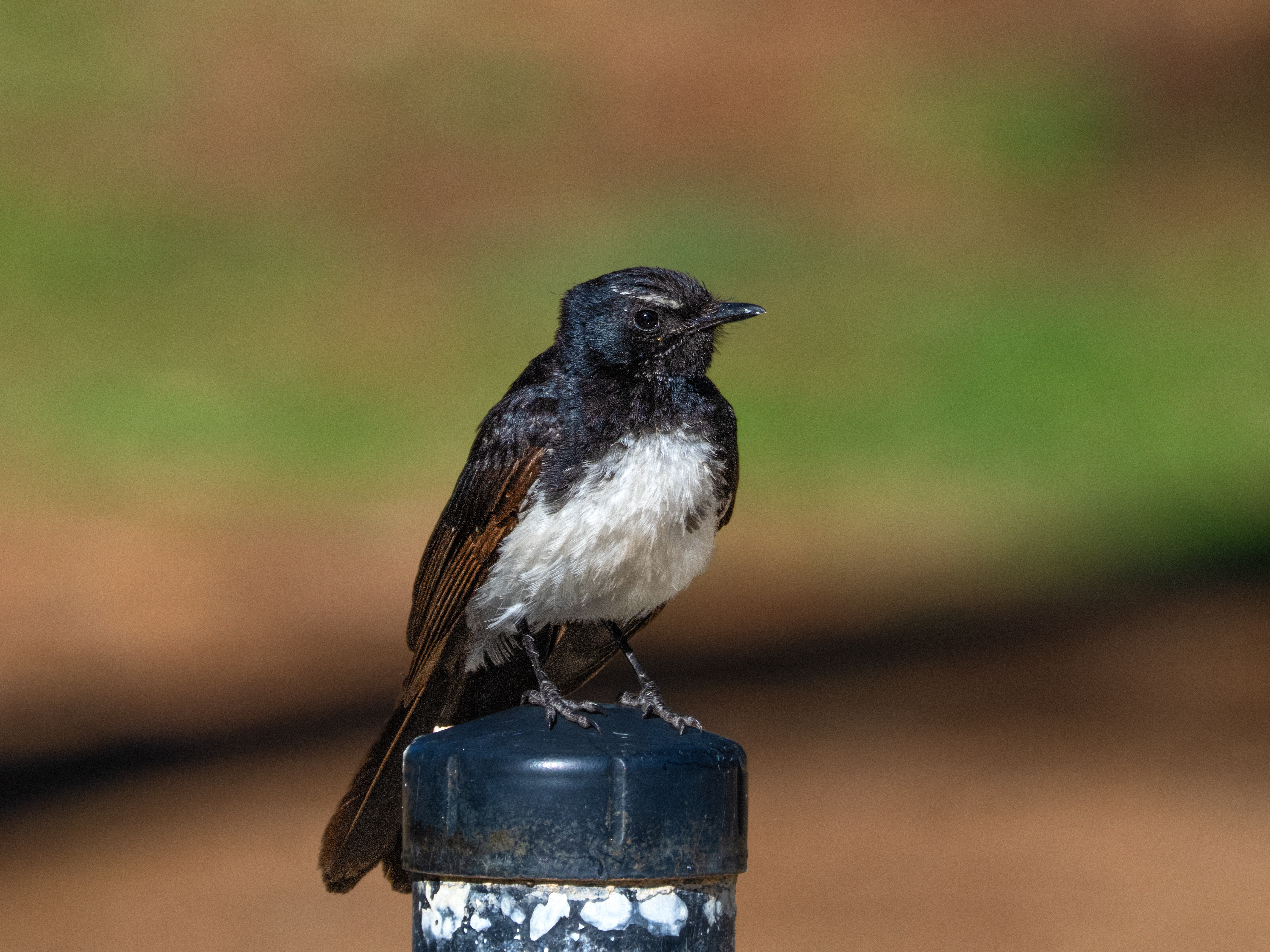
Djidi-djidi or Willie Wagtail (Rhipidura leucophrys) chicks that have out grown their nest.


The unusually placid Djidi-djidi or Willie Wagtail (Rhipidura leucophrys) parent.


Willie Wagtails make incredibly tiny nests – smaller than a tea cup. The typical clutch of eggs is 2-4 which is fine until they hatch and then overcrowding sets in. I spotted this nest while walking back to the car. It looked quite a comical situation – 2 adolescent Willie Wagtails just about ready to fledge crowding round this tiny nest with one in it. All three looked incredible grumpy – it’s the eyebrow and the down turned mouth that gives that impression. One of the parents was sat on a fence post just 5m away closely watching. I was very surprised it didn’t try to chase me off as Willie Wagtails are incredibly aggressive and territorial. Perhaps it was too knocked form taking care of the chicks.

Dryandra Woodland National Park


Dryandra Woodland National Park is thirty minute drive from Narrogin or two hours south east of Perth. It is 15,000 hectares of remanent woodland – a taste of what the Wheatbelt was before colonisation. It is the home to some of Australia’s most at risk animals and because of this the Western Shield program was developed to minimise the effects of feral predators – foxes and cats – and allow the native fauna to re-established.


For us Dryandra has attained an almost mythical status. We have been going for years, and we always want to go again. Every time we always have some kind of amazing animal interaction whether it be Wedge-tailed Eagles, Woylies, Echidnas, Ring Tailed Possums or kangaroos.


The Woylie or brush-tailed bettong (Bettongia Penicillata) is a small hopping marsupial that stands approximately 30 cm high and weighs up to 1.6 Kg. Once quite common the population has been decimated by the introduction of foxes and the practice of large scale land clearance. The Dryandra Woodland Reserve is an important part of CALM’s Western Shield project which aims to re-establish the species.


Dryandra is really famous for its Numbats, and in all the years we have been visiting we’ve never seen one. The only Numbat I’ve seen was at Perth Zoo, and they can be tricky to see there too.


A Numbat at Perth Zoo.


This visit the plan was quite simple. After the previous hot day and with another forecast we planned to stake out the Old Mill Dam and try and catch the early morning activity at the waters edge. It was a great morning the only problem photographically was the heat haze over the water, but that only effected the shots where the subject was on the other side of the water. Anything I was close to was pin sharp.


Yongka by Paul Amyes on 500px.com
This mother andJoey Yongka or Western Grey Kangaroos (Macropus fuliginosus) were feeding on the side of the track as we entered Dryandra.


Ngoolyak by Paul Amyes on 500px.com
Ngoolyak or Carnaby’s Black-cockatoo (Calyptorhynchus latirostris) drinking from the dam.


Miyamit by Paul Amyes on 500px.com
Miyamit or Yellow-plumed Honeyeater (Ptilotula ornatus).


Djiring-djiring by Paul Amyes on 500px.com
Djiring-djiring or Restless Flycatcher (Myiagra inquieta). Old Mill Dam, Dryandra.


Djiring-djiring and Miyamit by Paul Amyes on 500px.com
“I was here before you!!” Miyamit or Yellow-plumed Honeyeater (Ptilotula ornatus) and Djiring-djiring or Restless Flycatcher (Myiagra inquieta). Old Mill Dam, Dryandra.


Djangkang by Paul Amyes on 500px.com
Djangkang or Red Wattle Bird (Anthochaera carunculata).