I’ve Got A Silver Nose


Olympus G_Zuiko 50mm f1.4 lens
Blimey it’s a silver nose!


A little while ago I got a new to me camera (more about that in a later entry) and it came with an Olympus OM Zuiko 50mm f1.4. Initially I wasn’t really interested in the lens at all as I already had a copy. However, on arrival I noticed that the front filter ring and the edge of the aperture ring were silver chrome and I realised that it was an Olympus “Silver Nose” lens. This realisation sent me down a rabbit hole looking at all the variations of Olympus lenses and the effects of lens coatings and trying to see which lens is better.


Olympus G_Zuiko 50mm f1.4 lens
First and third generation Olympus 50mm f1.4s.


Get online and look at the many forums that talk about classic film cameras and lenses you can find “Olympusphiles” (or should it be “Zuikoholics”) discussing/arguing about the merits of silver nose lenses and whether they are better than black nosed lenses. So what is a silver nose exactly? Well when Olympus launched its 35mm OM camera system at Photokina in 1972 the lenses all had the chromed filter rings and they were single coated, I think there were a couple of exceptions, but, I’ve not managed to confirm this one way or the other. These lenses stayed in production until roughly 1983/4 and were replaced by multi-coated lenses. The situation is not entirely clear cut as between 1972 and 2002, when production of OM Zuiko lenses ceased there were four generations where each iteration brought some improvement in either the optical performance, or manufacturing efficiency. The table below goes through the various changes each generation brought.


1st generation The original lenses released in 1972 and they have the characteristic silver nose. They also have a prefix letter in front of the Zuiko label that indicates the number of lens elements. My 50mm f1.4 is G.Zuiko which shows it has seven elements. The lens elements are single coated.
2nd generation This was largely just a cosmetic change where the silver nose was dropped in favour of the so-called black nose.
3rd generation The letter prefix is dropped and replaced with Zuiko. MC which indicates the lens is multi coated which makes the lens appear sharper.
4th generation The MC designation ceases and construction was changed to cementing the lens elements in place.


To further aid in identification Olympus OM lenses have a code indicating place and date of manufacture. Pre 1983 this code is found underneath the rubber focusing ring and accessing it is a destructive process. After 1983 the code was printed on the light baffle retaining ring in the lens mount. Having said this I have a 1984 35-105mm f3.5-4.5 that doesn’t have this. An example of this code can be found on my 21mm f3.5 which has the code TNMA. The first two letters are the factory where the lens was made, in this case Tatsuno-Machi. The third letter is the year 1993, and the fourth letter is October. If you would like more information about these codes then I would suggest looking at Konrad Beck’s entry on photo.net.

To further understand what a silver nosed lens is we need to talk a little about lens coatings. This is going to be very brief as it is such a complicated subject.  Simply put lens coatings are thin layers of minerals applied to a lens surface to improve optical performance by reducing reflections and improving the transmission of light through the glass element. The effects of lens coatings was discovered by accident in 1886 by John William Strutt, 3rd Baron Rayleigh. He observed that a new lens he had acquired didn’t transmit as much light as an older version he had which was a bit tarnished. It was found that by controlling the material used, examples being magnesium fluoride and calcium fluoride amongst others and its thickness meant you could fine tune the characteristics of a lens. Initially this was done in a single coating. Zeiss pioneered multi-coating in 1935, but it wasn’t until a collaboration with Pentax in the early 1970’s until the process bore fruition with the launch of Pentax’s Super Multi Coating, or SMC and Zeiss’ T* coating. The first multi-coated lens for an SLR was the Pentax 50mm f1.4 Takumar in 1972. These multiple layers of minerals increase the amount of light transmitted through the lens, cut down on flare, and improves the contrast which all adds to the apparent sharpness of the lens. The need for multi-coated was accentuated by the increased take up colour film.


Olympus G_Zuiko 50mm f1.4 lens
That orange coloured coating is not radio-active. The thorium glass used for some of the elements is the radio active bit.


A little known fact about the silver nose 50mm f1.4 is that it is mildly radioactive. Most people attribute this to the lens coating which is incorrect. There is no thorium in the coating, it is in the glass used in the lens elements. This was done to increase the refractive index of the glass so as to reduce chromatic aberration. With age the thorium glass discolours and developes a yellowish tinge. People often mistake the yellow hue of lens coatings for this but the only way to find out is to hold your lens up to a plane white illuminated background and look through it. If the image has a yellowish brown tint then the thorium has started to degrade. This can be reversed by exposure to UV light. Is thorium glass dangerous? Well only if you grind up the glass and either inhale it or digest it. To put this into context you are exposed to more radiation when you eat a banana. Having said that for the sake of my love spuds I’m not going to walk around all day with this in my trouser pocket. The use of radioactive materials in glass was phased out by the 1980’s mainly as a health and safety precaution for the people who made the lens elements – they  came into contact with a lot of thorium glass dust when grinding and polishing the lens elements. Another reason was that lens manufacturers had discovered they could get better results by using magnesium fluoride and calcium fluoride.

In the end it is all very bewildering. So I decided to take a more practical approach and compare my first generation Olympus OM G.Zuiko 50mm f1.4 to my third generation Olympus OM Zuiko MC 50mm f1.4 and see which one I thought was better.


Physical Properties

 

Irrespective of the version the Olympus 50mm f1.4 has seven elements in six groups.


Olympus OM G.Zuiko 50mm f1.4 Olympus OM Zuiko MC 50mm f1.4
Focal length 50mm 50mm
Angle of view 43º 43º
Minimum focusing distance 45cm 45cm
Maximum magnification 0.15x 0.15x
Lens construction 7 elements in 6 groups 7 elements in 6 groups
Lens coatings Single coated Multi-coated
Maximum aperture f1.4 f1.4
Minimum aperture f16 f16
Diaphragm 8 curved blades 8 curved blades
Focusing Manual focus with a straight helicoid Manual focus with a straight helicoid
Filter size 49mm 49mm
Dimensions 36mm (h) x 60mm ⌀ 40mm (h) x 60mm ⌀
Weight 227g 229g

Apart from the cosmetics the only differences are the lens coatings, the length and the weight. Both lenses have that loverly dense feel with glass inside the metal barrel. The focusing is beautifully buttery smooth with a throw of 180º and the aperture ring is click stopped in one whole stop intervals. They are wonderfully tactile – I just can’t help fondle them.


Optical Performance


f1_4 sharpness


f2.8sharpness


f4sharpness


f8sharpness
Wide open both lenses were very noticeably soft in the centre and at the corners with the MC version having a bit more contrast. The silver nose had very pronounced chromatic aberration while on the MC version it was more controlled. By f2.8 the MC version’s chromatic aberration has cleared up completely. In the centre of the frame both lenses have improved sharpness and contrast. In the corners the MC has improved sharpness and contrast while the silver nose shows no improvement in sharpness but the contrast is slightly better. At f4 the silver nose is now equal in performance to the MC version in all areas except for chromatic aberration where it is still present. At f8 both lenses have reached their best optical performance and the CA has cleared up in the silver nose. By f11 both lenses are starting to show the effect of diffraction and at f16both lenses are quite soft and CA has returned.


Olympus G_Zuiko 50mm f1.4 lens


Olympus OM Zuiko MC 50mm f1.4
Olympus G_Zuiko 50mm f1.4 lens


Olympus OM Zuiko MC 50mm f1.4


You don’t buy an f1.4 lens and not be concerned about the quality of the bokeh. Well given both lens have the same lens construction and aperture configuration they are all but identical. Misshapen cat eye bokeh at f1.4 throughout the frame. Polygonal bokeh balls as you stop down. More importantly the transitions from in focus to out of focus are nice and smooth.

In terms of optical aberration both lenses exhibit mild barrel distortion and produce vignetting. Stop down to f4 and the vignetting disappears.


Olympus G_Zuiko 50mm f1.4 lens
At f2.8 with a specular light source in the frame the OM G.Zuiko 50mm f1.4 is prone to flare. Note the veiling flare and the relections of the lens elements. The effect gets more pronounced as you stop down.


Olympus OM Zuiko MC 50mm f1.4
At f2.8 with a specular light source in the frame the OM Zuiko MC 50mm f1.4 is also prone to flare.The MC handles the flare better than the earlier silver nose. What is interesting is the change in colour of the rflections, from yellow orange to green. This is the change in colour of the lens coatings.

That leaves us with flare resistance. Well it should come as no surprise that the later multi-coated version is better than the single coated, but the difference isn’t as marked as you’d expect. Both lenses are prone to veiling glare which which reduces contrast and dynamic range. Lens flare and reflective glare is also present in both lenses – this is where light is reflected off the lens elements and bounces around the lens internals until it hits the film/sensor. The colourful  polygons that are often seen is light reflected off of the rear of the lens diaphragm. The more you stop down the worse they become. Changing your composition so specular highlights aren’t visible in the frame and/or using a lens hood can fix the problem. On the subject of lens flares we should also talk about diffraction spikes or sun stars – well they aren’t very special being poorly defined. This all sounds pretty damming, but we shouldn’t compare these lenses to their modern counterparts. A lot has happened in lens design and manufacture in the last 40-50 years. You buy these old lenses if you are looking for character.


Olympus G_Zuiko 50mm f1.4 lens
Olympus G_Zuiko 50mm f1.4 lens at f16. The diffraction spikes aren’t that thrilling.


Olympus OM Zuiko 50mm 1.4 test
Olympus OM Zuiko MC 50mm 1.4 shooting into the sun at f16. Note the ghosting, the veiled flare and lack lustre diffraction spikes.


Conclusion


Olympus G_Zuiko 50mm f1.4 lens


Which one of these lenses would I recommend? Well I didn’t buy either of these lenses intentionally. Both of them came bundled with a camera body that I bought – the Olympus OM Zuiko MC 50mm f1.4 came with an OM4 that I bought in 1986 and the Olympus OM G.Zuiko 50mm f1.4 came with a camera body I bought last month. Now if you were to ask me which Olympus OM Zuiko 50mm f1.4 is the best I’d have to say neither of these. It is generally acknowledged that the best version is a 4th generation one with a serial number higher than 1,100,000. 

The argument that single coated lenses are inferior to multi coated lenses doesn’t take into account what the photographer actually wants from a lens. Generally single coated lenses are favoured for black and white film photography as the lack of contrast and flatter look suit the medium especially if you do your own printing in a darkroom. Multi-coated lenses give stronger colours, more contrast, and reduced flare which makes them more suitable for coloured photography. But it’s not that hard and fast. Some colour photographers like a more muted palate, lower contrast and lens flare as they think it adds character so favour the use of single coated lenses, indeed they are also popular with cinematographers for the same reason. If you like punchy high contrast black and white look at multi-coated lenses.

Oh and if someone offers to sell you silver nose 50mm f1.4 and says they are rare, well Olympus churned these lenses out by the barrel load. To give some perspective my silver nose has a serial number of 347876 and my MC version is 800260 – that’s a difference of 452, 384 lenses.


Sample Images

All images below were taken with the Olympus OM G.Zuiko 50mm f1.4 mounted on a Sony A7r via Fotodiox OM to E adapter.


The Stromalites
The Stromalites Jazz Trio perfom at the York Mill.


York Mill
The main gates at the York Mill.


The Book Nook
The Book Nook second hand bookshop at the York Mill.


York Mill
Doors on a wall. York Mill.


20240328-Mundaring-0224-Edit
The Naked Butcher. Becareful when you ask for 1/2Kg of sausages.


20240328-Mundaring-0228-Edit
The Railways Heritage Trail, Mundaring.


20240328-Mundaring-0232-Edit
The little people at Mundaring Sculpture Park.


20240407-York-0226-Edit
Coils


20240413-York-0229-Edit
Dayzies on Avon Terrace.


20240415-York-0235-Edit-2
York Mill at sunset.


20240415-York-0237-Edit
The River Avon in the evening light.


20240415-York-0239-Edit
Holy Trinity York bathed in the light from the setting sun. Even thought the sun is not in the frame notice the lens flare.


20240418-York-0225-Edit
Knackered Bedford.

That Was Then This Is Now

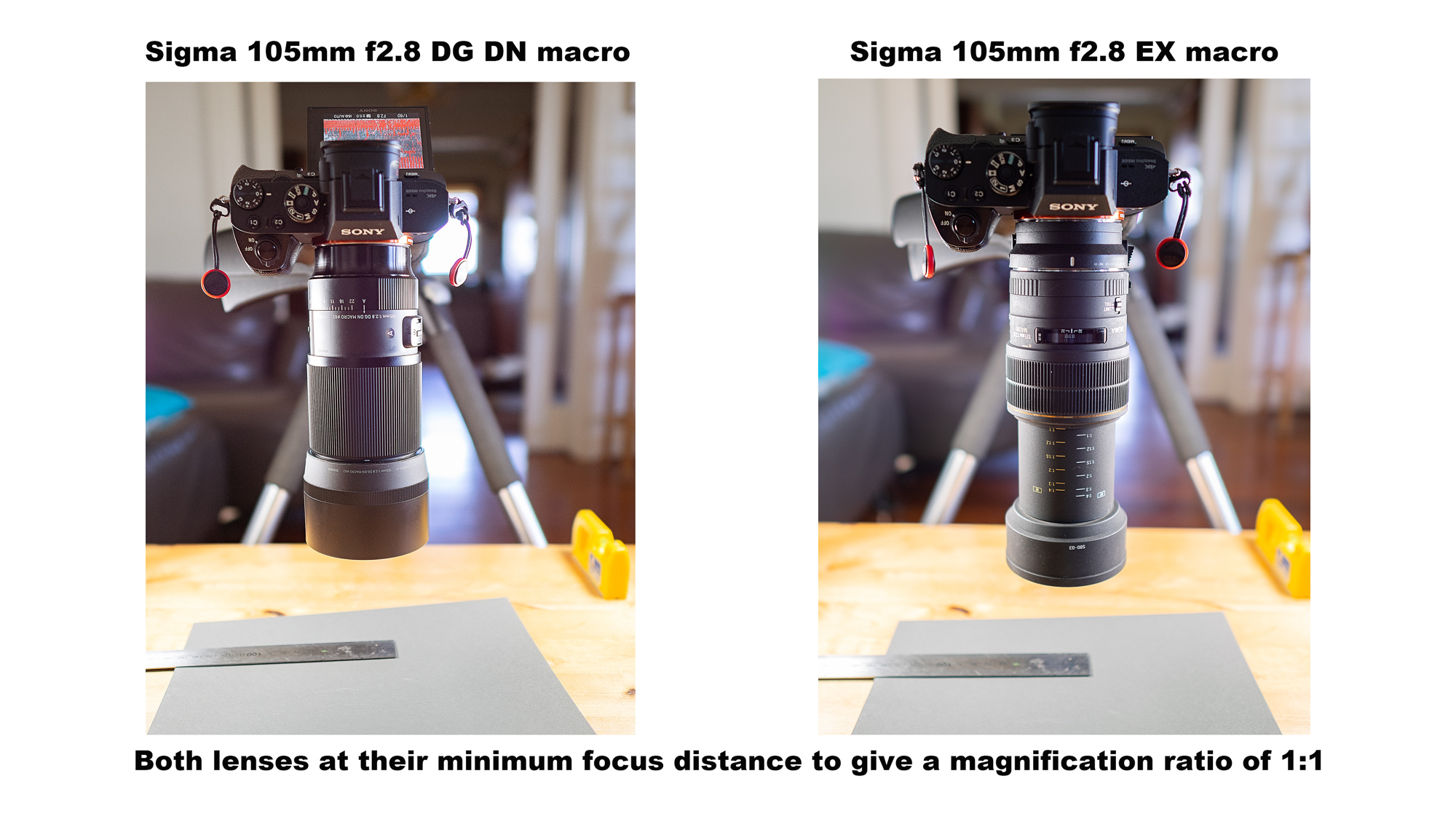
The Sigma 105mm f2.8 EX macro compared to its newer variant the Sigma 105mm f2.8 DG DN macro lens. Both lenses have their lens hoods attached.

Back in the annals of time, well 1999 to be precise, Sigma released the Sigma 105mm f2.8 EX Macro lens. Twenty one years later they released the Sigma 105mm f2.8 DG DN Art Macro lens. So let’s see what has changed in macro lens design.

As always click on the images to see them larger.


TLDR

.


Physical Attributes

Sigma 105mm f2.8 EX Macro

The Sigma 105mm f2.8 EX macro lens in Canon EF mount. The lens has no weather sealing.


As I said above this lens was introduced back in 1999 and it was well received by reviewers and users alike. In fact it cemented Sigma’s reputation for producing excellent macro lenses. One of my photography lecturers reckoned that this was one of the best lenses he’d used so I bought the lens new in 2003 to use with my then Canon EOS 3 and 30 and it remained in regular use until 2016. I’ve used it for macro, product shots, still life, portraits, fine art reproduction and copywork and of course close ups of flowers.

The lens was designed with film use in mind and was made available in the following mounts:

  • Canon EF
  • Minolta A
  • Nikon F
  • Pentax K
  • Sigma SA

Pick up the lens and it feels very well made. It is light by modern standards but it has a nice heft to it. The lens barrel is metal – none of your plastic composites here – and the lens mount is a chrome plated brass affair. The front lens element is recessed 25mm into the lens barrel and it is ribbed to prevent reflections and acts as shallow lens hood. Combine it with the included metal lens hood and it is virtually impossible  to induce flare. The lens hood screws firmly into place on the lens’ front filter thread and is threaded to take 77mm filters which is a neat idea as it makes it possible to quickly attach filters without having to take the lens hood off.

The finish is the peculiar matt black finish that Sigma had for all their EX range of lenses with a gold ring at the end of the focus ring and the text done in a mixture of white and gold. The focusing ring is 35mm wide and has ribbed rubber to aid grip. In autofocus mode the ring spins freely, but pull that ring back and flip the AF switch and it has a nice smooth 270º throw taking you from infinity to 31cm. The lens barrel extends as you focus closer by 50mm and there are magnification scales marked on the barrel extension for both manual and auto focusing. This means you can quickly set the lens to a desired magnification ratio. It is to my mind still one of the best implementations of manual focus on an autofocus macro lens. The lens motor makes quite a bit of noise and it can’t be called quick by any stretch of the imagination, however, macro lenses are not noted for their speed of use.


The Sigma 105mm f2.8 EX macro lens at full extension to give 1:1 magnification. Note the magnification ratios marked on the lens barrel. This makes manual setting of the lens for specific ratios a breeze.


Behind the focusing ring is a clear panel over a focusing scale in both feet and metres. There are two switches on the right side of the lens. The first is a focus limiter which speeds up auto focus by preventing the lens racking back and forth through the whole focus range. The second switch is the previously mentioned focus mode switch. Both are very positive in their action.

Sigma 105mm f2.8 DG DN Art Macro Lens

Sigma’s 105mm f2.8 DG DN macro lens attached a Sony A7Rii.


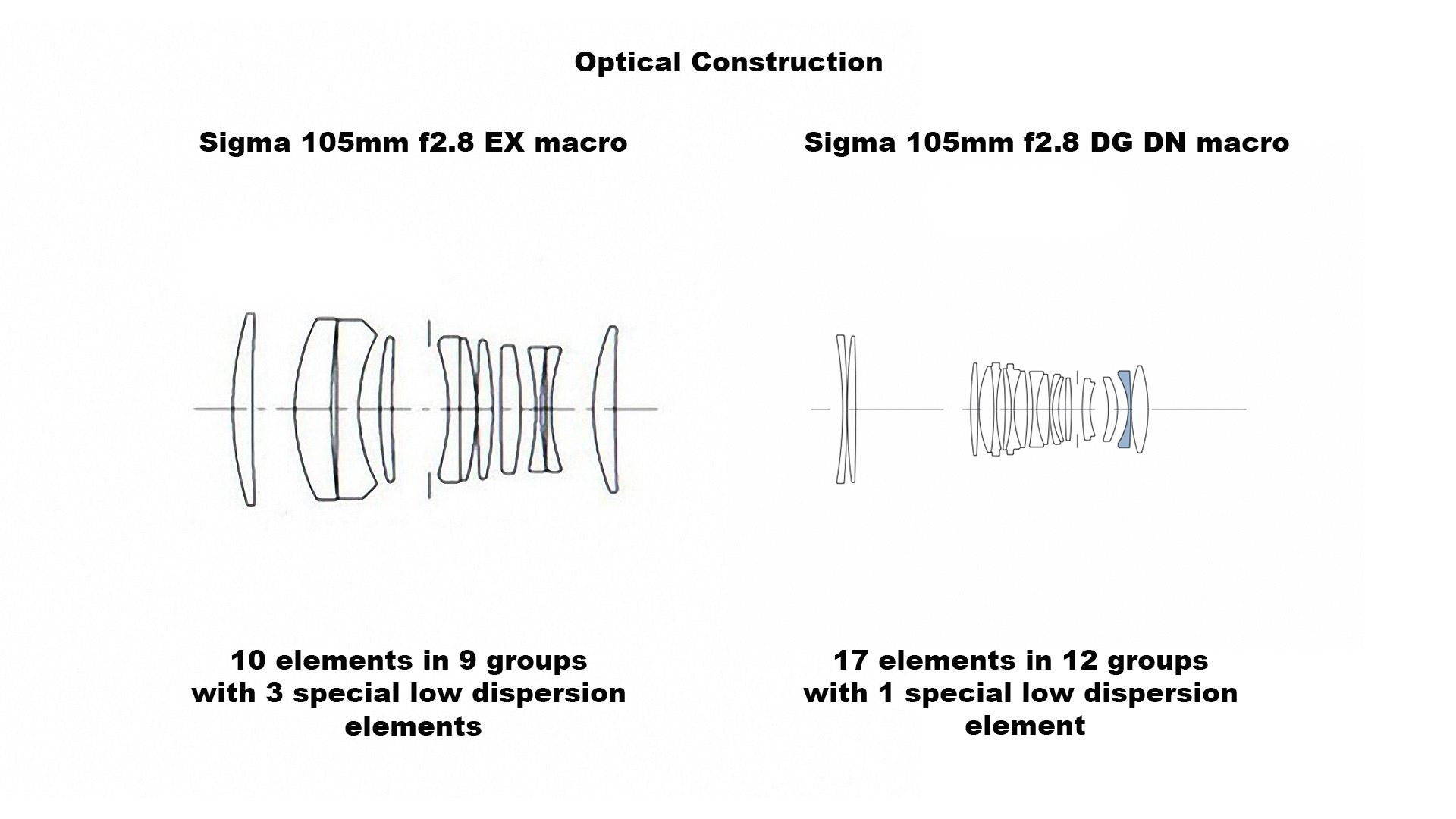
Announced in September 2020 the DG DN is available in Sony FE and Panasonic/Leica/Sigma L mounts. It is part of Sigma’s Art series and so shares the same gloss black finish with understated white graphics and lettering. No 1990’s gold bling here, just a minimalist workman like appearance. The body is a combination of metal and Sigma’s Thermally Stable Composite a kind of plastic with thermal expansion properties the same as aluminium. There are a number of ribbed panels to facilitate a secure grip. It’s great to see that Sigma has not abandoned the chrome plated brass  lens mount – it’s a proven method and lasts a long time. Pick the lens up and the first thing you notice is the weight. It is very heavy for its size. The 17 lens elements really make their presence felt when compared to the EX’s 10.


Both lenses are focused at their minimum focusing distance to give a maximum magnification ratio of 1:1. The DG DN focus internally and remains the same length while the EX’s barrel extends.


So weight and appearance aside how else does the DG DN differ from its distant ancestor the EX? Well the DG DN is 40mm longer, but it is important to remember that it is made for mirrorless cameras with a shorter lens flange distance than DSLRs. Put a Sigma MC-11 on the EX and they are virtually the same length. Another difference is that the new DG DN focuses internally – there’s no extending barrel and this will help with the weather sealing. The large ribbed focusing ring is of the fly-by-wire type, there’s no pulling it back to engage a manual focus mechanism. Consequently there are no hard stops and you get no feedback as you focus other than the image in the EVF or on the back panel. Macro photography is an area where you do use manual focus a lot and using it on the DG DN is not a very pleasant or positive experience to my mind. 


The controls on the Sigma 105mm f2.8 DG DN macro lens include an AF/MF switch, a reprogrammable focus lock button, a focus limiter switch and a switch to de-click the aperture ring.


There are a lot more controls on the newer lens:-

  • an AF MF switch
  • a focus lock button that can be reprogrammed
  • a focus limiter switch with 3 settings – 0.295 to 0.5m, 0.5m to infinity, full range.
  • a switch for de-clicking the aperture ring
  • an aperture ring
  • a locking switch for the aperture ring


The aperture ring on the Sigma 105mm f2.8 DG DN macro lens. Not only can it be de-clicked it can also be locked in the auto position for those who would prefer to chasnge aperture using camera dials.


The focus limiter switch has three settings. 0.295-0.5m macro, 0.5m to infinity normal range, and a full range option.


So let’s have a quick gander at the specs for both lenses.


Sigma 105mm f2.8 EX Macro lens Sigma 105mm f2.8 DG DN Art Macro lens
Focal length 105mm 105mm
Angle of view 24º (on full frame) 23.3º
Maximum aperture f2.8 f2.8
Miniumum aperture f45 for Canon, Sigma, and Minolta

f32 for Nikon and Pentax

f22
Filter size 58mm on the lens body

77mm on the lens hood

62mm
Stabilisation No No
Maximum magnification 1:1 1:1
Minimum focusing distance 31cm from the film plane 29.5cm (from the sensor plane)
Focusing modes Auto and manual Auto and manual
Optical construction 10 elements in 9 groups with 3 special low dispersion elements 17 elements in 12 groups with 1  special low dispersion element
Aperture blades 8 9 (rounded)
Weather sealing No “Dust and splash proof construction”
Weight 456g (Canon EF mount) 710g
Dimensions 95mm (h) x 74mm ⌀ 135.6mm (h) x 74mm ⌀

Optical Performance

Sharpness

A comparison between the 1999 Sigma 105mm f2.8 EX macro lens and the 2021 Sigma 105mm f2.8 DG DN macro lens. Aperture: f 2.8

This is where we really start to what has changed in terms of lens design over the years. Wide open at f2.8 the DGDN is sharper and more contrasty in the centre of the frame. The corners are sharp but the contrast is lower. The EX on the other hand is softer and has less contrast in the centre and the corners are not only softer but display prominent chromatic aberration and have a warm tinted vignetting. Older Sigma lenses were known for having a warmer look than other brands and it is clearly visible.


A comparison between the 1999 Sigma 105mm f2.8 EX macro lens and the 2021 Sigma 105mm f2.8 DG DN macro lens. Aperture: f 4


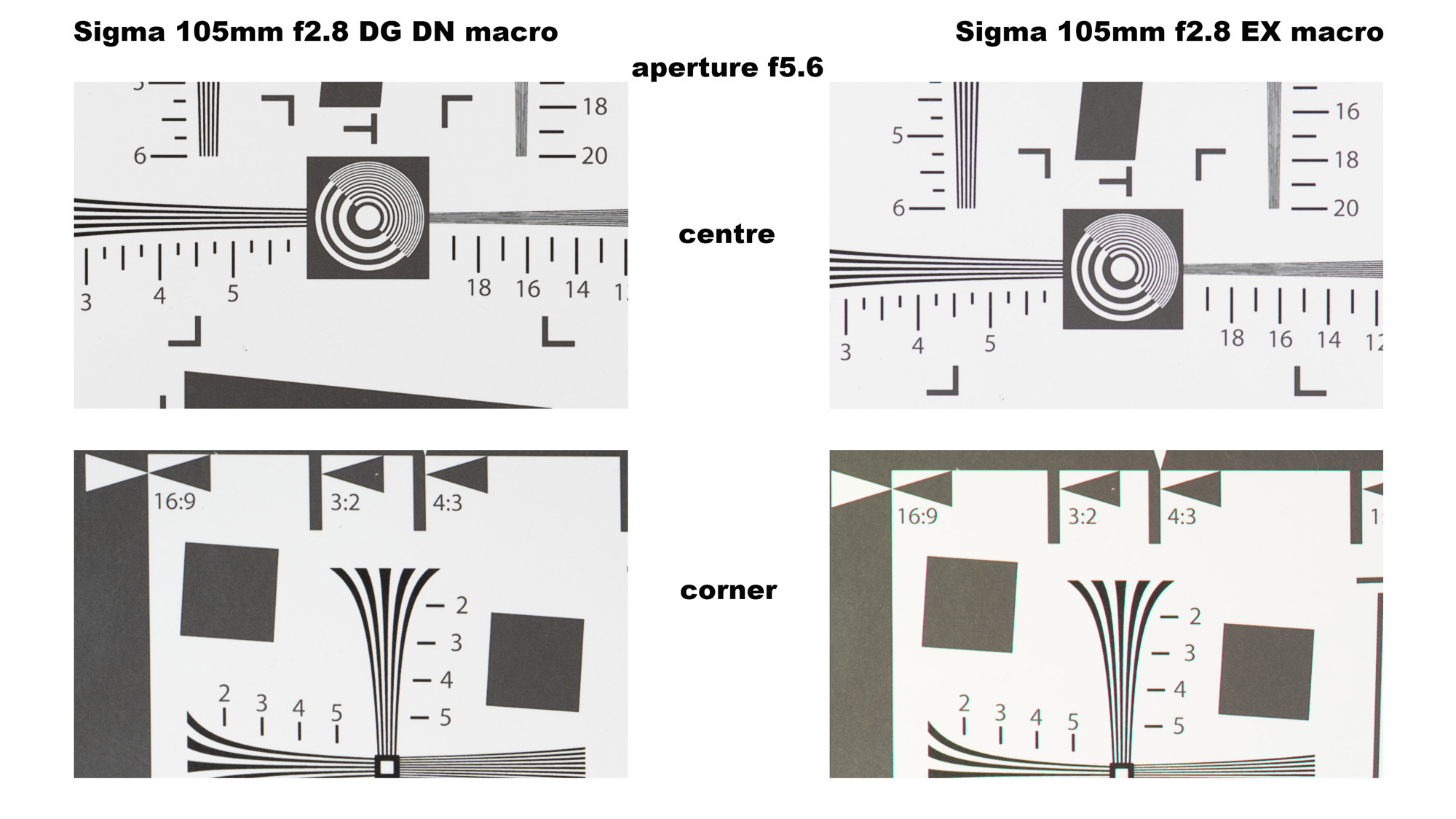
A comparison between the 1999 Sigma 105mm f2.8 EX macro lens and the 2021 Sigma 105mm f2.8 DG DN macro lens. Aperture: f 5.6

By f5.6 the corners of the DGDN have improved considerably and the centre is even sharper. The centre of the frame for the EX has improved but not to the same extent as that of the DGDN. The corners of the EX are still quite soft and still exhibit vignetting.


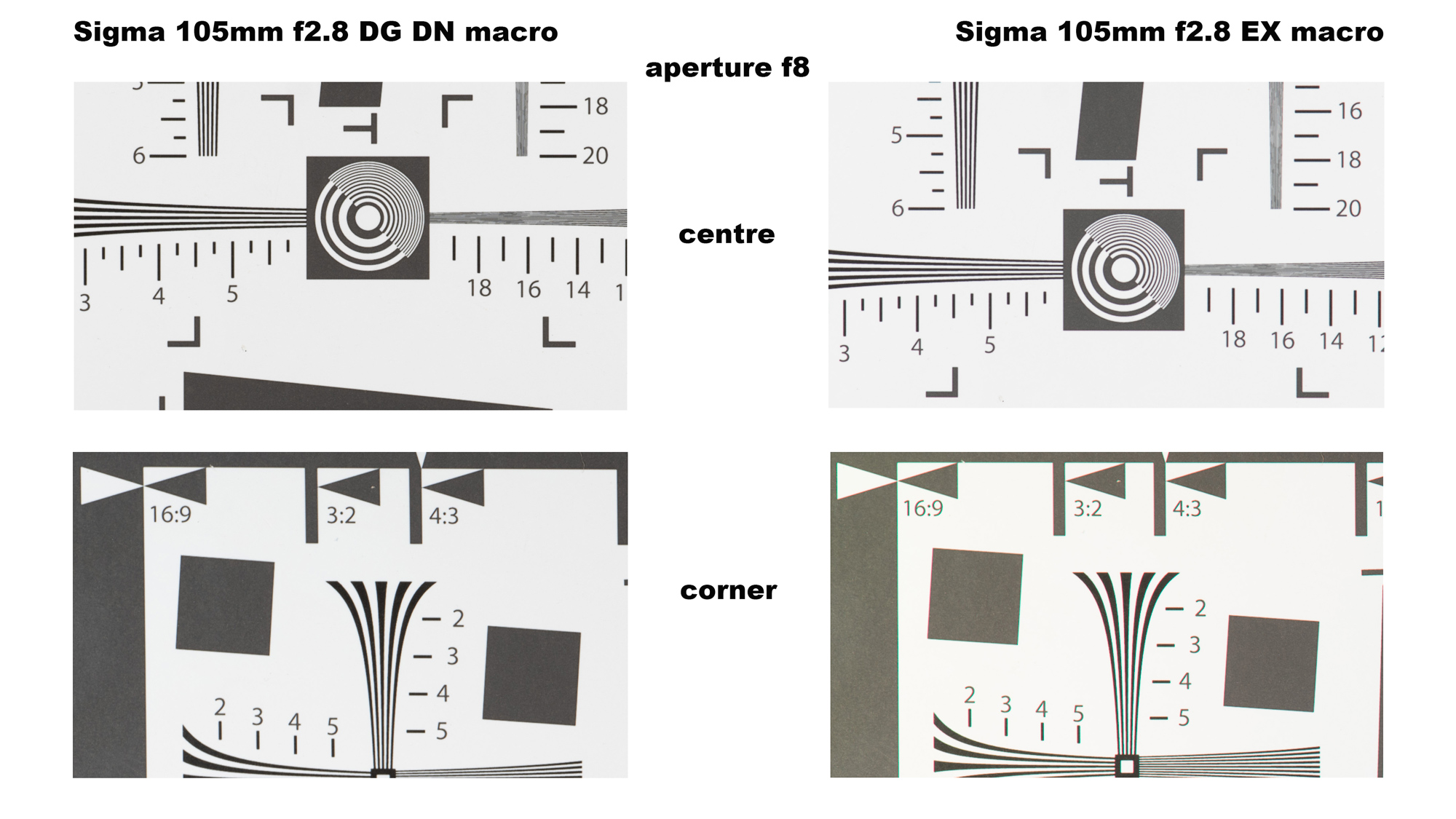
A comparison between the 1999 Sigma 105mm f2.8 EX macro lens and the 2021 Sigma 105mm f2.8 DG DN macro lens. Aperture: f 8


At f8 the DGDN really hits its stride and produces its best optical performance with both the centre and the corners having excellent sharpness and contrast. The EX has reached its best centre performance but it is still not as good as its younger sibling. The corners have improved slightly but vignetting is still present.

At the aperture of f11 the DGDN’s performance remains the same as it was at f8 in both the centre and the corners of the frame. The EX now turns in its best performance but some vignetting remains.


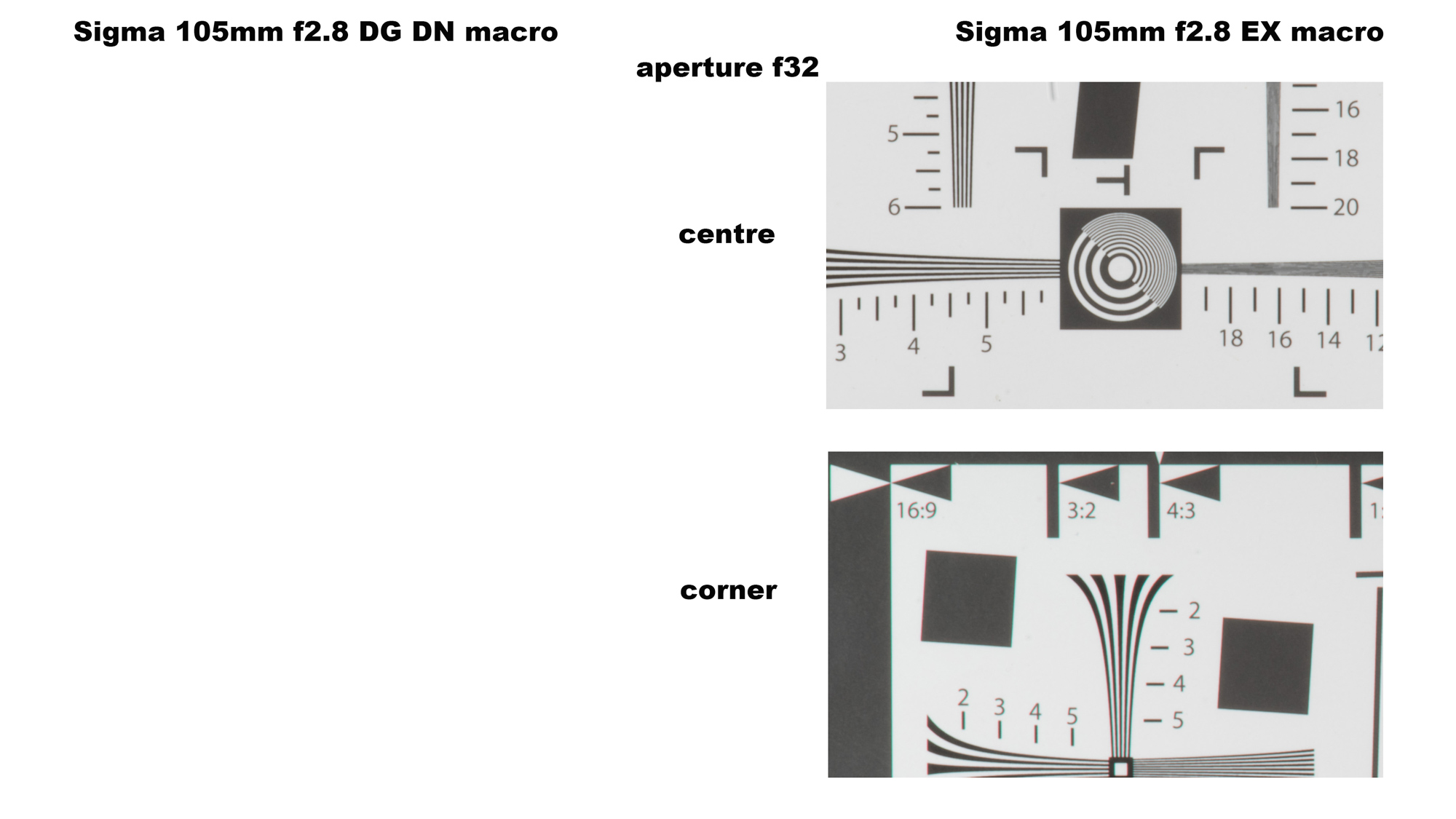
A comparison between the 1999 Sigma 105mm f2.8 EX macro lens and the 2021 Sigma 105mm f2.8 DG DN macro lens. Aperture: f 32

At f16 diffraction is taking effect on both lenses. Interestingly the EX will stop down to f45 but you wouldn’t want to use it as it looks like someone has smeared vaseline over the front lens element.

Chromatic Aberration 

Chromatic aberration is the failure of a lens to focus all colours at the same point and there are two types:-

  1. Axial or longitudinal chromatic aberration – this where different wave lengths of light are focused at different distances from the lens. Generally it can be reduced by stopping down thereby increasing the depth of field so that all the wavelengths fall with acceptable focus. This is very hard to remove in post processing.
  2. Transverse or lateral chromatic aberration – different wavelengths of light are focused at different positions in the focal plane. It does not occur in the centre of an image and increases as you move out to the edges. It is not effected by stopping down, but can be removed in post.

The DGDN is exceptional well controlled for both kinds of chromatic aberration and even at magnifications of 200% I could not observe any. The EX is really showing its age here as both types can be seen. The transverse chromatic aberration is very prominent.

Flare


The Sigma 105mm DGDN shows good resistance to flare. In this extreme case we can see some evidence of veiled flasre and a little reflection.


The EX despite having that recessed front element that acts as a de facto lens hood suffers badly from halation, veiling flare, and reflections when specular light sources were in the frame. The DGDN has better lens coatings which means that the halation and reflected glare is minimal and there is no halation. This means that there’s little loss of contrast.

Bokeh

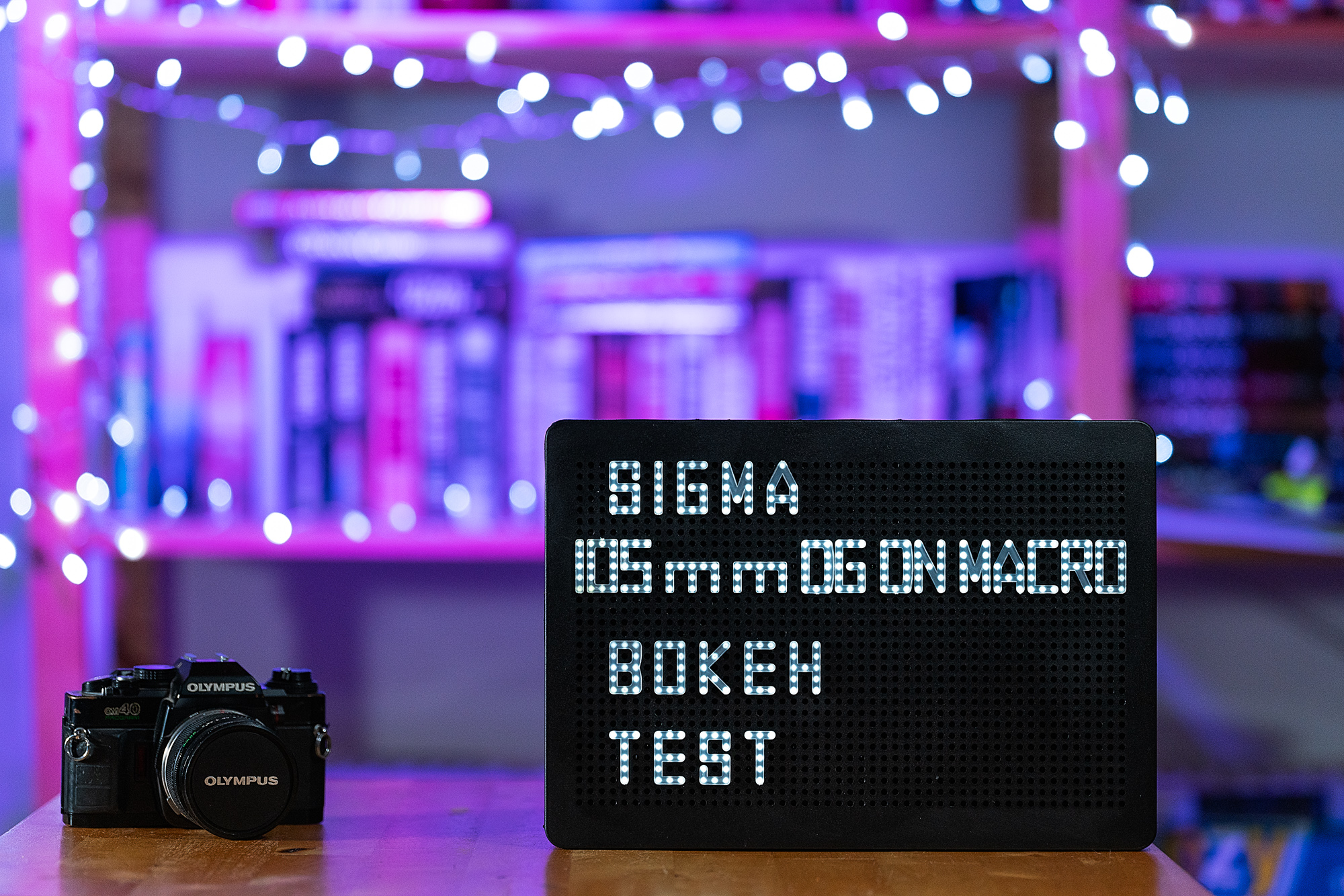
Sigma 105mm f2.8 DGDN Macro lens bokeh test.


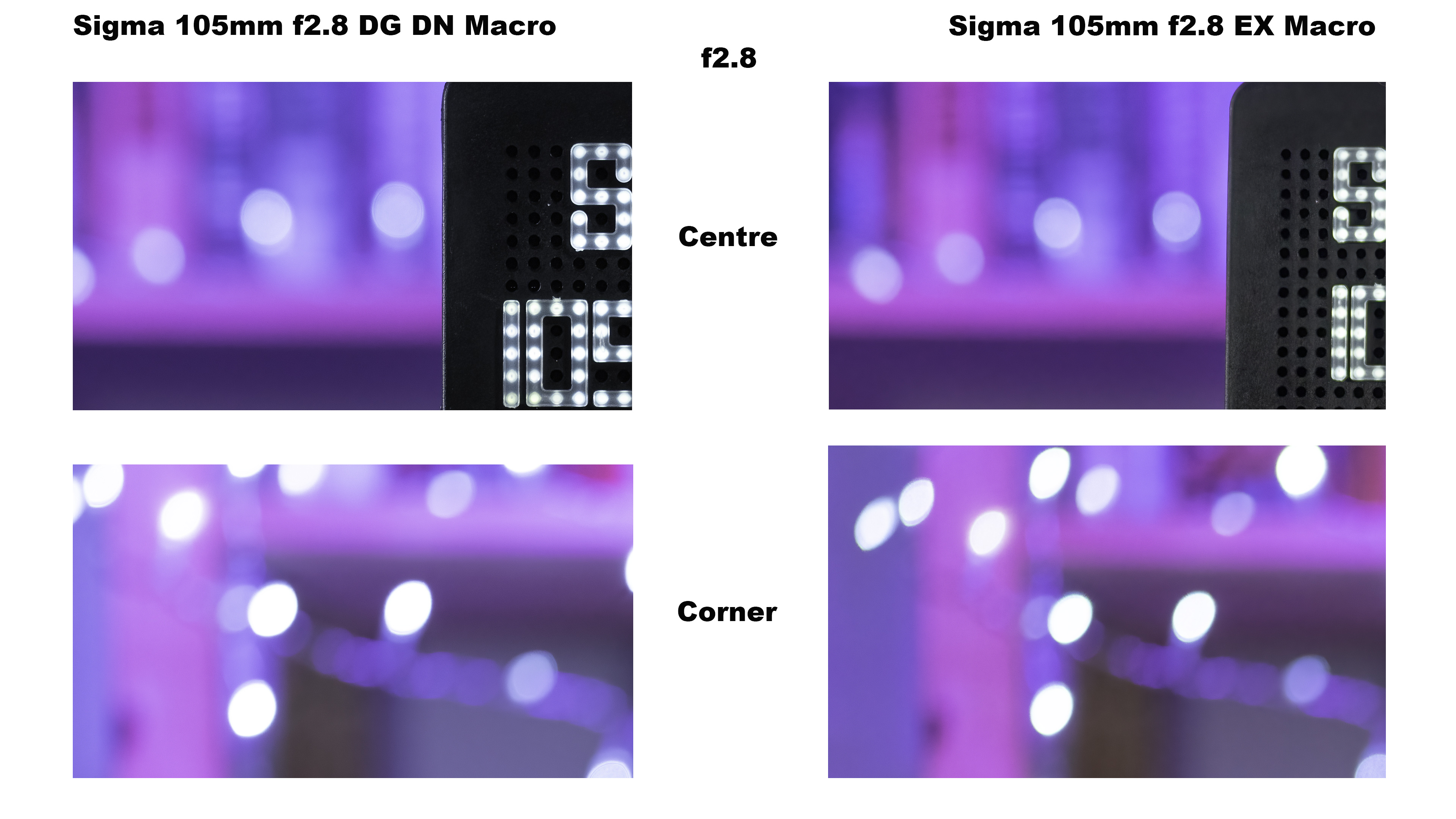
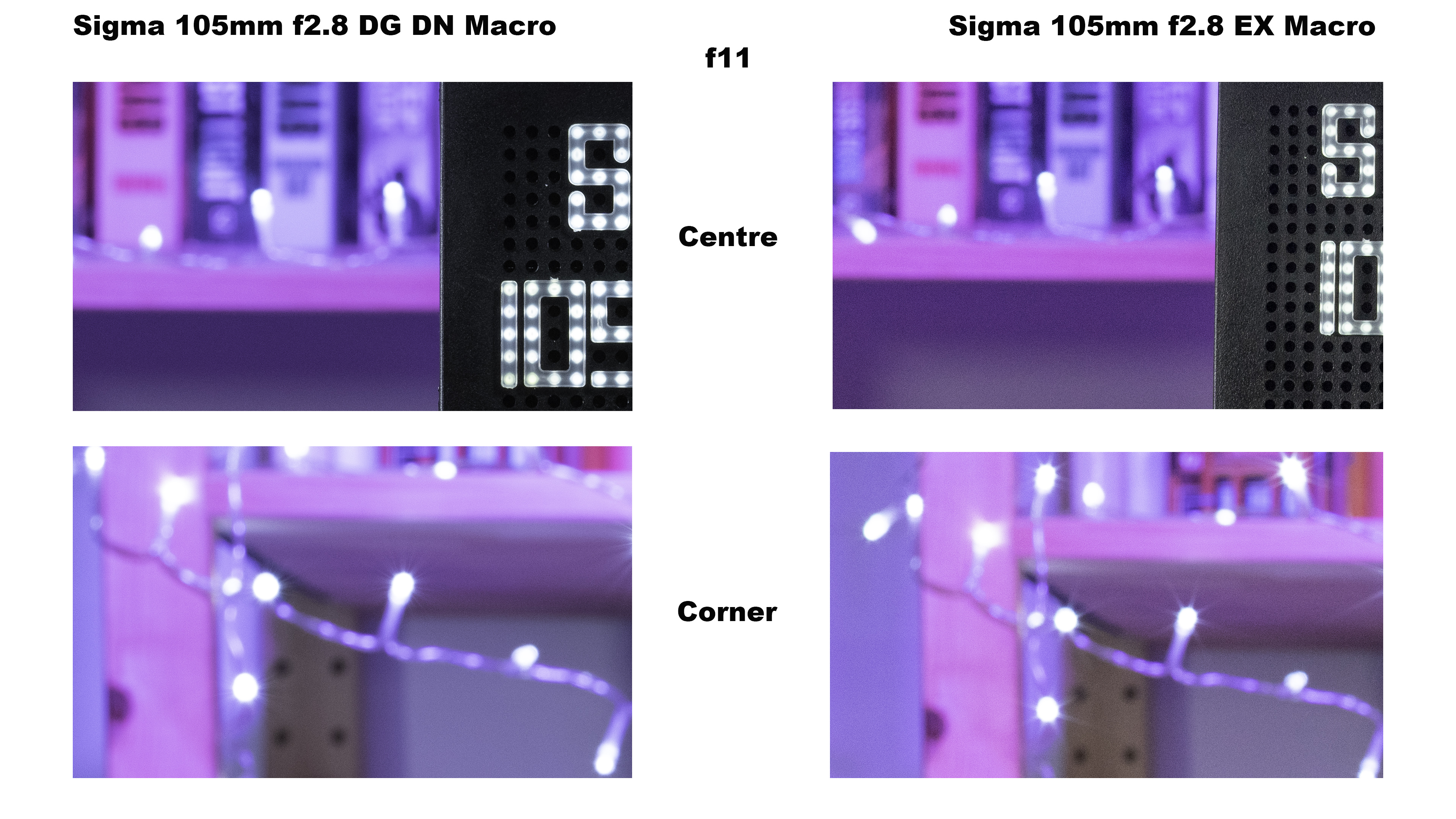
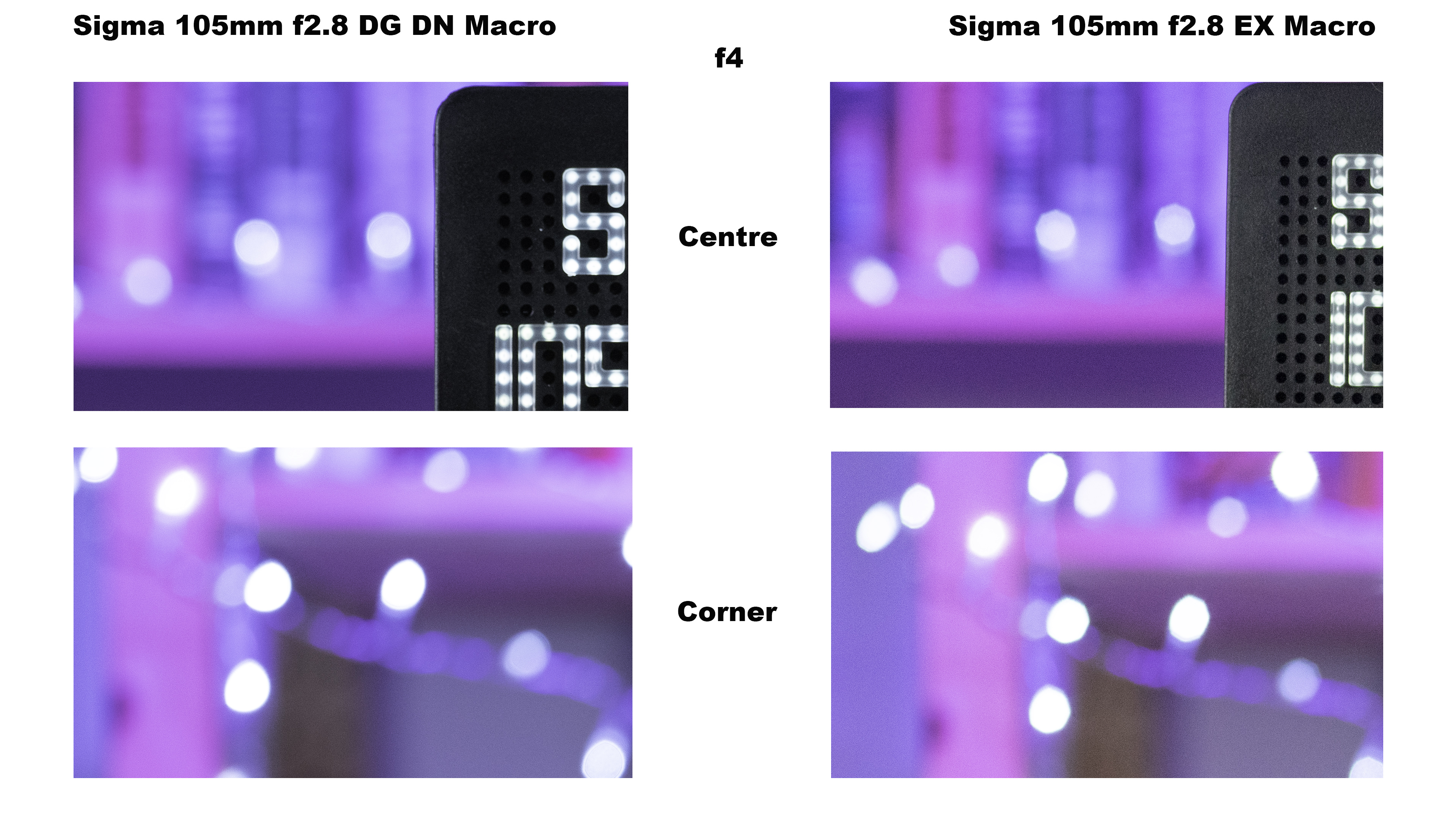
Both lenses at f2.8 have nice round bokeh balls in the centre of the frame and at the edges exhibit that elliptical cats eye effect. The tonal transitions are nice and smooth, there is no busyness or swirly effect. At f4 the EX is starting to develop polygonal balls while those of the DGDN are still nice and round. At f11 the bokeh balls in the corners of the DGDN are starting to develop into sun stars and the effect on the EX is more profound. The 9 rounded aperture blades are producing much more pleasing bokeh effects than the 8 straight ones of the EX.


Autofocus

Continuous autofocus with the Sigma 105mm f2.8 mounted on a Canon EOS 6d.


Autofocus is where there has been an enormous improvement in performance over the last 22 years. The EX when mounted on the Sony A7r ii with either the Metabones V Smart Adapter or the Sigma MC-11 just won’t autofocus. When you switch the camera on the lens racks through its entire focus range (depending on where the limiter is set) and then does nothing. So to test the AF performance I had to mount it on a Canon EOS6d which wasn’t known for its blistering AF speed. I shot several sequences with the focus limiter on at f2.8 of me walking slowly towards the camera with it set Continuous AF and obtained a nit rate of between 70-75%. Video AF was a non starter and it just would not find focus. To be fair the CAF of the 6d in video mode is pretty lacklustre. With the DGDN mounted on the Sony A7r ii the stills burst rate for AF averaged out at 94% which is pretty impressive. The DGDN handled the video AF test with aplomb, it was smooth and positive keeping up with me moving about in the frame. The AF was noisy and was picked up by the shotgun microphone mounted in the camera hot-shoe. Speaking of noise the EX was incredibly noisy.


Continuous auto focus using the Sigma 105mm f2.8 DG DN macro lens on a Sony A7rii.


Conclusion

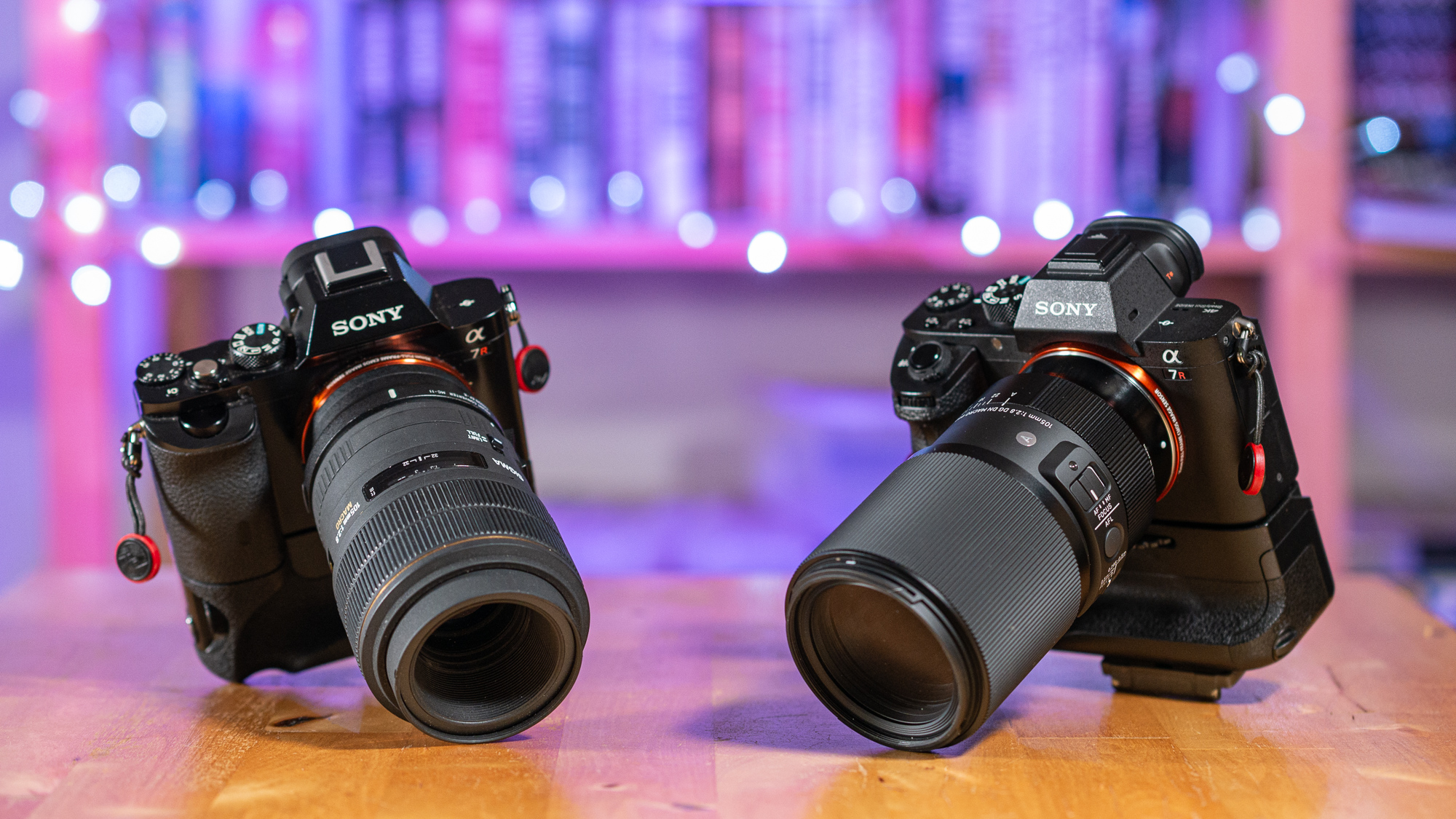
Both lenses mounted on Sony bodies. The EX is mounted via the Sigma MC-11 lens adapter.
 

This should really come as no surprise, time has marched on and the advances in lens design are easily apparent.The Sigma 105mm f2.8 EX macro was considered a very good lens in its day, and even now it is remembered fondly on photographic forums. The DGDN is just at another level of performance both in terms of optics and auto focusing. The EX while being optically suited to a number of tasks its AF performance let it down when it came to anything that moved quickly or erratically. The DGDN on the other hand can be confidently used as a general purpose short telephoto with a wide variety of subjects as well as being a dedicated macro lens. The only area in which the EX is superior to the DGDN is in the handling department. The manual focusing experience and the ability to pre-set specific magnification ratios makes the lens a joy to use manually. The DGDN is clearly aimed at the autofocus only photographer. A great shame.

So if you have a Sony FE or one of the  offerings from the “L mount alliance” then the lens is worth a look at. Well it is your only option in L mount. It is also a worthy competitor to the Sony 90mm f2.8 FE macro OSS G at a cheaper price.


Sample Images


Looking through the Olympus OM Zuiko 135mm f2.8 lens at an Olympus OM 40.


Lime slice oozing juice.


Cream runs down over a strawberry.


Where there’s smoke there’s fire.


Australian one and two dollar coins.


Sigma 105mm f2.8 DG DN Macro lens auto focus test. Auto focus tracking a subject walking towards the camera while the lens is wide open at f2.8.


Darth Vader divided by the light.


Bee feeding on lavender flowers.


A bee feeding on a daisy.


A ladybird looking for aphids.


Clubbed Spider Orchid, Caladenia longiclavata. Mount Observation, Western Australia.


Custard Orchid, Thelymitra villosa. Mount Observation, Western Australia.


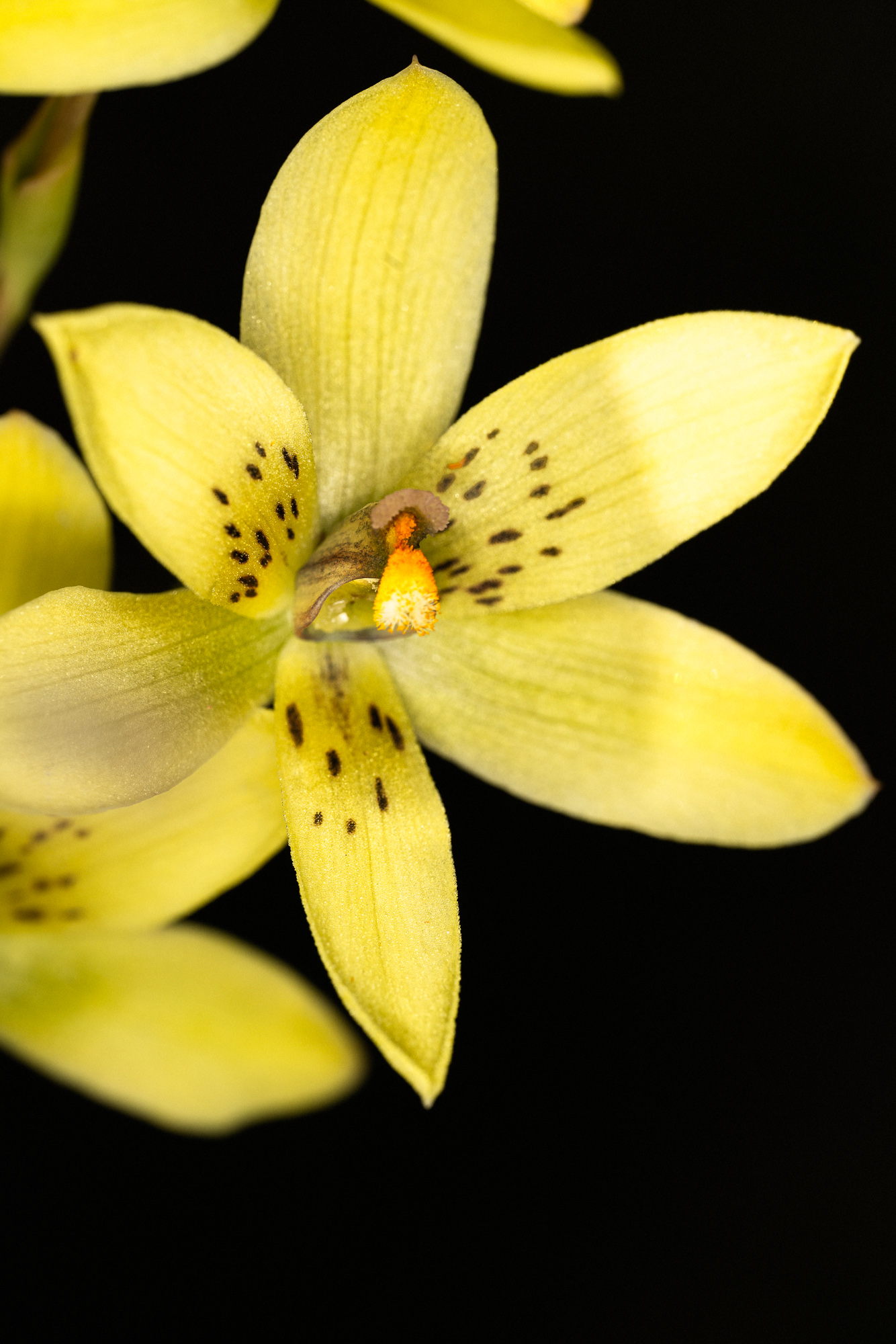
Known by a variety of names the dancing spider orchid (Caladenia discoidea) is also known as the antelope orchid and sometimes the bee orchid. St. Ronan’s Nature Reserve, Western Australia.