I like trains, not in that anorak wearing train spotter way, but I have happy associations with them of journeys done and I’ve always lived by railway tracks. It’s not the first time I’ve made blog entry about trains. The other one was TransPerth Transhumance. So the first of my photos is this:
York CBH Nocturne. Train been filled at the York CBH grain handling facility in York, Western Australia. Canon EOS 5D with Canon EF24mm f/2.8 lens. Exposure: manual mode 20.0 s at f/4.0 ISO 800.
I live very close to the CBH grain handling facility in York and can hear when they are filling the trains, which for some reasons always seem to happen at night. Anyway last night I heard the train pulling in at about 8:30pm and I quickly grabbed a camera and tripod and headed down there. So here it is fresh from the camera card.
Thomas the tank engine pulls into the platform at the Beverley Station Art Gallery. Immediately he senses that something is not quite right. Beverley, Western Australia. Canon EOS 550D with Canon EF24mm f/2.8 lens. Exposure: aperture priority mode 1/320 s at f/11.0 ISO 1600.
The picture of Thomas was just a piece of fun. My partner had an exhibition at the Beverley Station Gallery, and I found this old battered Thomas The Tank Engine Toy in the gallery so it was a picture just begging to be made.
Oh and for those wondering about the title of the post and where it comes from – it’s from a track called “Crazy Train” by Western Australian band The Waifs.
Night time at the old York drive in movie theatre. Canon EOS 5D with Canon EF20mm f/2.8 USM. Exposure 64.0 s at f/4.0 ISO 800.
Apologies to the late, great JJ Cale, who wrote the absolutely sublime song “After Midnight”, but I have been prowling around after dark with my camera and tripod. Every summer I do this because endless blue skies and fields of sun bleached wheat stubble do not make for very interesting photographs. Shooting at night can make the mundane look strangely beautiful and ethereal.
CBH Nocturne, York, Western Australia. Canon EOS 550D & Sigma 17-50mm f2.8 OS EX. Exposure; manual mode 30.0 s at f/4.0 ISO 3200.
Most of the time the images are straight, i.e. I just set the camera up on my tripod and make an exposure, like the two images above. Sometimes I like to play a little with light painting and flash to make something a little more out there.
In the wreckers yard at night. York, Western Australia. Canon EOS 5D, Canon EF24mm f/2.8 lens, Canon 550EX Speedlite and Canon 430EX Speedlite . Exposure: manual mode 30.0 s at f/2.8 ISO 400.
This image and the one below used flash with gels attached and fired by a set of el cheap “Poverty Wizards” I bought off of Ebay. I keep meaning to get a couple more old manual speedlites and some more wireless receivers to achieve more complicated lighting effects, but what usually happens is that summer ends and I stop going out at night and I quickly forget about it. Maybe this year.
Toxic Waste. Something’s happening in York’s drains!!! York Western Australia. Canon EOS5d with EF20mm f/2.8 USM lens, 430EX Speedlite, and 550EX Speedlite. Exposure 251.0 s at f/5.6 ISO 400.
What makes this fun is that it is experimental, you’re never completely sure how the image is going to turn out. Also with exposures knocking around 30 to 240 seconds it is a slow process and that makes it a more thoughtful exercise as it is not just a case of blazing away and hoping. I find because it can take up to twenty minutes making test exposures and then the final image I become thoughtful about composition. It is not unusual to have been out for a couple of hours and only make four or five images.
As always clicking on an image will take you through to my online gallery.
Comparing the sizes of full frame, APSc and m4/3 cameras and lenses.
Internet forums are full of self-proclaimed experts spouting absolute crap about things they know nothing about. Unless you were hiding out in a cave with Osama Bin Laden or not visited the home of countless pointless photographic brand based crusades that is otherwise known as dpreview.com you maybe aware of this hot topic that has spawned a thousand fevered posts and countless character assassinations. If not it goes like this: equivalence is the idea that the size of the camera format effects focal length, depth of field, and exposure, and that when talking about equipment one should express this in terms relating to 35mm equivalents. These arguments became particularly prevalent when Olympus and Panasonic started to have some success with their micro four thirds format. The people express this idea most fervently are those who have sold two of their children and a kidney on Ebay to fund the purchase of a so-called full-frame dSLR and they want to let everyone who uses a smaller format that they are using an inferior product. Usually these arguments go like this:
m4/3 user: Hey I’ve just got my self a new lens, it’s the Olympus 45mm f1.9. It’s a lovely lens, wide open it produces very portraits wide open.
Full framer: It’s not a 45mm f1.8 it is a 90mm f3.8. It cannot render out of focus backgrounds and the smaller sensor needs more light and therefore longer exposures or higher ISO. A proper photographer would use an 85mm f1.2 on a full frame camera.
The argument will typically degenerate and lead to insults and other full frame users diving in to bolster the argument with lots of spurious mathematical equations, graphs and claims of mental deficiency on the part of any smaller format user and maybe even casting doubts on the mental faculties of their parents as well. So what is all this about then and why are people getting so hot under the collar?
Equivalence is not a new thing, it didn’t come with digital, it was a known fact back in the dim dark ages of film, and then funnily enough 35mm film was seen as the miniature inferior format. In those far off times a lot of professional work, and when I use the term professional I mean done for money, was shot using large format, the smallest was 5×4 inches and the largest practical was 10×8 inches. The next step down was medium format where a roll of film was used that was nominally 6cm wide, the popular sizes were 6×7, 6×6 and 6×4.5 cm. Small format, or miniature format was 35mm and smaller. It wasn’t until the advent of modern electronics and a significant breakthrough with tabular grain film in the 1980’s that 35mm really took off as a format. The ease of use that automation made with sharper finer grained films that made many professional photographers and advanced amateurs take up using 35mm and by the end of the 1990’s the larger formats had become niche products for specialised uses.
Professional photographers were well aware of equivalence. A 10×8 camera with a 300mm lens has the same angle of view as a 5×4 camera with 150mm, a 6x6cm camera with 80mm and a 35mm camera with a 50mm. As most working photographers ran more than one format and some three or more favourite angles of view would be duplicated across the systems. So for 5×4 a photographer may have a 90mm, a 150, and a 300. His/her 6×6 system would then have a 55, 80 and 150mm lenses, and the 35mm system 35, 50 and 100mm lens all giving roughly the same angles of view.
Factors that influence depth of field are:
format size
focal length
distance to subject
magnification
lens aperture
From this we can, therefore assume that the larger the format size , the longer the focal length, the closer to the subject, the larger the lens aperture, and the greater the magnification the less the depth of field. So that is clear then. Well no because when we talk about depth of field it is also important to remember that what we are really talking about is acceptable sharpness because a lens can only render one single distance in focus (the plane of critical focus) and objects at other distances to the front and rear will have diminishing sharpness the further they are away from that point. The reality of this is that for most normal usage part of the scene will be acceptably sharp both in front of and behind the point of critical focus, and this zone will be formed that 1/3 of it is in front of the subject and 2/3 behind. This zone can be shallow with only a small part of the scene appearing to be sharp, or it can be deep with the apparent sharpness seemingly covering everything. Seems simple so far, well it gets more complicated because you can break these relationships. As magnification increases the depth of field decreases and the zone of apparent sharpness also shifts from the one-third in front and two-thirds to the rear to an equidistant amount front and rear. Also once you start playing with the plane of the lens in relation to the sensor and subject then everything can go a bit strange. Typically one of the problems that plagued large format shooters was that of getting enough depth of field. Large sensor, small depth of field, not much chop if you’re a landscape shooter. Well using the Scheimpflug rule you can place the plane of focus wherever you want in a scene by positioning the plane of the lens to be parallel with the plane of the subject by tilting the camera front, if that does not completely achieve what you want then you tilt the sensor plane as well so that the planes of the subject, lens and sensor form an intersecting point and this will mean that the subject plane will then be completely sharp while shooting wide open. Working the other way round you can diminish the zone of sharpness by swinging and tilting the camera front. This is not the sole prerogative of large format camera, tilt and shift lenses are available in medium format, 35mm, APS and even m4/3 . The other thing that throws a spanner in the works for depth of field is that the size of the output and viewing distance plays a big part. Simply put big print viewed at a distance and apparent sharpness is reduced.
12mm .v. 24mm
To test the theory I decided to print out an A3 sized lens resolution test chart and this was then set up on an easel in my garden. A tripod was then set up 1.8 metres away from the easel. The cameras tested were the Olympus EP-2 and the Canon EOS5d, both having roughly the same number of megapixels. Choosing lenses was somewhat problematic although I have a set of professional grade fast aperture constant zooms for my 5d I don’t for the EP-2. The lenses used were for the Canon an EF 24mm f2.8, a Sigma 105 f2.8 macro and an 75-300mm f/4-5.6 IS USM. For the Olympus the lenses were a Zuiko 12-50mm f3.5-6.3, a Zuiko 60mm f2.8 macro, and a Zuiko 40-150mm f4-5.6. Each camera was mounted on the tripod in turn and set to shoot large quality jpegs in aperture priority, image stabilisation where appropriate was switched off and the self timer was used to prevent any camera shake. The lens was focused on the chart. None of the images have been processed in any way and the full-sized images can be seen by clicking on any of the composite shots below where you’ll be taken to my Flickr account. At the 24mm and equivalent view the DOF was pretty much equal, although I suspect that there maybe more apparent differences at apertures of f2 and wider, but I wasn’t able to test that. The comparison between the two short telephoto macro lenses highlighted the most difference and at wide open at f2.8 the Olympus manages to resolve some background detail while the Canon doesn’t at all. At the equivalent of 300mm at f5.6 there is very little discernible difference, but that changes at f8 and smaller where the m4/3 camera starts to resolve more detail.
Zuiko 60mm .v. Sigma 105mm150mm .v. 300mm
So what happens to exposure. Doesn’t that change? The short answer is no. When I got my first medium format camera, a secondhand Mamiya C330 Professional , it had no built in metering and the handheld Weston meter that came with it had obviously been dropped and no longer worked properly so I used my Olympus OM1n as a meter and guess what? It worked! Much later when working in the studio with studio flash I determined the exposure with my flash meter and would often make exposures with different format cameras but the exposure value remained the same and the images were correctly exposed. Memory is a fine thing, but I wanted to make definitely sure so I decided to run a quick test comparing full frame, to APS-c, m4/3 and compact camera with a sensor measuring 8.07 x 5.56 mm. The test was simple each camera would use a lens of as near as possible field of view equivalent to 105mm on full frame. The ISO was set to 200, and the shutter speed was set to the maximum synch speed so as not to let ambient light interfere with the result. White balance was set to flash, and pictures settings were natural and the images recorded as fine jpegs. A Canon 550EX speedlite was mounted on a light stand, set on manual to 1/2 power and fired at the test scene through an umbrella diffuser and was triggered by a synch cord. The flash output was measured with my Minolta flash meter which is accurate to 1/10 of a stop, the aperture required for correct exposure was f7.7, each cameras lens was set to the nearest corresponding value which was f7.1. All images are straight out of the camera without any processing. Each cameras image was opened up large in Lightroom 3 and screen shot was taken of the image showing the histogram. Looking at the histogram shows that there’s barely any discernible difference between each cameras recording of the scene.
So what does all this mean? Well the full framer is right in that a 45mm lens on m4/3 does have an angle of view equal to a 90mm on a 35mm sensor. As to the inability to have shallow depth of field that is wrong, it is definitely possible to minimise depth of field but we are talking about subjective differences here as there is that nebulous term “acceptable sharpness” and then it depends on how big you print, and how close you are when you view it. Personally when I take a head and shoulders portrait of someone I like to have from the tip of the nose to the ears in focus as I like to be able to see who I’m looking at. Shooting at 85mm f1.2 the depth of field can be measured in millimetres and so the iris of the eye might be in focus but the rest is just blur. This is just a matter of taste. If you were shooting landscapes using wide-angle lenses then there is little to choose between m4/3s and full frame, and in fact I might go as far to say that the smaller camera has the advantage being smaller and lighter. As to the matter of the smaller format needing more light to form an image that is just plain wrong.
So is the 35mm dSLR superior to m4/3? Yes and no. Infuriating aren’t I! It all depends upon your photographic priorities. If you want to squeeze every last ounce of image quality out of a scene then 10×8 or whole plate large format film cameras either contact printed or drum scanned cannot be beat. Hopeless though for getting shots of the rug rats playing at the park, expensive to run, not very portable and definitely not conducive to spontaneity. Want something you take anywhere and be able to upload images to the web, well your phone cam is your best bet. My Olympus EP-2 is my favourite go anywhere camera. I can rig it up to be like a dSLR by adding its optional electronic viewfinder when I want to use a long lens, put on the 17mm f2.8 pancake lens and it fits in my jacket pocket, put on a mic, a loupe, put it in its cage or rig and its a great little video camera. It perfect for lightweight travel. Out walking the dog or shopping then chances are I’ve got my Panasonic LX-5. My Canon EOS5d is the original 13Mp version and I still keep for certain things and for certain lenses that I just don’t want to give up. There are no absolutes, pick your camera for what you need not what other people think that you should use.
Apian Activity. Canon EOS 550d, Sigma 105 f2.8 macro, Canon 430EX Speedlite with Stofen Omni-bounce off camera. Exposure 1/200 s at f/8.0 ISO
This year has been a very busy one for the bees. Despite what the calendars say is the official start of spring in reality here in the Avon Valley it arrived four weeks early this year with everything kicking off. I said in a previous post that most of the orchids were out early, well where there are flowers there are bees and the early start has kept them very busy. Not only have they been very busy feeding and pollinating flowers they have been busy swarming. I’ve never seen so many swarms. In one week I saw four flying around as I took the dog out on her morning walks. One particularly memorable formed in Avon Terrace, which is Yorks main drag, and made its way up the street causing chaos as people tried to avoid it before it settled on a TV aerial on the back of a caravan.
Bee Swarm
The swarm in the picture above was on a blind corner on the river walk trail and I nearly walked into it. As it was I got stung several times on the face. Despite the drama of the swarms I’ve had a lot of fun this spring just photographing the bees in my garden and here are some of the shots that I’ve taken.
Bee gathering pollen on an apricot blossom. Canon EOS 550d Sigma 105mm f2.8 macro with Canon 430EX speedlite fitted with a Stofen Omni-bounce on a flash bracket. Exposure 1/50 s at f/5.6 ISO 200.Pure Nectar. A bee feeding on the nectar from a bottle brush tree. York, Western Australia. Canon EOS5d, Sigma 105mm f2.8 macro lens, Canon Speedlite 550EX with Stofen Omnibounce on a flash bracket.Cleared For Landing. Canon EOS5d Sigma 105mm f2.8 macro lens and Canon 550EX speedlite fitted with a Stofen Omni-bounce on a flash bracket. Exposure 1/125 s at f/11.0 ISO 200.
As far as photographic technique goes it is fairly simple. I shot these using a Canon EOS550d or an EOS5d with a Sigma 105mm f2.8 macro lens. I mounted my flash on Custom Brackets Mini-RC with a Stofen Omni-Bounce as diffuser, and I connected the flash to the camera via a TTL cable and shot in aperture priority setting -1 stop exposure compensation so that the flash light is the main source as light (or key) and the ambient is the fill. The High Speed Sync function is also selected. I then select an aperture to give me sufficient depth of field – around f8 or f11. The ISO is set to give me a shutter speed of above 1/100th sec. I don’t worry about the speed of the bees when they move as the flash freezes the motion with its very short duration. Easy peasy. At this point I should point out that when doing this you should keep your mouth shut as you don’t want to be stung on the tongue and if the bees start getting upset you should back off a bit to allow them to settle. Also if you are allergic to bee stings might I suggest butterflies it may be safer.
Sorry for the absence of a post last weekend – my trusty laptop had pass away and gone to Silicon Heaven. It may come as a shock to many people that there is an afterlife for electric and electronic appliances.
So I had to get myself another computer, this time I bought myself a desktop. All very swish looking with lots of brushed aluminium and shiny glass. The OS interface is all very futuristic looking in that sleek modern shiny way. Of course it wasn’t just a straight forward turn the thing on and then install my apps – no my last machine was a little on the ancient side and things had moved on and I had to search for updates, patches and firmware revisions. It’s amazing what a time sink a computer can be, I first started working with them in the mid 1980’s and we were promised a lot of things like they’d make us more efficient and we’d have a paperless office. Well thirty years on the paperless office still hasn’t arrived and anything involving a computer still takes longer than it did without one. In 1985 2013 sounded so futuristic and full of possibilities, yet now we’re here it is all a bit of an anticlimax. Whatever happened to the 3 day working week we were promised? I distinctly remember watching a TV program aired on the BBC called Tomorrow’s World which said that we’d all have flying cars. I suppose somethings did change – if you’d have told me thirty years ago I’d be taking photos with a phone I’d have thought that:
you’re nutty as squirrel pooh
I’d need a jolly long cable just get the phone out of the house
Well here I am and although it is possible to take photos with a phone I’m not actually doing it because a smart phone would be pretty pointless as there’s no 3G coverage where I live. I suppose I could get one just to take photos with, then it would become a camera with an optional phone built in.
Talking about all things “timey-whimey”, as Doctor Who might say (you can see from this post that I spend too much time watching sci-fi from the BBC) the town of York in Western Australia suffered a huge temporal disturbance and was transported back to the middle ages, and more to the point it wasn’t Medieval Australia but Medieval Europe. I walked down to the park besides the River and there were all manner of people walking about in suits of armour, there were jesters hey nony no-ing and all manner of other Olde Worlde frippery. I quickly came to my senses and realised that it wasn’t a temporal disturbance after all but the 2013 York Medieval Fayre. There was a Medieval market where you could get the latest in Long Bows, armour, heraldic devices and even toys. I avoided the stall selling Medieval German sausages as they were probably past their sell by date – I know I know that was the wurst joke ever!!! 🙂 There were the good people of the Grey Company who put on displays of historical re-enactment focusing on the Dark Ages and Medieval times. Then there was the The Free Company who’re a group of biffologists who dress up in armour and give each other a serious belting as the YouTube clip below shows.
I fear that at this point in time I must make a confession – I strayed from the micro four thirds path and returned to full frame goodness. I broke out the 5d and the 70-200 f2.8 IS L because I knew that it would be difficult to isolate subjects from crap distracting backgrounds with the smaller format but easy to do with the larger format and fast glass. Does this mean that I will stop using m4/3? No, I’m just using the appropriate tools for the job. If anyone would like to see the stills outside of the video clip they can be seen here.
York Town Hall and the Imperial Hotel on Avon Terrace.
The pearl in the Avon Valley, York is approximately 100 Km east of Perth. First settled in 1831 it is WA’s oldest inland town and it prospered as an important agricultural centre. The Gold Rush saw York become an important commercial centre and fueled its rapid growth. Many of York’s historic buildings date from this era and it is the number of intact Colonial and Federation buildings that has earned the town its National Trust classification of historic town. The main focus of activity is Avon Terrace and walking along it is like stepping back in time. The town hall was built in 1897 and was renovated in 1911 to give it the large and grandiose Romanesque entrance hall that is seen today. Next door is the Imperial Hotel opened in 1886 and is a particularly fine example of a railway hotel. It was the first two storey commercial building in York to be made out of local stone.
The historic streetscape of York’s Avon Terrace, Western Australia’s oldest inland town. The old Saregent’s Pharmacy building, and the Castle Hotel are fine examples of Gold Rush era colonial architecture.
The Castle Hotel , just a little further up Avon Terrace, has the distinction of being the oldest inland hotel in WA and was built by ticket of leave men from the York Convict Hiring Depot in 1853. Other significant buildings on Avon Terrace are the Courthouse and Gaol Museum and Settlers House .
York Motor Museum on Avon Terrace in York.
Also on the terrace is the York Motor Museum which houses the Peter Briggs collection of one hundred and fifty vehicles that range from an 1894 Peugeot to a Williams FW07 which Alan Jones drove on his way to becoming the 1980 World Grand Prix Champion. The Residency museum on Brook Street ((08) 9641 1751) is all that remains of the original Convict Hiring Depot which was built in 1852. In 1867 the building became the residence of the colonial governor and now houses an interesting museum. Close by is the old hospital building which opened in 1896 in response to a cholera outbreak in the Goldfields.
An old farmhouse sits derelict on a hill just outside York in Western Australia.Parts of Mount Brown, in York Western australia, are covered in a carpet of pink everlastings.White spider orchid, caladenia longicauda, is one of Western Australia’s most well-known orchids. Mokine, Western Australia.
In spring the surrounding areas of York become festooned with a huge variety of wildflowers, many of which can be found on the roadside verges. If you wish to see more prolific displays the main wildflower sites are:
Mokine Reserve has great many different species of wildflower with silky blue orchids, white spider orchids, donkey orchids, leschenaultia, and fringed lily being just a few.
St Ronan’s Reserve just off the Great Southern Highway does not have the density or variety of Mokine Reserve, but if you have time to walk around it will not disappoint.
Wallaby Hills Reserve off the Goldfields Road also puts on an impressive display including climbing fringed lilly, calytrix, yellow hibertia, rosy cheeked donkey orchids, paperlilly, peabush, cowslip orchids, and dryandra.
Mt Brown in York itself is also a great spot for everlastings and donkey orchids.
The roadside verges along Wambyn Road, which is a turn off from the Great Southern Highway, have blue leschenaultia, blue/purple dampiera, yellow/orange pea flowers, cowslip orchids, Donkey orchids, everlastings, white candle flowers, kangaroo paws, fringed lily flowers, and running postman creeper.
Beverley
Beverley is 130Km east of Perth in the historic Avon Valley. It is a quiet agricultural town with a unique blend of architectural styles that gives its characterful appearance.
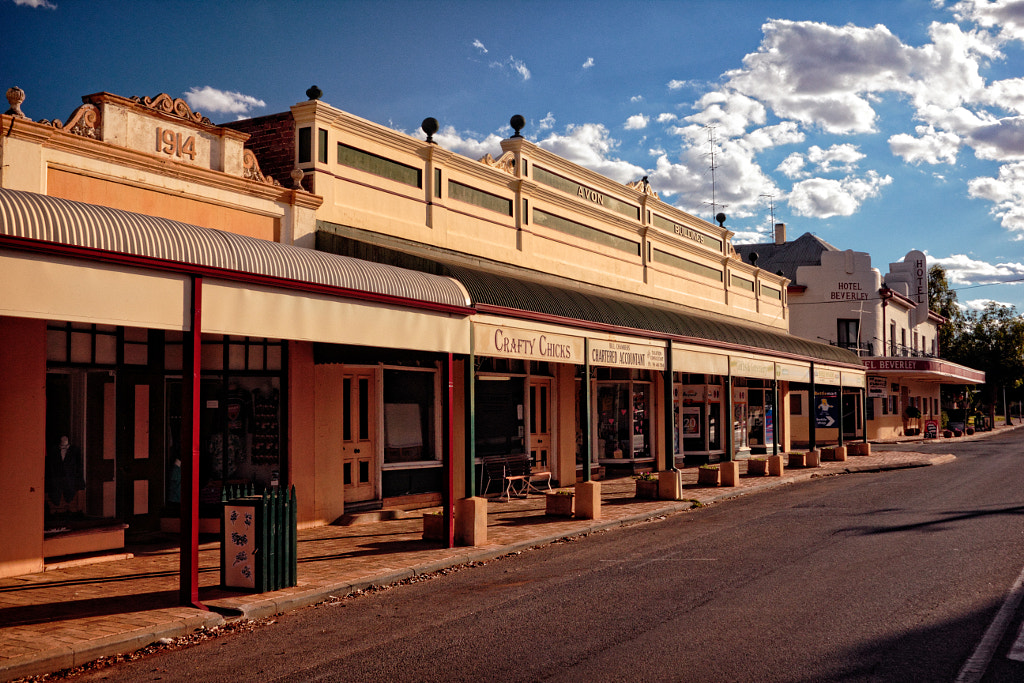
Beverley is 130 Km east of Perth and is a quiet agricultural town with its own distinct character which has been created by the wide range of architectural styles used to build it. A walk down Vincent Street will take you from Colonial, to Federation, to art deco to a 1960’s geodesic dome. It all sounds a bit of a hodge podge but it really hangs together well. There is a collection of farm machinery at Ferguson’s Machinery Shed on Hunt Road that recalls Beverley’s by-gone years as an important agricultural hub.
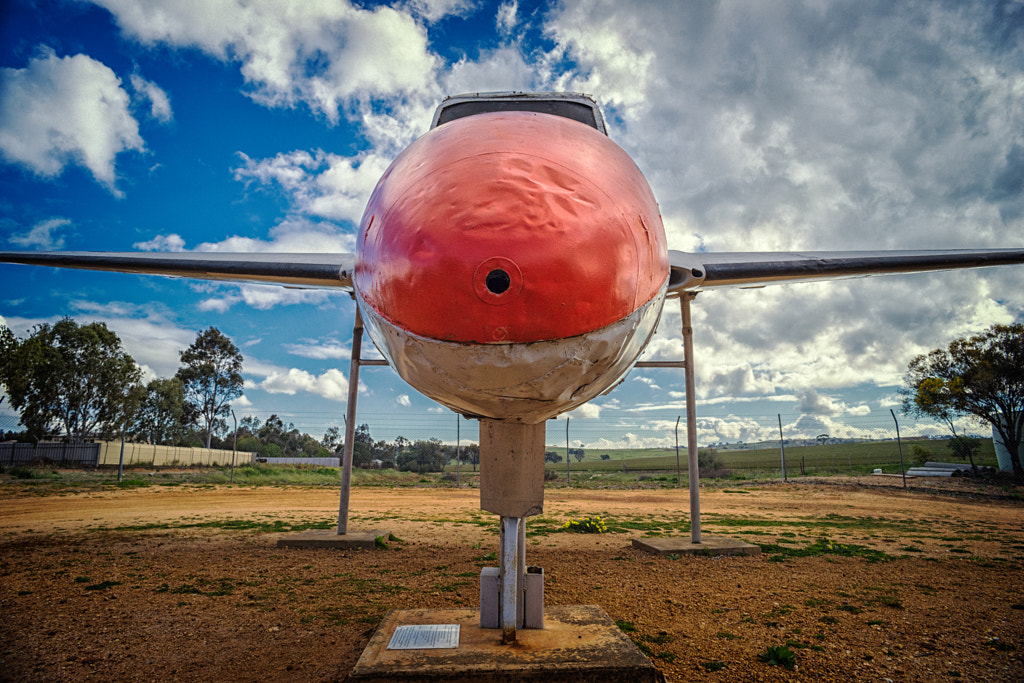
A Vampire jet on the Beverley-York Road
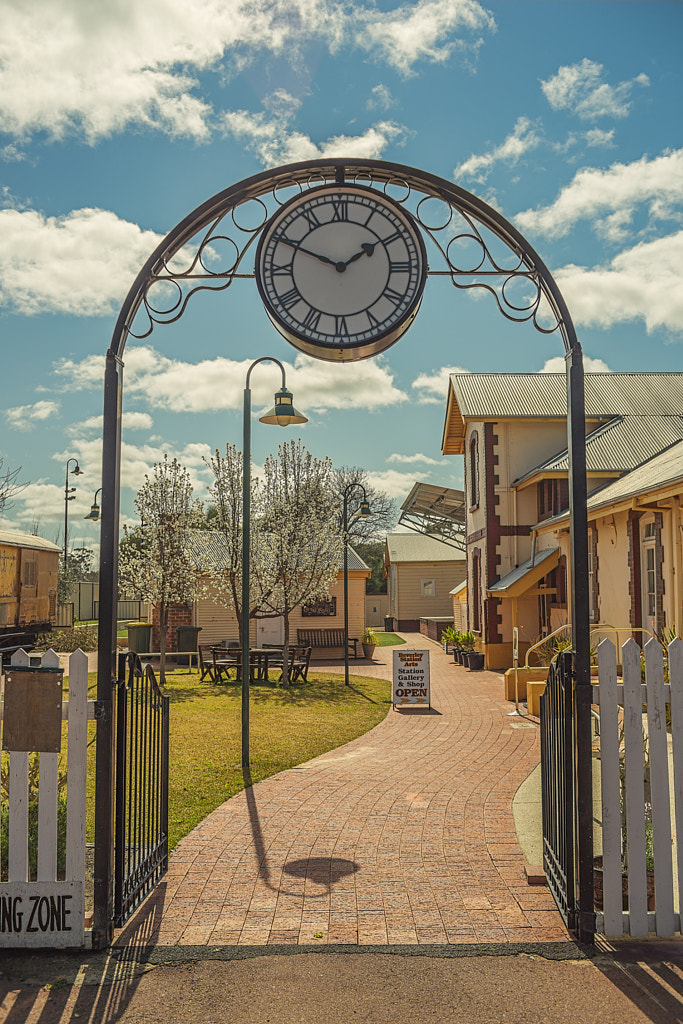
The entrance to Beverley Station Arts in the Western Australian town of Beverley.
The Railway Station was designed by George Temple-Poole and built in the Victorian Tudor style in 1886. It ceased to be a working station some years ago and has been renovated and converted into an arts centre. The Beverley Art Collection is on permanent display, there are resident artists, workshops and an outdoor theatre. The Dead Finish Museum was originally a hotel of the same name, its displays give an insight into what life was like in the early days of the district.
Dead trees ring Lake Yenyenning which became a salt lake after the land surrounding it was cleared for agricultural use. Beverley, Western Australia.
Outside of town are the Yenyenning Lakes which are a haven for birdlife and used for water sports, for directions ask at the Visitor Centre. Also out-of-town is Avondale Discovery Farm which has an 1850’s era homestead and is a working farm run by the National Trust using historic agricultural machinery and techniques.
Beverley Ester Art Exhibition – a very popular event which attracts lots of visitors to the town.
Beverley Clydesdale and Vintage Day has demonstrations of horse-drawn ploughing and vintage tractors and is held at the Avondale Discovery Farm in June.
The Great Southern Working Sheepdog Society Finals coincide with the above event and are also held at Avondale.
Beverley Agricultural Show is a real agricultural show. There are jam and cake competitions, pony events, tug of war, competitions for the best poultry, sheep, and cattle, and displays of country crafts. It is held in August of every year.
Beverley Harvest Festival at Avondale has displays of historic harvesting methods, working dogs, local produce to taste all capped off with music and dancing.
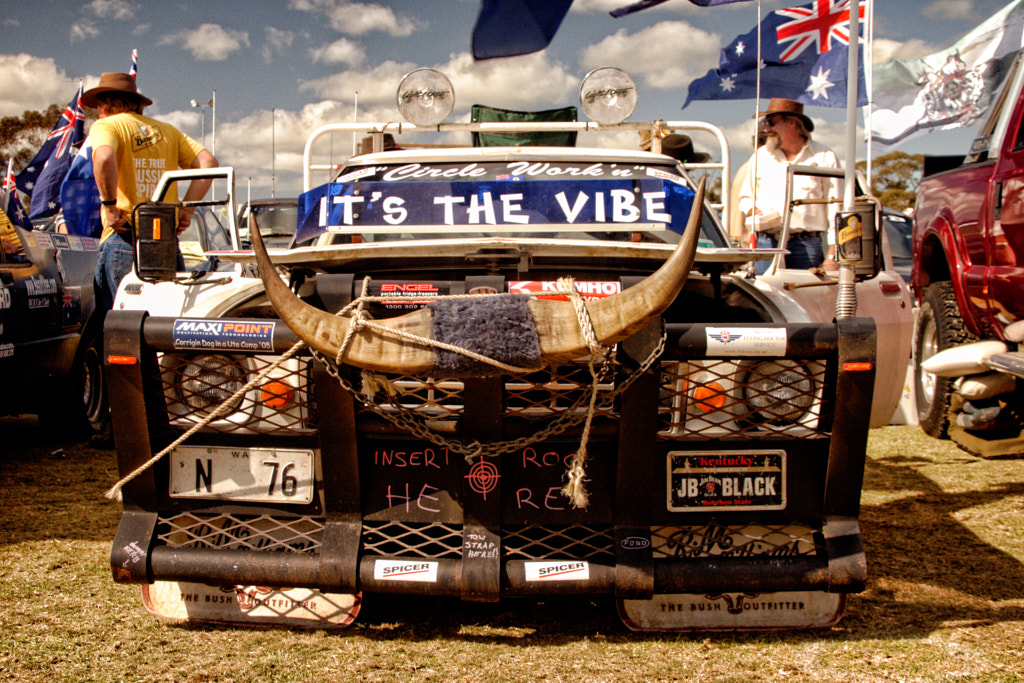
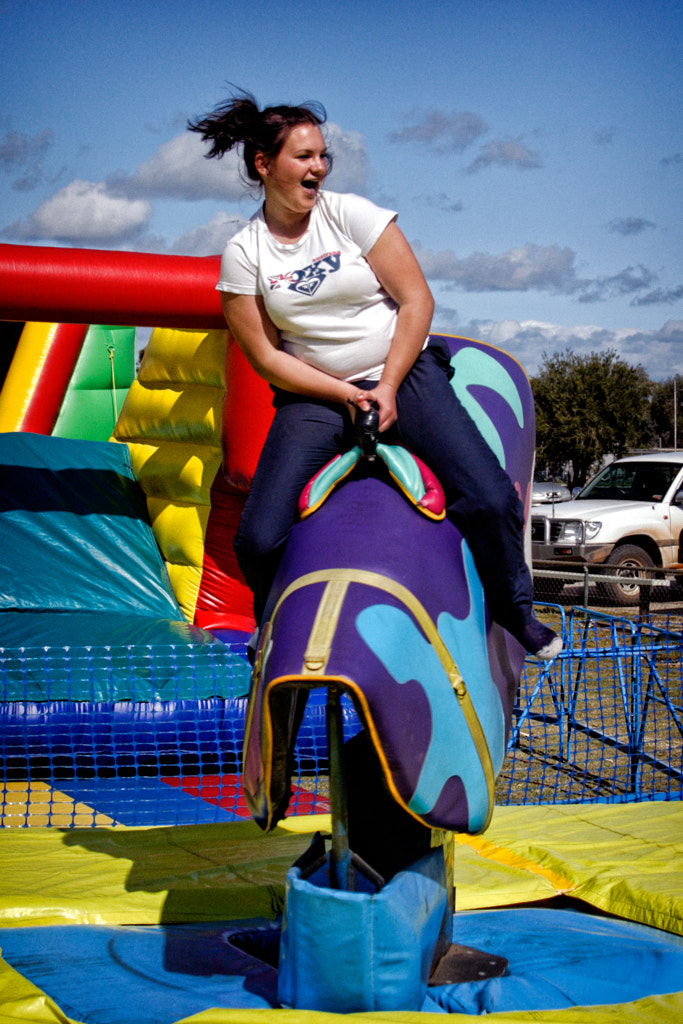
Riding the mechanical bull at the Beverley Agricultural Show.
The Avon valley was officially discovered by Ensign Dale in 1830 when Governor Stirling saw that the newly established Swan River Colony was going to starve unless it found some decent arable land. Of course the Nyoongar people knew about its existence all along and the upper reaches of the Avon were very important to their dream time stories. As we drive out of Perth on the Great Eastern Highway it’s difficult to imagine how hard it was for Dale all those years ago. What takes us an hour today in a car took him nine days of sheer heart breaking slog. The going was so bad that his horses became bogged in mud and it took all day just to travel one mile or 1.6 Km and he named one spot the Vale of Misery. Ensign Dale opened up a parcel of land the size of Tasmania, although in many cases it was not until the 1860’s that the townsites were established. In the tradition of Nineteenth Century explores he named many of the places after his friends, family and places back in England where he grew up.
Standing on top of Mount Brown and looking across towards Mount Bakewell and the town of York in Western Australia’s historic Avon Valley. A 4 image stitch done in Adobe Photoshop CS5. Camera used Panasonic Lumix LX-5. Focal length equivalent to 35mm in full frame terms. Exposure: 1/800 s at f/4.0 ISO 80.
Ensign Robert Dale of the 63rd Regiment of Foot is perhaps one of the great unsung heroes of early colonial exploration. Everyone remembers Burke and Wills, and Leichhardt because they lost their lives and that heroic failure mythologized them. Ensign Dale’s exploration and surveying of the Avon Valley, the Canning River and Mount Barker region was of vital importance to the survival of the early settlers in Western Australia. His survey of King George’s Sound in Albany was considered an important work then and is seen as an important artistic and historical document today. While undertaking this achievement he never got lost, he did not loose any men and he maintained excellent relations with the local aboriginal population. In total he mounted seven official expeditions and the journals from them were published in 1833. He was appointed to the post of temporary assistant government surveyor and promoted to the rank of Lieutenant. He acquired a lot of property with two town allotments in Albany, a thousand hectares in York and a further 750 hectares in the Swan Valley. But as quickly as his star had risen it fell. He was placed under virtual house arrest by his commanding officer in mid 1832. Soon after he became embroiled in the ugly saga of Yagan’s murder where he was ordered to take Yagan’s pickled head back to England and explain the situation to the Colonial Office and they stripped him of his rank of Lieutenant. Disenchanted Dale resigned from the military and went into business with his brother Thomas importing mahogany. In 1853, at the age of forty-four, he died of tuberculosis in the English town of Bath on the banks of the River Avon.
Today tourists drive out to the Avon Valley to see historic heritage towns, atmospheric homesteads, rocky outcrops and to picnic along the banks of the River Avon. A pleasant spring time trip would be to drive out to Toodyay and then follow the Avon down through Northam, York and Beverley returning to Perth via Westdale and the Brookton Highway. If time permitted you could arrange to stay overnight in Northam or York to get the most out of the trip.
Toodyay
Connors Mill in Toodyay, situated in the Avon Valley of Western Australia.
85 km northeast of Perth Toodyay was settled in 1836 and named after the Nyoongar name for the area “Duidgee” which means place of plenty. The original townsite was prone to flooding so it was abandoned in the 1850’s and relocated 5 km and renamed Newcastle. In 1911 the name was changed back to Toodyay because people confused Newcastle in WA with Newcastle in NSW. The Heritage Council of WA list over one hundred places of historical significance in or around Toodyay. Some of these are:
Newcastle Gaol – this was constructed in the 1860’s using convict labour in response to Moondyne Joe’s repeated escapes .
Connor’s Mill on Stirling Terrace was built in 1870 and was as the name suggests a flour mill, it was then converted into an electricity generating plant, and is now the Toodyay Visitors Centre.
Toodyay Post Office – designed by George Temple-Poole and built in 1897
Toodyay Fire station – designed by Ken Duncan and built in 1938
Stirling Street is the main drag in Toodyay and is full of colonial and federation architecture.
Toodyay plays host to several events throughout the year, the major ones are:
The Moondyne Festival is held on the first Sunday of May and celebrates Moondyne Joe’s life with re-enactments of Colonial life.
The Festival of Food coincides with the Avon Descent and provides culinary delights from all over the world, cooking demonstrations and free entertainment.
Theo’s Run is a convoy of classic cars and motorbikes that starts in Midland and travels to Dowerin via Toodyay.
Black powder demonstration. On the first Sunday of May the Avon Valley town of Toodyay celebrates Moondyne Joe’s life with the Moondyne Festival and the townsfolk re-enact the towns colonial past in the main street. The Perth Volunteer Rifle and Artillery Regiment 1860 is a Living-History group that seeks to portray the military and social life of a volunteer soldier in Western Australia during the period 1860 to 1901. Canon EOS5d with Canon EF28-135mm f/3.5-5.6 IS USM lens. Exposure 1/80 s at f/8.0 ISO 200.
Toodyay’s Moondyne Festival is the story of Western Australia’s favourite Bushranger, Joseph Bolitho Johns, aka Moondyne Joe is a classic case of where truth is stranger than fiction. Transported to WA as a convict, given a ticket of leave and released, some would say that Johns was a victim of society while others would see him as a recidivist, but what ever your viewpoint it is a fascinating story of a man who is hard done by, has a disdain for authority, who makes repeated escapes from custody and ends up spending his last days in Fremantle Asylum suffering from dementia.
A convivial chat at the Moondyne Festival in Toodyay.
Moondyne Joe on the run up Stirling Street in Toodyay.
The Toodyay Moondyne Festival has Joe and his gang running riot in the streets of Toodyay. He holds people up, consorts with floozies, avoids the incompetent police and the annoying temperance ladies, is arrested, put on trial and escapes. With local people dressing up in period costume the end result is a gigantic al fresco pantomime with heaps of audience participation (chants of “Free Joe” and “Behind you” ). Alongside the theatrical mayhem there are bush poets, market stalls, displays from the 1860 Regiment, vintage cars and mustache and cleavage competitions. A brilliant day out for all the family.
Northam
Hot air balloons flying over the Avon River at Northam in Western Australia.
Northam is 98 Km from Perth on the Great Eastern Highway and it is the largest town in the Avon Valley. With its central location in the valley it makes the perfect base from which to explore. Up until 1891 it was the poor relation to York, but this changed with the coming of the railway linking Perth with the Goldfields and the town became an important staging post. During the 1940’s and 50’s Northam became an important centre for housing displaced European refugees and migrants, in fact the Northam Accommodation Centre was the third largest such facility in Australia. By the time it closed some 23,000 people had passed through its gates. There is a photographic exhibition telling the story at the Northam Visitor Centre. There is a historic town walk that enables visitors to experience the town’s history, some of the significant places on the trail are Morby Cottage – home of the founder of Northam and built in 1836 – and the Old Railway Museum which was built in 1886. More details for both venues can be had by contacting the Visitor Centre. The town hall on Fitzgerald Street is a wonderful example of concrete carbuncle architecture from the 1970’s.
A Yellow-billed Spoonbill (Platalea flavipes) flying back to its nest on the Avon River. Northam, Western Australia.
Northam’s Concrete Carbuncle. The town hall on Fitzgerald Street is a wonderful example of concrete carbuncle architecture from the 1970.
Northam is also the eastern terminus of the Kep Track a 75 km long mountain bike and walking trail that starts in Mundaring and follows the water pipeline the engineering genius CY O’Connor built to take water out to the Goldfields of Western Australia. The name Kep comes from the local Nyoongar word for water. The Golden Pipeline Heritage Trail follows the pipeline in its entirety all the way from Mundaring Weir to Kalgoorlie 650 km to the east, and it also passes through Northam.
The paddlers get ready to start the Avon Descent. Northam, Western Australia.
Northam is the staring line for The Avon Descent, which was first held in 1973, and there were only forty nine competitors. The event has grown so much now that this year there were over 800 competitors and 2000 plus support crew. In more ways than one it deserves the title the “world’s greatest white water event”. The 134 km two day event starts at Northam and finishes at the Riverside Garden in Bayswater with an over night stop at the Boral Campsite just outside Toodyay. For the majority of entrants the aim is just to complete the course, but for the elite athletes it is a chance of competing in a unique endurance race. The race happens on the first weekend of August every year. It kicks off on the Friday night in Northam with a float parade and firework display. On Saturday morning the event kicks off proper.
Despite the recent cold wet snap here in the Avon Valley I’ve managed to keep getting out into the bush looking for native orchids.
The dancing spider orchid (Caladenia discoidea) is also known as the Bee Orchid and Antelope Orchid. Although it is very small and easily missed its distinctive shape means that it cannot be mistaken for anything else. Mount Observation, Western Australia. Canon EOS5d, Sigma 105 f2.8 macro lens, Canon 430EX speedlite with Stofen Omnibounce mounted on camera. Exposure: 1/200 s at f/8.0 ISO 100 in manual mode.
The dancing spider orchid (Caladenia discoidea) is also known as the Bee Orchid and Antelope Orchid. Although it is very small and easily missed its distinctive shape means that it cannot be mistaken for anything else. Mount Observation, Western Australia.
Canon EOS5d, Sigma 105 f2.8 macro, Canon 430EX Speedlite fitted with a Stofen Omnibounce off camera left triggered by OCF TTL cord. Manual exposure 1/200 s at f/8.0 ISO 100 with -1 stop FEC.






You must be logged in to post a comment.