I mentioned a couple of weeks ago we’d gone to Hyden. We’ve been plenty of times before and I have written about those visits here, here and here. Wave Rock doesn’t hold much interest in itself – its just a big rock shaped like a wave. What is more interesting is the nature around the rock. When the winter rains come an incredible amount of water runs off the rock and this means there is a lot of vegetation that has become home to animals around the base. Not far from the rock and the vegetation gives out and you can see a salt plain with Lake Magic. This too is great place for observing animals and seeing wildflowers.
Unfortunately we’d had our beautiful weather on the drive down and the rain really set in – so much so that my walk along the base of Wave Rock, out to Lake Magic and then back via Wave Rock Airport and the Wildlife Park was in danger of becoming an aquatic walk. Thankfully I was dressed for the occasion and swathed in Gore Tex. My Olympus EM 1 mk ii is very well sealed against the elements as are the lenses. Despite my careful preparation the subject matter – orchids and birds – didn’t want to oblige. Regardless of the weather that the walk was really enjoyable.
Hairy stemmed snail orchid, Pterostylis sp. ‘hairy’. Hyden, Western Australia.
Dark banded greenhood, Pterostylis sanguinea. Hyden, Western Australia.
Blue beard or blue fairy orchid (Pheladenia deformis). Hyden, Western Australia.
Hairy stemmed snail orchid, Pterostylis sp. ‘hairy’. Hyden, Western Australia.
Singing Honeyeater, Gavicalis virescens. Hyden, Western Australia.
This could have been titled Hyden – the return. Hyden is a small town in the middle of the Wheatbelt in Western Australia some 292Km east of Perth. Regular readers will remember that we’ve been before and maybe somewhat perplexed as to why we’d bother to visit again. Well Hyden’s claim to fame is Wave Rock which is a large granite rock face that has been eroded in the shape of a perfect breaking wave. More than 100,000 tourists make their way there very year. Most just stay about an hour before zooming off to another destination to get the perfect instagram shot without taking any time to see what else is there. A great shame really as there is so much more to offer. When I wrote about our previous visit I concentrated more on other sites and the Aboriginal heritage of the area. This time I’ll look at what Hyden has to offer in terms of the natural world.
We decided to make a three day trip and on our way we’d stop off in Corrigin whose main claim to fame is the being the holder of the world record for the number of dogs in a ute and being the home to a dog cemetery. You’d be forgiven for thinking that Corrigin is a bit obsessed with dogs. Anyway it was a nice spot to break the journey, stretch the legs, make the bladder gladder etc. Corrigin does have a pretty impressive wildflower drive which begins just opposite the dog cemetery just on the outskirts of town. Most people just pull up in their car, jump out and walk a couple of metres. They then declare that there’s nothing to see and rush off in a cloud of red dust. Just take your time and have a poke about and you’d be amazed at what you can find. Here are a few examples.
Sugar Candy Orchid, Caladenia hirta subsp. hirta. Wildflower Drive, Corrigin, Western Australia. Panasonic Lumix G85 with Olympus mZuiko 60mm f2.8 macro lens and Metz 15MS-1 flash. Exposure: AE priority 1/200 sec, f4 at ISO 400 with -1 stop exposure compensation.
Chameleon Spider Orchid, Caladenia dimidia. Wildflower Drive, Corrigin, Western Australia. Panasonic Lumix G85 with Olympus mZuiko 60mm f2.8 macro lens and Metz 15MS-1 flash. Exposure: AE priority 1/100 sec, f4 at ISO 400 with -1 stop exposure compensation.
Blood Spider Orchid, Caladenia filifera. Wildflower Drive, Corrigin, Western Australia.
Slender Spider Orchid, Caladenia pulchra. Wildflower Drive, Corrigin, Western Australia.
Sugar Orchid, Ericksonella saccharata. Wildflower Drive, Corrigin, Western Australia.
When we got to Hyden we drove out to the Wave Rock Resort on the shore of Magic Lake which is where we were staying. The lake is quite startling. It’s not very big but is comprised of crystal clear salt water with a gypsum base. That pale coloured lake bed combined with the water makes a giant reflector that takes on the colours of the sky so as the day progresses the lake changes colour. To add to it’s other worldly qualities is that it lies in the middle of a salt plain which is fairly uniform in colour and is covered in mainly scrubby bush and a smattering of trees. It all made me want to get the tripod and graduated neutral density filters out.
Magical Magic Lake. A canoe on Magic Lake beach at sunset. Western Australia. Panasonic G85 with Panasonic Leica 8-18mm f2.8-4 lens and +3 stop graduated neutral density filter. Exposure: AE priority 1/8 sec, f11 at ISO 200 with +1 stop exposure compensation.
Magical Sunset. Magic Lake at sunset. Hyden Western Australia.
The next day we decided to combine the Wave Rock Walk Circuit with the Hippo’s Yawn Loop and the Breakers Trail to create a loop that would take us from the resort up to the Hippo’s Yawn then along the bottom of the rock out to the Breakers picnic area and then back to our accommodation at the resort. The best part of it was that we could take the dog as it is all very pet friendly. Along the way we hoped to see more orchids and birds as we passed through the salt plain and into the bush at the base of the rock.
Old fence posts march across the salt flats at Magic Lake near Hyden in Western Australia. Panasonic Lumix G85 with Panasonic Leica 100-400mm f4-6.3 lens. Exposure: 1/250 sec, f8 at ISO 200.
Crested pigeon, Ocyphaps lophotes, Magic Lake, Hyden, Western Australia. Panasonic G85 with LEICA DG 100-400/F4.0-6.3 lens. Exposure: Shutter priority 1/500 sec, f6.3 at ISO 200 with -1/3 stop exposure compensation.
Known to the Nyoongar as Kayibort the Black-faced woodswallow, Artamus cinerus, can be seen on the shores of Magic Lake, Hyden, Western Australia. Panasonic G85 with LEICA DG 100-400/F4.0-6.3 lens. Exposure: shutter priority 1/500 sec f6.3 at ISO 200.
Salt Lake Spider Orchid, Caladenia exilis subsp. exilis. Magic Lake, Hyden, Western Australia. Panasonic g85 with OLYMPUS M.60mm F2.8 Macro lens. Exposure: aperture priority 1/640 sec, f4 at ISO 200 with +2/3 stop exposure compensation.
Yellow Spider Orchid, Caladenia denticulata subsp. denticulata. Magic Lake, Hyden, Western Australia. Panasonic G85 with OLYMPUS M.60mm F2.8 Macro lens. Exposure: aperture priority 1/125 sec, f8 at ISO 1000 with -1/3 stop exposure compensation.
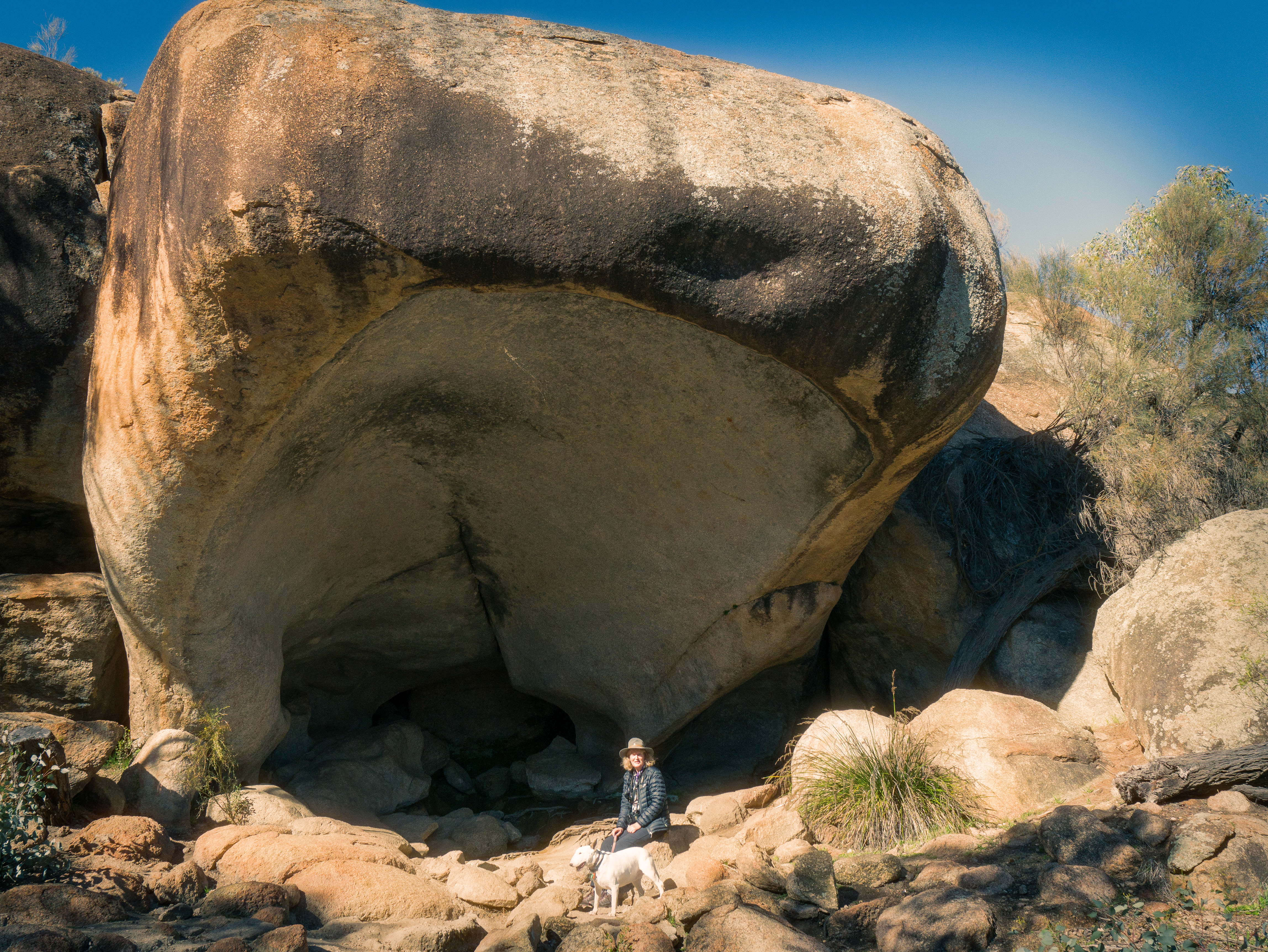
When we got to the base of the rock the vegetation changed from the scrub of the salt plain to thick bush fed by the water run off from the rock. We both enjoyed pocking around in the undergrowth looking for flowers, taking photos of each other and trying to dissuade Frida, our dog, from trying to climb up the rock face in search of interesting holes. It was amazing to see so many orchids – the blue beards were like a carpet in places. It was absolutely wonderful to see.
Helen and Frida at Hippo’s Yawn near Hyden in Western Australia.
Jug orchid, or recurved shell orchid (Pterostylis recurva). Wave Rock, Western Australia.
Blue beard or blue fairy orchid (Pheladenia deformis),. Wave Rock, Western Australia.
All in all we had a great time. There is so much to see and do that we’re already talking about going again. If you are planning a trip to Wave Rock there is a whole lot more to it than posing for a selfie for Facebook on the rock.
The Emu Fence at Wave Rock Resort. Hyden, Western Australia. iPhone SE in panorama mode. Exposure: 1/1400 sec, f2.2 at ISO 25.
Wave Rock at sunset. Hyden, Western Australia. Olympus OMD EM1 mki with Olympus m.Zuiko 12-40 f2.8 lens. Exposure: 1/160 th sec, f5.6, ISO 200.
Every day tour buses stop over in York on their way to Wave Rock near Hyden. The Northern Territory has Uluru (formerly known as Ayres Rock) and Western Australia’s tourism industry markets Wave Rock as our equivalent. I often feel sorry for the tourists, particularly the Chinese and Japanese ones, as they drive out from Perth to the middle of nowhere to see a large rock that looks like an enormous ocean wave frozen for posterity. I wonder what they think when they get there.
A week or so ago we went out to Hyden to visit Wave Rock. It’s not the first time we’ve visited, we first went in 2008. I find it very hard to be enthusiastic about it – it is just a curved rock face. My over all feeling is that Wave Rock is more marketing than substance. What I find more interesting is the way people interact with it. The majority of people just pull up in the car park and jump out to quickly take a selfie with their phone or a couple of seconds of video on a GoPro on one of those annoying sticks that they nearly poke someones eye out with as they are too busy on making strange faces for the camera. They then jump back into their cars and race off to the next destination on their itinerary. The next group of people are harried parents herding their bored looking children around and eventually persuading them to have their photo taken while they pretend to surf the perfect stone wave. The best was a young Chinese couple – he was shooting “glamour” photos of her while she was standing halfway up the curve in skimpy attire and the most incredible high heels – the sort that you need a ladder to get into and induce vertigo. My immediate reaction was not to perv the girl, but one of how the hell did she get up their dressed like that. The answer was obvious – when he finished taking photos he threw a bag up to her and she changed into a pair of track pants, a t-shirt and trainers and slid down on her backside.
Mulka’s Cave in the Humps Nature Reserve is a site of special significance to the Nyoongar people. Apart from being the subject of local folklore it also has the largest collection of rock paintings in the south of Western Australia. Olympus OMD EM1 mki with Olympus m.Zuiko 12-40 f2.8 lens. Exposure: 1/30 sec, f5.6, ISO 3200.
Sixteen Kilometres north-east of Wave Rocks is The Humps Nature Reserve. It’s not a very appealing name and probably doesn’t help with marketing to the tourist hordes. The Humps are a massive granite outcrop some 2 km x 1.5 km in area and rises to 80 m above the surrounding plain which was and is of huge cultural significance to the Nyoongar people. Mulka’s Cave is a gallery for 452 motifs which makes it the largest collection in southern Western Australia.It is thought that the paintings were produced over the last two or three thousand years and it feels like the people who made them are reaching out from the past to the present day. It really reinforces the impression of spirit of place and of belonging to the land. To me this is what makes The Humps more special than Wave Rock, it engenders a feeling to that felt at Uluru or Ubirr. Powerful stuff. Mulka’s Cave is named after one of its inhabitants about which there is a gruesome Dreamtime story.
‘Mulka was the illegitimate son of a woman who fell in love with a man to whom marriage was forbidden. As a result, Mulka was born with crossed eyes. Even though he grew up to be an outstandingly strong man of colossal height, his crossed eyes prevented him from aiming a spear accurately and becoming a successful hunter. Out of frustration, Mulka turned to catching and eating human children, and he became the terror of the district. He lived in Mulka’s Cave where the impressions of his hands can still be seen much higher than those of an ordinary man. His mother became increasingly concerned with Mulka and when she scolded him for his anti-social behaviour, he turned on his own mother and killed her. This disgraced him even more and he fled the cave, heading south. Aboriginal people were outraged by Mulka’s behaviour and set out to track down the man who had flouted all the rules. They finally caught him near Dumbleyung 156 km south-west of Hyden, where they speared him. Because he did not deserve a proper ritual burial, they left his body for the ants – a grim warning to those who break the law.’
R.G.Gunn, Mulka’s Cave Aboriginal rock art site: its context and content, Records of the Western Australian Museum 23: 19-41 (2006).
Nyoongar hand prints reach out from the past in Mulka’s Cave. Hyden, Western Australia. Olympus OMD EM1 mki with Olympus m.Zuiko 12-40mm f2.8 lens. Exposure: 1/100 sec, f4, ISO 1600.
There are a couple of walks in the reserve – The Gamma Trail a 1.2km interpretative walk explains the significance of the area to the local Nyoongar people, and the Kalari Trail, a 1.6 Km trail climbs to the summit. The early morning walk to the summit was fantastic. There were kangaroos amongst clumps silver princess trees (Eucalyptus caesia), nankeen kestrels were riding the thermal currents looking for prey and there were hosts of wrens bathing in the shallow pools of water on the rock surface. You get the feeling that this is a place where everything has been stripped back to the elemental essentials. Time was standing still. Of course the moment was lost as the multitudes of tourists pulled up in the car park jumped out to grab a selfie in the cave and use the toilet, their chattering voices carrying up to the summit shattering the tranquility. For a brief couple of hours on top of the humps I was somewhere else quite magical.
Rock pool on the Humps. The Humps are a large granite outcrop to the north-east of Hyden, Western Australia. Olympus OMD EM1 mki with Olympus m.Zuiko 12-40mm f2.8 lens. Exposure: 1/640, f8 at ISO 200.
A nankeen kestral soaring the summit of the Humps. Hyden, Western Australia. Olympus OMD EM1 mki with Olympus m.Zuiko 12-40mm f2.8 lens. Exposure: 1/500, f9, ISO 200.





You must be logged in to post a comment.