A male Blue Skimmer (Orthetrum caledonicum) at rest. Lake Leschenaultia, Western Australia.
We went to Lake Leschenaultia and I had all these plans to photograph dragonflies in flight. I’d got this shot all planed out in my mind to get a shot of one flying just over some reeds. I’d set the camera up with what would be the best lens and headed out to an area on the lakeside where I knew I’d find some and there would be some nice light. Except it was very windy and I couldn’t find any dragonflies. I went off to the reed beds behind the boat shed thinking that should prove more fruitful as it was in the lee of the wind. There were loads there flying around and it was amazing to watch them chase each other around, but from a photographic point of view it wasn’t so good as there was a rather belligerent tiger snake who really did not want to share his basking spot. So I walked around the lakeside a bit further and found another spot that was sheltered from the wind. But try as I might I just could not get the shot I was after. They wouldn’t fly where I wanted, wouldn’t fly slow enough or in a straight line. In the end I had to content myself with the photo above. The dragonfly just rested on that twig for a couple of seconds in the shade and then it was off.
Nature photography is hard. We can have an idea of the shot in our minds eye and try to make it happen, but then nature doesn’t play ball with us and then we have to adapt and take what we’re given. Bit like life really.
The Autumn burn off in the fields of the Western Australian Wheatbelt has left its distinctive stripes on the landscape.
Thought I’d put up a couple more pictures of the stripes fields we’ve got round our way. They won’t be around for much longer as we have had the first real rains and there will soon be a green flush that will change the colour of the landscape.
I must say it’s been quite nice to do some landscape photography again. I decided to go all retro and pull out the Cokin filters and a couple of older cameras. The top photo was taken with a Canon 6d and the Canon EF 70-200mm f2.8 IS L Mk I which completed the old school experience. The photo below was shot on the Olympus EM1 Mk i. They may not be the latest and greatest cameras and lenses but they still deliver
Time lapsing at Lake Leschenaultia in Western Australia.
The last few weeks I’ve been spending a day at Lake Leschenaultia. I’ve photographed there often but this time I thought I’d try making a video about some of the wildlife there. In the process I’ve discovered three things:
The animals don’t play ball. Quite a few times I went and they didn’t show up.
It’s harder than it looks. We’re accustomed to seeing the David Attenborough docos on the TV and they spoil us because trying to get anything halfway decent takes an enormous amount of time, dedication and skill.
All the cameramen and directors of photography I know of all complain of having wrecked backs. Having carted the equipment round for a few weeks I now know why – it’s bloody heavy!
Having said that it has been great fun and while I’m not particularly happy with the resulting video I enjoyed the whole experience immensely.
Now for a shameless plug. Autumn, Winter and Spring are the best times to go walking in Western Australia and the walk around Lake Leschenaultia is one of forty two that are in my book Perths Best Bush, Coast and City Walks which can be bought through the link given. Further more if you use the code PAULA15 you get a discount of 15%.
Beloved Significant Other collecting an armful of trophies from Emma Cole, mayor of the City of Vincent, at the recent Croqetwest awards presentation for 2018-9.
Well Beloved Significant Other (BSO) Helen Amyes had a stonker of a year on the croquet front and was invited to attend the Croquetwest 2018-9 trophy presentation. Yours truly was tagging along as the +1 with aim of taking just a couple of photos for her clubs Facebook page. The inevitable happened. Turn up with a camera, couple of lenses and a flash and suddenly you are the “official” photographer and taking the photos for the press and social media. As I’ve said before grip and grin is not my favourite form of photography. There wasn’t a lot of wriggle room for an alternative approach this time so it was pretty basic event photography. At least it was helped along in the form of a jolly jape where fake awards were interspersed with the real ones. Even the recipients were left wondering what they’d actually just won.
Brett McHardy and his partner Janine were winners of Golf Croquet Under Age Doubles. Brett is trying to work out what he’s just won.
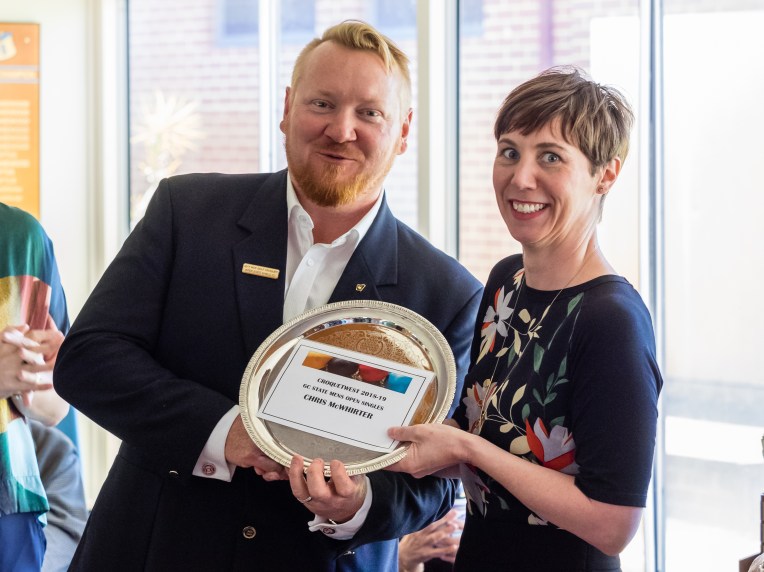
Chris McWhirtter receiving the prize for being the winner of the Golf Croquet open singles from Emma Cole.
Penguin Island is home to a colony of approximately 1,200 little penguins, the largest population of the birds in Western Australia. The Penguin Discovery Centre is home to a small population of rescued birds which cannot be rehabilitated to the wild.
This week’s episode of Paul’s Pootles takes us to Penguin Island.
This is another walk from my book which is available from all good Australian book stores.
Hell or high water is the new motto for the Avon Descent and was adopted because recent years have seen decreasing amounts of rainfall falling and competitors have had to carry their craft where there was insufficient water. This year, 2017 and the 45th occasion of the race, the water levels were high which meant potentially new records could be set. The Avon Descent was first held in 1973, and there were only forty-nine competitors. This year there were 370 competitors with many coming from interstate and overseas. In more ways than one it deserves the title the “world’s greatest white water event”. The 124 km or 77 mile two day event starts at Northam and finishes at the Riverside Garden in Bayswater with an over night stop at the Boral Campsite just outside Toodyay. For the majority of entrants the aim is just to complete the course, but for the elite athletes it is a chance of competing in a unique endurance race.
The beauty of this race is that you can pick out a few vantage points from a list put out by the race organisers on their website and follow the whole event documenting the whole story rather than just getting an isolated snap shot. In previous years I’d covered the race for magazines shooting stills and then writing the story. This year I had intended to cover the entire event from start to finish and it was to be first time I’d covered it shooting video. Having planned my weekend around the race it was time to check the maps and the approximate timings for each stage. For instance there was no point heading to the first stage after the start as I would not have had time to get there by car, park, and then walk along the river to find a good location to set up. Also I had to think about the weather conditions, because at some of the viewing points you are bussed in and that would mean I’d have to carry everything with me. As the forecast for the weekend was a cold start it was thermals, and fleece. he key was light layers that could be added or taken off as conditions permitted. Camera and lens choice was hard, and I found it difficult to make a decision. For the Friday shots I could work from the back of the car and it was all to be people shots around Northam and for the sake of mobility using either a monopod or a gimbal. In the end I decided to use the Sony A7r and with Olympus OM Zuiko lenses – the 20mm, 50mm and 135mm. This and the gimbal went in a belt pack. Saturday involved shooting at three sites and I wanted to shoot some time-lapse as well as video footage. So I chose the Olympus OMD EM 1 with 40-150mm f2.8 lens for the video work and the EM10 with 12-40mm f2.8 for the time-lapse. I couldn’t set up a tripod at the start as I was going to shoot on the swing bridge so I used a monopod for the video and for the time-lapse I clamped the Syrp Genie Mini to the bridge safety barrier with a Manfrotto super clamp. All this went into my photo back pack. Sunday was the biggest problem with no car access to Bells Rapids everything had to be carried. So I took the Canon EOS6d with 24-70mm, 70-200 and a x2 converter. I’d also need plenty of batteries and memory cards as there would be no nipping back to the car. I decided to carry all this in pouches on a belt as I needed to be able to scramble up some rocks to get a good vantage point. At Bells I mounted the camera on a tripod but at the finish line I shot just using a monopod.
The race happens on the first weekend of August every year. It kicked off on the Friday with the competitor registration at the Northam Swimming Pool and then their craft were taken down to the race marshalling area on the banks of the river. Late in afternoon and into the evening was the Avon River Festival with a huge fireworks display on the Avon River, stage shows featuring a variety of local talent, a family fun zone, rides for all the family, sideshow alley and roving entertainment, a community street parade, markets for avid shoppers, and food. On Saturday morning the event kicked off proper. As I arrived I could see hot air balloons drifting lazily above the river. The power craft were away quickly and smoothly and then it was the turn of the paddle craft. I was surprised to see that someone was competing for the first time on a Stand Up Paddleboard (SUP). Barely had half the paddle craft left than the news came through that the first power craft had reached Toodyay. It was going to be a very fast race with little hope of getting shots of the power craft. I spent a total of an hour and half standing on the swing bridge -it is a wire suspension bridge that bounces a lot, the police constable standing next to me complained of feeling seasick from the constant motion. It didn’t effect me but it really made me glad that I had the in body stabilisation activated on the cameras. After the start I went to Williamson Weir stayed there for an hour and a half. The Weir is man-made and its concrete lip and rock wall are hazardous to boat and paddler alike so around half the competitors choose to portage around it. Thankfully the other half run it and you get the thrills and spills with plenty of encouragement from the watching crowd. Finishing up in Toodyay for the day is great. There is always a great vibe with a tremendous crowd and a party like atmosphere. When I got there the town was packed and in full on carnival mode. It took an age to find some parking and get down to the river. Here there was a team change over area, and along the riverside were lots of anxious looking paddlers all staring up river for any sign of their team mates. As the first canoes started to come round the corner and pass under the timing gate they got their first sight of their team mates and their faces would burst into a huge grin of relief. The spectators would burst into rapturous cheers as the fresh team-mate paddled away heading for the Boral Campsite that marked the halfway point and the end of day one.
I couldn’t face getting up at 4;30am in the dark and freezing cold to get to the start at Boral Camp for day two so I just headed out a bit later and went straight to Bells Rapids in Walyunga National Park. You have to leave the car at the nearby state equestrian centre and then you taken in by bus. From there it was a quick walk to what I call the media rock. It’s a nice big rock that juts out into the river which gives a good view of the competitors coming under the bridge and through the rapids. I got there just as the TV crews were claiming their spots and setting up. I squeezed onto the end closest to the bank and put my tripod up to mark my territory. When the press photographers arrived they gave us a filthy look, but as they were shooting hand-held they didn’t need as much space. A little while later a hopeful photo enthusiast asked if could join us on the rock, one of the guys I know from the papers said it was OK if he didn’t talk about equipment – his or ours – and if he did he’d get thrown in the river. He decided that he couldn’t not talk about kit and took himself off somewhere else. After a couple of hours I knew that I’d have to get my skates on if I was to get to the finish line.
The finish line is in Bayswater a suburb of Perth. A huge screen had been put up and there was a live commentary being given. I positioned myself by the finish line as I find that the images taken as the paddlers beach their boats and walk ashore tells a very powerful story. It does not seem to matter whether they are newbie’s in their first race or veterans each face has a similar look etched upon it. It is a mixture of pain from the sheer physical effort, relief from finishing, and disbelief that it is all over. Some will swear that they will never do it again, but most know that even as they hit the finish line that they will be back next year.
So now a week later, I’ve edited the 50Gb of footage and made a 7 minute clip. As I write this I’m thinking about how things went and what I would change if I were to do it again. Well to start with I wouldn’t bother with the Sony. It produces very nice images, but the screen is terrible. It is winter here and the days aren’t as bright as they can be, but the Sony’s rear LCD panel is virtually unusable. The other thing that puts me off is that the user interface isn’t very intuitive and so adjusting some settings in a hurry is a pain in the nethers. The OMD EM1 mk i is constantly a surprise when shooting video. The touch screen is a pleasure to use and the phase detect auto focus does very well. It is tempting to run off and get a mk ii for the 4K and the improved focusing. The Canon EOS 6d was the surprise, the autofocus is crap, but Technicolor’s CineStyle Profile and Canon’s superb lenses produce gorgeous images. All it needs is a flippy flappy touch screen and dual pixel auto focus and it would be perfect. “The 6d mk ii has that!” I hear you say, but (and there is always a but) the mk ii’s video compression is worse than the mk i. What Canon give they take away! There is always the EOS 80d. I might try to hire one for the next project I shoot. I wish I’d used the gimbal more instead of the monopod, accepting the fact that I couldn’t use it for the long lens shots. Sound could be a lot better – it is the aspect of video I always struggle with. I’m also beginning to think that I’ve out grown iMovie – a better editor would give me some more options. I’ve downloaded DaVinci Resolve to give that a whirl on my next project. In many ways I’m no different to the competitors in the race – I’m already starting to plan for next year!
On the weekend of 19th-21st May 2017 I travelled with my significant other to the teeming Wheatbelt metropolis of Narrogin as she had entered the annual “Guns and Roses” croquet tournament put on by the Narrogin Croquet Club. Twelve of Western Australia’s best players (the “Guns”) would partner eighteen lesser ranked players (the “Roses”). Each “rose” would get the opportunity to play with a different “gun” at each round. The idea, which seems an excellent one I might add, is that inexperienced players can learn off of top players. My role in this was the self-given task of producing a video documenting the proceedings.
Video is a fairly new medium for me, I’ve been playing around with it but I’ve really not got to grips with it. This was to be a complex multi day project and it wasn’t helped by the fact that it was bitterly cold and there was intermittent heavy rain (yes dear reader we do have cold wet weather in Australia). I ended up using my Olympus OMD EM1 mk i with the Olympus m.Zuiko 40-150mm f2.8 lens as the main camera, an Olympus Pen EP5 with the Olympus m.Zuiko 12-40mm f2.8 for wide shots, a Leica D-Lux for time lapses, and my iPhone for social video in the evenings. For sound I used shot-gun microphones (a Rode VideoMicro on the EM1 and a Rode VideoMic Pro on the EP5) to record straight into the cameras. No external audio recorder was used as I felt I had my hands full enough. By the end of the weekend I had got through nine batteries and ten 16Gb SD cards. The EM1 was used on a tripod (a Manfrotto MDEVE 755XB with Manfrotto MV500AH Fluid Video Head), the EP5 was on a video monopod (Manfrotto 562B-1 Fluid Video Monopod), and the Leica D-Lux was on a photo tripod (a very old Manfrotto 190 tripod fitted with an equally old ball head).
What I learnt from this exercise was:
the weather sealing on both the EM1 and the two lenses works very well. At times I got soaked in the rain and the camera just kept going with no adverse effects.
I should have used an audio recorder to get better sound and record some general background noise.
the 40-150mm f2.8 is not parfocal (it is not sold as such) and the autofocus kept drifting and in some cases would not lock on at all. Trying to focus on the night games using just the rear screen and no peaking was hard. Either a camera that has focus peaking in video mode or a monitor that allows it would be really good.
I shot most of the footage at 1080 at 25fps except for that on the EP5 which only shoots 1080 at 30fps. I used Toast Titanium’s video converter to reconfigure it as 1080 25fps. On the whole it worked out well, but on two clips that I really wanted it dropped frames and lost the sound. So next time I won’t mix clips of different frame rates.
With four cameras, each having its own idea of what a neutral colour setting is, made life very hard during editing. This wasn’t helped by the fact that the 8 bit 4.2.0 files didn’t like being pushed too much in post as they would quickly fall apart. It would have been nice to have had a more video orientated camera with a flatter profile and more robust codec.
I did the slow motion in post, it would have been nice to have shot at 60fps or higher to get nicer slo-mo.
I should have shot more B-roll and tried to interview on camera some of the participants.
As a learning experience this was a very good exercise and I enjoyed the whole process immensely. If money were no object I’d get a more video orientated camera and a video field monitor and recorder, but being as I am fiscally challenged I’ll have to settle for some more memory cards and batteries.
I got a few enquiries about corellas after my post Tales From The Riverbank part 2. Yes the Shire has previously culled the birds in the run up to Australia Day, but this year they didn’t. The reasons given are that they are noisy – I mean really noisy. To show how noisy I made a short film about them.
“And we’re off to the races, places
Ready, set, the gate is down and now we’re goin’ in”
by Lana Del Rey and Tim Larcombe
York Cup Horse Races. In a small country town any event is an excuse to be seen and hang out. Olympus OMD EM-10 with OLYMPUS M.12-40mm F2.8 lens. Exposure: AE priority 1/2500th sec, f5.6 at ISO 200.
Place your bets at the TAB. Olympus OMD EM-10 with OLYMPUS M.12-40mm F2.8 lens. Exposure: AE priority 1/500th sec, f5.6 at ISO 200.
Getting ready for the race. Olympus OMD EM-1 with OLYMPUS M.40-150mm F2.8 lens. Exposure: AE priority 1/320th sec, f4.5 ISO 200.
Walking the horses so the punters can study the horses. Olympus OMD EM-1 with OLYMPUS M.40-150mm F2.8 lens. Exposure: AE priority 1/1000th sec, f4.5 at ISO 200.
Studying the form before the race. Olympus OMD EM-10 with OLYMPUS M.12-40mm F2.8 lens. Exposure: AE priority 1/1250th sec, f8 at ISO 200.
Warming up the horses before the start. Olympus OMD EM-1 with OLYMPUS M.40-150mm F2.8 lens. Exposure: 1/3200, f4 at ISO 200.
The horses come into the finishing straight for a last dash for the finish line. Olympus OMD EM-1 with OLYMPUS M.40-150mm F2.8 lens. Exposure: 1/4000th sec, f4 at ISO 200.
And they’re neck and neck. Olympus OMD EM-1 with OLYMPUS M.40-150mm F2.8 lens. Exposure: 1/2000th sec, f4 at ISO 200.
And the tic tac man holds onto the money. Olympus OMD EM-10 with OLYMPUS M.12-40mm F2.8 lens. Exposure: AE priority 1/60th sec, f4 at ISO 200.





You must be logged in to post a comment.