Evolution Of Technique And Style

Scented Sun Orchid by Paul Amyes on 500px.com
This shot of a Scented Sun Orchid was what I considered my first successful photo of an orchid. The subject is separated from the background making easy to see.


I took what I call my first proper shot of an orchid back in 2008. Back then my technique was very simple – handheld with a macro lens. The problem was that it was often very difficult to isolate the flower from the background while having sufficient depth of field and a low ISO. For every successful photo there were hundreds of duds.


Butterfly Orchid by Paul Amyes on 500px.com
This shot of a Butterfly Orchid is one of the hundreds of duds. The messy background threatens to overwhelm the subject.


After about a year of trial and error (mostly error) I decided to photograph the orchids in the same way I would take a portrait of a person. Get down at “eye” level, use an off axis flash to provide the key light and have the natural light as my fill light at -1 to -2 stops. This was a huge improvement, but I still wasn’t getting the clarity and sharpness in the images I desired.


Photographing Orchids
My first flash rig for photographing orchids. Using a flash brake allowed me to get the flash off of the lens axis and get a more pleasing lighting effect.


120907-York-1324
The next attempt at better lighting was a heavy tripod and light stand. My back hurts just looking at this photo.


The next evolution was to mount the camera on a tripod and then mount the flash to one of the tripod legs via a “magic arm”. This allowed greater choice in the positioning of the flash and allowed me to use different flash modifiers such as soft boxes, grids and snoots. The arrival of affordable and reliable wireless flash triggers  meant I could use multiple speedlights for more sophisticated lighting. This came a tremendous cost. I have a chronically bad back and all that kit was heavy, the tripod and “magic arm weighed just under 6Kg. Then there was the futzing about setting everything up, taking the shot, breaking it all down, walking to the next subject and then repeating it all again. Suddenly it wasn’t fun anymore. Something had to give and it was my back.


Olympus Pen EP-2
The diminutive Olympus EP-2. Just what the orthopaedic surgeon ordered.


Three Way Comparison
A size comparison of my DSLRs (Canon 5d and 550d) and the Olympus EP-2 which replaced them.


In 2013 I bought an Olympus EP-2 mainly for travel and street photography. It was a revelation – small size, In Body Image Stabilisation (IBIS), and excellent flash implementation. It quickly became my orchid camera of choice. I could chuck out the tripod and become more mobile. It wasn’t all beer and skittles though. The 12Mp sensor wasn’t the best in terms of high ISO performance and dynamic range, the lack of a viewfinder made usage in bright sunlight problematic (solved with the addition of the optional EVF) and the contrast based autofocus system was a bit on the temperamental side. But the positives were enough to keep me using it and when the EM10 came out with a built in EVF, a better IBIS system and an improved sensor then I knew that the system would be just about perfect for what I did. I could walk around in the bush for hours at a time without back pain which meant I could explore further afield. This freedom allowed me to experiment a lot more.


Sigma’s 105mm f2.8 DG DN macro lens attached a Sony A7Rii.


The Tamron 35mm f2.8 lens has excellent macro capabilities.


Curly Locks by Paul Amyes on 500px.com
Curly Locks, Thelymitra spiralis. Wandoo National Park, Western Australia. Sony A7r2 with Sigma 105mm f2.8 DG DN macro lens.


White Spider Orchid by Paul Amyes on 500px.com
White Spider Orchid, Caladenia longicauda subsp longicauda. Wambyn, Western Australia. Sony A7r with Tamron 35mm f2.8 lens.


In 2021 I felt that I wanted more resolution than the 20Mp EM1 mk ii was giving me. So I tentatively dipped my toe into the world of full frame mirrorless and I went with a second hand Sony A7r2. The image files produced by the camera were absolutely gorgeous. Alongside my usual working method of using flash with macro lens I decided to experiment with environmental portraiture of orchids. For this I used a 35mm lens with a half size macro capability and the results were pleasing. The downsides were as follows. The rear LCD is hopeless in bright light and it has no touch control facility. The IBIS wasn’t as effective as that on my Olympus cameras and the sensor resolution emphasised very tiny camera shake. A tripod was the solution. The sensor is a dust magnet which means that changing lenses enables dust bunnies to proliferate. The answer was to have one camera with the 105mm macro and one camera with the 35mm. Arrrrrgh! I was back carrying a load of heavy equipment. So it was back to the Olympus kit.


Lemon Scented Sun Orchid by Paul Amyes on 500px.com
This shot of a Lemon Scented Sun Orchid was made with the Olympus Em1 mk ii, Olympus 40-150mm f2.8 lens with 1.4 x teleconverter and the Olympus FL600R flash using the focus stacking function.


I’m still trying to evolve a style which produces a nice clean portrait of an orchid. One of the great benefits of Olympus’s cameras and lenses is that it allows very long telephoto lenses to have an almost macro capability. The use of such long lenses allows you to throw backgrounds well out of focus by dint of their increased magnification which reduces depth of field. The problem is that that decreased DOF means that it is hard to get your subject rendered sharp whilst retaining all that loverly bokeh. The counter to this is focus stacking which involves taking a series of pictures of the subject while moving the focus point and then blending the images in post. Olympus has a very neat feature that allows you to do this automatically in camera which is fantastic. Unfortunately the function limits your flash usage by restricting your maximum flash sync speed to 1/50th second and you have to manually set the flash exposure. I tried doing this for a while and it was a right royal pain. So now I don’t use the flash and just make the exposure using ambient light. The lens I’m using is the Olympus 40-150mm f2.8 with the the mc-14 1.4 x teleconverter. This gives me a 210mm f4 lens (420mm in full frame terms). Despite shooting wide open this invariably means shooting at a low shutter speed. So while the IBIS is fantastic on my EM1 mk ii using it with a long lens while focus bracketing wasn’t the best way to proceed. So it was back to a tripod. My aluminium Manfrotto 055 tripod is a good tripod but it is that heavy you could use it as a boat anchor. It was time to get a bit of fibre in my life – carbon fibre. So I bought a nice Sirui  AM-254 carbon fibre tripod which weighs just a smidge over 1Kg. It doesn’t have a centre column and so a minimum working height of 7.8cm which means you can get down and close to the subject. The results have been excellent and now I feel that using both my normal macro lens and the telephoto zoom with converter I’m getting closer to what I have envisioned.


20200818-Beverley-0002-Edit
The Sirui AM 254 tripod in action.


So this has been my journey of finding what works for me. I’ve discovered that learning how your equipment works is just as an important step in developing vision and style as is technique. Continual learning and experimentation will help you develop as an artist and we shouldn’t be afraid to do so. A few times I’ve felt that I was going backwards, but it was worth persevering. I’ve still got a couple of things to sort out, but I feel now I’m on the right track.

The following shots were made this last week.


Common Bunny Orchid by Paul Amyes on 500px.com

Common Bunny Orchid, Eriochilus dilatatus subsp. multifloris. Oswald Sargent Reserve, Western Australia.A focus stack using the Olympus EM1 mk ii with the Olympus 40-150mm f2.8 lens and 1.4 x teleconverter.


Hare Orchid by Paul Amyes on 500px.com
Hare Orchid or Fringed Hare Orchid (Leporella fimbriata). Oswald Sargent Reserve, Western Australia.


Off Course

Helen watching birds and basking in the winter sun at the York Golf Club.


This autumn and winter we’ve been spending quite a bit of time at the local golf course – not playing golf at all but walking in the woods at the back of the course. It is a fantastic piece of Wandoo forest with rocky out crops and steep gullies cut by water erosion.  In fact that’s probably why it still exists as the land wouldn’t be fit for any commercial purpose. For us it is a wonderful place where we can walk the dog and view native flora and fauna. The other great thing is other than seeing the occasional golfer on the fairways as we drive in there is nobody around.


Frida looking in holes at the York Golf Course.


Frida our wayward and reluctant Bull Terrier loves it. There are rocky outcrops to stand on and strike a heroic pose, holes to look down and lots and lots of interesting things to smell. It is the one place where she enthusiastically jumps out of the car rather than having to be enticed out with bribes.


Me I go there to photograph flowers and animals and just generally get away from everything. I find it so peaceful and relaxing. Here are a selection of photos I’ve taken this winter.


Djakal-ngakal by Paul Amyes on 500px.com
Djakal-ngakal or pink and grey galah enjoying the last warmth of the winter’s sun as it goes down.


Golden Orb Weaving Spider by Paul Amyes on 500px.com

The early morning sun highlights the golden web of the Golden Orb Weaving Spider.


Green-veined Shell Orchid by Paul Amyes on 500px.com

Green-veined Shell Orchid, Pterostylis scabra, growing just off the fairway in the rough.


Yongka by Paul Amyes on 500px.com

You never know who you’ll meet in the rough. Female western grey kangaroo aka sooty kangaroo (Macropus fuliginosus).


Fringed Mantis Orchid by Paul Amyes on 500px.com

Fringed Mantis Orchid, or Green Spider Orchid, (Caladenia falcata).


Cowslip Orchid by Paul Amyes on 500px.com

Cowslip Orchid, Caladenia flava subs. flava.


Sugar Orchid by Paul Amyes on 500px.com

Hundreds of Sugar Orchids, Ericksonella saccharata, can be seen growing in the bark and leaf litter beneath the wandoo trees.


Winter Donkey Orchid by Paul Amyes on 500px.com

Winter donkey orchid, Diuris brumalis.


Chapman's Spider Orchid by Paul Amyes on 500px.com

Chapman’s Spider Orchid, Caladenia chapmanii.


Yongka by Paul Amyes on 500px.com

A quick bite to eat.


Fridas enjoying a morning run in the bush at the York Golf Club.

Despair Versus Hope


Winter Donkey Orchid by Paul Amyes on 500px.com
Winter Donkey Orchid, Diuris brumalis.


The past week has been very difficult in terms of feeling motivated and optimistic. The news about COVID 19 in the Eastern Staes of Australia is not good. While we are nowhere near having the deaths that other places have had the walls of fortress Australia have been well and truly breached and the virus has established a beachhead in New South Wales and is fanning out to Victoria and Queensland. 


Standing Out From The Crowd by Paul Amyes on 500px.com
Standing Out From The Crowd. Little Pink Fairy Orchid aka the dwarf pink fairy orchid, Caladenia reptans subspecies reptans.


To make matters even worse The United Nations’ Intergovernmental Panel on Climate Change (IPCC) has released a report warning that the Earth’s temperature will have risen since industrialisation 1.5ºC within the next decade and that it was a “code red for humanity”. If that wasn’t bad enough the Australian government responded in its  predictable manner. Firstly some elements of the government dismissed the report as “fear porn”. Then our erstwhile prime minister Scott Morrison announced announced that Australia won’t be setting any goals to reduce greenhouse emissions but would rather rely on technology to solve the problem. Except that they won’t because this week it was also announced that those who have adopted solar panels to generate electricity will now be slugged with a “sun tax”. Australia “has the highest uptake of solar globally” with around 29% of homes with rooftop solar PV providing 28% of Australia’s electricity. This has placed the electricity utilities under considerable strain as the coal powered electricity stations have become unprofitable and the networks will need to be upgraded to cope with any further expansion of alternative energy generation. The choice was upgrade and reduce profitability or place a charge on solar panel owners to offset the costs. So now we have a situation where the government is impeding the uptake of technology that can reduce CO2 emissions. This isn’t the only area where our government has stepped in to make new technologies unappealing. Australia has one of the lowest uptakes of electric vehicles in the world yet according to an article on the ABC “since 2018, the proportion of Australians who would consider buying an electric vehicle as their next car has stayed at about 50 per cent” yet our government refuses to provide incentives for the purchase. This takes the form of the government refusing to adopt carbon targets for the reduction of greenhouse emissions and increase fuel efficiency standards. Morrison also ran an anti electric car campaign at the last election. The current managing director of Nissan Australia Stephen Lester has said “Clear and consistent direction from governments is a critical signal to car makers to prioritise the importation of the latest low and zero-emissions vehicles for Australian consumers.”. Volkswagen the world’s largest EV maker will not export any to Australia, their Australian general manager Michael Bartsch has said “Australia has some of the most lax environmental standards in the world …We are a Third World dumping ground in terms of automotive technology.”. So when Scott Morrison says we will do our bit globally by adopting the latest technology he is patently lying. Current government policy is just to keep the mining industry profitable so our political classes can retire onto the boards of the mining companies.


Eastern Curly-locks by Paul Amyes on 500px.com
Eastern Curly-locks, Thelymitra maculata.


So after all this I wasn’t in the best frame of mind and I decided to out go to a local reserve and look for some orchids and just generally hang out in nature and recharge. Unfortunately when I got there the ground had been all churned up by 4WDs and the signs and fence posts had been used for a bonfire. At this point despair well and truly took over and I felt there was little point to anything because it seemed that if COVID didn’t get you then climate change certainly would and the behaviour of people would only accelerate this. I have been environmentally aware and trying my best to reduce my carbon foot print since the early 1980’s but it now seemed all in vain and that we’re going backwards. I walked around the Wandoo woodland for a couple of hours just thinking everything is futile. 


Eastern Curly-locks by Paul Amyes on 500px.com
After 14 years of looking I found it! Eastern Curly-locks, Thelymitra maculata.


Come Friday I went out to another reserve, one that is harder to access. It was just marvellous. Within minutes of getting out of the car I found a hard to find orchid that I’d been looking for over the past 14 years. That certainly improved my mood. I followed a Kangaroo trail for a couple of hundred metres and found an incredible display of little pink fairy and cowslip orchids. A close encounter with a bob tailed lizard sunning itself and then an echidna only further enhanced my mood. Since then I realised that the natural world is spectacular and being out in it can restore the psyche. The environment is not yet dead as I had just experienced. Give it a chance and it will continue to support and amaze us. We, that is everyone, just have to give it a helping hand.


Cross Pollination by Paul Amyes on 500px.com
A hybrid of Cowslip Orchid (Caladenia flava subs. flava) and the little pink fairy orchid (Caladenia reptans subspecies reptans).

Apparently according to the Australia Talks National Survey 72% of Australians say climate change is a big concern but this doesn’t change the way we vote. It seems that we’d all much rather vote for a tax break rather a better environmental policy. If we think about the Earth as our home it seems that we would rather vote for someone who promised an extra $5 a week but would bulldoze our house rather than vote for someone who’d protect our home but make us pay and extra $5 a week in tax. At this stage you probably think I’m just anti the current Liberal Nationals Coalition Government, but the truth is Labour are no better. Both parties fudge the issue of climate change and don’t offer any practical solutions. So if elections aren’t the answer what is?


Winter Donkey Orchid by Paul Amyes on 500px.com
Winter Donkey Orchid, Diuris brumalis.


Mahatma Gandhi famously said “Be the change that you wish to see in the world.” So the change stars with us. Our actions no matter how small and insignificant they may appear magnify exponentially when we all do them. If you want some help on things to do to make the world a better place then I suggest the The Lazy Person’s Guide to Saving the World from the United Nations Sustainable Development Goals. Another good place to start is the #youneedtoknow 170 actions to transform our world. You don’t have to do them all just pick a couple of suggestions at first and see how you go. As you do this make sure you spend some time in the natural environment. Firstly because it will make you feel better, calmer and more relaxed. Secondly to experience and see what you’re hoping to save.


Little Pink Fairy Orchid by Paul Amyes on 500px.com

Little Pink Fairy Orchid aka the dwarf pink fairy orchid, Caladenia reptans subspecies reptans.

A Flash Piece Of Kit

The Olympus FC-WR flash controller mounted on an Olympus OMD EM1 mark 2 and the FR-WR connected to an Olympus FL-600R speedlight.

When Olympus launched their wireless radio controlled flash system there were howls of derision from the combined blogosphere and photographic forums. Mainly it went along the lines of Olympus had lost the plot in charging so much for something that others were offering so cheaply.  If all you want to do is take portraits with a couple of off camera speedlights then there maybe something to this argument. Let’s make a quick comparison.

Olympus Godox
Commander or transmitter Olympus FC-WR Wireless Commander $385 AUD Godox X2T-O Wireless TTL Trigger $99 AUD
Speedlights with built in receivers 2 x Olympus FL-700WR Flash $449 AUD each 2 x Godox TT685OP Speedlight Flash $195 AUD each
Total Cost $1283 AUD $489 AUD

So that is quite some difference – $794 AUD is a lot of money. Then the Godox fans will tell that the system is much more flexible because if you change camera system all you have to do is change the wireless trigger to one that is dedicated to your new system and you can keep using your existing speedlights. On the face of it it this quite a compelling argument. But this really doesn’t tell the whole story as it assumes that you have no existing flash equipment and that all you want to do is shoot basic lighting set ups with either TTL or full manual control. Now a lot of people who are attracted to Olympus cameras aren’t just attracted by the small size of micro four thirds but also by the advanced features that the cameras have such as focus stacking, keystone compensation, High Res Shot Mode, Live Bulb, Live Time, Live Composite, multi exposure, art filters, picture modes, and interval shooting. Plus Godox doesn’t offer a TTL enabled flash such as the Olympus Twin Flash STF-8 for macro and close up photography.

Using the Olympus STF-8 close up flash as part of a multi flash set up controlled by the Olympus FR-WR and FC-WR.

Regular readers will know that I do a lot of wildflower photography, product shots and the occasional portrait all using flash. I realised I wanted to use more complex lighting arrangements and so I decided to put together a system based around the existing flash units I already had – an Olympus FL-600R, an Olympus STF-8, 2 Metz 44AF-1’s, and a Metz 64AF-1. To that end I bought an Olympus FC-WR wireless commander and three Olympus FR-WR Wireless Radio Flash Receivers ($285 AUD each). Still not a super cheap option, but one that gives me a lot of scope. Now when I started this because the system was not well received there were next to no reviews of it and I didn’t know if everything I had, particularly the Metz units would work. Also I wanted to know whether they would also work with my Panasonic G85. So this was a real voyage of discovery

As I progressed with this I realised that I didn’t just want to write a review, but that I’d also say how to use the equipment in various modes across both Olympus and Panasonic cameras using third party flashguns so that prospective users can find all this information out without having to take a punt like I did. As usual I’ve provided the information in both video and written formats.

So with all that preliminary guff stated (phew!!) lets dig in by looking at the Commander and Receivers themselves first.

FC-WR Commander


Specifications

Maximum communication distance Approx. 30 m
Frequency 2.4 GHz band
Number of channels 15 (in the commander mode; with automatic channel setting function)
Number of groups 3; maximum number of flash units; unlimited
Flash control modes TTL / MANUAL / FP TTL / FP MANUAL / Off
Flash compensation ±5 EV (Increment: 1/3 EV or 1/2 EV)
Manual flash power settings From 1/1 to 1/128 (Increment: 1/3 EV or 1/2 EV)
Power supply AAA alkaline dry-cell batteries x 2 / AAA NiMH batteries x 2
Continuous usage duration Approx. 6.4 hours (when using AAA alkaline dry-cell batteries)
Operable temperature / humidity From -10 to 40℃ (14 to 104°F) / From 30 to 90%
Dimensions Approx. 59.5 (W) x 51.0 (H) x 67.4 (D) mm
Weight Approx. 73 g (excluding batteries)

Firstly the WR in designation is Olympus speak for the fact that the commander has a degree of weather resistance. This is a huge positive for me as I shoot a lot of stuff outside in all weathers. Olympus doesn’t specify the degree of water resistance, but says the unit will operate in temperatures ranging from -10 to 40ºC and humidity up to 90%. I didn’t throw it in a bucket of water but I have used it out in the rain on several occasions with no functional problems, and when I opened up the battery compartment it was dry so that’s all good.

The FC-WR uses AAA batteries. This was a bit of a disappointment and I would have liked AA as it means I only have to carry one type of battery and AAs last longer. However in practice I’m still using the first set of AAAs, and I suppose the use of them keeps the size down.

Olympus FC-WR, showing the information panel and the various controls.

Physically the FC-WR is made of sturdy plastic which doesn’t creak or flex if you give it a squeeze. The door to the batter compartment is on a sprung hinge and slides to lock and open. It fits well and there is some initial resistance to moving so there won’t be any accidental opening. On the base is a locking hotshot with the standard m4/3 pins providing electrical contact. On the to is a large LCD screen which gives all the necessary info and is backlit.  Underneath that are three buttons – one each for the the three groups. Then there is a mode button, a test button, a dial and rocker switch surrounding the OK button and finally the on/off button. A nice touch is that if you turn off your camera the FC-WR automatically switches off, and if you restart your camera within 10 minutes it will automatically switch back on. Any longer and you have to press the on/off button.

To use it is simplicity itself. First select the group or flashgun you want to control, press the button followed by the mode button. Select between TTL, manual or off. Use the right side rocker switch to move to the +/- ratio to select either flash compensation for TTL mode or the power levels for manual mode. Another press of the rocker switch and you can select whether you want high speed flash sync or FP mode in Olympus speak. A final press of the rocker switch lets you select the channel that you want all this to occur on.

FR-WR Receiver


Specifications

Maximum range Approx. 30 m
Frequency 2.4 GHz band
Number of channels 15
Number of groups 3
Control modes RCV (commander flash control), X-RCV (connected flash control)
Charging completion indication Beeping sound
External terminal Sync terminal (output)
Power supply AAA alkaline dry-cell batteries x 2 / AAA NiMH batteries x 2
Continuous usage duration Approx. 6.4 hours (when using AAA alkaline dry-cell batteries)
Operable temperature / humidity From -10 to 40℃ (14 to 104°F) / From 30 to 90%
Dimensions Approx. 59.1 (W) x 46.1 (H) x 51.0 (D) mm
Weight Approx. 75 g (excluding batteries)
Olympus FR-WR showing the controls on the rear of the unit.

In terms of construction what I said about the the commander applies here. On top of the receiver is a standard four thirds protocol hot shoe. On the base there is a locking cold shoe with 1/4 20 mount. On the left side (looking from the front) is a pc sync socket – does anyone actually use these any more? – which would allow you to tigger a studio mono block or power pack. On the other side is the battery compartment which takes two AA cells.  On the back panel is a dial that enables you to select channels (1-15) and beside it another dial for selecting channels. Then there are three buttons which are from the bottom the on/off switch. The neat little touch with this is if you are using an Olympus brand flash then switching off the receiver will switch off the flash. In the middle is a button for switching the beep on and off. I leave it on as it gives me an audible indication of when everything has recharged. Finally at the top is the X-RCV button. This allows you to either control the flash from the commander unit or from the flash itself. I choose to control the flash via the commander unit as I find that more convenient.

Usage Scenarios


Standard Mode

The Radio triggers work with both Olympus and Panasonic cameras and with third party flashes. It also works with the Olympus ST-F8 as part of a multi flash set up, but you will have to cobble together something to hold the FR-WR and ST-F8 body off of the camera.

Using the Olympus STF-8 close up flash as part of a multi flash set up controlled by the Olympus FR-WR and FC-WR.

FP Mode or High Speed Sync

FP mode or high speed sync is a function of the flashgun and not the camera. So if your flash supports it it you can use it. I got it work with the Metz 64AF-1 and the Olympus FL 600-R using both Panasonic and Olympus cameras.

Focus Stacking or Bracketing

The focus stacking feature found on Olympus cameras imposes certain operating restrictions:

  1. Uses the electronic shutter
  2. The flash sync speed is 1/50th sec or longer
  3. You can’t use TTL flash you have to manually adjust the power settings of the flash to get correct exposure

When you set operating parameters for focus stacking in the camera menu remember to allow a a delay between shots that allows for the flash to recycle. I’ve found four seconds to be sufficient. Having set that up switch on the FC-WR and it automatically selects manual flash mode and the camera selects the the flash sync speed. This worked with both the Olympus and Metz flashes on only the Olympus cameras. Panasonic’s focus stacking function is video based (4K capture) and not stills like that of the Olympus.

The original shot with no focus stacking.
The end result of the in camera focus stacking. Twelve shots taken at a different focusing distance and then merged in camera. The camera always applies a slight crop when doing this.

High Res Mode

In many ways this is similar to the focus stacking mode mentioned previously.  It requires an electronic shutter set at 1/50th sec or longer and the flash to be set manually. This worked well with both the Olympus and Metz flash guns. I didn’t test this with a Panasonic camera as my G85 doesn’t have this function.

Conclusion


The Olympus FC-WR flash controller mounted on an Olympus OMD EM1 mark 2 and the FR-WR connected to an Olympus FL-600R speedlight.

Lets get the niggly issue out of the way first. Yes the system is expensive and I wish that it was a little cheaper. Having said that you get rock solid dependability. I found that the Godox units were somewhat flaky at times – occasional misfires where the flash didn’t go off. I like dependability and I’m prepared to spend a little more to get it.

The good stuff. I like the fact that the operation of the constituent parts is seamless even when using the advanced Olympus camera features. The build quality and the weather resistance is excellent, Olympus do a really good job in making small equipment that can handle all the vagaries that life can dish out. The fact that this works with Panasonic cameras is great. Cross compatibility was another factor that brought me into the micro four thirds system. If you want full frame these should work with Panasonic’s full frame offerings as they also share the m4/3 protocols for flash. I say “should” as I’ve not tested it and cannot find anything online to confirm one way or the other. The fact that you can use it with third party speedlights is a huge bonus.

If you are a micro four thirds user and want a rock solid off camera flash solution that gives you access to multi-flash set ups even with specialist close-up equipment using the specialist in camera features such as focus stacking or high res mode then I think its worth spending the cash.


I have written and made videos about several aspects of the Olympus flash system and these are:

In The Bag

The video is the short version of this article with a slide show of the best of this year’s orchids at the end.


It’s not for nothing that Western Australia is referred to as the “Wildflower State”. There are over 13,000 species of plant to be found, with new discoveries added every year. If we narrow it down to my particular area of interest – orchids – there are 394 species of terrestrial orchids in the South West Corner of the state. Some of these species are so specialised that are confined to very small areas and found nowhere else. Some species will not bloom unless there has been a bush fire the summer before, others if the winter rains are delayed or are insufficient will not put a show on either. This means that no two years are the same. An example of this is my favourite spot near where I live is prolific with the number of orchid species found there. When I first went I was simply amazed by the number of fringed mantis and white spider orchids that were flowering. Over the ensuing ten years I’ve seen such a display of those species since. This year there was a carpet of purple and pink enamels like I’ve never seen before. So this not knowing quite what you are going to find adds to the whole experience. On a few occasions I may be lucky enough to be able to access the flowers by car and a short walk, but most of the time I end up walking through the bush for anything up to four hours.


Pink Enamel Orchid by Paul Amyes on 500px.com
Pink enamel orchid, Elythranthera emarginata. Mokine, Western Australia. Olympus OMD EM 1 mk ii with Olympus 60mm f2.8 macro lens. Aperture priority, exposure: 1/800 sec, f5.6 at ISO 400.


Purple Enamel Orchid by Paul Amyes on 500px.com
Purple Enamel Orchid, Elythranthera brunonis. Mokine, Western Australia. Olympus OMD EM 1 mk ii with Olympus 60mm f2.8 macro lens and Metz 64AF-1 flash. Exposure: Aperture priority mode, 1/40 sec, f8 at ISO 200 with -1 stop exposure compensation.


The Canon EOS 6d camera with 100mm f2.8 macro lens that I used to use for photographing orchids alongside the Olympus EM 1 mk ii with 60mm f2.8 macro lens that I use now.


I approach photographing orchids as I would shooting a person’s portrait – using off camera flash and reflectors to fill shadows, separate from the background, bring out the shape and textures. Too many botanic studies show indistinct photos where the subject does not fill the frame and the background is intrusive. To that end I use a macro lens of around 100 -120mm (35mm equivalent). It’s not because I’m necessarily shooting at a 1:1 ratio, it’s just because I’ve found there are very few zoom lens that focus close enough and have a fast aperture to allow control of depth of field.I used to use a Canon DSLR with a Canon EF 100mm f2.8 IS L lens and carry around a Manfrotto 143 Magic Arm Kit to support the lights. I made a video about using that setup some 7 years ago and that can be seen just below. Since making that video I added a full frame 6d, the Canon macro lens, and extra light and a set of TTL wireless flash triggers and consequently found myself schlepping 10-12Kg of kit into the bush on longer and longer forays. Something had to give – and my back did! So fast forward 7 years and I’m now using an Olympus OMD EM1 mk ii with Olympus 60mm f2.8 macro lens. I’ve not given anything up in terms of image quality with this change because I’m generally working at a base ISO of 200 with lighting which means all the usual objections to m4/3 about excessive noise and poor dynamic range have been taken out of the equation. The Olympus 60mm f2.8 is easily the optical equal of Canon’s EF 100mm f2.8 IS macro L lens at less than 1/2 the price and about 1/3 of the weight. The Manfrotto Magic Arm got binned as it was very heavy at 2.7 Kg and replaced with a Manfrotto Table Top Tripod Kit 209, 492 Long which weighs 454g. As far as lighting goes I’m using a Metz 64AF – 1 and an Olympus FL-600R flash with small soft box, snoot and honeycomb grid. The only thing that I have given up is radio TTL triggers for the flash, I’m using a TTL flash sync cable at the moment. I prefer to use the Metz unit when doing a lot of high speed sync work as it is the more powerful of the two. This may change in the New Year, it may not.


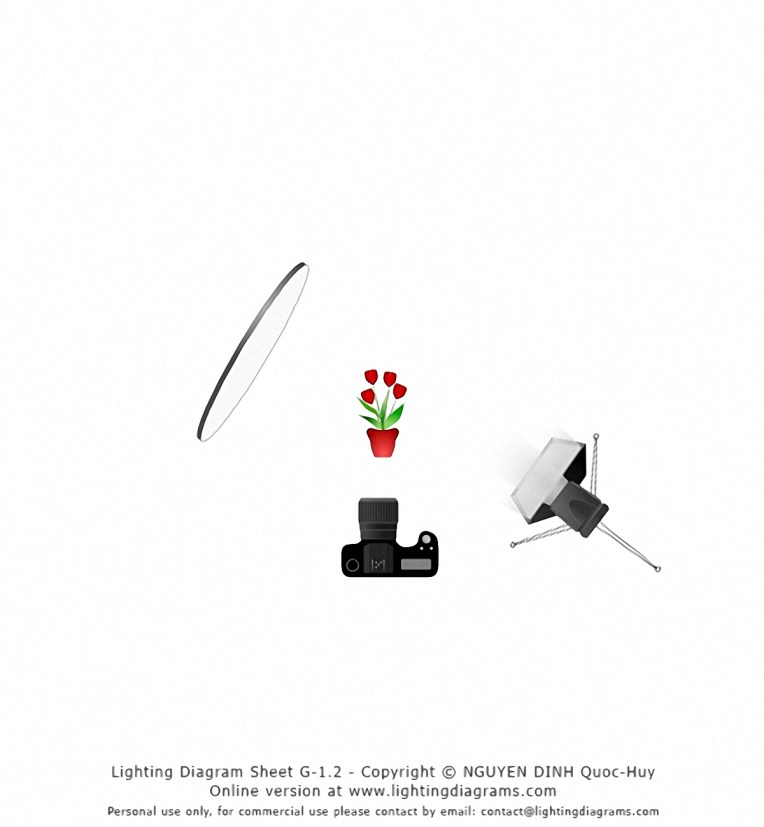
Lighting diagram for my basic lighting of an orchid.


The FL-600R is a flash with a guide number of of 50 (ISO200/m). In addition, it comes with a LED lightt for use when shooting video.


Other things in the bag include an 80cm 5 in 1 reflector – I only use the white reflector as the silver is too strong, the gold too garish. Some times I use the diffuser over a plant to cut down on ambient light levels. A Vittorinox CyberTool L is there. It has a good selection of small screwdriver bits that can most screws on a camera body, a set of pliers, wood saw, metal saw and file and a host of other doodads. I once re-assembled my Voigtländer 35mm f2.5 Color-Skopar with it while in on holiday in Beijing. Water – this can be in a 1L bottle for shorter expeditions or a 3L water bladder for longer ones. Extra clothing if needed, sunscreen and insect repellent to avoid nasty encounters. Batteries for camera and flash. Wallet of memory cards. That’s it. The whole process is very simple.

Goodness Gracious…. *


The Kangaroo Tick (Amblyomma triguttatum)

The Australian bush is a dangerous place for the intrepid orchid hunter. Poisonous snakes and spiders are the least of your worry. Nope the thing to worry about is the Kangaroo tick. Size is not an indication of dangerousness. At 4mm in length one of these horrid little beasties can cause a lot of pain and suffering. A lot! When we were away on our little jaunt to Nannup the other week unknowingly I picked up a couple of hitchhikers. Shortly after getting home they began to make their presence felt – quite literally. I woke up to find that my love spuds felt like they had been trapped in a vice and then set on fire. Very quickly it felt like I was walking around with a space hopper stuffed in me jocks.

My happy sack now resemble a space hopper thanks to kangaroo ticks.

Not for nothing are ticks referred to as “the dirty needles of the bush“. Each tick is like a little syringe loaded with all sorts of nasty toxic bacteria and unfortunately the process of removing them can inject even more of that horribleness into your bloodstream. Now after a few days of antibiotics and ibuprofen things are starting to improve. So if you are an orchid hunter let this be a salutary warning and please take precautions.

Funnily the word orchid  comes from the Ancient Greek ὄρχις (órkhis), literally meaning “testicle”, because of the shape of the twin tubers in some species of Orchis. In England between the 11th and 15th century orchids were called bollockwort with bollock meaning testicle and wort meaning plant. In medical lingo inflammation of the testicles is orchitis.

The tuber of the Red Beak Orchid (Pyrorchis nigricans) showing its testicular shape. Photo by Ken Macintyre 2010.

Here are some recent  pics from the suffering artist.


Lemon Scented Sun Orchid by Paul Amyes on 500px.com
Lemon Scented Sun Orchid, Thelymitra antennifera, also known as the vanilla orchid. Wambyn, Western Australia.


Wandoo Beard Orchid by Paul Amyes on 500px.com
Wandoo Beard Orchid, Calochilus stramenicola. Wambyn, Western Australia.


Custard Orchid by Paul Amyes on 500px.com
Custard Orchid, Thelymitra villosa. Wambyn, Western Australia


*  Today’s song reference seemed very appropriate. It is of course Jerry Lee Lewis’ “Great Balls of Fire”


Christmas Tree

Christmas Tree
You don’t have to go large to enjoy the festive season. Merry Christmas.

Another shallow DOF shot. Supposedly impossible on m4/3s. Olympus Pen EP-5 with OLYMPUS M.60mm F2.8 Macro lens and Olympus FL-600R flash with Lumiquest softbox. Exposure: 1/50 s at f/2.8 ISO 200.


Garden Update

Australian Painted Lady
Australian painted lady butterfly (Vanessa kershawi). Olympus Pen EP-5 with Olympus 60mm f2.8 macro lens and Olympus FL600-R speed light.

I’m always amazed at what I can find in my back garden. This is just an ordinary suburban backyard and yet I seem to find something new to photograph on a weekly basis. If you pine for an African Wildlife safari but never have the coin I’d try getting out in the garden and seeing what you can find.

Garden Katydid
A garden katydid (Caedicia simplex) found strangely enough in my garden. Olympus Pen EP-5 with Olympus 60mm f2.8 macro lens.
Cabbage White Butterfly
A cabbage white butterfly (Pieris rapae) on a lavender flower. Olympus Pen EP-5 with Olympus 60mm f2.8 macro lens and Olympus FL600-R speed light.
Eastern Common Froglet
Found in one of our raised veggie beds. The Eastern Common Frog (Crinia signifera) is a small ground dwelling frog and is one of Eastern Australia’s most common and widespread species. Olympus OMD EM-10 with Olympus 60mm f2.8 macro lens.

As always clicking on the image will take you to my online gallery.

The Future Is Now

Over the last few months I have been sharing about some of the features that I have found interesting with the Olympus m4/3s system. To me personally the remote control of flash and the wireless control of the camera are exciting, not necessarily in the form that they’re in now but in what they herald for the future. I know I talk a lot about the old days but I think its important to know where we have come from in order to understand the potential of modern equipment. I am as I keep saying a very promiscuous photographer – I rarely stick to any genre for long and photograph what gives me pleasure and interest.  At the moment I’m taking photos of the wildlife we find in our garden to document it because my wife has joined gardens for wildlife and because I’m lazy and like taking photos close to home, The following are just some photos of birds that can be found in the garden.

Pink and Grey Galah
Pink and Grey Galah or Eolophus roseicapilla, the most common Australian cockatoo.


Noisy Miner Bird
The appropriately named the noisy miner bird, Manorina melanocephala leachi, is a vocal species with a large range of songs, calls, scoldings and alarms, and almost constant vocalizations particularly from young birds.

With the modern technology we have at our disposal taking these pics was straight forward. When we look at the work of pioneer ornithological photographer Eric Hosking and see the amount of kit he had to set up to take similar types of photos it is quite staggering. Examples of Hosking’s work can be seen here.

Eric Hoskins pioneer ornithological photographer and possibly the worlds first professional wildlife photographer.

Now an EM-10, a telephoto zoom, a couple of flash lights and an iPad takes the place of a van load of stuff. I decided to put the kit to the test and then Mother Nature sank my plans. Here in the island paradise of Tasmania we are in the middle of what is laughingly called summer. The last few days it has been sheeting down and blowing a gale. In fact the weather has been so bad that 120mm rain fell overnight and this morning on my daily perambulation I had to wear a fleece and a soft shell water proof. As you can imagine the local wildlife isn’t too keen at putting in an appearance and I doubt that any equipment setup outside would last long. So in place of the local wildlife you’ve got me showing you how to do a hi-tech selfie. My wife would probably say that there is no difference as I’m pretty feral!

OK having done this what have I learnt? Well first of all using WiFi and the RC function uses power like a trust fund baby spends money. Setting up is easy but the amount of control offered by the Olympus Image Share App is very basic. You can control the exposure but you can’t get access to the Olympus Super Control Panel and that means that you still have to access the camera itself if you want to change your lighting ratios or switch from TTL to manual or vice versa. Although the camera is connected to the iPad via WiFi you still have to physically touch the screen to trigger the camera. So in future what would I like to see, well to start I’d like to have access to the SCP via the app so I’ve got more control over the camera and lights. Secondly I’d like to have more options to trigger the camera. At the moment I can’t use the ioShutter™ as my Olympus cameras have a proprietary connection to allow the use of a remote cable, so I’d certainly welcome either Olympus or the makers of ioShutter to make a remote that allows me to trigger the camera via sound or with a light trigger. I really think that we’re just at the very start of connectivity when it comes to cameras. Back in August 2012 I wrote about shooting using my Canon EOS5d tethered via a USB cable to a laptop and using Lightroom. Now I can do the same and more but wirelessly using a mobile phone or tablet. I hoping that in 2 or 3 years time we’ll see the functions I’ve talked about here.