Like most things in Australia the Clackline Refractory came into being more by luck than planning. In 1898 Western Australia was undergoing a gold rush and two blokes by the names of John Ford and James Murray were prospecting in the eastern end of the Darling Range. About 80Km east of Perth they decided to sink an exploratory shaft and instead of finding gold they found fire-clay. Disappointed they moved on. Fast forward a couple of years and it must of dawned upon them that they had stumbled upon a valuable commodity as they decided to extract the clay from what on closer inspection was a limitless supply. Why was the clay so valuable? Well fire-clay is used to make bricks for furnaces and kilns. It is used in the manufacture of crucibles for smelting. Before this discovery Australia was having to import bricks made of fire-clay from Britain at some considerable cost. The refractory was built to produce the bricks and it was found they were more durable than the imported ones. You’d think that having a ready made monopoly would have meant that Messrs Ford and Murray would be laughing all the way to bank. Well no and the refractory changed hands several times before being completely shut down in 1992.
The suns rays reflected on the white walls of a derelict brick kiln at the Clackline Refractory.
The remains of an electrical control panel at the Clackline Refractory.
I discovered the Refractory completely by accident. I was cycling along the Kep Track and as I was approaching Clackline I saw an enormous brick chimney rising out of the trees. It was definitely industrial looking so I decided to have a shufty and found this huge post industrial site. It had only been shut for a couple of years at that stage and everything looked pretty intact. I went back a few days later and photographed the place early in the morning and the sunlight shining through the huge kilns was magical. On further research I wasn’t surprised to learn that it had been given a heritage listing.
I didn’t think about the refractory again until a couple of months ago. I just purchased a new to me secondhand camera and I wanted to put a roll of film through it to see if it was working OK. My partner wanted to visit Clackline to get some material for a project she’s working on so I decided that the refractory was where I’d test the new camera. When we got there I wasn’t prepared for how much the site had changed. Everything of value had been stripped out, the buildings were in a dreadful state, there was graffiti everywhere along with drug paraphernalia. To add to the sombre mood we met a family there who were visiting to see where a relative had died just a couple of days previously. You couldn’t more get a more gothic atmosphere if you tried and this suited the black white film perfectly. All in all it was quite a strange experience and we moved on after I had shot the roll.
One of the old kilns at Clackline Refractory.
SOOT. Clackline Refractory.
Exit. Clackline Refractory.
Where the clay was mixed prior to being moulded and then fired.
State Route 120 is perhaps better known as the Great Southern Highway. It is the road that takes you to York once you leave Perth via the Great Eastern Highway. I always breathe a sigh of relief once we turn onto it because it means we’re leaving the madness of Perth and returning to our quiet country existence. I love driving down it watching the forest change gradually from Jarrah to Wandoo.The other thing I look forward to is the art work you see. For the last twenty or so years people have been decorating some of the trees. It maybe a complete paint job of a long dead tree or it maybe a small painting on board or sheet metal that has been attached to a tree.Every now and again a new piece turns up and its always a pleasant surprise.
Dave Minion. Great Southern Highway, Western Australia.
Australian Easter Stump. Great Southern Highway, Western Australia.
Startled stump. Gret Southern Highway, Western Australia.
Mary has seen better days. Great Southern Highway, Western Australia.
Tipper is not what he used to be – his ears have been broken off. Great Southern Highway, Western australia.
Happy to see you. Great Southern Highway, Western Australia.
Lucky The York Tree. Great Southern Highway, Western Australia.
I was feeling a bit of a loose end. The weather has been unpleasant and I didn’t feel like going out to photograph wildlife or wildflowers. I suddenly had the bright idea of documenting the art along the Great Southern Highway. To make it more interesting I decided to use some of my old classic film era Olympus lenses – specifically the OM Zuiko 21mm f3.5, the OM Zuiko 35mm f2, and the OM Zuiko 135mm f2.8 – on my Sony A7r. The whole process of framing up, setting up a tripod and manually focusing the cameras and carefully making the exposure is the complete antithesis of photographing birds and it made a nice change.
Not the dreadful film, but the camera company. On the 24th June 2020 Olympus announced that they were in talks with Japan Industrial Partners to divest themselves of their camera business after three continuous years of losses despite numerous restructuring attempts. I’ve got no idea what all this means from a practical point of view, but from an emotional point of view it is quite a sad day. I’ve always considered myself to brand agnostic and have used over the years Praktika, Pentax, Minolta, Canon, Leica, Voigtländer, Sony, Panasonic and of course Olympus. But I’ve got to say that over the last 38 years I’ve always had at least one Olympus camera. More than just a few key moments in my life have been documented by an Olympus camera.
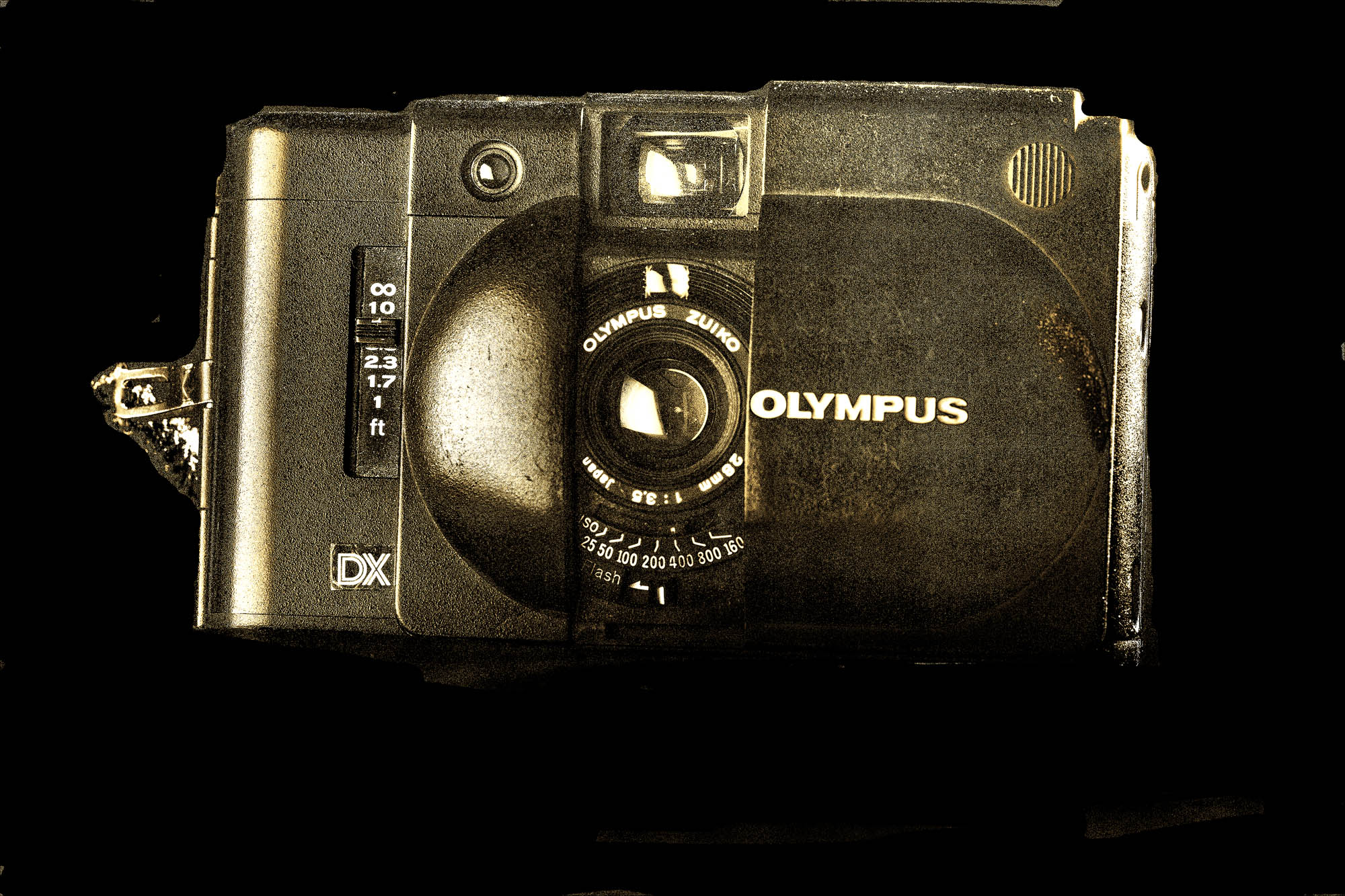
My first Olympus camera was an XA2. This is the XA4 I bought later to replace it, they look very similar, the major difference being that XA2 had a 35mm lens while the XA4 had a 28mm macro lens.
Portrait of me in Majorca taken in March 1986 by my father in law, Brooke Spencer. Probably taken with a Leica R4 with a Leica 135/2.8 Elmarit-R on Kodak colour negative film. I’m holding my OM1n with 35-105 lens.
I bought my first Olympus camera in 1982 after returning back home from an extended stay in Israel where I got into taking photos. Previously I had a Kodak 110 cartridge camera and when I got the films back from the processors I was dismayed with how crap they looked. I was determined that on the next trip I would take a much better camera. So after a trip to the newly opened Whibys camera shopping Chichester and a long and informative chat with the owner Derek Whitby I left with an Olympus XA2 – a unique 35mm clam shell compact camera. I kept going to Whitby’s until 1988 which was when I migrated to Australia. In that time Derek went on to sell me an OM20, OM1n, OM2n, OM4 and my partner an OM40. Along with those cameras was wheelbarrow load of lenses, some very specie flashguns for the time and a shed load of film. I’m glad their business is still going although Derek and his wife Jacqui no longer run it. The cameras kept marching on and were perfect for my travels being small, durable and highly featured for their time. The lenses were also compact and gave great image quality. I’ve still got most of the lenses and still use them, and I’ve written about them on this blog ( 21mm f3.5, 24mm f2.8, 35mm f2, 50mm f1.4,135mm f2.8, and 35-105mm f3.5-4.5).
Believe it or not that’s me in Red Square, Moscow in January 1987. The temperatures were -40ºC. You can just about see my camera bag slung over my shoulder. In it is an OM1n, an OM2n, a 35-105mm, a 50mm f1.4, a 200mm f4 lens a T32 flash and a T20 flash. We went to document the plight of Russians in Moscow and Leningrad (now St Petersberg for a human rights campaign that was to be launched later that year at the House of Commons in London). The cameras worked flawlessly in the cold. The photo was taken by my wife on an Olympus AF1.
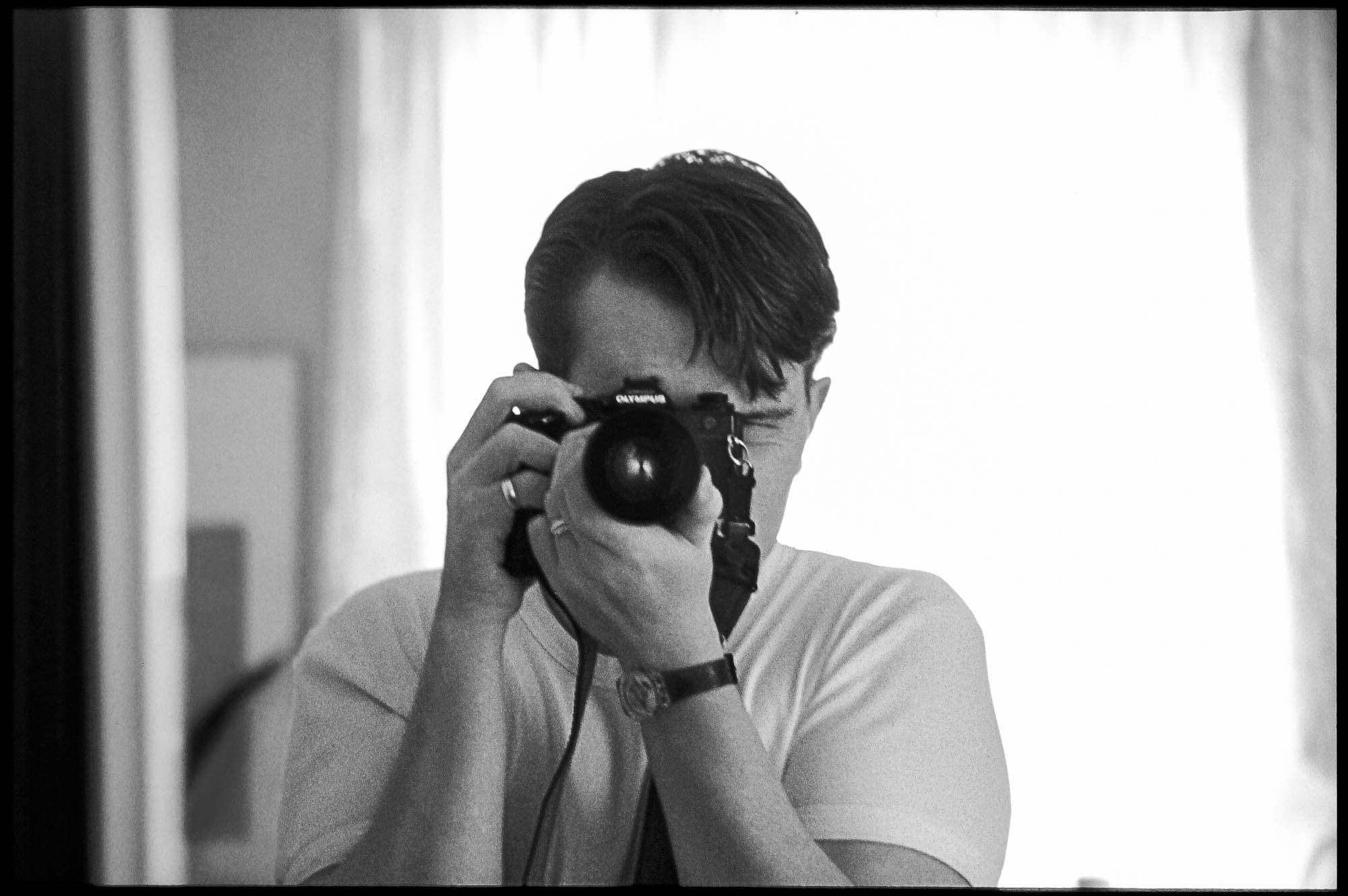
My earliest selfie – taken in September 1987 while I was staying with my in-laws just prior to departing for India and Nepal. The camera is an Olympus OM4 with an Olympus OM Zuiko 35-105mm lens. Originally shot on Ektachrome 200 but converted to black and white because of fading.
Yours truly on a house boat on Lake Dal in Srinagar, Kashmir, India. I’m wearing a Camera Care Systems pouch with my Olympus OM4 in it. Taken by my partner with her OM40 and 35-105 lens.
In 2003 I shot a couple of weddings and my OM4s developed problems, one the shutter failed and the other the film advance jammed. I took them to the local camera whisperer but he broke the bad news to me – there were no new spare parts. He said I could by up some old models and use them as donor cameras but there was no guarantee as to the condition of the parts and how long they would last. To say I was gutted would be an understatement. This came a a particularly bad time for me, I was recovering after a bad accident and was pretty broke. I had enrolled at college to study photography as a form of therapy and now I was pretty well camera less. My late father-in-law (Brooke Spencer) in an act of supreme kindness stepped into the breach. He had just bought a Canon EOS D60 digital SLR and he sent me his old EOS3 film SLR and a couple of lenses. I now had a camera to complete college with and had inadvertently changed system. I went digital with Canon but I wasn’t really happy with it. I found the Canon EOS system to be large, heavy and cumbersome. About this time I fell into writing about and photographing outdoor activities and then was commissioned to write a walking guide. Well after a year lugging a Canon 5d and three lenses on over 1000Km of walks I knew I needed something lighter.
The Canon EOS system full monty. Three bodies, seven lenses, two flashes, flash meter, filters, cables, flash triggers, and reflectors. It is a hernia inducing load.
This is the camera kit I used on my first walking guide book. Less hernia inducing than the Full Monty, but still coming in at 7Kg including filters and batteries.
When I saw the Olympus Pen EP1 in 2009 I was smitten, but it didn’t have a viewfinder so I held off buying one. Less than a year later Olympus introduced the EP2 and I got one. The next guide book was done with an outfit based around that camera and a a few lenses and I was much happier.
Coming in at under 2Kg complete with batteries, filters, microphone and assorted cables for video. This kit still gives me coverage from 24emm to 300emm with 1:1 macro and a smallish prime. All that’s missing is flash.
Here I am pausing to take a photo with EP2 while walking up Frenchman Peak in Cape Le Grand National Park, Western Australia.
Over the last ten years I’ve heard a lot reasons from keyboard warriors on various photographic forums why the micro four thirds format that Olympus and Panasonic used was inferior to full frame sensors and that you couldn’t get work published if you used it. Well after three books, two exhibitions and loads of print sales no one has ever said the image quality was not up to snuff. Unfortunately photography is an activity dominated by very conservative men who see a small camera, no matter how capable, as being an affront to their masculinity. So Olympus was sandwiched by the small minded conservatives that wanted big cameras and at the other end the onslaught of the do anything mobile phones which now have very good photo and video capabilities.
The Canon EOS6d with Sigma 150-600mm lens compared to the Panasonic G85, which uses the same sensor format and lens mount as Olympus, with the Panasonic Leica 100-400mm lens. The Panasonic has great reach, better video, the same number of megapixels, weighs less and costs less.
The Canon EOS 6d camera with 100mm f2.8 macro lens that I used to use for photographing orchids alongside the Olympus EM 1 mk ii with 60mm f2.8 macro lens that I use now. Both produce amazing images, but the Olympus is a lot nicer to carry through the bush all day.
As I said at the beginning of this piece I have no way of knowing what will happen. Maybe JIP will turn the company around and make it it profitable and innovative. Maybe they’ll just asset strip and close it down. The company does both. I hope it is the former, but if it is the later I guess that this a eulogy for Olympus. But whatever may happen my current Olympus cameras have plenty of mileage left in them and if I can get another 10 years out of them, and at this stage I don’t see why not, then I’ll be very happy.
Everlastings on Mount Brown in York, WA. Sony A7r with Olympus OM Zuiko 21mm f3.5 lens and Cokin “P” 2 stop graduated neutral density filter. Exposure: 1/30th sec, f16, ISO 100.
Everlastings on Mount Brown in York, WA. Sony A7r with Olympus OM Zuiko 135 f2.8 lens. Exposure: 1/1000th sec, f2.8, ISO 100.
The entrance to Beverley Station Arts in the Western Australian town of Beverley.
Those who regularly follow my blog will know that I’m currently the artist in residence at Beverley Station Arts in Western Australia. So for this entry I’ll talk a little about the place. The town of Beverley is located some 130Km (or 80 miles for those still using imperial measurements) east of Perth in the Avon Valley in the Wheatbelt of Western Australia. The Beverley Arts Gallery Committee was inaugurated in 1967 with the aim of establishing a venue for the fine arts in the town. Sir Claude Hotchin a noted arts benefactor donated work from his collection with the aim of starting the fledgling gallery off. The collection is now housed in what was the old railway station in Beverley.
Inside the exhibition space at Beverley Station Arts. Sony A7r, Fotodiox OM to Nex adapter, Olympus OM Zuiko 21mm f3.5 lens. Exposure: 1/400th sec, f5.6 at ISO 6400.
The old station master’s quarters is now where the visiting artists in residence are accommodated. Beverley Station Arts, Western Australia. Sony A7r, Fotodiox OM adapter, Olympus OM Zuiko 21mm f3.5 lens. Exposure: 1/400th sec, f8 ISO 400.
Beverley Station Arts also utilizes the former station masters living accommodation for the artist in residence program. This allows an artist to base themselves at the gallery and produce work, put on an exhibition, run workshops and generally interact with the community. Recently an open air stage was built which is suitable for all the performing arts. It has a seating capacity of 500 and local audiences enjoy music, theatre, movies and dance under the stars during the summer months. On Saturday 10th September 2016 the venue hosted the Voice Moves Country Choir Bash. This year there were eight participating choirs:
The Platform Theatre performing space at Beverley Station Arts, Western Australia. Sony A7r, Fotodiox OM to Nex adapter, Olympus OM Zuiko 21mm f3.5 lens. Exposure: 1/200th sec, f8 at ISO 400.
As is usual in country Western Australia a sumptuous afternoon tea was provided in the intermission. The event was great fun and enjoyed by both the audience and the participants alike. Below is a short video featuring the Beverley Station Singers.
The garden bench even has a railway theme. Beverley Station Arts, Western Australia. Sony A7r, Fotodiox OM to Nex adapter and Olympus OM Zuiko 21mm f3.5 lens. Exposure: 1/80th sec, f16, at ISO 400







You must be logged in to post a comment.