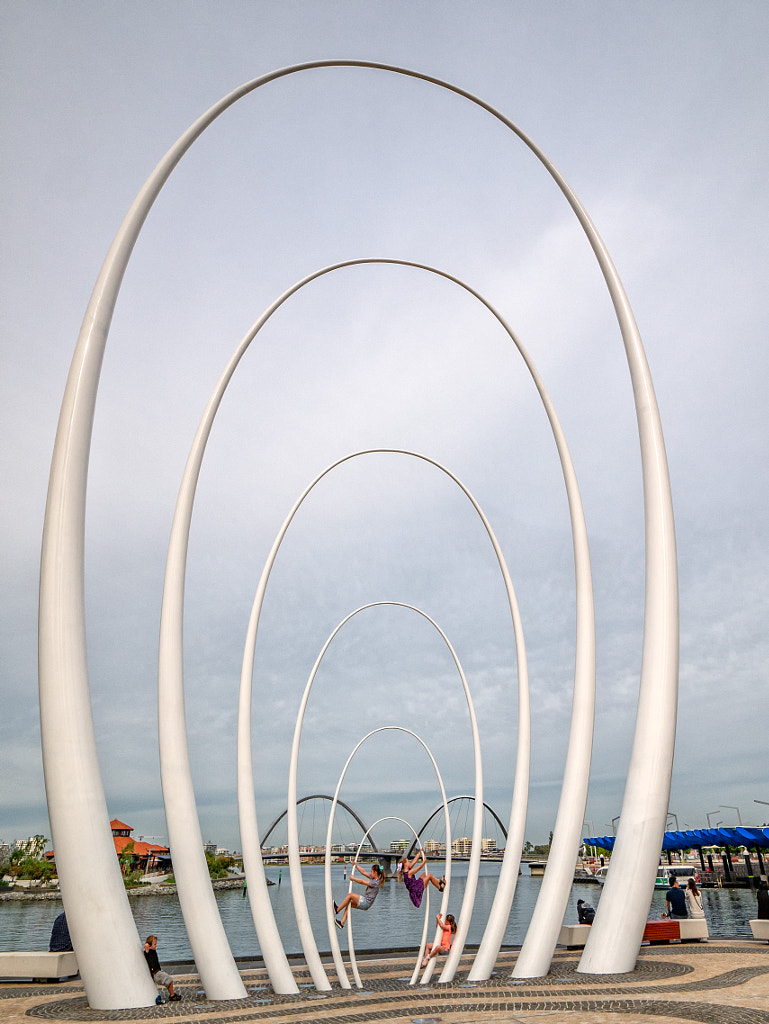
Spanda by Christian de Vietri is a striking sculpture that arrests the attention of visitors to Elizabeth Quay. “Spanda is a Sanskrit word that means ‘divine vibration’. The term is used to describe how consciousness moves in waves of contraction and expansion. The sculpture gives form to this primordial energy. My intention in making this sculpture is to express and facilitate oneness of the individual with the universal.” Artist, Christian de Vietri
Panasonic G85 with Panasonic LEICA DG 8-18/F2.8-4.0 lens. Exposure:1/320 sec, f8 at ISO 200.
My latest pootle took me to Woodman Point south of Fremantle. It’s a very pleasant walk around an area with important Aboriginal, historic and environmental significance. Well worth a visit.
Woodman Point, Western Australia. Panasonic G85 with Panasonic LEICA DG 8-18/F2.8-4.0 lens with a Cokin Harmony variable neutral density filter. Exposure:: 1/3 sec, f16 at ISO 200.
Woodman Point Jetty. Panasonic G85 with Panasonic LEICA DG 8-18/F2.8-4.0 lens with a Cokin Harmony variable neutral density filter. Exposure: 1/3 sec, f16 at ISO 200.
This walk was also from my book Perth’s Best Bush, Coast, and City Walks, published by Woodslane (ISBN 9781921606793 ) in 2010. It’s available from all good bookstores.
Penguin Island is home to a colony of approximately 1,200 little penguins, the largest population of the birds in Western Australia. The Penguin Discovery Centre is home to a small population of rescued birds which cannot be rehabilitated to the wild.
This week’s episode of Paul’s Pootles takes us to Penguin Island.
This is another walk from my book which is available from all good Australian book stores.
The sun shines from behind the York Shire Christmas tree on Avon Terrace. York, Western Australia. Panasonic Lumix G85 with LEICA DG 8-18/F2.8-4.0 lens. Exposure: Aperture priority with -2 stops exposure compensation 1/250 s at f/16.0 ISO 200.
After Jesus was born in Bethlehem in Judea, during the time of King Herod, Magi from the east came to Jerusalem and asked, ‘Where is the one who has been born king of the Jews? We saw his star when it rose and have come to worship him.’
Hand Spring in the city. Hay Street Mall, Perth, Western Australia. Olympus OMD EM10 with Panasonic Leica 8-16mm f2.8-4 lens. Exposure: 1/160, f5.6, ISO 200.
Floating floral wreaths. Spring in the city. Hay Street Mall, Perth, Western Australia. Olympus OMD EM10 with Panasonic Leica 8-16mm f2.8-4 lens. Exposure: 1/1000, f5.6 at ISO 200.
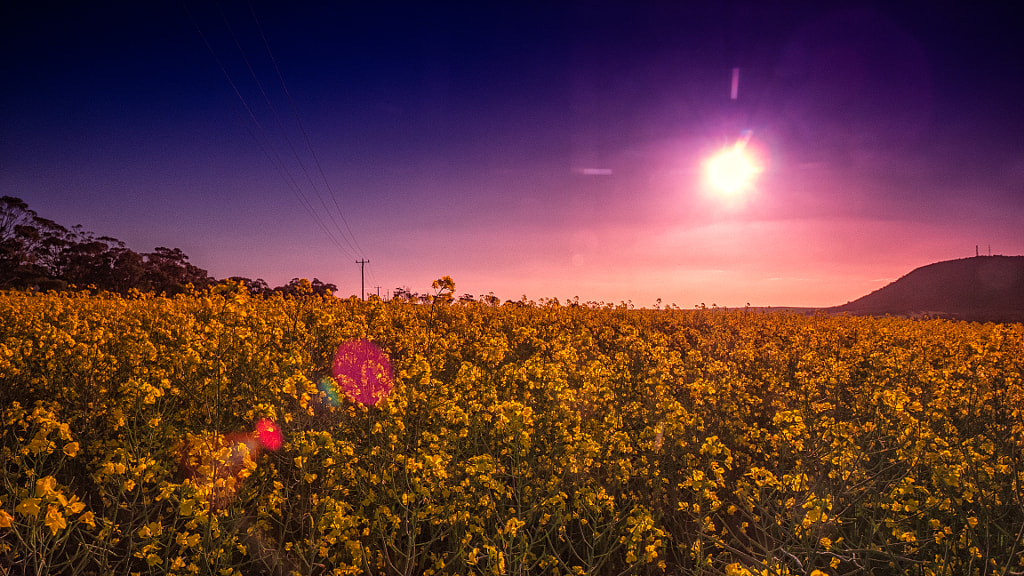
Rural Idyll. The sun sets on the canola by Mount Bakewell in York, Western Australia. Olympus OMD EM1 with Olympus 12-40mm f2.8 lens and Cokin 3 stop ND and 3 stop GND filters. Exposure: 1/13th sec, f8 ISO 200.
Photography and video are both media that allow the artist to play with the concept of time. Up until recently I primarily worked using still photography. With the advent of good quality video being added to most digital cameras I started playing tentatively with moving images and enjoying the whole idea of capturing movement in another way. Now I’m playing with time-lapse which is a way of using still photos to play with movement that the eye doesn’t normally perceive.
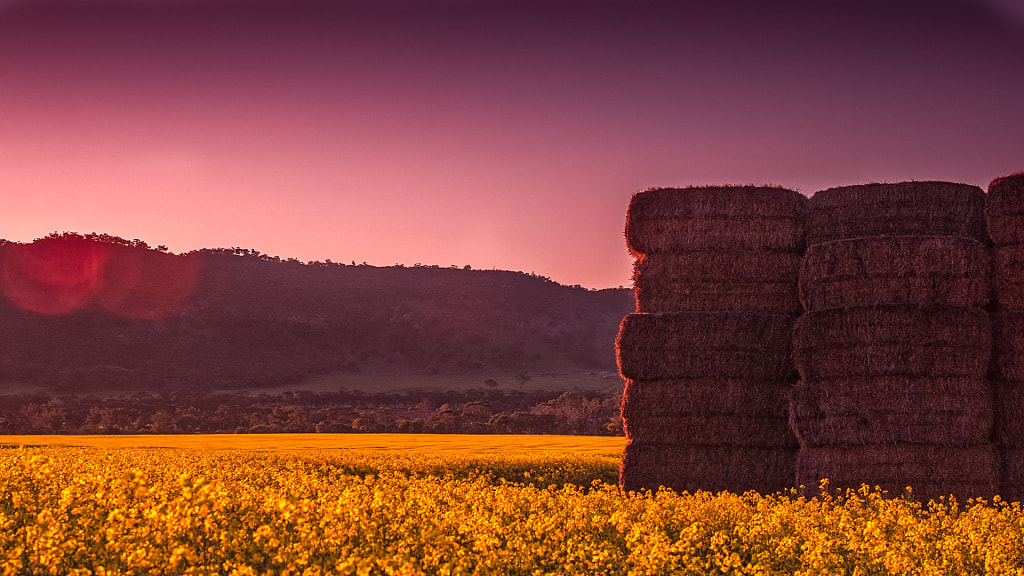
Sunset over the canola fields. York, Western Australia. Olympus OMD EM1 with Panasonic Leica 8-18/F2.8-4.0 lens a Cokin 3 stop ND and a 3 stop GND. Exposure: 1/50th sec, f8 at ISO 200.
The last couple of weeks have seen me shooting the canola fields around York. I’ve yet to do anything with the resulting video footage, but the pictures illustrating today’s post are still out takes. It is just a matter a shooting hundreds of shots of the same scene over a defined time period. My normal landscape gear and technique are used. I’m also experimenting with adding my own movement in the form of pans, tilts and slider moves. Thankfully my camera has an electronic shutter so I’m not burning through the shutter life.
Abandoned. An old colonial farmhouse amidst the canola. York, Western Australia. Olympus OMD EM1 with Olympus M.Zuiko Digital ED 75-300mm f/4.8-6.7 II lens and Cokin 3 stop GND. Exposure: 1/30th sec, f8 at ISO 200.
The thing with experiments is to allow ourselves to make mistakes. This can be difficult if you have, like I have, been practicing in a medium for many years because you tend to develop a certain competence/mastery (pick whichever is the most appropriate) and expect a certain result for your efforts. So when confronted with learning something new and seeing all the mistakes and failures it is tempting to run back to the security of our old established ways of working as it is more ego friendly. In our society the notion of mistakes and failure is seen as a negative, but they really should be embraced. We need to give ourselves freedom to explore and experiment in a nurturing environment so that we can learn and progress. At the moment I’ve got a couple of dozen time-lapse clips sitting on my hard drive, two of them are OK the rest suck big time. Looking at them objectively and looking at the work of people who are considered masters of this art form I can see where I have made my mistakes and so I can now work to avoid repeating them. Who knows in another couple of years I might actually get good at it.




You must be logged in to post a comment.