Operation Numbat

The world has become a very grim place at the moment now that the Mango Menace has unleashed “Operation Epic Fury” (really who comes up with these ridiculous names?) which means we have to take out a mortgage to buy a tank of petrol if we can  find a servo with any in stock. So we decided to launch “Operation Numbat” whose sole function was to produce joy.


Dryandra, Western Australia.


The goal was to spend a couple of nights at Dryandra and find a numbat. Easier said than done as we have been looking for around thirty years and never seen one. A numbat for the uninformed is smallish, about 30-40 cm long, marsupial that eats termites. It was once quite common across southern Australia, but was driven to the point of extinction when somebody thought that introducing foxes to Australia would be a good idea. There now exist only a few small isolated populations in Australia and Dryandra is one of them. The Western Australian state government introduced Operation Western Shield (another silly name) to protect vulnerable native fauna from feral foxes and cats. In Dryandra this is done with a combination of 1080 baiting and trapping. It’s reckoned that the programme has reduced the fox population by 80% (Marlow et al., 2015). 

We weren’t there just for the numbats, we there for Woylies, Echidnas, birds and everything and anything wildlife related.


Day 1


Wandoo Walk by Paul Amyes on 500px.com
Helen on the Wandoo walk at Dryandra, Western Australia.

We arrived at Dryandra at at lunch time and once we’d eaten we set off to walk the Wandoo Walk (day walk) the start of which is located at the Old Mill Dam. The walk is 2.7 Km long and takes about 1 1/2 hours – more if you are looking for animals like we were. It is touted as being good for wildlife with a chance of seeing Numbats. Now the great thing about Numbats is that unlike other small marsupials they are diurnal, and to cap it off like sunning themselves in open areas which in theory should make them easier to see. I say in theory as we have been looking for over thirty years without any luck and I was hoping that this trip would be fruitful. It was a really enjoyable walk and we saw loads of birds – in fact I’d never seen so many Rufous Treecreepers in one day. But, when it came to Numbats we saw neither hide nor hair.


Jacky Winter by Paul Amyes on 500px.com
Jacky Winter, Microeca fascinans. Dryandra, Western Australia.


Djini by Paul Amyes on 500px.com
Djini or Rufous Treecreeper (Climacteris rufa), Dryandra, Western Australia.


Djini by Paul Amyes on 500px.com


Just before sunset we decided to walk around the large open paddock adjacent to the Dryandra Lions Village where we were staying. Western Grey Kangaroos were grazing on the grass and then we saw something we’d never seen before. We’d spotted an Echidna wandering round looking for ants when it encountered another Echidna. Now Echidnas are incredibly solitary animals and are rarely seen in the company of others. The two animals sniffed each other carefully and then went on their separate ways continuing their search for ants. As I continued walking along the perimeter of the paddock I found another Echidna and it came quite close allowing me to get some nice close ups.


Dryandra Lions Village is comprised of old forestry bush cottages.


Nyingarn by Paul Amyes on 500px.com
A pair of Nyingarn or Short Beaked Echidnas aka Spiny Anteaters (Tachyglossus aculeatus). Dryandra, Western Australia.


Nyingarn by Paul Amyes on 500px.com
Nyingarn or Short Beaked Echidna.


Day 2

Kawana Trail information board. Dryandra, Western Australia.


The morning saw us out on the Kawana Walk which is a 3.3Km walk through the Brown Mallet plantation, through the kwongan heath and then back through the Mallet trees. The varied landscape gives great opportunity to spot different birds, Kangaroos, Echidnas and fingers crossed Numbats. Again, like yesterday’s walk, we saw loads of wildlife – birds, kangaroos, and skinks – but no Numbats. It was hard not to feel a little dispirited at this stage. You plan trips and hope to see certain animals, like we did in our recent trip to Broome, but when you don’t find them you can feel very deflated even though you saw other animals. 


Djini by Paul Amyes on 500px.com
More Rufous Treecreepers


Miyamit by Paul Amyes on 500px.com
Miyamit or Yellow-plumed Honeyeater (Ptilotula ornatus).


Yongka by Paul Amyes on 500px.com
Yongka or Western Grey Kangaroo (Macropus fuliginosus).


Buchanan’s snake-eyed skink, Cryptoblepharus buchananii. Dryandra, Western Australia.


My companion in the Old Mill Dam hide – a Southern Slider (Lerista dorsalis). Dryandra, Western Australia.


After grabbing a quick drink I set off to walk down to the Old Mill Dam and sit in the hide there.  Apart from seeing a Southern Slider Skink and a dragonfly I saw nothing. Desperation was really starting to set in now, so at 4pm we decided to go on a very slow drive around the park in the hoping that we’d see something. Driving along a deeply corrugated gravel road at 20Kph is enough to shake your fillings out of your teeth. It was torturous. At this stage your mind starts to play tricks on you. You so want to see that animal and you are desperately willing it to happen and every time a branch moves or a bird flies just above the ground you think NUMBAT! Your head twitches backwards and forwards trying to get a better glimpse of what wasn’t there. Suddenly at a junction just standing there as cool as you like was a Numbat just 20 metres away from the car. Gently stopping the car and winding the front passenger window down I managed to rattle off a few frames before it started moving. As it walked further round I could no longer shoot through the open window and I was having to use the front passenger quarter light window. At the time I knew this would seriously degrade the image quality, but I continued anyway in the hope that I might be able to salvage the images in post later. Then within 5 or 10 seconds it was off into the bush and we lost sight of it. We were both exhilarated – we had huge grins on our faces. We’d seen a Numbat! We had really seen a Numbat. Operation Numbat had been a huge success.


At long last! A Numbat (Myrmecobius fasciatus). Dryandra, Western Australia.


Numbat on the move. Shooting through the glass of a car window gives less than optimum image quality.


I love this pose, but the image quality is shot to hell.


Maybe it works better as a black and white.


It’s now a week since that sighting and the memory of it still brings a huge smile to my face and a feeling of excitement. One Numbat isn’t enough – I want to back and see and photograph more. Hopefully it won’t take another 30 years to do it.

Lake Leschenaultia In Autumn


Time lapsing at Lake Leschenaultia in Western Australia.


The last few weeks I’ve been spending a day at Lake Leschenaultia. I’ve photographed there often but this time I thought I’d try making a video about some of the wildlife there. In the process I’ve discovered three things:

  1. The animals don’t play ball. Quite a few times I went and they didn’t show up.
  2. It’s harder than it looks. We’re accustomed to seeing the David Attenborough docos on the TV and they spoil us because trying to get anything halfway decent takes an enormous amount of time, dedication and skill.
  3. All the cameramen and directors of photography I know of all complain of having wrecked backs. Having carted the equipment round for a few weeks I now know why – it’s bloody heavy!

Having said that it has been great fun and while I’m not particularly happy with the resulting video I enjoyed the whole experience immensely.


Now for a shameless plug. Autumn, Winter and Spring are the best times to go walking in Western Australia and the walk around Lake Leschenaultia is one of forty two that are in my book Perths Best Bush, Coast and City Walks which can be bought through the link given. Further more if you use the code PAULA15 you get a discount of 15%.

Thank Goodness!!


Lake Leschenaultia by Paul Amyes on 500px.com
Lake Leschenaultia at sunrise. The glowing rising sun is refected in the trees on the opposite shore.


After the onslaught of the hottest summer ever, which I wrote about in the last post we’ve had a few days of respite with temperature dropping 15ºC to the more manageable mid twenties. All of a sudden it feels like my brain has kicked up a gear.


Time lapsing at Lake Leschenaultia in Western Australia.


Kwilom by Paul Amyes on 500px.com
Kwilom or purple swamp hen (Porphyrio porphyrio subsp bellus). Lake Leschenaultia, Western Australia.


I went out to Lake Leschenaultia at sunrise to film a time lapse sequence for a video I’m working on. While there I decided to take a few pics of the birds I could see while I waited for the time lapse to finish. With the lower temperatures the birds were all a lot more active. When I visited last week a lot of the birds were just sleeping in the shade. The Eurasian Coots were putting on quite a show – preening, feeding, chasing each other. One of them was determined to explore the contents of my bag. The purple swamp hens weren’t very happy to see me on their bit of beach. One of them would walk backwards and forwards in front of me giving me the evil eye. The male musk duck I talked about in the last post came steaming out of the reeds. Man that is a fast duck. A few minutes later I was delighted when a female musk duck came out of the same reed bed with two ducklings in tow. That was a first for me.


Kodara by Paul Amyes on 500px.com
A male Kodara or musk duck (Biziura lobata). Lake Leschenaultia, Western Australia.


Kodara by Paul Amyes on 500px.com
A female Kodara or musk duck (Biziura lobata) with two ducklings. Lake Leschenaultia, Western Australia.


Away from the shoreline and in the trees the passerine birds were very busy looking for food. The grey fantails are a lot like their cousins the willie wagtail in that they just don’t give a stuff about people. They will perch on small branches and give you a good look over. That doesn’t mean they are easy to photograph as they have very short attention spans and don’t sit still for long. They are, however, quite territorial and will often come back to the same perch over and over so that increases your chances of getting a photo. The Western Thornbills are much more erratic and it can be difficult just to get a good look at as they move through the low lying scrub and shrubs. After a while I became aware of a large number of gum nuts dropping from two of the trees in front of me. Looking up I saw half a dozen Red-tailed Black Cockatoos feeding in true parrot fashion. Take a bite out of a fruit, drop it and then get another one. Repeat until you have stripped the tree bare or have had enough, whichever comes first. One of them gave me quite a long look and not for the first time I got the sense that there was a real intelligence behind those little black eyes.


Koodjinok by Paul Amyes on 500px.com
Koodjinok. A juvenile Grey fantail (Rhipidura fuiginosa preissi). Lake Leschenaultia, Western Australia.


Karak by Paul Amyes on 500px.com
Karak or Red-tailed Black Cockatoo (Calyptorhynchus banksii subs samueli) feeding on gum nuts. Lake Leschenaultia, Western Australia.


While at the lake amongst all this wonderful nature it wasn’t hard to feel intensely grateful to have this experience but also a little guilty. Over the course of the last couple of years it seems as if the world has gone to hell in a handcart what with the climate crisis, COVID and now the Russian invasion of the Ukraine with Putin threatening global nuclear annihilation. So what gives me the right to have all this serenity  and beauty when elsewhere people are suffering  and dying? This sort of thinking isn’t new. Henri Cartier-Bresson the Godfather of socially concerned documentary photographers said of the American fine art photographers Ansel Adams and Edward Weston:

“The world is going to pieces and people like Adams and Weston are photographing rocks!”

(quoted by Adams, Oral History, Univ. of Calif., Berkeley, p. 498)

For Bresson a documentary photograph should deliver the truth and be an agent of social change making life better for all humanity. He felt that Adams’ love of the beauty of nature was sentimental, naive and wasted. So was my being at Lake Leschenaultia taking pretty pictures just self indulgent sentimentalism? Perhaps I should be doing something more useful to try and solve the climate crisis and stop the war in the Ukraine. I could take the defence that Ansel Adams took when he made the address “The Role Of The Artist In Conservation” where he said:

“I believe the approach of the artist and the approach of the environmentalist are fairly close in that both are, to a rather impressive degree, concerned with the ‘affirmation of life’….Response to natural beauty is one of the foundations of the environmental movement.”

(www.anseladams.com/ansel-adams-the-role-of-the-artist-in-the-environmental-movement/)

I can say that I do through my books and photos hope that people will become more interested in the environment  and look to protect and conserve it. But I’m aware that what I do is very small. Adams had access to the presidents of the United Staes, millionaire philanthropists and captains of industry. So if I’m not influencing the opinions of the great and the good should I still be out taking pretty pictures?


Djoboldjobol by Paul Amyes on 500px.com
Djoboldjobol or Western Thornbill (Acanthiza inornata). Lake Leschenaultia, Western Australia.

The last week or so I’ve been reading ‘Journeys In The Wild – the secret life of a camera man’ by Gavin Thurston. Thurston is a film cameraman and director of photography who has worked on many of the BBC’s David Attenborough documentaries amongst other things. An interesting read about what really happens behind the scenes when those programs are made. Thurston admits that even taking into account all the difficulties and the missing out on family life he has been extremely privileged to have seen what he has seen. He recounts of how he was filming for the ‘Trial of Life’ series during the civil unrest in Panama. After a particularly dangerous drive out to the rainforest where they could have easily been killed by Panamanian Defence Force he’s out filming stingless bees when he realises:

“Nature and its beauty and complexity is an easy diversion from the rigours of human turmoil.”

I find that being in nature is a way to re-establish calm in my life. So I could sit at home and become fearful and anxious about what is happening in the world, but what does that achieve? Going out to spend time in the natural world and allowing myself to be totally immersed in that world brings about calmness, joy and an appreciation of life. It recalibrates my thinking. So as an act of self care spending a morning watching the sunrise at Lake Leschenaultia and enjoying the antics of the animals around me was very important.


“I’m out of here”. Kidjibroon or Eurasian Coot (Fulica atra). Lake Leschenaultia, Western Australia.

Magical Magic Lake

This could have been titled Hyden – the return. Hyden is a small town in the middle of the Wheatbelt in Western Australia some 292Km east of Perth. Regular readers will remember that we’ve been before and maybe somewhat perplexed as to why we’d bother to visit again. Well Hyden’s claim to fame is Wave Rock which is a large granite rock face that has been eroded in the shape of a perfect breaking wave. More than 100,000 tourists make their way there very year. Most just stay about an hour before zooming off to another destination to get the perfect instagram shot without taking any time to see what else is there. A great shame really as there is so much more to offer. When I wrote about our previous visit I concentrated more on other sites and the Aboriginal heritage of the area. This time I’ll look at what Hyden has to offer in terms of the natural world.

We decided to make a three day trip and on our way we’d stop off in Corrigin whose main claim to fame is the being the holder of the world record for the number of dogs in a ute and being the home to a dog cemetery. You’d be forgiven for thinking that Corrigin is a bit obsessed with dogs.  Anyway it was a nice spot to break the journey, stretch the legs, make the bladder gladder etc. Corrigin does have a pretty impressive wildflower drive which begins just opposite the dog cemetery just on the outskirts of town. Most people just pull up in their car, jump out and walk a couple of metres. They then declare that there’s nothing to see and rush off in a cloud of red dust. Just take your time and have a poke about and you’d be amazed at what you can find. Here are a few examples.


Sugar Candy Orchid by Paul Amyes on 500px.com
Sugar Candy Orchid, Caladenia hirta subsp. hirta. Wildflower Drive, Corrigin, Western Australia. Panasonic Lumix G85 with Olympus mZuiko 60mm f2.8 macro lens and Metz 15MS-1 flash. Exposure: AE priority 1/200 sec, f4 at ISO 400 with -1 stop exposure compensation.


Chameleon Spider Orchid by Paul Amyes on 500px.com
Chameleon Spider Orchid, Caladenia dimidia. Wildflower Drive, Corrigin, Western Australia. Panasonic Lumix G85 with Olympus mZuiko 60mm f2.8 macro lens and Metz 15MS-1 flash. Exposure: AE priority 1/100 sec, f4 at ISO 400 with -1 stop exposure compensation.


Pink Candy Orchid by Paul Amyes on 500px.com
Pink Candy Orchid, Caladenia hirta subsp. rosea. Wildflower Drive, Corrigin, Western Australia.


Blood Spider Orchid by Paul Amyes on 500px.com
Blood Spider Orchid, Caladenia filifera. Wildflower Drive, Corrigin, Western Australia.


Slender Spider Orchid by Paul Amyes on 500px.com
Slender Spider Orchid, Caladenia pulchra. Wildflower Drive, Corrigin, Western Australia.


Sugar Orchid by Paul Amyes on 500px.com
Sugar Orchid, Ericksonella saccharata. Wildflower Drive, Corrigin, Western Australia.

When we got to Hyden we drove out to the Wave Rock Resort on the shore of Magic Lake which is where we were staying. The lake is quite startling. It’s not very big but is comprised of crystal clear salt water with a gypsum base. That pale coloured lake bed combined with the water makes a giant reflector that takes on the colours of the sky so as the day progresses the lake changes colour. To add to it’s other worldly qualities is that it lies in the middle of a salt plain which is fairly uniform in colour and is covered in mainly scrubby bush and a smattering of trees. It all made me want to get the tripod and graduated neutral density filters out.


Magical Magic Lake by Paul Amyes on 500px.com
Magical Magic Lake. A canoe on Magic Lake beach at sunset. Western Australia. Panasonic G85 with Panasonic Leica 8-18mm f2.8-4 lens and +3 stop graduated neutral density filter. Exposure: AE priority 1/8 sec, f11 at ISO 200 with +1 stop exposure compensation.


Magical Sunset by Paul Amyes on 500px.com
Magical Sunset. Magic Lake at sunset. Hyden Western Australia.


The next day we decided to combine the Wave Rock Walk Circuit with the Hippo’s Yawn Loop and the Breakers Trail to create a loop that would take us from the resort up to the Hippo’s Yawn then along the bottom of the rock out to the Breakers picnic area and then back to our accommodation at the resort. The best part of it was that we could take the dog as it is all very pet friendly. Along the way we hoped to see more orchids and birds as we passed through the salt plain and into the bush at the base of the rock.


Fence Line by Paul Amyes on 500px.com
Old fence posts march across the salt flats at Magic Lake near Hyden in Western Australia. Panasonic Lumix G85 with Panasonic Leica 100-400mm f4-6.3 lens. Exposure: 1/250 sec, f8 at ISO 200.


Crested Pigeon by Paul Amyes on 500px.com
Crested pigeon, Ocyphaps lophotes, Magic Lake, Hyden, Western Australia. Panasonic G85 with LEICA DG 100-400/F4.0-6.3 lens. Exposure: Shutter priority 1/500 sec, f6.3 at ISO 200 with -1/3 stop exposure compensation.


Kayibort by Paul Amyes on 500px.com
Known to the Nyoongar as Kayibort the Black-faced woodswallow, Artamus cinerus, can be seen on the shores of Magic Lake, Hyden, Western Australia. Panasonic G85 with LEICA DG 100-400/F4.0-6.3 lens. Exposure: shutter priority 1/500 sec f6.3 at ISO 200.


Lets Dance by Paul Amyes on 500px.com
Salt Lake Spider Orchid, Caladenia exilis subsp. exilis. Magic Lake, Hyden, Western Australia. Panasonic g85 with OLYMPUS M.60mm F2.8 Macro lens. Exposure: aperture priority 1/640 sec, f4 at ISO 200 with +2/3 stop exposure compensation.


Yellow Spider Orchid by Paul Amyes on 500px.com
Yellow Spider Orchid, Caladenia denticulata subsp. denticulata. Magic Lake, Hyden, Western Australia. Panasonic G85 with OLYMPUS M.60mm F2.8 Macro lens. Exposure: aperture priority 1/125 sec, f8 at ISO 1000 with -1/3 stop exposure compensation.


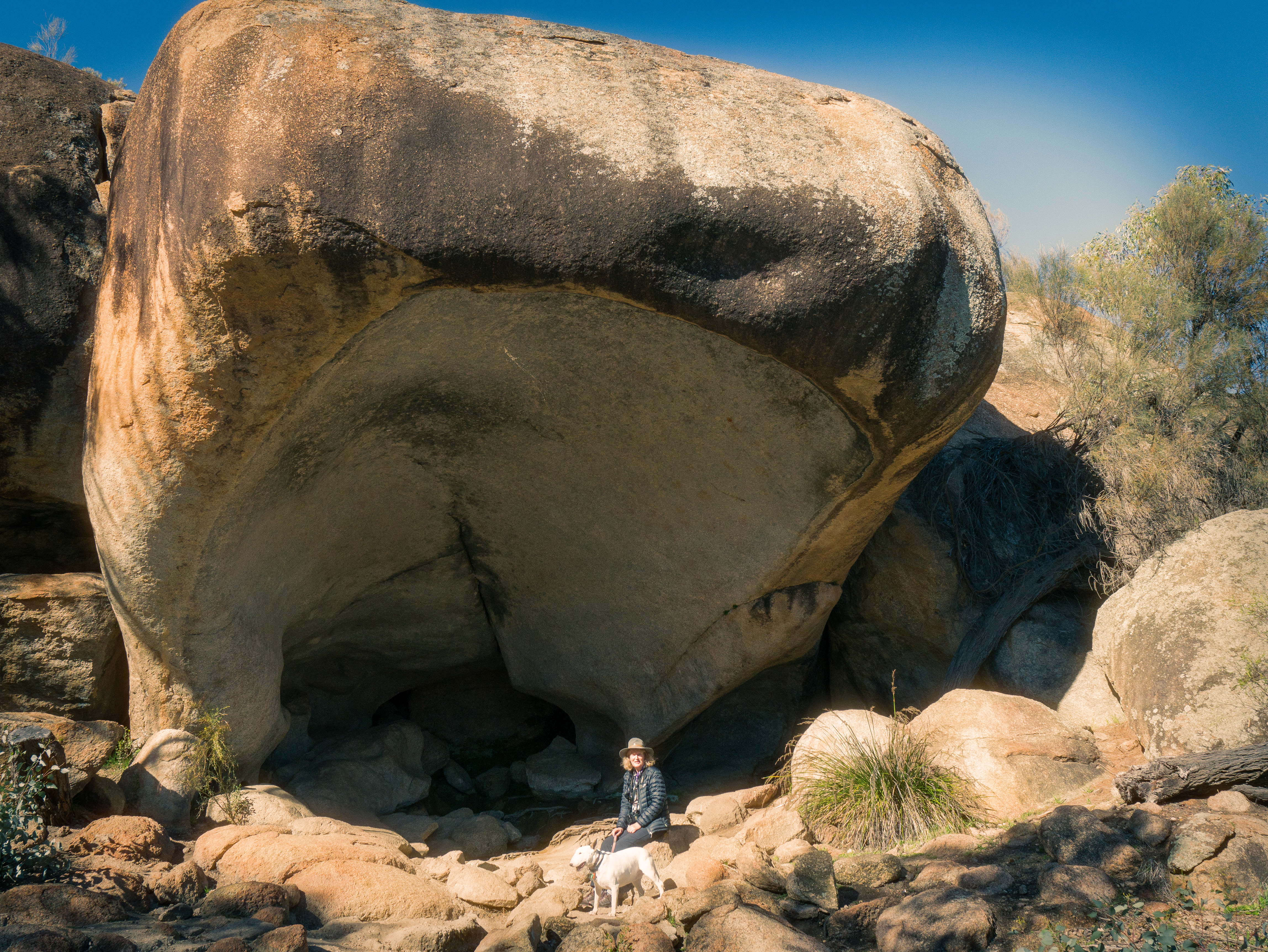
When we got to the base of the rock the vegetation changed from the scrub of the salt plain to thick bush fed by the water run off from the rock. We both enjoyed pocking around in the undergrowth looking for flowers, taking photos of each other and trying to dissuade Frida, our dog, from trying to climb up the rock face in search of interesting holes. It was amazing to see so many orchids – the blue beards were like a carpet in places. It was absolutely wonderful to see.


Helen and Frida at Hippo’s Yawn near Hyden in Western Australia.


Recurved Shell Orchid by Paul Amyes on 500px.com
Jug orchid, or recurved shell orchid (Pterostylis recurva). Wave Rock, Western Australia.


Blue Beard by Paul Amyes on 500px.com
Blue beard or blue fairy orchid (Pheladenia deformis),. Wave Rock, Western Australia.


All in all we had a great time. There is so much to see and do that we’re already talking about going again. If you are planning a trip to Wave Rock there is a whole lot more to it than posing for a selfie for Facebook on the rock.


Emu Fence by Paul Amyes on 500px.com
The Emu Fence at Wave Rock Resort. Hyden, Western Australia. iPhone SE in panorama mode. Exposure: 1/1400 sec, f2.2 at ISO 25.


Broadening My Horizons…


… with the Panasonic Leica DG Vario-Elmarit 8-18mm f2.8-4 micro four thirds lens which will be referred to hence forth as the 8-18 for brevity’s sake. For those who prefer video there is a video review at the bottom of the page.

The 8-18 was introduced as part of Panasonic’s Leica branded f2.8-4 lens range in April 2017. I was immediately interested as I wanted a wide-angle zoom in m4/3. I had discounted the existing Panasonic 7-14mm f4 and the Olympus 7-14mm f2.8 because they wouldn’t accept screw in filters and the Olympus 9-18mm f4-5.6 because the collapsible design means the lens is prone to failure due to the internal ribbon cables breaking. The new 8-18 presented itself with a high quality metal construction that was splash proof and a modest 67mm filter thread. I wanted to use the lens for video work and so the ability to take a variable neutral density filter was a must. So when the lens became available here in Australia I plonked my cash down and got one.


My first impression on opening the box was that it is a quality bit of kit – it feels nice in the hand with a cool metallic feel and satisfying density. The bulbous front element is well recessed and combined with the excellent locking lens hood means that it is protected from stray light and from being physically damaged. The lens barrel has two ring controls – the front being for focus and the rear for zoom – and a switch for selecting auto or manual focus.The focusing ring is of the fly-by-wire type that twiddles endlessly – I wish that Panasonic would follow Olympus’s lead and have the pull back clutch type focusing rings with hard stops. The zoom ring is nicely damped and travels in a smooth 90º rotation. Another gripe is that both Panasonic and Olympus are members of the m4/3 consortium so why oh why can’t they agree on which way the zoom ring turns? Both zoom and focus are internal which is nice as it does not affect the centre of balance while using a gimbal. The lens body is finished in a smooth black satin with the engravings done in the Leica font and colours. The lens mount is metal and looks to be chrome plated brass. So full marks to Panasonic for presentation.

Vital Statistics

lens mount m4/3
focal length 8-18mm (16-36mm 35mm full frame equivalent)
angle of view 62º – 107º
maximum aperture f2.8-4
minimum aperture f22
filter size 67mm
optical stabilisation no
internal focusing yes
internal zoom yes
minimum focusing distance 23cm
maximum magnification 0.12 x
number of lens elements 15
number of lens groups 10
weight 315g
length 88mm
diameter 73.4mm


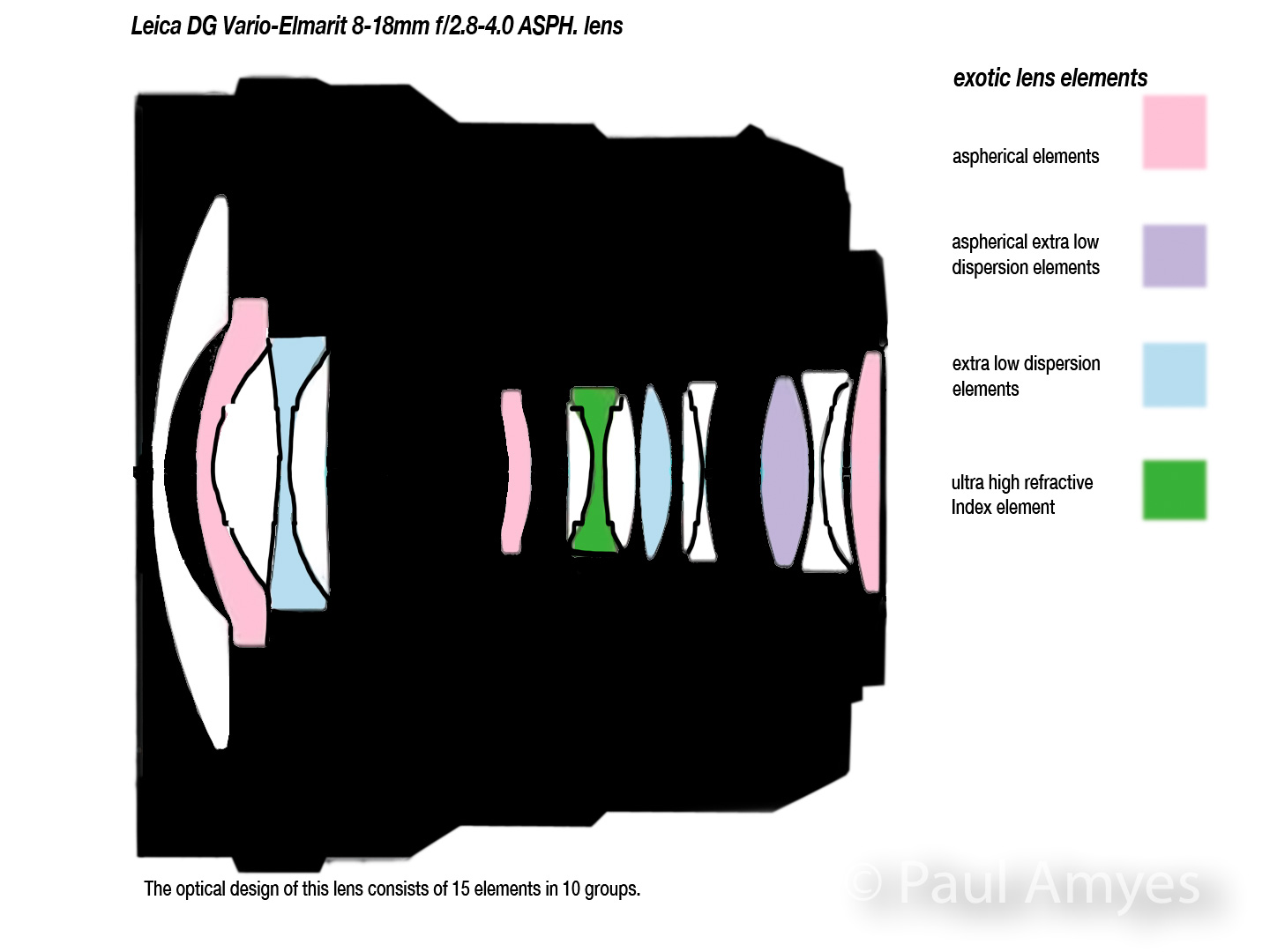
The lens construction is 15 elements in 10 groups with 1 aspherical extra low dispersion element, 2 extra low dispersion elements and 1 ultra high refractive index element. Combined with the nano coatings they should reduce internal flare, distortion and chromatic aberration. Control of distortion and chromatic aberration is also aided by an internal software profile that is baked into the image file. A lot of people don’t like this approach as they feel corrections should be made optically. The main criticism is that there is too much of an image quality hit in the corners with this approach. Hasselblad was the manufacturer to take this approach with their H3 camera and when that was introduced there were few complaints about image quality. The reality is that using lens profiles means lenses can be cheaper, smaller, and lighter than their optically optimised brethren.

The 8-18 has a variable aperture and unfortunately it quickly steps down as you zoom in as can be seen by the chart below.

8mm f2.8
9mm f3.1
10mm f3.2
12mm f3.4
14mm f3.6
18mm f4

Test Results

I’ve done my standard tests to look for distortion, chromatic aberration, and sharpness at 8mm, 12mm and 18mm to give an indication of how the lens does throughout its zoom range. I have just for interest sake posted images with no profile correction to give an idea of what the lens is actually doing. Click on the images to see them at full size.


8mm at f2.8 no lens profile applied


8mm at f2.8 with internal profile applied.

At 8mm without any inbuilt lens profile applied there is very obvious barrel distortion and vignetting at f2.8. With the profile applied there is still a very slight barrel distortion and the vignetting remains until f5.6. In terms of sharpness well at f2.8 the centre of the image is nicely sharp and contrasty and remain so until f16 when diffraction kicks in and softens the image. In the corners the story is different, at f2.8 the corners are significantly softer and less contrasty than the centre, they improve a little as you stop down reaching best performance at f5.6 and then get worse at f16 with diffraction. A small amount of chromatic aberration is present throughout the aperture range and is easily corrected in post.


12mm at f3.4 no lens profile applied


12mm at f3.4 with profile applied.

At 12mm we can see no distortion when the lens profile is applied and the vignetting is about 1/2 stop and is barely discernible. Wide open at f3.4 the centre of the image is sharp and contrasty and the best performance is at f5.6. In the corners the image is softer and has less contrast than the centre. The best performance is at f8. Diffraction starts to set in at f11.


18mm at f4 no lens profile


18mm at f4 with internal profile applied.

At 18mm there is some pincushion distortion in the profile corrected image. There is also a tiny bit of vignetting at f4 but this clears up at f5.6. Sharpness at f4 is very, very good in the centre throughout the aperture range only deteriorating at f16 due to diffraction.The corners are remarkably sharp at f4 but have slightly less contrast than the centre. Peak performance sets in at f5.6 and then again diffraction rears its ugly head at f16 and spoils the party. Chromatic aberration is very well controlled across the whole range and is very, very slight.

Like most ultra wide-angle zooms Panasonic’s 8-18mm f2.8-4 is prone to flare. The recessed front element and tulip lens hood do minimise this, but with the sun in the frame you will see veiling flare. When stopped down you can achieve nice sun stars.

Like most wide-angle zooms the 8-18 is prone to flare. In order to reduce this the engineers recessed the front lens element and then provided a decent lens hood. The Panasonic 7-14mm f4 caused purple blobs on Olympus cameras when there was a specular light source in the frame. Some people pointed the finger at the difference in UV coatings between Panasonic and Olympus cameras. Others said the thickness of the Olympus sensor stack caused the problem. Anyway the 8-18 is thankfully free of those artefacts. Shooting into the sun there is some veiling flare and ghosting.

Auto focus is done via a stepping motor and it is designed to work with Panasonic’s Depth From Defocus technology that is basically a contrast based auto focus system that is enhanced by software profiles for each Panasonic lens. Single point autofocus in single shot drive mode is incredibly fast and accurate. I decided to check the Continuous Auto Focus by continuous shooting at medium speed wide open on the Panasonic G85 with a person walking slowly towards the camera at focal lengths of 8mm and 18mm. All the shots were in focus. Then I tried to see how the lens would perform on a camera without DFD – in this case an Olympus OMD EM1 mk i. At 8mm and f2.8 all the images were in focus. At 18mm shooting a burst of 10 images the camera lost focus on the last 2 images of the burst. So this very limited test shows that the autofocus of the lens does perform better on Panasonic cameras with DFD.

Conclusions

The Panasonic Leica DG Vario-Elmarit 8-18mm f2.8-4 lens with Cokin P system wide-angle lens filter holder attached.

Ok I’ve had the lens a year now and I’ve used it for stills, time lapses and video shooting on the afore-mentioned EM1 and G85 along with an EP5 and EM10 so what can I say. The in camera lens profiles make a huge difference in terms of distortion, but most people won’t see this as they’ll see the corrected images. I did expect this to have some impact on sharpness in the corners but was pleasantly surprised to find that not the case at all. Most zooms perform best at the short end and become softer at the long end. With my copy of the 8-18 this lens is very good at the long end and it is a little softer at the short end. The ability to use filters is a boon for landscape photography and video. The 67mm filter size does not make filter purchases onerous and with the wide-angle filter holder you can use the Cokin P filter system with rectangular filter with an 85mm width. It is really nice not to use filters the size of dinner plates with this lens. I’ve been caught in a couple of downpours while using the 8-18 and have had no problems. I have found the lens immensely satisfying to use and have put it to more uses than I originally thought I would. In all I feel it is a very good lens if you can live without a fixed aperture. I would definitely recommend it.


This slideshow requires JavaScript.


It’s a hard life…

Pelican Point by Paul Amyes on 500px.com
Carrot cake and a drink at the Bayside Kitchen Cafe, Matilda bay. Olympus OMD EM1 mk i with Panasonic Leica 8-18mm f2.8-4 lens. Exposure: 1/800, f8, ISO 200.

The posts have been a bit sporadic and short of late and for that I apologise. I’ve been working on a book project and have been very busy. Indeed the above photie was taken while on a field trip. It’s a hard life ehh?