Matagarup

What do you do when you have to take your car into Perth to get it serviced but don’t want to hang around in the city and catch COVID? Go on a safari of course!!


My safari took me to Point Fraser and Heirisson Island. Heirisson Island is a small island of 285,600 sq. metres in the Swan River between East Perth and Victoria Park. Most people will know of it through crossing the Causeway which is the bridge over the river. It wasn’t always called Heirisson Island. Long before European explorers and colonists arrived there was a few smaller islands and some mudflats which was called Matagarup by the Beeloo Nyoongar. The name means one leg deep. The first known European visitors were led by Willem de Vlamingh in 1696. He and some of his crew rowed up the river and saw the black swans which led him to name the river the Swan River (Zwaanenrivier in Dutch). They got as far as the mudflats and island and could go no further. In 1801 Nicolas Baudin  from the French ship Le Naturaliste traveled up river and he named the island after his midshipman François-Antoine Boniface Heirisson. Since the early arrivals the river has been dredged and there has been a lot of land reclamation which has seen the mudflats disappear and the formation of the present island.


Yongka by Paul Amyes on 500px.com
Yongka or Western Grey Kangaroo, Macropus fuliginosus. Herrison Island, Western Australia.


There is a footpath round the island which is 2 Km in length which makes it perfect for an inner city safari. As far as the wildlife goes 92 different species of bird have been observed on the island and there is a resident population of Western Grey kangaroos which were introduced in 1998. Funnily enough I’ve walked round the island several times over the years and not seen a single kangaroo. Amazing considering that it’s a small island and they’re relatively large animals. But kangaroos are very good at making themselves scarce during daylight hours. This visit was different I saw three female kangaroos, two lazing around in the bushes and one grazing. In fact the one that was grazing was very curious and came right up to me – I think it was an attempted mugging because as soon as she realised I didn’t have anything worth stealing in the way of food she was off.


Yongka by Paul Amyes on 500px.com
This female checked me out to see what food offerings were available. I was a bit of a disappointment as I had nothing.


I must say it was a very pleasant way to pass the time and I’m looking forward to going again – hopefully to coincide with dawn or dusk.


Koonamit by Paul Amyes on 500px.com

These two welcome swallows were very obliging and let me take their photo.


Black and White by Paul Amyes on 500px.com

The Swan River Cormorants Club does not discriminate on the basis of colour or species – all are welcome.


Djidjinook by Paul Amyes on 500px.com

Not having any chips meant this silver gull just kept flying past.


Straw-necked Ibis by Paul Amyes on 500px.com

Straw-necked Ibis, Threskiornis spinicollis. Herrison Island, Western Australia.


Great Egret by Paul Amyes on 500px.com

Great Egret, Ardea alba modesta. Herrison Island, Western Australia.


Wyan by Paul Amyes on 500px.com

White-faced heron, Ardea novaehollandiae. Point Fraser, Western Australia.


Brown Jellyfish by Paul Amyes on 500px.com

No visit to the Swan River is complete without the ubiquitous Brown Jellyfish (Phyllorhiza punctata).

Ashfield Flats

Ashfield Flats by Paul Amyes on 500px.com
A tranquil spot by the Swan River at Ashfield Flats in Western Australia.


Ashfield Flats by Paul Amyes on 500px.com
The dual use paths along the river at Ashfield are popular with cyclists and walkers alike

This 6Km walk takes you through the area between Sandy Beach Reserve and Claughton Reserve. Heading out westwards from Sandy Beach Reserve the walk takes you through areas of open grassland and salt marsh interspersed with stands of paperbarks and bulrushes. When you get to Claughton Reserve you will see grasslands and mature flooded gums. At the weekends it is a popular recreational area attracting walkers, cyclists, and various paddle sports.


SUP at Ashfiled by Paul Amyes on 500px.com
The Swan River by Ashfiled Flats is a popular location for canoeists and stand up paddle boarders.


The best time to visit and see wildlife is early morning midweek and take time to explore the stands of trees and scrub off of the trail. What can you expect to see? Well EBird Australia have a list of 95 different species that have been recorded in the area. Birds that are regularly seen include:

  • Pacific Black Duck
  • White-faced Heron
  • Red Wattle Bird
  • Singing Honeyeater
  • Brown Honeyeater
  • Great Egret
  • Black-shouldered Kite
  • Nankeen Kestrel
  • Galah
  • Australian Ringneck
  • Sacred Kingfisher
  • Magpie-lark
  • Black-faced Cuckoo-shrike
  • Grey Butcherbird
  • Richard’s Pipit
  • Welcome Swallow
  • Silvereye

On my visit I managed to spot 18 different species on a busy Saturday morning so I was happy with that and I’ll try and get back earlier in the morning midweek next time.


Fishing by Paul Amyes on 500px.com
Great egret (Ardea alba modesta) fishing at Ashfield Flats, Western Australia.


Madi by Paul Amyes on 500px.com
Australian Pied Cormorant,Phalacrocorax various. Ashfield Flats, Western Australia.


Kokoko by Paul Amyes on 500px.com
Little pied cormorant, Microcarbo melanoleucos, drying out in the sun. Ashfield Flats, Western Australia.


Dilabot by Paul Amyes on 500px.com
Magpie-lark, Grallina cyanoleuca. Ashfielde Flats, Western Australia.


Biako by Paul Amyes on 500px.com
A pair of Galahs, Eolophus roseicapilla, at Ashfield Fats, Western Australia.


Dooromdorom by Paul Amyes on 500px.com
Singing Honeyeater, Lichenostomus virescens virescens. Ashfield Flats, Western Australia.


Rufous Whistler by Paul Amyes on 500px.com
A female Rufous Whistler, Pachycephala rufiventris, at Ashfield Flats, Western Australia.


Karbanga by Paul Amyes on 500px.com
Karbanga or great cormorant (Phalacrocorax carbo subsp. carboides) , sunning itself. Ashfield Flats, Western Australia.


Rufous Whistler by Paul Amyes on 500px.com
A male Rufous Whistler, Pachycephala rufiventris, singing. Ashfield Flats, Western Australia.


Djitidjiti by Paul Amyes on 500px.com
Willie Wagtail, Rhipidura leucophrys leucophrys, singing. Ashfield Flats, Western Australia.


Karak by Paul Amyes on 500px.com

Red-tailed Black Cockatoo, Calyptorhynchus banksii subs samueli. Ashfield Flats, Western Australia.

Photography …

… it’s a bit like fishing. There’s always the one that got away. It doesn’t matter how prepared you think you are the opportunity presents and disappears in a nano second. One of my photography lecturers used to talk about what he called ‘the retrospective drive home’ where you analyse everything you did and didn’t do that contrived to create that missed opportunity. The frustrating thing is as you try and tell someone about it they invariably say “A photograph or it didn’t happen”.  Well this time I’ve got the photos to prove it! Sort of.

The other day I was walking along the Swan River foreshore at Claremont when I saw an Osprey drop like a stone from the air and scoop up a fish.  In less than the blink of an eye it was over. I was ready the camera was out of the bag and had a long lens fitted, it was switched on and the settings were optimised. So what did I get?

The osprey making its escape with catch of the day.

With some Photoshop magic this is what I got.


That was the best I could get – pathetic isn’t it? There I am with (hang on the other half may read this) an untold amount of money tied up in photo equipment and this is it! I remember watching the original Bladerunner where they had a fancy doodad that could extract a useable photo out of some ridiculous enlargement. You know that film was set in 2019 and it is now 2018 and we haven’t got that fancy photo doodad let alone flying cars. The future is such a disappointment. So as I walk away from the scene looking dismally at the LCD on the back of the camera I’m mentally kicking my backside.

Half an hour later I hear a commotion coming from the water. A shoal of fishing flapping on the surface coming on to the shoreline. Low and behold a fin and then a head break the surface. It’s a pair of bottle nosed dolphins driving fish into the shore. With the relaxes of a dead cat I leap into action and fire off a burst.


Claremont Foreshore Walk by Paul Amyes on 500px.com
Indo-Pacific Bottle Nosed Dolphins can often be seen in in Freshwater Bay. They often drive shoals of fish into towards the shore to make hunting easier. They also feed on the crabs found on the sandbar.


Well this time I got a sharp photo of something recognisable as a dolphin. But that is the best I got. This wildlife photography lark is hard – the wildlife aren’t giving me chance.

Divine Vibrations

Swan River Walk by Paul Amyes on 500px.com

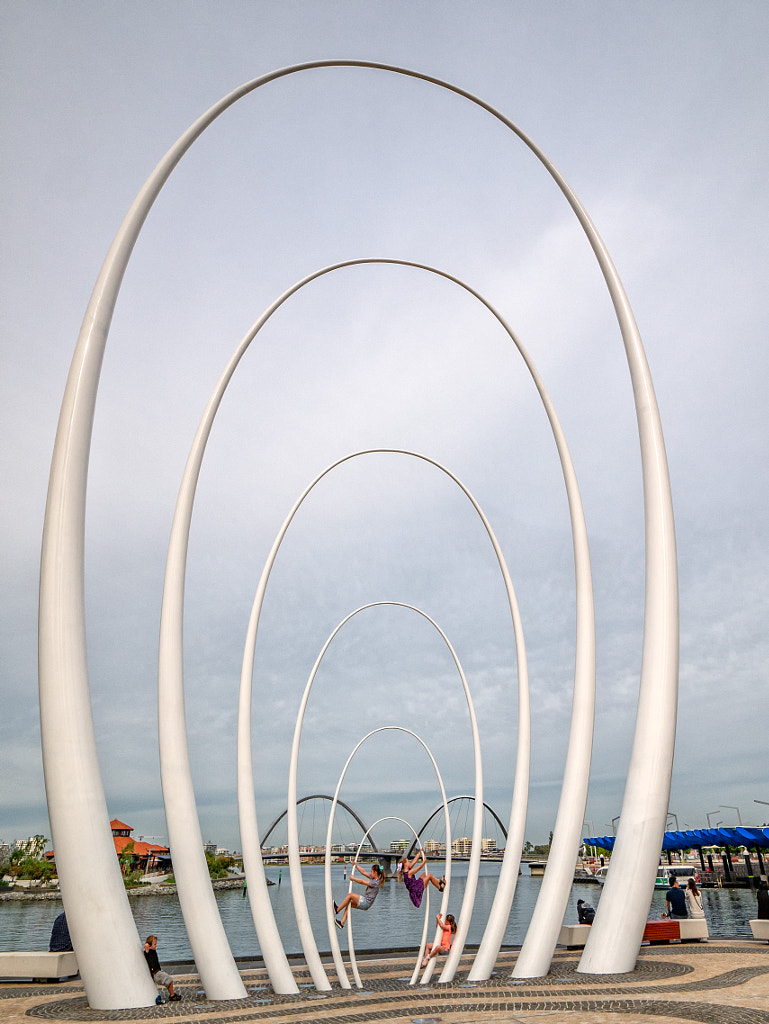
Spanda by Christian de Vietri is a striking sculpture that arrests the attention of visitors to Elizabeth Quay. “Spanda is a Sanskrit word that means ‘divine vibration’. The term is used to describe how consciousness moves in waves of contraction and expansion. The sculpture gives form to this primordial energy. My intention in making this sculpture is to express and facilitate oneness of the individual with the universal.” Artist, Christian de Vietri

Panasonic G85 with Panasonic LEICA DG 8-18/F2.8-4.0 lens. Exposure:1/320 sec, f8 at ISO 200.

Swanning Around*

Rainbow Lorikeet by Paul Amyes on 500px.com
The rainbow lorikeet (Trichoglossus haematodus) is a feral bird in Perth that commonly nests on the platforms at the base of palm fronds. Olympus Pen EP-5 with OLYMPUS M.45mm F1.8 lens. Exposure: 1/25 sec, f5.8 at ISO 200.


Warning this blog entry contains avian themes!

The other day I had to take the car into be serviced in Victoria Park near the Causeway. This meant I had time to kill so I decided to take a walk along the northern bank of the Swan River Foreshore. I hadn’t been along there for ages and there has been some recent redevelopment of the area so I decided to have a sticky beak. These are a few of the pictures I took as I wandered around.


Little Corellas by Paul Amyes on 500px.com
Little Corellas (Cacatua sanguinea) Swan River foreshore, Perth, Western Australia. Olympus Pen EP-5 with OLYMPUS M.45mm F1.8 lens. Exposure: 1/800 sec, f4 at ISO 200.


Australian darter (Anhinga novaehollandiae) by Paul Amyes on 500px.com
Australian darter (Anhinga novaehollandiae) on the Swan River foreshore, Perth, Western Australia. Olympus Pen EP-5 with OLYMPUS M.45mm F1.8 lens. Exposure: 1/2000 sec, f4 at ISO 200.


Little Dove by Paul Amyes on 500px.com
Little Dove. The Duyfken (Little Dove in English) replica moored at Elizabeth Quay on the Swan River, Perth, Western Australia. Olympus Pen EP-5 with OLYMPUS M.17mm F2.8 lens. Exposure: 1/125 sec, f8 at ISO 200.


First Contact by Paul Amyes on 500px.com
First Contact , Elizabeth Quay in Perth, is a five metre tall artwork by Nyoongar artist Laurel Nannup. The work depicts the arrival of European settlers to Perth. As the European boats arrived, the local Nyoongar people believed that these ships, were their past ancestors returning from the sea. Olympus Pen EP5 with OLYMPUS M.17mm F2.8 lens. Exposure: 1/400 sec, f8 at ISO 200.


Elizabeth Quay Bridge by Paul Amyes on 500px.com
The 20-metre high suspension bridge is an iconic architectural feature of Elizabeth Quay. The bridge forms part of the popular ‘bridges’ recreational route along the Swan River and provides a link between the promenades, the island and Barrack Street Jetty. Olympus Pen EP5 with OLYMPUS M.17mm F2.8 lens. Exposure: 1/500 sec, f8 at ISO 200.


*Swanning around and swanning about mean to move about aimlessly, irresponsibly and in a carefree manner. Related terms are swan around or about, swans around or about, swanned around or about. When the terms swanning around and swanning about first appeared in the late nineteenth century, they simply described the process of swimming like a swan. Today’s meaning of the term swanning about has its origins in World War II, interestingly. At that time, swanning around and swanning about described the movements of tanks in battle, in seemingly aimless maneuvers. The term made its way into mainstream English to mean anyone moving about in an irresponsibly carefree or aimless pattern. Swanning around and swanning about are primarily British terms, they are rarely seen in the United States.

http://grammarist.com/usage/swanning-around-and-swanning-about/