New Victoria Dam

The ubiquitous New Holland Honeyeater (Phylidonyris novaehollandiae), New Victoria Dam, Korung National Park, Western Australia.

Over the last few days my FaceBook feed has been seeing some seriously tasty bird photos from one of the groups that I belong to. The photos all come from one area  – New Victoria Dam which is 30Km east of Perth on the Darling Range in Korung National Park. So when the Beloved Significant Other (BSO) announced she was competing in a croquet competition at a location just 20 minutes drive away I immediately volunteered myself as driver.


There are two starting points to the walk and which you choose will largely depend upon when you visit. If you visit outside of office hours Monday to Friday or anytime at the weekend then y ou have to use the upper carpark as your start point as the access road is shut. During office hours you can drive down to the lower carpark keeping in mind that if stay till after 5pm then you won’t be able to drive out. I started at the upper carpark which only adds 800m each way to the walk. The walk consists of a 7Km round trip down past the New Victoria Dam to the Old Victoria dam wall and the garden and picnic area. There used to be a path through the trees at the edge of the road but it has become quite overgrown and indistinct so you are best walking along the access road. As you walk down the road on your left is the  gravesite of Francis Weston who died in 1876 aged two days, his parents lived in the timber workers settlement at Bickley. When you get to the lower carpark walk through it and then follow the trail markers. After walking through the forest you come to New Victoria Dam. Walk down the steps and at the bottom turn right onto the road and walk down to the remains of the Old Victoria Dam.


The gravesite of Francis Westson who died in 1876 aged two days. His parents lived in the timber workers settlement at Bickley.


The steps down to the New Victoria Dam.


The original dam was built in 1891 and pumped water via pipelines to Kings Park and a reservoir there on Mount Eliza. The dam became the first permanent water source for Perth and was operated by the private City of Perth Waterworks Company. As the water catchment area took in agricultural land and timber settlements there were fears that it would be polluted by raw sewage and excrement from livestock. Between 1895 and 1900 typhoid broke out in Perth and 425 people died. The water was tested and found to be contaminated so the government took control and made changes to prevent re-occurrence. By 1988 the concrete structure was beginning to degrade to such an extent it could no longer be repaired so in 1990 work on the new dam commenced and because of the use of roller compacted concrete it was completed by the following year. It can hold 9.5 million kilo-litres and is used to supply drinking water to Kalamunda and Lesmurdie. 


The wall of the old Victoria dam and the garden beside it.


In the lee of the old dam there is a grassed picnic area and toilets. Thickets of ti-tree and one-sided bottlebrush or claw flower have been planted and the thick vegetation along the creek line provides dense cover for a number of bird species. On this trip I used the picnic gazebo as an impromptu bird hide and spent a couple of hours watching the various birds feed and drink. I saw  red-eared firetails, mistletoe birds, splendid fairy wrens, western spinebills, new holland honeyeaters, white faced herons and rosellas. The dam spillway feeds water to the pond and creek that provides a year round water supply which means that the birds are always active all here. If you are there at dawn or dusk then kangaroos can be seen feeding on the grass. It is a great little spot and doesn’t require too much effort to get there.


Red-eared Firetail (Stagonopleura oculata), New Victoria Dam, Korung National Park, Western Australia.


White Faced Heron (Egretta novaehollandiae), New Victoria Dam, Korung National Park, Western Australia.

Anastasis

190206-Albany-0248-Edit.jpg by Paul Amyes on 500px.com
Male Musk duck (Biziura labata) at Lake Seppings, Albany, Western Australia. Olympus OMD EM1 mk ii with Panasonic Leica 100-400mm f/4-6.3 lens. Exposure: 1/1000 sec, f6.3, ISO 1600 with +0.7 stops exposure compensation


Anastasis –  from Ancient Greek ἀνάστασις (anástasis, “resurrection”).

A funny name for a blog post about Lake Seppings in Albany, Western Australia, but it does describe what happened.


20191228-Albany-0257-Edit.jpg by Paul Amyes on 500px.com
Australian Pelican, Pelecanus conspicillatus, Lake Seppings, Western Australia. Olympus OMD EM1 mk ii with Panasonic Leica 100-400mm f4-6.3 lens. Exposure 1/1000, f10, ISO 200.


Way back in the Nyittiny (creation times) the spirit Djrat walked on the earth and created south coast of Western Australia and as he walked he left a footprint which filled with water and created a freshwater lake 1.1 Km long and 400m wide. The Minang group of the Nyoongar called this place Tjuirtgellong or “place of the long necked turtle” which was an important food source for them in the summer months. The lake was surrounded by a variety of vegetation. Fringing the lake are bullrushes, sedges, and reeds reeds. Further back were Western Australian peppermint trees, spearwoods, paperbarks, native willows, wattles, banksias and melaleuca. All this provided habitat  for over 100 different bird species including Australian white ibis, yellow-billed spoonbil,  white-faced heron, blue-billed duck, musk duck, black swan, hoary-headed grebe, Australian pelican, Eurasian coot, spotless crake, masked lapwing, dusky moorhen, purple swamphen and buff-banded rail. 


Purple swamp hen by Paul Amyes on 500px.com
Purple swamp hen, Porphyrio porphyrio, Lake Seppings, Western Australia. Olympus OMD EM1 mk ii with Panasonic Leica 100-400mm f4-6.3 lens. Exposure: 1/1000 sec, f6.3 at ISO 2000.


20191228-Albany-0277-Edit.jpg by Paul Amyes on 500px.com
Jewel spiders (Austracantha minax) are often called Christmas spiders as they are commonly found during December and January. Lake Seppings, Western Australia. Olympus OMD EM1 mk ii with Panasonic Leica 100-400mm f4-6.3 lens. Exposure: 1/250 sec, f8, ISO 320.


All was fine and dandy until 1790 when the British explorer George Vancouver arrived. While he was mapping King George Sound he didn’t see any Minang but saw plenty of evidence that they were around and he later wrote that he found a ‘native village; fresh food remains near a well-constructed hut; a kangaroo that had apparently been killed with a blow to the head; a fish weir across what is now called the Kalgan River; and what appeared to be systematic firing of the land.’ (R. Appleyard. ‘ Vancouver’s Discovery and Exploration of King George’s Sound’ in Early Days, Journal and Proceedings of the Western Australian Historical Society, 1986, pp.86-97). That was the start of colonial settlement. As far as the lake is concerned well initially the settlers tried to do the right thing and in 1887 the Albany Municipal Council applied to the state government for permission to make the Lake and some of its surrounding bushland a botanical park. This lasted up until 1900 when it became a rubbish dump for the city of Albany. This sad state continued until 1972 when it was decided by the department of fisheries and fauna to turn the lake into a water fowl reserve.  Very quickly the community got on board with initially a bird-walk being established by the Apex club of Albany in 1980. By 2004 a walk around the lake had been completed and the lake was given protected status. In 2018 there was a ‘community planting’ of some 22,000 trees and understory plants to provide a ‘biodiversity corridor’ and habitat for endangered wildlife such as the western ring tailed possum.


Brush Bronzeing, by Paul Amyes on 500px.com
Brush Bronzeing, Phaps elegans, Lake Seppings, Western Australia. Olympus OMD EM1 mk ii with Panasonic Leica 100-400mm f4-6.3 lens. Exposure: 1/1000 sec, f5.7 at ISO 2500.


Every time we go to Albany I always visit Lake Seppings. I love walking around the edge of the lake and observing all the wildlife. I see it in many ways as a beacon of hope. The local community came together and have made a serious and worthwhile attempt to restore the lake to what it once was it still has a long way to go before it reaches its former status but it is a very good start. For the Nyoongar I hope that the recent claim for compensation for the loss of their traditional lands succeeds and can bring them some way of moving forward.


Red-winged Fairy-wren by Paul Amyes on 500px.com
Red-winged Fairy-wren, Malarus elegans, Lake Seppings, Western Australia. Olympus OMD EM1 mk ii with Panasonic Leica 100-400mm f4-6.3 lens. Exposure: 1/1000, f7.1 at ISO 1000 with -1 stop exposure compensation.


New Holland Honeyeater by Paul Amyes on 500px.com
New Holland Honeyeater, Phylidonyris novaehollandiae subsp. longirostris, Lake Seppings, Western Australia. Olympus OMD EM1 mk ii with Panasonic Leica 100-400mm f4-6.3 lens. Exposure: 1/1000 sec, f6.3at ISO 800.


Yoondoordo

Yoondoordo by Paul Amyes on 500px.com
The Eastern Osprey (Pandion cristatus) is known to the Nyoongar people of the south west of Western Australia as yoondoordo. Oyster Bay, Lower King, Western Australia. Olympus OMD EM 1 mk 2 with Panasonic Leica 100-400mm f4-6.3 lens. Exposure: 1/2000 sec, f6.3 at ISO 400.


I’ve got to say of the bird types raptors, or birds of prey, are my favourite. The way they hover above the landscape looking for prey or ride the thermals brings a quickening to my heart. Probably a corny thing to say but I really enthralled by their power and majesty –  they are the epitome of an apex predator. It’s not just the large raptors like wedge tailed eagles that do this but the smaller species such as falcons and kites as well. I’m lucky that where I live I often see birds of prey hunting and I’ve shared some  photos on the blog of collared sparrowhawks, nankeen kestrels, and brown goshawks over the years.


Yoondoordo by Paul Amyes on 500px.com
Look at the talons on that! Eastern Osprey (Pandion cristatus), Oyster Bay, Lower King, Western Australia. Olympus OMD EM1 mk 2 with Panasonic Leica 100-400mm f4-6.3 lens. Exposure: 1/1000 sec, f6.3 at ISO 400.


When we started making plans to spend Christmas in Albany I was excited because it would mean that I’d be able to photograph Eastern Ospreys at a nest site near where we staying. So when we set out I made sure I had the necessary kit to take advantage of the opportunity. I spent a very happy Christmas Day filming these wonderful animals.


Tyger Tyger, burning bright…

Tyger Tyger, burning bright, 
In the forests of the night; 
What immortal hand or eye, 
Could frame thy fearful symmetry?
William Blake 1794 from “Songs of Experience“
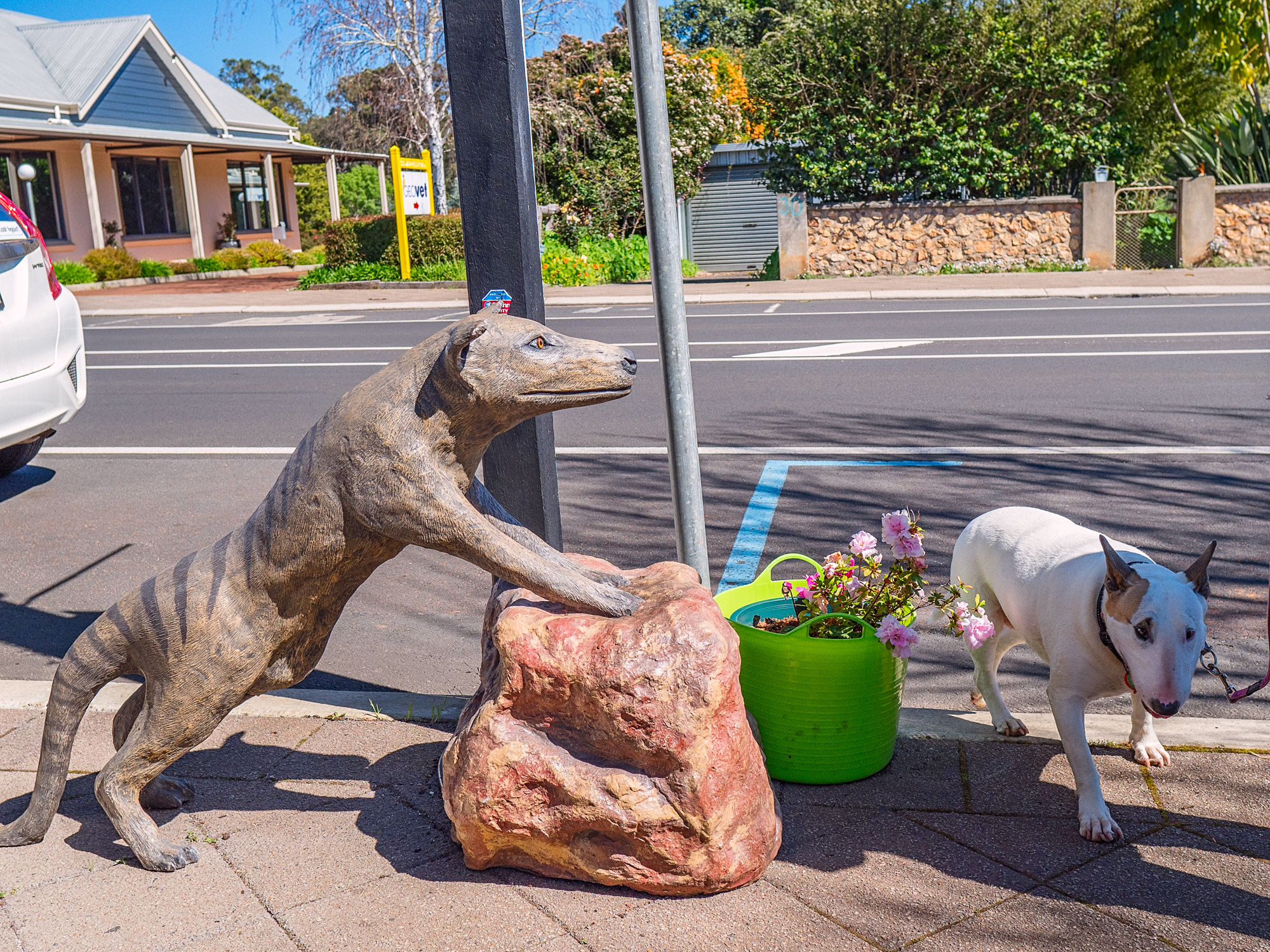
Tasmania does not have a monopoly on the thylacine. Many people believe they can be seen in Western Australia’s Blackwood Valley. Nannup is the focus of Thylacine tourism in Western Australia.
William Blake when he wrote his famous poem was thinking of the Bengal Tiger. We have/had tigers in Australia. Well kind of – hmmmm  not really. The Tasmanian tiger or to give it its proper name the thylacine (Thylacinus cynocephalus) once roamed all over Australia. But by the time the island continent was colonised it was restricted to the rain forests of Tasmania. I wrote a blog post about them a while ago. The thylacine is a tourist draw card in Tassie and it has become an icon for the tourist industry, but they don’t have a monopoly on it. Down in the South West corner of Western Australia, in the Blackwood Valley is the sleepy town of Nannup. Many of the locals are convinced that the Thylacine roams the forests in the valley and consequently it is now part of Nannup’s tourism campaign.


As it would happen we found ourselves in Nannup the other week. We weren’t looking for the tiger, but we certainly found them as we walked up and down the main street. Again like in Tassie the thylacine has been “gnomified” and can be found in front gardens all over the shop.


Frida was none too pleased with her thylacine encounter in Nannup.


It’s not the first time we’d visited the town, but we’d not been for a while and it had changed quite a bit. With the winding down of the forestry industry Nannup is seriously chasing the tourist dollar and the place has been titivated to reflect that. Once you were hard pushed to get a decent coffee now it seems that every other building is a cafe. It presents as a nice up beat place with a friendly vibe.


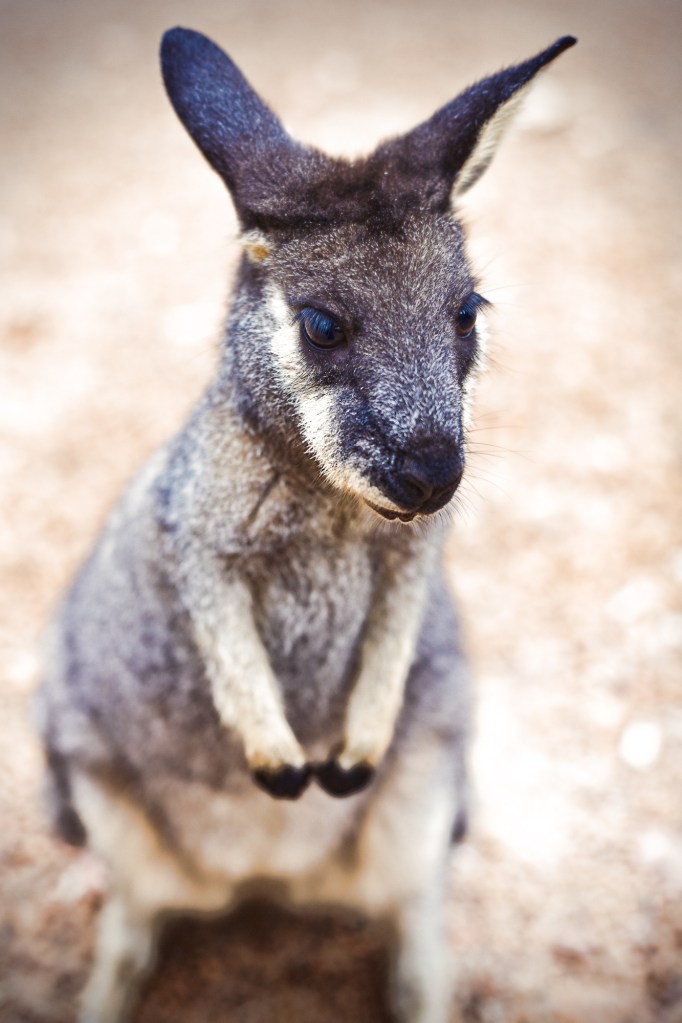
One of the Nannup locals, a Western Brush Wallaby (Macropus irma) also known as the black-gloved wallaby. Nannup, Western Australia.


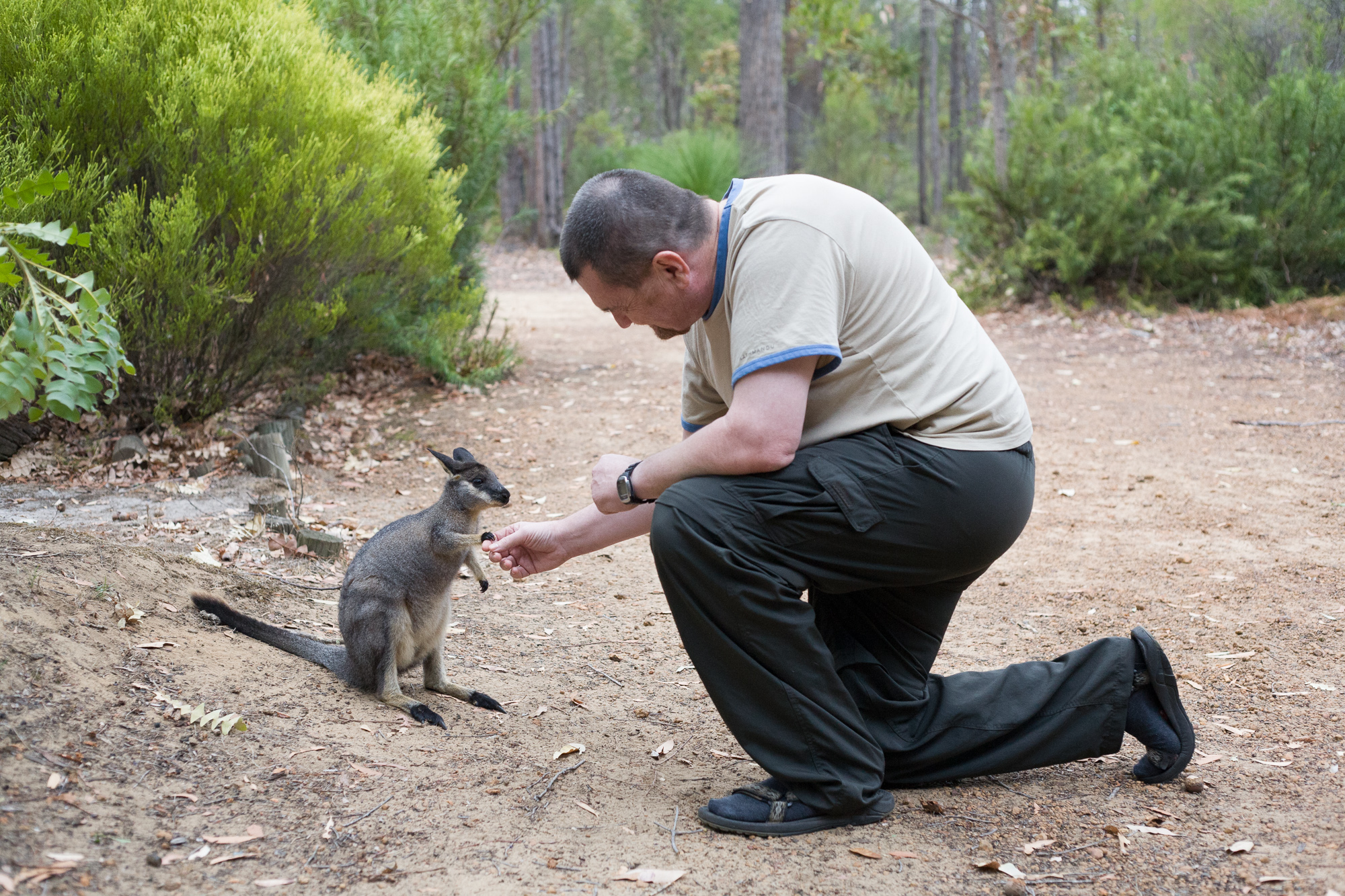
… and they proved to be very friendly.

Our accommodation was ideally located in the forest and only a stone’s throw from Kondil Wildflower Park. The park consists of new growth forest which contains an incredible diversity of flora. There are three walking trails within the park and I walked two of them. The Woody Pear Walk which is a 1 Km easy walk trail and the the Wildflower Wander which according to the information board is 3.5 Km but according to my GPS is 4.9 Km – either way it’s an easy walk on well sign posted trails.


Below are some of the orchids I found while walking around.


Bird Orchid by Paul Amyes on 500px.com
Bird Orchid, Pterostylis barbata. Nannup, Western Australia. Olympus OMD EM 1 mk ii with Olympus m.Zuiko 60mm f2.8 macro lens. Exposure: 1/125 sec, f4 at ISO 1000.


Leaping Spider Orchid by Paul Amyes on 500px.com
Leaping spider orchid, Caladenia macrostylis. Nannup, Western Australia. Olympus OMD EM 1 mk ii with Olympus m.Zuiko 60mm macro lens. Exposure: 1/60 sec, f8, ISO 3200.


Albino Silky Blue Orchid by Paul Amyes on 500px.com
Albino Silky Blue Orchid, Cyanicula sericea. Nannup, Western Australia. Olympus OMD EM 1 mk ii with Olympus m.Zuiko 60mm macro lens. Exposure: 1/125 sec, f4 at ISO 200.


Silky Blue Orchid by Paul Amyes on 500px.com
Silky Blue Orchid, Cyanicula sericea. Nannup, Western Australia. Olympus OMD EM 1 mk ii with Olympus m.Zuiko 60mm f2.8 macro lens. Exposure: 1/100, f5.6 at ISO 1000.


Warty Hammer Orchid by Paul Amyes on 500px.com
Warty Hammer Orchid, Drakaea livida. Nannup, Western Australia. Olympus OMD EM 1 mk ii with m.Zuiko 60mm f2.8 macro lens. Exposure: 1/30 sec, f8 at ISO 64.


Magical Magic Lake

This could have been titled Hyden – the return. Hyden is a small town in the middle of the Wheatbelt in Western Australia some 292Km east of Perth. Regular readers will remember that we’ve been before and maybe somewhat perplexed as to why we’d bother to visit again. Well Hyden’s claim to fame is Wave Rock which is a large granite rock face that has been eroded in the shape of a perfect breaking wave. More than 100,000 tourists make their way there very year. Most just stay about an hour before zooming off to another destination to get the perfect instagram shot without taking any time to see what else is there. A great shame really as there is so much more to offer. When I wrote about our previous visit I concentrated more on other sites and the Aboriginal heritage of the area. This time I’ll look at what Hyden has to offer in terms of the natural world.

We decided to make a three day trip and on our way we’d stop off in Corrigin whose main claim to fame is the being the holder of the world record for the number of dogs in a ute and being the home to a dog cemetery. You’d be forgiven for thinking that Corrigin is a bit obsessed with dogs.  Anyway it was a nice spot to break the journey, stretch the legs, make the bladder gladder etc. Corrigin does have a pretty impressive wildflower drive which begins just opposite the dog cemetery just on the outskirts of town. Most people just pull up in their car, jump out and walk a couple of metres. They then declare that there’s nothing to see and rush off in a cloud of red dust. Just take your time and have a poke about and you’d be amazed at what you can find. Here are a few examples.


Sugar Candy Orchid by Paul Amyes on 500px.com
Sugar Candy Orchid, Caladenia hirta subsp. hirta. Wildflower Drive, Corrigin, Western Australia. Panasonic Lumix G85 with Olympus mZuiko 60mm f2.8 macro lens and Metz 15MS-1 flash. Exposure: AE priority 1/200 sec, f4 at ISO 400 with -1 stop exposure compensation.


Chameleon Spider Orchid by Paul Amyes on 500px.com
Chameleon Spider Orchid, Caladenia dimidia. Wildflower Drive, Corrigin, Western Australia. Panasonic Lumix G85 with Olympus mZuiko 60mm f2.8 macro lens and Metz 15MS-1 flash. Exposure: AE priority 1/100 sec, f4 at ISO 400 with -1 stop exposure compensation.


Pink Candy Orchid by Paul Amyes on 500px.com
Pink Candy Orchid, Caladenia hirta subsp. rosea. Wildflower Drive, Corrigin, Western Australia.


Blood Spider Orchid by Paul Amyes on 500px.com
Blood Spider Orchid, Caladenia filifera. Wildflower Drive, Corrigin, Western Australia.


Slender Spider Orchid by Paul Amyes on 500px.com
Slender Spider Orchid, Caladenia pulchra. Wildflower Drive, Corrigin, Western Australia.


Sugar Orchid by Paul Amyes on 500px.com
Sugar Orchid, Ericksonella saccharata. Wildflower Drive, Corrigin, Western Australia.

When we got to Hyden we drove out to the Wave Rock Resort on the shore of Magic Lake which is where we were staying. The lake is quite startling. It’s not very big but is comprised of crystal clear salt water with a gypsum base. That pale coloured lake bed combined with the water makes a giant reflector that takes on the colours of the sky so as the day progresses the lake changes colour. To add to it’s other worldly qualities is that it lies in the middle of a salt plain which is fairly uniform in colour and is covered in mainly scrubby bush and a smattering of trees. It all made me want to get the tripod and graduated neutral density filters out.


Magical Magic Lake by Paul Amyes on 500px.com
Magical Magic Lake. A canoe on Magic Lake beach at sunset. Western Australia. Panasonic G85 with Panasonic Leica 8-18mm f2.8-4 lens and +3 stop graduated neutral density filter. Exposure: AE priority 1/8 sec, f11 at ISO 200 with +1 stop exposure compensation.


Magical Sunset by Paul Amyes on 500px.com
Magical Sunset. Magic Lake at sunset. Hyden Western Australia.


The next day we decided to combine the Wave Rock Walk Circuit with the Hippo’s Yawn Loop and the Breakers Trail to create a loop that would take us from the resort up to the Hippo’s Yawn then along the bottom of the rock out to the Breakers picnic area and then back to our accommodation at the resort. The best part of it was that we could take the dog as it is all very pet friendly. Along the way we hoped to see more orchids and birds as we passed through the salt plain and into the bush at the base of the rock.


Fence Line by Paul Amyes on 500px.com
Old fence posts march across the salt flats at Magic Lake near Hyden in Western Australia. Panasonic Lumix G85 with Panasonic Leica 100-400mm f4-6.3 lens. Exposure: 1/250 sec, f8 at ISO 200.


Crested Pigeon by Paul Amyes on 500px.com
Crested pigeon, Ocyphaps lophotes, Magic Lake, Hyden, Western Australia. Panasonic G85 with LEICA DG 100-400/F4.0-6.3 lens. Exposure: Shutter priority 1/500 sec, f6.3 at ISO 200 with -1/3 stop exposure compensation.


Kayibort by Paul Amyes on 500px.com
Known to the Nyoongar as Kayibort the Black-faced woodswallow, Artamus cinerus, can be seen on the shores of Magic Lake, Hyden, Western Australia. Panasonic G85 with LEICA DG 100-400/F4.0-6.3 lens. Exposure: shutter priority 1/500 sec f6.3 at ISO 200.


Lets Dance by Paul Amyes on 500px.com
Salt Lake Spider Orchid, Caladenia exilis subsp. exilis. Magic Lake, Hyden, Western Australia. Panasonic g85 with OLYMPUS M.60mm F2.8 Macro lens. Exposure: aperture priority 1/640 sec, f4 at ISO 200 with +2/3 stop exposure compensation.


Yellow Spider Orchid by Paul Amyes on 500px.com
Yellow Spider Orchid, Caladenia denticulata subsp. denticulata. Magic Lake, Hyden, Western Australia. Panasonic G85 with OLYMPUS M.60mm F2.8 Macro lens. Exposure: aperture priority 1/125 sec, f8 at ISO 1000 with -1/3 stop exposure compensation.


When we got to the base of the rock the vegetation changed from the scrub of the salt plain to thick bush fed by the water run off from the rock. We both enjoyed pocking around in the undergrowth looking for flowers, taking photos of each other and trying to dissuade Frida, our dog, from trying to climb up the rock face in search of interesting holes. It was amazing to see so many orchids – the blue beards were like a carpet in places. It was absolutely wonderful to see.


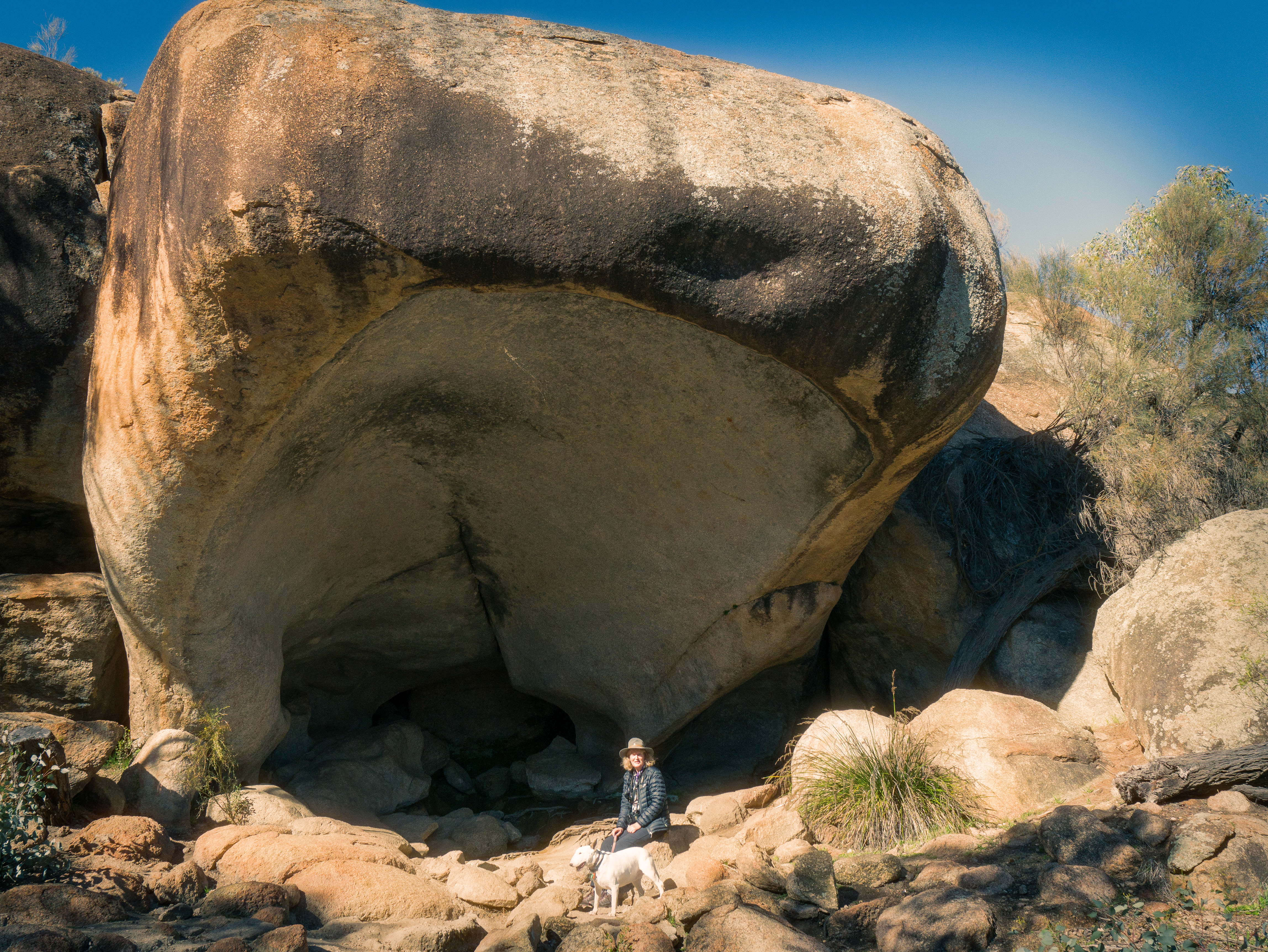
Helen and Frida at Hippo’s Yawn near Hyden in Western Australia.


Recurved Shell Orchid by Paul Amyes on 500px.com
Jug orchid, or recurved shell orchid (Pterostylis recurva). Wave Rock, Western Australia.


Blue Beard by Paul Amyes on 500px.com
Blue beard or blue fairy orchid (Pheladenia deformis),. Wave Rock, Western Australia.


All in all we had a great time. There is so much to see and do that we’re already talking about going again. If you are planning a trip to Wave Rock there is a whole lot more to it than posing for a selfie for Facebook on the rock.


Emu Fence by Paul Amyes on 500px.com
The Emu Fence at Wave Rock Resort. Hyden, Western Australia. iPhone SE in panorama mode. Exposure: 1/1400 sec, f2.2 at ISO 25.


The Near East

At a bit of a loose end we decided to go out on the Goldfields Road to Tammin. The town’s sole raison d’être is the transportation of the surrounding areas grain crops. The grain bins and railway siding around which the town is built are the key features of the town. With the increasing industrialisation of modern agriculture farms have got bigger and bigger and employ less and less people so like many rural areas although generating a lot of wealth the town is in decline.


Derelict by Paul Amyes on 500px.com
Abandoned farmhouse on the Goldfields Road in Western Australia. Olympus Pen EP-5 with Olympus 12-50mm f3.5-6.3 lens. Exposure: 1/640 sec, f5.6 at ISO 200. Converted to monochrome in AlienSkin Exposure 4.

When I first got interested in photography I was living in the South East of England which is a very verdant and prosperous region. Naturally the first photographers who caught my eye were British ones like David Bailey, Snowdon, Patrick Litchfield and Terrance Donovan.As I went on I discovered more socially aware photographers such as Chris Killip, Graham Smith and Don McCullin. I  remember going to see Killip and Smith’s exhibition “Another Country” in 1985 and being absolutely blown away by the subject matter and the quality of the work – it was one of transcendent experiences and it altered my perception of what photography could be dramatically. It was quite a while before I turned my attention to non British photographers. When I first saw the work of Walker Evans, Robert Frank, Joel Sternfeld, Stephen Shore, and Robert Adams I couldn’t really relate to the subject matter. Their vision and representation of the USA was one that was completely foreign to me and outside that which the mainstream media presented. It wasn’t until I migrated to Australia and started to explore the rural areas seldom visited by tourists that the penny finally dropped. I started to see similar scenes and over time I have attempted to capture them. I’m never quite sure whether it should be in black and white or colour so I find myself fluctuating between the two mediums and never quite happy with the results.


Tamin by Paul Amyes on 500px.com
Tammin grain bins and railway station. Olympus Pen EP-5 with Olympus 12-50mm f3.5-6.3 lens. Exposure: 1/800 sec, f5.6 at ISO 200. Converted to monochrome in AlienSkin Exposure 4.

Which brings us to the photos in this post. They are just a small sample of the photos that I took on our road trip to Tammin. At first I processed them as colour and felt that the colour detracted from the starkness that I saw and felt. I then tried monochrome. When I worked in the darkroom I liked to use Ilford Multigrade  FB warm tone glossy paper and that is a look I try to replicate with my digital images albeit without much success. When Ilford’s digital media arm Harman Technology introduced their warm tone gloss baryta inkjet paper I thought that my prayers had been answered and I used it for a couple of exhibitions I did. It was a sad day when it was discontinued – I still have 5 sheets of A3+, not enough to do any proper work. So now I try to replicate the look in AlienSkin Exposure 4 which is what I have done with these photos. The problem is that while it looks OK on screen when you translate it to printed media it does work as it is not subtle enough. Perhaps the photos should have stayed in colour after all.


Closed by Paul Amyes on 500px.com
Empty shop front in Tammin, Western Australia. Olympus Pen EP-5 with Olympus 12-50mm f3.5-6.3 lens. Exposure: 1/100 sec, f5.6 at ISO 200. Converted to monochrome in AlienSkin Exposure 4.


Bibra Lake Bird Walk


South of the Swan River is a string of lakes known as the Beeliar Wetlands which are a chain of twenty six lakes stretching from Manning Lake in Hamilton Hill to Madura Swamp near Mandurah Wetlands. Nineteen of those lakes and associated wetlands have been incorporated into the Beeliar Regional Park. This extensive belt of wetlands that has been widely acknowledged as a biodiversity hot-spot having a greater number of endemic species than most other regions in Australia. Within this the Nyoongar with their hunter-gatherer life-style managed the land with their fire-stick farming and survived by hunting and trapping a variety of game, including kangaroos, possums and wallabies; by fishing using spears and fish traps; as well as by gathering an extensive range of edible wild plants, including wattle seeds.  Since colonisation three-quarters of these wetlands have been drained for urban development. What remains has suffered untold damage through the introduction of feral animals and plants. Thankfully Australia is a signatory of the Ramsar Convention and several key wetlands on the Swan Coastal Plain have been set aside for conservation. Bibra Lake is the fourth lake (heading southwards) in that chain of lakes that makes up Beeliar Regional Park. Whitefellas believe that they discovered the lake in 1842 and named it after the bloke who bought the land in 1843, one Benedict von Bibra. The Nyoongar say they have known about the lake since time began and to them it known as Walubup.

I first went to Bibra Lake about thirty years ago and thought it was a bit boring and hadn’t been back until the other week. I was called upon for driving duties for the Beloved Significant Other (BSO) and I was left with a morning to kill. So I looked in my copy of Birding Sites around Perth by Ron Van Delft (sadly out of print and unavailable now) and saw that Bibra Lakes was nearby and rated as a good location for birding. The down side to this was that we were experiencing the first major cold front of winter and that meant it was bucketing down and blowing a gale. So suitably swathed in Gore-Tex and equipped with a suitably weather resistant camera I headed off to walk around the lake not expecting to see much.


Live Here by Paul Amyes on 500px.com
A comforting warning painted on the cycle path that runs around Lake Bibra. It was cold and wet in winter so not much chance of a snakey encounter.


Initially I thought that with it raining I had more chance of photographing ducks as it was the perfect weather for them. There were quite a number of different species on the shore and the water. I was quite taken by the Shovelers and the Pink Eared Ducks. The Shovelers are quite a string looking duck with colouring and almost disproportionately large bills. They can often be seen foraging in shallow water where they filter water through their bills insects looking for insects, crustaceans and a variety of plants. Such a specialised mode of feeding means that they are limited to certain types of habitat such as freshwater swamps and lakes with large reed beds. Shovelers also tend to hang out with pink-eared ducks which are so called because of the patch of pink feathers on the sides of the drakes head. Like the Shovelers they too are filter feeders. As the walk moved through areas of paperbark and sheoak trees then smaller insect eating birds were seen such as Willie Wagtails, Grey Fantails, Silvereyes, and various types of wrens. Over all as I did the 8.5 Km walk I saw 18 different species of bird which I felt was a pretty good haul considering the weather conditions. So I’ve revised my opinion of Bibra Lakes and will not wait another 30 years before my next visit.


Australasian Shoevelers by Paul Amyes on 500px.com
Australasian Shoevelers, Spatula rhynchotis. Bibra Lake, Western Australia. Panasonic Lumix G85 with Panasonic LEICA DG 100-400/F4.0-6.3 lens. Exposure: 1/400 sec, f6.3 at ISO 250.


Keeping A Low Profile by Paul Amyes on 500px.com
A pink-eared duck (Malacorhynchus membranaceus) keeping a low profile while amongst Eurasian coots (Fulica atra). Bibra Lake, Western Australia. Panasonic Lumix G85 with Panasonic LEICA DG 100-400/F4.0-6.3 lens. Exposure: 1/500 sec, f6.3 at ISO 3200.


Brown Honeyeater, by Paul Amyes on 500px.com
Brown Honeyeater, Lichmera indistincta. Bibra Lake, Western Australia. Panasonic Lumix G85 with Panasonic LEICA DG 100-400/F4.0-6.3 lens. Exposure: 1/500 sec, f6.3 at ISO 2500.


Varigated Fairy-wren by Paul Amyes on 500px.com
Varigated Fairy-wren, Malurus lamberti. Bibra Lake, western Australia. Panasonic Lumix G85 with Panasonic LEICA DG 100-400/F4.0-6.3 lens. Exposure: 1/500 sec, f6.3, ISO 320.


Willie Wagtail by Paul Amyes on 500px.com
Willie Wagtail, Rhipidura leucophrys leucophrys, Bibra Lake. Panasonic Lumix G85 with Panasonic LEICA DG 100-400/F4.0-6.3 lens. Exposure: 1/500 sec, f6.3 at ISO 1600.


Mistletoebird by Paul Amyes on 500px.com
A female mistletoebird, Dicaeum hirundinaceum, at Bibra Lake in Western Australia. Panasonic Lumix G85 with Panasonic LEICA DG 100-400/F4.0-6.3 lens. Exposure: 1/500 sec, f6.3 at ISO 2000.


Bibra Lake by Paul Amyes on 500px.com
Bibra Lake is part of the Beeliar Wetlands which is an internationally recognised birding hotspot. This is one of two bird hides that have been buit at Bibra Lake.


Feed A Bird? by Paul Amyes on 500px.com
Don’t feed the birds sign at Bibra Lake complete with Willie Wagtail, Rhipidura leucophrys leucophrys. Panasonic Lumix G85 with Panasonic LEICA DG 100-400/F4.0-6.3 lens. Exposure: 1/500, f4, ISO 250.

If you are interested in the birds that can be seen at Bibra Lakes, and indeed throughout the Beeliar Wetlands Birding WA has a useful webpage that gives info on the species that can be seen and where. Birdlife Australia put out a couple of useful brochures which can be got from regional visitors centres or downloaded as PDFs from their website. The brochures are:


White-headed Stilt. by Paul Amyes on 500px.com
White-headed Stilt, Himantopus himantopus subsp. leucocephalus. Bibra Lake, Western Australia. Panasonic Lumix G85 with Panasonic LEICA DG 100-400/F4.0-6.3 lens. Exposure: 1/500 sec, f6.3 at ISO 1600.


Nice and Easy

Splendid Fairy Wren by Paul Amyes on 500px.com
Splendid Fairy-wren, Malarus splendens subs splendens, out of the breeding period. Lake Leschenaultia, Western Australia. Canon EOS 6D with Sigma 150-600mm f/5-6.3 DG OS HSM Contemporary lens. Exposure: 1/1000sec, f6.3 at ISO 6400.

Sometimes I think that have got to be easier ways to enjoy birding and bird photography than dragging 3.5Kg of camera and lens quietly through the bush and trying to get a picture of something that is literally so flighty that the slightest sound sees your subject leave at a tremendous rate of knots.


Western Thornbill by Paul Amyes on 500px.com
Western Thornbill, Acanthiza inornata. Lake Leschenaultia, Western Australia. Canon EOS 6D with Sigma 150-600mm f/5-6.3 DG OS HSM Contemporary lens. Exposure: 1/1000 sec, f6.3 at ISO 1000.


Case in point. Not so long ago Beloved Significant Other (BSO) went for a trip to Lake Leschenaultia in Chidlow. I spent an age crawling around in the bush looking for a cooperative subject. In that time every small twig that I inadvertently trod on sounded like a thunder clap that sent all the wildlife scurrying for cover in a 5Km radius.


Silvereye by Paul Amyes on 500px.com
Silvereye, Zosterops lateralis. Lake Leschenaultia, Western Australia. Canon EOS 6D with a Sigma 150-600mm f/5-6.3 DG OS HSM Contemporary lens. Exposure: 1/1250 sec, f6.3 ISO 2500.

Even if you manage to creep up on a suitable subject you then have the problem of photographing something that is 5-10cm and hoping and twitching around like a meth user suffering from St Vitus’ dance while you are trying to track it and keep it in focus as it darts in and out of the foliage. So I’ve come up with an easier method. The BBQ. If you have BBQ in Australia every animal in the neighbourhood will be trying to relieve you of your food. The little buggers will climb into your lap and pose for photos if food is involved.


A picnic feast with the birds of lake Leschenaultia by Helen Amyes (aka BSO). Panasonic Lumix LX5. Exposure: 1/160 sec, f2.8 at ISO 80.


MTB in Denmark

Denmark Nornalup Heritage Trail and Munda Bidi Trail by Paul Amyes on 500px.com
Green Pool, Wilson’s Bay National Park Denmark Western Australia. Apple iPhone SE camera in panorama mode. Exposure: 1/1400s, f/2.2, at ISO 25.

Denmark the town in Western Australia not the country. There is a lot of opportunity for trail riding in the area with several long distance trails converging on the town. So after a few days of goofing around on some of them to get the lie of the land I then put together a loop ride that would make for an epic birthday bash.

By combining the Denmark – Nornalup Heritage Trail , the Munda Biddi and some cycle path along Ocean Beach Road I ended up with a 42Km loop ride that would take me through some beautiful country.


Denmark Nornalup Heritage Trail and Munda Bidi Trail by Paul Amyes on 500px.com
Elephant Rocks, Wilson Bay, Denmark Western Australia. Apple iPhone SE camera in panorama mode. Exposure: 1/1600s, f2.2 at ISO 25.


Denmark Nornalup Heritage Trail and Munda Bidi Trail by Paul Amyes on 500px.com
On the Nornalup Heritage trail which is a rail to trails project. Denmark, Western Australia. Leica DLux Type 109. Exposure; 1/1000s, f4 at ISO 200.


Denmark Nornalup Heritage Trail and Munda Bidi Trail by Paul Amyes on 500px.com
Lights Beach on the Munda Biddi Trail, Denmark, Western Australia. Apple iPhone SE. Exposure: 1/10s, f2, ISO 25.

Below is a video of how I got along.