“What?” cried the Rat, open-mouthed: “Never been in a—you never—well I—what have you been doing, then?””Is it so nice as all that?” asked the Mole shyly, though he was quite prepared to believe it as he leant back in his seat and surveyed the cushions, the oars, the rowlocks, and all the fascinating fittings, and felt the boat sway lightly under him.
“Nice? It’s the only thing,” said the Water Rat solemnly as he leant forward for his stroke. “Believe me, my young friend, there is nothing—absolute nothing—half so much worth doing as simply messing about in boats. Simply messing,” he went on dreamily: “messing—about—in—boats; messing—”
“Look ahead, Rat!” cried the Mole suddenly.
It was too late. The boat struck the bank full tilt. The dreamer, the joyous oarsman, lay on his back at the bottom of the boat, his heels in the air.
“—about in boats—or with boats,” the Rat went on composedly, picking himself up with a pleasant laugh. “In or out of ’em, it doesn’t matter. Nothing seems really to matter, that’s the charm of it. Whether you get away, or whether you don’t; whether you arrive at your destination or whether you reach somewhere else, or whether you never get anywhere at all, you’re always busy, and you never do anything in particular; and when you’ve done it there’s always something else to do, and you can do it if you like, but you’d much better not. Look here! If you’ve really nothing else on hand this morning, supposing we drop down the river together, and have a long day of it?”
The MyState Australian Wooden Boat Festival is held every two years and Hobart’s historic waterfront comes alive with the colour and excitement of Australia’s rich maritime culture and history.There were hundreds of wooden boats, from magnificent tall ships to classic sailboats, rugged working boats to superbly detailed models.The Madoc is a Fenwick Williams “Annie”. The MyState Australian Wooden Boat Festival is the largest wooden boat festival in the Southern Hemisphere .2015 Australian Wooden Boat Festival HobartHop The Wag is an old English saying which means to play truant.Captain Jack Sparrow has docked and gone walkabout at 2015 Australian Wooden Boat Festival in Hobart.Hanging From The Yard Arm. The captain of the Lahara deals with pirates very seriously as pirate Ted found out.The Tasmanian Gilbert and Sulivan Society get all swash buckling at The Elizabeth Street Pier.A Member of the Tasmanian Gilbert & Sulivan Society at the Elizabeth Street Jetty.The much-loved 1880 Steam Carousel was whirling all weekend in the Princes Wharf Forecourt.Single-oar sculling is the process of propelling a watercraft by moving a single, stern-mounted oar from side to side while changing the angle of the blade so as to generate forward thrust on both strokes.
Easy Rider Horse, Kulin Tin Horse Highway, Western Australia
The other day I got an email from 500px telling me that some of the pictures I had listed with them for licensing could not be accepted because I didn’t have model releases for them. On contacting 500px I got the following reply:
“We recently ran an algorithm to detect images that had people in them with no release attached, this was our attempt to speed up the ingestion process since we are working through a bit of a backlog at the moment. It has certainly been effective in identifying unreleased photos, but it sometimes tags photos that don’t have people in them so we still have some tweaking to do :)”
Heather
500px Prime
Now I can sort of understand how the shot at the top got selected by the computer as the sculpture does have some anthropomorphic features. But this next one sort of defies any sort of reasoning.
White spider orchid, caladenia longicauda, is one of Western Australia’s most well known orchids. Mokine, Western Australia
A stone lion guarding Tiananmen Square.
Here the program picked the face of Chairman Mao on the wall of the Tiananmen gate tower to the Forbidden City north of Tiananmen Square. I don’t think I’d have much chance of getting a model release from Mao Zedong seeing as he’s been dead for 39 years! I also think it’s a bit late to get a release from the subject of this next photo.
Australian Gothic. An old kangaroo skull found on Mount Brown.
I was even expected to get a model release from Elvis Presley for this next shot.
There’s a little bit of Elvis in all of us. York Vintage Car Show 2013. York, Western Australia
The annoying thing was that were 134 photos with this error so it doesn’t inspire a lot of faith in 500px to actually do a good job of selling the work because when you buy stock you enter what you want into a search engine and their computer has just demonstrated that it has no clue as to the subject content despite captioning and tagging.
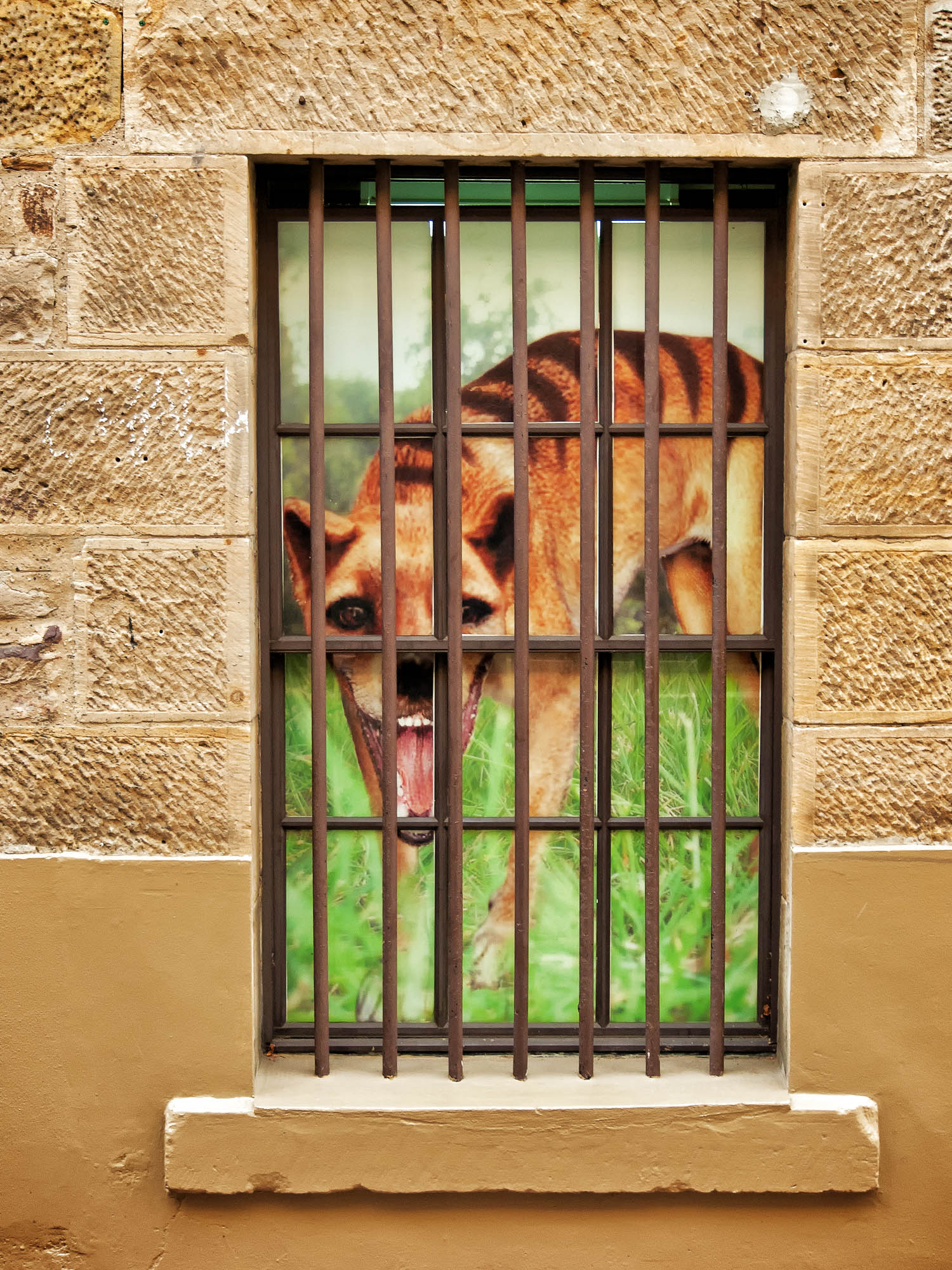
I went to the touristy olde world town of Richmond a little while ago and saw a Tasmanian Tiger or Thylacine. It had been turned into a garden ornament – “gnomified” if you like, just like the Buddha has been.
Tasmanian Tiger, aka the thylacine, spotted in a front garden in Tasmania’s historic town of Richmond.
Tasmanians have a very complicated relationship with the Tassie Tiger. Images of the thylacine can be seen everywhere, it’s on beer labels, the state coat of arms, the coat of arms for Launceston, the logo for Tourism Tasmania. In fact it is everywhere. You might, therefore, come to the conclusion that it is a much-loved animal. In a way it is, but the truth is it wasn’t.
The Tasmanian Tiger roams in Salamanca, Hobart, Tasmania.
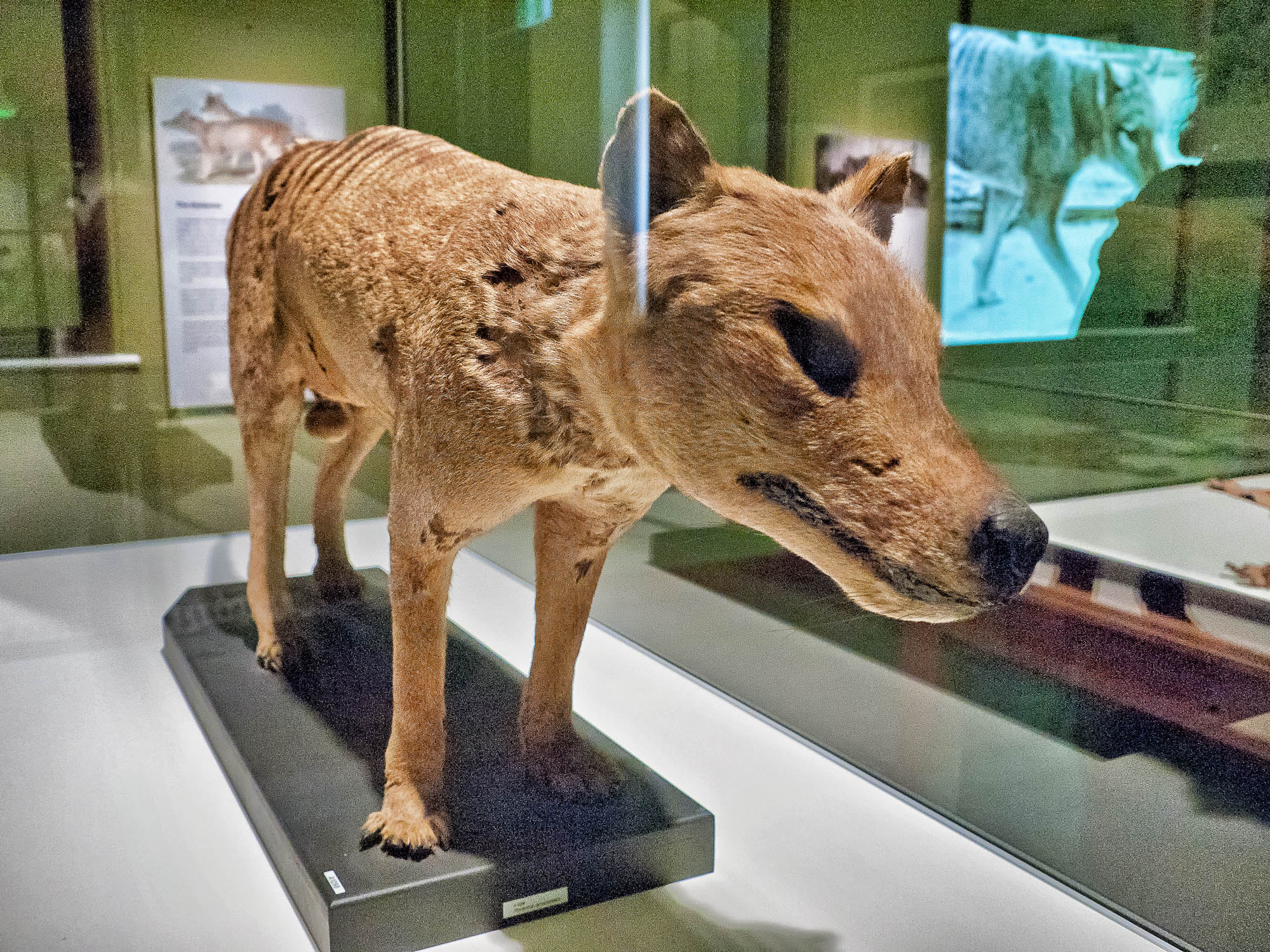
The Thylacine was a shy reclusive animal, the last of its kind – a carnivorous marsupial that was an apex predator and whose relatives went back into the mists of the mammalian era some 5 to 23 million years ago (the Miocene). Computer modelling has shown that the thylacine was not a very strong animal and would have been incapable of handling anything larger than 5Kg and it is now widely believed that they were ambush predators who preyed on small animals such as bandicoots and possums. When the first aboriginal people crossed to the Australian Continent via a land bridge some 40,000 years they brought with them the first dogs, the descendants of what we now call the dingo. The dog was simply a much better and more adaptable predator than the thylacine and by the time British colonisation started they were already extinct on the mainland. When the first settlers in Tasmania saw the thylacine they named it the Tasmanian Tiger or Tasmanian Wolf. There was an apocryphal tale appealing to Victorian gothic drama that can be traced back to just one source that the Thylacine was a blood drinker which preyed on sheep and poultry. That sealed its fate and a bounty was placed upon it and it was hunted vigorously.
A particularly moth eaten stuffed thylacine, or Tasmanian Tiger, in the Tasmanian state museum.
The bounty of £1 for a dead adult and 10 shillings for a dead pup meant that by the 1920’s it was rare to see a thylacine in the wild. In 1930 a farmer by the name of Wilf Batty shot the last wild one. This was bad enough but the tale takes a more tragic turn. In 1933 the Hobart Zoo acquired a thylacine, which was later referred to as Benjamin, which lived there for three years. Inevitably the animal died not of old age but because it was locked out of its shelter on a very cold Tasmanian night. In effect killed by neglect. The last of a species going back millions of years killed because somebody couldn’t be bothered to make sure it was sheltered safely for the night. So after 133 years of settlement, thirty years after a conservation movement was founded seeking its protection and just 59 days after the Tasmanian government signed a conservation order to protect it the last thylacine had died. Optimistically it remained on the endangered list until the 1980’s , but with no confirmed sightings for 50 years it was declared officially extinct.Every now and again there is some crack pot scheme to clone it from DNA harvested from remains in museums, or some millionaire will put a reward for the capture of a live one, but the reality is that the thylacine is long gone because of an indifference to its plight.
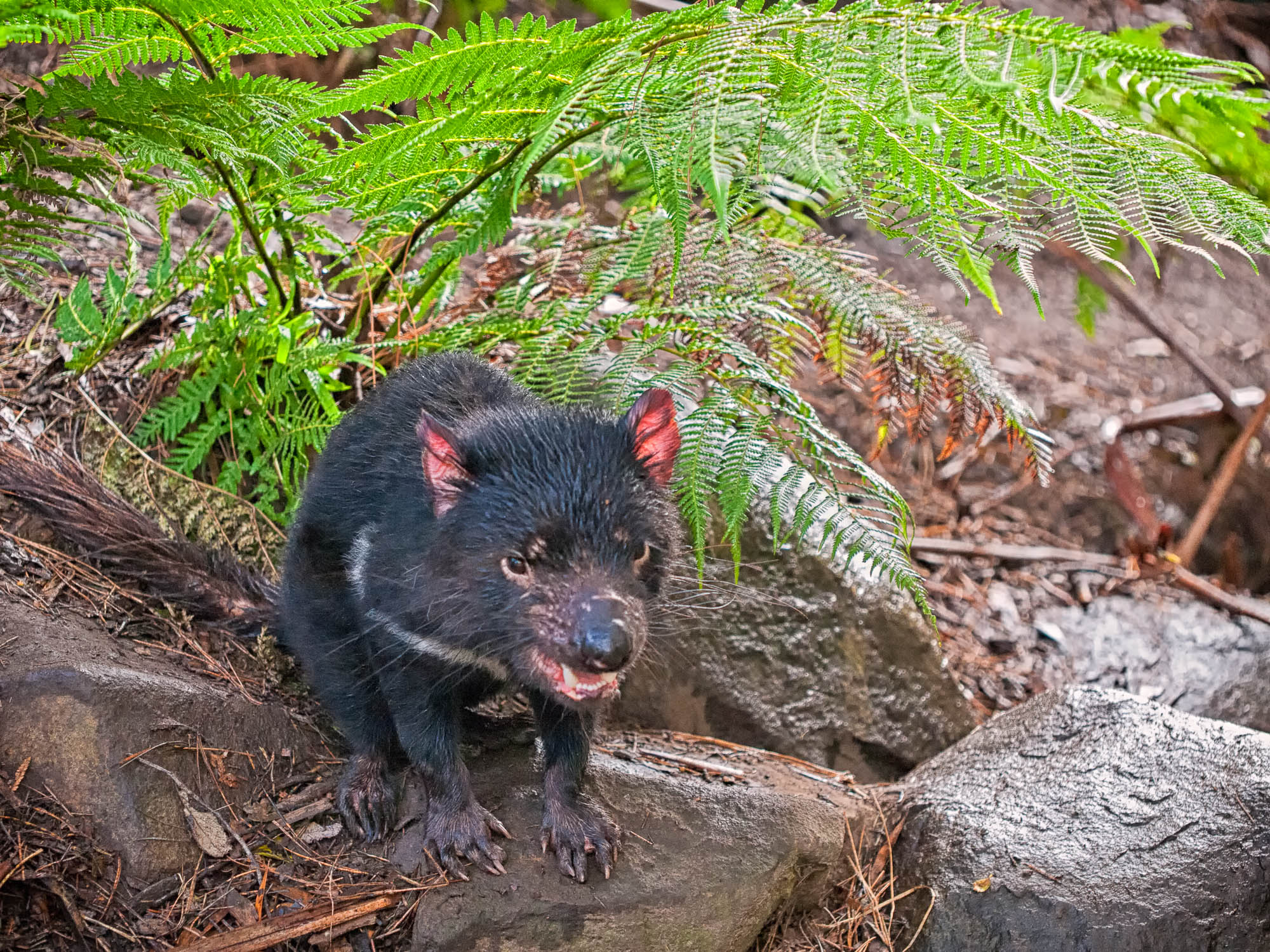
In the mid 1990’s a biologist by the name of Nick Mooney gave an interview to the Hobart Mercury newspaper. Mooney was concerned that the attention the thylacine was getting was diverting the attention away from Tasmania’s other iconic animal – the Tasmanian Devil. He argued that the Devil should be researched and protected. Many people thought that he was barmy as there were more Devils in Tasmania then than at the time of first settlement and farmers were claiming that they were at plague proportions and were a threat to livestock. Fast forward twenty years and the devil is now on the verge of extinction from a combination of devil facial tumour (a transmissible cancer), habitat destruction, traffic fatalities and environmental pollution caused by high levels of flame retardant chemicals found in consumer electronics. These chemicals are banned and were phased out in the 1980’s but their effects are still being felt and it is thought that they play a part in devil facial tumour disease. Because devil populations are declining the gene pool is also diminishing this had laid the Devils very vulnerable to disease.
The devil is an iconic symbol of Tasmania and many organisations, groups and products associated with the state use the animal in their logos. It is seen as an important attractor of tourists to Tasmania.
Today Tasmanians mourn the passing of the thylacine even though there are very few people who are left alive that actually saw one. All that remains are a few preserved specimens in museums, some black and white photos and some grainy film footage. Tourist operators say that the extinction of the devil will severely impact their industry and slowly people are starting to wake up to the fact that the devil is likely to go the same way if something is not done. There has been some research on the on devil facial tumour disease which is fantastic. So is devil saved? Well some scientists believe that the only way for the devil to survive is to quarantine healthy devils in captivity and let the wild population die out. Even if the wild population could survive the current Tasmanian state and Australian Federal governments are working to open up Tasmania’s national parks and world heritage areas to commercial logging. The federal government is also not prepared to fund research into Devil Facial Tumour Disease. So at present your best chance of seeing a Tasmanian devil is either at a zoo, animal sanctuary or dead beside a road. In another twenty years all we could be left with is some video footage and some memories. I would urge every Australian and prospective visitor to Tasmania to write to:
Matthew Groom the Tasmanian minister for the environment
and
Greg Hunt the federal minister for the environment
asking that more funding should be given to ensure the survival of the devil and to ask them not to open the Tasmanian national parks to logging.
They’re not the most loveable of creatures but the world would be a worse place without them.
Dunalley is a small coastal village that sits on the isthmus that takes you to the Tasman Peninsular and is the gateway to the tourist attraction of Port Arthur.
In January 2013 the town was ravaged by bushfire which produced many haunting images of the devastation and suffering. At the time many feared that Dunalley wouldn’t survive. Fast forward to today and Dunalley has under gone an amazing recovery, although as you walk down the main street there are still some vacant blocks where the original has not been rebuilt. If you didn’t know about the bush fires you’d never guess from looking at the place or the people.
The seafood is fresh at the Dunalley Hotel. Dunalley, Tasmania. Proof that humour and kitsch is alive and kicking in Dunalley. Panorama made up of 5 images stitched in Photoshop CS5. Olympus EM-10 with an OLYMPUS M.12-50mm F3.5-6.3 lens. Exposure – manual mode 1/400, f8 at ISO 200.
For many tourists the place is just a quick stop over to use the public toilets or get something to eat at the bakery as they continue the journey on to Port Arthur. But if you have a poke around you can see that Dunalley is a very quirky place indeed. from the zany sculpture outside the Dunalley Hotel to the delightfully strange Fish Market.
The Dunalley Fish Market is a quirky little place – part fish monger, part cafe, part curiosity shop and part museum.
Just before you pull into Dunalley is the turn off to Marion Bay which according to Wikipedia has several claims to fame. Firstly several explorer chap pies from Holland and France pulled up there while on their epic voyages of discovery. Secondly it has outbreaks of army worms, or Mythimna separata if you want to get technical. The caterpillar stage of their life cycle is marked by the fact that they form long lines and voraciously consume any foliage that lies in their path. Sort of like a wriggly form of agent orange. We didn’t see anything like that as we walked along the beach, but there were copious amounts of Wombat dropping – which sort of suggests that wombats like to go to the beach. Who would have thought!
Marion Bay. One of the many creeks that feed into the estuary and then out to sea. Tasmania. Panasonic Lumix LX-5. Exposure – aperture priority 1/160 f8 at ISO 80.
* “The Tide Is High” is a song originally written by John Holt and recorded by The Marions in 1967. The version I like is the one recorded by Blondie and released in 1980. I went and saw Blondie at the Portsmouth Guildhall when I was 16 and I’ve got to say that Debbie Harry in the flesh did weird and wonderful things to a hormonally enraged adolescents psyche. Here’s the official video clip.
I had been in Western Australia for 26 years, and to be honest although I hadn’t seen everything in WA things were starting to feel a little stale. Now I’m in Tasmania and everything is brand new. A change in the environment has suddenly got the creative juices flowing.
Yesterday I went unto Woodvine Reserve. It is a farm that has been held by one family since colonial times and has now been gifted to the Crown as a reserve. To me it is interesting to see how nature is reclaiming the land and gradually traces of human settlement are disappearing. The farm building are largely intact as they show the changes that occurred for the owners over the life of the farm. But the fields, the boundary fences, the farm tracks are all being over grown.
The comforting warning sign on the entrance to the reserve.
Woodvine Farm was gifted to the Crown on the condition that it was to be made a reserve in order to protect the animals that lived there. Prior to proclamation, the property had belonged to his family since it was first settled in 1861.
The back garden of the third house to be built on the farm.
Daffodils growing in what used to be the front garden of the second dwelling to be built at Woodvine.
The first building on the farm was this slab timber structure which provided the first home. When a new dwelling was built it was converted into a sheering shed.
Peat soils support wetlands, button grass moorland and fern fields. Woodvine Reserve.
Waxlip orchid (Glossodia major) found in Woodvine Reserve. Tasmania, Australia.
Small Duck Orchid or Paracaleana minor. Also called Caleana minor in some reference books. Woodvine Reserve, Tasmania.
Just back from another visit to Tasmania – our third in just over a year.
In The Pink. Salamanca Market, Hobart Tasmania. Olympus EM-10 with 17mm f2.8 lens. 1/250, f4 at ISO 400.Pink and Yellow, Salamanca Market, Hobart, Tasmania. Olympus EM-10 with 17mm f2.8 lens. 1/400 sec, f4, ISO 400.
Despite being cold and wet Salamanca Markets was its usual funky self and pink fairy floss and strange fury hats were the order of the day.
Clothes Tree. Salamanca Markets, Hobart, Tasmania. Olympus EM-10 with 17mm f2.8 lens. 1/160, f4, ISO 400.
As usual the scenery didn’t fail to disappoint, and like always I just wish that I’d had more time and better range of equipment than I had on hand.
Baranjay, Franklin, Tasmania. Olympus EM-10 with 40-150mm F4.0-5.6 lens.
Sea Shells By The Sea Shore, Primrose Sands, Tasmania. Olympus EM-10 with 17mm F2.8 lens. 1/50 sec, f22, ISO 200.No One Home, Randalls Bay. Olympus EM-10 with 12-50mm F3.5-6.3 lens. 1/100 sec, f6.3, ISO 400.
Then there was the usual close encounter of the animal kind. The wildlife in Tassie is amazing and thankfully not all of it lies dead on the side of the road.
The eastern quoll (Dasyurus viverrinus), also known as the eastern native cat, is a medium-sized carnivorous marsupial native to Australia. Olympus EM-10 with 40-150mm F4.0-5.6 lens. 1/15 sec, f5.1 at ISO 12800!!
Well I guess there’s only one thing for it – the global photographic juggernaut that is Paul Amyes Photography (PAP) is now relocating to the southern beaches of Tasmania. We apologise profusely in advance for the break in our regular programming schedule and hope to get everything back online Telstra permitting.
On the last weekend of our trip to Tasmania we got the weekend paper and saw they were running a video competition on the theme “Why I Love Tasmania”. Bugger! If I’d known I would have taken a lot more kit, recorded in 1080, used an external recorder with better microphones and written a proper story board and script. Why didn’t I find out about this at the beginning of the trip. Ah well I thought you’ve got to be in it to win it and I put together a short video with what I had shot on my Olympus EP-2 with the SEMA-1 mic which is only marginally better than the built in camera mic, and the four lenses that I always carry when on holiday – the Olympus 17mm f2.8, the 12-50mm f3.5-6.3, the 40-150mm f4-5.6 and the 60mm f2.8 macro. This trip was the first trip I’d taken my tripod, thankfully with a fluid head, and my video monopod (which I happen to think is one of the best accessories I have bought for doing run and gun video). In my wildest dreams I don’t expect to do well in the competition let alone win it, but it was a bit of a larff doing it and it was good experience to work to a deadline on a project.
“Fun? Ah yes, the employment of time in a profitless and non-practical way.”
– Arnold J Rimmer, The Last Day, Red Dwarf, Series 3
I absolutely adore photographing Tasmania. It is not just the gob smacking beauty of the natural environment, although that is a huge plus, it is also the quirky sense of fun that is often displayed in the everyday mundane things.Take traffic light control boxes for instance. In most places they are boring grey metal boxes about 1.5m tall, a metre wide and 0.5 metre deep that sit on pavements by intersections controlled by traffic lights. You’ve probably not noticed them, they just sit there being dull, boring, and virtually invisible. In the state capital of Tasmania, Hobart, they are individual works of art. Some are satirical political commentary, some just abstract designs, but the thing is someone made a decision to allow these boring items to be made into something fun. Does it make them more efficient? No. What it does do is allow the community to express its humanity on a bit of space that otherwise wouldn’t be doing anything other than being a grey metal box. Our present day prime minister ever on the drive to improve the efficiency and profitability of the nation would see them as a frivolous waste of time. Time that could have spent making multi-millionaires even richer. But then he sees people as mere economic units rather than as human beings, and economic units don’t express themselves creatively nor have fun.
Safe With Us Now. A control box for traffic lights painted with Tasmanian Tigers the extinct emblem of the state.
Dreamtime Fish Traffic light control box, Hobart, Tasmania.
Movies Traffic light control box, Hobart, Tasmania.
On our last trip to Tassie just a few weeks ago we encountered another example of this expression of fun or “joie de vivre” as the French would say. We drove from Coles Bay on the north-east coast up to St Mary’s via Elephants Pass. It was a hair-raising drive with steep drops at the roads edge, warnings signs about rock falls and logging trucks, the switch back corners and narrowness of the road. Often our speed drop down to 25 Km per hour which on one particular corner seemed excessively fast. Our camper van certainly felt ponderously elephantine as it awkwardly worked its way to the top and to St Mary’s. St Mary’s is an attractive little town of just over 500 people and it sits beneath St Patrick’s Head, an impressive rocky outcrop standing at 694 metres or 2277 feet in the old money. We had the obligatory coffee stop at the Purple Possum and then took a stroll up and down the two main streets. It was in many ways nothing remarkable, just a small Australian country town. Then I noticed that one of the businesses had a small windmill attached to the facade that depicted what it did, and as I continued to walk my eye was now in so to speak and I noticed that virtually all the shop fronts had a small custom-built windmill. Apparently talking to one of the shop owners a local artist had been making them. They serve no function, they are just a small piece of gratuitous fun.
Australia Post. The Windmills Of St Mary’s
The Windmills Of St Mary’s
Laundromat. The Windmills Of St Mary’s.
The Windmills Of St Mary’s
The Pharmacy. The Windmills Of St Mary’s.
The Windmills Of St Mary’s
As an aside I like doing this type of dead pan photography, because it allows me to become a collector without actually buying or physically owning something. It allows me to group things together and organise them. In the field of archaeology this known as a typography which is where you group things according to their physical characteristics. Photography embraced the term in the early Twentieth Century when the German Photographer August Sander shot a series of portraits of people called “People of the 20th Century” a monumental work that looked to document every profession, trade and social start of the German people living in the Weimar Republic. Sander’s photographs however were shot in such a way as to express the individuality of each subject. Bernd and Hilla Becher’s typography of the industrial landscape looked to capture each subject in the same dead pan manner and the photos were often displayed in grids like scientific specimens. I’m not that anally retentive, but I do enjoy the process and have applied to things that take my fancy as I travel about – sign posts, mail boxes, shop fronts. I’d been doing this sort of stuff long before I’d heard of the term typography. I also like the work of Stephen Shore who combined this methodology with colour and road trips. Shore endlessly catalogues the things he sees. Both the Bechers and Shore were grouped together in an exhibition with some other photographers called “New Topographics: Photographs of a Man-Altered Landscape” in 1975. Although no longer ‘new’, after all 1975 was a long time ago, the exhibition has had a far-reaching impact upon photography and as late as 2011 it was still being shown in venues. The resulting book from the exhibition was recently republished by Steidl and is definitely worth looking at if you are interested in landscape photography that falls outside the typical tree and rock photos most people think of when they hear the word landscape.
In my last entry I mentioned that I would be going to Esperance, on the the south coast of Western Australia (next stop Antarctica!) and I’ve now returned home and have chance to process the pictures and reflect on the experience.
Twilight Beach, Esperance, Western Australia. Olympus EP2 and OLYMPUS M.12-50mm F3.5-6.3 lens.
Firstly I would like to say that this was not a photographic expedition, it was a holiday with a major focus on bush walking. Walking has been a big part of my life since my mid teens and I feel it is an excellent way to explore, to reconnect with myself and nature, and see things I might otherwise not see. Generally my long suffering partner is encouraging in my photographic endeavours but the one area which is an exception is when bushwalking as she hates hanging around while I fiddle around taking pictures. Fair enough. In 1986 we went to the Greek Island of Thira, more popularly known as Santorini. I took two SLRs, flash, filter system and a swag of lenses and fifty rolls of film in a shoulder bag. We decided to walk round the island, it is only small, but very quickly I wished that I had not got that stupid bag with me. It was a salutary lesson and ever since I’ve explored light weight alternatives and different ways of carrying. So my camera of choice was my Olympus EP-2. The EP-2 packs into a small bag (20cm x 18cm x 10 cm) and in that I can fit the camera, six batteries, 72GB of SD cards, two polarising filters, two variable neutral density filters, a SEMA-1 microphone and two zoom lenses that gives me the full frame equivalent of 24 – 300 mm coverage. I’ve found that I can shoot multiple exposure panoramics handheld and get reasonable results. The big let down for this trip was that I took no camera support so the handheld video footage I shot has been filed in the bin.
Lake Warden Wetlands Reserve, Esperance, Western Australia. Olympus EP-2 with OLYMPUS M.12-50mm F3.5-6.3 lens. Image created in Lightroom 3 with Niksoft HDR Efx Pro 2 and Silver Efx Pro 2.
Who, What, Where, When and Why
Esperance is a medium sized Aussie country town and is blessed with 16 beaches that are picture perfect and excellent for all manner of beach pursuits and are widely reputed to be the best in Australia. All but one of them are dog friendly. It is quite an isolated place and it is therefore very likely that you’ll able to get a beach to yourself. We didn’t go for the beaches but for Cape Le Grand National Park.
A bit of history about the area. Twenty thousand years ago the indigenous people of the south west of what is now Western Australia, the Wudjari group of the Nyoongar, inhabited the land they called “Kepakurl” or the place where the sea lies like a boomerang. It was a region blessed with a good climate, plenty of water and an abundance of wildlife and consequently they did not feel the need to roam very far. In 1627 a Dutch ship, the Gulden Zeepaerdt, captained by François Thijssen, sailed through the islands off the coast and so began the colonial era. In 1792 the next European visitors were two French ships, the Recherche and l’Esperance, under the command of Admiral Antoine Bruni d’Entrecasteaux, took shelter from a storm which nearly wrecked both ships. One of the crew, an officer by the name of Le Grand had spotted the anchorage and so it was named after him. In 1802 Matthew Flinders on HMS Investigator was charting the southern coastline of Australia and sailed through the Bay of Isles claiming it for King and country before those “Johnny foreigner” types could claim it for themselves. While sheltering from a storm he and his crew explored the area and named Lucky Bay, because they found safe anchorage there, and Thistle Cove after a Mr Thistle who was one of the crew. In the 1870’s the townsite of Esperance was established and the rest as they say is history.
Thistle Cove, Cape Le Grand National Park, Western Australia. Olympus EP-2 with OLYMPUS M.12-50mm F3.5-6.3 lens. HDR panorama of 12 shots blended using a combination of Photoshop CS5 and Niksoft HDR Efex Pro 2.
Cape Le Grand National Park is 631 km (392 miles) south-east of Perth and 56 km (35 miles) east of Esperance. Established in 1966 the park covers an area of 31,801 hectares (78,600 acres) and is made up of coastal heathland made up of dense thickets of showy banksia (Banksia speciosa) on the sand flats and scrub banksia (Banksia pulchella) on the gravel outcrops. This is punctuated by granite and gneiss peaks. There are beautiful bays with the most amazing white beaches where the sand squeaks underfoot, and the sea is the most breathtaking turquoise blue in colour. The most spectacular scenery is found in the south eastern corner of the park where is a chain of peaks that includes Mount Le Grand, Frenchman Peak and Mississippi Hill.
A mother and Joey from the famous mob of kangaroos that frequent the beach at Lucky Bay in Cape Le Grand National Park. Olympus EP-2 with OLYMPUS M.40-150mm F4.0-5.6 R lens. Exposure 1/4000 s at f/5.6 ISO 200.
All up the park is home to 1169 different species of animal and plant. The native mammals include western pygmy-possum, quenda, black flanked wallaby, bush rats, and honey possums. The park is a bit of a twitcher’s paradise with 110 species of birds and while there we saw a white-bellied sea-eagle, numerous types of wattlebirds, a wedged tailed eagle, emu, cuckoo shrikes, crested pigeon, and bronze wings.
Lucky Bay, Cape Le Grand National Park, Western Australia. Olympus E-P2, OLYMPUS M.12-50mm F3.5-6.3 lens, and circular polarising filter. Exposure 1/200 s at f/8.0 ISO 100.
There are a number of walks to do. The Coastal Trail is a 15Km (9.3 miles) one way trail that takes about 8 hours to complete. It has also been divided up into four sections. We chose to walk from Lucky Bay to Thistle Cove. Lucky Bay is famed as having the most beautiful beaches in Australia and somewhat incongruously you can as we did see kangaroos on the sandy beach. There is a campsite there with gas barbecues, toilets, picnic areas, water, and shade shelters. We chose to stay in Esperance rather than camp this time. The walk trail is clearly marked out and takes you round the headland giving views over the bays and inlets. I saw a pod of six dolphins playing in on of the inlets and I stayed and watched them until they decided to swim back out to sea. As you get to Thistle Cove there is a picnic table in the lee of a large rock that looks like an enormous mitten standing on end which provides a bit of necessary shade while you sit and take in your surroundings. Matthew Flinders thought that Thistle Cove was even better than Lucky Bay, I’m not sure I would agree but it is a very beautiful spot.
Frenchman Peak is a 262 metre granite outcrop that is part of a chain in the south-west of Cape Le Grand National Park. Olympus EP-2 with OLYMPUS M.12-50mm F3.5-6.3 lens. 15 exposure HDR panoramic created with a combination of Photoshop CS5 and Niksoft HDR Efx Pro2.
As mentioned earlier there are several peaks to bag; Mount Le Grand at 345 metres (1132 feet), Mississippi Hill 180 metres (590 feet), and Frenchman Peak at 262 metres(860 feet). Frenchman Peak was our choice as it has a clearly marked track to the top which is 3km or 1.8 miles return which is graded as hard and not recommended on wet and/or windy day. The peak did not get its name from the early French explorers but rather from explorer and prominent colonist John Forrest who passed through the area in 1870, in search of good country for pasture. The peak got its name because his brother, surveyor Alexander Forrest, thought its profile resembled a man wearing a Frenchman’s cap. The Aboriginal name for the peak was Mandooboornup and was a significant site for them. The Department of Parks and Wildlife who administer the park describe the route as being up the easy angled east slope. A better description to my mind would be up the not as hard east slope. At times the pitch of the slope is very steep, but thankfully the rock surface is very grippy in the dry and given a good pair of shoes and plenty of time it is very doable. The result is worth it as you’ll be rewarded with be rewarded with magnificent panoramic views of the park and islands in the Recherche Archipelago. The top of the peak has been eroded to form deep arch or cave which is not immediately obvious from looking up from the base and swallows make their nests in its walls and can be seen chasing insects as you climb up. The cave was formed 40 million years ago in the Eocene when sea levels were 300 metres (984 feet) higher than they are now and the top of the peak was under water. I don’t know about you but the geologic timescale just boggles my mind.
The walktrail up Frenchman Peak is a hard steep 3Km return walk. Cape Le Grand National Park.Views of the park and islands in the Recherche Archipelago from the top of Frenchman Peak. Cape Le Grand National Park, Western Australia. Olympus EP-2 with OLYMPUS M.12-50mm F3.5-6.3 lens.The cave on top of Frenchman Peak, Cape Le Grand National Park.
Did we enjoy our visits? Are the Kennedy’s gun shy? We will certainly visit again and aim to spend more time in the park, but we will go earlier in the spring so we can see more of the wildflowers and maybe even see some whales.
One of the famous kangaroos that frequent the beach at Lucky Bay in Cape Le Grand National Park. Olympus EP-2 with OLYMPUS M.40-150mm F4.0-5.6 R lens. Exposure: 1/2500 s at f/5.6 at ISO 200.
As always clicking on an image will take you through to my gallery for print purchases.





You must be logged in to post a comment.