The town hall in the historic Western Australian town of York in pre-dawn light. Sony A7r with Olympus OM Zuiko 35mm f2 lens and Cokin 3 stop graduated neutral density filter. Exposure: 2.5 sec, f8 at ISO 100.
The other morning I got up at stupid O’clock to shoot a dawn time-lapse of the York Town Hall. So what do you do while you’re hanging around waiting for it to finish? Why take photos of course! So while the Leica D-Lux clicked away doing it’s time lapse thing I set up the Sony A7r and started taking snaps of the town hall. Good job I did as the time lapse wasn’t that crash hot.
I got a few enquiries about corellas after my post Tales From The Riverbank part 2. Yes the Shire has previously culled the birds in the run up to Australia Day, but this year they didn’t. The reasons given are that they are noisy – I mean really noisy. To show how noisy I made a short film about them.
Last Saturday I found myself in town wandering around with my Olympus Pen EP-5 and the just 3 lenses (17mm f2.8, 25mm f1.8, 45mm f1.8) when I found myself outside the building that is home to Jan de Jong Martial Arts Fitness in Hay Street. I knew the fun day demonstration was about to start as I had received the flier from them a few days previously so I thought I’d pop in and say “Hello” for old times sake. I started attending the school in the early 1990’s as a solution to a problem with work place violence. I had no idea I would become completely fascinated by the martial arts taught by Shihan Jan de Jong OAM and that continues to this very day. Over the years I’ve tried many times to photographically capture what it is that appeals to me. I’m not after a static record shot, but something that shows the grace, beauty, refined power and energy that is inherent in bujutsu. Under equipped and ill prepared I had another go shooting first stills and then some video footage. One day I’ll actually get something close to what I see in my mind’s eye and feel in my heart.
The entrance to Beverley Station Arts in the Western Australian town of Beverley.
Those who regularly follow my blog will know that I’m currently the artist in residence at Beverley Station Arts in Western Australia. So for this entry I’ll talk a little about the place. The town of Beverley is located some 130Km (or 80 miles for those still using imperial measurements) east of Perth in the Avon Valley in the Wheatbelt of Western Australia. The Beverley Arts Gallery Committee was inaugurated in 1967 with the aim of establishing a venue for the fine arts in the town. Sir Claude Hotchin a noted arts benefactor donated work from his collection with the aim of starting the fledgling gallery off. The collection is now housed in what was the old railway station in Beverley.
Inside the exhibition space at Beverley Station Arts. Sony A7r, Fotodiox OM to Nex adapter, Olympus OM Zuiko 21mm f3.5 lens. Exposure: 1/400th sec, f5.6 at ISO 6400.
The old station master’s quarters is now where the visiting artists in residence are accommodated. Beverley Station Arts, Western Australia. Sony A7r, Fotodiox OM adapter, Olympus OM Zuiko 21mm f3.5 lens. Exposure: 1/400th sec, f8 ISO 400.
Beverley Station Arts also utilizes the former station masters living accommodation for the artist in residence program. This allows an artist to base themselves at the gallery and produce work, put on an exhibition, run workshops and generally interact with the community. Recently an open air stage was built which is suitable for all the performing arts. It has a seating capacity of 500 and local audiences enjoy music, theatre, movies and dance under the stars during the summer months. On Saturday 10th September 2016 the venue hosted the Voice Moves Country Choir Bash. This year there were eight participating choirs:
The Platform Theatre performing space at Beverley Station Arts, Western Australia. Sony A7r, Fotodiox OM to Nex adapter, Olympus OM Zuiko 21mm f3.5 lens. Exposure: 1/200th sec, f8 at ISO 400.
As is usual in country Western Australia a sumptuous afternoon tea was provided in the intermission. The event was great fun and enjoyed by both the audience and the participants alike. Below is a short video featuring the Beverley Station Singers.
The garden bench even has a railway theme. Beverley Station Arts, Western Australia. Sony A7r, Fotodiox OM to Nex adapter and Olympus OM Zuiko 21mm f3.5 lens. Exposure: 1/80th sec, f16, at ISO 400
It seems like absolutely ages since I last made a post. The break came about because I moved house (yes again!) and as usual Telstra and iiNet cocked the whole re-location up resulting in me being without phone and internet for 6 weeks. Now I have signed up with Optus and I’m the proud owner of a fantastic broadband connection.
So in the last six weeks what have I been up to? Well I’ve definitely not been slacking off I can tell you! I’m pleased to announce that for the whole of September I will be artist in residence at Beverley Station Arts and I’ll also be showing a body of work entitled “Sex, Lies, and Flowers”. Sex, Lies and Flowers is a project on the terrestrial orchids of the Wheatbelt of Western Australia. The word orchid comes from the Greek “orchis”, which literally means ‘testicle’ (with reference to the shape of its tuber). Orchids are distinguished from other flowers by their uniquely shaped column which is composed of the fused stamens and pistils. Often the petals are modified to mimic the shapes of insects to attract male insects to mate with the faux female and pollinate the flowers. Some of the forms they take also resembles human genitalia Hence the title “Sex, Lies and Flowers”. Over the last eight years I have travelled within the region photographing the plants on location. Instead of taking the standard approach of photographing the plant in its environment showing its full structure I’ve chosen to photograph them in a style more used in portraiture so as to bring out the distinguishing features and characteristics of the plants. The aim is not to produce an exhaustive catalogue of the plants but to produce a series of images that show case the beauty of the plants and raise awareness of them and how fragile they are. Hopefully some of you can pop in and see me and the work, if you are unable then the images from the exhibition and many more can be seen here.
Below is a video clip I made a while ago about photographing orchids in the Avon Valley of Western Australia.
Thanks for your patience everyone and regular programming should now resume.
This wasn’t intended to be a video project – I’d just gone along to take some photos using my Olympus EM1 and EM10 with the 12-40mm and 40-150mm f2.8 zooms. Then right at the end I’d realised that I had never shot any video on the EM1. So without a tripod or monopod I filmed one song hand-held using the 12-40mm. Luckily I had my Rode VideoMic Pro in my bag and I just mounted this in the flash hot shoe and hoped the sound was good enough. I just love the built in image stabilisation – it did a fantastic job here.
The Faversham vintage van in Avon Terrace, York, Western Australia. Olympus OMD EM1 with Olympus OM Zuiko 35-105mm f3.5-5.6 zoom. Exposure: 1/200 sec, f5.6 ISO 400.
… or not to print. That is the question.
I picked up the latest edition of my fave photo mag (Black And White Photography ) and it had a short snippet of news that made me sit up and pay attention. Jessops the large UK photo chain commissioned a survey which found that 20% of British adults have NEVER had a photo printed, 8% of British adults printed a photo at least once a month, and a whopping 44% have lost a digital photo they wish that they had printed. Amazing stuff.
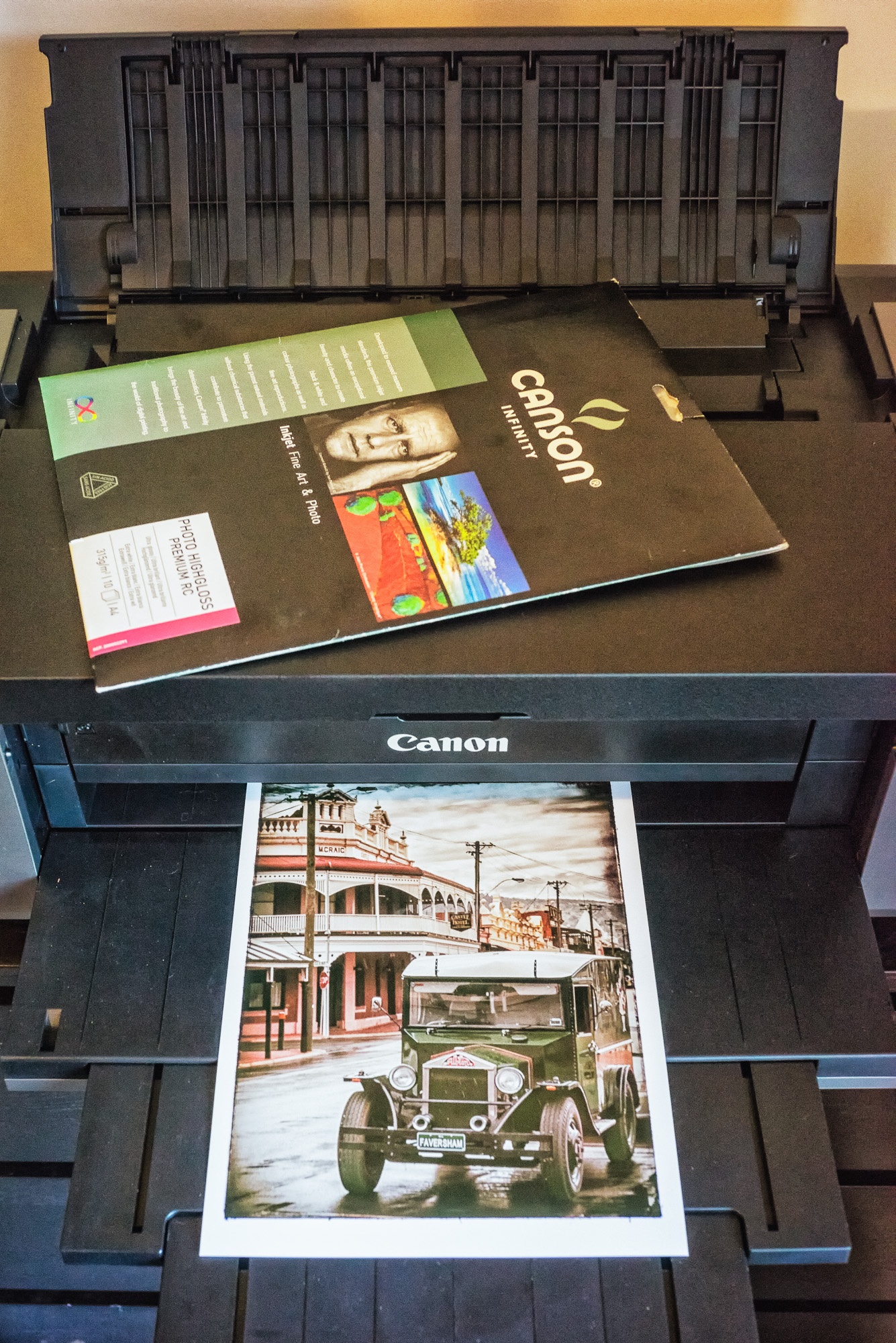
It maybe an age related thing, but, I have always liked prints. Even when I shot slide film I had prints made. To me prints are the ultimate expression of my photographic endeavours. I realise that for many people who came to photography post the digital revolution prints are anachronistic hang over from a bygone era, but for me printing is an essential part of the photographic process. I think many people are put off by the apparent complexity of the process – look on the internet and it all looks so hard, but actually it is relatively simple to get good prints. The first step in the process is to profile your monitor – this ensures that are no strange colour casts. I use a ColorMunki Display which is ridiculously easy to use and is relatively inexpensive. For the second step you can either send or take your image files to a lab and have them do the next bit, or like me print your own at home. I choose to print at home because I live in a rural area where there is no local lab, I’m impatient and want to see the results immediately and the surge to print often happens at odd times. I chose a Canon Pixma Pro 100S as it is an A3+ sized dye based printer. I prefer my prints to be on glossy paper and dye based inks look better than pigment based ones. Also dye based printers are less likely to clog. I don’t profile my printer for the paper I use I just use the canned profiles from the paper manufacturers website. The video below shows how easy the whole process is.
Shortly after reading the piece in Black and White Photography I was perusing the BBC website when I came across a piece on the science pages that was warning that the world was facing a ‘digital Dark Age” . Apparently Dr Vint Cerf an internet pioneer and Chief Internet Evangelist for Google (and yeah I had to Google him to find out who he was) has become famous for his predictions on how technology will affect future generations. He reckons that a lot of the digital images created in the early Twenty First Century will be lost as current hardware and software become obsolete so future generations will have no records of the period. I find this ironic considering Google is really pushing Google Photos as an in the cloud archive system. Anyway Google are apparently spending shed loads of money to try to prevent this with some you beaut techno solution. Personally I think the answer is obvious. The one material we know a lot about with regards to its archival properties is paper. In fact I’ve got quite a few family photos that date from the later half of the Nineteenth Century. So if you want to make sure your precious photos survive print them. Use good quality papers and inks and a lifespan in excess of 100 years is easily attainable. The Wilhelm Institute gives archival ratings for most ink and paper combinations and advice on how to store your prints. If you print at A4 then should your digital archive disappear into oblivion with a great deal of wailing and gnashing of teeth then you can scan your prints and salvage the situation.
So there you have it. Now you’re not only making art but you are protecting your precious images from a digital apocalypse.
Photographic print on Canson Infinity Photo High Gloss Premium RC by a Canon Pixma Pro 100S printer. Shot on a Sony A7r with Voigtlander 35mm f2.5 Color-Skopar lens.
Regular readers will have noticed that since Christmas that I have been putting up video and stills that had been taken with a fish eye lens. For a while I was considering purchasing a suitable lens for either my Canon or Olympus systems as I had been intrigued by the effect. I was also very mindful that having bought such an item I would quickly tire of it and see it as a gimmick and so feel I had wasted my money. So when Dick Smiths (a popular chain of electronic stores here in Australia) offered the Sony HDR-AS20 ActionCam for $120 AUD just before Christmas I bought one seeing it as an affordable way of trying out extreme wide-angle photography and videography.
So what are my feelings about the camera. Well I do believe every photographer should have one of these cameras. They open up a world of creative photography. The lens is outside of the protective case pretty decent. It has a 170º field of view which is roughly equivalent to a 17mm on a full frame 35mm camera, a minimum focusing distance of 30cm (12 inches), a fixed aperture of f2.8 and is pan focus. There is obvious barrel distortion and some chromatic aberration. The distortion is all part of the look of fish eye lenses and the CA can be easily fixed in still images in apps such as Lightroom with a single click. The camera only produces jpegs, which bright and contrasty without too many artefacts. There is no control over sharpening and there are only two pictures styles, normal and underwater. You can’t control the ISO, the shutter speed nor the white balance. All being said it produces nice files and the exposures and white balance were largely spot on requiring minimal adjustments in post. For video the Steadyshot image stabilisation while being software based produces impressive results and was one of the major selection criteria for me when purchasing the camera. It’s not got the best video codec in the world nor the best bit rate and compression but it edits reasonably well as long as you don’t push it too far. A very nice feature is that the supplied software for the camera is embedded as firmware so that you don’t have to mess around with downloads or install discs. So what’s not to like – well the optical quality of the lens port on the protective case is pretty appalling, the supplied software is pretty flakey and crashes a lot on my relatively new iMac. No matter what I tried I couldn’t get the WiFi function to work using either my Sony Android phone or iPad. The Sony mount system isn’t as comprehensive nor widely as available as that of the GoPro alternatives. No problem just get an inexpensive adapter and then you can use anything made for GoPro. A real annoyance is that Sony have made it very difficult to plug in an exterior microphone. You can’t use one with the LCD case nor the standard protective housing. The one you can use it with means you loose the LCD and the protection.
The Australian National Maritime Museum’s magnificent replica of Captain Cook’s HMB Endeavour docked at Hobart in Tasmania.
Overall I’m very happy with the camera and have had a load of fun using it. The only thing is that it is totally addictive and I keep coming up with ideas for shots which inevitably means I have to buy another mount for it. Luckily they are cheap, but I have quickly acquired a bag full of them.
The beach at Verona Sands. The minimum focusing distance is 30cm which allows you to get very close up to subjects.
Sunrise at the The Lady Franklin Museum in Ancanthe Park, Lenah Valley. The auto white balance and exposure handled this scene very nicely.
Quite a few scenes in this video were shot with the Sony HDR-AS20. I was surprised that the camera proved parrot proof!
I know I’ve said in the past that I’m not a great fan of MONA but just lately I’ve been going up there a bit because I’ve signed up to study a unit in Art Theory at University of Tasmania (UTas). I got up extra early to see an installation by American artist James Turrell called Amarna. There’s not a lot I can say about this work except that it is gob smackingly beautiful and very serene.
Here are a few stills.
Wim Delvoye’s Seventeenth Century Flemish Baroque style.Truck and James Turrell’s Amarna at dawn. MONA, Hobart, Tasmania.Amarna At DawnJames Turrell’s Amarna at dawn. MONA, Hobart, Tasmania.
Technical notes: the time-lapse sequence was made with a Sony ActionCam HDR AS20. The stills were shot using an Olympus OMD EM-10 with either an Olympus mZuiko 17mm f2.8 or an Olympus mZuiko 25mm f1.8 lens.





You must be logged in to post a comment.