Cack-handed Day

Newly mobile, I had such high hopes for this trip to Bernard Park in the Wheatbelt metropolis of Northam. I walked the dog through the park the day before and saw plenty of bird activity. Everything was checked and packed carefully the night before and the car had a full tank of petrol. What could go wrong? I pulled up in the carpark just after dawn and the conditions were looking perfect. I could see and hear plenty of birds. Then I found out what could go wrong. Me! I just couldn’t do anything right. It was as if I’d never picked up a camera before. Forty years of photographic knowledge and experience had evaporated. A lot of the birds got so bored sitting around waiting for me to get my act together that they took off in search of a better photographer. I missed lots of sitters because I was just so slow in sorting out focus, exposure and composition. After an hour and a half of abject failure I threw in the towel  and called it a day.

I’ve put the two best photos below and they are quite frankly very, very pedestrian.


Three Little Birds. Kanamit or Welcome Swallows (Hirundo neoxxena). Bernard Park, Northam, Western Australia.


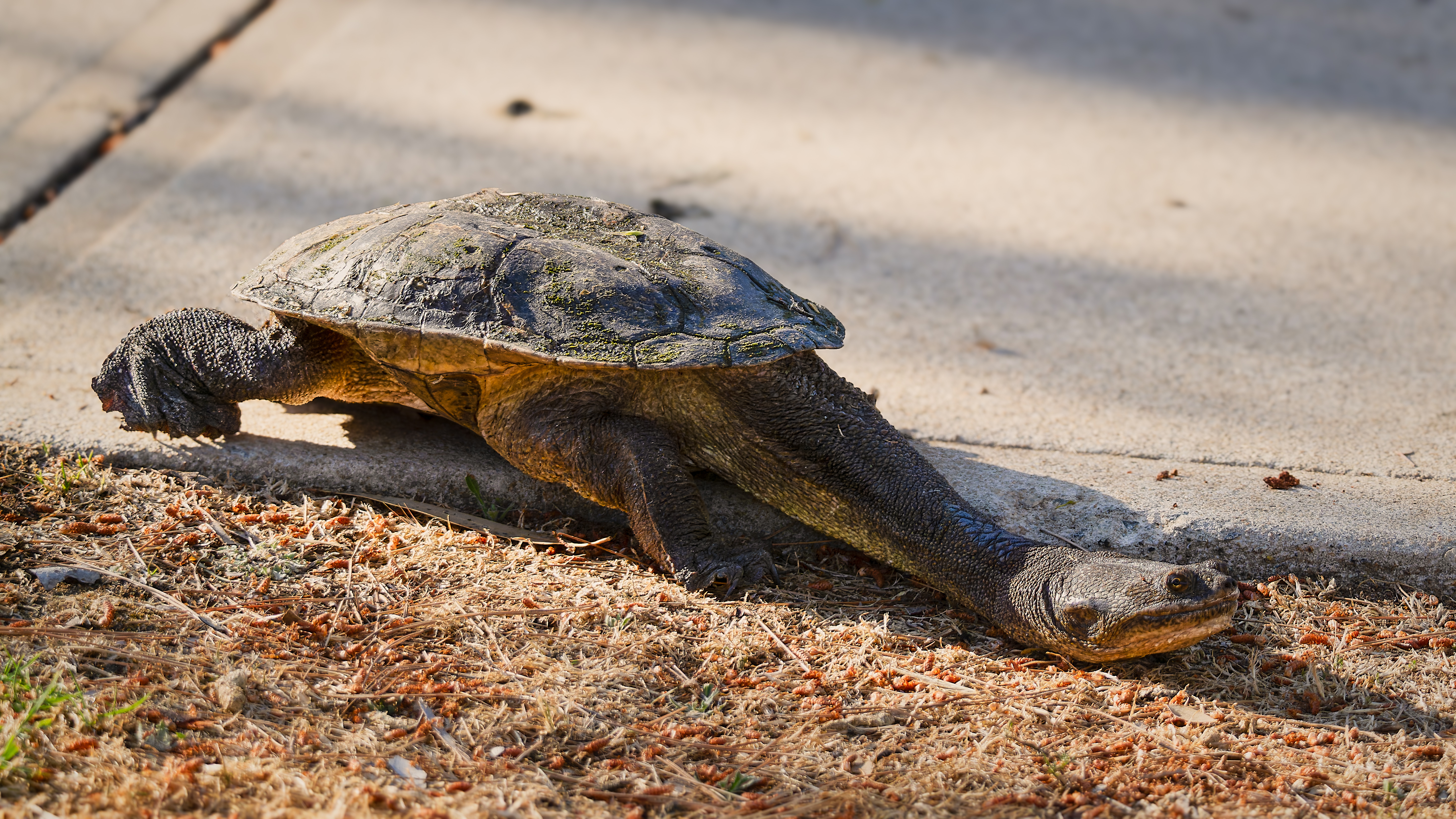
A female Choonya or Long-necked turtle aka oblong turtle (Chelodina oblonga) having laid its eggs slowly makes its way back to the safety of the river. Bernard park, Northam, Western Australia.


The only upside to the day was that I saw two of the Long-necked Turtles. It’s egg laying season for them and they come up from the river – no mean feet as the bank is very high and steep at this point – and lay their eggs. They will have hatched out at this spot and every year they will lay their eggs there. Their offspring will do the same. Thirty years ago I used to see turtles quite regularly, but now they are very rare so to see 2 within five minutes of each other was something rather special. This time of year sees the turtles try to cross busy roads to get to their nesting sites, so if you live in these areas please be careful as you drive. A word to the wise. If you ever feel the need to help one not get run over by picking it up and moving it to a safe location  a word of caution. Make sure that the rear end is pointing away from your body. Long-necked Turtles void as a defence mechanism – it is an incredibly foul smelling mess that is very difficult to wash off yourself and out of your clothes. Once smelt never forgotten.


The issues regarding my blog that I spoke about a couple of weeks ago have not resolved. I still can’t link images from my account at 500px to my pages here at WordPress. I had extensive communications with both companies and each is blaming the other and I’m the meat in the sandwich. I hope in another couple of weeks to find a permanent solution.

Settling Down

Spring is now almost over and most of the wildlife has now settled down to domestic duties – having and raising young.

A recent visit to Bernard Park in the Wheatbelt metropolis of Northam showed this to be true. The Australian Reed Warblers were still building nests and it won’t be long before the serious business of egg laying starts.


Koordji-koordji by Paul Amyes on 500px.com
Koordji-koordji or Australian Reed Warbler (Acrocephalus australis subspecies gouldi) gathering nesting material. Northam, Western Australia.
Koordji-koordji by Paul Amyes on 500px.com


Koordji-koordji by Paul Amyes on 500px.com


The Welcome Swallows were mostly content to hang out together between hunting forays, but we did see a couple which did seem to be in the middle of a domestic alternately screeching at each other. Do birds separate and divorce? No idea. Perhaps I anthropomorphising them too much, but it is hard not to project human feelings into animal interactions.


Kanamit by Paul Amyes on 500px.com
A contented pair of Kanamit or Welcome Swallows (Hirundo neoxxena) taking a breather under the Peel Terrace Bridge. Northam, Western Australia


Kanamit by Paul Amyes on 500px.com
These two seemed to be in some sort of domestic dispute.


Kanamit by Paul Amyes on 500px.com
It wasn’t one sided either. Both were carrying on like pork chops in a frying pan. Perhaps a referral to Relationships Australia is in order?

Hard To Swallow

This week’s walk along the River Avon looking for birds was very odd. It was a magnificent morning. There was loads of birdsong, but no birds out in the open. Everything was hidden in the high tree canopy – even the ducks. By the time I’d reached Avon Park I’d only managed a couple of photos and I felt like I should have stayed in bed. So while sitting on a park bench pondering my options I noticed that there were lots of Welcome Swallows flying very low over the grass – like 30-50cm above the ground.

At this point it should be said that when comes to Bird In Flight photography (often abbreviated to BIF on forums) I am absolutely useless. For some reason I just can’t get it going. It may be partly due to the environment I go birding in – mainly forest – and this throws off the autofocus system. For a while I thought it was due to the fact that I didn’t have a camera with bird detect autofocus, but now I do and I still haven’t improved. So the idea of photographing a very fast erratic small bird seemed somewhat implausible. But, I had made the effort of getting up early and I was in the park and there were loads of Welcome Swallows so I thought why not? In all I spent the next hour trying to photograph the little buggers. Man alive are they quick. Up to 60 kmph or 25m per second! Just when you think you’ve lined one up perfectly they suddenly alter course and you’ve lost it. Despite all that I really enjoyed myself. I didn’t look at any of the images I’d taken as I feared that would have been too discouraging. In that hour I ended up taking nearly 3,000 photos. Now in the online wildlife forums people regularly brag they have a 90% hit rate of perfectly in focus shots of birds flying. So I’m a little ashamed to admit that out of those 3,000 photos I only got four photos where the bird was in focus and one of those was of a Welcome Swallow perching on a park bench. Now either I’m spectacularly inept or there is great deal of bovine excrement flying around. Whatever! I had a thoroughly enjoyable morning and that is all that counts.


Kanamit by Paul Amyes on 500px.com
Banking to begin fly past. Kanamit or Welcome Swallow (Hirundo neoxxena). York, Western Australia.
Kanamit by Paul Amyes on 500px.com


Kanamit by Paul Amyes on 500px.com
Coming in fast and low.


Kanamit by Paul Amyes on 500px.com
It’s a lot easier to photograph them when they sit still.


Welcome Swallows


The Welcome Swallow (Hirundo neoxena subs. carteri and called Kanamit by the Nyoongar of Western Australia) is a small bird approximately 14cm long and weighing up to 20g. They are an attractive looking bird with a glossy blue-black body and crown, dark brown wings, and a rusty red face, neck and upper breast. They have a forked dark grey tail which forms two streamers when flying. They are very fast and acrobatic in flight swooping on their insect prey and they often drink water while flying over bodies of water.


Kanamit by Paul Amyes on 500px.com
An adult Kanamit or Welcome Swallow (Hirundo neoxxena) taking a breather from catching insects and feeding chicks. York, Western Australia.


When Europeans first colonised Western Australia Welcome Swallows were confined to coastal areas. As land clearing progressed they spread further inland and northwards. They differ from their Eastern State cousins in that they are not migratory. They have readily adapted to human habitation and can be easily found in urban areas. To thrive they require substantial insect populations and large flocks can be commonly found near water. They are often seen perching on fences and overhead power lines. They nest in a cup shaped structure made by both parents from mud and grass and is lined with feathers and fur. This typically takes between 8 and 23 days to make. The nests are often attached to walls, rafters, cranes, bridges, rock faces, and dead trees.The monogamous pairs will re-use their old nest. A warming climate has meant that Swallows in Western Australia are having 2-3 broods per year and lay a clutch of up to 5 eggs. The female incubates the eggs for around 3 weeks and when they hatch they are fed by both parents. The young fledge after a further 3 weeks and become independent after 35 days.


Kanamit by Paul Amyes on 500px.com
An adult Kanamit or Welcome Swallow (Hirundo neoxxena) perched on the nest. York, Western Australia.


Kanamit by Paul Amyes on 500px.com
Juvenile Kanamit or Welcome Swallows (Hirundo neoxxena) impatiently waiting to be fed by their approaching parent. York, Western Australia.


Kanamit by Paul Amyes on 500px.com
“Where’s my dinner!!!” Welcome Swallow (Hirundo neoxxena) demanding to be fed by it’s parent. York, Western Australia.


Kanamit by Paul Amyes on 500px.com

A juvenile Kanamit or Welcome Swallow (Hirundo neoxxena) demanding to be fed by it’s parent.


“More! More!”


Swanning Around

A couple of weeks ago I posted about all the Ibis nesting at Tomato Lake and how it heralded the start of the breeding season for them. Well this week the Black Swans at lake Claremont were building nests and pairing off and spring is just round the corner. It was an uninspiring morning, the rain was bucketing down and the usually frenetic Welcome Swallows looked unimpressed.


Kanamit by Paul Amyes on 500px.com
Kanamit or Welcome Swallow (Hirundo neoxxena) looking unhappy in the rain. Lake Claremont, Western Australia.


A bit further on amongst the reeds the swans were busy in spite of the inclement weather.


Maali by Paul Amyes on 500px.com
This swan was very obliging and allowed me to take its photo.


Maali by Paul Amyes on 500px.com
A female black swan sits on the nest while the male gathers more nesting material.


Elsewhere on the lake things were much more advanced  with the Shelducks as there were several mothers escorting very young ducklings out on the water.


Nyimarak by Paul Amyes on 500px.com
No water wings in sight. A Shelduck takes her young brood out for a swim on Lake Claremont.


I was a bit apprehensive about walking in the rain. My usual camera – an Olympus OMD EM1 mk ii and its Panasonic Leica 100-400mm f4-6.3 – are incredibly resistant to rain fall, but this time I was out with my Sony A7r2 and the Sigma 150-600mm whose weather sealing leaves a bit to be desired. Thankfully the combination worked flawlessly and lived to tell the tale. It was, however, its last outing. I’ve developed quite bad arthritis in my right hand, elbow, and shoulder and find the larger full frame cameras too much to handle so I’m going to put it all up for sale. Getting older really sucks sometimes.

Matagarup

What do you do when you have to take your car into Perth to get it serviced but don’t want to hang around in the city and catch COVID? Go on a safari of course!!


My safari took me to Point Fraser and Heirisson Island. Heirisson Island is a small island of 285,600 sq. metres in the Swan River between East Perth and Victoria Park. Most people will know of it through crossing the Causeway which is the bridge over the river. It wasn’t always called Heirisson Island. Long before European explorers and colonists arrived there was a few smaller islands and some mudflats which was called Matagarup by the Beeloo Nyoongar. The name means one leg deep. The first known European visitors were led by Willem de Vlamingh in 1696. He and some of his crew rowed up the river and saw the black swans which led him to name the river the Swan River (Zwaanenrivier in Dutch). They got as far as the mudflats and island and could go no further. In 1801 Nicolas Baudin  from the French ship Le Naturaliste traveled up river and he named the island after his midshipman François-Antoine Boniface Heirisson. Since the early arrivals the river has been dredged and there has been a lot of land reclamation which has seen the mudflats disappear and the formation of the present island.


Yongka by Paul Amyes on 500px.com
Yongka or Western Grey Kangaroo, Macropus fuliginosus. Herrison Island, Western Australia.


There is a footpath round the island which is 2 Km in length which makes it perfect for an inner city safari. As far as the wildlife goes 92 different species of bird have been observed on the island and there is a resident population of Western Grey kangaroos which were introduced in 1998. Funnily enough I’ve walked round the island several times over the years and not seen a single kangaroo. Amazing considering that it’s a small island and they’re relatively large animals. But kangaroos are very good at making themselves scarce during daylight hours. This visit was different I saw three female kangaroos, two lazing around in the bushes and one grazing. In fact the one that was grazing was very curious and came right up to me – I think it was an attempted mugging because as soon as she realised I didn’t have anything worth stealing in the way of food she was off.


Yongka by Paul Amyes on 500px.com
This female checked me out to see what food offerings were available. I was a bit of a disappointment as I had nothing.


I must say it was a very pleasant way to pass the time and I’m looking forward to going again – hopefully to coincide with dawn or dusk.


Koonamit by Paul Amyes on 500px.com

These two welcome swallows were very obliging and let me take their photo.


Black and White by Paul Amyes on 500px.com

The Swan River Cormorants Club does not discriminate on the basis of colour or species – all are welcome.


Djidjinook by Paul Amyes on 500px.com

Not having any chips meant this silver gull just kept flying past.


Straw-necked Ibis by Paul Amyes on 500px.com

Straw-necked Ibis, Threskiornis spinicollis. Herrison Island, Western Australia.


Great Egret by Paul Amyes on 500px.com

Great Egret, Ardea alba modesta. Herrison Island, Western Australia.


Wyan by Paul Amyes on 500px.com

White-faced heron, Ardea novaehollandiae. Point Fraser, Western Australia.


Brown Jellyfish by Paul Amyes on 500px.com

No visit to the Swan River is complete without the ubiquitous Brown Jellyfish (Phyllorhiza punctata).

Welcome

Welcome Swallows
Nesting Welcome Swallows (Hirundo neoxena) on Avon Terrace, York WA. Canon EOS 550d with Canon EF70-200mm f/2.8L IS USM +2.0x Extender. Exposure: 1/200 sec f8 at ISO 1600.


Most days post canine perambulation I call in on at my favourite cafe for a drink. The last few weeks I have been enthralled with the activities of the Welcome Swallows (Hirundo neoxena) which have nested under the eaves. The parents have for the last for the last three weeks been frantically working to feed the chicks. The chicks fledged this week – tentatively making their first flights anxiously watched by mum and dad on Monday – and when I went for my morning drink the nest was quiet and empty. Job done!


Welcome Swallows
Welcome Swallows on Avon Terrace, York, Western Australia.