New Arrival

The EM-10 fitted with the Olympus m4/3 Zuiko 12-50 f3.5-6.3 lens. A good walk around combination for stills and video.

It has been a very exciting two weeks here at Paul Amyes Photography Towers. A little note from the Fed-Ex man turned up in the mail box saying he wanted to deliver me something. To say I was perplexed was an understatement as I hadn’t been bashing the plastic in an orgy of online shopping. So I dutifully walked up to the depot (its only 500m) up the road, and collected it. On getting it home I found inside a was a shiny new Olympus OM-D EM-10 (which shall just be referred to as the EM-10 henceforth) and an offer to have for long-term testing and evaluation. Woooohooo! A new toy to play with.

The EM-10 is smaller than the EP-2 with the VF2 viewfinder attached.

So two weeks later I’m siting down and trying to marshal my thoughts about the experience thus far. I think that I should give a little background. My first 35mm camera was an Olympus XA2 and since then I have owned OM1, 2, 4, 20, and 40’s, an XA4, an AF10, a C720 UZ and more recently an EP-2. I was shooting weddings professionally with my OM4 up until 2005 when one sad day it broke down and the repairman said there were no more parts to fix it. I then had an expensive dalliance with Canon, which no matter how hard I tried I could not turn into fully fledged relationship because the spark just wasn’t there. I’ve used other cameras and I really enjoyed them – Voigtlander Bessas, Pentax 645, Panaonic LX-5 all spring to mind, but I have to confess that the EM-10 is the first camera I’ve ever used that has made me want to hurl it across the room and then jump up and down on the pieces in sheer frustration. My EP-2 is my all time favourite camera to use. I accept its idiosyncrasies and can work round them because the whole process is so enjoyable. I use it as my travel camera and for multimedia projects. The EM-10 I thought would be an ideal replacement.


The pop up flash can also act as a remote control for off camera speedlites.

Well lets talk about the good stuff. The camera looks drop dead gorgeous and it feels just right in the hands. My father always used to say that I had hands like bunches of bananas yet this small camera feels just right. In fact it such a tactile experience I’ve found that I often just pick it up to fondle and just hold. I know, I know it just sounds so wrong, but for me a camera has to actually feel good in the hand. I like cameras that become transparent and don’t get in the way of taking photos.

Portrait of my bully, Frida, using m4/3 Olympus 17mm f2.8 on the Olympus EM-10. Exposure 1/100 sec, f2.8 ISO 1600.

Olympus when they introduced the 16Mp sensor with the EM-5 were onto a sure-fire winner. Its origins were, and still are hotly debated on internet forums and while most accept that it is from Sony a few diehards are like the Birthers in the US arguing that it comes from Panasonic. Personally I don’t care where it comes from, all I know is that the latest iteration in the EM-10 is very good. The dynamic range and the pixel amount are just about perfect for my needs. If you want more details then DXO or DPReview can shed more light on the technical aspects.

Using the built in pop up flash as in RC mode to controll a Metz 44AF1 speedlite.

I very much like the EVF. When I bought the C720 UZ in 2002 I was convinced that EVFs were the future. The EVF in the EM-10 is not the same as the one in the flagship EM-1 or in the VF4, but it is better than the VF2 and the one in the EM-5. It is crisp, has a good refresh rate, and I find that I can focus manually quite accurately which is better than I can say for the viewfinders on many dSLRs. Where my EP-2 used to frustrate me was that I could not use the viewfinder and a flash, it had to be either or. I like having the EVF built in to the camera. Speaking of flash the EM-10 is the first in the series to have a pop up flash. I can’t see myself using it as a flash, but it can be used as a remote control for off camera flashguns and in that mode it works excellently and I can see myself using the function a lot when I start photographing orchids in spring. The rear screen is nice, it is the first tilt and touch screen that I’ve used and I like both features. The aspect ratio of the screen is 3:2 rather than 4:3 so you have black bars at the edges when shooting in the native 4:3 format. In the strong Aussie sun the screen is hard to see, I think this to do with it being a LCD rather than an OLED as in the other OMDs.

The 3 axis IBIS is a down grade from the previous models 5, but it works very well and the video below demonstrates that. With my 17mm f2.8 I’m able to get sharp images at 1 second which I find amazing. It works very well in video mode in conjunction with digital image stabilisation and it possible to capture steady video without the need for a rig or monopod. Many have poo pooed the video quality of Olympus cameras as being not suitable for serious work because there is only 30fps and a maximum bit rate of 24Mb/s in 1080p. Well I would have to say that while I do shoot a fair bit of video it is only destined for YouTube or converting to SD for DVDs that my elderly relies can play. So for those purposes it is more than adequate. The video clips below are straight out of the camera, nothing has been done to them apart from adding subtitles and a sound track. I’ve uploaded them to YouTube in 1080 so you can see what the camera actually produces. Any artefacts you may see will be a result of the compression YouTube uses. The only thing about the video function I don’t like is that there is nowhere to plug an external mic or recorder in. Yup no accessory port under the hot shoe and no 3.5mm socket. Bad Olympus, very bad!


Ok as I have just started with a fault I’ll move on to them. I like shooting HDR panoramas. I know many will consider that as a crime against humanity, but I like doing it. The EM-10 has both HDR and panorama modes. Can they be used in conjunction? NO! Ah well back to shooting them manually. I’ve programed the function button on my 12-50mm lens to turn exposure bracketing on. Nice it means I don’t have to delve deeply through the notorious Olympus menus. Not so nice is that the bracketing is still limited to 3 frame at -1, 0, and +1 EV. Come on Olympus it is 2014, your sensor has great dynamic range lets at least have 2 stop intervals.

While the EM-10 has both a HDR mode and panoramic function they cannot be used together. This handheld panorama is made up of 12 frames put together in CS5 and HDR Efex Pro 2. The 3 axis stabilisation works very well and makes this sort of work a doddle.

Focus peaking is a very nice feature and it works very well, but as a default straight out of the box it will only work with native m4/3 lenses that have electronic contacts in the lens mount. I searched the manual and there is no mention of focus peaking with legacy glass. I searched the internet high and low and there seemed to be a great deal of confusion as to whether focus peaking could be activated with old lenses. After some fiddling around I found that if you assign a button to activate it you can use it with adapted lenses. Hoorah! But you can’t use it in video. Boo!


Nodding Jesus. Using legacy glass on the EM-10 is a breeze with the new focus peaking function. Shot wide open on an Olympus Zuiko 50mm f1.4 lens.

Speaking of the manual it deserves special mention. It should be held up as an example to all consumer manufacturers as an example of how not to write a manual. I wanted to test the new live composite function. I shoot a lot of night photos and this looked like it could really be good and save time faffing around in Photoshop with blending layers. Did the instructions tell you how to use it? No. Did Olympus Australia’s website shed any light on how to use it? No. After searching for ½ a day on the internet I found a photo forum in Singapore where one of its members had posted some shots using the function and enough information for me to work it out. Unfortunately since then the local farmers have been burning off their fields and the Avon Valley is choking to death on the smoke haze which means no clear night skies. Hopefully in the next couple of weeks I’ll be able to see the stars and photograph them.

I won’t say any more at the moment as I want to use the camera some more. However, I find the EM-10 to be a curious beast. Olympus is going after the first time DSLR buyer with this model, you know the people who buy something like a Canon Rebel or the Nikon equivalent because they want to be able take better pictures while on holiday, or photograph the kids sports day etc. Well both Canon and Nikon know that market very well and they sell their cameras by the boat load because they are relatively cheap, easy to use and can still satisfy the user as their skills grow. The EM-10 is a bit more expensive but thanks to the awful menu structure Olympus insists on continuing to use and poor instructions it is not easy to use. I have a feeling that there will be a lot of EM-10s for sale on EBay in six months time with a lot of frustrated buyers being either put off photography as a whole or buying something from Canikon. I think it is a great shame. The EM-10 could have the makings of a great camera, the sensor is terrific, it looks great, it handles well, but the user interface is absolutely appalling. I’m all for giving people the option of custom configuration, but on a camera targeted at the beginner who doesn’t know their f stops from their ISOs it is not as it just adds to confusion with such a frustrating UI. The EM-10 is like the curates egg – good in parts.

 

Very Adaptable

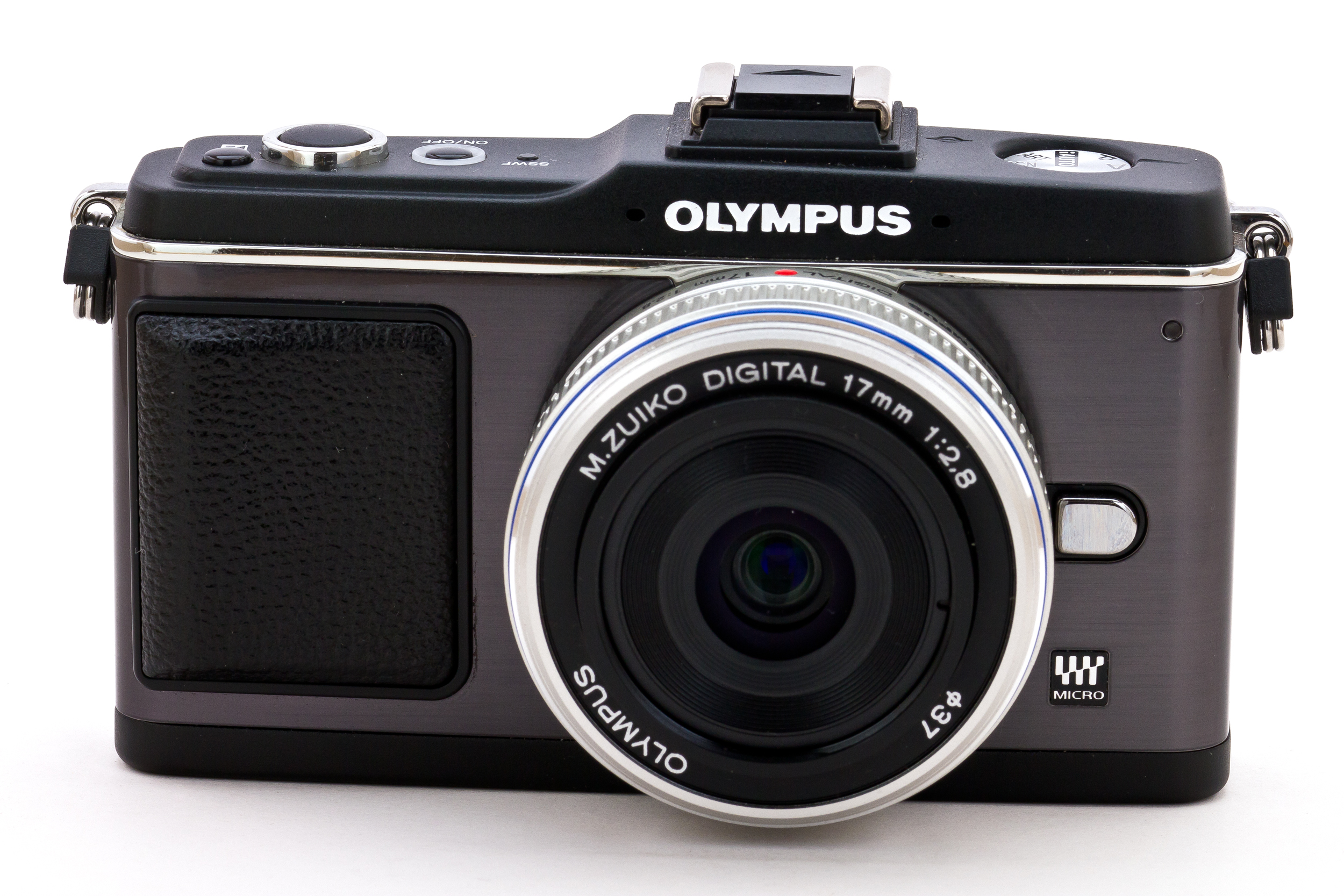
Olympus Pen EP-2 with a 17mm lens. This gives a 35mm equivalent. For wide angle lenses it is cheaper and easier to use native m4/3 lenses.

Not so long ago I was lucky enough to be given an Olympus Pen EP-2, it was an old superseded model, but still a very fine camera. My eyes were quickly opened up to the advantages of having a small light high quality camera with interchangeable lenses and it became, and still is, my most used camera. A little while later I was having a clear out of stuff and I “found” six “orphaned” lenses from film cameras that I no longer had. They were to me so good that I could never bring myself to part with them so I had kept them with the vague notion that one day if I ever got some surplus cash I would get a film body for them. However despite my nostalgia for film the reality is that I live a long way from any lab and I no longer wish to run a darkroom so any new found enthusiasm for film would quickly evaporate because of the inconvenience. One day while perusing a forum dedicated to M4/3 I discovered the whole subculture of using adapted lenses. My interest was piqued. There are a couple of reasons to use adapted lenses. The first and most sensible is that you do so because an equivalent focal length is not yet manufactured for your camera. The second reason is that it is just good fun to use old lenses that you already own or can get very cheaply.

From left to right is a 75mm Color-Heliar, a Sigma 70-210, an Olympus Zuiko 50mm, on the camer is a 35mm Color-Skopar, Olympus Zuiko 35-105, and a Tamron 28mm.

Olympus made adaptors for OM and 4/3, Panasonic for Leica R and M, and Novoflex and Voigtländer make adapters for older manual focus legacy lenses, but they are in the $200 bracket. If you look on E-Bay there are a myriad of adaptors all hailing from China and Hong Kong with prices starting at $12 AUD. So here is what to look for. For manual focus lenses the basic requirement is a rigid body and a well-built lens mount that allows infinity focus.  I would recommend either a chrome plated brass or stainless steel mount as they are more resistant to wear. Cheaper adaptors are often built deliberately to focus beyond infinity as it means tolerances do not have to be so tight. Initially this is a little disconcerting in use but you get used to it. Some of the cheaper makes can be a bit sloppy and this makes focusing accurately difficult. Forums such as Micro Four Thirds User have discussions on how to fix this quite easily, but this can be avoided by buying better quality ones such as those made by Metabones. If you believe the sales pitch by Voigtländer and Novoflex  you are risking your camera to cheap Chinese adaptors as swarf and dirt can fall onto your sensor and ruin it. The easiest thing to do is give them a wipe with a cloth and then a blast of compressed air to dislodge anything prior to mounting. In the end only you can decide on how much you want to spend, personally I took the view that this would be an experiment and I bought two $12 jobs in OM and M mount with the thought that if they were duff I could replace them and they had not cost a lot. With more modern auto focus lenses with stabilization and electronic aperture control things are a little more complicated. Firstly you will have to accept the loss of AF and IS. The cheaper adaptors also offer no control over the aperture, so the lens defaults to its widest aperture.

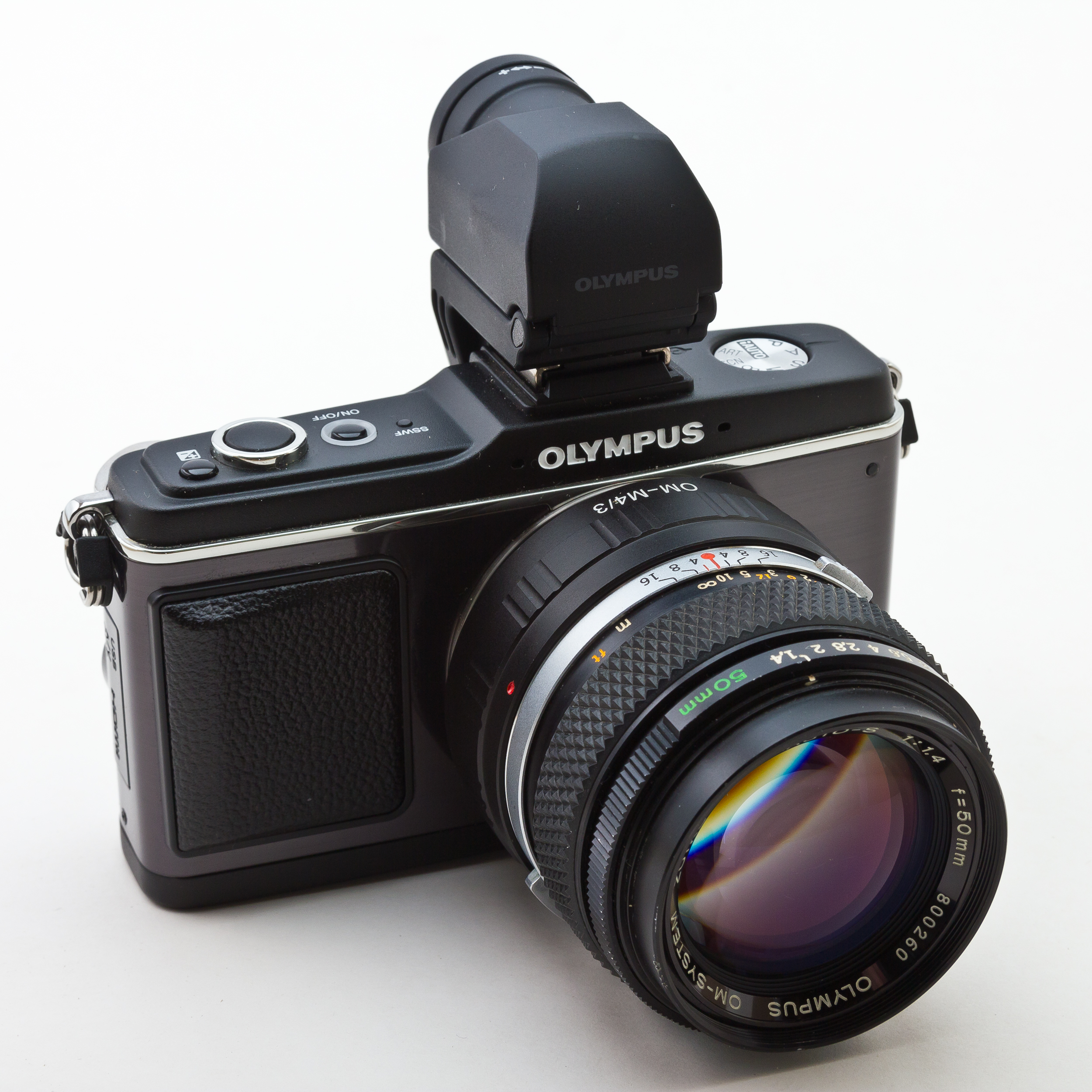
The Olympus Pen EP-2 with optional viewfinder and an Olympus Zuiko Om 50 mm f1.4 lens mounted via an adapter.

In day-to-day use is all this worth the hassle? Well there is no easy answer, it all depends upon whether you are prepared to accept work arounds and sometimes less than perfection. Digital capture does impose a lot of demands upon a lens as the sensor behaves very differently from film. The sensor is actually a very reflective surface and this means that modern lenses made for the digital era are multi-coated on the rear lens elements as well as the front to prevent glare. Some lenses, especially single coated ones, are also very susceptible to glare so I would definitely use a lens hood and be prepared for less than stellar images when shooting into the light. Older lenses designed for film are sharp in the centre but the edges and corners can let them down. Thankfully as of this time all the CSCs use a sensor that is smaller than 35mm film, and this means that the sensor is only using the best part of the lens. Talking of sensor size it is the crop factor of the various digital formats that causes the biggest problem for many users of adapted lenses as your wide angles cease to be wide angles.  A moderate wide-angle of 28mm becomes a short standard on APS having the same field of view as a 42 mm lens on full frame, or a long standard on M4/3 with a field of view similar to a 56mm. My favourite 35mm Color-Skopar is now a short telephoto on my EP-2, and my old Olympus Zuiko OM 35-105 ceases to be standard zoom but becomes a telephoto zoom. Voigtländer made a 12mm and 15mm lenses in either Leica screw (L39) or Leica M, but their performance on smaller formats leaves lots to be desired with most users complaining of excessive smearing in the corners. So the loss of wide angles is a problem for many, but on the other hand the multiplying effect of the smaller formats also brings many benefits. My 75mm f2.5 Color-Heliar becomes a very nice compact 150mm equivalent, and my Sigma 70-210mm becomes a very small 140-400mm equivalent. So if you are a frequent long lens user you will be very happy. Older manual lenses are also very suited to video usage because the focusing action has a long throw and is damped making it easy to get very precise manual focus. Throw in wide aperture lenses and your mirrorless camera becomes a very capable tool for giving beautiful “filmic’ footage. The biggest hurdle to using adapted lenses is manual focusing. I am at that age where my arms are not long enough to use the rear LCD screen for focusing so an electronic viewfinder that allows me to magnify the subject is a must. Thankfully the EP-2 and all the later variants can all take one. An alternative to an LCD viewer is a loupe designed to go over the rear LCD screen. The brand named one is by Hoodman  and sells in Australia for about $110, if that is a bit steep for you there are plenty of cheap Chinese knock offs for the $20 mark on E-Bay.

Olympus EP-2 in video mode showing the Zuiko 50 mm f1.4 mounted via an adapter, a Hoodman Loupe and the Olympus SEMA external microphone.

All in all my own personal conclusion is that it has been great fun to re-visit some old lenses I’d already got and use them in different ways. Plus there is the added fun of trawling through websites such as E-Bay and Gumtree looking for cheap interesting lenses. The other thing in its favour is that if you are a little financially embarrassed and you want to explore digital photography as a hobby then using old lenses maybe just the ticket.

Frida, my Bull Terrier co-operating nicely. Olympus EP-2 with OM Zuiko 50mm f1.4 lens. Exposure 1/60 sec, f1.4 at ISO 3200 processed in Lightroom and Silver Efx Pro 2 by Google.

Photography …

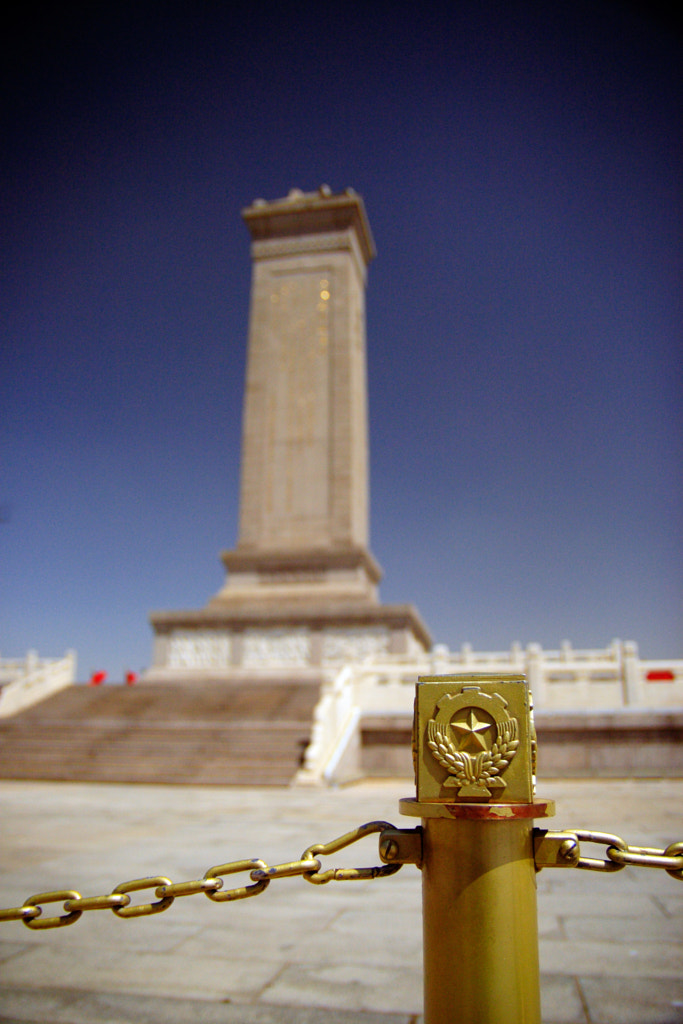
2007china00008 by Paul Amyes on 500px.com
The Monument to The People’s Heroes, Tiananmen Square, Beijing.


… is a bit of a strange pastime really. It is supposed to be about making images, artistic expression and all that sort of stuff, but the reality is that it is more about the gear than we care to admit. When I first started down the road of making photography a hobby I became brand aware. I saw that the photographers that I admired used a particular make and model of camera and certain lenses. I didn’t realize that they were paid endorsements and  my flawed logic was that if I had one of those cameras and those lenses I would instantly become a better photographer. So I gave the credit card a good bashing and my pictures still sucked. Over the ensuing 32 years I slowly learnt it was more important to have a good mix of technical knowledge and artistry than have the latest and greatest camera. Don’t get me wrong, I’m still afflicted by large bouts of techno-lust and I would in many ways love a new camera, computer, printer, and scanner, but I just don’t have the financial means to go out and satisfy those urges. I have to make do with what I’ve actually got and this has made me focus on what photography really is – making images. In fact I’ve come to the conclusion if you have too much stuff it actually gets in the way of making pictures because you become wracked with indecision about what equipment to use.


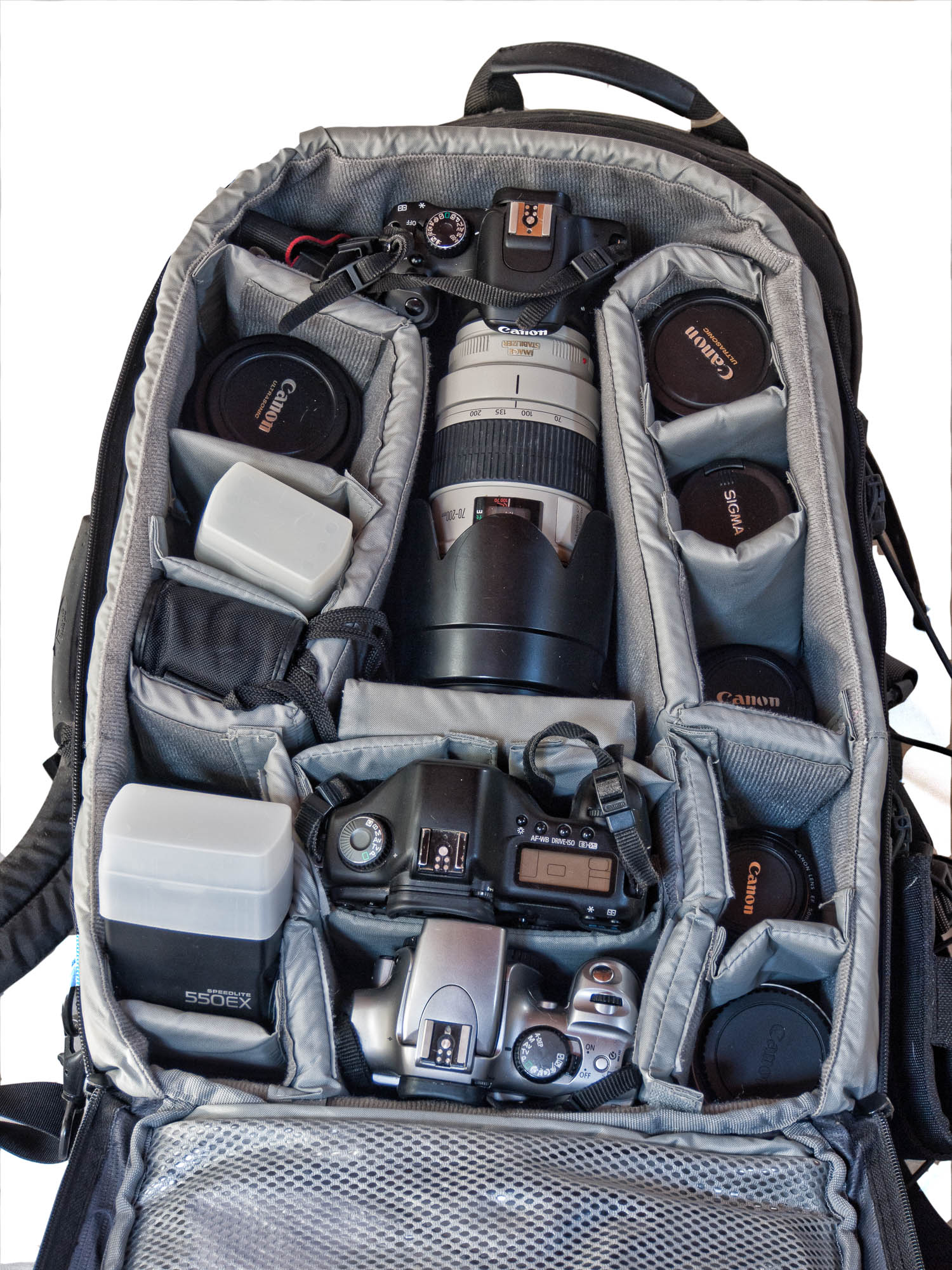
Three bodies, seven lenses, two flashes, flash meter, filters, cables, flash triggers, and reflectors. It is a hernia inducing load.


A couple of weeks ago I was sat down reading Black and White Photography Magazine and came upon an article by Tim Clinch (www.timclinchphotography.com) and he was basically saying that if you invest all your money in equipment you won’t have the necessary folding to do anything with it. If I look at my Lightroom library I can see that the majority of my photos have been taken within a short distance from where I live, but if I look at the most memorable ones then they have come from dedicated photo trips away. So I believe what Tim Clinch is saying is true, you can have a lot of top-notch gear but no money or time to use it, or you can have stuff that is adequate for your needs and the time and money to actually go out and create art. I know which one I’d sooner have.


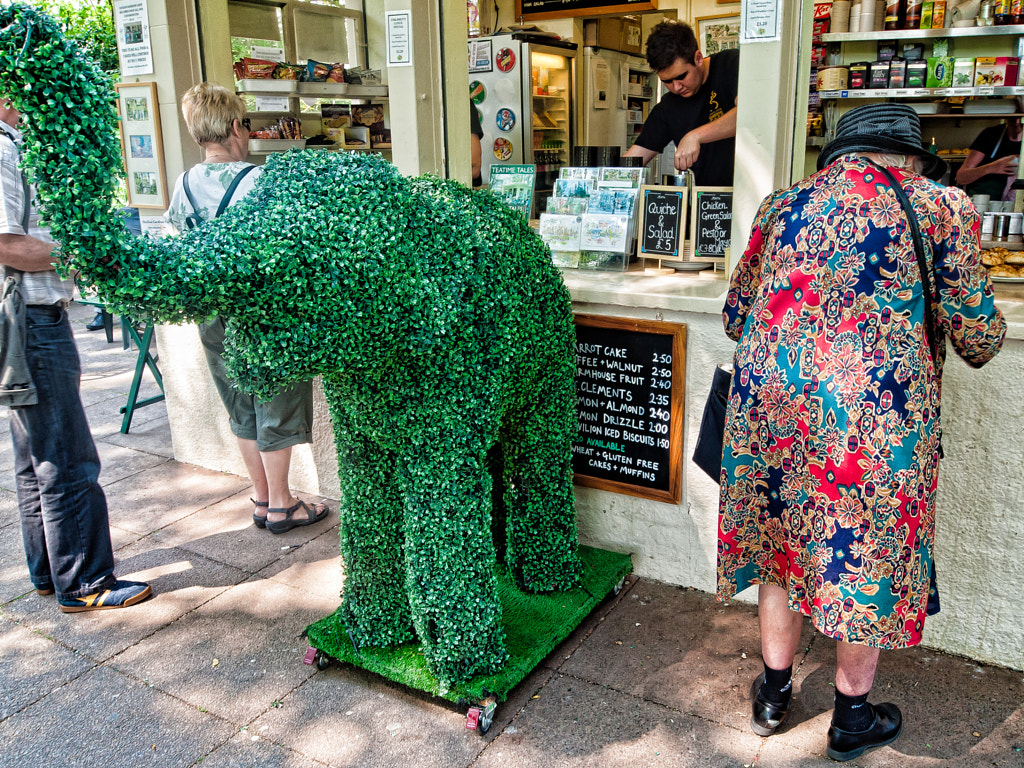
The Elephant in the Tearoom by Paul Amyes on 500px.com
Topiary at the Pavillion Gardens Cafe, Brighton, England.


Bicycle Made For Two


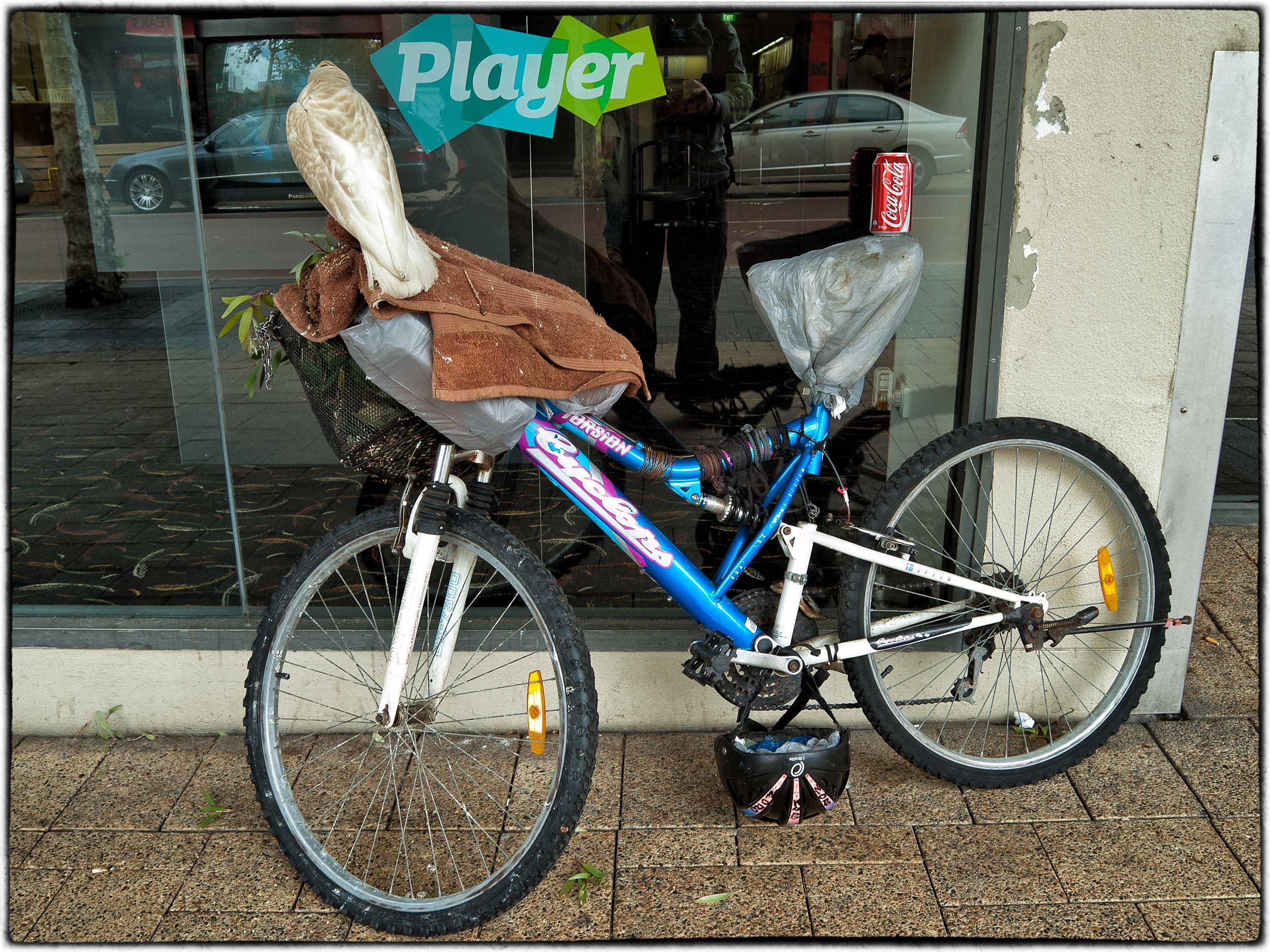
I see this bloke and his pet parrot all over Northbridge. In fact it is common to see just the parrot and the bicycle outside the Northbridge TAB (betting shop or bookies for the non-Aussies).

Cocky waiting patiently outside the TAB


Least We Forget – ANZAC Day

Yesterday was ANZAC Day here in York. Like many Australian rural towns York held a parade and then a service at the war memorial. As a migrant to Australia it is hard for me to really comprehend what ANZAC Day really means, if I were to take a stab at defining it would be:

“a day of national mourning coupled with enormous national pride and the closest thing to religious experience for most Australians“

Here are some photos I took from yesterday’s parade and service.

For non-Australians looking to know more about ANZAC Day here is a good account by The Australian War Memorial and there is an interesting account here at SBS TV.

Chance Favours The Prepared Mind

I was driving home the other  night and saw that the local farmers were burning off their fields in preparation for planting their next crop. The smoke and dust combined to give a spectacular sunset. I didn’t have my normal landscape kit with me, all I had was my EP-2 with a Voigtlander Color-Heliar 75mm f2.5. No filters, no tripod.