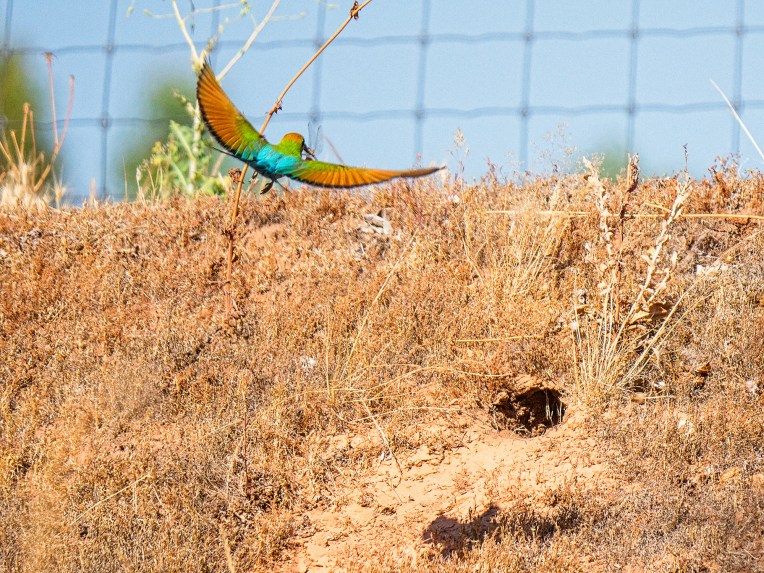
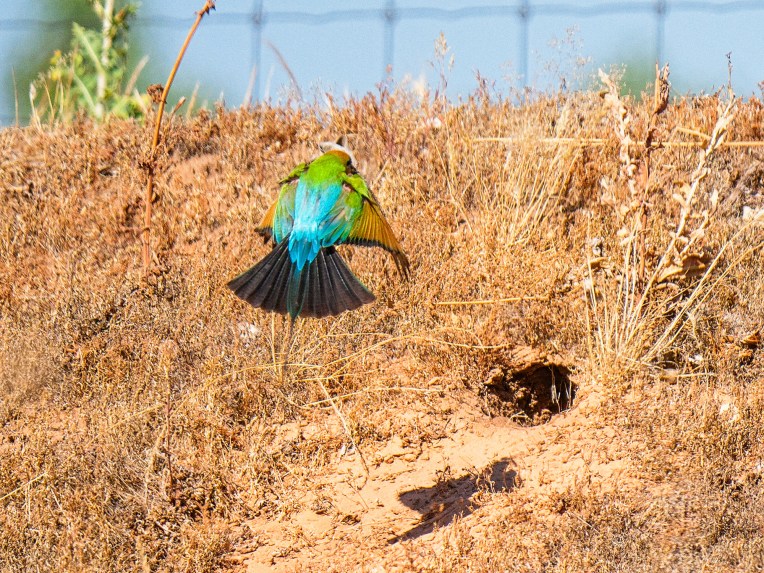
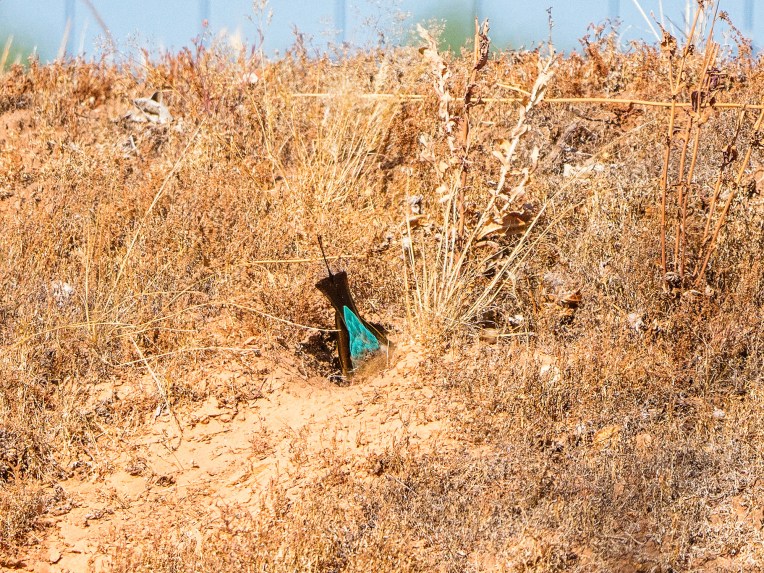
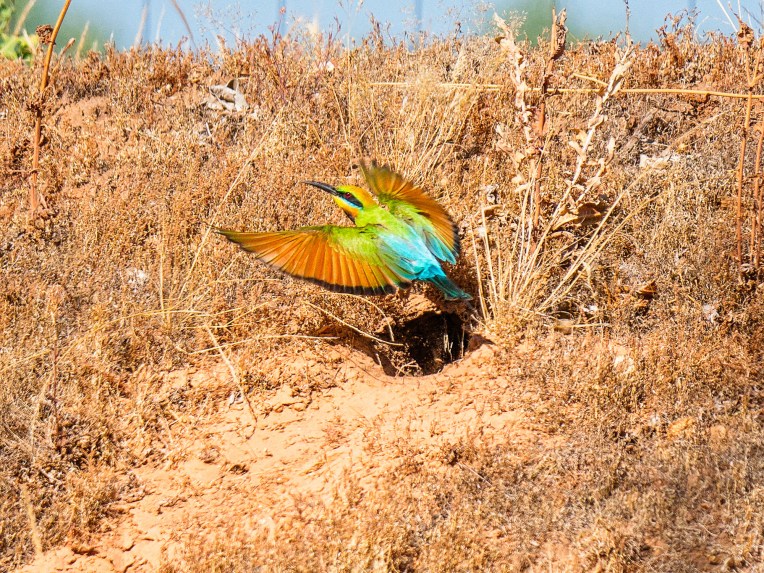
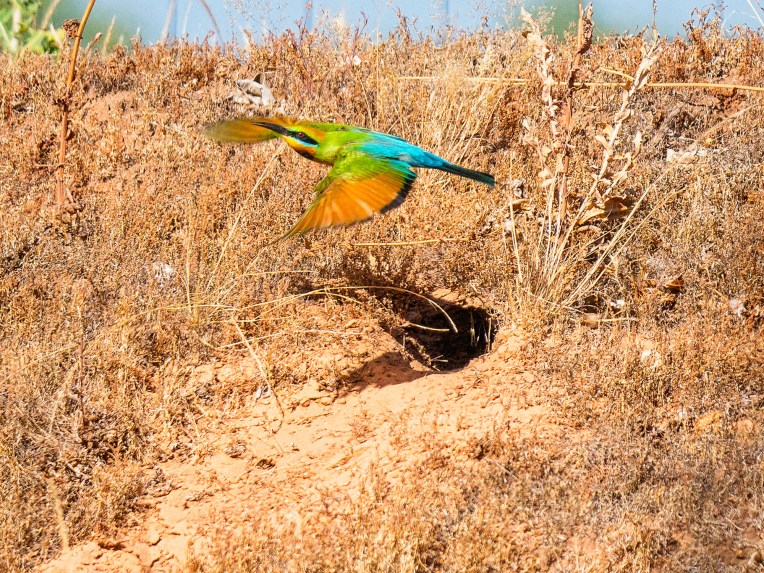
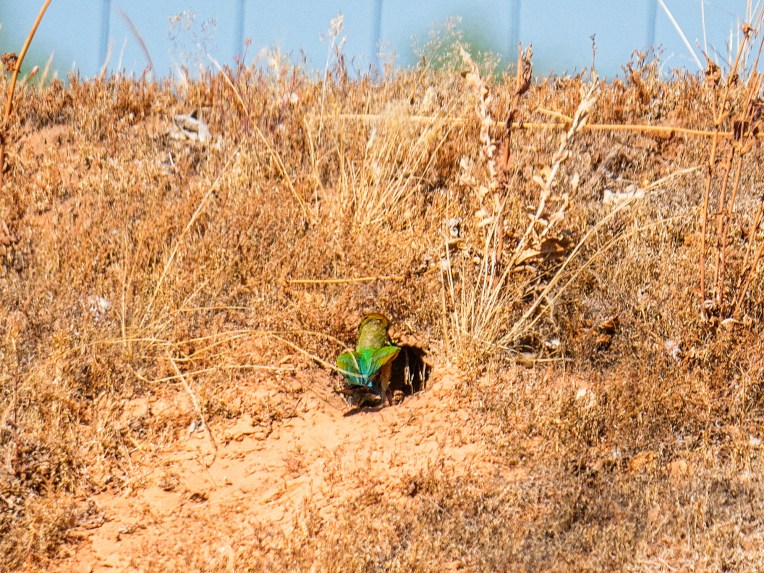
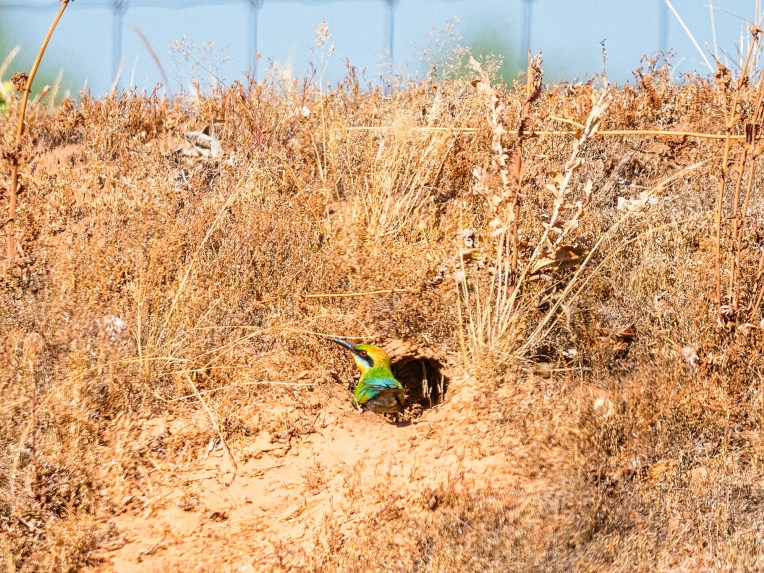
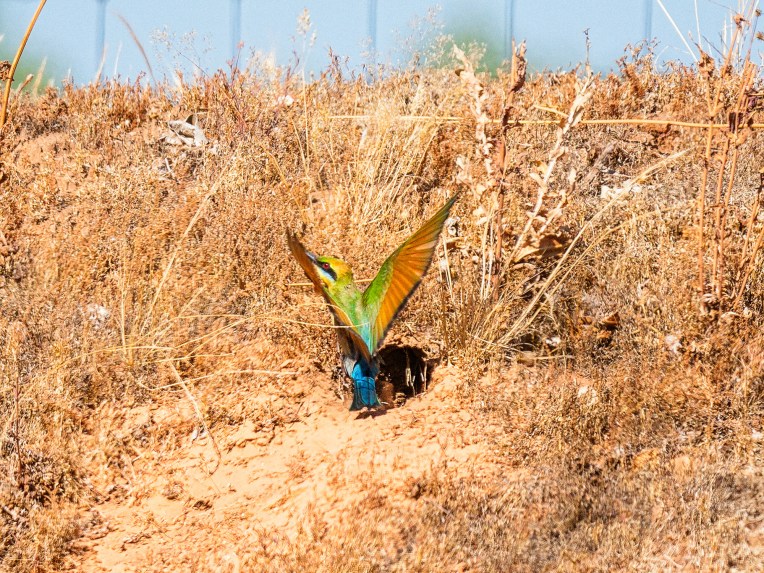
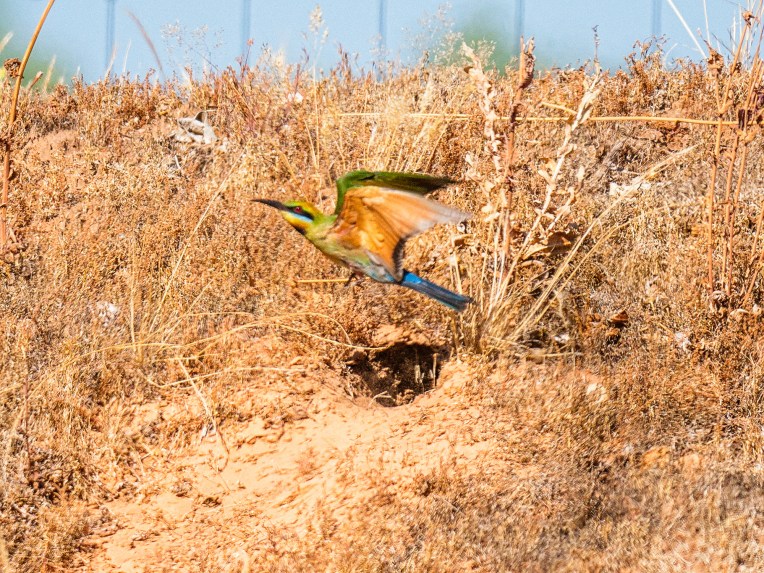
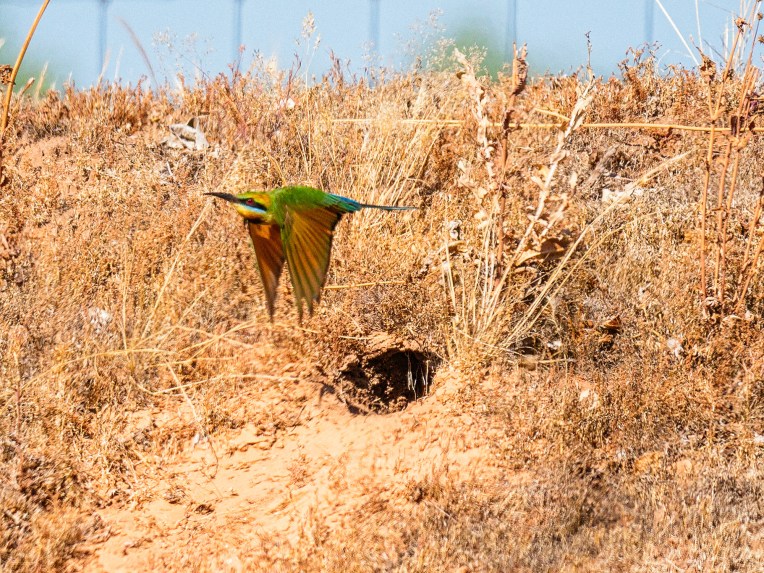
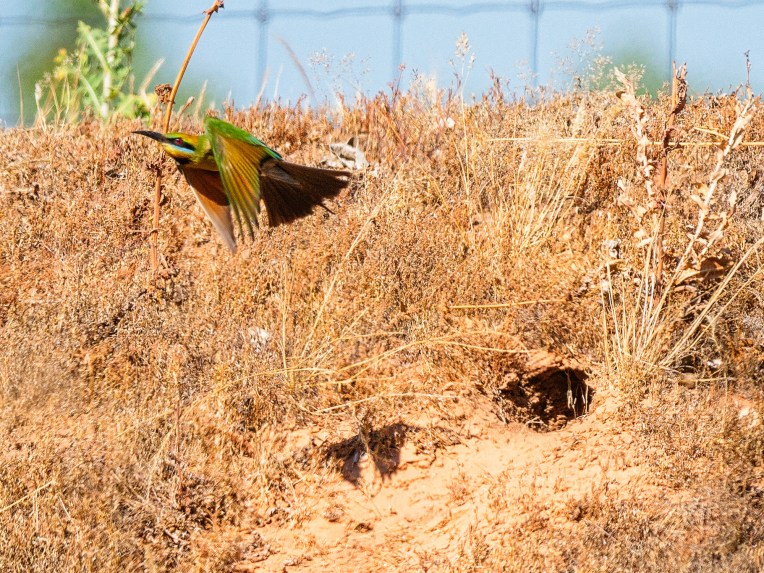
Rainbow Bee Eaters (Merops ornatus) catching insects and taking them to their chicks in their burrows.
Walking down by the Avon this morning there was a lot of commotion. A steady “prrrp-prrrp” sound followed by a flash of bright colour. Scanning the trees I found what I was looking for in the branches of a big old dead gum tree. A male rainbow bee eater bashing a large insect on the branch till it was dead so it could take it to its young brood. On further inspection I noticed that there was a holding pattern going on with mum and dad taking it in turns to take food to their ever demanding young.
Mum taking off to make the delivery while dad waits patiently to be cleared for take off.
A further shufti and I find the burrow and settle myself in to watch the parents fly in the food supplies. It was non stop, no let up at all. First off we see dad make a trip.
Rainbow Bee Eaters (Merops ornatus) catching insects and taking them to their chicks in their burrows.
Rainbow Bee Eaters (Merops ornatus) catching insects and taking them to their chicks in their burrows.
Rainbow Bee Eaters (Merops ornatus) catching insects and taking them to their chicks in their burrows.
Rainbow Bee Eaters (Merops ornatus) catching insects and taking them to their chicks in their burrows.
Rainbow Bee Eaters (Merops ornatus) catching insects and taking them to their chicks in their burrows.
Rainbow Bee Eaters (Merops ornatus) catching insects and taking them to their chicks in their burrows.
Rainbow Bee Eaters (Merops ornatus) catching insects and taking them to their chicks in their burrows.
As soon as he is clear it’s mum turn.
Rainbow Bee Eaters (Merops ornatus) catching insects and taking them to their chicks in their burrows.
Rainbow Bee Eaters (Merops ornatus) catching insects and taking them to their chicks in their burrows.
Rainbow Bee Eaters (Merops ornatus) catching insects and taking them to their chicks in their burrows.
Rainbow Bee Eaters (Merops ornatus) catching insects and taking them to their chicks in their burrows.
Rainbow Bee Eaters (Merops ornatus) catching insects and taking them to their chicks in their burrows.
Rainbow Bee Eaters (Merops ornatus) catching insects and taking them to their chicks in their burrows.
Rainbow Bee Eaters (Merops ornatus) catching insects and taking them to their chicks in their burrows.
All pictures taken with a Panasonic Lumix G85 with Panasonic Leica Vario Elmar 100-400mm f4-6.3 lens.
Below is a short video clip containing footage of the birds and some more stills.
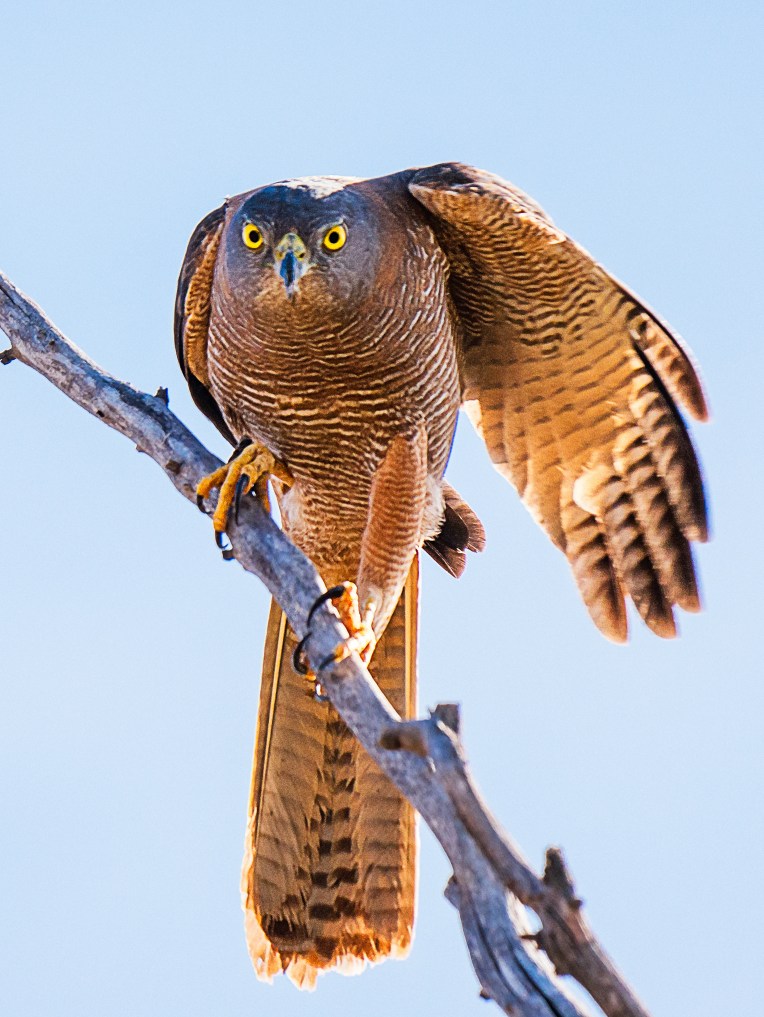
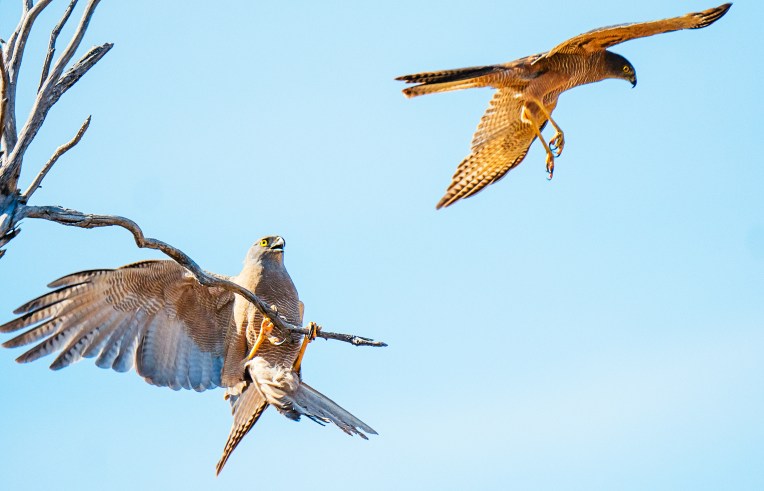
Brown goshawk, (Accipiterr fasciatus.) called Matwelitj, by the Nyoongar people of Western Australia. Avon River Walk, York, Western Australia. Panasonic Lumix G85 with LEICA DG 100-400/F4.0-6.3 lens. Exposure: 1/1000 sec, f6.3 at ISO 640 with + 1/3 stop exposure compensation.
The last few mornings dog walks have been spiced up by some very territorial brown goshawks. As we walk along the river and then down onto the river bed we can hear them calling and chattering. It then goes quiet for a second or so and then there is a loud whoosh as you are buzzed from behind. As the bird passes overhead you can feel the air current generated by its wings. At first I thought the birds were objecting to the dog but I and this pattern persisted for about a week. But then something happened that disabused me of that notion – my hat suddenly became the victim of a bird of prey. The last time it happened they managed to knock it off my head. I’m beginning to think my bicycle helmet may be more appropriate headwear.
You know what they say “Any landing you can walk away from is a good landing”. Brown goshawk, (Accipiterr fasciatus.) Avon River Walk, York, Western Australia. Panasonic Lumix G85 with LEICA DG 100-400/F4.0-6.3 lens. Exposure: 1/1000 sec, f6.3 with +1 1/3 stops exposure compensation.
What you Looking At? Brown goshawk, (Accipiterr fasciatus.) called Matwelitj, by the Nyoongar people of Western Australia. Avon River Walk, York, Western Australia.
Get Lost! Brown goshawks, (Accipiterr fasciatus.) called Matwelitj, by the Nyoongar people of Western Australia. Avon River Walk, York, Western Australia.
Little Bob does brunch on our back patio. Panasonic Lumix G85 with LEICA DG 100-400/F4.0-6.3 lens. Exposure: 1/500 sec, f6.3 at ISO 320 with -1 stop exposure compensation.
We have at present three bob tailed lizards (Tiliqua rugosa) living in the back garden. There’s Big Bob – he’s big male who must be very old judging from the size of him. He’s been here the longest and when he got sick with bobtail lizard flu one winter a couple of years ago we had him inside the house to help him get over it and then tucked him up under a pile of leaves for the remainder of the winter. Just a couple of weeks ago I heard this thrashing about under the sofa on our back patio and when I went and looked it was Big Bob mating with a smaller sleeker female who I called Mrs Bob (hey I can’t be stunningly original all the time!). They are unlike other lizards monogamous and give birth to live young so we’re looking forward to the new arrivals. Little Bob made an appearance on the patio this morning, he’s significantly smaller than the other two so I guess he’s not very old. They are omnivores and very partial to fruit – strawberries being a favourite – so I sliced up a cherry tomato and he/she scoffed the lot very quickly. As they also eat snails and insects I’m hoping that having three of them will mean that they keep the garden pests down. There’s also a bit of an old wives tale that says if you have one in your garden it’ll keep snakes away. I dunno if it’s actually true or not, but having three has got to be good.
Going through a bit of a blue phase at the moment.
Scented Sun Orchid, Thelymitra macrophylla. Mount Ronan, Western Australia. Olympus OMD EM 1 mk ii with OLYMPUS M.60mm F2.8 Macro lens and Metz 64AF-1 flash. Exposure: aperture priority mode with high speed sync flash I/3200, f4 at ISO 200 with -2 stops exposure compensation.
Blue lady orchid, Thelymitra crinita, also known as the queen orchid and lily orchid. Mount Ronan, Western Australia. Olympus OMD EM1 mk ii with OLYMPUS M.60mm F2.8 Macro lens and Metz 64AF-1 flash. Exposure: Aperture priority mode 1/80 sec, f4 at ISO 200 with -1stop exposure compensation.
Granite Sun Orchid, Thelymitra petrophila. Mount Ronan, Western Australia. Olympus OMD EM1 mk ii with OLYMPUS M.60mm F2.8 Macro lens. Exposure: aperture priority 1125 sec, f5.6 at ISO 800.
* Todays musical reference is to Blondie‘s “Look Good In Blue” taken off their debut album “Blondie” released in December 1976. Some 43 years and eleven album later the band are still touring.
The Australian bush is a dangerous place for the intrepid orchid hunter. Poisonous snakes and spiders are the least of your worry. Nope the thing to worry about is the Kangaroo tick. Size is not an indication of dangerousness. At 4mm in length one of these horrid little beasties can cause a lot of pain and suffering. A lot! When we were away on our little jaunt to Nannup the other week unknowingly I picked up a couple of hitchhikers. Shortly after getting home they began to make their presence felt – quite literally. I woke up to find that my love spuds felt like they had been trapped in a vice and then set on fire. Very quickly it felt like I was walking around with a space hopper stuffed in me jocks.
My happy sack now resemble a space hopper thanks to kangaroo ticks.
Not for nothing are ticks referred to as “the dirty needles of the bush“. Each tick is like a little syringe loaded with all sorts of nasty toxic bacteria and unfortunately the process of removing them can inject even more of that horribleness into your bloodstream. Now after a few days of antibiotics and ibuprofen things are starting to improve. So if you are an orchid hunter let this be a salutary warning and please take precautions.
Funnily the word orchid comes from the Ancient Greek ὄρχις (órkhis), literally meaning “testicle”, because of the shape of the twin tubers in some species of Orchis. In England between the 11th and 15th century orchids were called bollockwort with bollock meaning testicle and wort meaning plant. In medical lingo inflammation of the testicles is orchitis.
The tuber of the Red Beak Orchid (Pyrorchis nigricans) showing its testicular shape. Photo by Ken Macintyre 2010.
Here are some recent pics from the suffering artist.
Lemon Scented Sun Orchid, Thelymitra antennifera, also known as the vanilla orchid. Wambyn, Western Australia.
Wandoo Beard Orchid, Calochilus stramenicola. Wambyn, Western Australia.
Custard Orchid, Thelymitra villosa. Wambyn, Western Australia
* Today’s song reference seemed very appropriate. It is of course Jerry Lee Lewis’ “Great Balls of Fire”
Red Capped Robin, Petroica goodenovi, Avon Walk Trail, York, Western Australia. Panasonic G85 with Panasonic Leica 100-400mm f4-6.3 lens. Exposure: 1/500 sec, f6.3 at ISO 1000 with -2/3 stop exposure compensation.
Tomorrow here in Western Australia is the first day of spring. I don’t think Mother Nature got the memo as the bush around York sprung into life a couple of weeks ago. Flowers are bursting into bloom and the birds are in a frenzy of nest building and dancing around trying to attract mates. This means that I have also sprung into action trying to document as much of thais activity as possible. The cameras are working over time.
The unusual lutea or “yellow” form of the common donkey orchid (Diuris corymbosa). Talbot Hall, Western Australia. Canon EOS 6d with Canon EF 100mm f2.8 IS L macro lens. Exposure: 1/800 sec, f8 at ISO 400.
Green Spider Orchid, also known as the Fringed Mantis Orchid (Caladenia falcata). Talbot Hall, Western Australia. Canon EOS 6d with Canon EF100mm f/2.8L Macro IS USM lens. Exposure: 1/160 sec, f5.6 at ISO 400.
White Spider Orchids, Caladenia longicauda, Wambyn Reserve, Western Australia. Canon EOS 6D with Canon EF100mm f/2.8L Macro IS USM lens. Exposure: aperture priority with off camera flash 1/50 sec, f11 at ISO 100 with -1 stop exposure compensation.
Winter Donkey Orchid, Diuris brumalis, Wambyn Reserve, Western Australia. Canon EOS 6d with Canon EF100mm f/2.8L Macro IS USM lens. Exposure: 1/25 sec, f8 at ISO 100.
Brown Honeyeater, Lichmera indistincta, Avon Walk Trail, York, Western Australia. Panasonic G85 with Panasonic LEICA DG 100-400/F4.0-6.3 lens. Exposure: 1/500 sec, f13 at ISO 200 with -2/3 stop exposure compensation.
Female Western Whistler, Pachycephala occidentalis,, Avon Walk Trail, York, Western Australia. Panasonic G85 with Panasonic LEICA DG 100-400/F4.0-6.3 lens. Exposure: 1/500 sec, f11 at ISO 200.
The Sigma 150-600mm f5-6.3 DG OS Contemporary lens is part of Sigma’s Global Vision line of lenses. It offers an inexpensive way of getting into wildlife photography.
Not so long ago I looked at the the Panasonic Leica DG Vario-Elmar 100-400 f4-6.3 ASPH Power OIS lens for micro four thirds, well today I’m looking at an alternative lens for APS and full frame cameras – the Sigma 150-600mm f5-6.3 DG OS Contemporary lens. Now confusingly Sigma make two versions of the 150-600 and they are labelled the Sport and Contemporary. The-Digital-Picture.com has put up a good article explaining the difference between the two. The main ones are price and weight with the Contemporary being a 1Kg lighter and $1200 AUD cheaper. This is quite a significant difference and I for one prefer a lighter lens and a heavier wallet. The Contemporary is part of Sigma’s Global Vision line of lenses and is thus compatible with the Sigma TC-1401 1.4x Teleconverter which allows auto focus to work to a maximum of f8 while wide open if your camera supports this feature. This is an interesting option as it allows a reach of 860mm on full frame and a humongous 1376mm on an APSC sensor which is impressive reach for a lens and converter costing less than $2000 AUD. I didn’t happen to look at this option because none of my Canon DSLRs allow f8 auto focusing. shuttermuse.com has an article on f8 focusing with extenders or teleconverters and a list of compatible Canon DSLRs. This does not apply to the mirrorless R and RP which have f11 auto focusing.
Lens mounts available
Canon EF
Nikon F
Sigma SA
Focal length
150-600mm
Angle of view
4.1° – 16.4°
Aperture range
f5/6.3 to f22/27
Filter size
95mm
Minimum focusing distance
2.8 metres
Maximum magnification
1:4.9
Focusing
Silent HSM with internal focusing and manual override
Aperture blades
9
Lens construction
20 elements in 14 groups with 1 FLD and 3 SLD elements
Image stabilisation
Yes – 3 stops equivalent
Length
26cm
Diameter
10.5cm
Weight
1.93Kg without lens hood and tripod collar.
Fully extended to the 600mm focal length the lens is a beast. There is no sign of any wobble in the zoom extension.
Physically this is a large lens, it stands head and shoulders above my Canon 70-200mm f2.8 IS L lens which in itself quite a large lens. The 150-600 is also 500g heavier. At 2.1 Kg with lens hood and tripod collar attached it definitely has heft to it. Interestingly Sigma refer to it as a lightweight lens, I suppose it’s all a matter of perspective as the Panasonic Leica 100-400 is 0.985 Kg so the Sigma feels gargantuan compared to it while the Canon EF 600 mm f4L IS is over 3Kg so the Sigma then seems svelte and compact. The lens body is made out of what Sigma calls a Thermally Stable Composite (TSC) which is substantially stronger than conventional polycarbonates while having similar thermal expansion properties to aluminium. The lens mount is made of chromium plated brass which should ensure a long life. All in all it feels a well made and rugged lens, it may feel like plastic but the TSC body feels substantial and gives the impression of being very durable with no creaking or flexing. The Sigma 150-600 is advertised as being dust and splash proof but on closer reading of Sigma’s spec sheet there is only one seal and that is at the lens mount. If you want better then you’ll have to spring for the Sports version.
The Canon EF lens mount is made of chromium plated brass.
When looking at the lens from the front there is a large ribbed rubber zoom ring that has a long throw of about 160º. The action is smooth and feels not too tight nor too loose. As you rotate the zoom ring the lens barrel extends by 8cm. The extension feels secure with no slop or wobble. Just behind the zoom ring on the lefthand side is a zoom lock switch which can lock the zoom ring at the 150mm focal length to prevent zoom creep while carrying the lens. The focusing ring is narrow ribbed rubber and allows you to manually adjust focus while the lens is in the autofocus mode. There are no hard stops which might concern you if you were to use the lens for video. Behind the focusing ring is a panel of four switches and they are:
An AF switch allowing to choose between AF, MF and MO (Manual Override)
A focus limiter switch allowing a choice of full range, 10m to ∞, and 2.8 to 10m.
An optical stabilisation switch that gives a choice of off, on and a panning mode.
A custom switch that allows you to select two custom modes that can be programmed using the Sigma FD-11 USB Dock
There are three switches on the lens barrel. One fotr focus modes, the second a focus limiter and the third is for the optical stabilisation.
The focus distance scale is behind a window just below the the focus ring.
Above the switches is a window showing the focusing scale and then behind that is the lens collar. The lens collar allows you to turn the camera from horizontal to vertical while mounted on a tripod, but, unfortunately there are no detents to allow you to do this while looking through the viewfinder of the camera, you have to align the marks on the collar with those on the lens body. The tripod collar can be detached and thoughtfully Sigma provide a cosmetic rubber ring to slide over the lugs that hold the collar in place. The lens comes with a large plastic lens hood the size of a flower pot, it seems sturdy enough and bayonets into place and a nice touch is that is ribbed internally to prevent reflections. The 150-600 has a 95mm filter thread which means filters will be expensive and potentially hard to get. In terms of accessories Sigma provide a nice well padded lens case, a shoulder strap for it and a Sigma branded camera strap. Like all Sigma lenses you get a lot for the money you spend. Nice one Sigma!
The 150-600 has a 95mm filter thread which means filters will be the size of dinner plates, be expensive and potentially hard to get.
I tested the lens on a Canon EOS 6d and an EOS 550d to see how it would perform on both crop and full frame cameras. In terms of AF performance as neither of those cameras have what can be considered state of the art AF systems, in fact it is over twelve years old, the lens did very well. The single point AF using the centre point was fast and precise and well capable of fixing on small birds amongst foliage. In terms of continuous AF on the EOS 550d the camera was the limitation being only able to shoot 6 frame bursts in RAW, but out of my six shots when tracking my dog trotting five of the six would be in focus. The 6d is able to shoot 4.5 frames per second for 15 frames and on the trotting bull terrier test it managed 12 frames in focus.
This slideshow requires JavaScript.
When it came to BIF (birds in flight not fisticuffs) the AF was more than capable of focusing on and tracking medium to large birds. It really struggled with small birds especially swallows. Put it on a better camera and I’m sure you’d get better results.
Australian white ibis, Threskiornis molucca, Herdsman Lake, Western Australia.
My primary use for a lens like this is handheld bird photography, and as such I didn’t really give the image stabilisation a workout as I seldom use a shutter speed below 1/500 sec. But messing around at home in the house and garden I figured it was good for three stops. Mind you I do have steady hands so your experience may differ from mine.
The optical construction of the lens is twenty elements in fourteen groups with 1 FLD and 3 SLD elements. The FLD (“F” Low Dispersion) glass element, which offers performance equivalent to fluorite. Canon and other manufacturers have used synthetically grown crystals of calcium fluoride components in lenses to aid apochromatic design, and to reduce light dispersion so lenses made from it exhibit less chromatic aberration. What Sigma has done is use newer glasses and computer-aided design to render the use of fluorite crystals unnecessary. Sigma claim that the FLD element is “highly transparent, its refractive index and dispersion are extremely low as compared to conventional types of glass. It offers characteristics very similar to those of fluorite, which is valued for its anomalous dispersion. These characteristics minimize residual chromatic aberration (secondary spectrum), which cannot be corrected by ordinary optical glass, while helping to produce sharp, high-contrast images.” (https://sigmaphoto.com.au). The three SLD (Special Low Dispersion) glass elements also help to minimize chromatic aberration. To help achieve attractive out of focus transitions there are nine rounded aperture blades which should help achieve nice round bokeh balls when shooting specular highlights.
In terms of optical performance well I’ll deal with full frame and crop separately. First up using the lens on the crop framed 550d. At 150mm the centre of the lens wide open was sharp and contrasty and stayed A as such until f22 when it softened due to the effects of diffraction. At the edges the peak performance was attained at f11 and remained until f22 when it softened again. At 600mm the centre wide open was a little soft and lacking in contrast. This improved by f8 and then deteriorated at f22. The edges weren’t so good – wide open they were soft and lacking contrast and remained so until f22 when they got worse. As for vignetting well at the short end wide open it was apparent, about 1/2 to 1 stop and this disappeared by f8. It was the same story at the long end. Throughout the focal range there is slight pin cushion distortion and some chromatic aberration can also be seen. Open the files up in Lightroom and apply the lens profile and things improve nicely. On the full frame 6d the story is the same except for the vignetting which is naturally worse at around 1-1 1/2 stops which is totally understandable as you are using the whole frame rather than just the central part of the lens coverage.
100 % crop from the centre of a New Holland Honeyeater to show how detail is rendered by the Sigma 150-600mm f5-6.3 Contemporary lens.
What’s all this mean in real life. Well if we look at the image for the New Holland Honeyeater which I took at a distance of around 3.5 to 4 metres and then enlarge the section around the head you can see that there is nice feather detail and that the eye is sharper than a very sharp thing. To get much better you’d have to spend an awful lot of money and if we look at the Canon 600mm f4 lens I mentioned earlier that has an eye watering price of $18,500 AUD which is over 11 times the cost of the Sigma. Personally I know that if I plonked $18 K down on a lens I’d be heading for the divorce court which would make the Canon a doubly expensive lens. So for what it costs the Sigma is amazing value.
Below are some examples of bird photography shot with the lens on both a Canon EOS 6d and 550d.
Welcome Swallow, Hirundo neoxxena, Herdsman Lake, Western Australia. Canon 6d with Sigma 150-600mm Contemporary. Exposure: 1/500 sec, f7.1 at ISO 250.
Red capped robin, Petroica goodenovi, Avon Walk Trail, York, Western Australia. Canon 550d with Sigma 150-600mm Contemporary lens. Exposure: 1/500, f6.3 at ISO 160.
Chestnut-rumped Thornbill (Acanthiza uropygialis), York, Western Australia. canon 550d with Sigma 150-600mm Contemporary lens. Exposure: 1/1000 sec, f6.3 at ISO 320.
Mistletoebird, Dicaeum hirundinaceum. The Nyoongar name is Minnijit. York, Western Australia. Canon 6d with Sigma 150-600mm Contemporary lens. Exposure: 1/1000 sec, f8 at ISO 1600.
So would I recommend the lens? Yes without hesitation. It performs very well and is sold at a very good price and you can’t argue with that.
Been left on my own for the weekend means it’s time for a curry extravaganza. Here we have Murgh musallam (baked chicken), Saag aloo (spinach with potatoes), Khili hui khichri (rice with yellow split peas) , popadoms and some ginger and mango chutney on the side. All this washed down by Ashai Dry.
Beloved Significant Other (BSO) has taken her sainted self off for the weekend to play croquet leaving yours truly and the dog at home. This can only mean one thing …CURRY NIGHT!!!!! And what’s more it’s not your usual blokey vindaloo. No here we have the height of Moghul culinary sophistication. There was Murgh musallam, Saag aloo, Khili hui khichri, accompanied by papadums, and ginger and mango chutney. It is next to impossible to get Kingfisher beer here so it was washed down with Asahai Dry. Three plus hours of cooking for a meal to be had on my own might seem a tad extravagant but I really enjoy cooking and I like to crank up the sound system and get stuck in. The recipes are not my own but were from Madhur Jaffrey’s eponymous book “Madhur Jaffrey’s Indian Cookery”. She is my cooking guru.
The photography was old school. I dug out the Canon EOS 5d – the original version – and the Canon EF 50mm f1.8 mike aka the nifty fifty and the plastic fantastic. Sure there is better on the market now but the Canon 5d was very special and had great colour science and beautiful tonality.
Frida says “Wake me up in spring.”. Panasonic G85 with OLYMPUS M.45mm F1.8 lens. Exposure: 1/15 sec, f2 at ISO 3200. Processed in AlienSkin Exposure 4.










You must be logged in to post a comment.