William Shakespeare, Act 3, scene 1, Julius Caesar
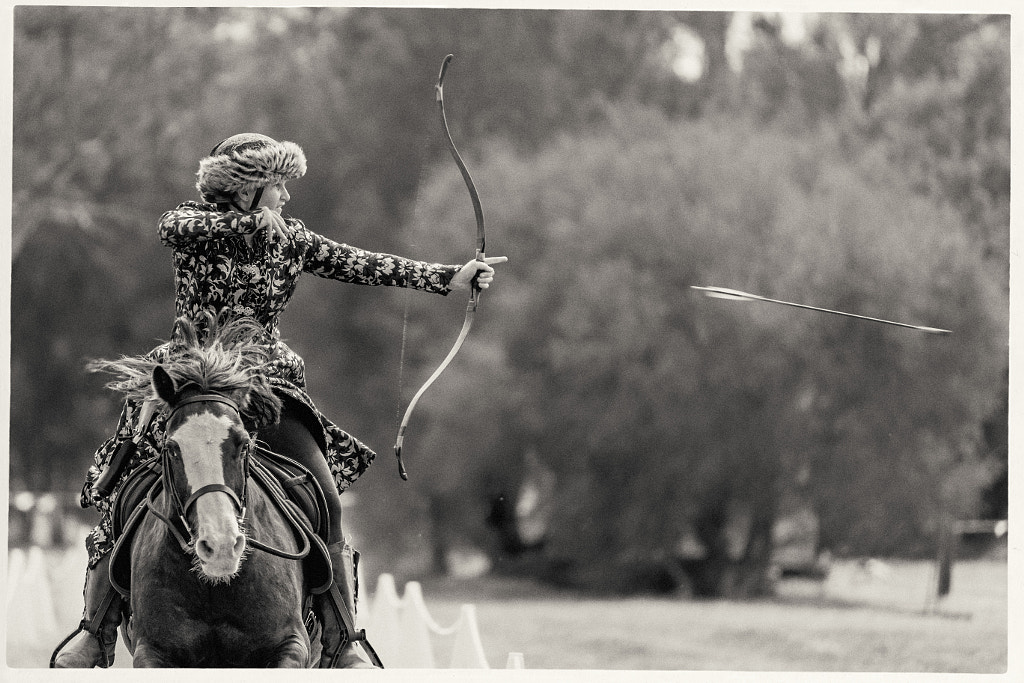
Mounted archery demonstration. 2023 York Medieval Fayre.
It’s always a bit surreal when the Medieval Fayre is on – things like people in Medieval costume buying drinks in the local supermarket. Even the whole idea of Australians dressing up in Medieval costume and doing re-enactments is a bit of a strange notion when you consider that Australia had no European history prior to the Seventeenth Century. I go most years just for the spectacle, I always like watching the mounted archery demonstration. Amazing skills in hitting a target while at a full gallop. It makes for great photos as well.
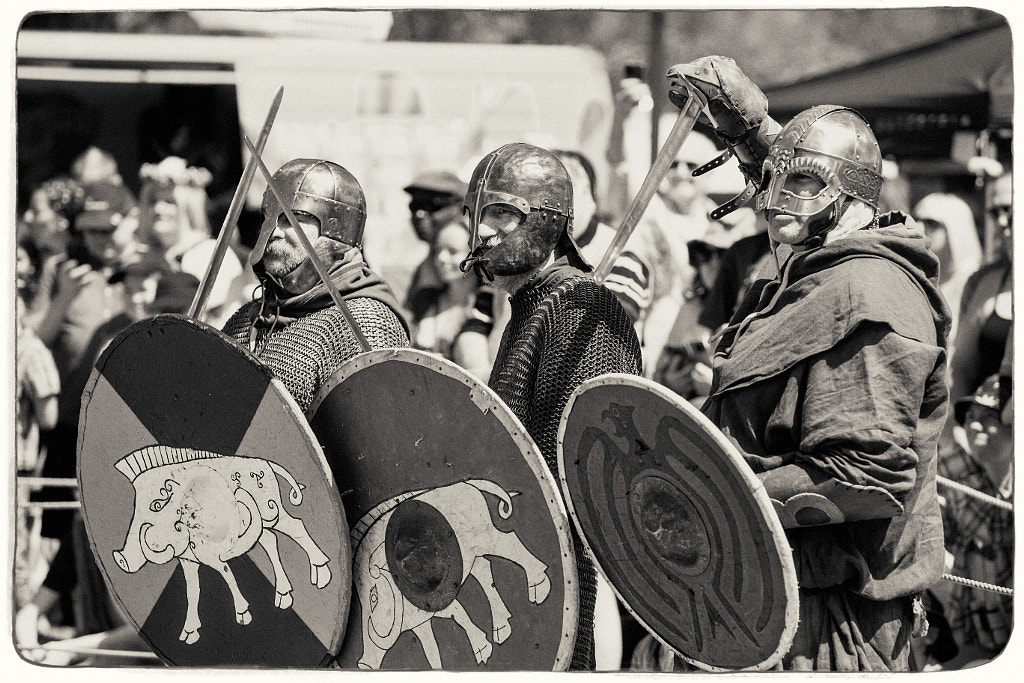
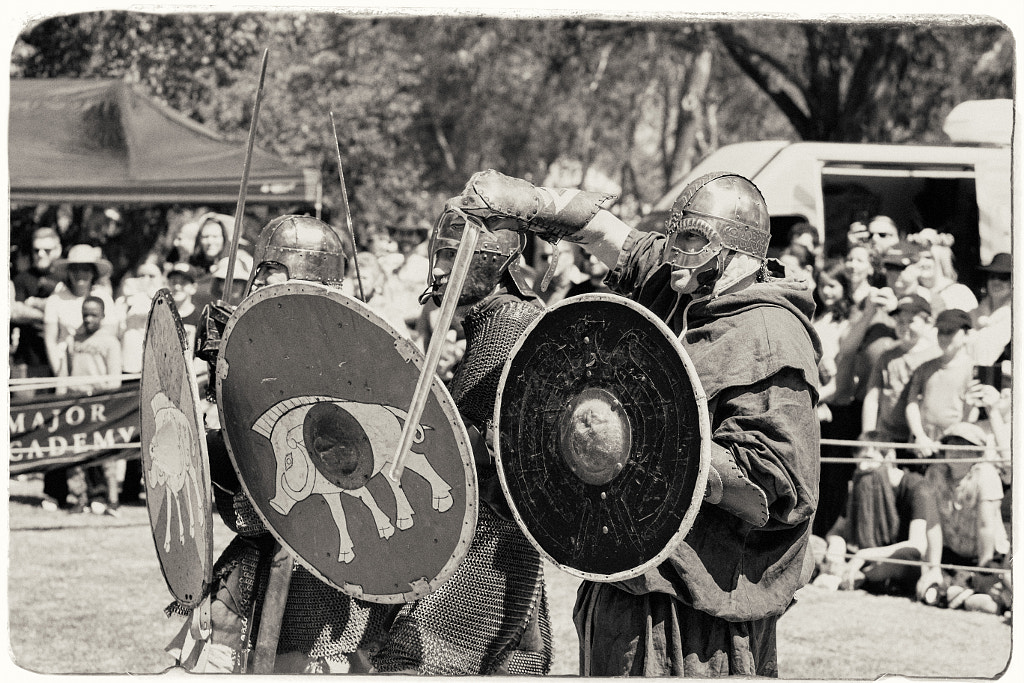
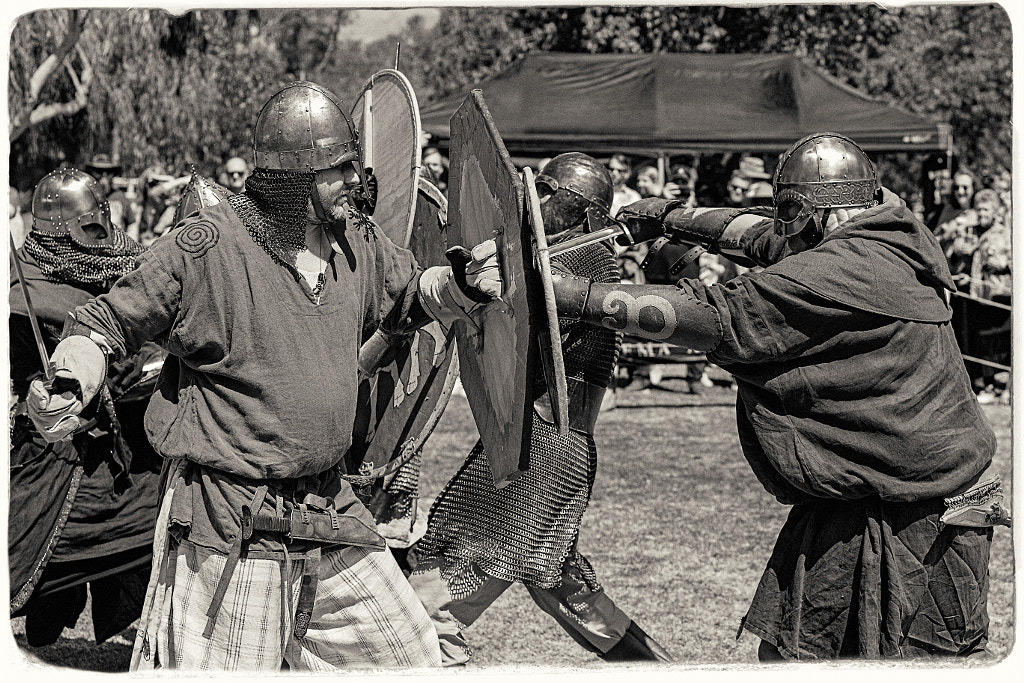
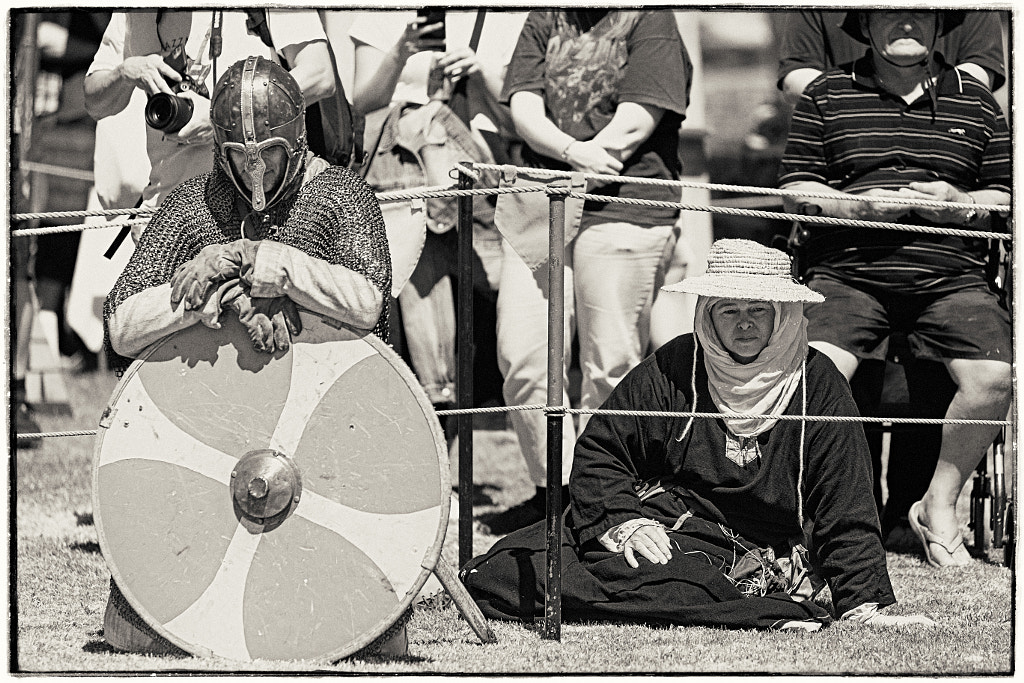
Just lately I’ve been on a bit of historical journey – over the last 8 weeks I’ve watched all the Time Team episodes on YouTube. It’s been quite an education and it was a very fun way to find out more about where I’m from. I particularly liked the episodes about the Saxon period just because up to recently very little has been known about that time. Another connection is that I spent part of my childhood in Hastings in East Sussex and growing up there you’re very aware of the fate of the last Saxon King of England – Harold Godwinson – at the Battle of Hastings. So when I walked into the Medieval Fayre I was quite delighted to see the Grey Company putting on a display re-enacting that period.
The Grey Company focuses primarily on the so called “Dark Ages” period of history (600-1100 AD).
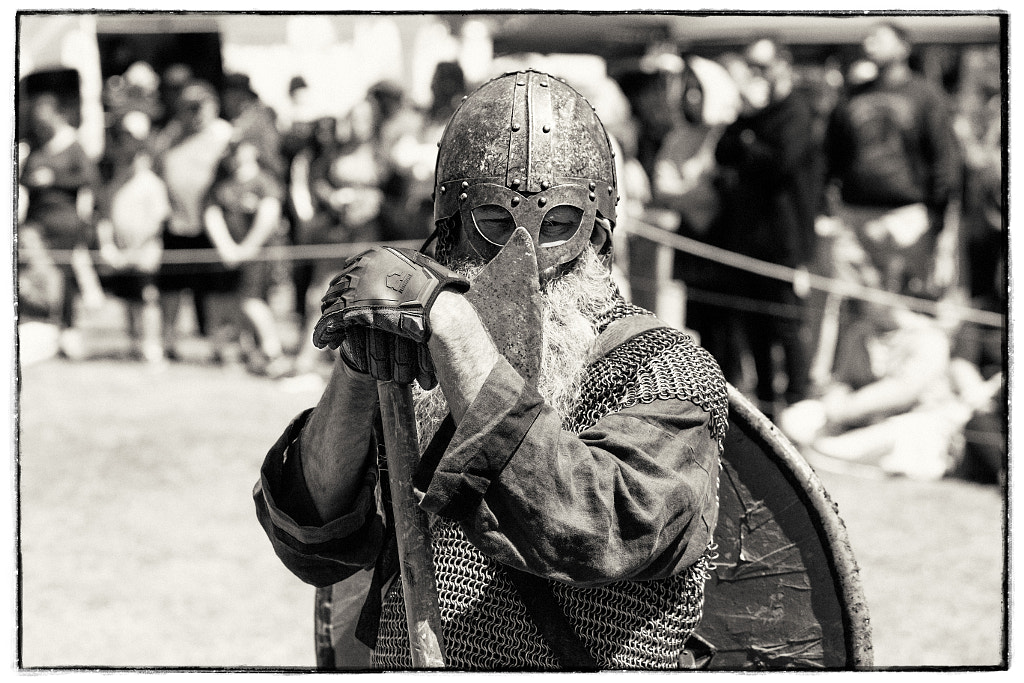
A Norman knight waits for the start of the demonstration.
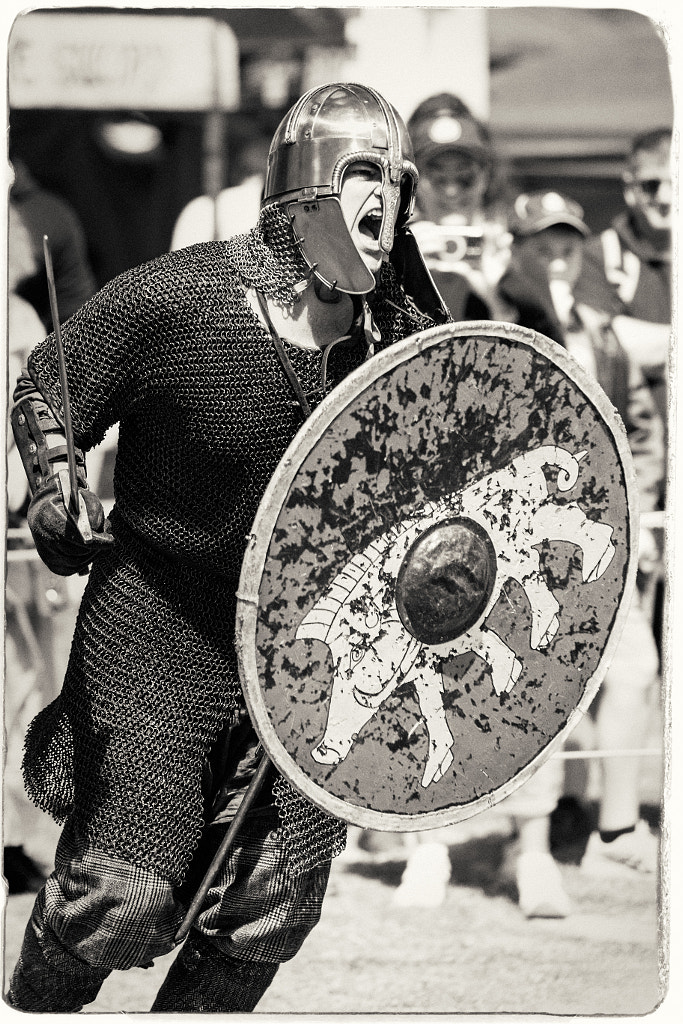
Rushing into the fray with a blood curdling cry.
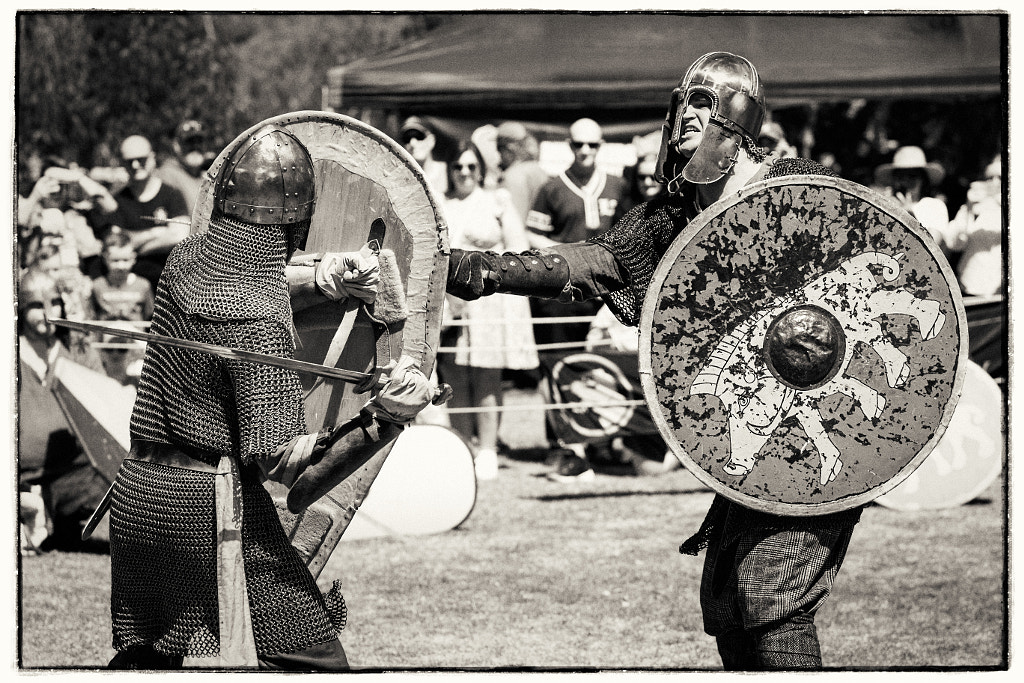
The clash of swords on shields.
A Saxon shield wall prepares to engage Norman invaders.
A few insults and banging shields with swords gets the blood up.
Engaging the enemy.
A well earned breather.
Photographically it was a case of using my Canon 6d, the EF24-70mm f4 and EF 70-200mm f2.8. Processing was all done in Lightroom and Exposure X7. I felt a black and white treatment would be the most sympathetic.
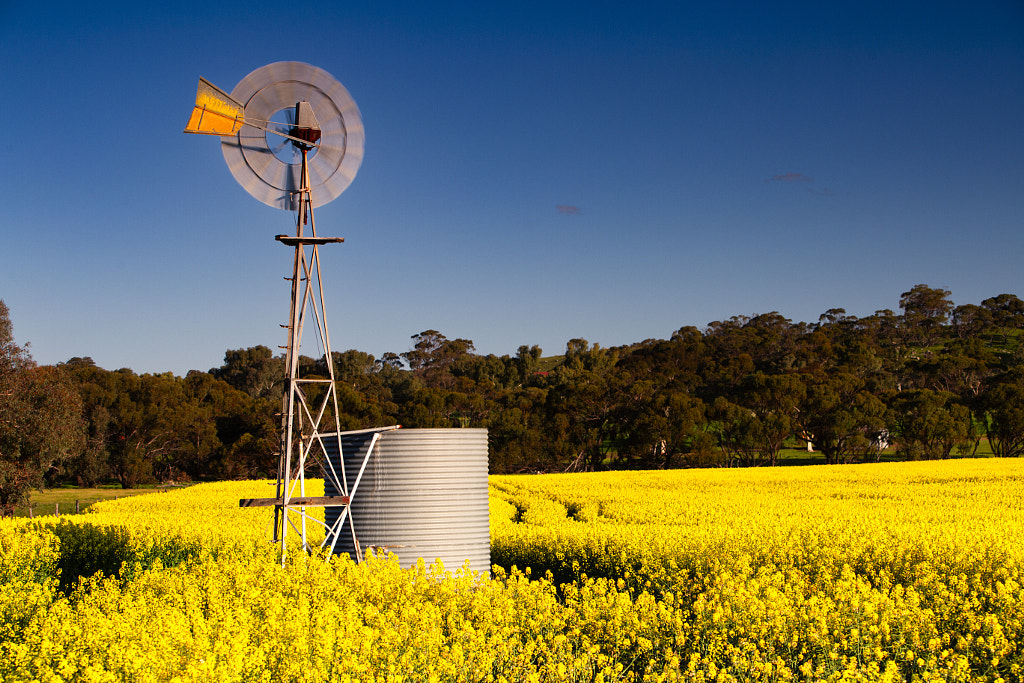
Golden hour light illuminates the canola. York, Western Australia.
It’s the time of year again when I post a gratuitous canola photograph. But the yellow of the canola and the blue of the sky are hard to resist. It’s really strange – York is a wildflower hot spot with an incredible number of spectacular species, yet I see more tourists pull up to photograph canola than the wildflowers.
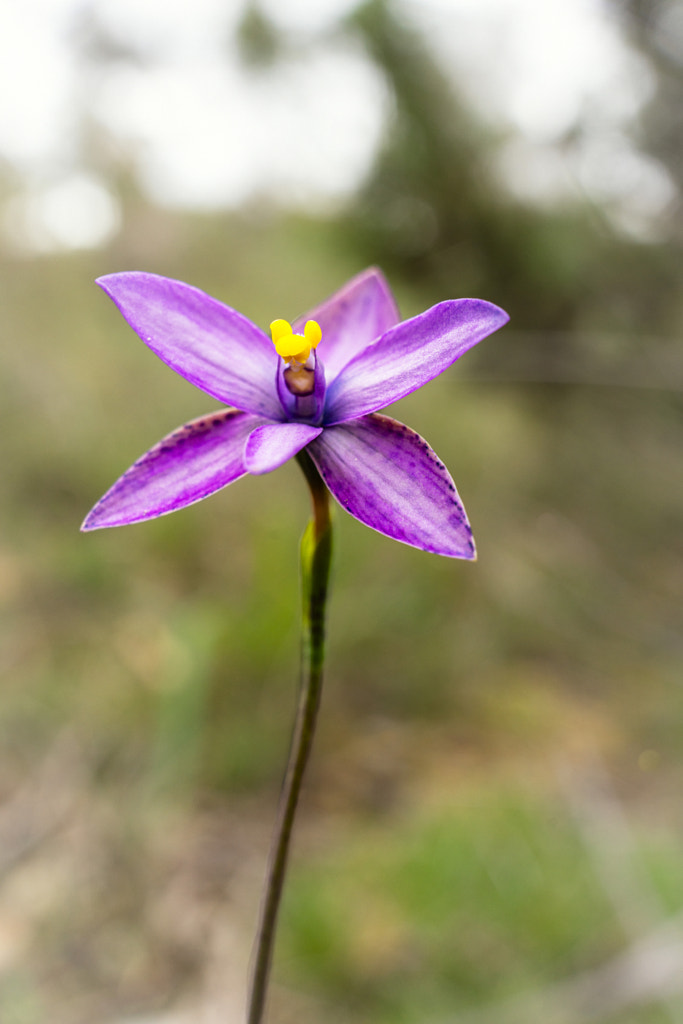
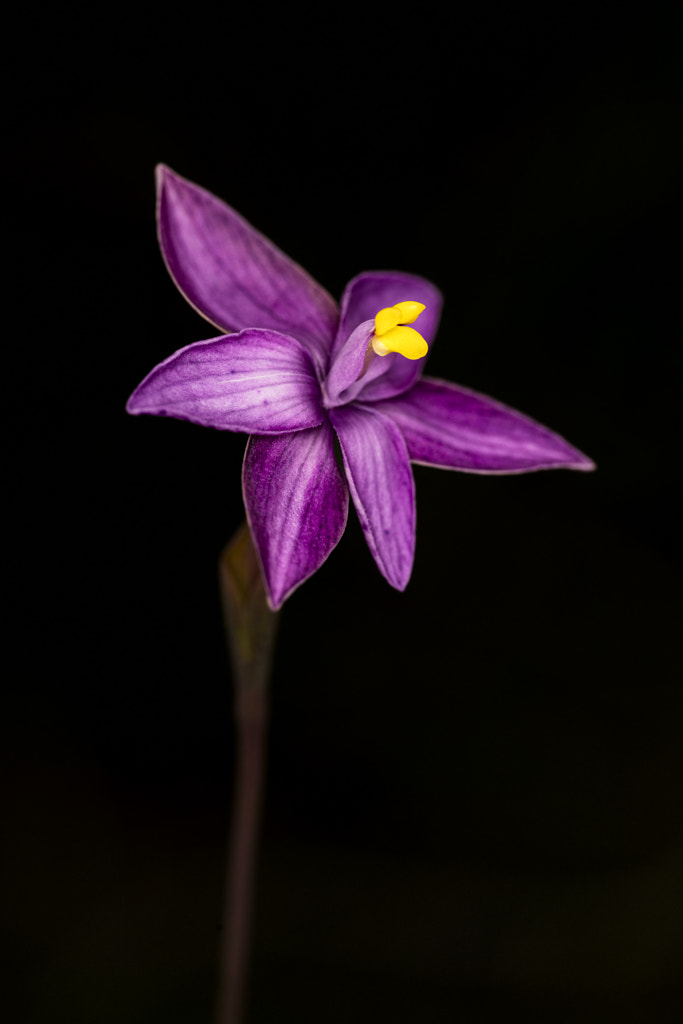
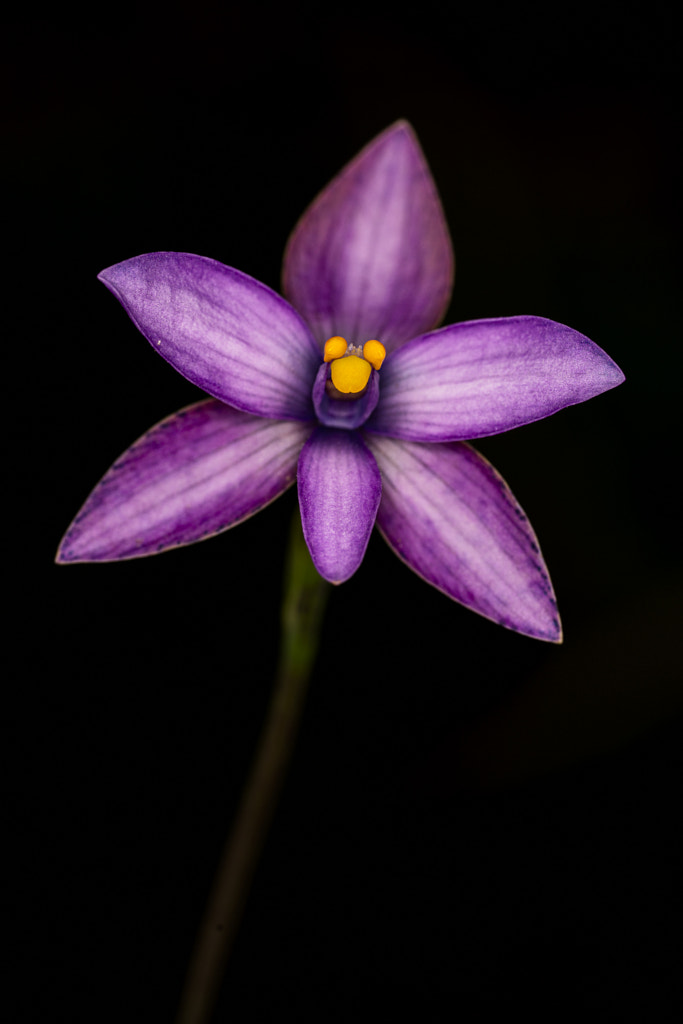
Yep you read that right. You know how you can stand at a bus stop for ages and not see a single one and then suddenly three come along together? Well orchids are like that. I’ve been walking the same patch of woodland looking for the Curly Locks Orchid for years without seeing a single one and then the other day low and behold there were three of them just standing there.
Curly Locks, Thelymitra spiralis. Wandoo National Park, Western Australia.
Curly Locks, Thelymitra spiralis. Wandoo National Park, Western Australia.
Curly Locks, Thelymitra spiralis. Wandoo National Park, Western Australia.
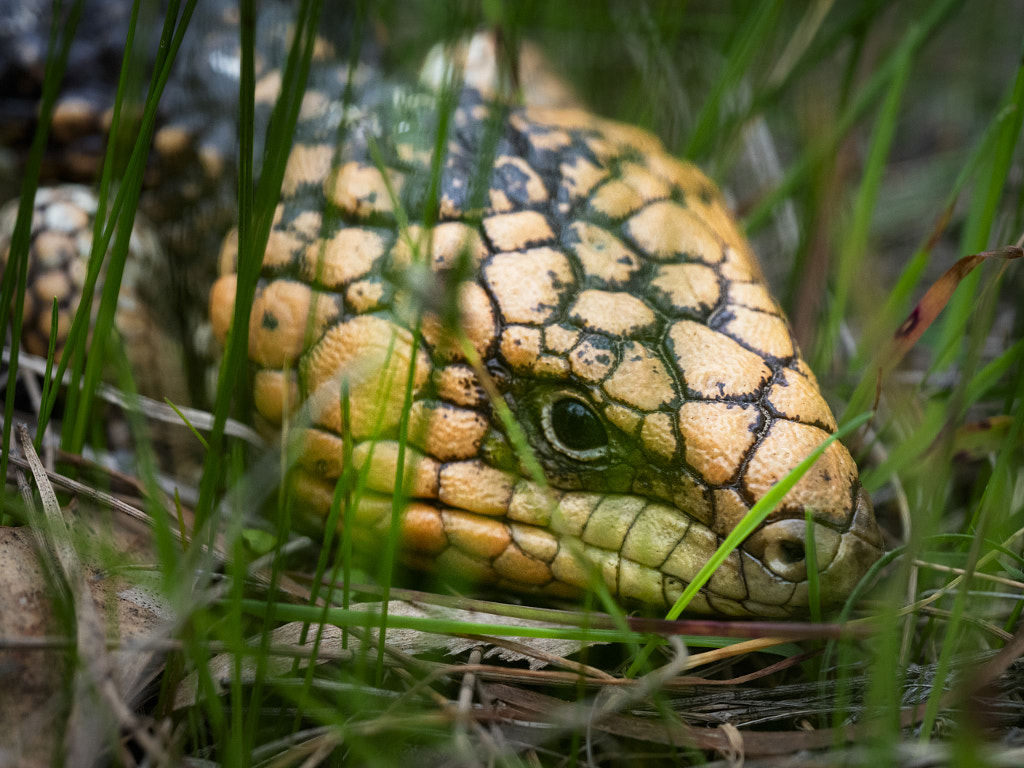
I’ve spent the last couple of weeks walking the Wandoo forest looking for various orchids. I’ve bumped into a male emus and his brood (too quick to photograph), met bob tailed lizards and countless Western Grey Kangaroos (again too quick to photograph). So even if I’ve not found the particular flower I’m looking for it has still been quite an experience.
The slower bob tailed lizards are easier to photograph than fleeing emus and kangaroos.
Speaking of finding orchids well I’ve seen plenty. On Thursdays outing to Wambyn Reserve I saw eleven different species and was amazed by how early some of them were.
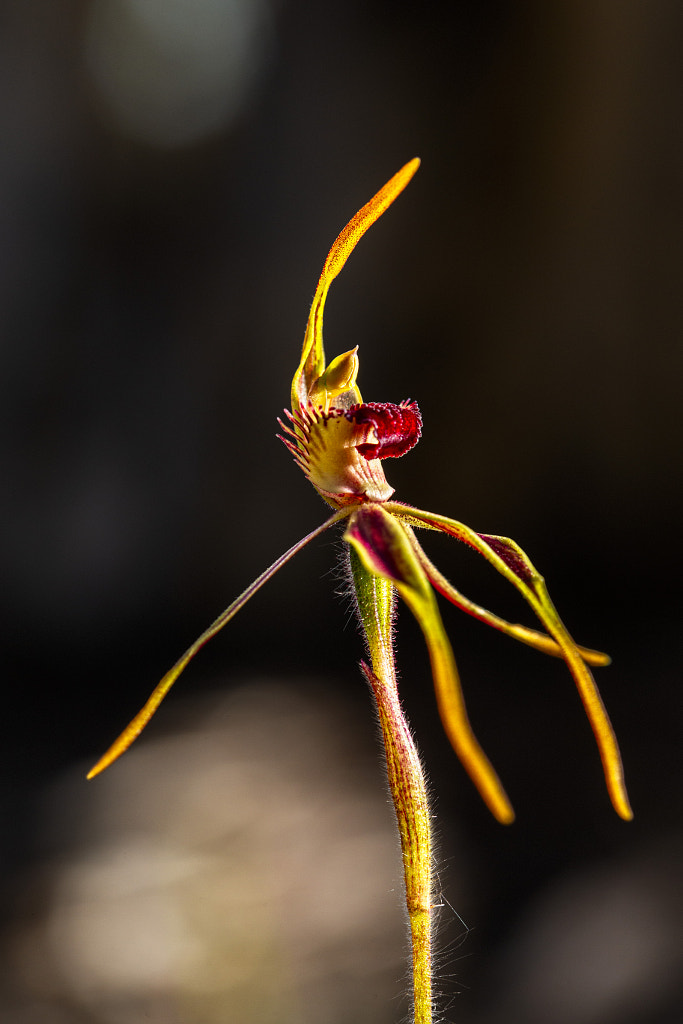
A very early flowering Clubbed Spider Orchid, Caladenia longiclavata. Wambyn Reserve, Western Australia.
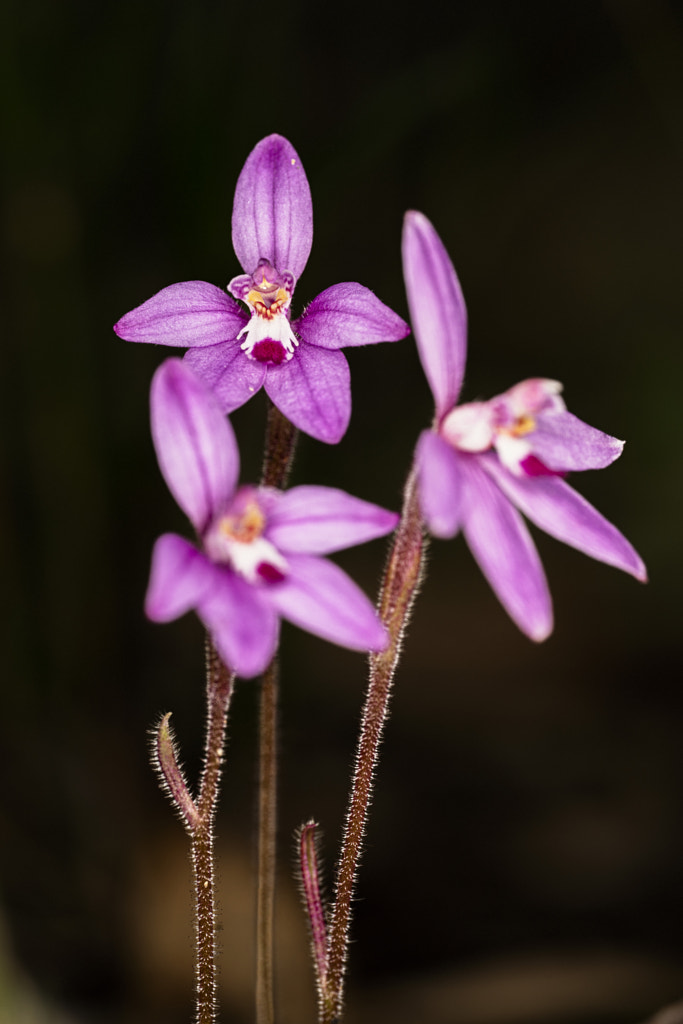
Little Pink Fairy Orchid or dwarf pink fairy orchid, Caladenia reptans subspecies reptans. Wandoo National Park, Western Australia.
Sugar Orchid, Ericksonella saccharata. Wambyn Reserve, Western Australia.
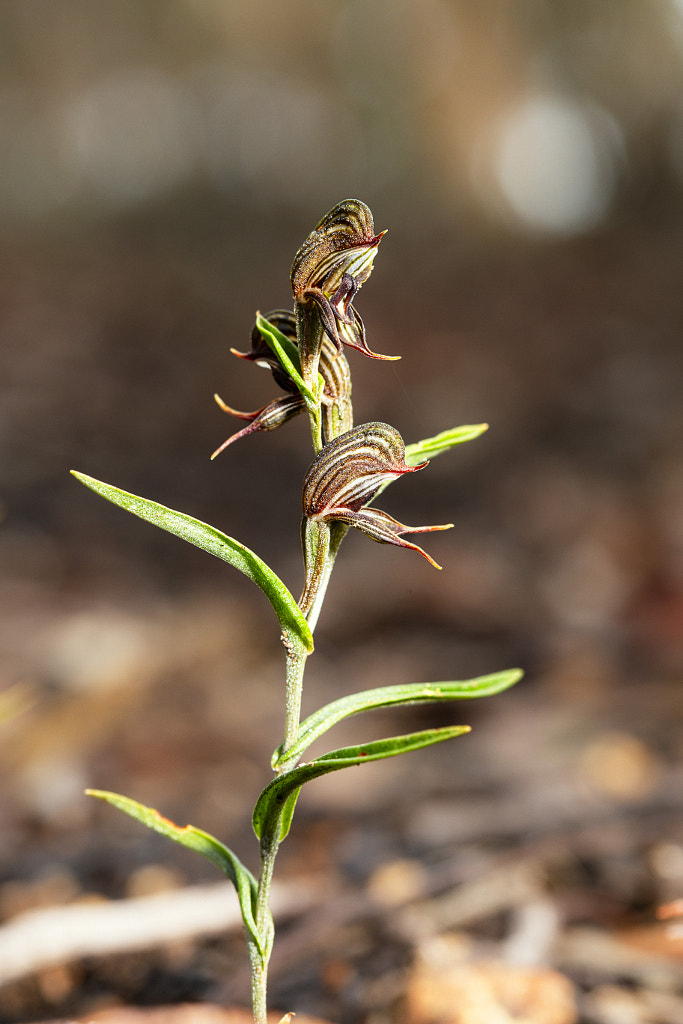
Frog Greenhood, Pterostylis sargentii. Wambyn Reserve, Western Australia.
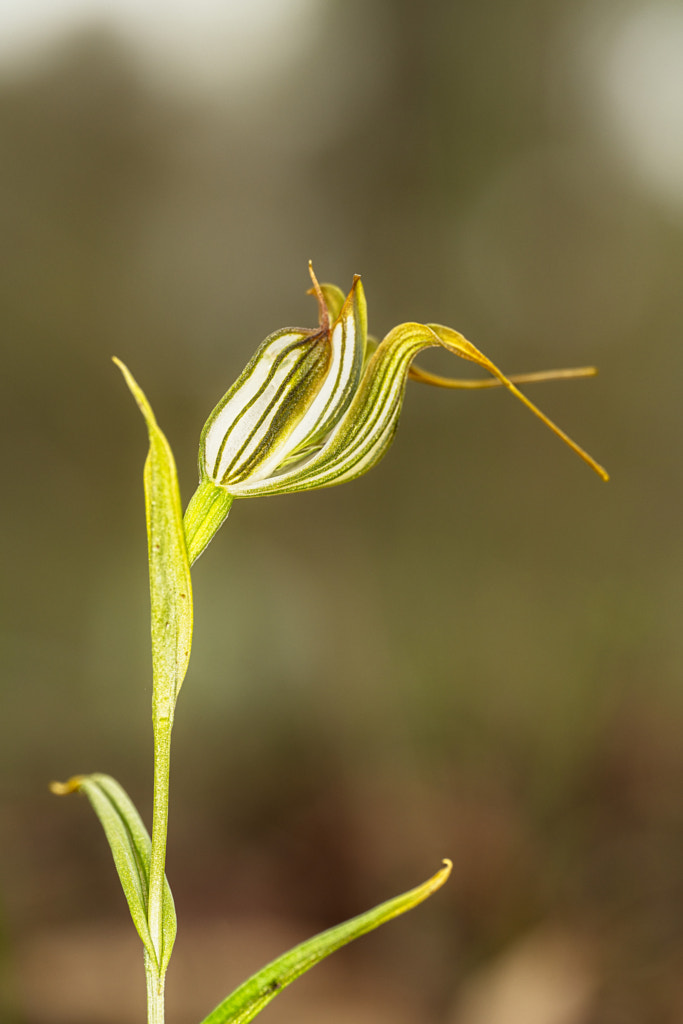
Jug orchid or recurved shell orchid, Pterostylis recurva. Wandoo National Park, Western Australia.
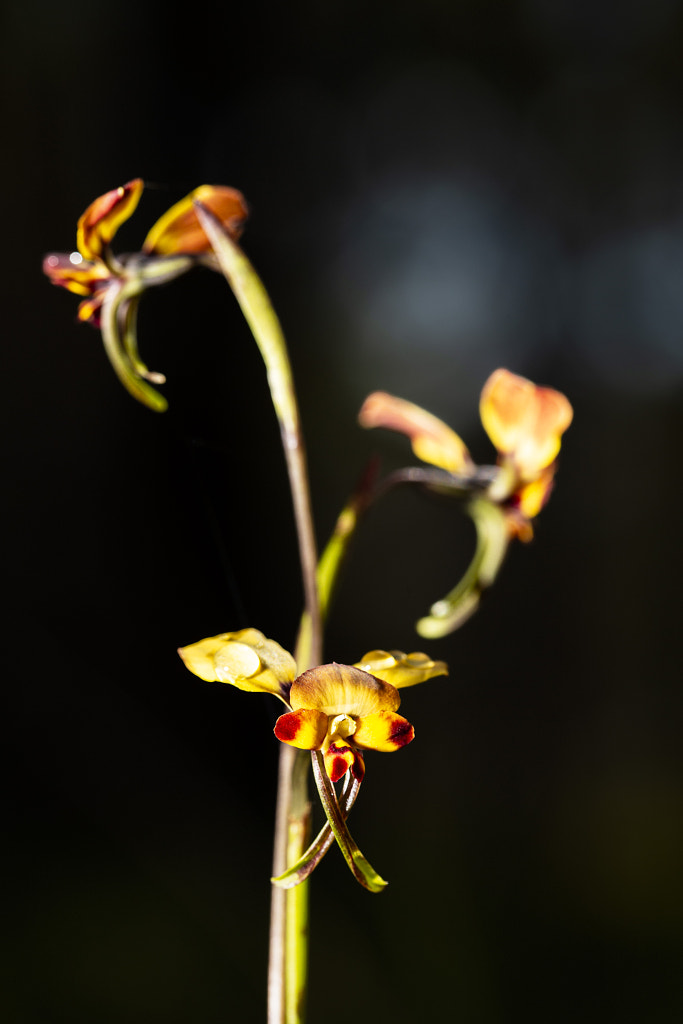
Common Donkey Orchid or wallflower orchid, Diuris corymbosa. Wambyn Reserve, Western Australia.
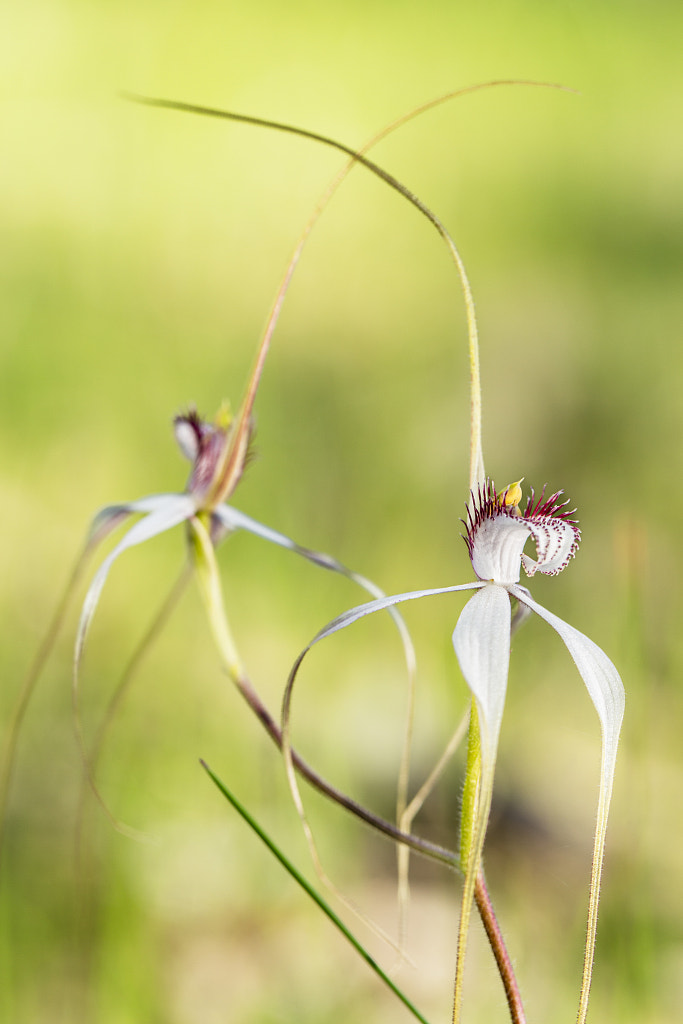
Stark White Spider Orchid, Caladenia longicauda subsp eminens. Wambyn Reserve, Western Australia.
Photographically I’ve been on a bit of a full frame kick preferring to either use the Sony A7r ii and sigma 105mm macro lens or the Canon EOS6d with Canon 100mm macro lens. All the shots are lit with a flash being used as the key light and natural light as the fill. I’ve enjoyed the change but my back doesn’t. There’s a huge weight difference between the full frame cameras, lenses and flash equipment compared to the usual Olympus micro four thirds system I usually use. But to be honest shooting at base ISO using artificial lighting and only printing at A3+ I can’t see any real advantage to shooting full frame so this next week I’ll go back to using the Olympus kit.
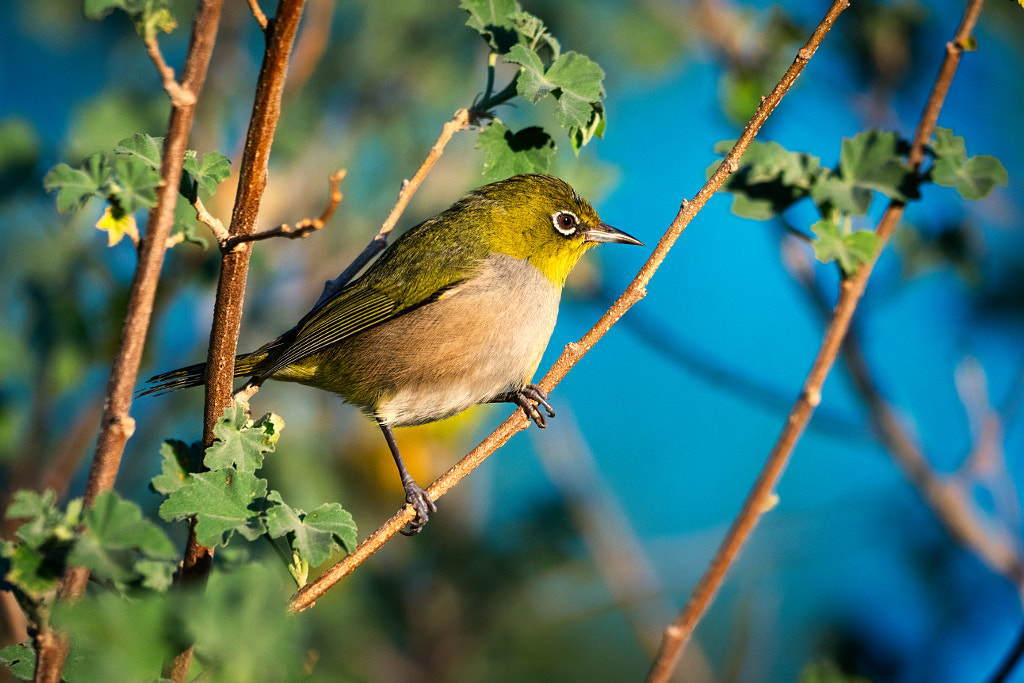
Silvereye, Zosterops lateralis. York, Western Australia.
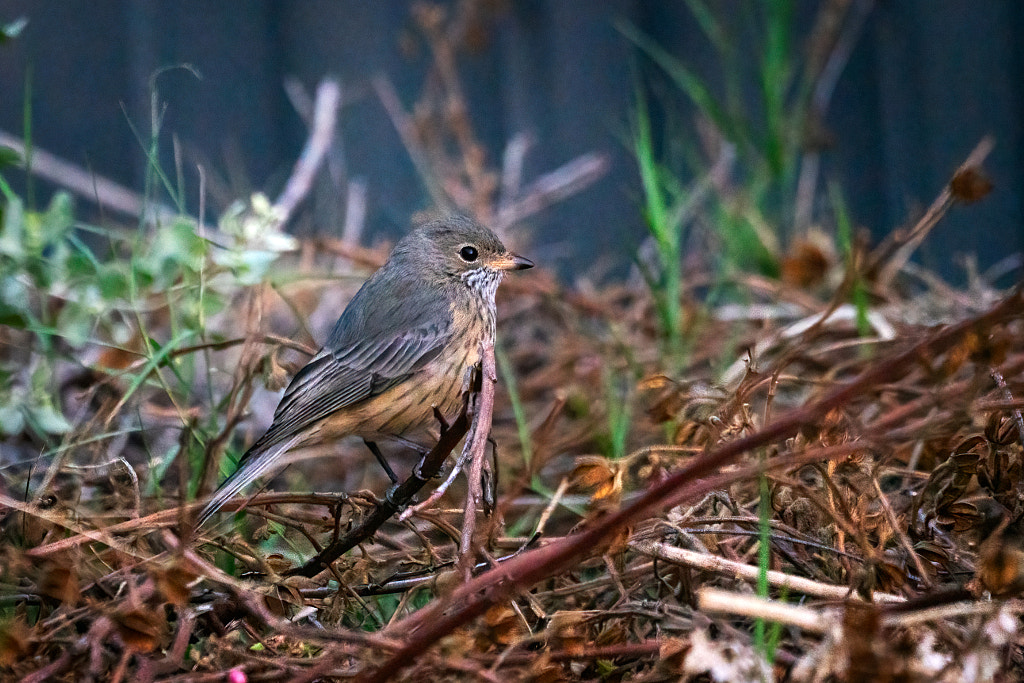
We’re still getting visitors to the garden. Lately we’ve been getting half a dozen or so Silvereyes visit at around 4-5pm. They’re tricky things to photograph because they are so small (about 10cm beak to tail) and they move so erratically- think manic clockwork toy on speed and you’ll be in the ball park. Just before sundown we get a female rufous whistler pick over the mulch in the garden beds. I can hear the male in the peppercorn tree but I’ve not seen him.
A female rufous whistler visits the garden.
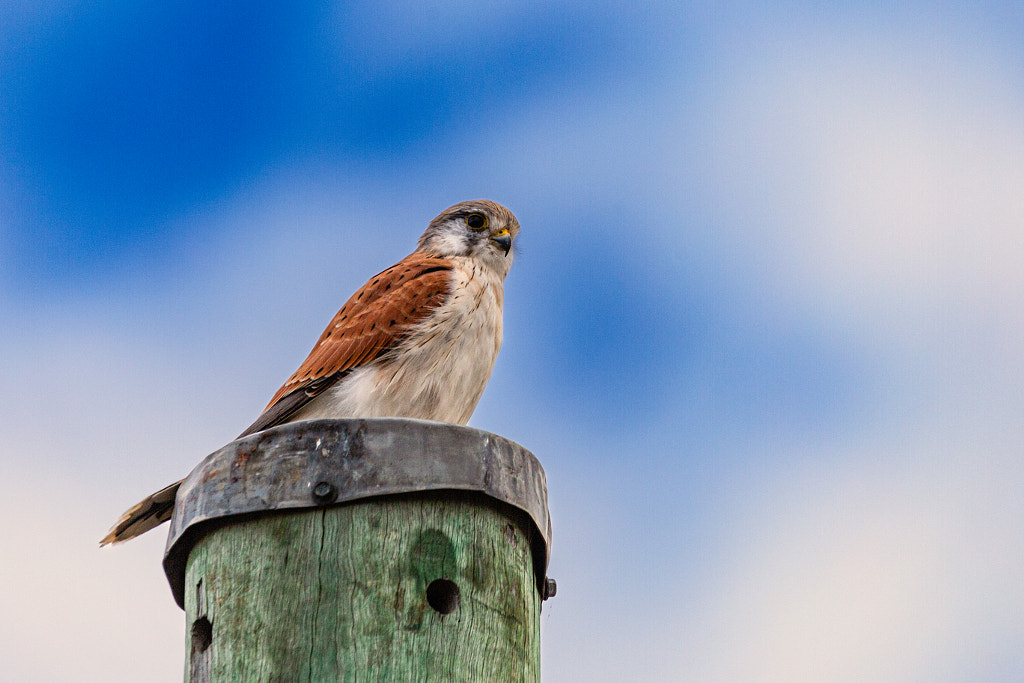
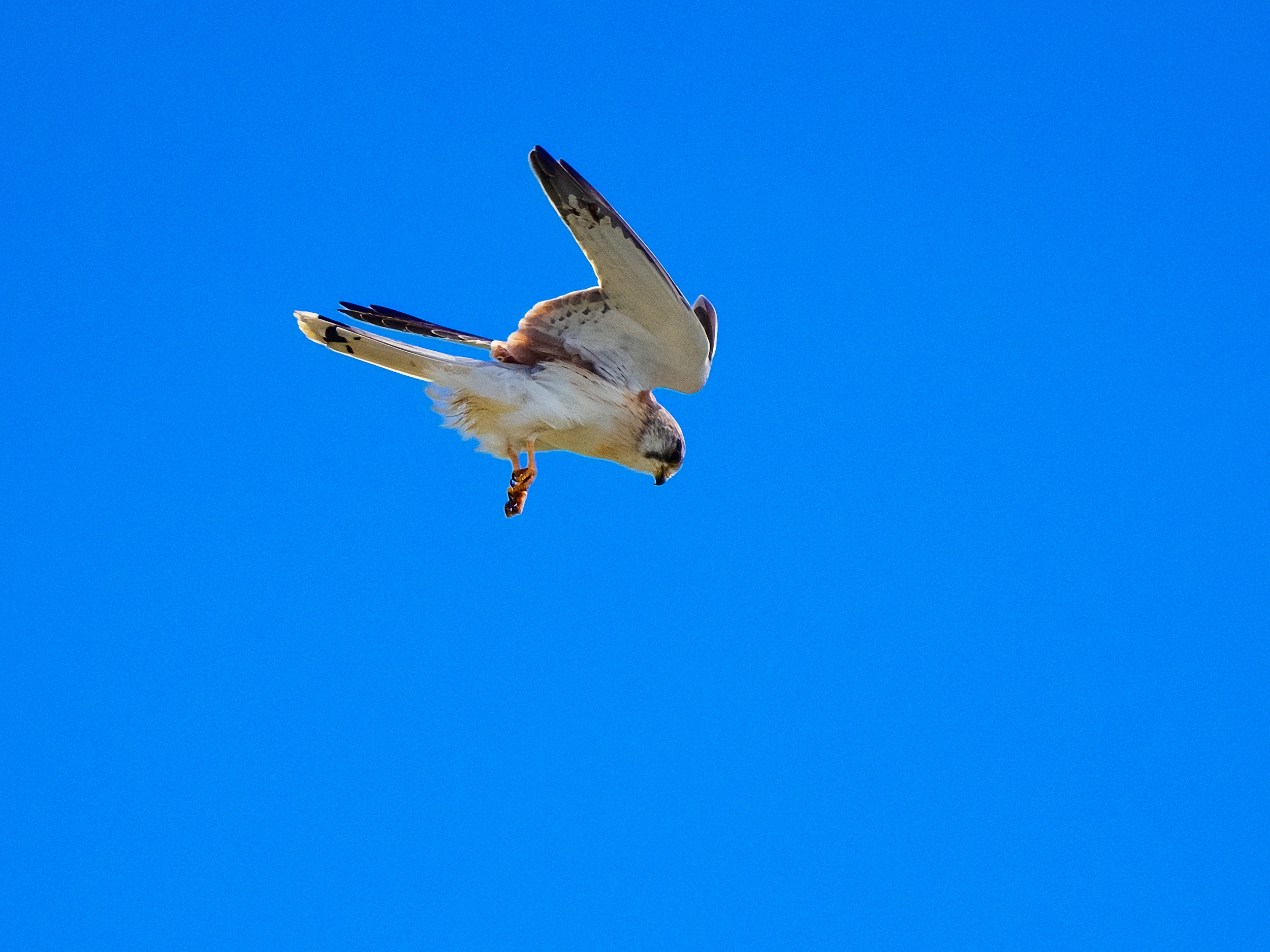
The Nankeen Kestrels have been spending a lot of time on out TV aerial and the power pole on the street. They largely just sit and watch the paddock opposite. Occasionally they are digesting a recent meal. Every now and again we are treated to display of aerial acrobatics where the kestrel will hover over a spot and watch it carefully before diving at great speed to take its prey.
Nankeen kestrel (Falco cenchroides cenchroides), York, Western Australia.
Prey sighted now dive! Nankeen kestrel (Falco cenchroides cenchroides), York, Western Australia.
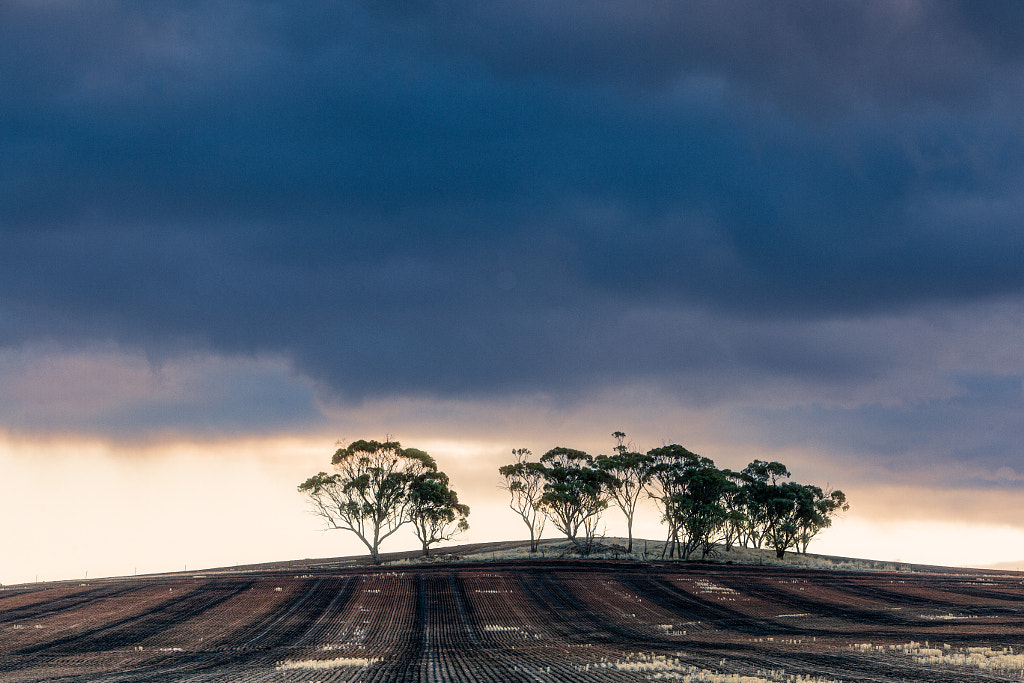
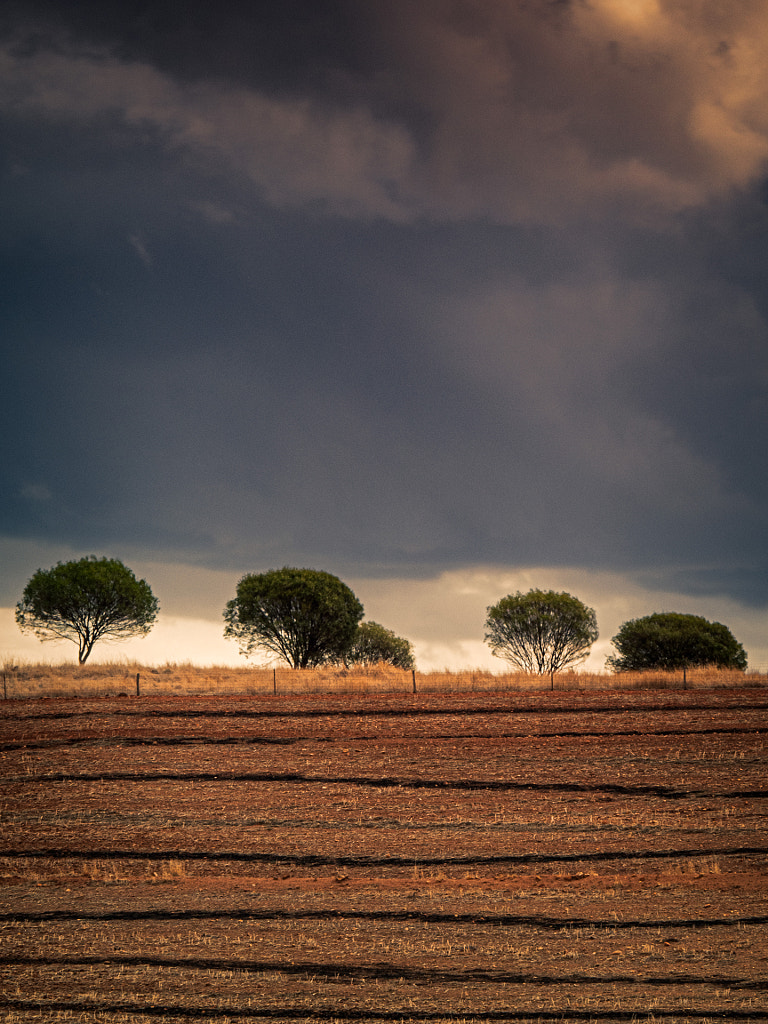
The Autumn burn off in the fields of the Western Australian Wheatbelt has left its distinctive stripes on the landscape.
Thought I’d put up a couple more pictures of the stripes fields we’ve got round our way. They won’t be around for much longer as we have had the first real rains and there will soon be a green flush that will change the colour of the landscape.
I must say it’s been quite nice to do some landscape photography again. I decided to go all retro and pull out the Cokin filters and a couple of older cameras. The top photo was taken with a Canon 6d and the Canon EF 70-200mm f2.8 IS L Mk I which completed the old school experience. The photo below was shot on the Olympus EM1 Mk i. They may not be the latest and greatest cameras and lenses but they still deliver
I like the changes in the seasons and particularly look forward to the arrival of autumn. In fact spring and autumn are what living here are all about – fantastic weather with near perfect temperatures.
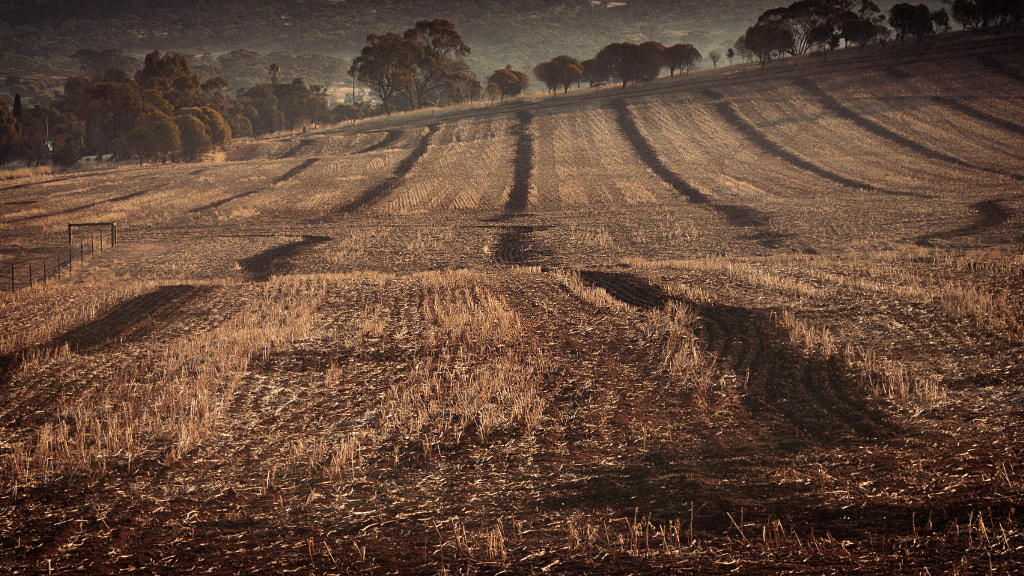
The Autumn burn off in the fields of the Western Australian Wheatbelt has left its distinctive stripes on the landscape.
The farmers have launched into a frenzy of activity – the fields are being burnt in preparation for the next crop. They are hoping that the war in the Ukraine and the sanctions against Russia will bring about record wheat prices. That optimism is being tempered by rising costs of fuel, fertiliser and pesticides. As usual for this time of year the valley fills with palls of smoke leading to some spectacular sunsets.
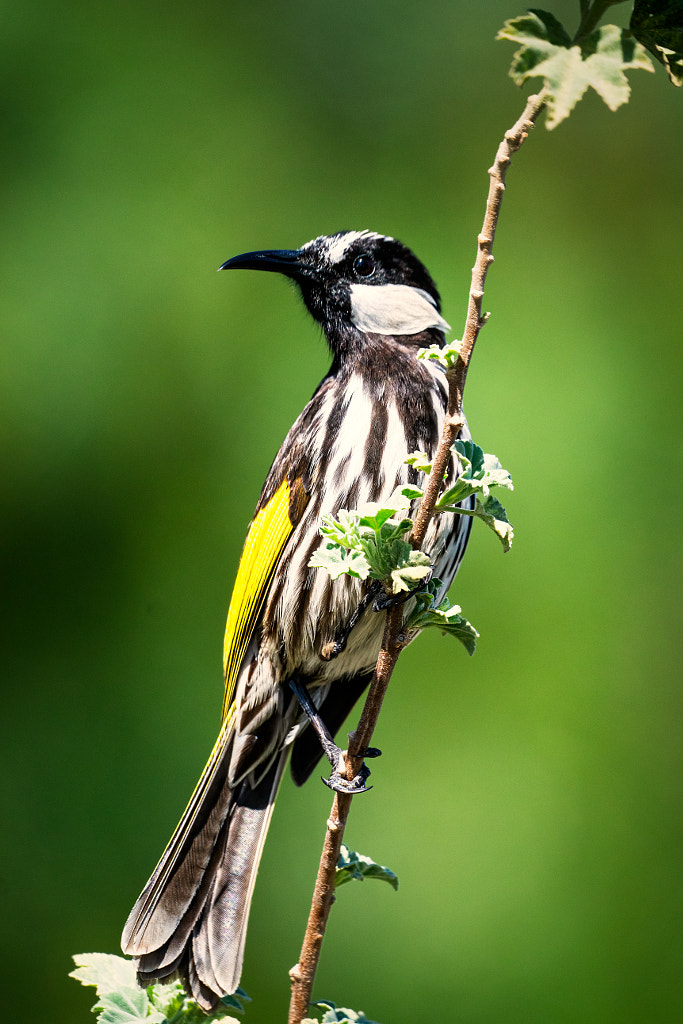
In the garden the bob tailed lizards are nowhere to be seen. While they don’t exactly hibernate they go into torpid state where they hide up and live off the fat reserves in their tails. The white browed babblers have upped sticks and moved to another garden and the only real activity is coming from the white-cheeked honeyeaters. They had a bit of a population explosion over summer so there are lots of adolescents chasing one another around the garden. This has led to some spectacular demonstrations of flying with some very close calls with windows and near misses while dodging around the rear veranda. Just as dawn breaks lots of them sit on the fence outside my bedroom window and make a tuneless racket. What they lack in musical ability they make up for with enthusiasm.
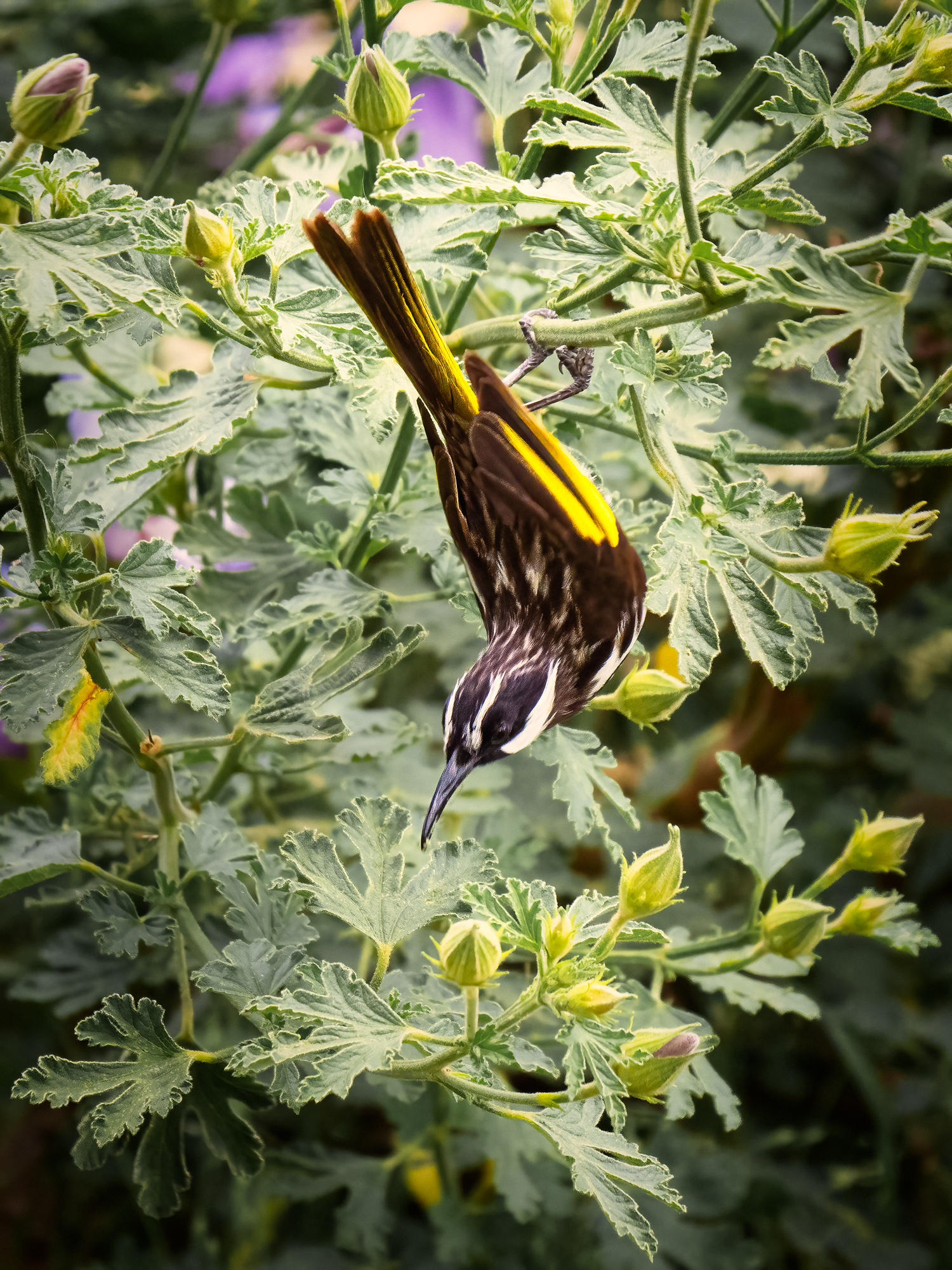
White-cheeked Honeyeater (Phylidonyris niger).
Yes I like autumn it marks the start of more activity out in nature.
White-cheeked honeyeater, Phylidonyris niger. York, Western Australia.
Well we’re at the start of another year. I’d like to think that it’s going to be better than the last two, but that does not seem likely. In another four weeks our borders will open and COVID will come flooding in. Most years we like to plan projects and trips, but this we haven’t as so many things get cancelled due to COVID. My partner and I have decided that the priorities for this next year will be to get the booster shot – not easy in rural Western Australia – and to hole up at home for the duration. Anything that we do undertake will be either based at home or in the locality of York. Last year I started documenting the birds that come to our garden. This next year I’m casting the net wider and am going to include all animals. In fact I’ve already started so here are few photos of our visitors.
A less than graceful landing on the fence by a juvenile Zebra Finch (Taeniopygia guttata). York, Western Australia.
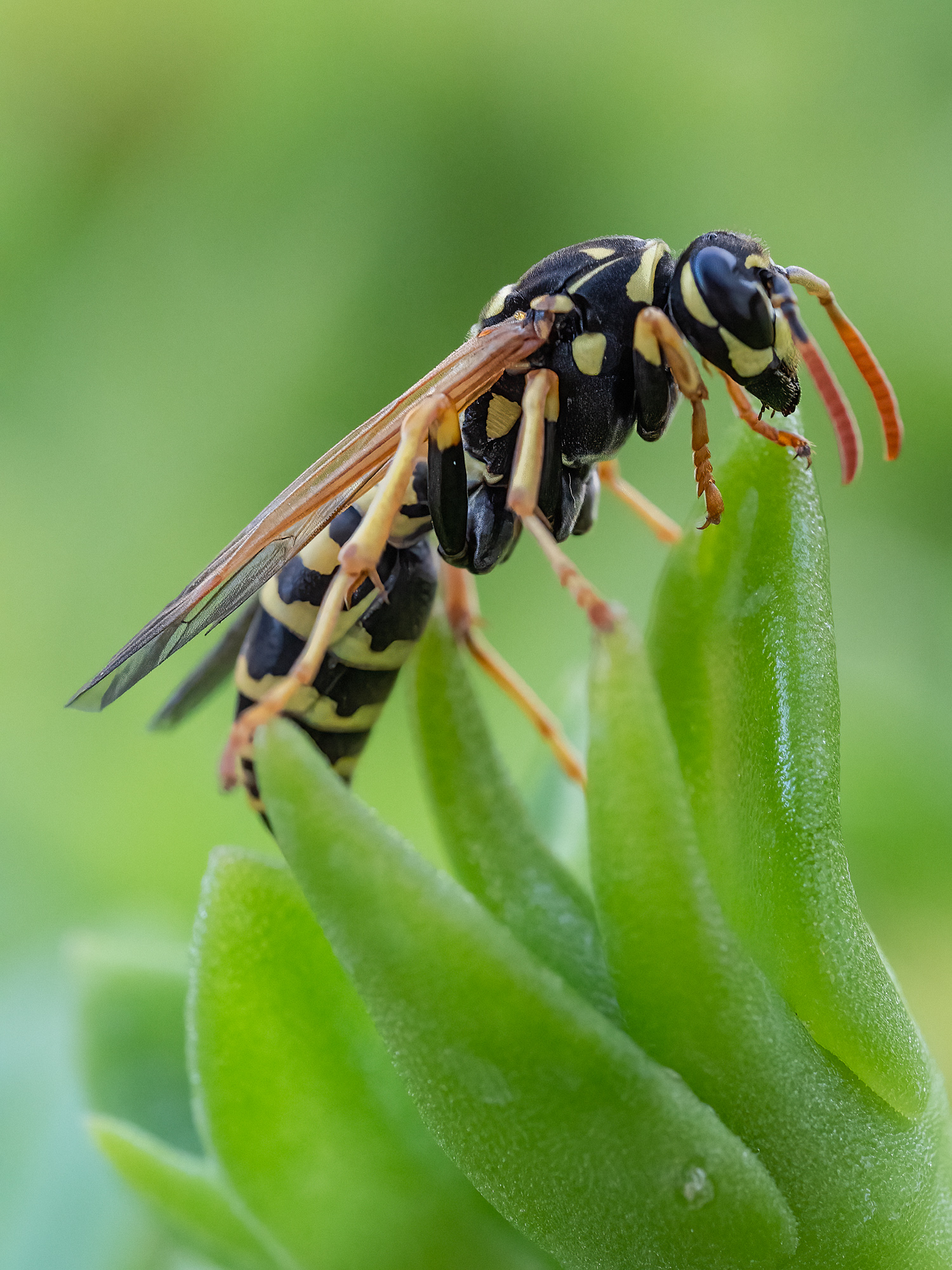
Yellow paper wasp, Polistes dominulus. York, Western Australia.
Feral honeybee (Apis mellifera) feeding on sap from a Brazillian Peppercorn tree (Schinus molle). York, Western Australia.
Blue ringtail damselfly, Austrolestes annulosus. York, Western Australia.
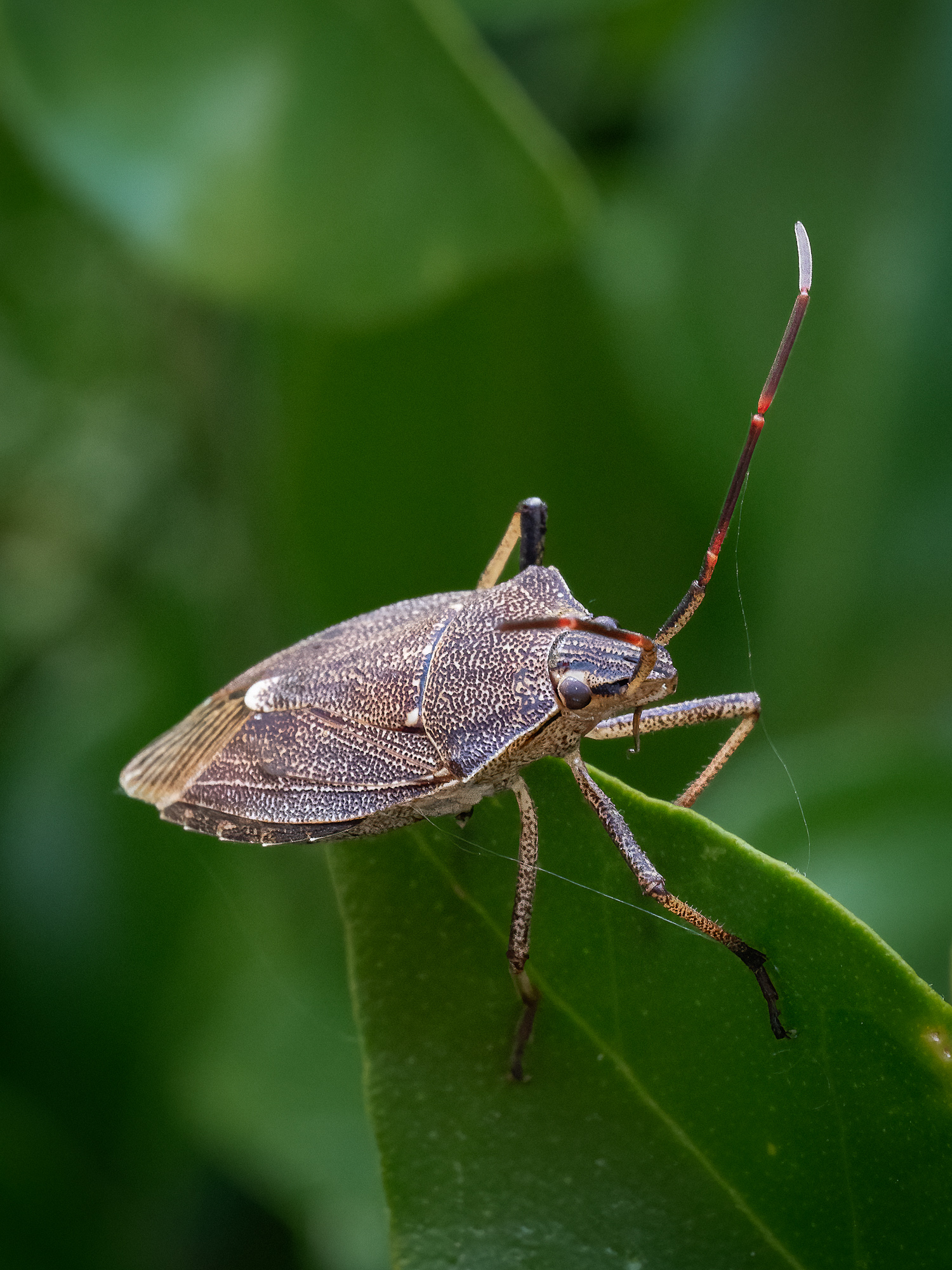
Gum tree Shield Bug (Poecilometis spenceri) aka stink bug. York, Western Australia.
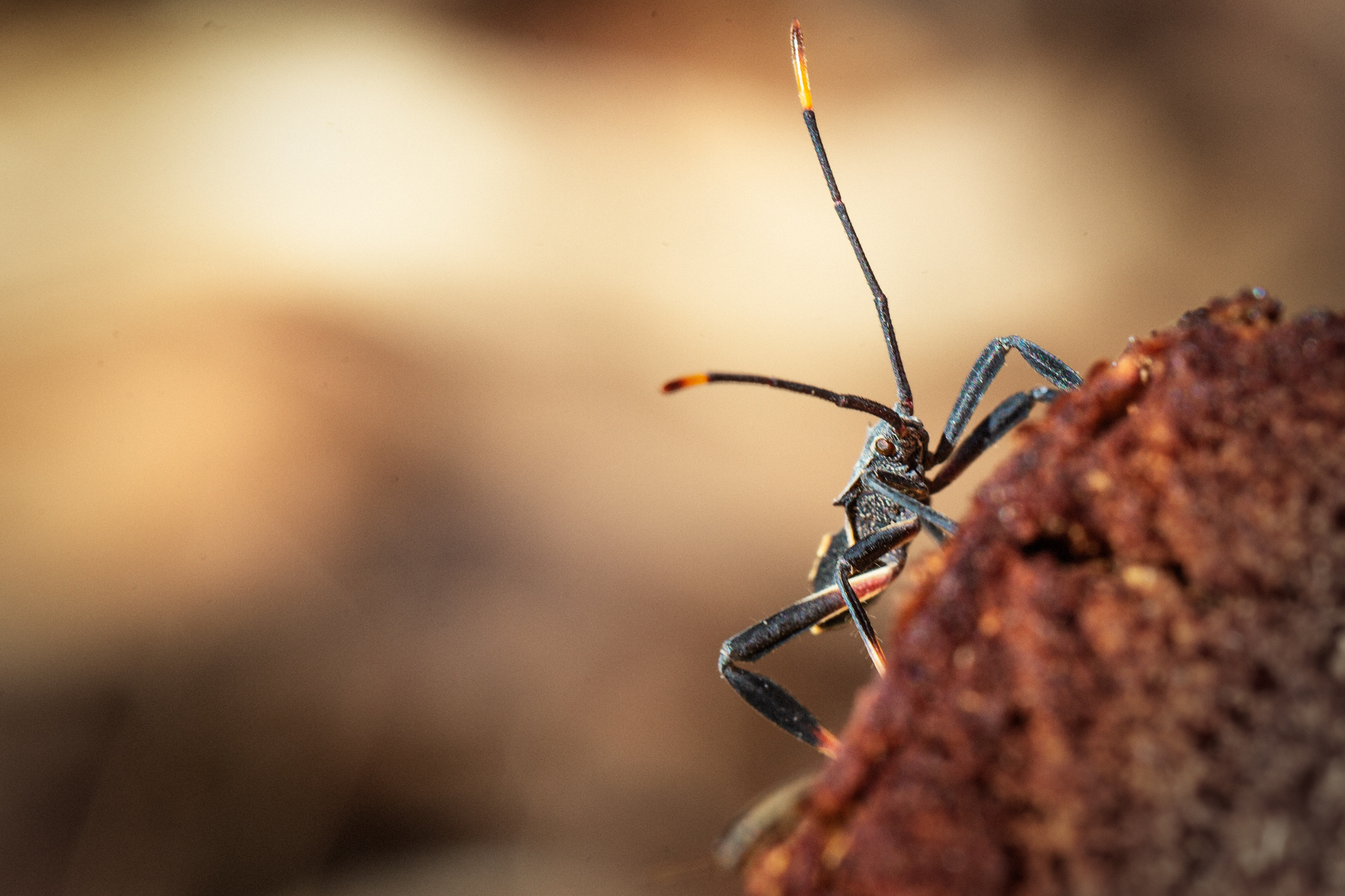
Crusader bug (Mictis profana) instar nymph. York Western Australia.
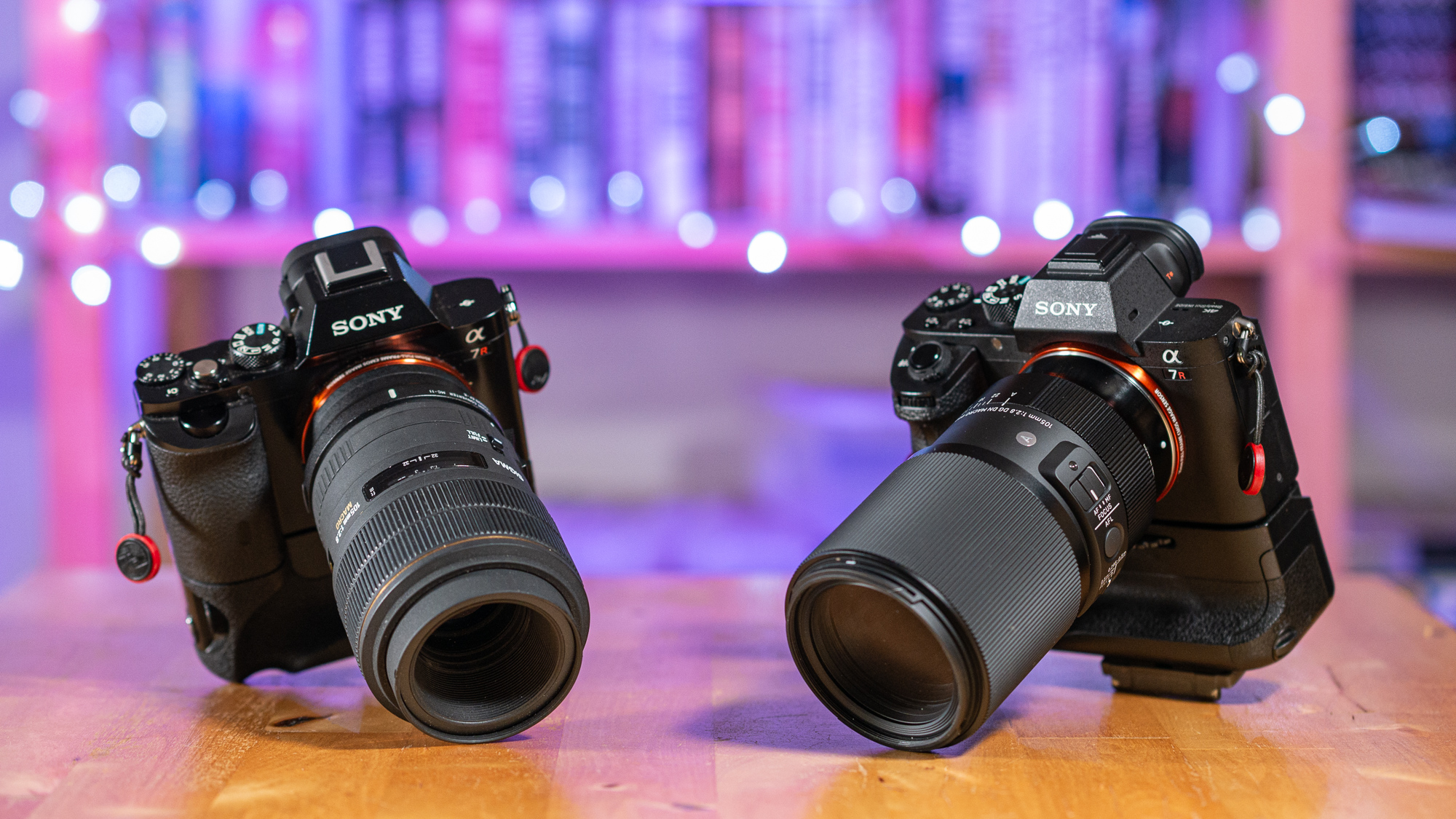
The Sigma 105mm f2.8 EX macro compared to its newer variant the Sigma 105mm f2.8 DG DN macro lens. Both lenses have their lens hoods attached.
Back in the annals of time, well 1999 to be precise, Sigma released the Sigma 105mm f2.8 EX Macro lens. Twenty one years later they released the Sigma 105mm f2.8 DG DN Art Macro lens. So let’s see what has changed in macro lens design.
As always click on the images to see them larger.
TLDR
.
Physical Attributes
Sigma 105mm f2.8 EX Macro
The Sigma 105mm f2.8 EX macro lens in Canon EF mount. The lens has no weather sealing.
As I said above this lens was introduced back in 1999 and it was well received by reviewers and users alike. In fact it cemented Sigma’s reputation for producing excellent macro lenses. One of my photography lecturers reckoned that this was one of the best lenses he’d used so I bought the lens new in 2003 to use with my then Canon EOS 3 and 30 and it remained in regular use until 2016. I’ve used it for macro, product shots, still life, portraits, fine art reproduction and copywork and of course close ups of flowers.
The lens was designed with film use in mind and was made available in the following mounts:
Canon EF
Minolta A
Nikon F
Pentax K
Sigma SA
Pick up the lens and it feels very well made. It is light by modern standards but it has a nice heft to it. The lens barrel is metal – none of your plastic composites here – and the lens mount is a chrome plated brass affair. The front lens element is recessed 25mm into the lens barrel and it is ribbed to prevent reflections and acts as shallow lens hood. Combine it with the included metal lens hood and it is virtually impossibleto induce flare. The lens hood screws firmly into place on the lens’ front filter thread and is threaded to take 77mm filters which is a neat idea as it makes it possible to quickly attach filters without having to take the lens hood off.
The finish is the peculiar matt black finish that Sigma had for all their EX range of lenses with a gold ring at the end of the focus ring and the text done in a mixture of white and gold. The focusing ring is 35mm wide and has ribbed rubber to aid grip. In autofocus mode the ring spins freely, but pull that ring back and flip the AF switch and it has a nice smooth 270º throw taking you from infinity to 31cm. The lens barrel extends as you focus closer by 50mm and there are magnification scales marked on the barrel extension for both manual and auto focusing. This means you can quickly set the lens to a desired magnification ratio. It is to my mind still one of the best implementations of manual focus on an autofocus macro lens. The lens motor makes quite a bit of noise and it can’t be called quick by any stretch of the imagination, however, macro lenses are not noted for their speed of use.
The Sigma 105mm f2.8 EX macro lens at full extension to give 1:1 magnification. Note the magnification ratios marked on the lens barrel. This makes manual setting of the lens for specific ratios a breeze.
Behind the focusing ring is a clear panel over a focusing scale in both feet and metres. There are two switches on the right side of the lens. The first is a focus limiter which speeds up auto focus by preventing the lens racking back and forth through the whole focus range. The second switch is the previously mentioned focus mode switch. Both are very positive in their action.
Sigma 105mm f2.8 DG DN Art Macro Lens
Sigma’s 105mm f2.8 DG DN macro lens attached a Sony A7Rii.
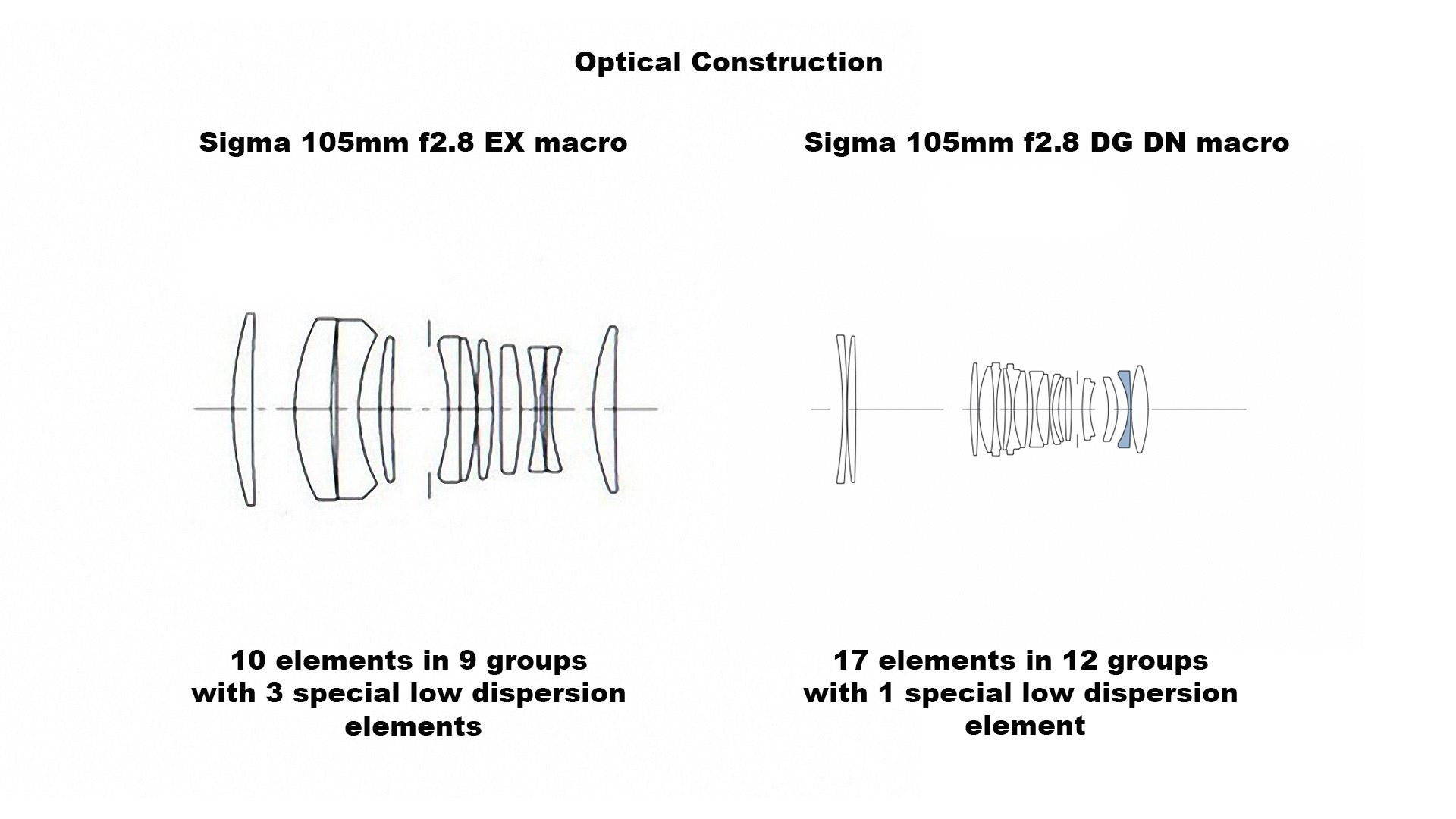
Announced in September 2020 the DG DN is available in Sony FE and Panasonic/Leica/Sigma L mounts. It is part of Sigma’s Art series and so shares the same gloss black finish with understated white graphics and lettering. No 1990’s gold bling here, just a minimalist workman like appearance. The body is a combination of metal and Sigma’s Thermally Stable Composite a kind of plastic with thermal expansion properties the same as aluminium. There are a number of ribbed panels to facilitate a secure grip. It’s great to see that Sigma has not abandoned the chrome plated brasslens mount – it’s a proven method and lasts a long time. Pick the lens up and the first thing you notice is the weight. It is very heavy for its size. The 17 lens elements really make their presence felt when compared to the EX’s 10.
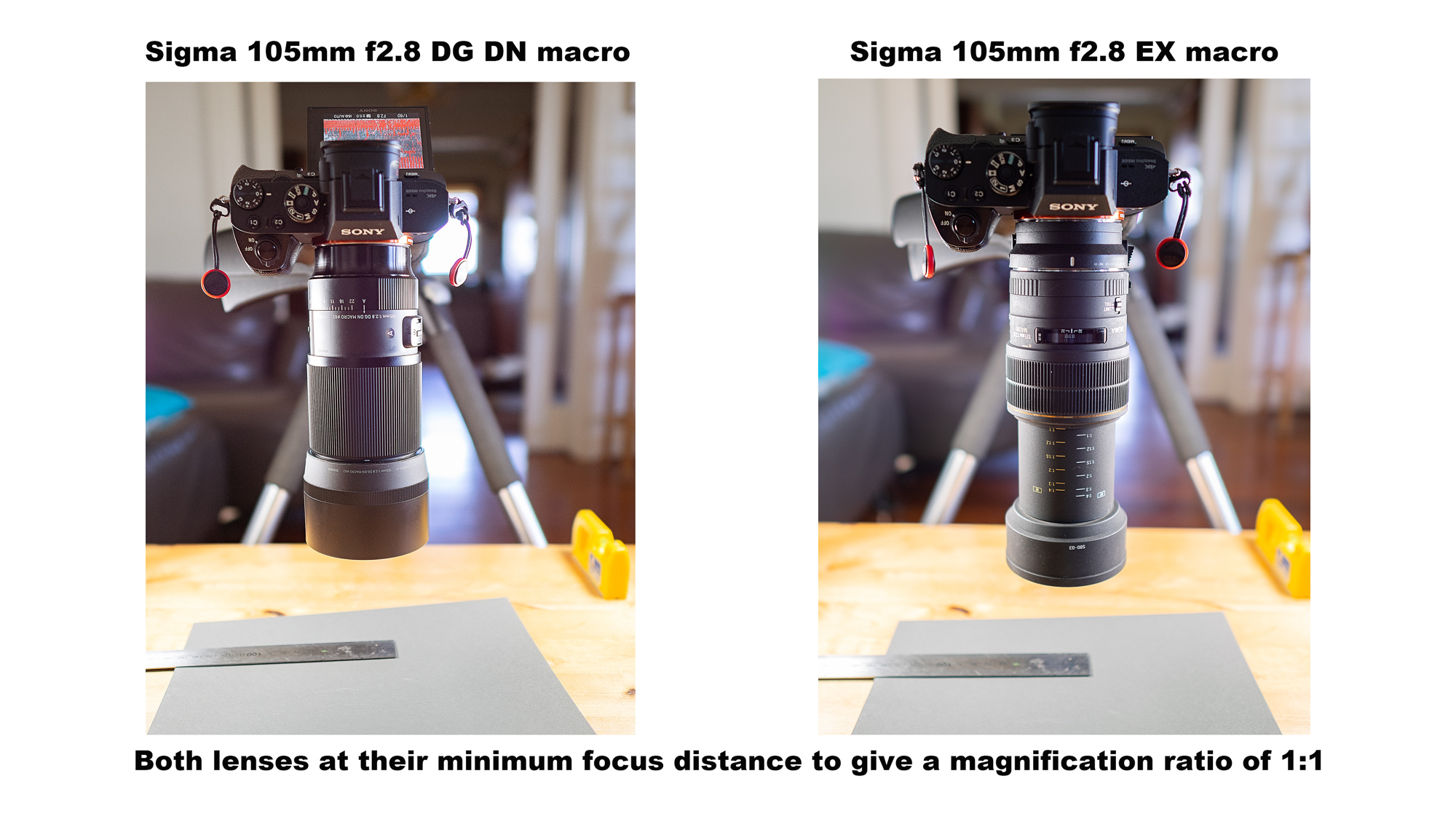
Both lenses are focused at their minimum focusing distance to give a maximum magnification ratio of 1:1. The DG DN focus internally and remains the same length while the EX’s barrel extends.
So weight and appearance aside how else does the DG DN differ from its distant ancestor the EX? Well the DG DN is 40mm longer, but it is important to remember that it is made for mirrorless cameras with a shorter lens flange distance than DSLRs. Put a Sigma MC-11 on the EX and they are virtually the same length. Another difference is that the new DG DN focuses internally – there’s no extending barrel and this will help with the weather sealing. The large ribbed focusing ring is of the fly-by-wire type, there’s no pulling it back to engage a manual focus mechanism. Consequently there are no hard stops and you get no feedback as you focus other than the image in the EVF or on the back panel. Macro photography is an area where you do use manual focus a lot and using it on the DG DN is not a very pleasant or positive experience to my mind.
The controls on the Sigma 105mm f2.8 DG DN macro lens include an AF/MF switch, a reprogrammable focus lock button, a focus limiter switch and a switch to de-click the aperture ring.
There are a lot more controls on the newer lens:-
an AF MF switch
a focus lock button that can be reprogrammed
a focus limiter switch with 3 settings – 0.295 to 0.5m, 0.5m to infinity, full range.
a switch for de-clicking the aperture ring
an aperture ring
a locking switch for the aperture ring
The aperture ring on the Sigma 105mm f2.8 DG DN macro lens. Not only can it be de-clicked it can also be locked in the auto position for those who would prefer to chasnge aperture using camera dials.
The focus limiter switch has three settings. 0.295-0.5m macro, 0.5m to infinity normal range, and a full range option.
So let’s have a quick gander at the specs for both lenses.
Sigma 105mm f2.8 EX Macro lens
Sigma 105mm f2.8 DG DN Art Macro lens
Focal length
105mm
105mm
Angle of view
24º (on full frame)
23.3º
Maximum aperture
f2.8
f2.8
Miniumum aperture
f45 for Canon, Sigma, and Minolta
f32 for Nikon and Pentax
f22
Filter size
58mm on the lens body
77mm on the lens hood
62mm
Stabilisation
No
No
Maximum magnification
1:1
1:1
Minimum focusing distance
31cm from the film plane
29.5cm (from the sensor plane)
Focusing modes
Auto and manual
Auto and manual
Optical construction
10 elements in 9 groups with 3 special low dispersion elements
17 elements in 12 groups with 1special low dispersion element
Aperture blades
8
9 (rounded)
Weather sealing
No
“Dust and splash proof construction”
Weight
456g (Canon EF mount)
710g
Dimensions
95mm (h) x 74mm ⌀
135.6mm (h) x 74mm ⌀
Optical Performance
Sharpness
A comparison between the 1999 Sigma 105mm f2.8 EX macro lens and the 2021 Sigma 105mm f2.8 DG DN macro lens. Aperture: f 2.8
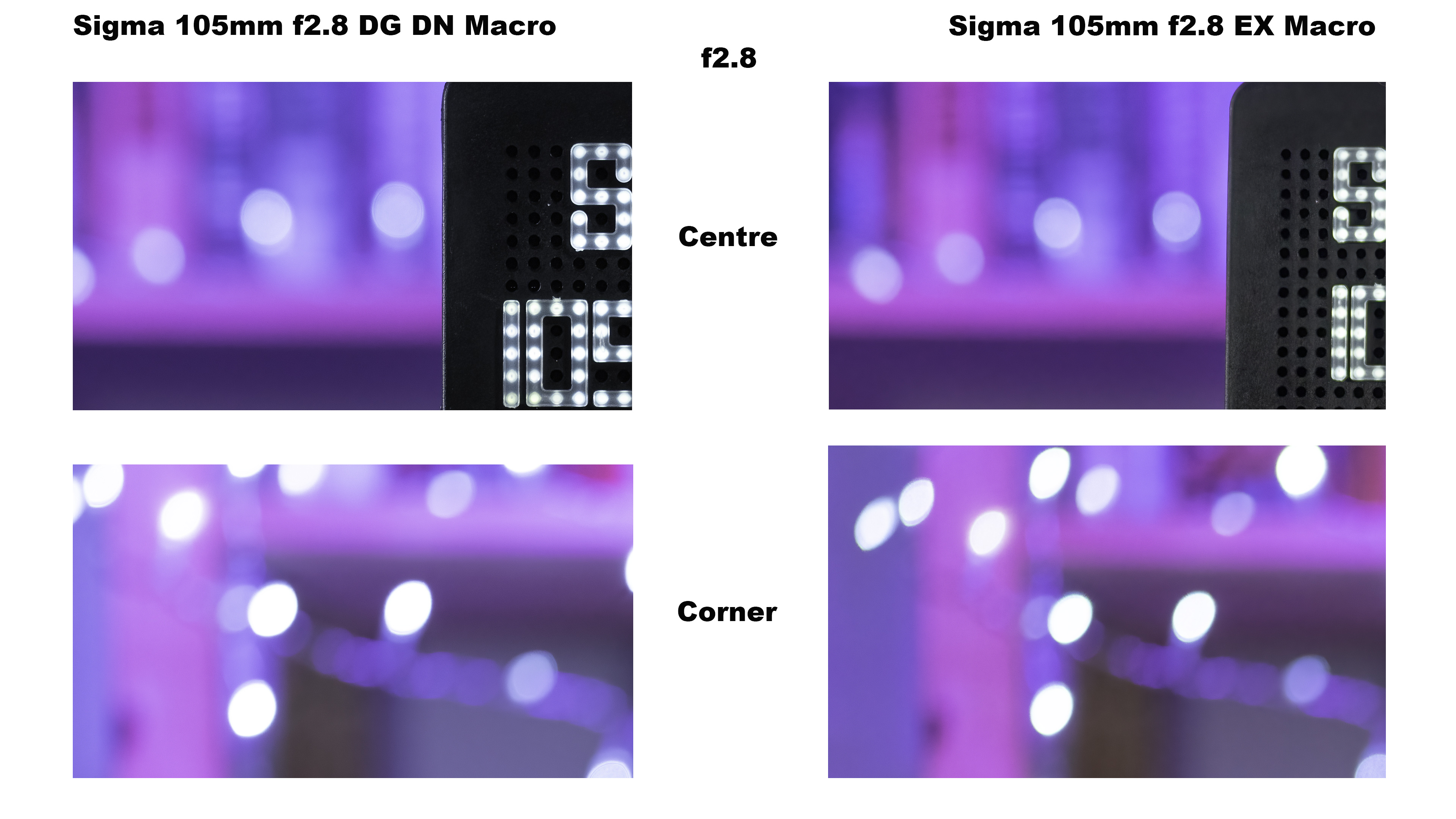
This is where we really start to what has changed in terms of lens design over the years. Wide open at f2.8 the DGDN is sharper and more contrasty in the centre of the frame. The corners are sharp but the contrast is lower. The EX on the other hand is softer and has less contrast in the centre and the corners are not only softer but display prominent chromatic aberration and have a warm tinted vignetting. Older Sigma lenses were known for having a warmer look than other brands and it is clearly visible.
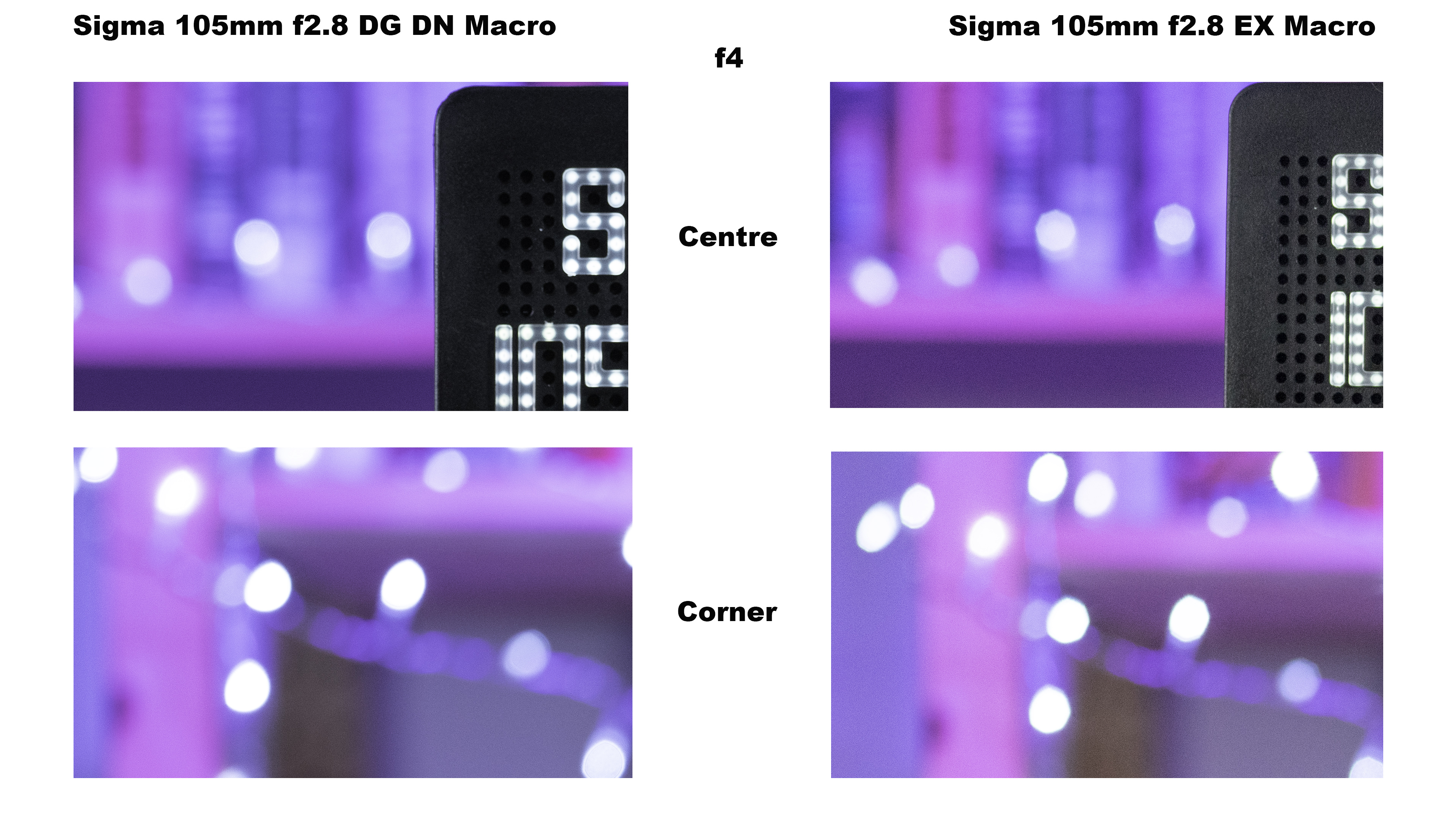
A comparison between the 1999 Sigma 105mm f2.8 EX macro lens and the 2021 Sigma 105mm f2.8 DG DN macro lens. Aperture: f 4
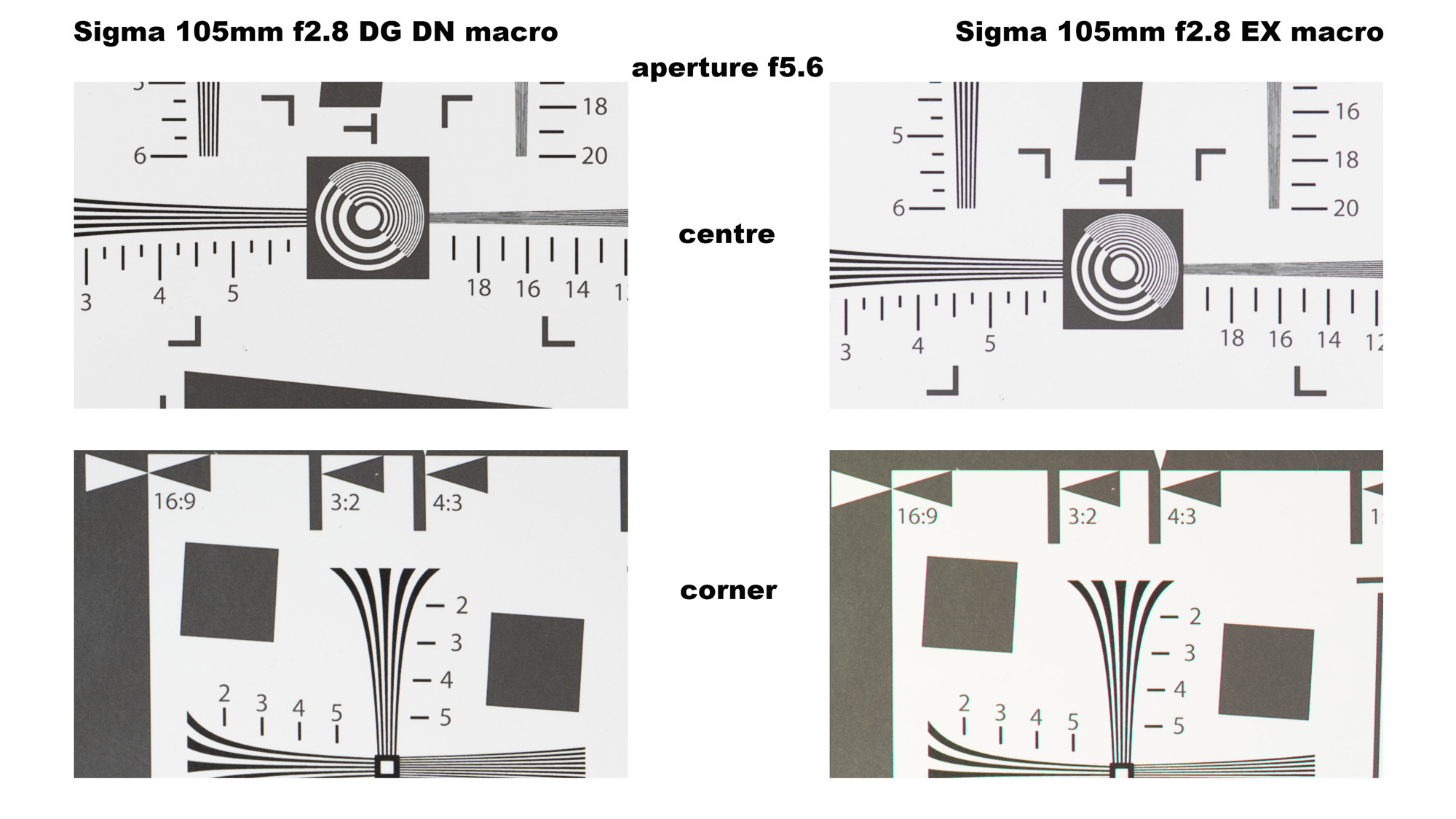
A comparison between the 1999 Sigma 105mm f2.8 EX macro lens and the 2021 Sigma 105mm f2.8 DG DN macro lens. Aperture: f 5.6
By f5.6 the corners of the DGDN have improved considerably and the centre is even sharper. The centre of the frame for the EX has improved but not to the same extent as that of the DGDN. The corners of the EX are still quite soft and still exhibit vignetting.
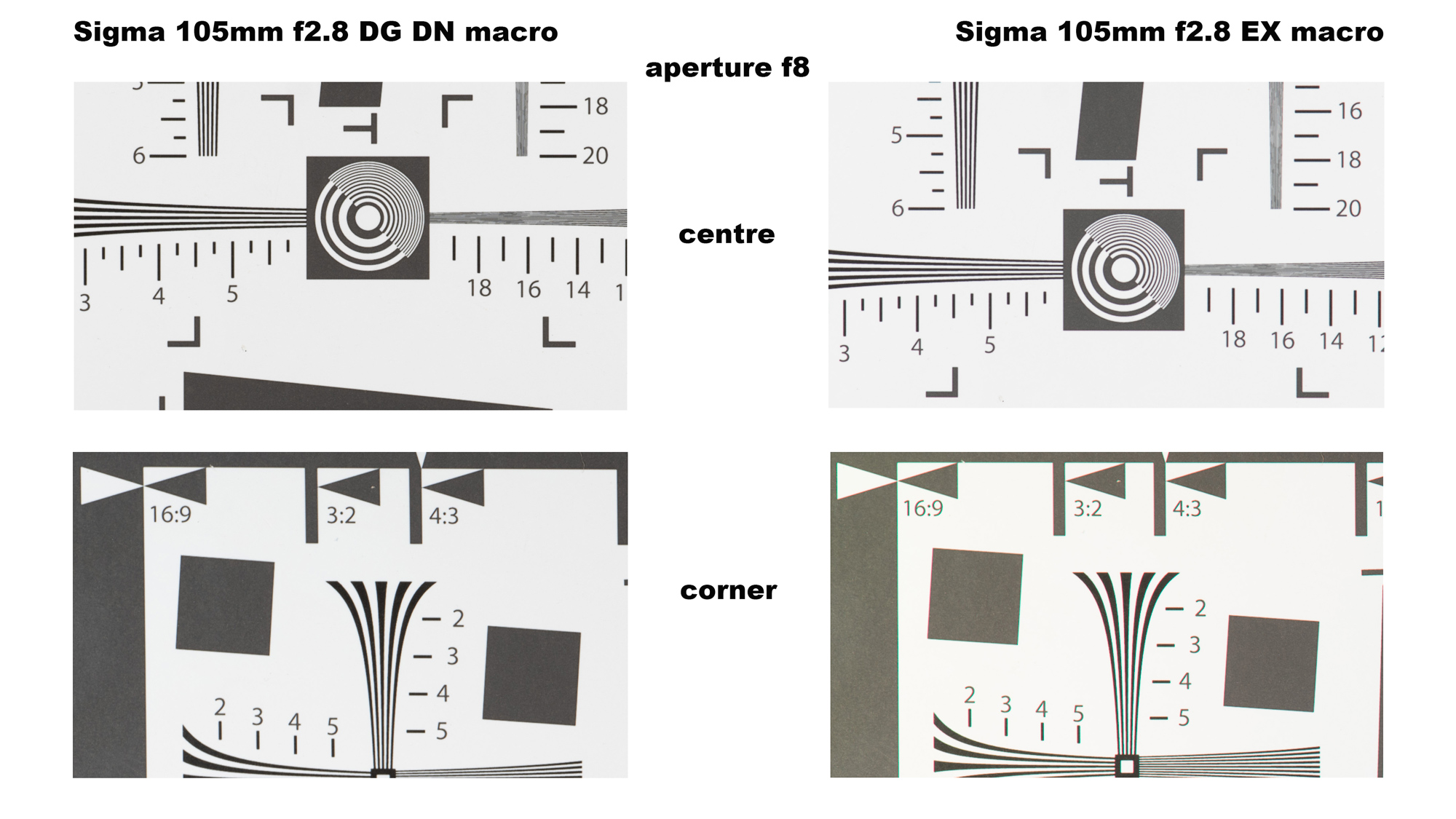
A comparison between the 1999 Sigma 105mm f2.8 EX macro lens and the 2021 Sigma 105mm f2.8 DG DN macro lens. Aperture: f 8
At f8 the DGDN really hits its stride and produces its best optical performance with both the centre and the corners having excellent sharpness and contrast. The EX has reached its best centre performance but it is still not as good as its younger sibling. The corners have improved slightly but vignetting is still present.
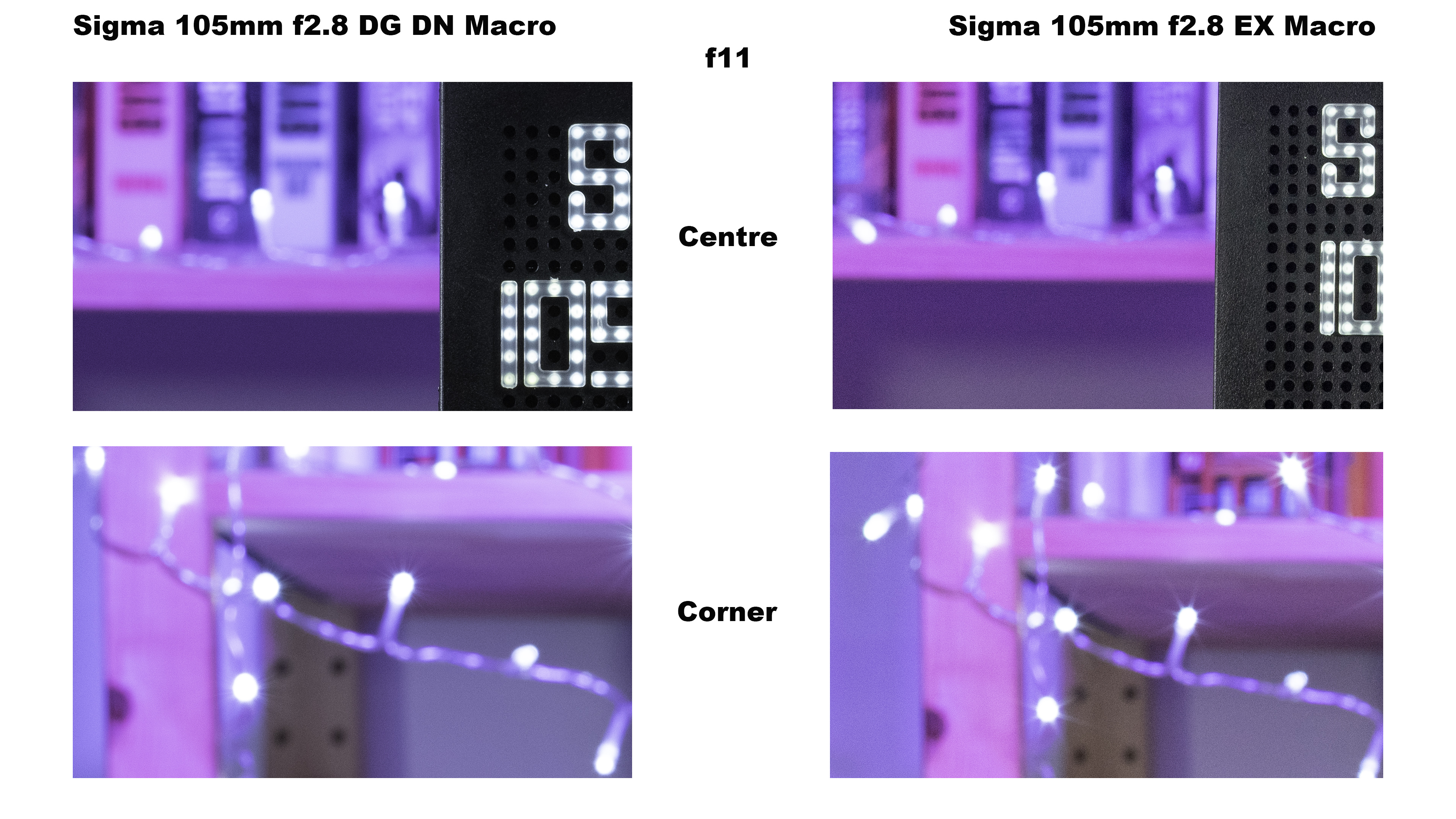
At the aperture of f11 the DGDN’s performance remains the same as it was at f8 in both the centre and the corners of the frame. The EX now turns in its best performance but some vignetting remains.
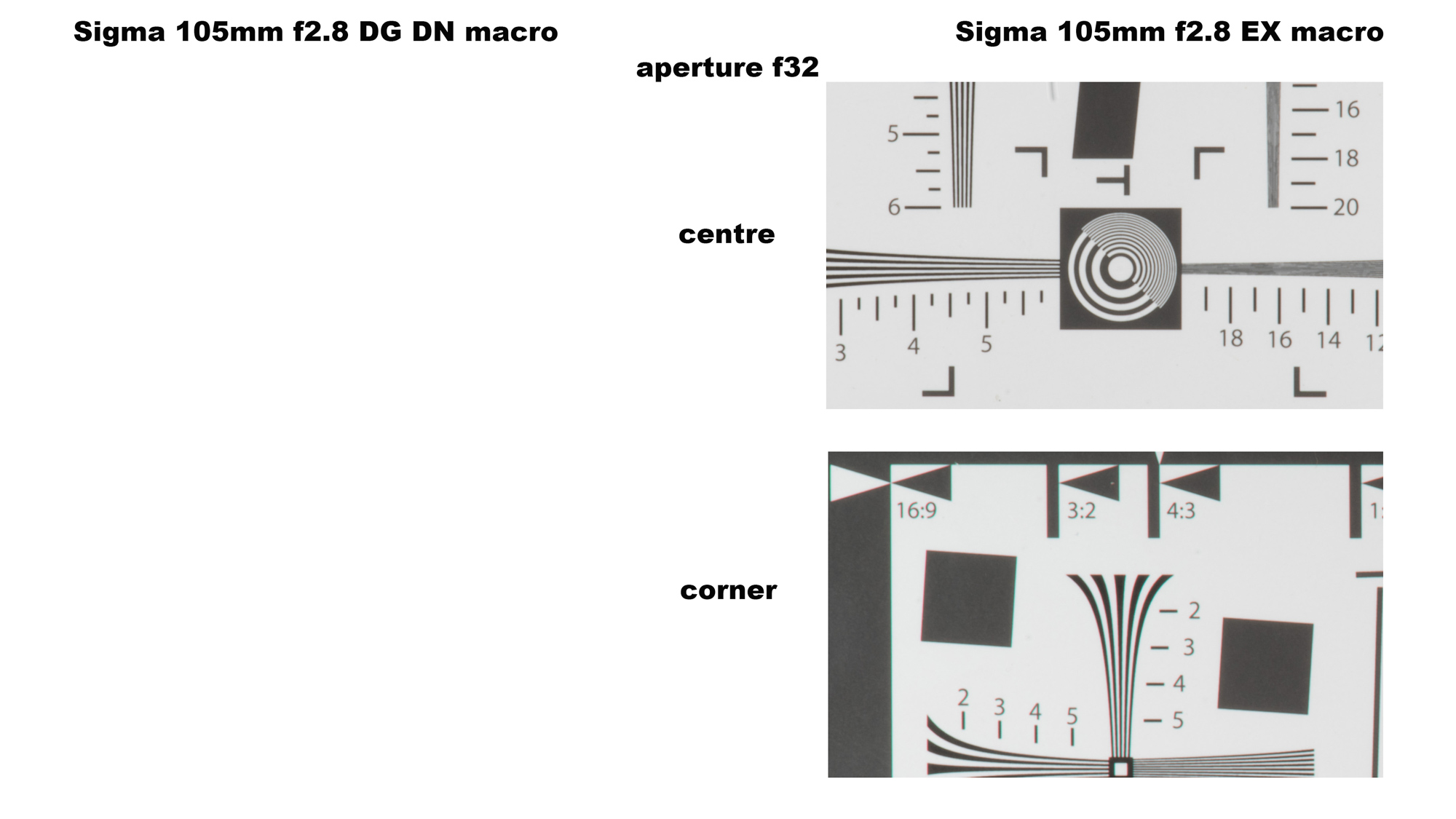
A comparison between the 1999 Sigma 105mm f2.8 EX macro lens and the 2021 Sigma 105mm f2.8 DG DN macro lens. Aperture: f 32
At f16 diffraction is taking effect on both lenses. Interestingly the EX will stop down to f45 but you wouldn’t want to use it as it looks like someone has smeared vaseline over the front lens element.
Chromatic Aberration
Chromatic aberration is the failure of a lens to focus all colours at the same point and there are two types:-
Axial or longitudinal chromatic aberration – this where different wave lengths of light are focused at different distances from the lens. Generally it can be reduced by stopping down thereby increasing the depth of field so that all the wavelengths fall with acceptable focus. This is very hard to remove in post processing.
Transverse or lateral chromatic aberration – different wavelengths of light are focused at different positions in the focal plane. It does not occur in the centre of an image and increases as you move out to the edges. It is not effected by stopping down, but can be removed in post.
The DGDN is exceptional well controlled for both kinds of chromatic aberration and even at magnifications of 200% I could not observe any. The EX is really showing its age here as both types can be seen. The transverse chromatic aberration is very prominent.
Flare
The Sigma 105mm DGDN shows good resistance to flare. In this extreme case we can see some evidence of veiled flasre and a little reflection.
The EX despite having that recessed front element that acts as a de facto lens hood suffers badly from halation, veiling flare, and reflections when specular light sources were in the frame. The DGDN has better lens coatings which means that the halation and reflected glare is minimal and there is no halation. This means that there’s little loss of contrast.
Bokeh
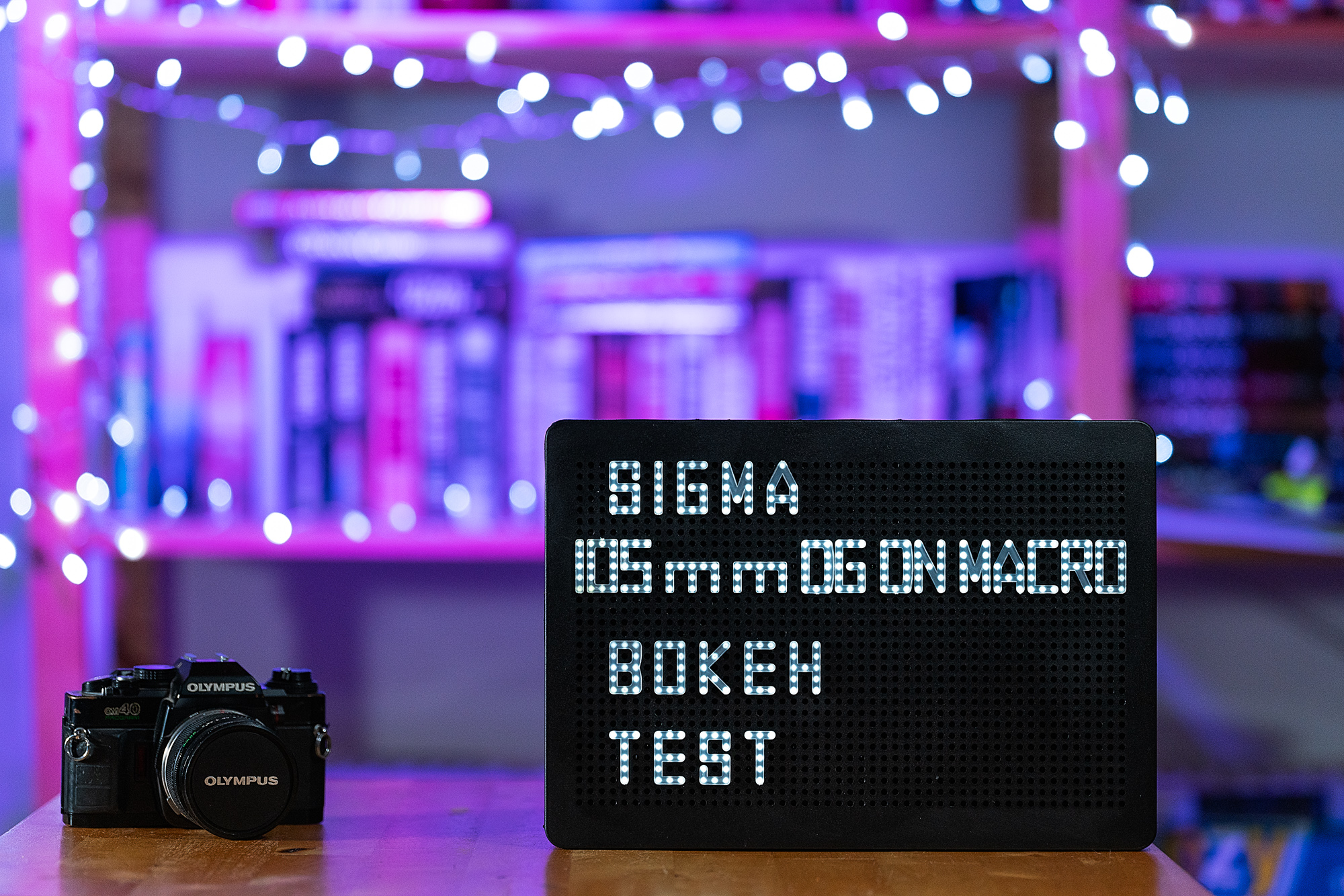
Sigma 105mm f2.8 DGDN Macro lens bokeh test.
Both lenses at f2.8 have nice round bokeh balls in the centre of the frame and at the edges exhibit that elliptical cats eye effect. The tonal transitions are nice and smooth, there is no busyness or swirly effect. At f4 the EX is starting to develop polygonal balls while those of the DGDN are still nice and round. At f11 the bokeh balls in the corners of the DGDN are starting to develop into sun stars and the effect on the EX is more profound. The 9 rounded aperture blades are producing much more pleasing bokeh effects than the 8 straight ones of the EX.
Autofocus
Continuous autofocus with the Sigma 105mm f2.8 mounted on a Canon EOS 6d.
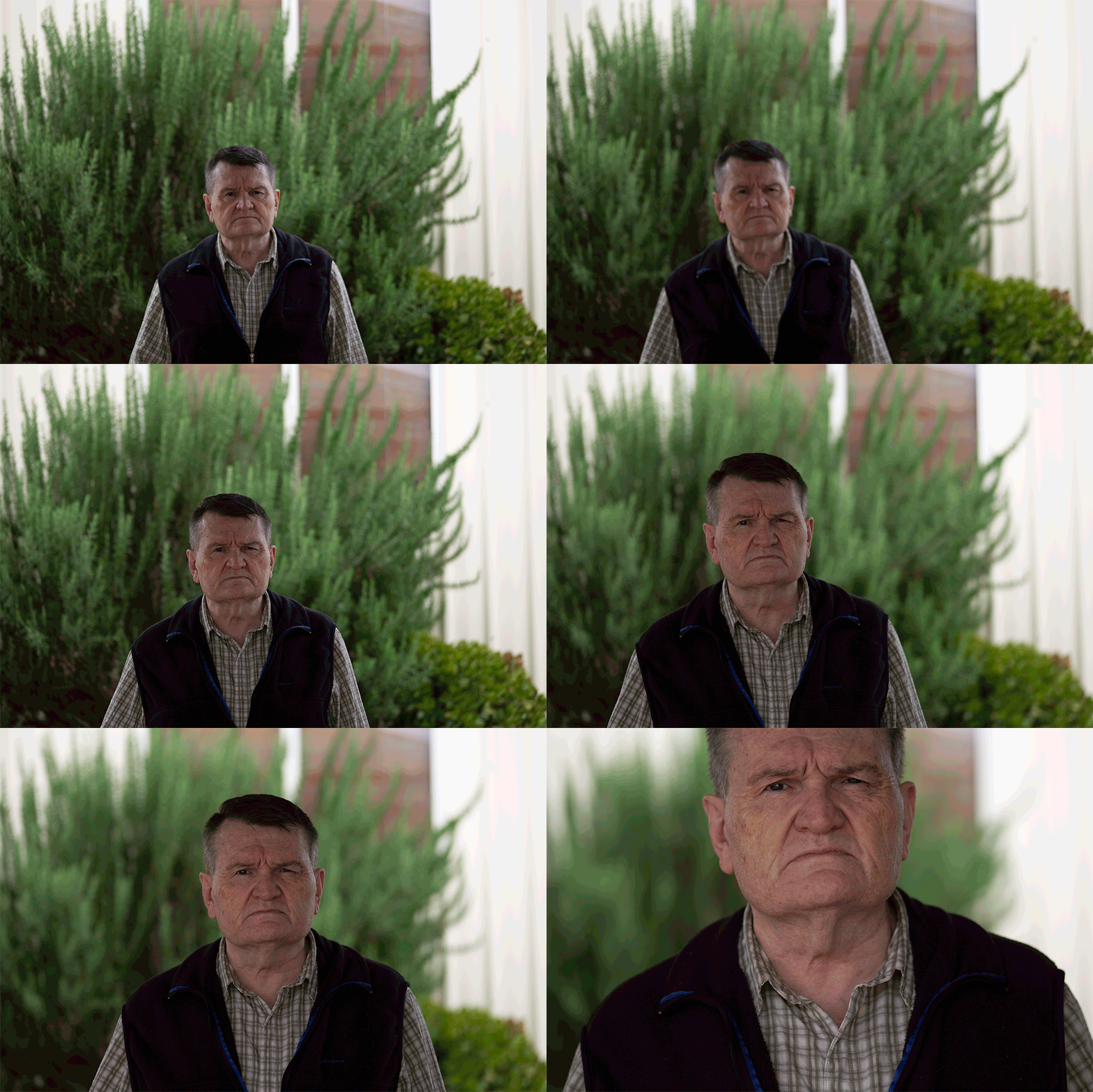
Autofocus is where there has been an enormous improvement in performance over the last 22 years. The EX when mounted on the Sony A7r ii with either the Metabones V Smart Adapter or the Sigma MC-11 just won’t autofocus. When you switch the camera on the lens racks through its entire focus range (depending on where the limiter is set) and then does nothing. So to test the AF performance I had to mount it on a Canon EOS6d which wasn’t known for its blistering AF speed. I shot several sequences with the focus limiter on at f2.8 of me walking slowly towards the camera with it set Continuous AF and obtained a nit rate of between 70-75%. Video AF was a non starter and it just would not find focus. To be fair the CAF of the 6d in video mode is pretty lacklustre. With the DGDN mounted on the Sony A7r ii the stills burst rate for AF averaged out at 94% which is pretty impressive. The DGDN handled the video AF test with aplomb, it was smooth and positive keeping up with me moving about in the frame. The AF was noisy and was picked up by the shotgun microphone mounted in the camera hot-shoe. Speaking of noise the EX was incredibly noisy.
Continuous auto focus using the Sigma 105mm f2.8 DG DN macro lens on a Sony A7rii.
Conclusion
Both lenses mounted on Sony bodies. The EX is mounted via the Sigma MC-11 lens adapter.
This should really come as no surprise, time has marched on and the advances in lens design are easily apparent.The Sigma 105mm f2.8 EX macro was considered a very good lens in its day, and even now it is remembered fondly on photographic forums. The DGDN is just at another level of performance both in terms of optics and auto focusing. The EX while being optically suited to a number of tasks its AF performance let it down when it came to anything that moved quickly or erratically. The DGDN on the other hand can be confidently used as a general purpose short telephoto with a wide variety of subjects as well as being a dedicated macro lens. The only area in which the EX is superior to the DGDN is in the handling department. The manual focusing experience and the ability to pre-set specific magnification ratios makes the lens a joy to use manually. The DGDN is clearly aimed at the autofocus only photographer. A great shame.
So if you have a Sony FE or one of theofferings from the “L mount alliance” then the lens is worth a look at. Well it is your only option in L mount. It is also a worthy competitor to the Sony 90mm f2.8 FE macro OSS G at a cheaper price.
Sample Images
Looking through the Olympus OM Zuiko 135mm f2.8 lens at an Olympus OM 40.
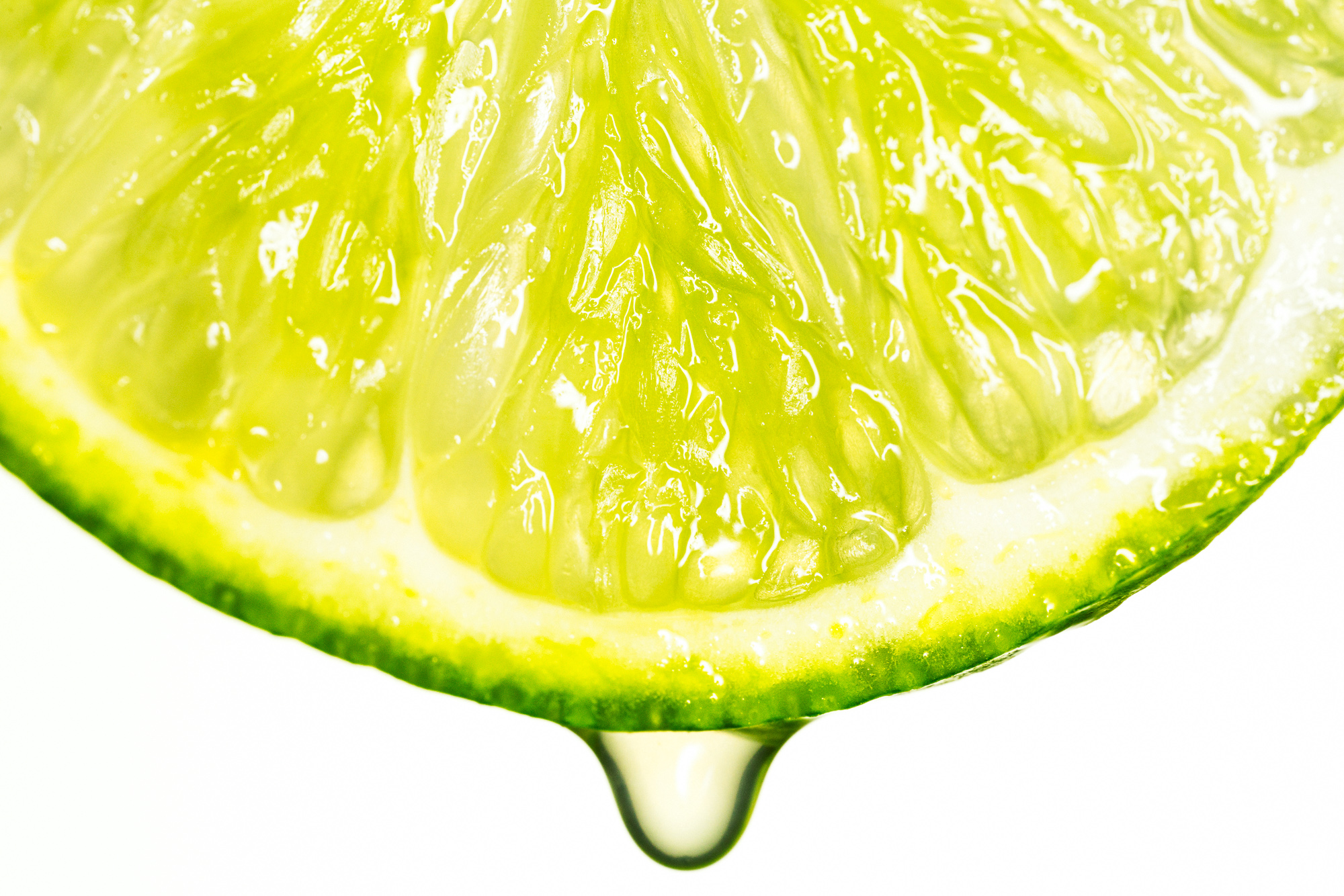
Lime slice oozing juice.
Cream runs down over a strawberry.
Where there’s smoke there’s fire.
Australian one and two dollar coins.
Sigma 105mm f2.8 DG DN Macro lens auto focus test. Auto focus tracking a subject walking towards the camera while the lens is wide open at f2.8.
Darth Vader divided by the light.
Bee feeding on lavender flowers.
A bee feeding on a daisy.
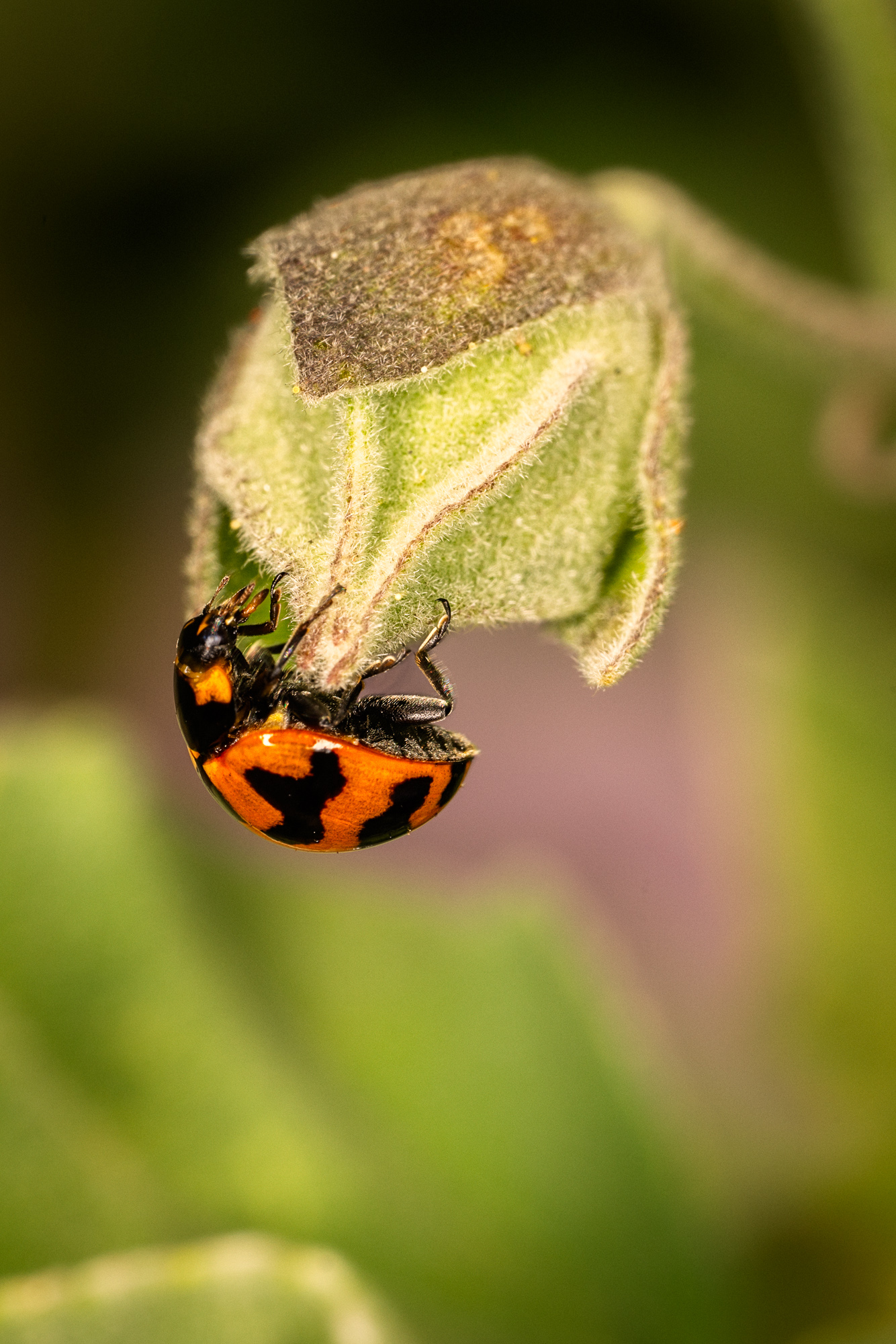
A ladybird looking for aphids.
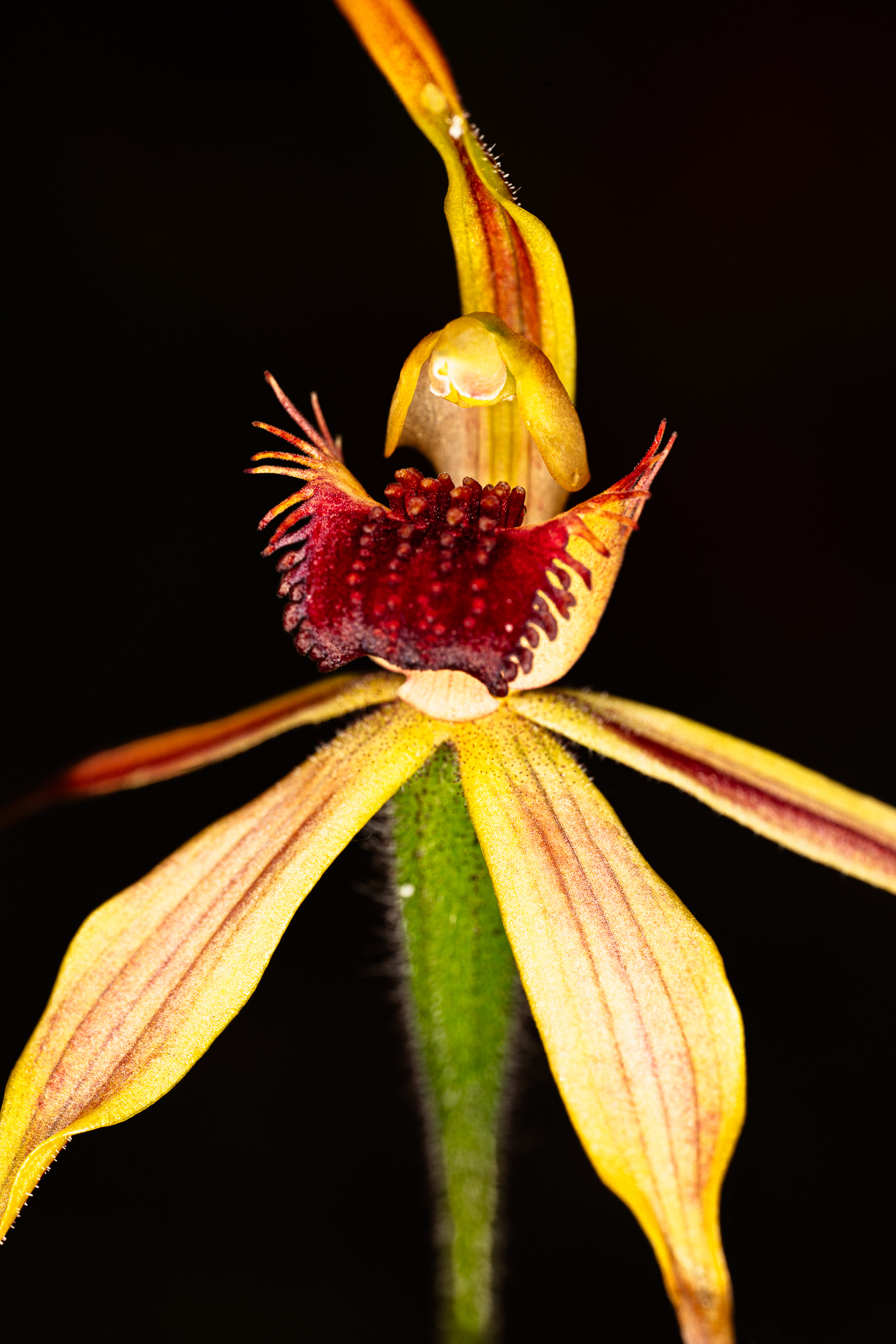
Clubbed Spider Orchid, Caladenia longiclavata. Mount Observation, Western Australia.
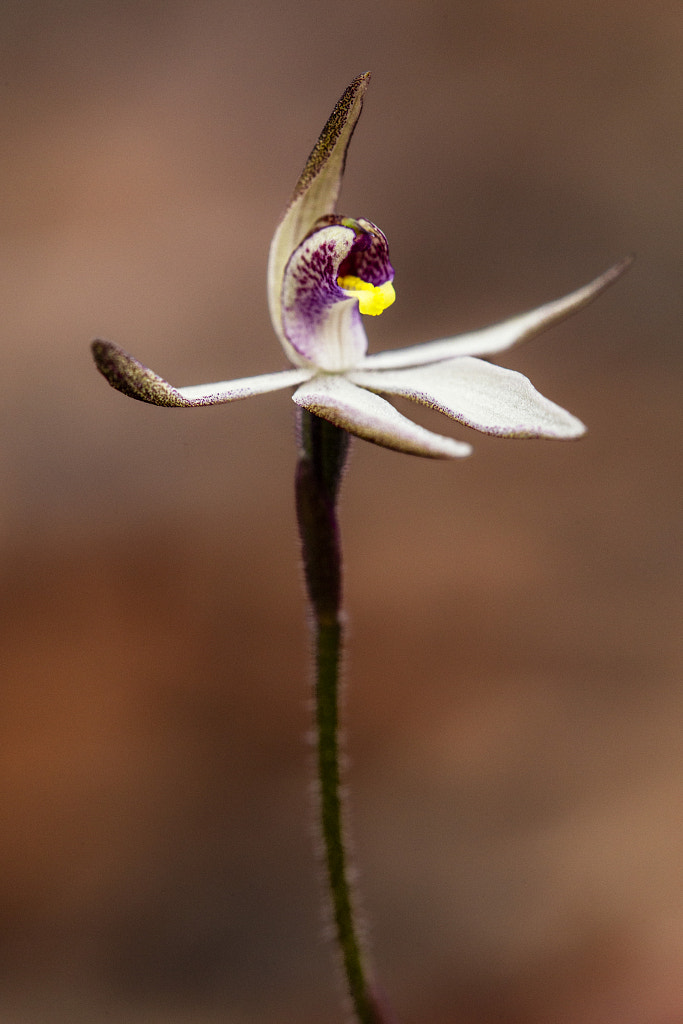
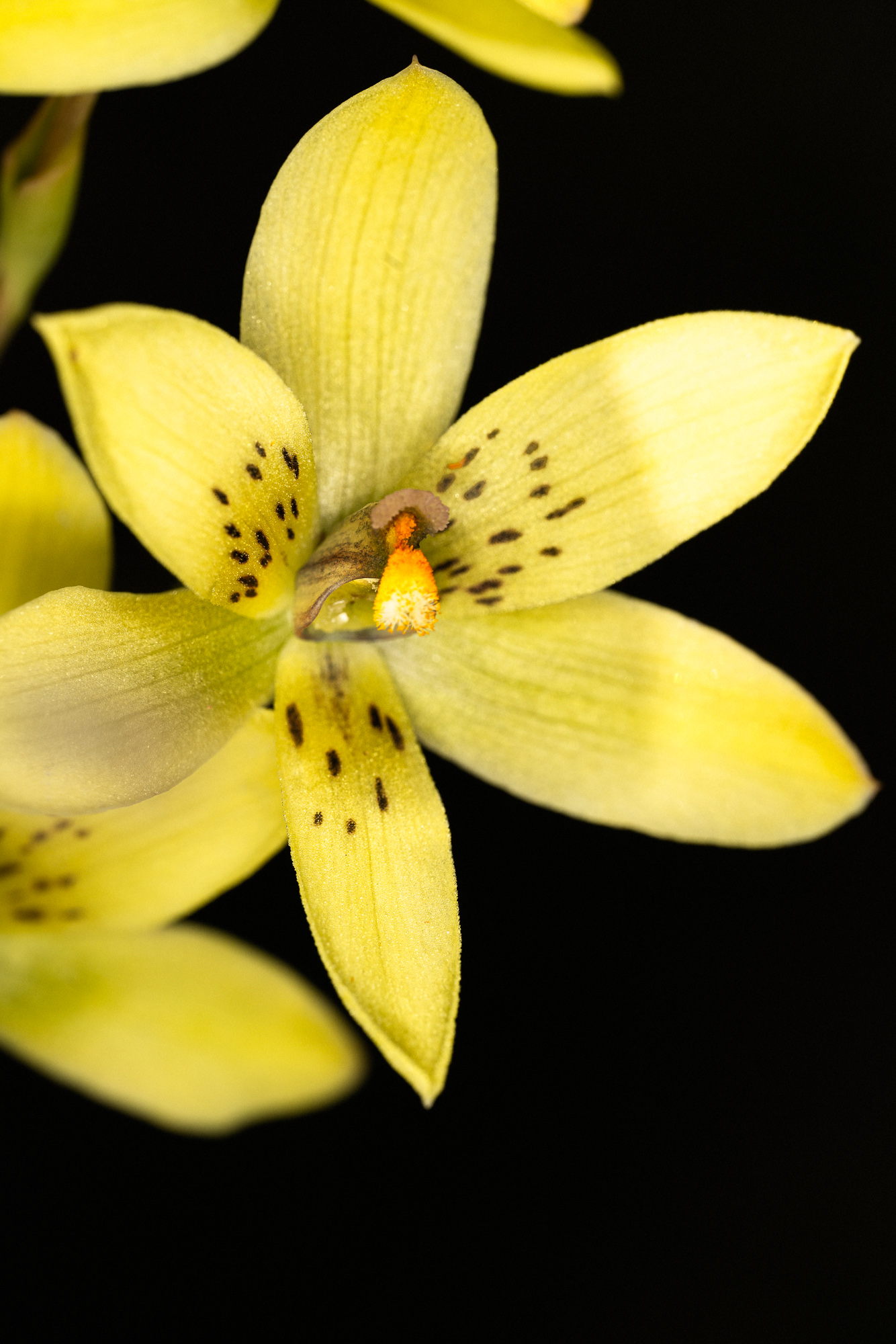
Custard Orchid, Thelymitra villosa. Mount Observation, Western Australia.
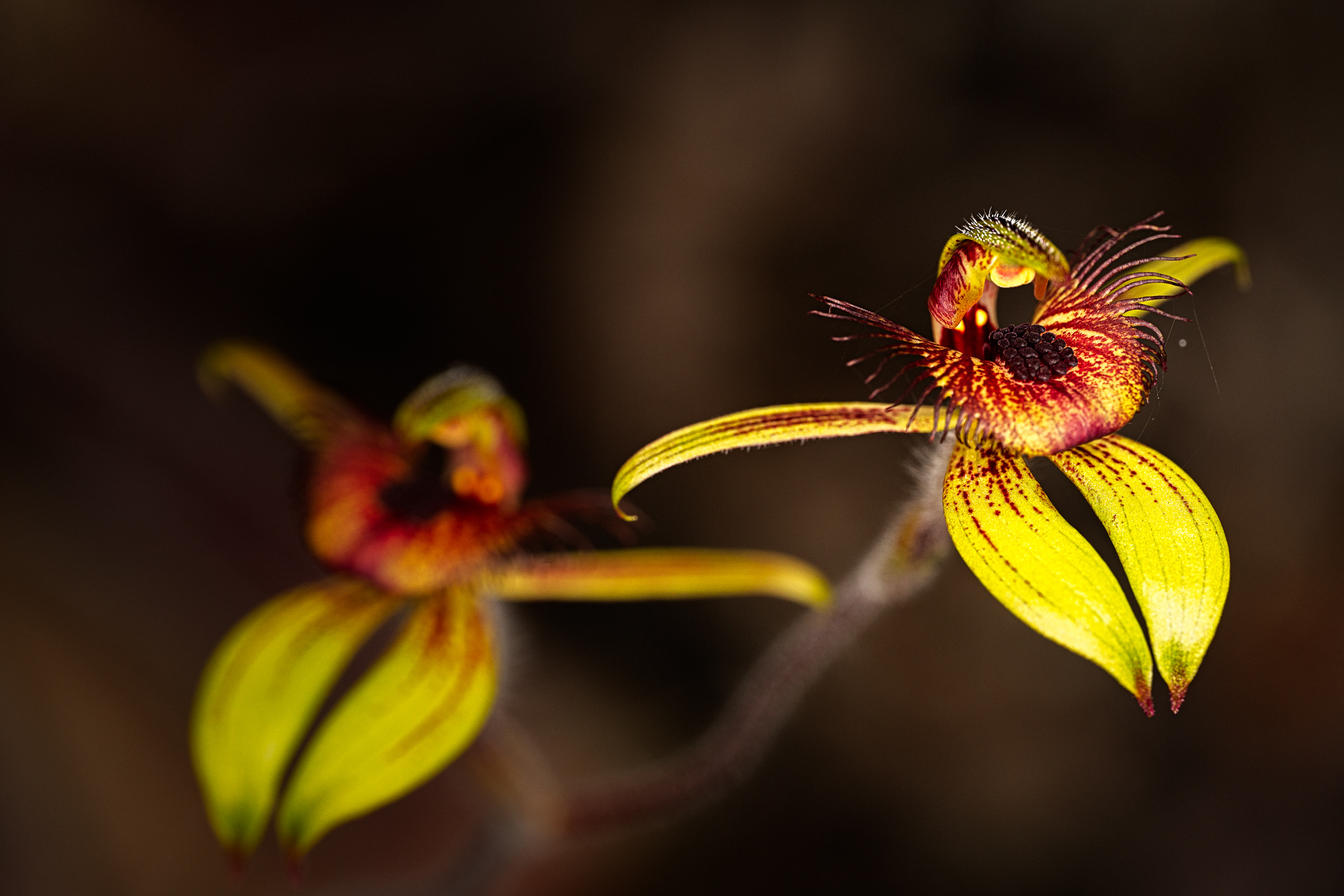
Known by a variety of names the dancing spider orchid (Caladenia discoidea) is also known as the antelope orchid and sometimes the bee orchid. St. Ronan’s Nature Reserve, Western Australia.





















You must be logged in to post a comment.