A visual representation of the differences in sensor size.
Since 2011 I have been primarily a micro four thirds (m43) shooter supplemented by occasional full frame usage. Until about 18 months ago I was very happy with my choice. I accepted that the benefit of a lighter more portable camera system would come at the cost of reduced megapixel count, reduced dynamic range, and high ISO performance that was less than stellar. But now I have this desire to return as it were to the full frame fold. The reason why is that I sell prints and I felt that if I had a camera with better dynamic rangeand more megapixels then I would generate more sales. This belief was what was really behind my recent dalliance with the 42Mp Sony A7r ii.
Canon EOS 550D with EF75-300mm f/4-5.6 IS USM lens. Exposure: 1/100, f8 at ISO 400.
Olympus EM 1 mk ii with Panasonic Leica 100-400mm lens.
Sony A7r with Olympus OM Zuiko 135mm f2.8 lens. Exposure: 1/1000 sec, f4, at ISO 200.
Canon EOS 6d with Canon EF100mm f/2.8L Macro IS USM lens. Exposure: 1/100 s at f/11.0 at ISO 1600.
The other day I started going through my statement for print sales for this year and surprisingly I’d had a very good year which buoyed me up considerably. When I started looking closely at what images had sold and what they were taken with I made a startling discovery. Full frame made up 26%, APSC came in at 26% and m43 took 48%. In terms of Megapixels:
36 Mp + 6.66%
20 Mp 33.33%
18 Mp 26.66%
16 Mp 6.66%
12 Mp 13.33%
Intrigued I decided to look at print sales going back to 2004 when I went digital and the results were as follows:-
Full frame 34%
APSC 14%
m43 37.5 %
Compact cameras 5.5%
Mobile phone 1.5%
Scanned film 7.5%
My two best selling prints of all time were taken with a Panasonic Lumix FX-01 which was introduced all the way back in 2004 had a sensor that measured 6.4mm x 4.8mm and had a whopping 6.4 Mp of resolution. It also suffered badly from noise at anything beyond 100 ISO and had a very limited dynamic range.
Panasonic Lumix FX-01
Panasonic FX-01
Dropped from use. The Panasonic FX-01 was a 6Mp camera introduced in 2004.
Moving beyond prints sales to look at PR and editorial work I’ve never once had a complaint about image quality or size. So do all these buyers of my images know something that I don’t? Well I think that they’re not looking at the images as photographers, they are looking at the subject and how it makes them feel. When photographers look at images they see all the technical deficiencies and then think they need better cameras and lenses. When we look at new gear we always see the promise of more resolution, more frames per second, more dynamic range. The manufacturers know that we’re easily seduced by bigger numbers and they play to our insecurities.
So in the light of this do I need a bigger and better camera? Need – no. Want – yes. But needs and wants are two different things. What I’ve got is perfectly adequate and so perhaps the answer to generating more sales is, therefore, taking more pictures with appealing content.
Lately I’ve been reading a lot of how photography has become really expensive. Sony released the A1 at $10,000 AUD, Canon are due to release the R3 at the same amount. As for lenses well the latest fast primes are priced in the stratosphere. But here’s the news – photography is very expensive if you treat it as technological proliferation. If you insist on having the latest and greatest you are going to have to pay. But do you really need the latest and greatest? Do you honestly need 30 fps shutter speed? 8K video? 4K 10 bit 4:2:2 video at 120fps? Fifteen stop dynamic range? Only you can say what you need, but I’m guessing that like 90% of photography enthusiasts you don’t. I know I don’t. Let’s face it the greatest photos of the Twentieth Century were taken with basic equipment. The vast majority on cameras that didn’t have autofocus or built in metering.
The back bone of my professional kit has been full frame Canon DSLRs since the launch of the original Canon 5d in 2005. Here is my 6d with my lenses.
Maybe you’re a bit like me. You’ve been doing the photography thing for quite a while. You were a happy SLR user in the days of film and when the digital revolution took place you patiently waited for the affordable DSLRs to arrive on the market and you made the switch. You bought into a system, acquired some nice lenses and upgraded the camera body as needed. But now something has come along that threatens that. That something is the advent of the mirrorless camera. These new wonder cameras are technological marvels with their WYSIWYG viewfinders and their information overlays, the incredible image stabilisation systems, the convergence with video, and the list of features goes on and on. The fly in the ointment is that to achieve this the manufacturers abandoned their lens mounts and developed new ones that could take advantage of the lack of the mirror box. This is where the expense comes in because to make the switch you have to spend big on not only a new camera body but also on new lenses. When I went digital I went Canon and over the years I ended up with a modest kit based around an EOS 6d, a 24-70 f4, a 70-200 f2.8, a 100mm f2.8 macro, a 50mm f1.8, and a Sigma 150-600mm. To get the equivalent kit based around an R6 body would cost me a few dollars under $20,000. That is a phenomenal amount of money. My wallet puckers up just thinking about it. So I looked at the more wallet friendly option of the R6, a Canon EOS-R Mount Adapter to adapt my EF lenses to the new RF mount, and a Canon RF 50mm f1.8 STM as my old 50mm f1.8 wouldn’t cope with CAF needed for video. The damage would be just under $5000 which while more wallet friendly was still more than I really wanted to spend. The other problem is that theCanon EOS-R Mount Adapter is currently back ordered here in Australia at the time of writing with no word on when stock would become available. Bugger!
The Olympus OMD EM1 mk ii with the Olympus m.Zuiko 60mm f2.8 macro lens.
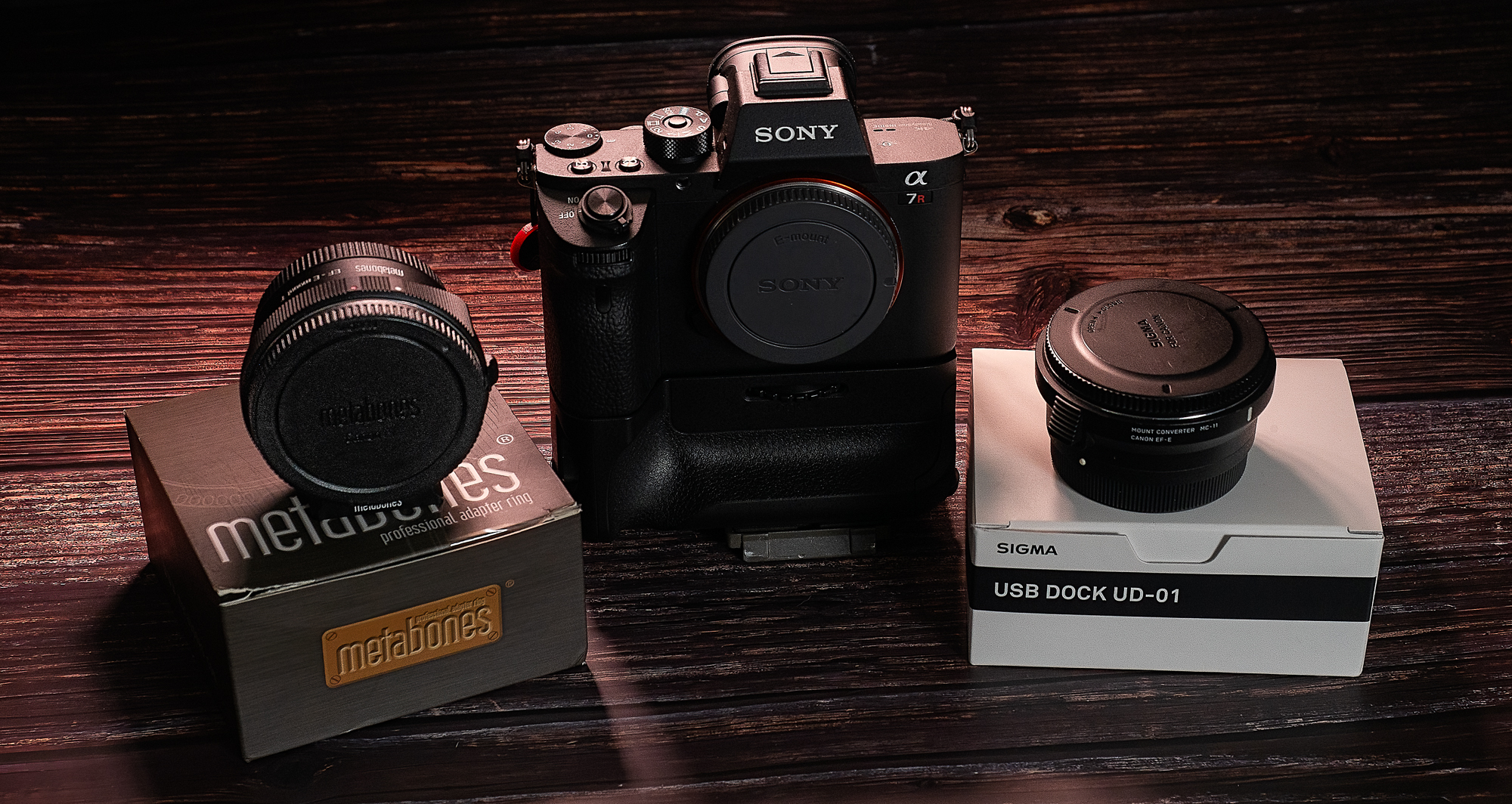
Time to reappraise the problem. As regular readers will know I went mirrorless about ten years ago with the Micro Four Thirds system and this is what does the bulk of my work. But I wanted a larger sensor and higher resolution for certain situations. A bit like when I was running Canon35mm SLRs in conjunction with a Pentax 645n II. So m43 gives enough quality for about 80% of my needs. I wanted auto focus, 5-6 fps frame rate, in body image stabilisation, 4K video , and of course full frame. So the Canon R and RP wereimmediately excluded. Then it occurred to me that if I was going to have to adapt my Canon glass to use on an R series camera why not consider adapting them to another make such as Sony. Now again regular readers will be aware that I acquired a Sony A7r with which to use my old collection of manual focus Olympus OM mount and Voigtländer M mount lenses. So perhaps going Sony was the solution. From what I read the Sony A7r was not a suitable candidate for this because of its contrast based auto focus so it was going to have to be 2nd generation cameras or later. New prices were still out of my league, but secondhand looked promising. I also found that the secondhand prices on the Metabones Canon EF to Sony E-mount T Smart Adapter (Mark V) and the Sigma MC-11EF-Mount Lenses to Sony E mount were less than half the price of new. To keep within my $2000 AUD budget I decided to go for a Sony A7r II as I wouldn’t need to buy extra batteries as I already had loads for my A7r. So it was just a case of searching and eventually I came up trumps and found an A7r II with less than 50 shutter actuations, a Sigma and a Metabones adapter that kept me within my budget.
The Olympus OM Zuiko 35mm f2 mounted on a Sony A7r.
So did this end up a workable solution? Well I’m not going to review the A7r II as that has been done to death on the internet. But, suffice to say it gave everything I was looking for in a full frame mirrorless camera. The next two parts will look at how well the adapters worked with my lenses and the A7r II.
The Sony A7rii with the Sigma MC-11 and Metabobes V EF to FE lens adapters.
Mount your Canon EF lenses to your Sony A7rii using the Metabones V Smart Adapter.
Will the Sony A7rii work well with my Canon lenses? Is it time to say “Adios EOS”?
The last 2 1/2 weeks I’ve been laid up at home with the flu. After a year of social distancing and scrupulous was of hands, the use of copious amounts of hospital grade hand sanitizer, and a flu jab I’ve gone down with the most persistent of bugs that just won’t leave me alone. Consequently I’ve been stuck at home and not up to much photographically.
Just before Christmas we managed to get away for a few days and one of those days was spent in Mandurah. It was a good place to start a trip that was to be primarily focused on bird photography. For a bit of a change I decided to leave the micro four thirds kit at home and take my Canon DSLR and relevant lenses. I did this for a number of reasons:
I fancied a change
With the collapse of Olympus and the future of the brand uncertain and Panasonic’s recent statements about concentrating predominantly on full frame cameras geared at video usage I felt that perhaps I should move away from micro four thirds and look at another system.
Curiosity as to whether the difference between the two formats is actually that apparent in real world usage. The key board warriors on the photographic forums are so specification orientated that they have lost sight of the fact that cameras are just a tool to produce photographs not endlessly obsess over minute details that make no real world difference.
I’m thinking about selling off surplus equipment and just concentrating on one system. So I was trying to decided which one was I prepared to get rid of.
Boring really for you guys, but as I’ve said I’ve been laid up at home for a couple of weeks with nothing much to think about. So without further ado here are some of the photos.
White-faced heron, Ardea novaehollandiae. Mandurah, Western Australia.
Goegrup Lake Nature Reserve in the morning light.
Australian Pelican, Pelecanus conspicillatus. Serpentine River in Mandurah, Western Australia.
Nankeen Night Heron, Nycticorax caledonicus subsp mannillenis. Mandurah, Western Australia.
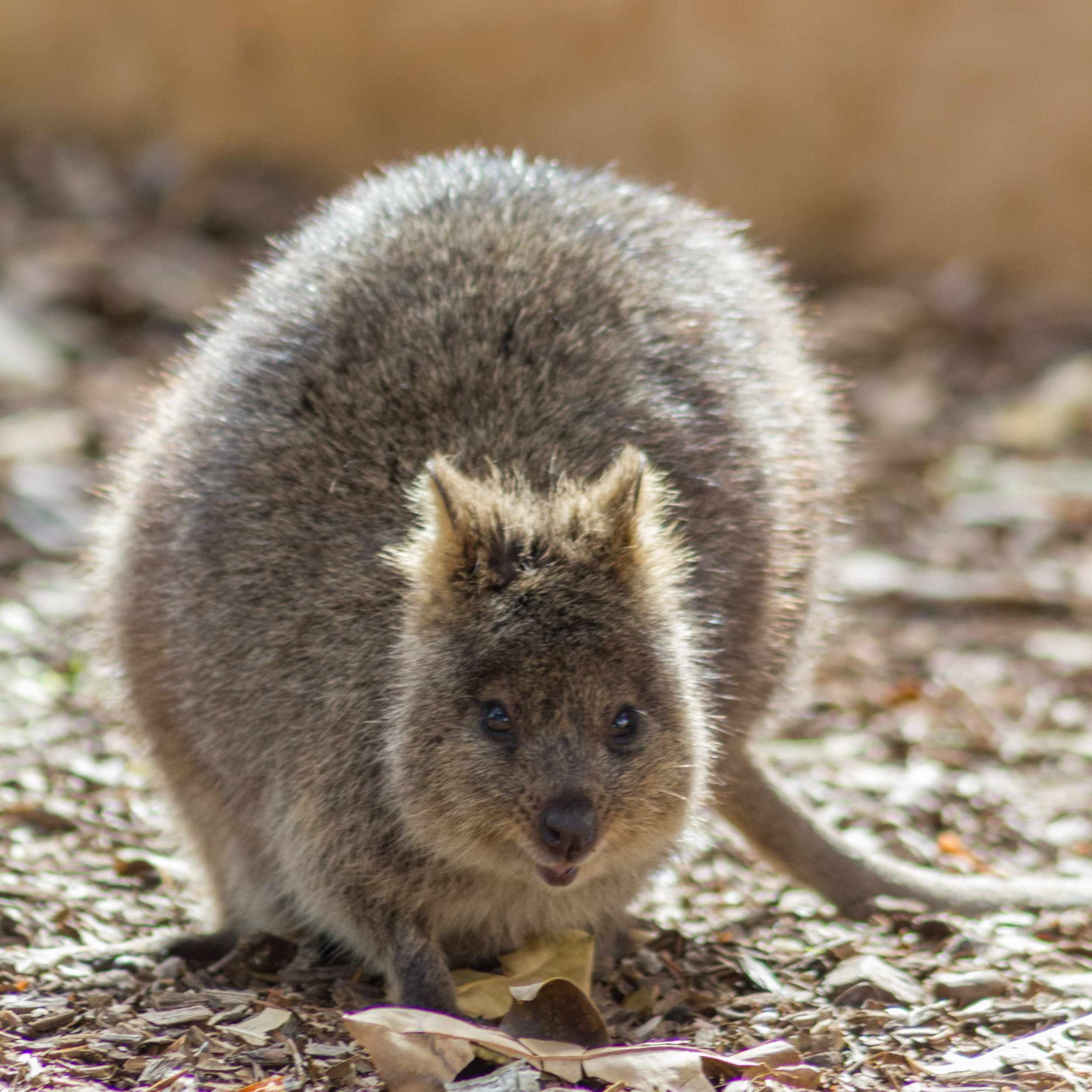
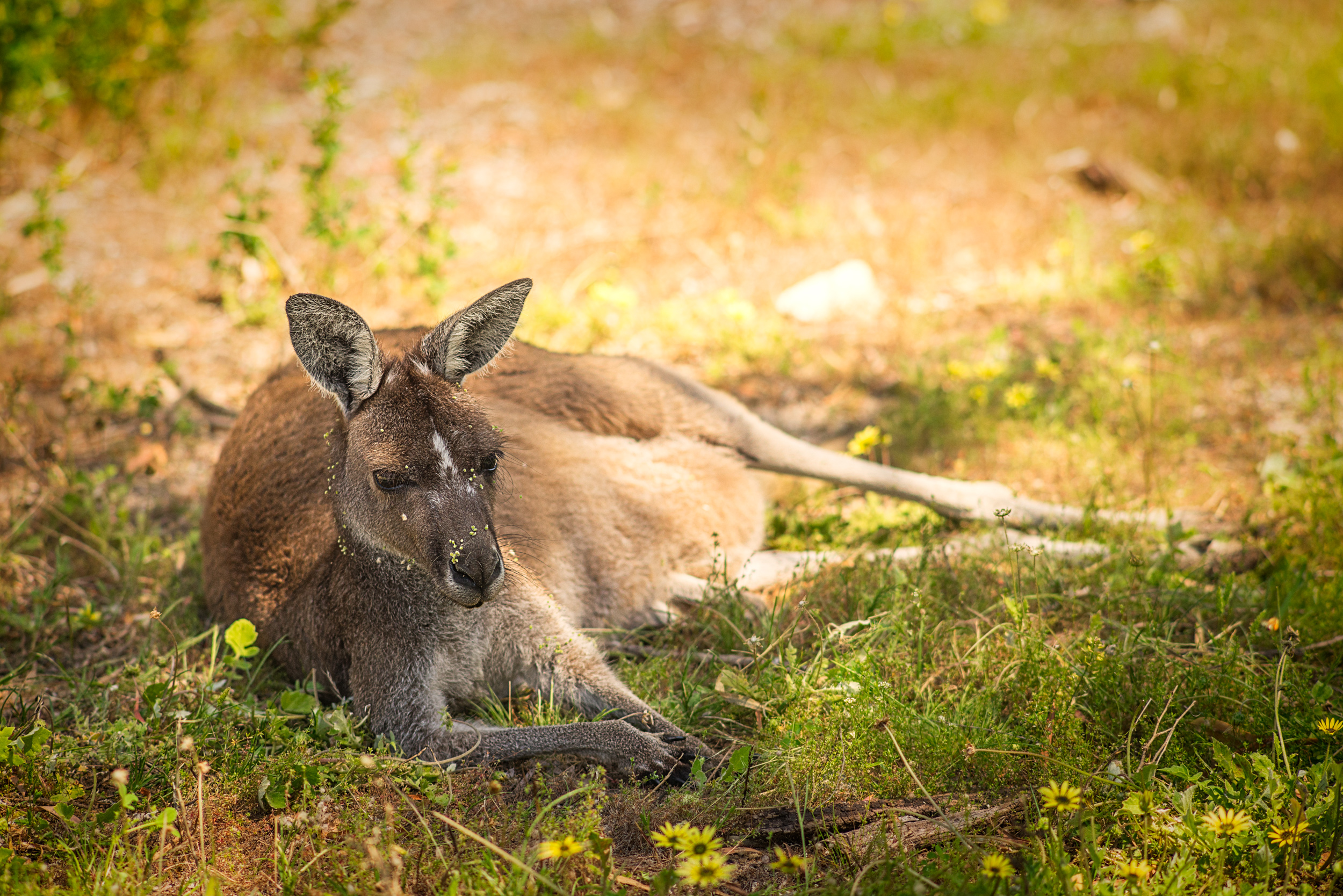
Mother and nearly fully grown joey in the Len Howard Conservation Park in Western Australia.
Inland Thornbill, Acanthiza apicalis. Len Howard Conservation Park, Western Australia.
This bob tailed lizard, Tiliqua rugosa, has a bad tick infestation. Note the engorged female tick on the shoulder – these can grow up to 2.5cm long. There is a smaller tick above and one in the ear canal behind the jaw. Older lizards or those with lower imune responses are more prone to them.
Crested Pigeon, Ocyphaps lophotes. Len Howard Conservation Park in Western Australia.
An observation platform on the southern end of Lake Geogrup just before it joins the Serpentine River. Mandurah, Western Australia,
So did I come to any conclusions? Yes – a Canon EOS 6d plus Sigma 150-600mm lens is heavy. I missed the reach of micro four thirds lenses.
Sometimes you come across a place so stunningly beautiful words cannot describe it adequately. Two Peoples Bay is one of those places. I’m not going to write anymore.
Little Beach at Two Peples Bay in Western Australia.
Two Peoples Bay in Western Australia
Australian Pelican, Pelecanus conspicillatus.
Scarlet Banksia, Banksia coccinea. Two Peoples Bay, Western Australia.
Not the dreadful film, but the camera company. On the 24th June 2020 Olympus announced that they were in talks with Japan Industrial Partners to divest themselves of their camera business after three continuous years of losses despite numerous restructuring attempts. I’ve got no idea what all this means from a practical point of view, but from an emotional point of view it is quite a sad day. I’ve always considered myself to brand agnostic and have used over the years Praktika, Pentax, Minolta, Canon, Leica, Voigtländer, Sony, Panasonic and of course Olympus. But I’ve got to say that over the last 38 years I’ve always had at least one Olympus camera. More than just a few key moments in my life have been documented by an Olympus camera.
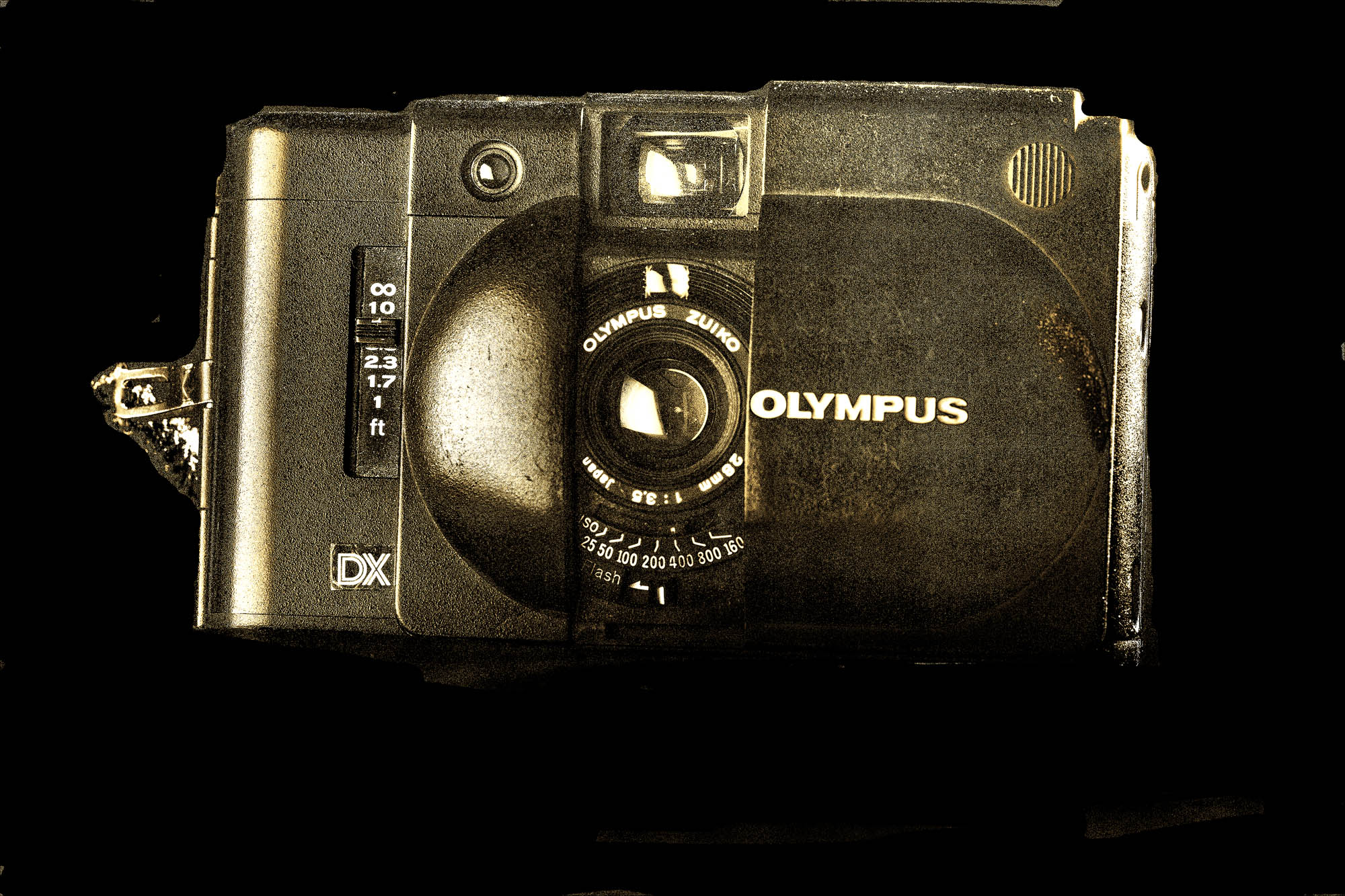
My first Olympus camera was an XA2. This is the XA4 I bought later to replace it, they look very similar, the major difference being that XA2 had a 35mm lens while the XA4 had a 28mm macro lens.
Portrait of me in Majorca taken in March 1986 by my father in law, Brooke Spencer. Probably taken with a Leica R4 with a Leica 135/2.8 Elmarit-R on Kodak colour negative film. I’m holding my OM1n with 35-105 lens.
I bought my first Olympus camera in 1982 after returning back home from an extended stay in Israel where I got into taking photos. Previously I had a Kodak 110 cartridge camera and when I got the films back from the processors I was dismayed with how crap they looked. I was determined that on the next trip I would take a much better camera. So after a trip to the newly opened Whibys camera shopping Chichester and a long and informative chat with the owner Derek Whitby I left with an Olympus XA2 – a unique 35mm clam shell compact camera. I kept going to Whitby’s until 1988 which was when I migrated to Australia. In that time Derek went on to sell me an OM20, OM1n, OM2n, OM4 and my partner an OM40. Along with those cameras was wheelbarrow load of lenses, some very specie flashguns for the time and a shed load of film. I’m glad their business is still going although Derek and his wife Jacqui no longer run it. The cameras kept marching on and were perfect for my travels being small, durable and highly featured for their time. The lenses were also compact and gave great image quality. I’ve still got most of the lenses and still use them, and I’ve written about them on this blog ( 21mm f3.5, 24mm f2.8, 35mm f2, 50mm f1.4,135mm f2.8, and 35-105mm f3.5-4.5).
Believe it or not that’s me in Red Square, Moscow in January 1987. The temperatures were -40ºC. You can just about see my camera bag slung over my shoulder. In it is an OM1n, an OM2n, a 35-105mm, a 50mm f1.4, a 200mm f4 lens a T32 flash and a T20 flash. We went to document the plight of Russians in Moscow and Leningrad (now St Petersberg for a human rights campaign that was to be launched later that year at the House of Commons in London). The cameras worked flawlessly in the cold. The photo was taken by my wife on an Olympus AF1.
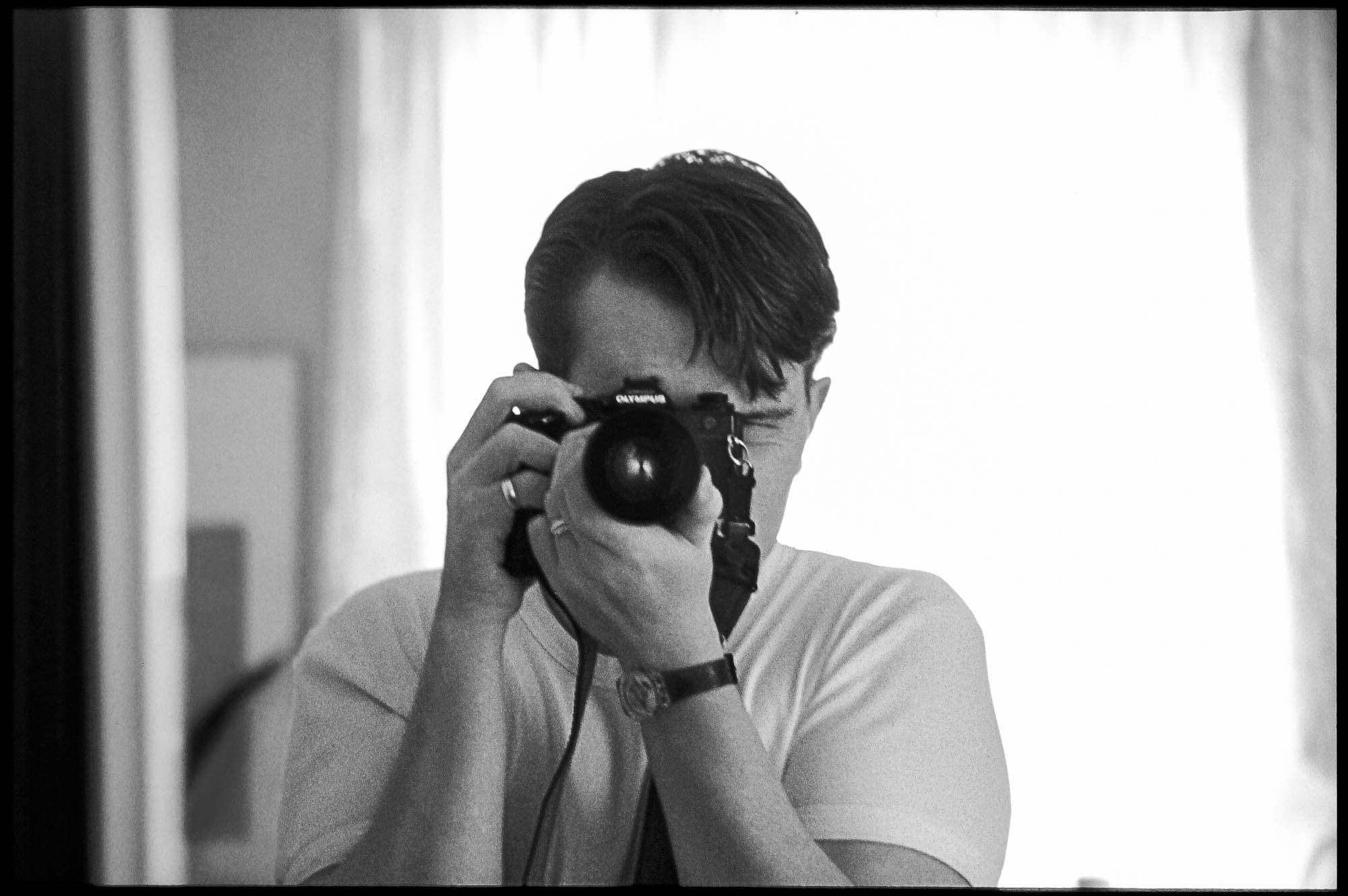
My earliest selfie – taken in September 1987 while I was staying with my in-laws just prior to departing for India and Nepal. The camera is an Olympus OM4 with an Olympus OM Zuiko 35-105mm lens. Originally shot on Ektachrome 200 but converted to black and white because of fading.
Yours truly on a house boat on Lake Dal in Srinagar, Kashmir, India. I’m wearing a Camera Care Systems pouch with my Olympus OM4 in it. Taken by my partner with her OM40 and 35-105 lens.
In 2003 I shot a couple of weddings and my OM4s developed problems, one the shutter failed and the other the film advance jammed. I took them to the local camera whisperer but he broke the bad news to me – there were no new spare parts. He said I could by up some old models and use them as donor cameras but there was no guarantee as to the condition of the parts and how long they would last. To say I was gutted would be an understatement. This came a a particularly bad time for me, I was recovering after a bad accident and was pretty broke. I had enrolled at college to study photography as a form of therapy and now I was pretty well camera less. My late father-in-law (Brooke Spencer) in an act of supreme kindness stepped into the breach. He had just bought a Canon EOS D60 digital SLR and he sent me his old EOS3 film SLR and a couple of lenses. I now had a camera to complete college with and had inadvertently changed system. I went digital with Canon but I wasn’t really happy with it. I found the Canon EOS system to be large, heavy and cumbersome. About this time I fell into writing about and photographing outdoor activities and then was commissioned to write a walking guide. Well after a year lugging a Canon 5d and three lenses on over 1000Km of walks I knew I needed something lighter.
The Canon EOS system full monty. Three bodies, seven lenses, two flashes, flash meter, filters, cables, flash triggers, and reflectors. It is a hernia inducing load.
This is the camera kit I used on my first walking guide book. Less hernia inducing than the Full Monty, but still coming in at 7Kg including filters and batteries.
When I saw the Olympus Pen EP1 in 2009 I was smitten, but it didn’t have a viewfinder so I held off buying one. Less than a year later Olympus introduced the EP2 and I got one. The next guide book was done with an outfit based around that camera and a a few lenses and I was much happier.
Coming in at under 2Kg complete with batteries, filters, microphone and assorted cables for video. This kit still gives me coverage from 24emm to 300emm with 1:1 macro and a smallish prime. All that’s missing is flash.
Here I am pausing to take a photo with EP2 while walking up Frenchman Peak in Cape Le Grand National Park, Western Australia.
Over the last ten years I’ve heard a lot reasons from keyboard warriors on various photographic forums why the micro four thirds format that Olympus and Panasonic used was inferior to full frame sensors and that you couldn’t get work published if you used it. Well after three books, two exhibitions and loads of print sales no one has ever said the image quality was not up to snuff. Unfortunately photography is an activity dominated by very conservative men who see a small camera, no matter how capable, as being an affront to their masculinity. So Olympus was sandwiched by the small minded conservatives that wanted big cameras and at the other end the onslaught of the do anything mobile phones which now have very good photo and video capabilities.
The Canon EOS6d with Sigma 150-600mm lens compared to the Panasonic G85, which uses the same sensor format and lens mount as Olympus, with the Panasonic Leica 100-400mm lens. The Panasonic has great reach, better video, the same number of megapixels, weighs less and costs less.
The Canon EOS 6d camera with 100mm f2.8 macro lens that I used to use for photographing orchids alongside the Olympus EM 1 mk ii with 60mm f2.8 macro lens that I use now. Both produce amazing images, but the Olympus is a lot nicer to carry through the bush all day.
As I said at the beginning of this piece I have no way of knowing what will happen. Maybe JIP will turn the company around and make it it profitable and innovative. Maybe they’ll just asset strip and close it down. The company does both. I hope it is the former, but if it is the later I guess that this a eulogy for Olympus. But whatever may happen my current Olympus cameras have plenty of mileage left in them and if I can get another 10 years out of them, and at this stage I don’t see why not, then I’ll be very happy.
Carnaby’s black-cockatoos, Zanda (Calyptorhynchus) latirostris, preening prior to roosting. York, Western Australia. Canon EOS 6d with Sigma Contemporary 150-600mm f5-6.3 lens. Exposure: 1/250 sec, f6.3 at ISO 6400.
Ok Ok if the last backyard birds was a little stretch over what is my backyard this one is a huge leap – across the road. From my neighbour across the road’s front garden came this delightful occurrence – Carnaby’s Black-cockatoos roosting. These large cockatoos are now endangered thanks to widespread land clearing so it was fantastic to have them visit the neighbourhood.
Welllllllll…not strictly true. This Nankeen Kestrel was on the power pole on the nature strip in front of our house. Another metre and it would have been in the front garden so I’m claiming it. They often perch there in the cooler months to either observe the field opposite for small animals or to eat the small animal they’ve just caught. This one was running an observation post.
A nankeen kestral (Falco cenchroides) uses the power pole on our nature strip to watch for prey in the field oppersite. Canon EOS 6d with Sigma 150-600mm f5-6.3 lens. Exposure: 1/500 sec, f7.1 at ISO 100.
Like many people at this time I’ve had my movements curtailed. Where I live we are allowed out locally for exercise so I’ve been going out for walks along the river to photograph and video the birds that can be found there. This is the third time I’ve tried to video wildlife and it is very hard.I don’t work from a hide so I have to set up quickly and quietly and often the birds will move on before I can get filming. Shooting mainly just after dawn or just before sunset has meant using high ISOs and made focusing difficult. But, the more you do it the better you get. The purpose of the video was to make something, learn something new and help keep me thinking positive thoughts during this time.
Just out of interest I’ll put the stills up below. They were shot on either a Canon EOS6d with the Sigma 150-600mm f4.5-6.3 Contemporary lens or the Olympus OMD EM1 mk ii with the Panasonic Leica 100-400mm f4-6.3 lens. I wonder if you can tell the difference at web size without enlarging to 100% or checking the EXIF data?
A male Rufous Whistler (Pachycephala rufiventris). York, Western Australia.
Laughing kookaburra, dacelo novaeguineae. York, Western Australia
Yellow Rumped Thornbill, Acanthiza chrysorrhoa, York, Western Australia.
Yellow-billed Spoonbill (Platalea flavipes), Avon River, York, Western Australia.
Great egret, Ardea alba, feeding on the Avon River. York Western Australia
Tatty robin. Red-capped Robin (Petroica goodenovii), York, Western Australia.
Brown Honeyeater, Lichmera indistincta, York, Western Australia.
A pair of Yellow-billed Spoonbill (Platalea flavipes) feeding on the Avon River in York, Western Australia.
A great egret (Ardea alba) and a white faced heron (Egretta novaeholladiae) hunting in the early morning light on the bank of the Avon River in York, Western Australia.
A great egret (Ardea alba) hunting in the early morning light on the bank of the Avon River in York, Western Australia.
Red-capped Robin (Petroica goodenovii), York, Western Australia.











You must be logged in to post a comment.