OM*

My new full frame Olympus with the Olympus OM Zuiko 50mm f1.4 lens mounted on a Fotodiox adapter.

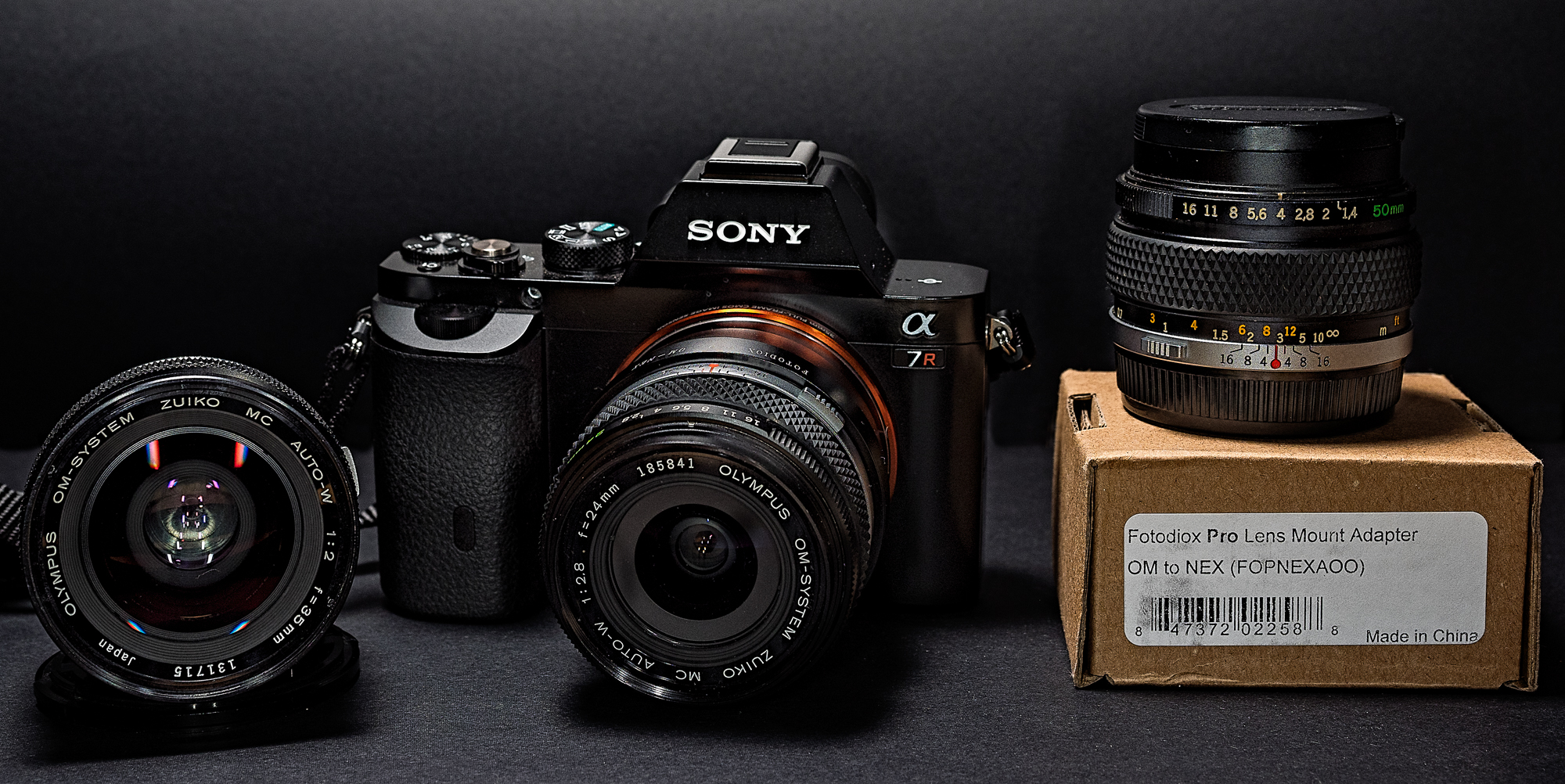
Well I’ve done it. I’ve gone full frame digital with Olympus. No I’ve not got access to some top-secret prototype from Olympus. Instead I’m mounting OM Zuiko lenses on a “full frame” (I hate that term, I much prefer 35mm sensor) camera digital – the Sony A7r to be precise – with a Fotodiox pro OM-NEX adapter.

“If you date your cameras, you marry your lenses.”
– David Hobby

Sony A7r with Olympus 24mm, 35mm and 50mm lenses. The Fotodiox Pro OM to Nex lens mount adaptor allows them to be mounted to the camera.

I was left with a collection of Olympus OM lenses when Olympus in their infinite wisdom decided to abandon the OM mount – this did not occur with the advent of digital imaging, but back in the film era. I migrated to the Canon EOS system reluctantly and left my lovely jewel like Zuiko lenses sitting in a drawer. Every now and again I would get one out and fondle it. Oh the beautiful feel of the buttery smooth focusing ring with its long throw. The cool feeling of the metal body with that heft that instantly denotes high quality precision engineering. To cap it off and send me into a rapturous state is the aperture ring – firstly there is one, and then there is the feel and sound of that ring as you change aperture. Just thinking about sends me into the throes of ecstasy.

Now it is a little known fact that when Yoshihisa Maitani designed the OM system he chose to make the flange distance a mere 46mm. At the time he probably thought that this would make a very compact SLR. But the unforeseen benefit of this decision is that it makes the OM lenses very easy to adapt to other cameras. Indeed when Canon brought out the ground breaking EOS 5d I was aware that you could buy an adapter to fit Olympus lenses to the body. But the experience was to me somewhat dismal. DSLRs really aren’t made to use manual lenses. It’s like expecting to find meat in a chicken McNugget. A disappointing experience. When Panasonic and Olympus announced the birth of micro four thirds in 2008 one of key features was the jettisoning of the mirror box found in SLRs. This has a couple of benefits. Firstly it means that a much shorter flange focal distance can be used. In ordinary speak this is the distance between the sensor/film plane and the lens mount on the camera body. Micro four thirds has a distance of 19.25mm which meant it was ideally suited to adapting lenses. I talked about this in April 2013 and again in April 2016. The second benefit was the provision of focus peaking. Focus peaking had long been found on video cameras by dint of them having an electronic viewfinder, it was quickly added to the feature list of mirrorless cameras. I first used it with the EM10 and was very happy with it. But there was a fly in the ointment. My carefully considered lens collection had been altered by virtue of the crop factor, basically a 50mm lens on m4/3 gives an angle of view equivalent to a 100mm lens on a 35mm sensor. Bugger! So apart from video use I put the old lenses away again.

A little while later Sony heralded the launch of their A7 series of full framed mirrorless cameras and initially my interest was piqued but the reality of buying into another camera system (I was already running Olympus m4/3 and Canon EOS) was just not an option. So I feigned disinterest. But an interesting thing happened, Sony update their models with incredible speed and that meant the prices of second-hand A7 and A7r dropped faster than an Essex girl’s knickers. All of a sudden my beautiful OM lenses were restored to their full frame glory.

 

Olympus OM Zuiko 50mm f1.4 at f8.

To test the lenses I shot a standard scene which was composed of a book shelf in my sitting room. Mounting the camera on a tripod I then framed up so that the complete height of the shelf filled the frame. The shots were taken wide open and then stopped down to f8. To see more detail in the test shots just click on the image and it will open in a new browser. This will be an evolving series of articles about using various OM lenses.


Olympus OM Zuiko MC 50mm f1.4


Olympus OM Zuiko MC 50mm f1.4

The first lens most people whack an adapter on is a fast standard. The 50mm f1.4 was one of the original lenses that was introduced when the OM system was launched at Photokina in 1972. The original silver nosed (a term referring to chromed front mount ring) had a single lens coating and was 36mm in length.The newer MC version was introduced in 1984. Along with the new improved lens multi coating the design was changed resulting in a length of 40mm with a weight of 280g. The lens construction is seven elements in six groups. Despite being a fast lens it has a modest size and has a 49mm filter thread.

50mmf14optic


Shooting my test subject one of the very first things I noticed is that the image displays very slight barrel distortion. This is where image magnification decreases with distance from the optical axis and makes parallel straight lines look like the edges of a wooden barrel. This phenomenon is usually associated with wide-angle prime lenses or the wide end of standard zooms. It does happen in standard primes lenses but usually only at close focussing distances so it was surprising to see it here. Wide open lateral chromatic aberration (CA) is perceptible and at f8 cannot be seen. In terms of sharpness at f1.4 the image is universally soft and lacking in contrast. Stopping down to f8 improves the image and the lens is sharp across the frame. The lens renders beautifully with a gentle fall off in tones and the bokeh is a delight being soft and smooth. The lens is quite resistant to flare and I haven’t felt any great need to put on a lens hood.

olympus-50-cpmparison-1

A street sign on Avon Terrace in York, Western Australia. Taken on a Sony A7r with Olympus OM Zuiko 50mm f14. Shot at f1.4.


Al fresco at Henry Saw in Grand Lane in Perth WA. Olympus OM Zuiko 50mm f1.4

In conclusion – well I always thought that it was a very good lens when I shot film and now having had the opportunity to mount it on a high megapixel digital camera I am not disappointed. If adapted lenses are your thing I would definitely recommend you to acquire a copy.


* today’s musical reference is to the Moody Blues the pioneers of art rock and progressive rock.

When The Saints…


This wasn’t intended to be a video project – I’d just gone along to take some photos using my Olympus EM1 and EM10 with the 12-40mm and 40-150mm f2.8 zooms. Then right at the end I’d realised that I had never shot any video on the EM1. So without a tripod or monopod I filmed one song hand-held using the 12-40mm. Luckily I had my Rode VideoMic Pro in my bag and I just mounted this in the flash hot shoe and hoped the sound was good enough.  I just love the built in image stabilisation – it did a fantastic job here.

Nostalgia Versus Current Reality

Paul in Majorca
Portrait of me in Majorca taken in March 1986 by my father in law, Brooke Spencer. Probably taken with a Leica R4 with a Leica 135/2.8 Elmarit-R on Kodak colour negative film. I’m holding my trusty Olympus OM1n with the Olympus Zuiko 35-105mm f3.5-4.5 lens. Those were the days.

Since the trans-continental relocation of the global behemoth that is Paul Amyes Photography (PAP) I have been hunkered down in the research lab deep in thought. To continue with my quest for photographic world domination I have been contemplating a new fine art project with a commercial bent that trades heavily on nostalgia for a bygone age.

While studying photography at art school I took two units in fine art photography and I was particularly taken with alternative processes, namely gum bichromate and cyanotypes. I experimented with taking digital images and then turning them into an A4 sized negative and using that to contact print onto papers that I had coated. To tap into that nostalgia thing and enjoy a retro photographic process I initially thought about capturing the new images on large format and using the resulting negative to make the contact print. There is something very beautiful about a large format contact but this is countered by the very damaging effect a large format camera has on your bank account. So this made me think about using digital capture and then making a negative from the file. It is not particularly difficult and at art school I experimented with paper negatives and ones made using overhead projector sheets. The paper negatives were best oiled with WD40 and they produced an image which was softened by the natural fibres of the paper. OHP transparencies gave a sharper image but the out put still looked like a modern image. Then I had a brain wave. What if I took older lenses and adapted them to a modern high-resolution digital body. The Sony A7r is now appearing on the second had market at very reasonable prices, and these will continue to fall as Sony introduces a new updated model every other week (a slight exaggeration perhaps). But before I splashed out some serious cash I thought I better find out whether the motley collection of old lenses I’ve got tucked in a shoe box in my equipment cupboard would be suitable. I decided to put them on an m4/3 camera and see how they perform.


A New Lease Of Life
Four of my favourite lenses; an Olympus Zuiko 35-105 zoom, an Olympus Zuiko 50mm f1.4, a Voigtlander 75mm shot telephoto and a Voigtlander 35mm lens.


The test was relatively straight forward. I’d use my Olympus EM1 as the camera body and mount the lenses using the relative adapters. The camera would be hand-held with the image stabilisation set manually to the focal length. The camera would be in aperture priority at base ISO (which for the EM1 is 200) and I would shoot wide open and then stop down full aperture stops until f8 – any smaller aperture and the results would be clouded by diffraction. I’d use focus peaking to focus accurately and I would refocus after every aperture change to avoid focus shift.

Voigtlander 35mm f2.5 Color Skopar
Voigtlander 35mm f2.5 Color-Skopar mounted on an Olympus OMD EM-1 mirrorless camera.

The lenses were:

Olympus Zuiko 50mm f1.4 MC. This was the third version of the lens and was introduced in 1984. I had fond memories of the lens and it produced some cracking images for me.
Olympus Zuiko 35-105mm f3.5-4.5. This lens was introduced in 1983, which is when I bought it. It cost me a small fortune, if I recall correctly £189, which at that time was two weeks wages. At the time I thought it was worth it and I used it as my every day do anything lens right up until 2003 when I switch to Canon because I could no longer get my OMs serviced. This was a lens that figured prominently in my plan.
Voigtländer 35mm f2.5 Color-Skopar. Introduced in 2004 this was another favourite lens, it was tiny, and very sharp. I loved using this with Ilford Delta 400 on my Bessa R2. Again a lens I had very high expectations for.
Voigtländer 75mm f2.5 Color-Heliar Introduced in 1999 this was a lens I feel I should have liked. It is wickedly sharp and with its ten aperture blades produced wonderful bokeh. But for some reason I just did not click with it – I think it was the minimum focusing distance which made it possible to only get a head and shoulders portrait rather than a full headshot.


The images were shot with the camera in RAW and then opened up in Lightroom and examined at full screen size and then at 100%. There was no post processing done. The results weren’t really a surprise, but they were somewhat disappointing as they revealed some uncomfortable truths and some pleasant surprises. Here are the results:

Olympus 50mm f1.4 – wide open there was significant colour fringing, low contrast, and overall the image was soft getting worse at the edges. Stopping the lens down brought about significant improvements – the chromatic aberration all but disappeared by f8 and the corner sharpness really started to improve from f4. The bokeh was nice and smooth. A good start.


Olympus Zuiko 35-105mm f3.5-4.5
Olympus Zuiko 35-105mm f3.5-4.5. Focal length 105mm f4.5


Olympus 35-105mm – at 35mm and wide open the colour fringing very apparent even before pixel peeping at 100% and it didn’t improve any by f8. At 105mm and wide open the CA was significant but it does improve by f8, but is still visible. Edge sharpness was nothing to write home about wide open but by the time it was stopped down to f8 it did improve. Surprisingly the bokeh was better than expected at both extremes of the focal range.

35mm Color-Skopar – chromatic aberration was quite well controlled wide open and just improved as it was stopped down. The edge sharpness was slightly soft wide open but improved dramatically once stopped down to f4 and kept improving past that. Bokeh was a bit iffy, something that Voigtländers are often criticised for on the inter web.

Voigtlander 75mm f2.5 Color-Heliar
Voigtlander 75mm f2.5 Color-Heliar. Aperture 2.5

75mm Color-Heliar – straight off the bat this was a very strong performer and for me was a real surprise. Wide open CA was virtually non-existent and disappeared by f4. Edge sharpness was very good from f4 onwards. The bokeh was just gorgeous. The 10 aperture blades produce very smooth tonal transitions and lovely perfectly round bokeh balls.


Olympus Zuiko 35-105mm f3.5-4.5
Frida. Olympus OMD EM1 with Olympus Zuiko 35-105mm lens.


Olympus Zuiko 35-105mm f3.5-4.5
Avon Terrace – York. Olympus EM-1 with Olympus 35-105mm f3.5-4.5 lens.

Of the 4 lenses the poorest performer is the 35-105 zoom. In reality this should be expected in a thirty year old zoom lens design, but it is disappointing to me as I had such a high regard for this lens based upon my extensive use of it. Countless rolls of Fuji Velvia and Kodachrome 64 over a twenty year period had convinced me that it was a good performer. However slap it on a digital camera and the results are quite frankly so-so at best and absolutely pants at worst.

The 50mm has a lovely creamy dreamy quality to it that would make it very suited to fashion and beauty portraiture. The 50mm has a very nice smooth tonal fall off which now makes me question whether sensor size is as significant factor for this and that perhaps lens design also plays a considerable part.

The 35mm Color-Skopar was OK – meaning it wasn’t good or bad. I’d be interested to see what it does on a full frame sensor.


Voigtlander 75mm f2.5 Color-Heliar
Frida on Mount Brown taken on an Olympus EM10 with Voigtlander 75mm f2.5 Color-Heliar.


Voigtlander 75mm f2.5 Color-Heliar
Pig melons on Mount Brown. Olympus EM-10 with Voigtlander 75mm f2.5 lens.

The 75mm Color-Heliar was a revelation, and it is certainly the standout lens here. It was when introduced an underrated lens when introduced with the Bessa rangefinder film cameras and was quickly replaced with an f1.8 version. But since then this lens has developed quite a following with people adapting it for use on digital cameras. Voigtländer took a classic lens design, gave it modern glass and coatings, boosted the lens aperture blades to 10 and produced something rather special. For shooting studio portraiture it would make anyone look good. Definitely a keeper lens and quite possibly the kind of lens you’d buy a camera body for just so you can use it. If only the 35mm was that good – I’d go out and hit the camera shops and dent the credit card straight away.

Modern lenses are technically very good, most of the problems with vignetting, corner and edge sharpness and colour fringing are now corrected in camera by software. They are sharp and contrasty which appeals to a great many photographers who have only known digital imaging. The legacy lenses are sharp in the centre of the frame, but they have lower contrast and this doesn’t give the edge acuity that many digital photographers want. But this also makes them more attractive because they have character and render images in a more 3D way with smoother tonality. The test has shown that the Olympus Zuiko 35-105mm is really not up to the demands of a high-resolution digital sensor. Nostalgia destroyed by the brutal reality of modern digital imaging. The other three lenses could stand some further experimentation.

Action

Wagin Woolarama 2016 by Paul Amyes on 500px.com
Women’s barrel racing at the Wagin Woolarama Rodeo. Olympus E-M1 with OLYMPUS M.40-150mm F2.8, exposure: /1/2000s, ƒ/4.0 at ISO 200.

If you believe the online forums you can only shoot action or sport with a Canon EOS 1d X or a Nikon 4D with very expensive f2.8 lenses. At the very least you should be using a Nikon 500d or Canon EOS 7d Mkii because it is impossible to use anything else. I have to say this is like most things written by the denizens of photography forums complete and utter rubbish.


boddington rodeo by Paul Amyes on 500px.com
Boddington Rodeo 2005. Canon EOS 300d with Canon EF 75-300mm f3.5-5.6 IS lens.

I started photographing rodeo with a Canon EOS 300d and an EF 75-300mm f3.5-5.6 IS lens. Hardly state of the art sports equipment back in 2005. The buffer for RAW was 6 frames and it did a massive 3fps and there was no continuous auto focus when shooting RAW – you could only get that in the sports picture mode which then limited you to shooting jpg.

Matt
Matt, El Caballo’s Extreme Rodeo compere tries his hand at bronco riding with catastrophic results. Canon EOS 5D with Canon EF 70-200 f2.8 IS. Exposure: 1/1/500s, ƒ/7 at ISO 800.

The next big jump up was the Canon EOS 5d. Again no sports shooting, terrible buffer, slow frame rate and apparently the AF couldn’t cope with anything but a slow walking bride on a bright day.

Wagin Woolarama 2016 by Paul Amyes on 500px.com
Women’s barrel racing at the Wagin Woolarama Rodeo. E-M1 with OLYMPUS M.40-150mm F2.8 lens. Exposure: 1/1250s, ƒ/4.0 at ISO 200.

Today we have the advent of mirrorless cameras. The cognoscenti say that only a DSLR with an optical viewfinder can capture action, mirrorless cameras cannot and will not do it. Well as I said at the beginning there is a lot of rubbish spouted on photography forums. I follow Nike’s advice – “Just Do It!”

Rendering Beautifully

There’s no doubt about it the OLYMPUS M.45mm F1.8 lens renders images beautifully. It’s not razor-sharp in that clinical digital way most modern lenses are thank goodness, but it is sharp enough with a pleasing fall off at the edges. This lens is for taking pictures of complex 3 dimensional subjects not flat test charts and brick walls. The bokeh is very pleasing – it renders the transition between areas of sharpness to blur in a very smooth manner. As I have said before I don’t consider myself a bokeh slut by any means but there is something about this lens that just makes you want to shoot at wide apertures. Anyway enough of my wibbling lets just look at some pictures.


Game Over
An abandoned dog ball. Lewisham, Tasmania. Olympus EM1 with 45mm 1.8 lens. Exposure: 1/3200, f2, ISO 200.


Orb Weaver On A Geranium
Orb Weaver On A Geranium. Olympus EM1 with 45mm f1.8 lens. Exposure: 1/800, f2.8 at ISO 200.


Insecure
You can never be too careful. Lewisham, Tasmania. Olympus EM1 with 45 f1.8 lens. Exposure: 1/8000, f2 at ISO 200.


Knitivism
Knitivism – Tassie Nannas protesting children being held in mandatory detention, Elizabeth Street Mall, Hobart. Olympus Pen EP5 with 45mm 1.8 lens. Exposure: 1/500, f2.8 ISO 200.


Serenade
Serenade – Busking in Elizabeth Street Mall, Hobart. Olympus Pen EP5 with 45mm f1.8 lens. Exposure: 1/250, f2.8, at ISO 200.


Whovian
Whovian waiting for a taxi, Hobart. Olympus Pen EP-5 with 45mm f1.8 lens. Exposure: 1/1000, f2.8, at ISO 200.


Deck Hand
Deck Hand – Cray boat, Franklin Wharf, Hobart. Olympus Pen EP-5 with 45mm f1.8 lens. Exposure: 1/2500, f2, at ISO 200.

Christmas Tree

Christmas Tree
You don’t have to go large to enjoy the festive season. Merry Christmas.

Another shallow DOF shot. Supposedly impossible on m4/3s. Olympus Pen EP-5 with OLYMPUS M.60mm F2.8 Macro lens and Olympus FL-600R flash with Lumiquest softbox. Exposure: 1/50 s at f/2.8 ISO 200.


The Long And The Short Of It

The Olympus M.ZUIKO DIGITAL ED 75-300mm f/4.8-6.7 II mounted on an OMD EM-10.


The Olympus m.Zuiko 75-300mm f4.8-6.7 mk ii (which shall now on referred to as the 75-300) is an updated version of their original super telephoto zoom for the micro four thirds format.Yes I said super telephoto zoom because that is what it is as it is equivalent to a 150-600mm lens in 35mm sensor terms.

The Olympus M.ZUIKO DIGITAL ED 75-300mm f/4.8-6.7 II mounted on an OMD EM-10.


The Olympus M.ZUIKO DIGITAL ED 75-300mm f/4.8-6.7 II compared with Canon EF 75-300 f4.5-5.6 IS for comparison. The Olympus gives an equivalent focal length of 150-600mm.

Keeping up with the m4/3s promise of smaller cameras and lenses this lens does not disappoint. It fits comfortably in the hand is quite a bit smaller than my Canon 75-300mm f3.5-5.6 IS which only covers half the focal range when mounted on my EOS5d. There are rumours on the various forums that the lens is designed and built by Sigma, but there is no evidence of that fact when looking at it. The 75-300 is largely constructed from engineering plastic and has a metal mount. There is no weather sealing. The lens extends while zoom, roughly doubling its length, there is no lens creep which is nice. While not heavy it feels reassuringly dense in the hand and not at all cheap and wobbly like some budget zoom lenses.The filter diameter is 58mm which it shares with the 40-150mm f4-5.6 and means that filters won’t be too pricey. Optically the lens has 18 elements in 13 groups, two of which are ED glass and one is Super ED (extra low dispersion). These exotic elements are there to minimise chromatic aberration throughout the zoom range. They certainly do the job for when I open up images shot with the 75-300 in Lightroom they are remarkably free of CA. The lenses elements are coated with Olympus propriety ZERO (Zuiko Extra-low Reflection Optical) coatings and I’ve found the lens to be quite resistant to backlit flare, however flare can be induced by bright light sources just outside of the frame so I would heartily recommend the use of a lens hood. Unfortunately Olympus does not include one in the box.


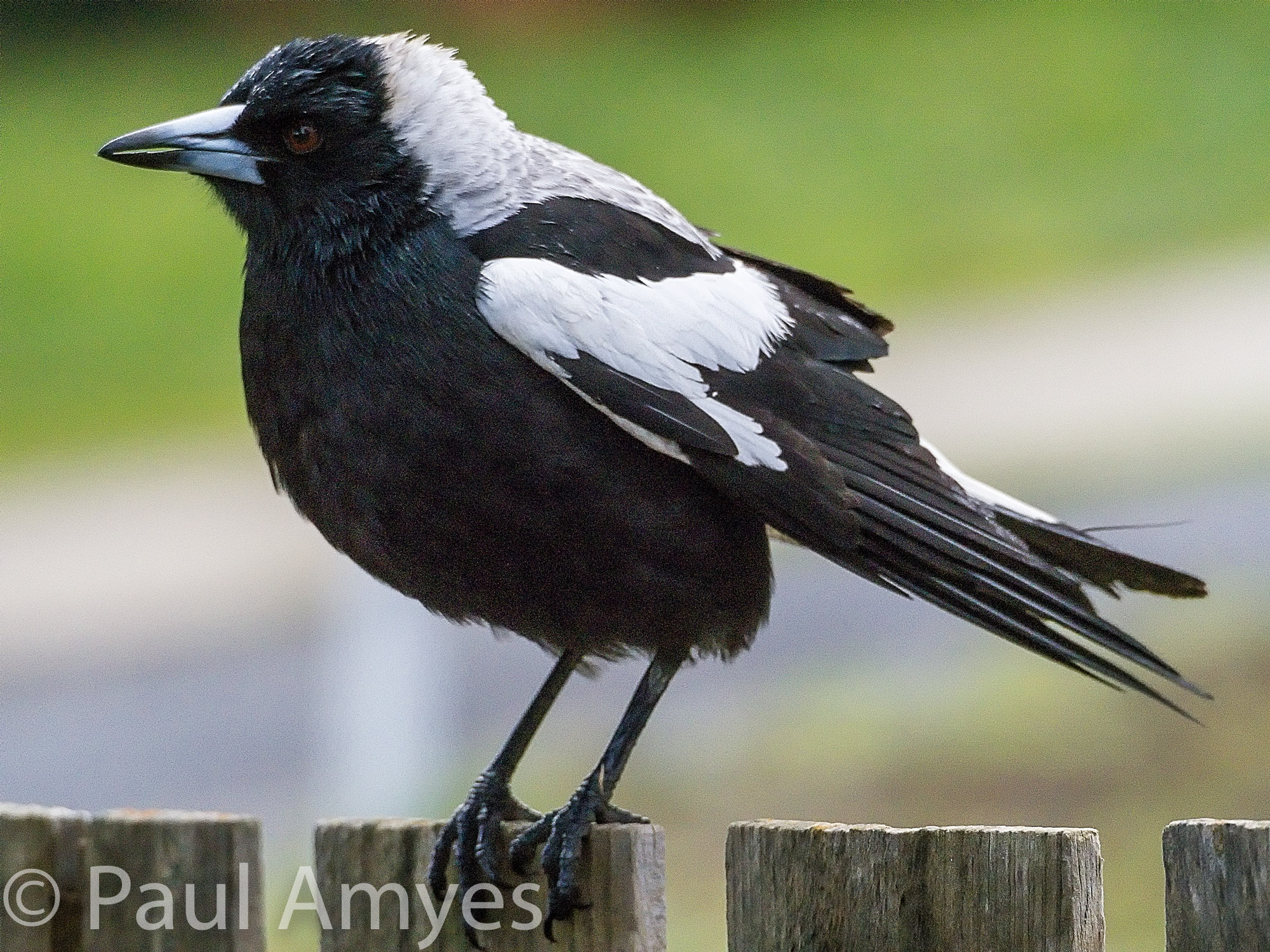
Cracticus tibicen hypoleuca is a subspecies of white backed magpie found on Tasmania, King and Flinders Islands.


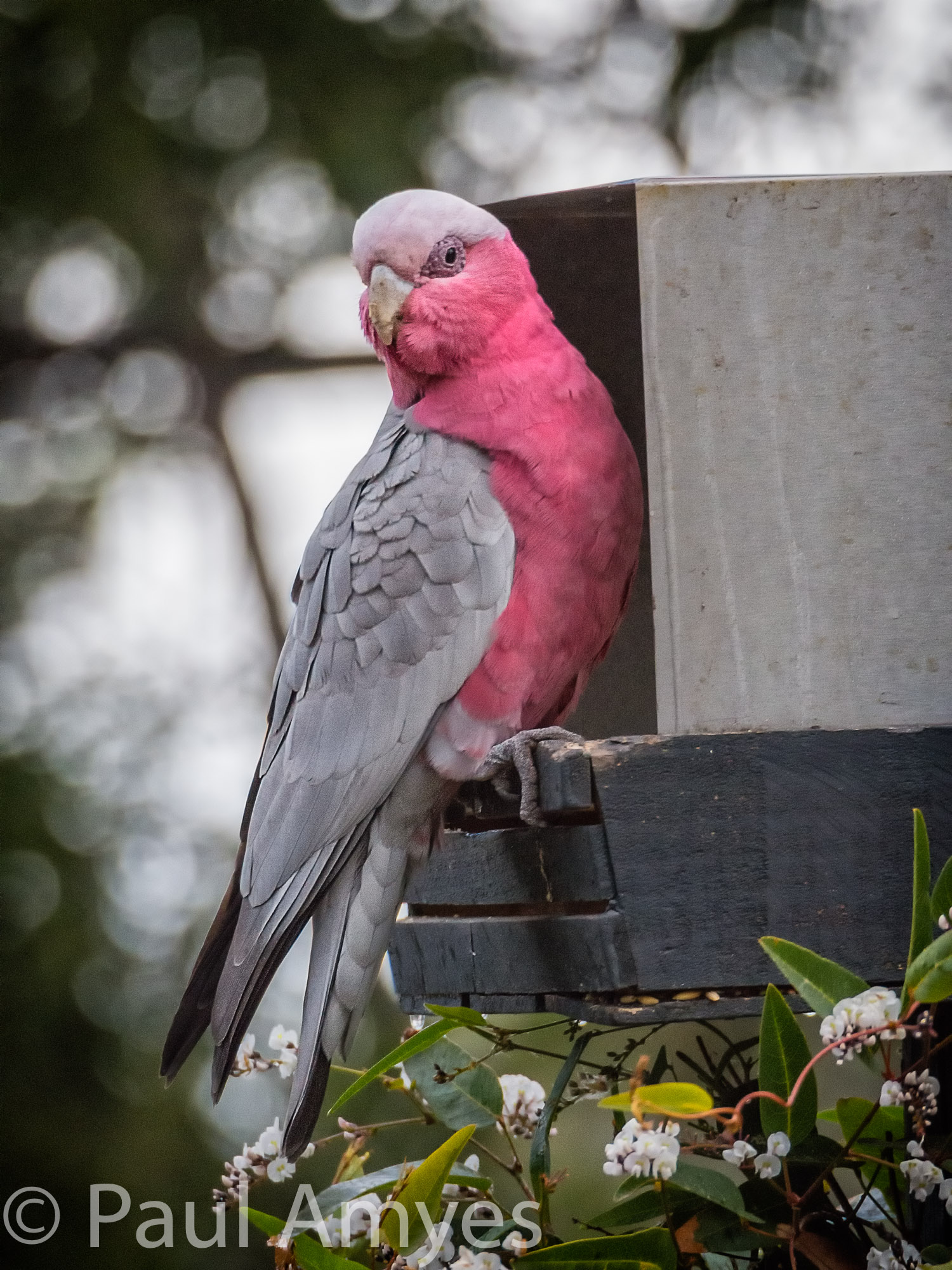
A pink and grey galah at our bird table.


Performance wise the 75-300 is remarkably good for a lens of this price and zoom range. The AF is quick and precise when shooting stills on both my EM-10 and EP-5, and quite a lot slower when shooting video. Optically the lens is very sharp up until the 200mm mark and then it does soften slightly, but this is not at all unusual with zoom lenses, which is unfortunate because this lens will be bought more for its uses at 300mm than 75mm. There is not a lot of love for this lens on the internet forums where it is harshly criticised for it performance at the long end, but from my experience with it it’s not as bad as people make out. I wonder whether camera shake is a contributing factor here. While Olympus bodies have In Body Image Stabilisation (IBIS) there is a limit to what it can achieve and we have to remember that this is the equivalent of a super telephoto 600mm lens in full frame terms and not many people would expect to handhold one of those and get tack sharp results. When using the lens on a tripod and monopod it certainly delivers the goods. When handholding I would certainly recommend not using a shutter speed of lower than 1/300th sec even when using IBIS.


Kite surfing off Park Beach in Tasmania.


Kite surfing off Park Beach in Tasmania.

Downsides of the 75-300. Well the slow maximum aperture will be a drawback for many, and I’ve read many threads where people have stated they would have preferred a constant f4. This all very well but lens design is a compromise and such a lens would be very large and heavy and cost considerably more. Personally I don’t mind using higher ISOs to keep the shutter speeds up as I’m happy to clean up my images with Niksoft’s Denoise. Another downside is when shooting video – this is not really a lens for run and gun style shooting, it is much to long to effectively control shooting handheld. Even on a tripod the lens showed up the failings of my fluid head for when panning there was quite a pronounced shudder when using it at its longest end.

Overall I feel that the few drawbacks are outweighed by the positives and I like this lens a lot. It is a very good lens when one considers the price. In Oz a full frame equivalent will cost at least double. I would recommend the 75-300 to anyone who was prepared to accept the trade offs involved i.e compact size and affordability versus the slow maximum aperture and the slight softening of the image at the long end. At the time of writing this there is only one other alternative, the Panasonic Lumix G.Vario 100-300mm f4-5.6 OS, which is at the same price point and has a similar performance. I would only consider the Panasonic over the Olympus if I was shooting on a Panasonic camera which has no IBIS. Both Olympus and Panasonic are introducing higher performance lenses at the 300mm focal length at some time in the near future, but I think we’ll find they are considerably bigger and more expensive.


Two black faced cormorants, a little black cormorant, and a little pied cormorant hang out while a silver gull watches on. Lewisham, Tasmania.


Frida giving me a cheeky grin while waiting for me to catch up.

So if you fancy doing a bit of sport or wildlife photography then I would thoroughly recommend this lens to all Olympus users.

Before and After

I’m going to preface this entry with the statement that most post processing is a matter of personal taste and that there are a hundred and one different ways of editing an image in Photoshop to get the same result. If this doesn’t appeal to you, or I do things differently to you it doesn’t mean I’m right and you’re wrong, nor does it mean you’re right and I’m wrong.

I have posted this because I got a lot enquiries about how I make my images and whether the colours captured are real or not. So the image below is a straight jpg conversion of the RAW file that came off my memory card. All I’ve done is reduce the size and convert to sRGB. The original exposure was made on an Olympus Pen EP-5 with OLYMPUS M.12-50mm F3.5-6.3 lens. A Cokin 2 stop soft graduated neutral density filter was used to hold back the sky. Exposure: 3.2 s at f/11.0 ISO 200 in manual exposure mode.

OLYMPUS DIGITAL CAMERA
Lewisham foreshore at first light. This is a straight conversion of the untouched RAW file converted to jpg sRGB with no processing.

The video below shows how I work on the file in Adobe Lightroom 5.7 , Adobe Photoshop CS5.04, Alien Skin Exposure 3, Nik Soft’s Dfine 2 and Color Efex Pro 4. I use these products because I like them and have paid for them with my own money.

The finished image.

First Light in Lewisham
Lewisham foreshore at dawn. Tasmania. Olympus Pen EP-5 with OLYMPUS M.12-50mm F3.5-6.3 lens. Cokin 2 stop soft graduated neutral density filter. Exposure: 3.2 s at f/11.0 ISO 200 in manual exposure mode.

Clicking on the image will take you through to my gallery. I hope that you found this helpful.

Happy Birthday

The Mobile Kit
The Canon EOS5d – the first “affordable” dSLR with a 35mm sensor.

On 22 August 2015 the Canon EOS 5d turned ten years old – my own 5d turned 10 last week. Now they reckon dog years are seven for every human year. In terms of digital photography I reckon ten years equates to over a hundred human years as technology has advanced so fast. Despite that the original 5d, or if you want to really annoy the anally retentive Canon fan bois over on the DPReview forums the 5d Classic, is still more than a capable camera, in fact I would go onto say that if you don’t shoot video and don’t print any larger than A3+ you don’t need anything else. If all you do is post shots on Flickr and Facebook then I would say you’re over gunned and look for a Canon EOS 300d! Why was it so special – well it was the first “affordable” dSLR with a 35mm sized sensor. That meant a lot back in 2005 because a lot photo enthusiasts and pros had cut their teeth shooting 35mm film and had got used to a certain look with particular focal lengths. The advent of the cropped sized sensor (APS-C for Canon and DX for Nikon) meant that we couldn’t just look at a scene and say that calls for a 85mm lens, or a 24mm lens. No we had all these funny focal lengths and the other annoying thing was the camera and lens manufacturers didn’t populate their lens line ups with high quality cropped factor lenses – a fact that is still true today. So when the 5d was announced I thought at last I can get my favourite focal lengths back. I literally ran to my then favourite retailer PRA and placed my order. Since then my 5d has been in constant use, there are some 14,000 images in my Lightroom catalogue taken with that camera and it hasn’t missed a beat. It still gets used on a regular basis because those 12.8 Mp render an image beautifully. Many of the cameras detractors said that it had an atrocious auto focus system but I never had any problems with mine.


2007 Boddington Rodeo, Boddington, WA.
Gotcha!!! 2007 Boddington Rodeo, Boddington, WA. The 5d in full on action mode, something a lot of people said was impossible.


2005 Perth H2O Gravity Games

A lot of people complain that Canon sensors are crippled when it comes to dynamic range, again it has never been something that has caused me any problems.

Photograph 2006 Avon Descent by Paul Amyes on 500px
Hot Air Balloons over the Avon River in Northam, Western Australia. Canon EOS 5D, Canon  75-300mm f/4-5.6 IS USM lens. Exposure 1/1000 s at f/5.6 ISO 400.


 An Evening Walk Down The Lane. by Paul Amyes on 500px
A walk down the lane at sunset. York, Western Australia. Canon EOS5d, Canon EF 28-135 f3.5-5.6 IS lens, Cokin 2 stop graduated neural density filter, Cokin circular polarizing filter. Exposure 20.0 s at f/22.0 ISO 100 in manual mode.


Long exposures such as the shot above and below didn’t cause any problems, just a little judicious use of noise reduction software in post.


Photograph York CBH Nocturne by Paul Amyes on 500px
York CBH Nocturne. Train been filled at the York CBH grain handling facility in York, Western Australia. Canon EOS 5D with Canon EF24mm f/2.8 lens. Exposure: manual mode 20.0 s at f/4.0 ISO 800.


As I said earlier I’m still happily using the camera after ten years and in that time quite a few other cameras have come and gone. I think the EOS5d deserves the appellation Classic because it helped a lot of photographers recover their preferred means of working with focal lengths, it quickly became a mainstay of a lot of working photographers, and it established the idea of the prosumer full frame sensor in camera market. Will it last another ten years? I don’t think so as a working camera. The problem is that the spares are no longer manufactured to keep the camera going. I’ll still continue to use mine until it fails but not as a mission critical camera.


Tessellated Pavement
Tessellated Pavement. Canon EOS5d with EF28-135mm f/3.5-5.6 IS USM lens. Cokin filters – 3 stop ND filter, 2 stop grad, and circular polarizing filter. Exposure: 1.6 s at f/11.0 ISO 100.


As always clicking on an image will take you through to my online gallery.