Olympus OM Zuiko 21mm f3.5

Olympus OM Zuiko 21mm f3.5 lens


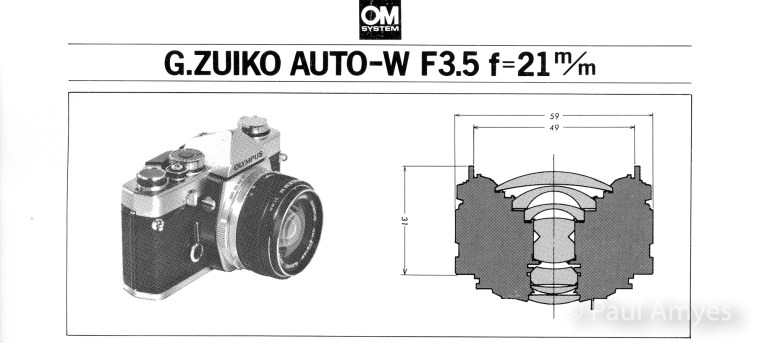
The Olympus OM Zuiko 21mm f3.5 was one of the original lenses released with the OM1 in 1972. It is fair to say that the lens has tended to be ignored somewhat since the release of the f2 version, this was true in the days of film and it is especially true today with the current trend of mounting legacy glass on cameras such as the Sony A7r. Demand for a product dictates the price and copies of the f2 change hands on eBay for over $1000 USD while the f3.5 goes for around $350 USD. Apart from the aperture what other differences are there between the two? Well asymmetrical-type ultra wide-angle lenses are designed for optimum performance at infinity and unfortunately when used at their closest focusing distance picture quality has a tendency to deteriorate. The 21mm f2 lens incorporates a floating element system for improved sharpness from its close 0.2 meter (0.7 ft) minimum focusing distance to infinity and ensuring its superlative optical performance be extended to its closest working range. So what are the advantages of the 21mm f3.5? Well it fits Yoshihisa Maitani’s design criteria for the OM system – being lightweight and very compact. This thing is
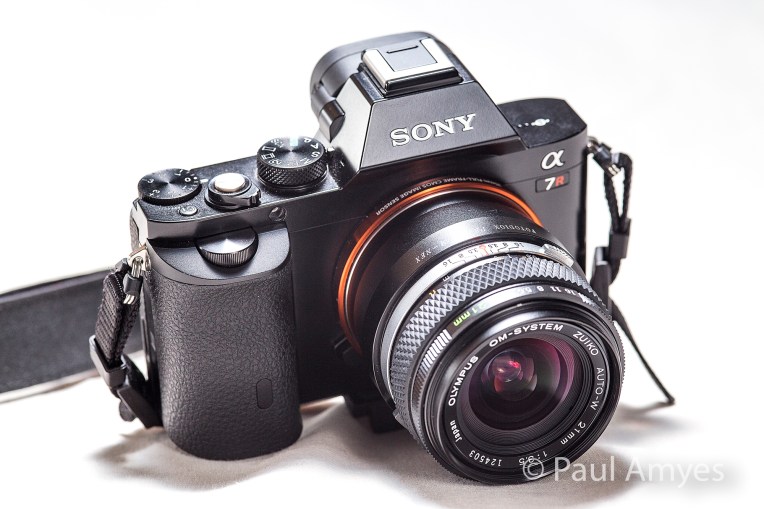
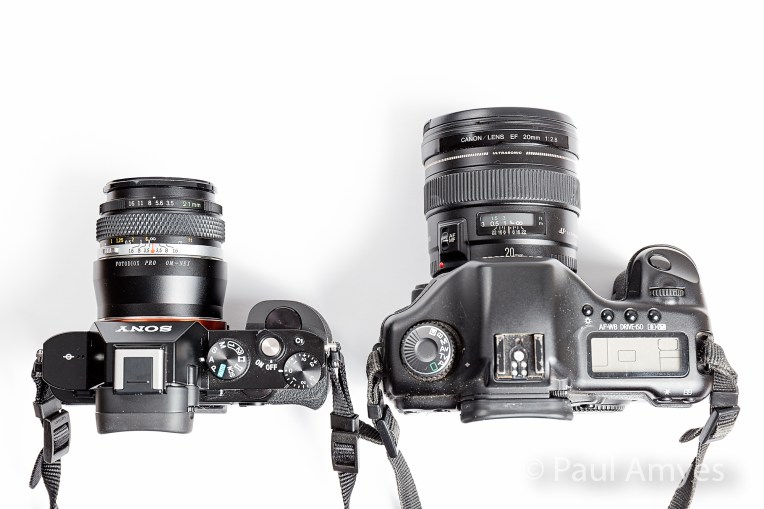
The Fotodiox OM to Nex adapter is bigger than the OM Zuiko 21mm f3.5 lens.

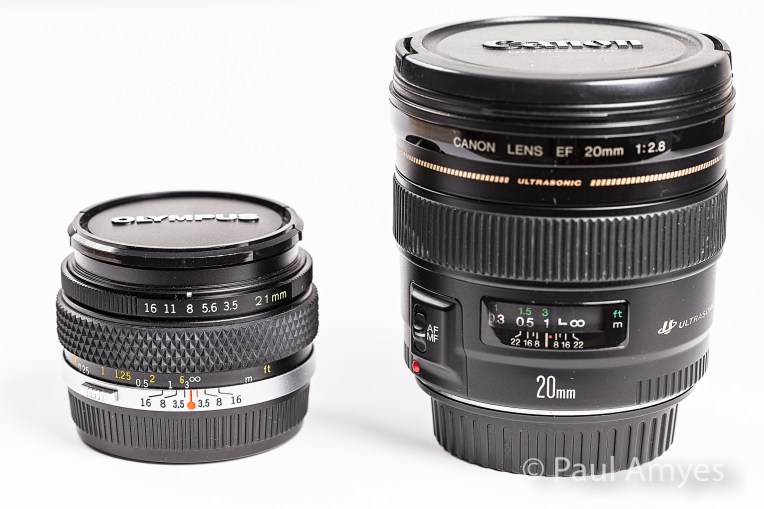
absolutely tiny. It is about the same size as the Fotodiox OM to NEX adapter. Most other camera systems would call this a pancake lens – it’s not, it’s just that most modern DSLR cameras are very bloated and unnecessarily large. Optically it has 7 elements in 7 groups, is 31mm (1.2 inches) long, 59mm (2.3 inches) in diameter and has a filter thread of 49mm. Like most Olympus OM lenses there are different versions of the lens – the original weighed in 185g (6.5 oz) while the newer MC (multi coated) one, which is tested here, is 180g (6.3 oz) while sharing the same optical construction and exterior dimensions. Although it does not have the floating rear element of the f2 version it still focuses down to 20cm (7.87 inches) and the quality is reasonable.
20160907-olympus21mm-0228

Test Results

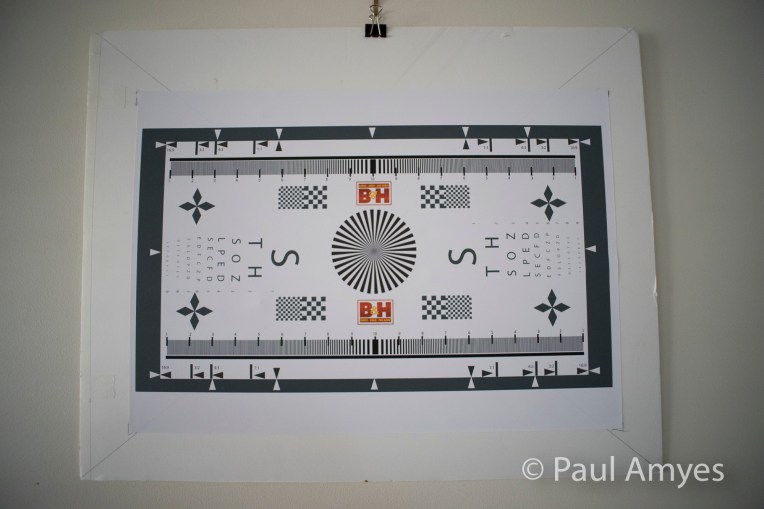
The book shelf optical test. The camera is mounted on a tripod so as to get the whole shelf in the frame without causing loss of the parallel vertical lines.

Using my standard book shelf test it is immediately apparent that the lens has noticeable barrel distortion. This is not uncommon in wide-angle lenses and occurs where the image magnification decreases with distance from the optical axis and makes parallel straight lines look like the edges of a wooden barrel. These days this can be easily corrected in post. Looking more closely it is easy to see chromatic aberration on high contrast edges, again easily corrected in post. Wide open at f3.5 the centre of the image is sharp with what would now be construed as having low contrast but is actually quite good and can easily be improved on with a quick adjustment in curves. The edges are very soft and lacking in contrast – not mush but would be easily noticeable in architectural shots. At f8 the centre has improved and you can forget the thoughts of a contrast adjustment. The edges have improved but they are still not good. It is at f11 where things start to come very good, the centre is excellent and the edges are not far off. Any further stopping down and optical quality will drop off due to the effects of diffraction. Vignetting is very apparent when wide open – maybe 2 to 2 1/2 stops difference between the centre and the corners. Things improve significantly by f8. Flare is very well controlled considering the angle of view and the sun stars are quite nice considering there are only six aperture blades.

All images are SOOC with no sharpening or optical corrections. The sections are 100% views from the centre and top left corner of the image. This can be viewed larger by clicking on the image.


Wide open vignetting causes a light loss of 2-21/2 stops in the corners.


A comparison between the Olympus OM Zuiko 21mm f3.5 and the Canon EF 20mm f2.8.


A comparison between the Olympus OM Zuiko 21mm f3.5 and the Canon EF 20mm f2.8.

So keeping in mind this is a sample of just 1 and I have no idea if this is a good example or a bad what can I say about this lens. Well I happen to own a Canon EF 20mm f2.8 and while not one of Canon’s primo L lenses it is considered quite a respectable performer when stopped down. When we compare the two the first thing that comes to mind is the size difference. As I said before the Olympus is tiny, and it still looks small when attached to the lens adapter. Vignetting on the Canon is very well controlled, this is the big benefit of that large front element (72mm filter size compared with 49mm). Chromatic aberration is no better and no worse. It is the wide open corner sharpness where the Canon beats the little Olympus, but not hugely so and by f5.6 they are both pretty much the same. The big advantage the Olympus has over the Canon is filter use – the smaller size makes filters more affordable and I would hazard that is one of the few, if not only, ultra wide-angle lens that safely use the Cokin P system (84mm in width). My Canon still vignettes with the larger Cokin Z-Pro system (100mm in width).


Real World Examples
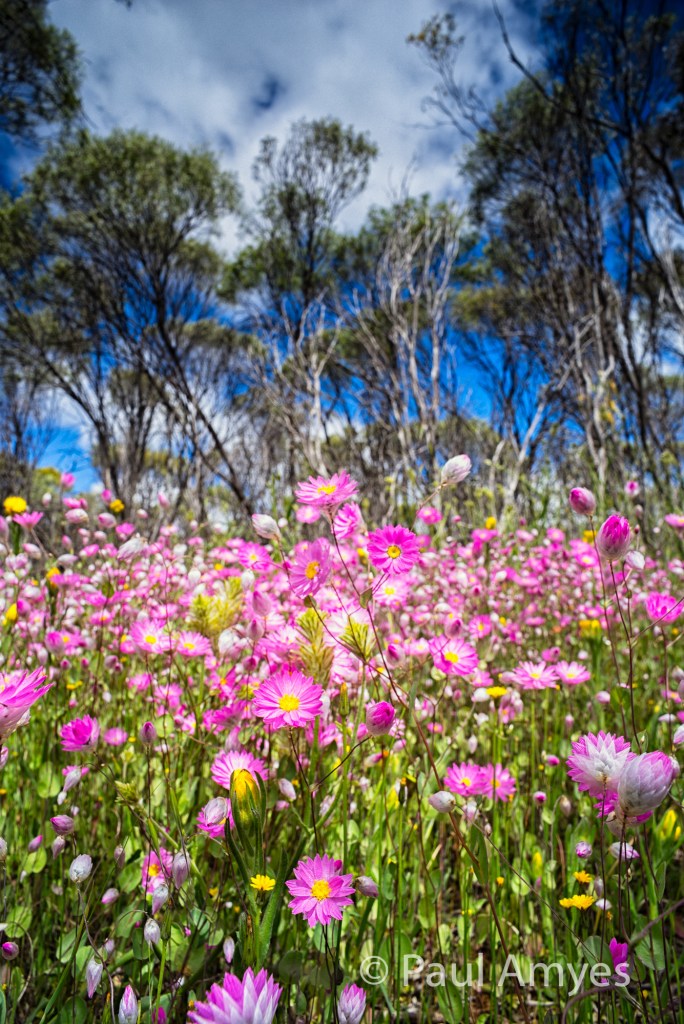
Stopping the lens down to f16 and then using the closest focusing distance of 0.2m I was able to to capture a wide angle close up of these flowers with plenty of DOF. Everlastings on Mount Brown in York, WA.
Stopping the lens down to f16 and then using the closest focusing distance of 0.2m I was able to capture a wide-angle close up of these flowers with plenty of DOF. Everlastings on Mount Brown in York, WA.


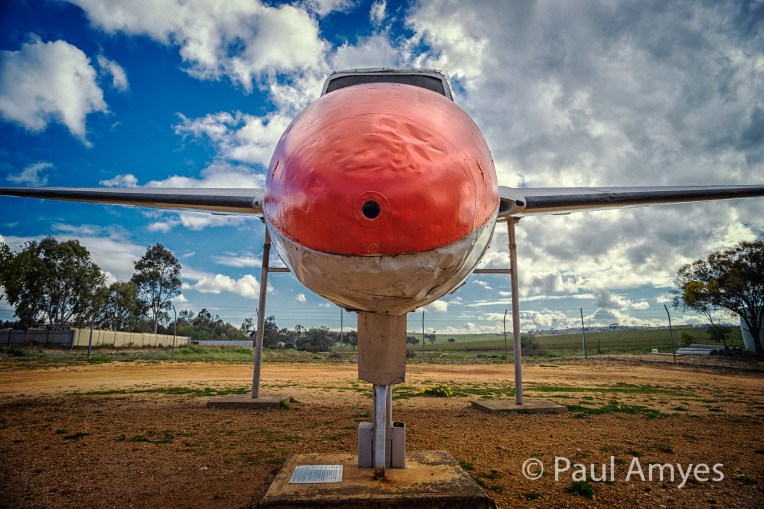
This lens encourages you to look for unusual points of view. A Vampire jet on the Beverley-York Road advertises the Beverley Aeronautical Museum.


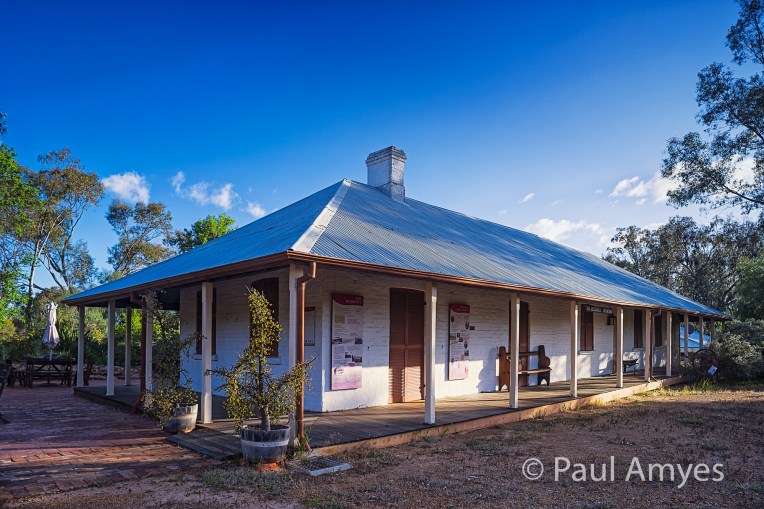
The OM 21mm f3.5 is well suited to architectural photography. The York Residency Museum. Built in the 1850's as the quarters for the superintendent of the York Convict Depot and is the last remaing building from the depot. Later it became the official residence of the magistrate, then it was used as part of the old York Hospital. It fell into disrepair and was saved by the work of the York Society. In 1972 it opened as a museum and has been used as such since.
The OM 21mm f3.5 is well suited to architectural photography. The York Residency Museum. Built in the 1850’s as the quarters for the superintendent of the York Convict Depot and is the last remaining building from the depot. Later it became the official residence of the magistrate, then it was used as part of the old York Hospital. It fell into disrepair and was saved by the work of the York Society. In 1972 it opened as a museum and has been used as such since.


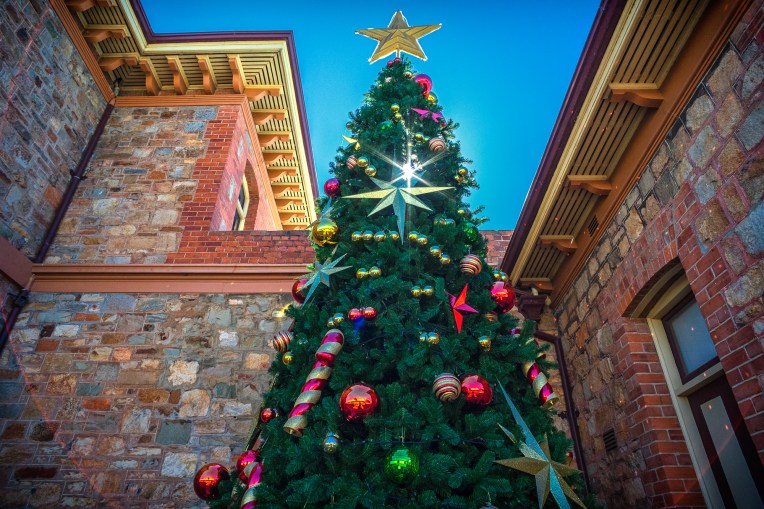
Shooting into the sun flare is very well controlled for such a wide lens. Note the sun star - the six aperture blades create a nice effect when stopped down to f16. The Shire of York Christmas tree for 2016 on Avon Terrace.
Shooting into the sun flare is very well controlled for such a wide lens. Note the sun star – the six aperture blades create a nice effect when stopped down to f16. The Shire of York Christmas tree for 2016 on Avon Terrace.

Conclusion

Well my only criticism of this lens is really nit-picking. It is just that aperture of f3.5 is a little dim and if I were to use it on an SLR (digital or analogue) it would make focusing using a split screen finder a little bit tricky. With the EVF of the A7r it makes no difference as the view can be made brighter and the focus peaking is easy to see. Probably this is not the lens to buy if you’re into astro, but if you shoot landscape and architecture as I do then it is a worthy addition to the camera bag.
The other OM lenses I’ve looked at are:

Olympus OM Zuiko 135mm f2.8
Olympus OM Zuiko MC 50mm f1.4
Olympus OM Zuiko 35-105mm f3.5-f4.5
Olympus OM Zuiko MC 35mm f2
Olympus OM Zuiko MC 24mm f2.8

2016 In Review

Faversham
The Faversham vintage van in Avon Terrace, York, Western Australia. Olympus OMD EM-1 with Olympus OM Zuiko 35-105mm f3.5-4.5 lens. Exposure: 1/200 sec, f5.6 ISO 400.


If you have slightly geeky bent, and to be honest if you are reading a photography blog it’s pretty much a given that you have, then Adobe’s Lightroom has several useful tools. One of the ones I’ve been looking at is the ability to look at your photographic work for a specific time frame, and in this case it’s for the year 2016. You can also look at the cameras and lenses you used for that period which enables you to see what patterns of equipment usage emerge. It might ultimately save you money i.e. if you have a hankering for an expensive lens you can look back on your past year to see if that focal length/s you used and whether the objective lens of your desires is one you’d actually use or not. This has actually happened to me – a while back I was working on my project Broncos and Bulls and I felt that the Canon EF 75-300 f4-5.6 IS was costing me shots as it wasn’t the fastest lens to focus and the images at the long end were pretty soft. I wanted a Canon 100-400 L IS but my then preferred local dealer didn’t have one in stock and after waiting nearly 3 months they informed they couldn’t get one. I allowed them to talk me into buying the Canon 70-200 f2.8 L IS with the Canon x2 converter which they had in stock. Their logic was that I’d end up using the 70-200 much more and would hardly use it combined with the teleconverter. Now looking back through my Lightroom library I can see that I’ve hardly used the 70-200 at all on its own and virtually all the times I have used it was in conjunction with the teleconverter. I should have stuck to my guns and gone to another dealer and that way I’d have a lens that met my needs gave and gave good image quality rather than put up with a convenient compromise.


Gotcha!!! by Paul Amyes on 500px.com
Gotcha. Steer roping, Boddington Rodeo Western Australia. Canon EOS 5D with Canon 70-200 f2.8 IS L and x2 converter. Exposure: 1/800 s at f/5.6 ISO 200
 So what have I deduced about my photography for 2016? Well I’ll start with commenting on 2015 – for that year over half my photographic output was shot with a DSLR (50:50 split between full frame and APS-C). In 2016 that dropped to 10% the other 90% was shot on mirrorless. The DSLR was only used for some macro work (radio controlled TTL flash), some architecture (a specialised lens) and one event where I had a crisis of confidence and didn’t think the mirrorless cameras would cope with high ISOs and low light focussing. When I look at lens usage it comes as a big surprise that one-quarter of the images were taken using adapted lenses and these with a focal range of between 15-135mm in full frame terms. Hmmm well I knew I preferred shorter lenses than


Quairading Railway Station by Paul Amyes on 500px.com
Aboriginal art at Quairading Railway Station, Western Australia. Sony A7r with Olympus OM Zuiko 24mm f2.8 lens. Exposure: 1/4000, f8 at ISO 400.

longer already, the main thing is that I enjoyed using legacy lenses and was more than happy with them in terms of image quality. I don’t have to use legacy lenses at all as I have 20 to 600mm covered by modern dedicated AF lenses. For work where it is appropriate I will use the legacy lenses because they give a certain aesthetic that I like which is a less digital and clinical look.


York Mill by Paul Amyes on 500px.com
As you drive into York on the Great Southern Highway standing tall on your left is the historic York Flour Mill built in 1892, home to The York Mill. Sony A7r with Voigtlander 15mm f4.5 Super Wide – Heliar lens. Exposure: 1/25 sec, f16 at ISO 100.

Well what will 2017 bring. Well for 2016 I experimented with finding a certain look. For 2017 will be more project driven as I have found the style I wanted and now want to put it to practice. There will be at least one new book (work on that has already started) and there will be some multi media projects. So exciting times indeed.


Hillside Farmhouse by Paul Amyes on 500px.com
Hillside Farmhouse was designed by Sir Talbot Hobbs, a leading architect and built in 1911 for Morris Edwards in the historic Wheatbelt town of York in Western Australia. Sony A7r with Olympus OM Zuiko 35-105mm f3.5-4.5 lens mounted via a Fotodiox adapter, Cokin circular polarizing filter and +3 stop graduated neutral density filter. Exposure 4 seconds, f16, ISO 50.


I hope for my readers that 2017 will be all that you hope and that you’ll be healthy and happy.


Everlastings by Paul Amyes on 500px.com
Everlastings on Mount Brown in York, WA. Sony A7r with Olympus OM Zuiko 135mm f2.8 lens. Exposure: aperture priority with +1 stop exposure compensation, 1/1000th sec, f2.8 at ISO 100.


Merry Christmas

Christmas Tree by Paul Amyes on 500px.com
The Shire of York Christmas tree for 2016 on Avon Terrace. Sony A7r with Cosina Voigtlander 15mm f4.5 Super Wide – Heliar lens. Exposure: 1/125th sec, f16 ISO 800.


Olympus OM Zuiko 135mm f2.8 lens

This is my fifth look at classic Olympus OM Zuiko lenses and how they perform on a Sony A7r.

The Olympus OM Zuiko 135mm f2.8 fresh out of the box. Even though it is thirty years old it is brand new, never having been used.

Many years ago I had a very basic camera kit consisting of an Olympus OM Zuiko 50mm f1.8 and 135mm f2.8 lenses with an Olympus OM20.One summer I made a series of portraits of friends down on the beach at Bognor Regis and shot a couple of concerts using the 135mm. The speed and shallow depth of field enabled me to get some shots that sold very well and that cemented the idea of my turning professional in my mind. Unfortunately I was seduced by the lure of zoom lens convenience and part exchanged the 135 for the Olympus 35-105mm. While the zoom was very good and became my photographic workhorse I regretted letting the 135 go.


The Olympus OM Zuiko 135mm f2.8 mounted on a Sony A7r using a Fotodiox adapter.


Fast forward some 30 years and I’ve been re-appraising my OM lens collection by mounting them on a Sony A7r. The results have exceeded my expectations so a little while ago I found my trawling EBay idly when I found a brand new OM 135mm f2.8 lens – and I mean brand new, never used complete in its unopened box. So I hit the “buy now” button and waited patiently for the lens to arrive. When it finally got here it was like being re-united with an old friend. The lens feels gorgeous – reassuringly sold and just oozing quality.The detents of the aperture ring cause it to have a very pleasing click as the ring is turned, and the focusing ring has a wonderfully smooth dampened action. The built in lens hood is a delightful touch in this day of $100 options one has to pay to get one for many modern lenses.


Olympus OM Zuiko 135mm f2.8
Part of the original instruction manual showing the optical construction of the lens. It is a very simple design of five elements in five groups.


The E-Zuiko AUTO-T 135mm f/2.8 was one of the first lenses released when the OM system was launched in 1972. It is easily identifiable thanks to the chromed front filter ring (the so-called “silver nose”). In 1977 it was replaced by the Zuiko AUTO-T 135mm f/2.8. Other than the improved multi-coated optics and some cosmetic changes (notably the loss of the silver nose) the lenses are largely the same with an optical formula of 5 elements in 5 groups and both versions come in at a svelte 360g (12.7 oz) The lens departs from the common Olympus filter size of 49mm and uses one of 55mm to allow a larger front element to facilitate the extra light gathering capability of this over the f3.5 version. This is a very modest size though in this day of 77 and 82 mm filter threads used on many modern lenses. Common to all Olympus OM prime lenses the aperture ring is forward of the focusing ring which makes the lens well-balanced in the hand and easy to use. In this day and age of F1.4 and f1.2 primes the maximum aperture seems a little pedestrian, but the aperture range of f2.8 to f22 allows for depth of field control when combined with the compression effect of a true telephoto.

Just to demonstarte the effect of stopping this lens down has on DOF. This is wide open at f2.8.
Just to demonstrate the effect of stopping this lens down has on DOF. This is wide open at f2.8.


Just to demonstarte the effect of stopping this lens down has on DOF. This is f8.
Just to demonstrate the effect of stopping this lens down has on DOF. This is f8.


Just to demonstarte the effect of stopping this lens down has on DOF. This is f22.
Just to demonstrate the effect of stopping this lens down has on DOF. This is f22.


olympus-om-zuiko-135mm-f2-8-lens


So down to the nitty-gritty – how does the lens perform on a modern digital camera. The quick answer is very well. Barrel distortion is virtually non-existent. In term of sharpness wide open the lens is pleasantly sharp although lacking in contrast and this improves when the lens is stopped down to f8. At the edges at f2.8 predictably the lens is very soft and has poor contrast. This is not altogether surprising considering the very simple design with no exotic elements. Things improve by f8 although it does not reach the standards of the centre.Vignetting is obvious wide open and again clears up as the lens is stopped down and disappears at f8. There is some chromatic aberration but it is very mild and easily fixed in Lightroom. The bokeh is nice and smooth but with only 8 aperture blades the “bokeh balls” turn into octagons as you stop down. When stressed by shooting into the sun veiling flare is very apparent, the solution to this is use a lens hood and that is easy as it is built into the lens.

 Shooting into the sun without a lenshood at f2.8. The veiling flare is very apparent.
Shooting into the sun without a lenshood at f2.8. The veiling flare is very apparent.


What a difference a lens hood makes. Shooting into the sun with a lenshood at f2.8. The rendition of the out of focus highlights (bokeh) is very pleasing.


With a minimum focusing distance of 1.5m the range of the depth of field at f2.8 is just 0.02m. Using the focus peaking set to mid on the A7r caused me no problems with finding focus on this shot. Everlastings on Mount Brown in York, WA.


One of the things I noticed when using this lens is that the weight and the resistance of the focusing ring shows the short comings of the Fotodiox adapter. You can feel the lens moving in the adapter as you turn the focus ring. The cheap no-name Chinese version was a lot worse. I am thinking about getting some longer lenses, but after this I think I’ll have to investigate a better adapter such as the one made by Novoflex.


Frida posing in the river. At f5.6 the lens is very sharp in the centre. Zoom into the area around Frida's eye and ear and the fine detail of her fur is clear.
Frida posing in the river. At f5.6 the lens is very sharp in the centre. Zoom into the area around Frida’s eye and ear and the fine detail of her fur is clear.


Subject isolation is what this lens is all about. Shooting at f4 through a chain link fence at this alpaca demonstrates this.


So to sum up – to get a better lens you’ll have to spend a lot of money on a more modern highly corrected design. With the softer edges the lens makes a very good portrait lens and you could make a strong argument that the decreased contrast in the centre at f2.8 and f4 would make it very suitable for glamour photography. The true telephoto effect of this focal length makes it a useful lens when you wish to compress perspective when shooting landscapes. The focus throw is a little over 180º and that makes finding focus a precise affair and would appeal to film makers. All in all if you want a manual focus telephoto for use on a full frame sensor then seriously consider this one.


At f11 the lens has bags of resolution and is capable of recording very fine detail. There is no sign of diffraction reducing the image quality. Wandoo tree (white gum) on the outskirts of the Western Australian town of Beverley.

So far I have looked at the following Olympus lenses:-


Leica Look

Leica want you and everyone around you to know that you are using one of its cameras.


First off a big thanks to Saul Frank and the nice people at Camera Electronic who very kindly awarded me a Leica D-Lux Type 109 in a recent in store competition.

It's all about the lens. Forget the red dot, the Leica DC Vario-Summilux 10.9-34mm f1.7-2.8 is the star of the show.
It’s all about the lens. Forget the red dot, the Leica DC Vario-Summilux 10.9-34mm f1.7-2.8 is the star of the show.

For many years Leica aficionados have talked about the “Leica look”. They weren’t talking about the design of the camera, but the way Leica lenses render an image. Many would say that they can look at a photo and tell whether it was taken with a Leica or not. Non Leica users scoff at this and generally accuse Leica owners of being people with more money than sense and with no knowledge of photography. Roger Hicks, the noted English photographic author, once attributed the Leica look to older Leica lenses, film with no anti-halation layer, and over exposure. This allowed soft light to reflected from behind the film and cause bright edges in the image. So that brings us to modern digital Leicas and in the case of the D-Lux those that are built by Panasonic. Do they exhibit the “Leica look”? I think the answer is emphatically no! Modern lenses, even those made by Leica, are inherently more contrasty and digital sensors behave in a completely different way to film.

The Leica D-Lux compared with the Panasonic Lunix LX5. Looking from the front there is not a lot of difference in the size despite the D_Lux have a sensor much larger than the LX5.
The Leica D-Lux compared with the Panasonic Lumix LX5. Looking from the front there is not a lot of difference in the size despite the D-Lux having a sensor much larger than the LX5.


The Leica D-Lux compared with the Panasonic Lunix LX5. From above the size difference is more apparent.
The Leica D-Lux compared with the Panasonic Lumix LX5. From above the size difference is more apparent.

So lets talk about the D-Lux, or should I say the Panasonic Lumix LX100? It’s not the first time Leica have re-branded a Panasonic model. The Panasonic Lumix LX5, which I own and have sung the virtues of on this blog, was marketed by Leica as the D-Lux5 and there were many others before that. So what does paying the Leica tax get you over the Panasonic? Leica say they have had the firmware tweaked to their specification and that differentiates it from the LX 100.  Both cameras have a Leica DC Vario-Summilux 10.9–34 mm f/1.7–2.8 ASPH zoom lens which gives a 35mm equivalent of a 24-75mm lens. I doubt very much that the lenses are made by Leica, it is more likely that Panasonic have licensed the Leica name in the same way that Sony have with Zeiss. The only thing that really differentiates them is the design of the outer shell. The Panasonic has a grip and a faux leatherette covering while the Leica is smooth with no grip. I’d have to say I prefer the look of the Leica, it is to my eye a very sexy looking beast. The only thing that lets it down to my mind is that the shell is plastic, and although the body has a very pleasing heft it feels disappointing not to have the cool feel of a metal shell. Technically the camera is a m4/3 camera with a 16Mp 17.3 mm × 13.0 mm sensor, but the reality is that the camera uses a smaller portion. This has enabled the manufacturer to provide a fast zoom lens in a small size and the image circle created by the lens is smaller than the sensor. The upshot is that you get a multi format camera (4:3, 3;2, 1:1 and 16:9) with a good fast lens. The down side is that you only get 12Mp out of a 16Mp sensor which means even at base ISO of 200 grain is apparent. Having said that thanks to the lens the image quality is good enough for an A3+ (13″ x 19″ or 329mm x 483mm) print which is great for a compact camera. The lens has some corrections applied in camera and is distortion free and suffers from minimal chromatic aberration. I only shoot RAW so can’t comment on the jpgs.

The top plate shows the camera was designed by a photographer. aperture, shutter speed, and exposure compensation all handled by dials. To switch to aperture priority put the shutter speed dial on "A". To go to shutter speed priority switch the aperture to "A". Want programe mode put both the aperture and shutter speed dial on "A". Simple.
The top plate shows the camera was designed by a photographer. aperture, shutter speed, and exposure compensation all handled by dials. To switch to aperture priority put the shutter speed dial on “A”. To go to shutter speed priority switch the aperture to “A”. Want program mode put both the aperture and shutter speed dial on “A”. Simple.


Everlastings on Mount Brown in York, WA. Exposure: 1/400th sec, f8 at ISO 800. The close focusing capability made this shot a doddle as did the evaluative metering and the dynamic range of the sensor.


St Mary’s Cathedral, Perth, Western Australia. Exposure: 1/320th sec, f8 at ISO 200. The lens is still very good, showing minimal distortion and very little chromatic aberration. Again the metering and the dynamic range combined to handle this scene with aplomb.


Graffiti under the Great Southern Highway traffic bridge in York, Western Australia. Exposure: 1/640th sec, f2.8, at ISO 1600. Wide open the lens is sharp and contrasty. The sensor is noisy at high ISO, but appears very organic and film like.


Nature trying to reclaim the CBD. Northbridge, Western Australia. Exposure: 1/640th sec, f16 at ISO 3200. The lens is quite resistant to flare which is just as well as like other premium compacts the camera ships without a lens hood.


Defacing Reclaim Australia notices in Northbridge, Western Australia. Exposure: 1/2000, f2.8 at ISO 200. A combination of large sensor and fast lens means that shallow depth of field shots are possible. The lens renders subjects very well with a nice fall off in tones and sharpness.


Wall mural at the North Metropolitan TAFE Campus in Northbridge. Exposure: 1/1000th sec, f8 at ISO 200. Panasonic aren’t as accomplished with colour science as some other manufacturers so it is safe to say that Leica’s secret sauce has delivered some really nice colour profiles.


The patterns on a pruned grass tree. Balladong, Western Australia. Exposure: 1/125th sec, f8 at ISO 250. This file prints out fantastically at A3+. The edge to edge sharpness and detail are amazing


Watching the large screen in the Perth Cultural Precinct. Exposure: 1/250th sec, f8 at ISO 200. With its small size, great lens, and good AF performance the Leica D-Lux makes an excellent street camera.

Video quality is very very good. The camera shoots 4K video at 25p 100Mbps and HD at 50p 28Mbps, but specs aren’t everything. For example my phone can shoot 4K video but it is horrible looking and very brittle when processing. The D-Lux gives you a good file that will stand some post processing. I’ve really enjoyed shooting movies and time-lapse sequences with the camera. This is where the DNA proves Panasonic’s paternity. There are only two things that lets it down. First is sound – there is no mic input. With this small feature added the camera would really rock as discrete video cam. Second some form of built in ND filter would really make the camera perfect enabling lovely wide open shots possible in bright sunlight. The wide shots in the video below were shot with the D-Lux.


The rear of the D-Lux is very tidy and well organised.


My Leica D-Lux pimped out with its accessory grip, tripod adapter and Peak Designs Anchor Link.


So to sum up. This was a prize that I won, not a purchase. To be honest if it were my money I would have bought the Panasonic LX100 which is over $500 AUD cheaper. Leica try to talk you up by saying their version thanks to its Leica firmware produces better images and they throw in a copy of Adobe Lightroom. But honestly Lightroom is less than $200 and if you shoot RAW you can get the look you want easily enough. I found the body too smooth and sprung for the accessory grip which made life a lot better. The EVF ain’t crash hot – it is a field sequential LCD which means that it is subject to tearing with moving subjects or moving your eye around the viewfinder. This doesn’t bother some people as much as others, but it may be a deal killer. There’s no floppy touch screen and no mic input. On the plus side the camera is responsive produces good stills, very good video and is compact enough that it can be taken anywhere. When I got the camera I initially thought I’d use it for a few days and then sell it on Ebay. Instead I’ve had so much fun with it I’ve decided to keep it.

UPDATE   Well I wrote this before Photokina, the big camera industry trade show in Cologne, Germany. I was hoping for a new updated model from either Leica or Panasonic to be announced with some of the changes I’ve talked about. Panasonic announced the  launch of the  LX10/LX15 (depending on which region you live in) camera. There are some worthy upgrades in the form of a tilt touch screen, an improved image stabilisation system, increase in MP to 20 and Panasonic’s very spiffy 4K photo mode which allows users to record video at 4K 30fps and extract stills from the clip. But the downsides are the loss of the viewfinder and the smaller sensor.

Grand Master Flash

The new mug shot of yours truly. Olympus EM-10 with Olympus m.Zuiko 45mm f1.8 lens. Exposure 1/200 sec, f3.2 at ISO 200.

The “Strobist” phenomena burst onto the photographic scene some ten years ago and thanks to the efforts of David Hobby and the timely release of reliable affordable radio controlled flash triggers a whole movement was born. What was exciting was that Hobby advocated a lean and mean approach to lighting using affordable and portable speedlites. In an era of auto everything Hobby also broke the mould by showing people how easy it was to use manual flash. Joe McNally shooting Nikon and Syl Arena using Canon quickly jumped on the band waggon extolling the virtues of off camera flash using the TTL systems of Canikon.

The other day I had the sudden realisation that I would need a new photo for the promotion of current exhibition as the one I had been using was out of date – I have considerably more hair on my head and less hair on my chin now. My preferred photographer is Liv Stockley but she is currently somewhere in Africa and unavailable for the job. So I would have to shoot this myself aided by my partner Helen. Using the Olympus OMD EM10 with the fantastic Olympus m.Zuiko 45mm f1.8 was a no brainer – bags of resolution, fantastic image quality and it allowed Helen to take the shot by controlling the camera via wi-fi using an iPad. Lighting was the conundrum. It would have to be flash, but how to control it? I wanted the key light in a big brolly box, but this would mean I would lose the TTL flash capability as Olympus use a line of sight light transmission system for their wireless flash. Once the slave flash is enveloped by a large light modifier it can’t pick up the signal from the master, so I would have to use a radio trigger. There are no reliable easily available radio controlled TTL triggers for the m4/3 system so it would have to be manual all the way and the excellent Hahnel Captur fit the bill perfectly. They are available from good camera stores, I got mine from Digital Camera Warehouse, and they have a good warranty. Why take a punt with cheap no name “poverty wizards” from dodgy Chinese Ebay sellers when you can get an excellent product locally? So that’s the triggering taken care of. To work out the exposure I used my trusty Minolta Auto Meter Ⅴ F. Sadly no longer made by Minolta as Sony took them over and canned the flash meter product line, but it is now made by Kenko. Yes it is old school and some may argue that in the digital era not needed, but I like working this way. In this scenario there is no need for TTL flash as the lighting and subject to camera distance remain constant.

An Olympus OMD EM1 with the Hahnel Captur flash trigger in the hotshoe, and a Metz 64 AF-1 with the Hahnel Captur receiver. Canon EOS6d with Sigma 105mm f2.8 EX macro, Canon 430 and 550 EX Speedlites. Exposure: 1/180 sec, f8 at ISO 400.

Equipment sorted the styling of the photo was the next consideration. The portrait would be a classic head and shoulders, but I wanted something clean and contemporary. Initially I thought about using the classic Rembrandt lighting style. It’s the studio portraitist’s bread and butter lighting, but it is a little bit staid. So I decided to go with broad lighting. One Metz Mecablitz 64AF-1 Flash in a brolly box was the key and a large reflector provided the fill. To provide a bit of separation from the background a Metz 44 AF-1 (now superseded by the 44 AF-2) fitted with a Hohnl Speed Grid. Simple and effective.

Basic lighting set for broad lighting using one key light, a reflector as fill and a guided background light.
Basic lighting diagram for broad lighting using one key light, a reflector as fill and a gridded background light.

So while the “Strobist” phenomena has largely gone out of fashion, the principles and skills are very useful and every photographer should have some grasp of the basics.

Olympus OM Zuiko MC 35mm f2.0

Some years ago I was going through a phase I called “delusions of Bresson“. It involved hanging around on the street corners of Perth with a range finder camera fitted with a 35mm lens. It enabled me get close enough to my subjects but not ground them. In modern terms 35mm is not considered a wide-angle lens – in fact quite a few photographers brought up in the digital age think that wide angles start at 20mm (35mm full frame equivalent) – 35mm is seen more as a widish standard lens. Either way it is how I have come to see the world and I consider a 35mm prime (or its equivalent angle of view depending on format size) to be an essential item in my camera bag and this brings me to the Olympus Zuiko 35mm f2 lens.

Olympus OM Zuiko MC 35mm f2 lens.


Olympus OM Zuiko MC 35mm f2 lens.


There are again multiple versions of this lens. The first silver nosed single coated version was 42mm in length, 230g in weight and had a filter thread of 49mm. This MC version is 43mm in length, 240g in weight and has a filter thread of 55mm. It has an optical construction of eight lens elements in 7 groups and a minimum focusing distance of 0.3m.


Olympus OM Zuiko MC 35mm f2 lens

There is slight barrel distortion evident in the test image. CA is present when wide open and clears up on stopping down Wide open the lens is quite soft and lacking in contrast both in the centre and at the edges. Both sharpness and contrast improve in the centre when stopped down to f8. The edges show some signs of improvement but not as much as the centre. Wide open there is some vignetting but that quickly disappears as you stop down. The lens is quite prone to flare, especially ghosting flare, when there is a point light source in the frame. The solution is to use a lens hood or you can do as I sometimes do and use my cap as a French flag. The alternative approach is to embrace the flare and use it creatively in your photos and videos.


York Cemetry, Mount Brown, Western Australia. Olympus OM Zuiko 35mm f2


York Cemetry, Mount Brown, Western Australia. Olympus OM Zuiko 35mm f2


York Cemetry, Mount Brown, Western Australia. Olympus OM Zuiko 35mm f2.


Canola and Patterson’s Curse at sunset. Mount Brown, York, Western Australia. Olympus OM Zuiko 35mm f2

If you can find a good clean copy of the multi-coated version of this lens at a good price then I recommend you pounce on it. It is a wonderful characterful lens that makes its modern counterparts look sterile and boring.

The Olympus OM Zuiko 35mm f2 lens mounted onto a Sony A7r via a Fotodiox adapter.


My reviews of the Olympus 24mm f2.8, 35-105mm f3.5-4.5 and 50mm f1.4 can be found by clicking on the links.

Olympus OM Zuiko 35-105mm f3.5-f4.5

So far I’ve looked at a couple of primes and now I’m going to turn my attention to a standard zoom, the Olympus OM Zuiko 35-105mm f3.5-f4.5.

Olympus OM Zuiko 35-105mm f3.5-4.5 lens.


Olympus OM Zuiko 35-105mm f3.5-4.5 lens.
As good as the day I bought it which was in 1983.


Introduced in 1983, which is when I bought my copy. This lens was often rumoured to have been designed and made by Tokina, but this has been refuted online and it would appear that it differs significantly enough that it can be until otherwise proven an Olympus lens.

35105mmf3545
Schematic of the Olympus OM Zuiko 35-105mm f3.5-f4.5 showing the lens elements in their various groups.


Over its production cycle there were two variants produced. The first version, which is the one I have, with serial numbers below 500,000 weighs in at 460g, is 116mm fully extended (in macro mode) and 86mm retracted, the rubber focusing grip is 42mm wide, and there is and Infra Red (IR) focusing mark above the aperture ring. The rear lens element is flat and flush with the back of the lens.The second version (serial numbers above 500,000) is 470g in weight, 87mm long retracted, and the focus grip is 38mm wide. There is no IR focus mark, but there is a white variable aperture dot between 3.5 and 5.6 on the aperture ring. The rear lens element is recessed and convex. The construction of the lens is that of a one touch zoom design with a built in close focus mechanism which allows a minimum focus distance of 31cm with a maximum reproduction ratio of 1:5. There are sixteen lens elements in twelve groups and the filter thread is 55mm. The variable aperture was a design compromise to keep weight and size down, it provides a reasonably bright f/3.5 at the wide-angle setting but gradually stopped down to a dimmer f/4.5 when reaches the telephoto range. The big disadvantage is the rate at which the aperture varies through the range and this convinced me of the practicality of using TTL flash back in my days of shooting transparency with OM cameras.


Olympus OM Zuiko 35-105mm f3.5-4.5. 35mm at f8.


Comparison chart of the Olympus OM Zuiko 35-105mm f3.5-f4.5 shot at 35mm focal length wide open and then at f8.


At the 35mm end the lens is remarkably free of distortion. Wide open the CA is very apparent, but this is easily corrected in post. The centre of the test image not crisply sharp and is also lacking in contrast which adds to the impression of softness. Bumping up the contrast in post improves things greatly. I never questioned the sharpness of this lens when shooting film – hardly surprising when you consider I most shot Fuji Chrome Velvia 50 or Kodachrome 25 or 64 all of which are high contrast films. At f8 the centre sharpness increases nicely but the edges are still soft and lacking contrast.


Olympus OM Zuiko 35-105mm f3.5-4.5. 105 at f8.


olympus-35-105-105-comparison
Comparison chart of the Olympus OM Zuiko 35-105mm f3.5-f4.5 shot at 105mm focal length wide open and then at f8.


At 105mm the lens exhibits a slight pincushion effect. This is where image magnification increases with distance from the optical axis and parallel lines bow inwards like a pincushion. This is not uncommon in this type of lens at the long end. Wide open at f4.5 the image is soft and lacking in contrast at the centre and the edges are even worse. By f8 the centre of the image has improved a little but the edges have not. CA is present but again is easily dealt with.

Back in the day this was my go to lens – I shot nearly everything on it and I thought it was great. Here are some examples of it from the early 1980’s shot on film and scanned.


Beccah and Jane
Beccah and Jane sitting on the back step at Molecomb Cottage, Goodwood, West Sussex. June 1985.


Helen Anderson
Helen, Chichester, West Sussex. September 1985.


Paradise Video-Music Pub
Paradise Video-Music Pub, Thira, Santorini, Greece.

So lets see how it does on the Sony A7r.


Balloons
Balloons in the window. York, Western Australia. Olympus OM Zuiko 35-105mm f3.5-4.5.


Bully Bridge
Bully Bridge. Frida, the English Bull Terrier, on the Swing Bridge in York, Western Australia. Olympus OM Zuiko 35-105mm f3.5-4.5


Bridge Over The Avon
The River Avon in York, Western Australia. Olympus OM Zuiko 35-105mm f3.5-4.5


Overall the lens lacks the contrast present in the other OM lenses. The bokeh is somewhat swirly though not as obvious as that exhibited by the Helios 58mm f/2 lens and is what some might call a little nervous. Wide open this lens is very prone to vignetting and filter users will have to be aware of this. Now zoom lens from this era have a bad rap for poor image quality so I thought that it would be interesting to compare this lens with a modern standard zoom – namely the Sony FE 28-70mm F3.5-5.6 OSS. Some people might find this an unfair comparison comparing a cheap kit lens with a premium quality zoom lens, but there is over thirty years separating them and lens design has come on a long way in that time especially in regard to zooms.


Sony 28-70mm f3.5-5.6 OSS


The most obvious thing that comes to mind when comparing the two lenses is the build quality – compared to the Olympus 35-105 the Sony feels like it came out of a Christmas cracker. It feels very cheap and plasticky and quite honestly it doesn’t feel very durable at all. In fact the word “disposable” comes to mind when handling it and  I don’t think we’ll see many working copies of this lens around in thirty years time.

Sony 28-70mm f3.5-5.6 OSS


Sony 28-70mm f3.5-5.6 OSS. 28mm at f8.


sony-28-70-28-28
Sony FE 28-70mm F3.5-5.6 OSS at 28mm comparing the centre and the edges of the frame at f3.5 and f8.


sony-28-70-28-70

So having looked at the test shots what can we say? Well wide open at 28mm the centre the lens is sharp and contrasty and amazingly it improves considerably when stopped down to f8. At the edges wide open there is a significant drop off of sharpness and contrast and this only improves slightly when stopping down to f8. Distortion and chromatic aberration are automatically corrected in camera. At 70mm wide open in the centre the lens is a little soft and flat with hardly improvement when stopping down to f8. At the edges it is much the same story. The only real advantage this lens has over the Olympus is the automatic lens profiles that correct CA and distortion and the lens coatings are marginally better all of which can be overcome with a little fiddling around in Lightroom. The Sony sells for around $350 AUD at the moment while the Olympus can be picked up for less than $100 AUD on EBay. What is more worrying is that according to DXO the Sony FE Carl Zeiss Vario-Tessar T* 24-70mm F4 ZA OSS which is priced at around $1500 AUD is not significantly better than its cheaper sibling and coupled with accounts of substantial sample variation just doesn’t seem to have endeared it to Sony Alpha users. All this makes the Olympus OM Zuiko 35-105mm f3.5-4.5 seem like a screaming bargain if you don’t mind having a manual focus lens as your walk about kit.

My reviews of the Olympus OM Zuiko MC 24mm f2.8 and the Olympus OM Zuiko MC 50mm f1.4 can be seen by clicking on the links.

“My love is wider…

…wider than Victoria Lake”*


York Mill
As you drive into York on the Great Southern Highway standing tall on your left is the historic York Flour Mill built in 1892, home to The York Mill.

I like wide-angle lenses, I use them a lot, but funnily enough mostly in the 24-35mm range (35mm full frame sensor speak that is). Occasionally I’d pull oy a 20mm, but as I said only very occasionally. The above shot was taken with a 24mm lens, it’s OK but a little cramped. I couldn’t back up any more as I was against the fence so I threw caution to the wind and chucked a 15mm lens on the front of the camera – and we’re talking full frame sensor here.


York Mill
York Mill again this time Voigtlander 15mm Super Wide-Heliar lens.

It’s amazing how much difference 9mm can make. Same viewpoint but this time with the camera in the landscape orientation. It sets the building in its context and thus makes it more appealing. I also like how the whole building is acting as a giant reflector for the setting sun. This will be the picture that is used for the end product, however, the one I like the most takes advantage of the enormous depth of field that such a short focal length provides.


York Mill
What a lot of depth of field – from 30cm to infinity at f16.


*  Today’s title comes from a couple of lines from the lyrics of “Is It A Crime” by Sade the über cool and totally smooth chanteuse of the 1980’s.