On the weekend of 19th-21st May 2017 I travelled with my significant other to the teeming Wheatbelt metropolis of Narrogin as she had entered the annual “Guns and Roses” croquet tournament put on by the Narrogin Croquet Club. Twelve of Western Australia’s best players (the “Guns”) would partner eighteen lesser ranked players (the “Roses”). Each “rose” would get the opportunity to play with a different “gun” at each round. The idea, which seems an excellent one I might add, is that inexperienced players can learn off of top players. My role in this was the self-given task of producing a video documenting the proceedings.
Video is a fairly new medium for me, I’ve been playing around with it but I’ve really not got to grips with it. This was to be a complex multi day project and it wasn’t helped by the fact that it was bitterly cold and there was intermittent heavy rain (yes dear reader we do have cold wet weather in Australia). I ended up using my Olympus OMD EM1 mk i with the Olympus m.Zuiko 40-150mm f2.8 lens as the main camera, an Olympus Pen EP5 with the Olympus m.Zuiko 12-40mm f2.8 for wide shots, a Leica D-Lux for time lapses, and my iPhone for social video in the evenings. For sound I used shot-gun microphones (a Rode VideoMicro on the EM1 and a Rode VideoMic Pro on the EP5) to record straight into the cameras. No external audio recorder was used as I felt I had my hands full enough. By the end of the weekend I had got through nine batteries and ten 16Gb SD cards. The EM1 was used on a tripod (a Manfrotto MDEVE 755XB with Manfrotto MV500AH Fluid Video Head), the EP5 was on a video monopod (Manfrotto 562B-1 Fluid Video Monopod), and the Leica D-Lux was on a photo tripod (a very old Manfrotto 190 tripod fitted with an equally old ball head).
What I learnt from this exercise was:
the weather sealing on both the EM1 and the two lenses works very well. At times I got soaked in the rain and the camera just kept going with no adverse effects.
I should have used an audio recorder to get better sound and record some general background noise.
the 40-150mm f2.8 is not parfocal (it is not sold as such) and the autofocus kept drifting and in some cases would not lock on at all. Trying to focus on the night games using just the rear screen and no peaking was hard. Either a camera that has focus peaking in video mode or a monitor that allows it would be really good.
I shot most of the footage at 1080 at 25fps except for that on the EP5 which only shoots 1080 at 30fps. I used Toast Titanium’s video converter to reconfigure it as 1080 25fps. On the whole it worked out well, but on two clips that I really wanted it dropped frames and lost the sound. So next time I won’t mix clips of different frame rates.
With four cameras, each having its own idea of what a neutral colour setting is, made life very hard during editing. This wasn’t helped by the fact that the 8 bit 4.2.0 files didn’t like being pushed too much in post as they would quickly fall apart. It would have been nice to have had a more video orientated camera with a flatter profile and more robust codec.
I did the slow motion in post, it would have been nice to have shot at 60fps or higher to get nicer slo-mo.
I should have shot more B-roll and tried to interview on camera some of the participants.
As a learning experience this was a very good exercise and I enjoyed the whole process immensely. If money were no object I’d get a more video orientated camera and a video field monitor and recorder, but being as I am fiscally challenged I’ll have to settle for some more memory cards and batteries.
The town hall in the historic Western Australian town of York in pre-dawn light. Sony A7r with Olympus OM Zuiko 35mm f2 lens and Cokin 3 stop graduated neutral density filter. Exposure: 2.5 sec, f8 at ISO 100.
The other morning I got up at stupid O’clock to shoot a dawn time-lapse of the York Town Hall. So what do you do while you’re hanging around waiting for it to finish? Why take photos of course! So while the Leica D-Lux clicked away doing it’s time lapse thing I set up the Sony A7r and started taking snaps of the town hall. Good job I did as the time lapse wasn’t that crash hot.
To visit and buy Ikea furniture is an experience that sears the psyche, but assembling it is a journey to the deepest and darkest levels of Hell itself and threatens your mortal soul.
Having fun with the time-lapse function of the Leica D-Lux. It is so much easier to use than the one in Olympus m4/3 cameras and will even generate the movie file for you at the end.
Last weekend you could be forgiven in thinking that the War of The Roses had broken out afresh in the Western Australian town of York. There were lots of grim looking men glad in chain mail and armour brandishing an assortment of fearsome looking weapons while women wafted around wearing hose, kirtles, gowns, surcoats, girdles, and bonnets while listening to bards strum away on lutes.
A grim looking man in chain mail with a fearsome looking axe.
The images were shot with an Olympus OMD EM-1, an OMD EM-10 with Olympus m.Zuiko 12-40mm f2.8 and 40-150mm f2.8 lenses. The files were processed in Adobe Lightroom and Alienskin Exposure X.
Leica want you and everyone around you to know that you are using one of its cameras.
First off a big thanks to Saul Frank and the nice people at Camera Electronic who very kindly awarded me a Leica D-Lux Type 109 in a recent in store competition.
It’s all about the lens. Forget the red dot, the Leica DC Vario-Summilux 10.9-34mm f1.7-2.8 is the star of the show.
For many years Leica aficionados have talked about the “Leica look”. They weren’t talking about the design of the camera, but the way Leica lenses render an image. Many would say that they can look at a photo and tell whether it was taken with a Leica or not. Non Leica users scoff at this and generally accuse Leica owners of being people with more money than sense and with no knowledge of photography. Roger Hicks, the noted English photographic author, once attributed the Leica look to older Leica lenses, film with no anti-halation layer, and over exposure. This allowed soft light to reflected from behind the film and cause bright edges in the image. So that brings us to modern digital Leicas and in the case of the D-Lux those that are built by Panasonic. Do they exhibit the “Leica look”? I think the answer is emphatically no! Modern lenses, even those made by Leica, are inherently more contrasty and digital sensors behave in a completely different way to film.
The Leica D-Lux compared with the Panasonic Lumix LX5. Looking from the front there is not a lot of difference in the size despite the D-Lux having a sensor much larger than the LX5.
The Leica D-Lux compared with the Panasonic Lumix LX5. From above the size difference is more apparent.
So lets talk about the D-Lux, or should I say the Panasonic Lumix LX100? It’s not the first time Leica have re-branded a Panasonic model. The Panasonic Lumix LX5, which I own and have sung the virtues of on this blog, was marketed by Leica as the D-Lux5 and there were many others before that. So what does paying the Leica tax get you over the Panasonic? Leica say they have had the firmware tweaked to their specification and that differentiates it from the LX 100. Both cameras have a Leica DC Vario-Summilux 10.9–34 mm f/1.7–2.8 ASPH zoom lens which gives a 35mm equivalent of a 24-75mm lens. I doubt very much that the lenses are made by Leica, it is more likely that Panasonic have licensed the Leica name in the same way that Sony have with Zeiss. The only thing that really differentiates them is the design of the outer shell. The Panasonic has a grip and a faux leatherette covering while the Leica is smooth with no grip. I’d have to say I prefer the look of the Leica, it is to my eye a very sexy looking beast. The only thing that lets it down to my mind is that the shell is plastic, and although the body has a very pleasing heft it feels disappointing not to have the cool feel of a metal shell. Technically the camera is a m4/3 camera with a 16Mp 17.3 mm × 13.0 mm sensor, but the reality is that the camera uses a smaller portion. This has enabled the manufacturer to provide a fast zoom lens in a small size and the image circle created by the lens is smaller than the sensor. The upshot is that you get a multi format camera (4:3, 3;2, 1:1 and 16:9) with a good fast lens. The down side is that you only get 12Mp out of a 16Mp sensor which means even at base ISO of 200 grain is apparent. Having said that thanks to the lens the image quality is good enough for an A3+ (13″ x 19″ or 329mm x 483mm) print which is great for a compact camera. The lens has some corrections applied in camera and is distortion free and suffers from minimal chromatic aberration. I only shoot RAW so can’t comment on the jpgs.
The top plate shows the camera was designed by a photographer. aperture, shutter speed, and exposure compensation all handled by dials. To switch to aperture priority put the shutter speed dial on “A”. To go to shutter speed priority switch the aperture to “A”. Want program mode put both the aperture and shutter speed dial on “A”. Simple.
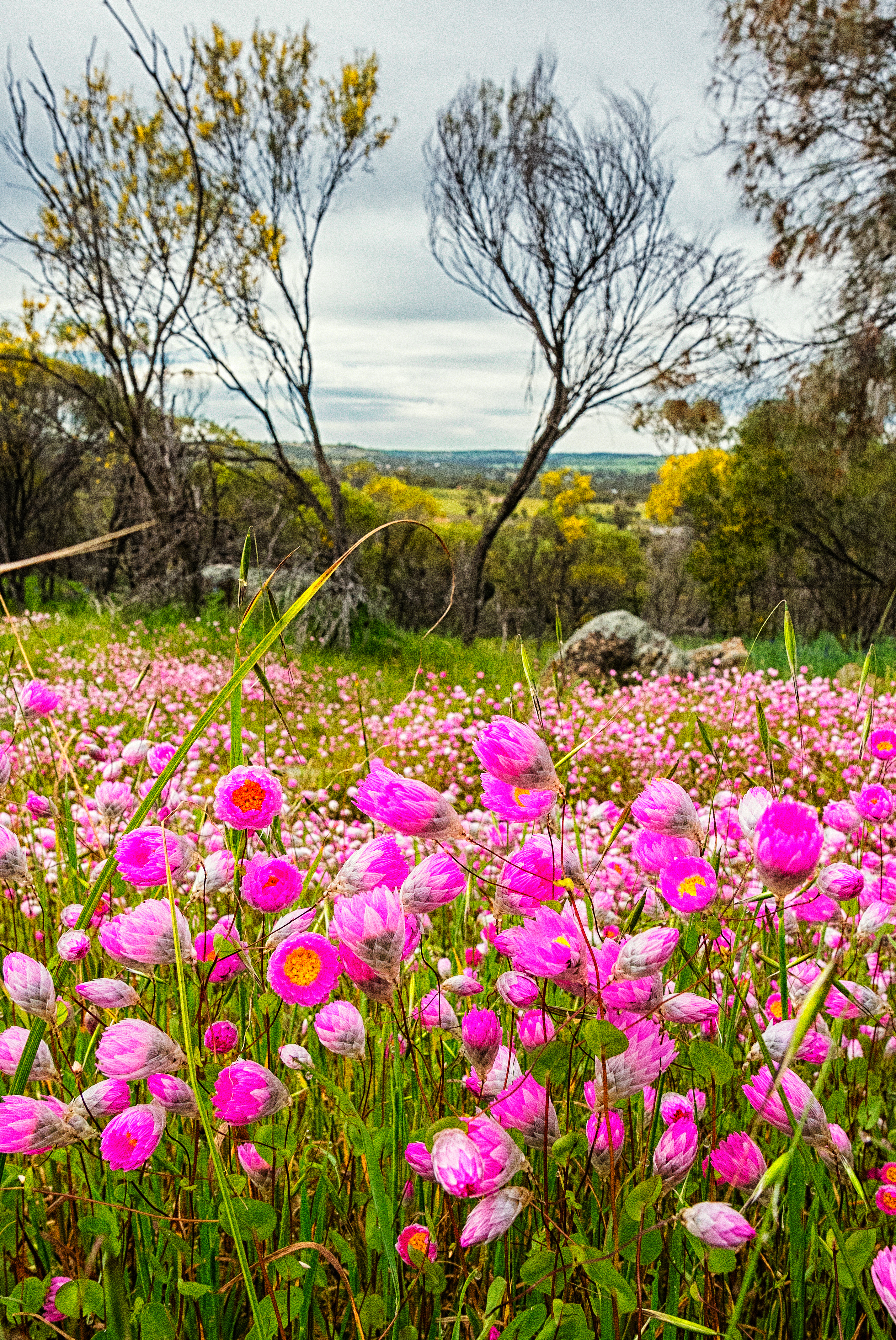
Everlastings on Mount Brown in York, WA. Exposure: 1/400th sec, f8 at ISO 800. The close focusing capability made this shot a doddle as did the evaluative metering and the dynamic range of the sensor.
St Mary’s Cathedral, Perth, Western Australia. Exposure: 1/320th sec, f8 at ISO 200. The lens is still very good, showing minimal distortion and very little chromatic aberration. Again the metering and the dynamic range combined to handle this scene with aplomb.
Graffiti under the Great Southern Highway traffic bridge in York, Western Australia. Exposure: 1/640th sec, f2.8, at ISO 1600. Wide open the lens is sharp and contrasty. The sensor is noisy at high ISO, but appears very organic and film like.
Nature trying to reclaim the CBD. Northbridge, Western Australia. Exposure: 1/640th sec, f16 at ISO 3200. The lens is quite resistant to flare which is just as well as like other premium compacts the camera ships without a lens hood.
Defacing Reclaim Australia notices in Northbridge, Western Australia. Exposure: 1/2000, f2.8 at ISO 200. A combination of large sensor and fast lens means that shallow depth of field shots are possible. The lens renders subjects very well with a nice fall off in tones and sharpness.
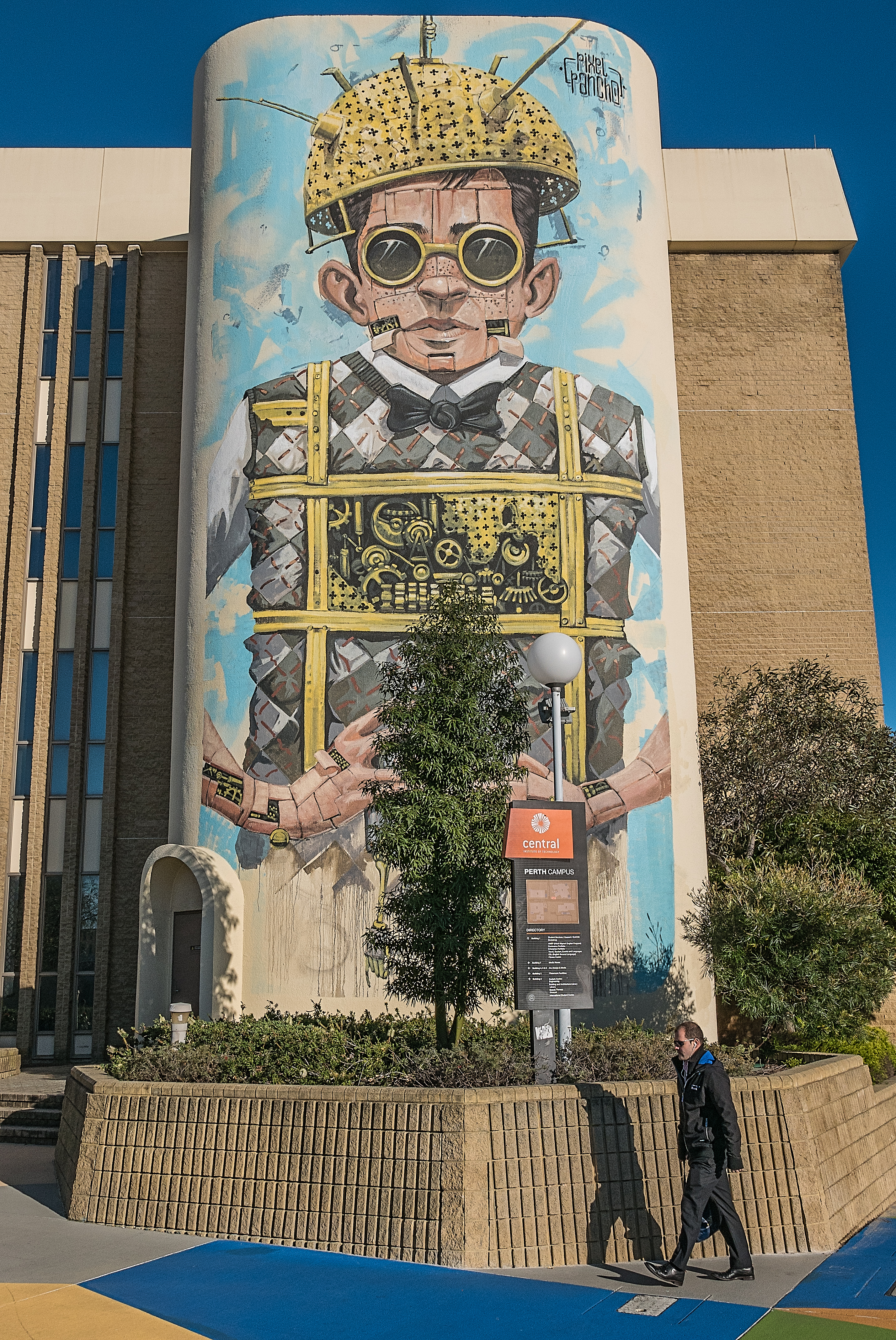
Wall mural at the North Metropolitan TAFE Campus in Northbridge. Exposure: 1/1000th sec, f8 at ISO 200. Panasonic aren’t as accomplished with colour science as some other manufacturers so it is safe to say that Leica’s secret sauce has delivered some really nice colour profiles.
The patterns on a pruned grass tree. Balladong, Western Australia. Exposure: 1/125th sec, f8 at ISO 250. This file prints out fantastically at A3+. The edge to edge sharpness and detail are amazing
Watching the large screen in the Perth Cultural Precinct. Exposure: 1/250th sec, f8 at ISO 200. With its small size, great lens, and good AF performance the Leica D-Lux makes an excellent street camera.
Video quality is very very good. The camera shoots 4K video at 25p 100Mbps and HD at 50p 28Mbps, but specs aren’t everything. For example my phone can shoot 4K video but it is horrible looking and very brittle when processing. The D-Lux gives you a good file that will stand some post processing. I’ve really enjoyed shooting movies and time-lapse sequences with the camera. This is where the DNA proves Panasonic’s paternity. There are only two things that lets it down. First is sound – there is no mic input. With this small feature added the camera would really rock as discrete video cam. Second some form of built in ND filter would really make the camera perfect enabling lovely wide open shots possible in bright sunlight. The wide shots in the video below were shot with the D-Lux.
The rear of the D-Lux is very tidy and well organised.
My Leica D-Lux pimped out with its accessory grip, tripod adapter and Peak Designs Anchor Link.
So to sum up. This was a prize that I won, not a purchase. To be honest if it were my money I would have bought the Panasonic LX100 which is over $500 AUD cheaper. Leica try to talk you up by saying their version thanks to its Leica firmware produces better images and they throw in a copy of Adobe Lightroom. But honestly Lightroom is less than $200 and if you shoot RAW you can get the look you want easily enough. I found the body too smooth and sprung for the accessory grip which made life a lot better. The EVF ain’t crash hot – it is a field sequential LCD which means that it is subject to tearing with moving subjects or moving your eye around the viewfinder. This doesn’t bother some people as much as others, but it may be a deal killer. There’s no floppy touch screen and no mic input. On the plus side the camera is responsive produces good stills, very good video and is compact enough that it can be taken anywhere. When I got the camera I initially thought I’d use it for a few days and then sell it on Ebay. Instead I’ve had so much fun with it I’ve decided to keep it.
UPDATE Well I wrote this before Photokina, the big camera industry trade show in Cologne, Germany. I was hoping for a new updated model from either Leica or Panasonic to be announced with some of the changes I’ve talked about. Panasonic announced the launch of the LX10/LX15 (depending on which region you live in) camera. There are some worthy upgrades in the form of a tilt touch screen, an improved image stabilisation system, increase in MP to 20 and Panasonic’s very spiffy 4K photo mode which allows users to record video at 4K 30fps and extract stills from the clip. But the downsides are the loss of the viewfinder and the smaller sensor.
The entrance to Beverley Station Arts in the Western Australian town of Beverley.
Those who regularly follow my blog will know that I’m currently the artist in residence at Beverley Station Arts in Western Australia. So for this entry I’ll talk a little about the place. The town of Beverley is located some 130Km (or 80 miles for those still using imperial measurements) east of Perth in the Avon Valley in the Wheatbelt of Western Australia. The Beverley Arts Gallery Committee was inaugurated in 1967 with the aim of establishing a venue for the fine arts in the town. Sir Claude Hotchin a noted arts benefactor donated work from his collection with the aim of starting the fledgling gallery off. The collection is now housed in what was the old railway station in Beverley.
Inside the exhibition space at Beverley Station Arts. Sony A7r, Fotodiox OM to Nex adapter, Olympus OM Zuiko 21mm f3.5 lens. Exposure: 1/400th sec, f5.6 at ISO 6400.
The old station master’s quarters is now where the visiting artists in residence are accommodated. Beverley Station Arts, Western Australia. Sony A7r, Fotodiox OM adapter, Olympus OM Zuiko 21mm f3.5 lens. Exposure: 1/400th sec, f8 ISO 400.
Beverley Station Arts also utilizes the former station masters living accommodation for the artist in residence program. This allows an artist to base themselves at the gallery and produce work, put on an exhibition, run workshops and generally interact with the community. Recently an open air stage was built which is suitable for all the performing arts. It has a seating capacity of 500 and local audiences enjoy music, theatre, movies and dance under the stars during the summer months. On Saturday 10th September 2016 the venue hosted the Voice Moves Country Choir Bash. This year there were eight participating choirs:
The Platform Theatre performing space at Beverley Station Arts, Western Australia. Sony A7r, Fotodiox OM to Nex adapter, Olympus OM Zuiko 21mm f3.5 lens. Exposure: 1/200th sec, f8 at ISO 400.
As is usual in country Western Australia a sumptuous afternoon tea was provided in the intermission. The event was great fun and enjoyed by both the audience and the participants alike. Below is a short video featuring the Beverley Station Singers.
The garden bench even has a railway theme. Beverley Station Arts, Western Australia. Sony A7r, Fotodiox OM to Nex adapter and Olympus OM Zuiko 21mm f3.5 lens. Exposure: 1/80th sec, f16, at ISO 400
It seems like absolutely ages since I last made a post. The break came about because I moved house (yes again!) and as usual Telstra and iiNet cocked the whole re-location up resulting in me being without phone and internet for 6 weeks. Now I have signed up with Optus and I’m the proud owner of a fantastic broadband connection.
So in the last six weeks what have I been up to? Well I’ve definitely not been slacking off I can tell you! I’m pleased to announce that for the whole of September I will be artist in residence at Beverley Station Arts and I’ll also be showing a body of work entitled “Sex, Lies, and Flowers”. Sex, Lies and Flowers is a project on the terrestrial orchids of the Wheatbelt of Western Australia. The word orchid comes from the Greek “orchis”, which literally means ‘testicle’ (with reference to the shape of its tuber). Orchids are distinguished from other flowers by their uniquely shaped column which is composed of the fused stamens and pistils. Often the petals are modified to mimic the shapes of insects to attract male insects to mate with the faux female and pollinate the flowers. Some of the forms they take also resembles human genitalia Hence the title “Sex, Lies and Flowers”. Over the last eight years I have travelled within the region photographing the plants on location. Instead of taking the standard approach of photographing the plant in its environment showing its full structure I’ve chosen to photograph them in a style more used in portraiture so as to bring out the distinguishing features and characteristics of the plants. The aim is not to produce an exhaustive catalogue of the plants but to produce a series of images that show case the beauty of the plants and raise awareness of them and how fragile they are. Hopefully some of you can pop in and see me and the work, if you are unable then the images from the exhibition and many more can be seen here.
Below is a video clip I made a while ago about photographing orchids in the Avon Valley of Western Australia.
Thanks for your patience everyone and regular programming should now resume.
This wasn’t intended to be a video project – I’d just gone along to take some photos using my Olympus EM1 and EM10 with the 12-40mm and 40-150mm f2.8 zooms. Then right at the end I’d realised that I had never shot any video on the EM1. So without a tripod or monopod I filmed one song hand-held using the 12-40mm. Luckily I had my Rode VideoMic Pro in my bag and I just mounted this in the flash hot shoe and hoped the sound was good enough. I just love the built in image stabilisation – it did a fantastic job here.








You must be logged in to post a comment.