Stopped off at Tarraleah to admire the pipes and electricity pylons as they cross the valley.
There’s no doubt about it Australians love a dam. Build one and the accompanying recreation area will be full of happy Aussies burning sausages while commenting sagely on rainfall and water levels. On our recent jaunt around the Tasmanian North West we stopped at Tarraleah to admire the hydro and the Art Deco cottages that were built to house the workers when being constructed. They are now part of a swank resort where you can admire massive pipes and electricity pylons as they cross the valley.
Big Pipes
The building of the dams polarised the community and gave birth to Australian green politics and the conservation of the Tasmanian Wilderness. Sounds odd doesn’t it? Renewable energy is supposed to be good for the environment, but not when you destroy the wilderness and make entire species extinct in the process. The Hydro Electric Commission (HEC) was set up in 1914 to capitalise on Tasmania’s topography and high rainfall which made it eminently suitable for the generation of hydro-electricity. The whole thing progressed smoothly until the HEC wanted to build three dams on the Upper Gordon River with the aim of attracting industry to the State with the incentive of cheap energy. In December 1982, the Franklin River dam site was occupied by protesters, leading to widespread arrests and world-wide dismay and condemnation. The Hydro and the Tassie government were dismissive of any criticism and saw it as outsiders meddling in Tasmanian affairs. As happened in 1930’s America where the photographs of the High Sierras by Ansel Adams were paramount in changing public opinion and convincing politicians to do more to conserve the natural environment, the photographs of Peter Dombrovskis brought the spectacular Tassie wilderness to the attention of the wider public and they were used in a media campaign that helped bring down the government of Malcolm Fraser at the 1983 election. The new government, under Bob Hawke, had promised to stop the dam from being built. The resulting stoush between the Tasmanian State government and the Australian Federal government ended up going all the way to the High Court which ended up as landmark decision in favour of the federal government. The building of the dams gave birth to Australian green politics and the conservation of the the Tasmanian Wilderness.
Regular readers will have noticed that since Christmas that I have been putting up video and stills that had been taken with a fish eye lens. For a while I was considering purchasing a suitable lens for either my Canon or Olympus systems as I had been intrigued by the effect. I was also very mindful that having bought such an item I would quickly tire of it and see it as a gimmick and so feel I had wasted my money. So when Dick Smiths (a popular chain of electronic stores here in Australia) offered the Sony HDR-AS20 ActionCam for $120 AUD just before Christmas I bought one seeing it as an affordable way of trying out extreme wide-angle photography and videography.
So what are my feelings about the camera. Well I do believe every photographer should have one of these cameras. They open up a world of creative photography. The lens is outside of the protective case pretty decent. It has a 170º field of view which is roughly equivalent to a 17mm on a full frame 35mm camera, a minimum focusing distance of 30cm (12 inches), a fixed aperture of f2.8 and is pan focus. There is obvious barrel distortion and some chromatic aberration. The distortion is all part of the look of fish eye lenses and the CA can be easily fixed in still images in apps such as Lightroom with a single click. The camera only produces jpegs, which bright and contrasty without too many artefacts. There is no control over sharpening and there are only two pictures styles, normal and underwater. You can’t control the ISO, the shutter speed nor the white balance. All being said it produces nice files and the exposures and white balance were largely spot on requiring minimal adjustments in post. For video the Steadyshot image stabilisation while being software based produces impressive results and was one of the major selection criteria for me when purchasing the camera. It’s not got the best video codec in the world nor the best bit rate and compression but it edits reasonably well as long as you don’t push it too far. A very nice feature is that the supplied software for the camera is embedded as firmware so that you don’t have to mess around with downloads or install discs. So what’s not to like – well the optical quality of the lens port on the protective case is pretty appalling, the supplied software is pretty flakey and crashes a lot on my relatively new iMac. No matter what I tried I couldn’t get the WiFi function to work using either my Sony Android phone or iPad. The Sony mount system isn’t as comprehensive nor widely as available as that of the GoPro alternatives. No problem just get an inexpensive adapter and then you can use anything made for GoPro. A real annoyance is that Sony have made it very difficult to plug in an exterior microphone. You can’t use one with the LCD case nor the standard protective housing. The one you can use it with means you loose the LCD and the protection.
The Australian National Maritime Museum’s magnificent replica of Captain Cook’s HMB Endeavour docked at Hobart in Tasmania.
Overall I’m very happy with the camera and have had a load of fun using it. The only thing is that it is totally addictive and I keep coming up with ideas for shots which inevitably means I have to buy another mount for it. Luckily they are cheap, but I have quickly acquired a bag full of them.
The beach at Verona Sands. The minimum focusing distance is 30cm which allows you to get very close up to subjects.
Sunrise at the The Lady Franklin Museum in Ancanthe Park, Lenah Valley. The auto white balance and exposure handled this scene very nicely.
Quite a few scenes in this video were shot with the Sony HDR-AS20. I was surprised that the camera proved parrot proof!
I know I’ve said in the past that I’m not a great fan of MONA but just lately I’ve been going up there a bit because I’ve signed up to study a unit in Art Theory at University of Tasmania (UTas). I got up extra early to see an installation by American artist James Turrell called Amarna. There’s not a lot I can say about this work except that it is gob smackingly beautiful and very serene.
Here are a few stills.
Wim Delvoye’s Seventeenth Century Flemish Baroque style.Truck and James Turrell’s Amarna at dawn. MONA, Hobart, Tasmania.Amarna At DawnJames Turrell’s Amarna at dawn. MONA, Hobart, Tasmania.
Technical notes: the time-lapse sequence was made with a Sony ActionCam HDR AS20. The stills were shot using an Olympus OMD EM-10 with either an Olympus mZuiko 17mm f2.8 or an Olympus mZuiko 25mm f1.8 lens.
Over the last few months I have been sharing about some of the features that I have found interesting with the Olympus m4/3s system. To me personally the remote control of flash and the wireless control of the camera are exciting, not necessarily in the form that they’re in now but in what they herald for the future. I know I talk a lot about the old days but I think its important to know where we have come from in order to understand the potential of modern equipment. I am as I keep saying a very promiscuous photographer – I rarely stick to any genre for long and photograph what gives me pleasure and interest. At the moment I’m taking photos of the wildlife we find in our garden to document it because my wife has joined gardens for wildlife and because I’m lazy and like taking photos close to home, The following are just some photos of birds that can be found in the garden.
Pink and Grey Galah or Eolophus roseicapilla, the most common Australian cockatoo.
The appropriately named the noisy miner bird, Manorina melanocephala leachi, is a vocal species with a large range of songs, calls, scoldings and alarms, and almost constant vocalizations particularly from young birds.
With the modern technology we have at our disposal taking these pics was straight forward. When we look at the work of pioneer ornithological photographer Eric Hosking and see the amount of kit he had to set up to take similar types of photos it is quite staggering. Examples of Hosking’s work can be seen here.
Eric Hoskins pioneer ornithological photographer and possibly the worlds first professional wildlife photographer.
Now an EM-10, a telephoto zoom, a couple of flash lights and an iPad takes the place of a van load of stuff. I decided to put the kit to the test and then Mother Nature sank my plans. Here in the island paradise of Tasmania we are in the middle of what is laughingly called summer. The last few days it has been sheeting down and blowing a gale. In fact the weather has been so bad that 120mm rain fell overnight and this morning on my daily perambulation I had to wear a fleece and a soft shell water proof. As you can imagine the local wildlife isn’t too keen at putting in an appearance and I doubt that any equipment setup outside would last long. So in place of the local wildlife you’ve got me showing you how to do a hi-tech selfie. My wife would probably say that there is no difference as I’m pretty feral!
OK having done this what have I learnt? Well first of all using WiFi and the RC function uses power like a trust fund baby spends money. Setting up is easy but the amount of control offered by the Olympus Image Share App is very basic. You can control the exposure but you can’t get access to the Olympus Super Control Panel and that means that you still have to access the camera itself if you want to change your lighting ratios or switch from TTL to manual or vice versa. Although the camera is connected to the iPad via WiFi you still have to physically touch the screen to trigger the camera. So in future what would I like to see, well to start I’d like to have access to the SCP via the app so I’ve got more control over the camera and lights. Secondly I’d like to have more options to trigger the camera. At the moment I can’t use the ioShutter™ as my Olympus cameras have a proprietary connection to allow the use of a remote cable, so I’d certainly welcome either Olympus or the makers of ioShutter to make a remote that allows me to trigger the camera via sound or with a light trigger. I really think that we’re just at the very start of connectivity when it comes to cameras. Back in August 2012 I wrote about shooting using my Canon EOS5d tethered via a USB cable to a laptop and using Lightroom. Now I can do the same and more but wirelessly using a mobile phone or tablet. I hoping that in 2 or 3 years time we’ll see the functions I’ve talked about here.
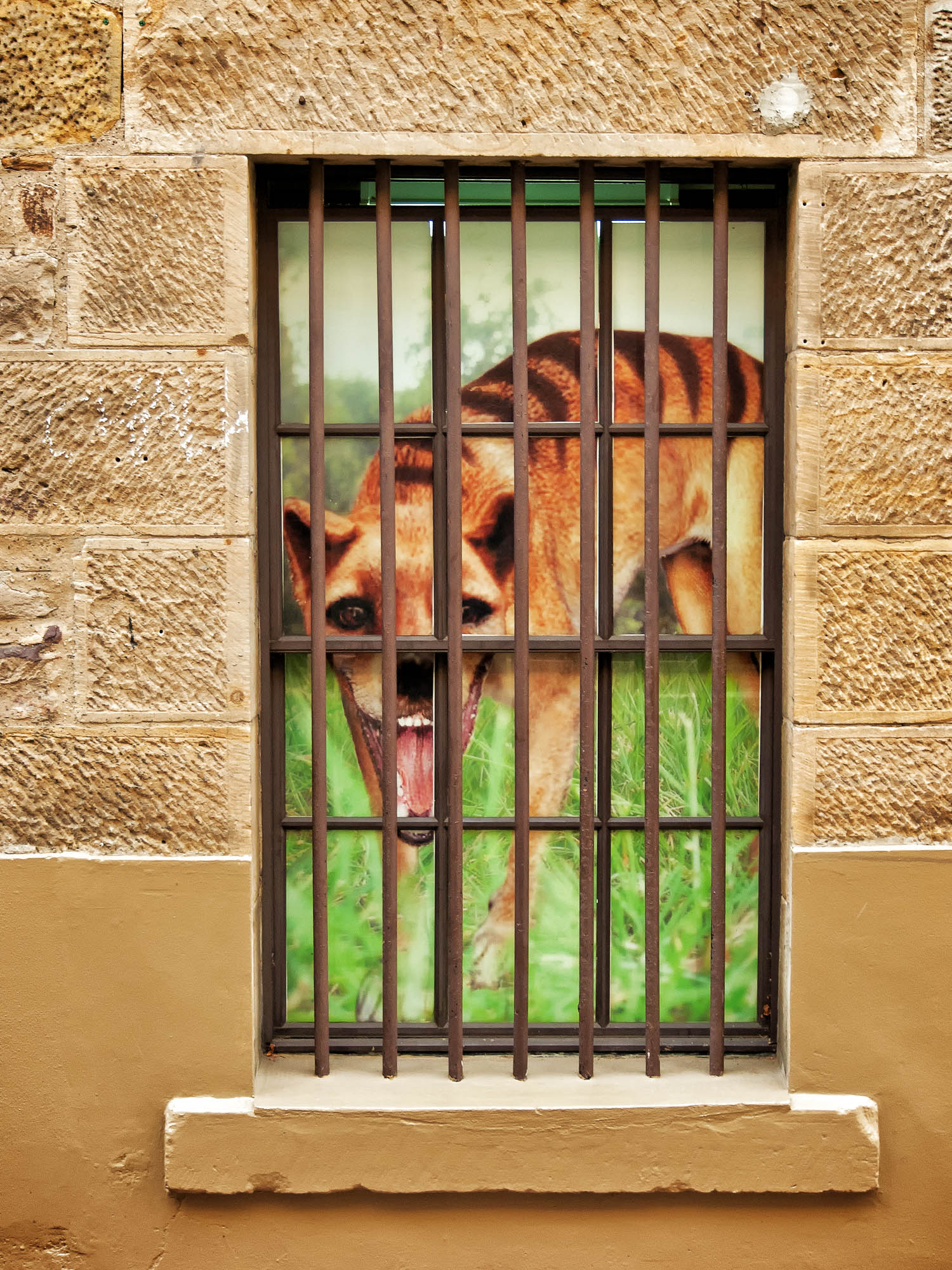
I went to the touristy olde world town of Richmond a little while ago and saw a Tasmanian Tiger or Thylacine. It had been turned into a garden ornament – “gnomified” if you like, just like the Buddha has been.
Tasmanian Tiger, aka the thylacine, spotted in a front garden in Tasmania’s historic town of Richmond.
Tasmanians have a very complicated relationship with the Tassie Tiger. Images of the thylacine can be seen everywhere, it’s on beer labels, the state coat of arms, the coat of arms for Launceston, the logo for Tourism Tasmania. In fact it is everywhere. You might, therefore, come to the conclusion that it is a much-loved animal. In a way it is, but the truth is it wasn’t.
The Tasmanian Tiger roams in Salamanca, Hobart, Tasmania.
The Thylacine was a shy reclusive animal, the last of its kind – a carnivorous marsupial that was an apex predator and whose relatives went back into the mists of the mammalian era some 5 to 23 million years ago (the Miocene). Computer modelling has shown that the thylacine was not a very strong animal and would have been incapable of handling anything larger than 5Kg and it is now widely believed that they were ambush predators who preyed on small animals such as bandicoots and possums. When the first aboriginal people crossed to the Australian Continent via a land bridge some 40,000 years they brought with them the first dogs, the descendants of what we now call the dingo. The dog was simply a much better and more adaptable predator than the thylacine and by the time British colonisation started they were already extinct on the mainland. When the first settlers in Tasmania saw the thylacine they named it the Tasmanian Tiger or Tasmanian Wolf. There was an apocryphal tale appealing to Victorian gothic drama that can be traced back to just one source that the Thylacine was a blood drinker which preyed on sheep and poultry. That sealed its fate and a bounty was placed upon it and it was hunted vigorously.
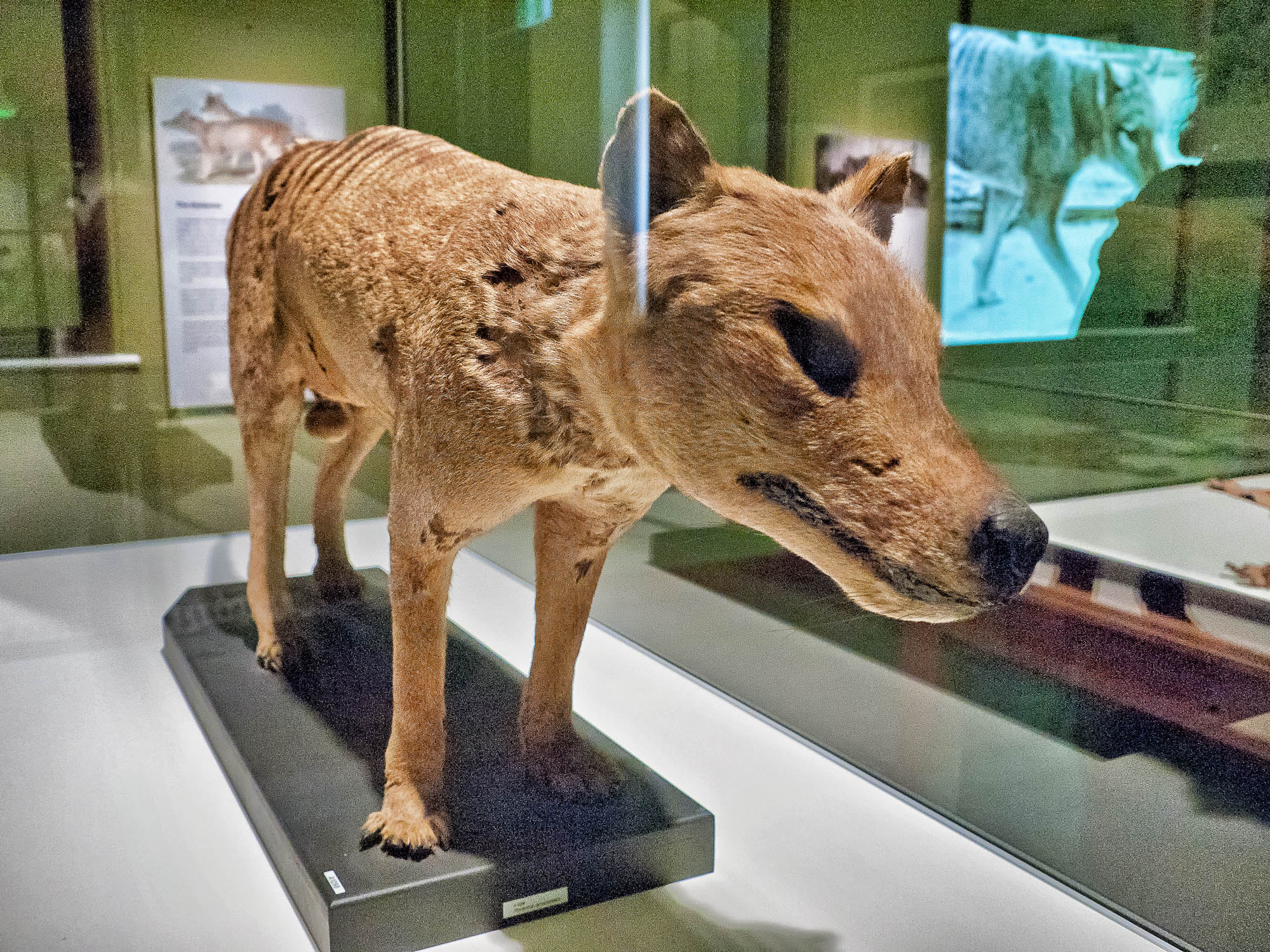
A particularly moth eaten stuffed thylacine, or Tasmanian Tiger, in the Tasmanian state museum.
The bounty of £1 for a dead adult and 10 shillings for a dead pup meant that by the 1920’s it was rare to see a thylacine in the wild. In 1930 a farmer by the name of Wilf Batty shot the last wild one. This was bad enough but the tale takes a more tragic turn. In 1933 the Hobart Zoo acquired a thylacine, which was later referred to as Benjamin, which lived there for three years. Inevitably the animal died not of old age but because it was locked out of its shelter on a very cold Tasmanian night. In effect killed by neglect. The last of a species going back millions of years killed because somebody couldn’t be bothered to make sure it was sheltered safely for the night. So after 133 years of settlement, thirty years after a conservation movement was founded seeking its protection and just 59 days after the Tasmanian government signed a conservation order to protect it the last thylacine had died. Optimistically it remained on the endangered list until the 1980’s , but with no confirmed sightings for 50 years it was declared officially extinct.Every now and again there is some crack pot scheme to clone it from DNA harvested from remains in museums, or some millionaire will put a reward for the capture of a live one, but the reality is that the thylacine is long gone because of an indifference to its plight.
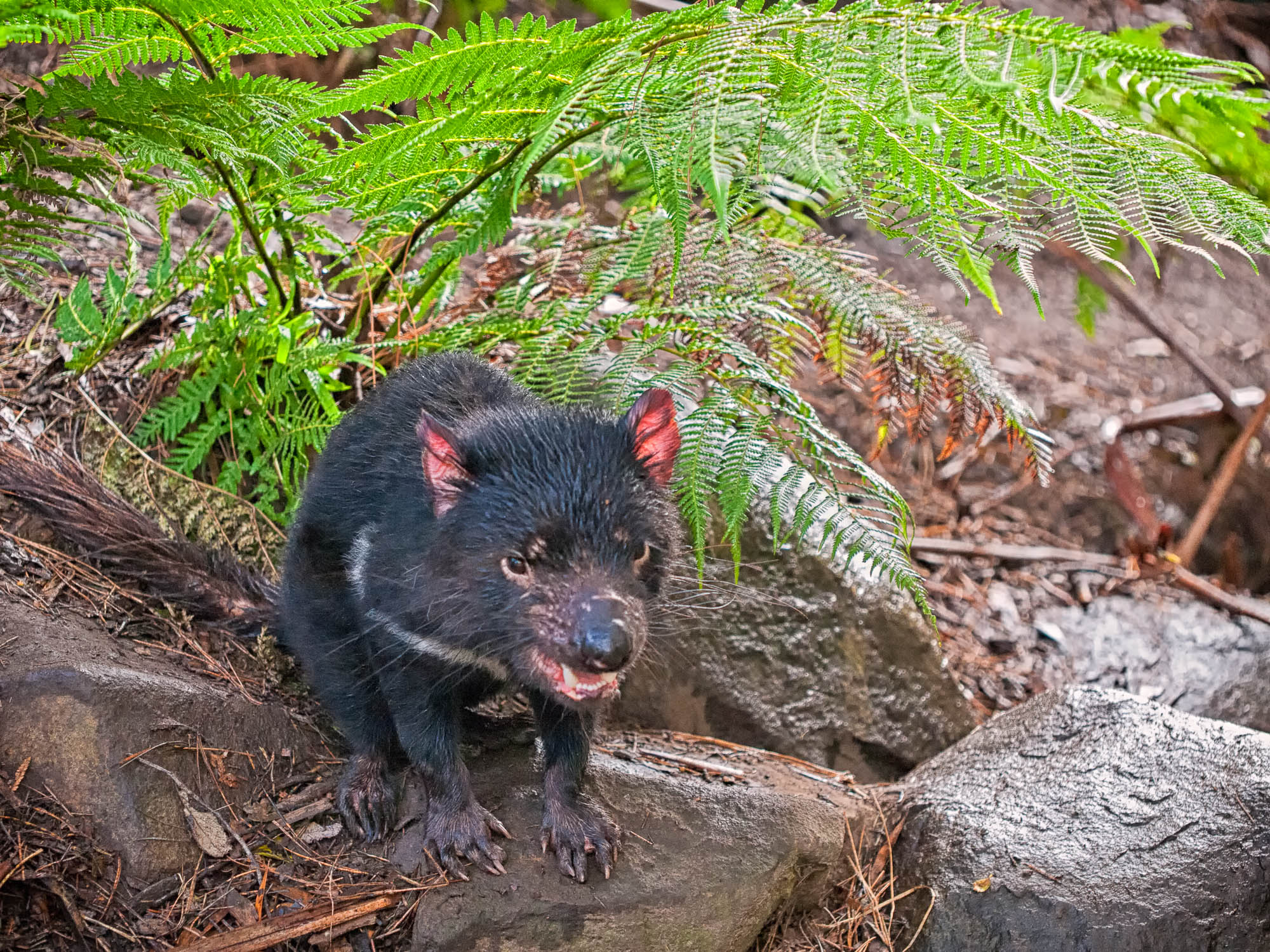
In the mid 1990’s a biologist by the name of Nick Mooney gave an interview to the Hobart Mercury newspaper. Mooney was concerned that the attention the thylacine was getting was diverting the attention away from Tasmania’s other iconic animal – the Tasmanian Devil. He argued that the Devil should be researched and protected. Many people thought that he was barmy as there were more Devils in Tasmania then than at the time of first settlement and farmers were claiming that they were at plague proportions and were a threat to livestock. Fast forward twenty years and the devil is now on the verge of extinction from a combination of devil facial tumour (a transmissible cancer), habitat destruction, traffic fatalities and environmental pollution caused by high levels of flame retardant chemicals found in consumer electronics. These chemicals are banned and were phased out in the 1980’s but their effects are still being felt and it is thought that they play a part in devil facial tumour disease. Because devil populations are declining the gene pool is also diminishing this had laid the Devils very vulnerable to disease.
The devil is an iconic symbol of Tasmania and many organisations, groups and products associated with the state use the animal in their logos. It is seen as an important attractor of tourists to Tasmania.
Today Tasmanians mourn the passing of the thylacine even though there are very few people who are left alive that actually saw one. All that remains are a few preserved specimens in museums, some black and white photos and some grainy film footage. Tourist operators say that the extinction of the devil will severely impact their industry and slowly people are starting to wake up to the fact that the devil is likely to go the same way if something is not done. There has been some research on the on devil facial tumour disease which is fantastic. So is devil saved? Well some scientists believe that the only way for the devil to survive is to quarantine healthy devils in captivity and let the wild population die out. Even if the wild population could survive the current Tasmanian state and Australian Federal governments are working to open up Tasmania’s national parks and world heritage areas to commercial logging. The federal government is also not prepared to fund research into Devil Facial Tumour Disease. So at present your best chance of seeing a Tasmanian devil is either at a zoo, animal sanctuary or dead beside a road. In another twenty years all we could be left with is some video footage and some memories. I would urge every Australian and prospective visitor to Tasmania to write to:
Matthew Groom the Tasmanian minister for the environment
and
Greg Hunt the federal minister for the environment
asking that more funding should be given to ensure the survival of the devil and to ask them not to open the Tasmanian national parks to logging.
They’re not the most loveable of creatures but the world would be a worse place without them.
The “blood moon” or the red lunar eclipse brought out the apocalyptic in me.
According to Wikipedia…”A lunar eclipse occurs when the Moon passes directly behind the Earth into its umbra (shadow). This can occur only when the Sun, Earth, and Moon are aligned exactly, or very closely so, with the Earth in the middle. Hence, a lunar eclipse can only occur the night of a full moon… the red colouring arises because sunlight reaching the Moon must pass through a long and dense layer of the Earth’s atmosphere, where it is scattered…Several cultures allude to the lunar eclipse as being a good or bad omen. For example, in some Chinese cultures, people would ring bells to remove wild animals that bit the moon. During the Zhou Dynasty in the Book of Songs, the sight of a red moon engulfed in darkness led them to believe the sign as a foreshadowing of famine or disease.” SPOOKY!
Thankfully we all woke up happy and well the next morning.
The weather conspired against me. I had planned my shoot using The Photographer’s Ephemeris, got my angles and location sorted out and then just half an hour before heading out I stuck my head outside and we have thick cloud cover. Bugger! What to do? I didn’t want to drive out to my location, walk to the point and stand in cold wind coming straight off of the Antarctic for nearly 3 hours with the chance of getting nothing. So I decided to set up my cameras on my deck and only start filming when there was a break in the cloud cover. So out of 3 hours and 20 minutes of potential eclipse action I got in total about 30 minutes. Ah well I shall wait until the next one on the 04/04/2015.
Filmed using the time-lapse movie function on the Olympus OMd EM-10 with a 75mm f2.5 Color-Heliar and a Zuiko 40-150mm f4-5.6 lens. Additional footage filmed on a Canon 550d with 70-200mm f2.8 L IS lens
Video/film relies on movement to make it interesting. That movement can be provided by the subject or it can be by moving the camera itself. Now big budget productions will use all sorts of clever and expensive gizmos to achieve this, but for the budget conscious amateur what can you do. Well you can use your tripod and using panning, but you can only do that so many times before it looks old. You can I suppose use a zoom lens and zoom in and out. Now some people do this, but most people in the “know” regard it as offence worthy of crucifixion if you ask about it on and forum dedicated to film making. But one of the easiest and most effective ways to bring movement is a slider. Prices can go from a few thousand for motorised versions to around one hundred bucks. Or you can go for the cheap skate route and make one in your shed for a few dollars and there are plenty of tutorials on You Tube showing you how. As I was playing truant when the handyman gene was dished out and I am fiscally challenged I looked at the budget end of the market and settled on the catchily named Kamerar S-23 Video Camera Slider.
In summary, for the money it is an absolute bargain and PNC are selling them for $130 USD from their website. I got my copy from Photo-Shop-Studio here in Australia for the amazing price of $120 AUD.
* Apologies to the late great Stevie Ray Vaughn. Slide Thing is a track on the debut album In The Beginning which was recorded live in 1980.



You must be logged in to post a comment.