We’ve had some really gorgeous weather lately – so good it made us want to go out and have a BBQ picnic. Thanks to the media there is the impression that the average Australian is born wearing an apron and holding a pair of BBQ tongs in one hand and a can of beer in the other. Well it’s not quite true. For us a migrants we don’t have a natural proclivity to burn every piece of meat we eat over a fire. But when the weather is as good as it has been lately the notion of throwing a sausage on the barbie in a nice location is quite overwhelming. We set off to Lake Leschenaultia which is smallish man made lake in the Perth Hills surrounded by woodland.
Now this was not a designated photographic expedition I did take a camera and while the Beloved Significant Other was having a swim I snuck off to see what was about. The light was bright, it was midday after all, and there were quite a few people about so I didn’t have high expectations. But half an hour of looking I managed to find some mating dragonflies, see some very cheeky splendid fairy wrens and be delighted by a mother musk duck feeding her duckling.
Tau emerald dragonflies (Hemicordulia tau) mating. Lake Leschenaultia, Western Australia.
Djer-djer aka splendid fairy wren. Lake Leschenaultia, Western Australia.
A female musk duck (Biziura lobata) feeding her duckling. Lake Leschenaultia, Western Australia.
They’re not the best photos I’ve taken, more snapshots really, but they added to what was a perfect day.
It’s safe to say this summer has been hotter than a very hot thing that is feeling hot. The knock on effect of all that heat is that motivation evaporates – literally. It is very hard to get out and about when temperatures are above 40ºC (104ºF). The UV index is so high that if you’ve been outside for longer than 5 minutes you need to see a dermatologist to have skin cancers removed.
Frida trying to trying to escape the summer heat in what’s left of the Avon River
So summer days are spent dreaming up ways to keep cool. You can go for the psychological approach like my Beloved Significant Other (BSO) – she is reading Scandi noir books set in chilly sub Arctic nordic climes hoping that she can convince her body that it is cold. I’ve tried watching a few films along those lines but my body is not easily fooled. Next is the physical approach. The BSO has also taken to spending as much time as possible at the swimming pool. I don’t go as when I get into the pool the water gets out. More seriously the pool isn’t heated in any way and the cold water has me shrieking like a teenage girl at a Beatles concert. So I’ve given up on that idea. I’ve taken to hanging around the freezer cabinet in the local super market along with the rest of the town. The competition for the best spots can be brutal. The little old ladies are the worst – they’ve got sharp pointy elbows that they use to great effect to secure prime position and maximum coolness. The best place to go is the bottle shop’s (liquor store or off-licence for non Aussies) coolroom. Absolutely blissful. Unfortunately I was banned after I tried to smuggle in a chair and a TV. The best strategy is to get up early and try and do everything before it gets too hot. Then you retreat back to the sanctity of home and crank up the air con. This is why I’ve been printing photos lately.
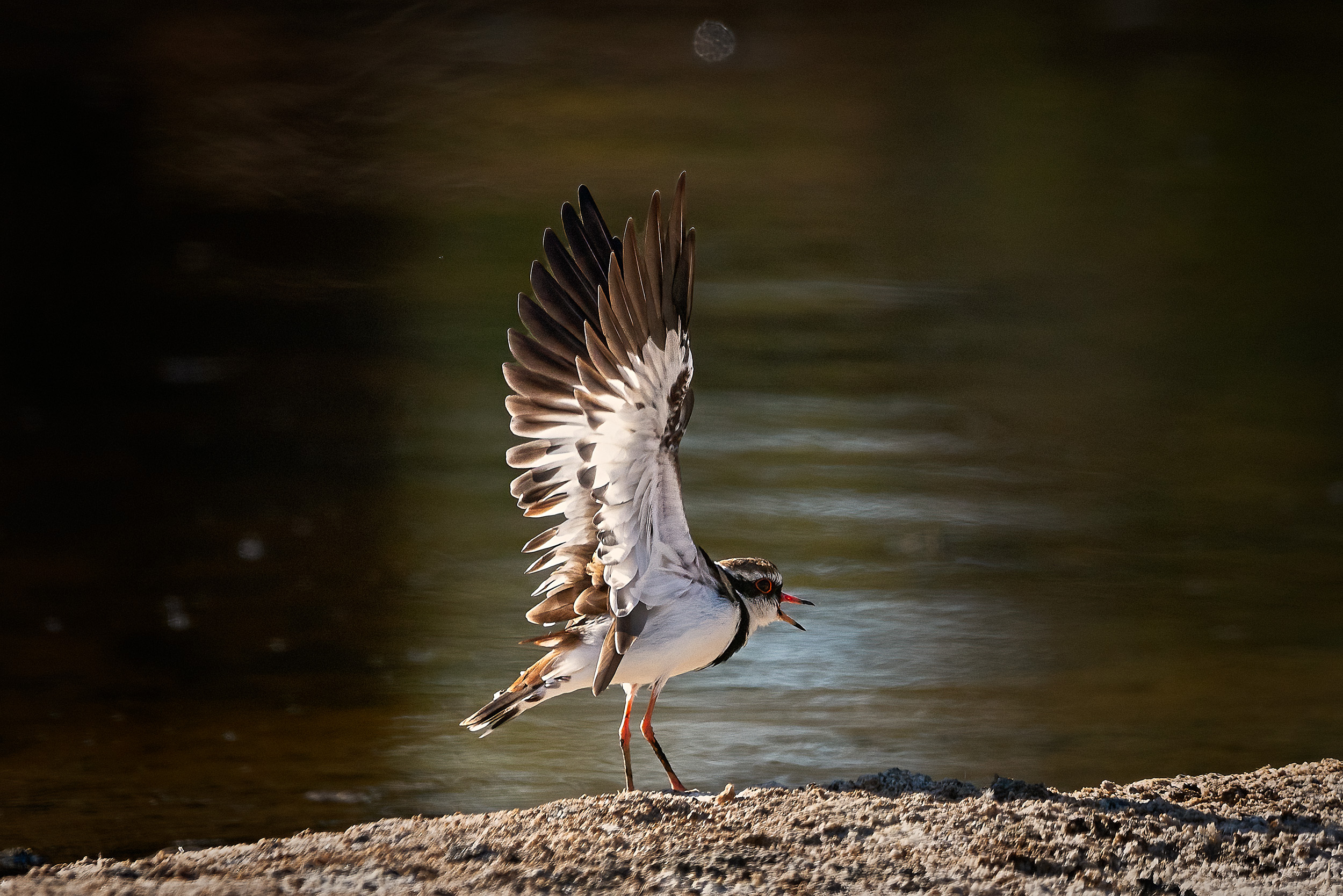
Nidoolyorong or Black-fronted Dotterel (Elseyornis melanops). York, Western Australia.
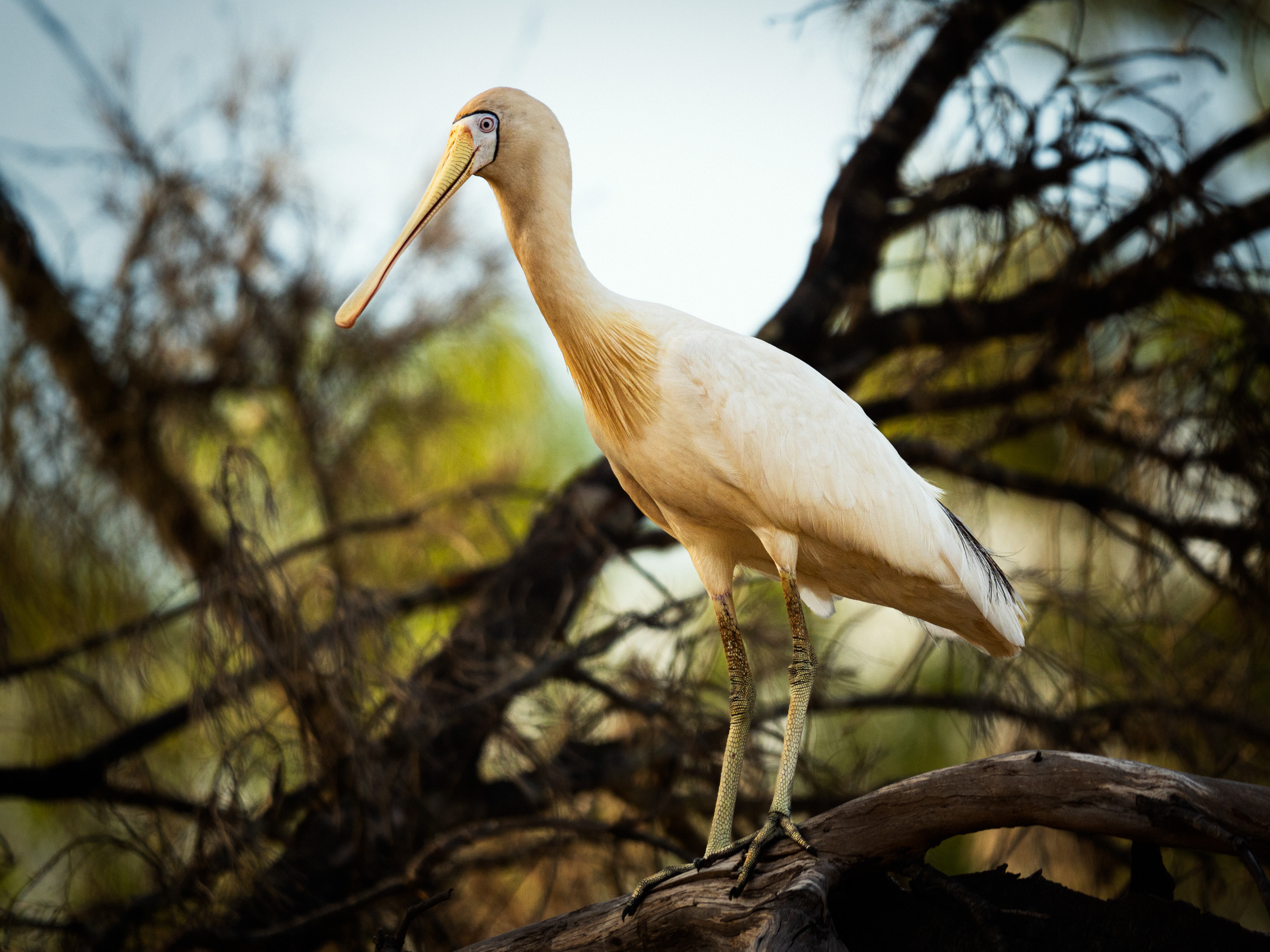
Yellow billed Spoonbill, Platalea flavipes. York, Western Australia.
A Willie Wagtail wondering if the Rainbow Bee Eater is going to share its dragon fly.
The impact of all this hot weather on the local wildlife has been considerable. The numbers of birds around is quite low. Lack of food and water. Even along the river, which now no longer resembles a river but a series of small fetid murky pools, there seems to be less activity. It has been a bumper year for dragon flies. I guess they must like it a little on the warm side. Once a week I’ve been going out to a large freshwater lake about 50Km from here to work on a new project. There’s been a bit more activity there but not much. Early in the mornings there is no vehicular access so you have to walk in through the bush and a couple of times I’ve come across a mob of kangaroos sparked out in the shade under the trees. They’re so hot and lethargic they can’t summon up the energy to move and they just lazily watch as I walk past. The only real activity at the lake has come in the form of a randy male musk duck desperately swimming up and down looking for a victim – err I mean prospective breeding partner. That duck can certainly move fast. Funnily enough I’ve not yet spotted a female musk duck – I guess they must be too hot and bothered and are avoiding him by hiding in the reed beds.
A male musk duck – not the randy one mentioned above.
Thankfully it is the end of February. That means we’ve only got to survive March and the the weather will start to cool in April. Can’t wait!!
A male musk duck (Biziura lobata) swiming on Lake Goollelal in Yellagonga Regional Park, Western Australia
Now it is fair to say that Australia is home to some pretty strange animals. One only has to look at the Platypus, the echidna and even the humble kangaroo. To my mind one of the strangest is the musk duck (Biziura lobata). They can be found on fresh water lakes in the southwest corner of Western Australia.
What makes them so strange? Well to start with they don’t quack like a duck. They emit a sound that is more akin to a demented sonar. They are rarely seen on land and are reluctant fliers. On the water they float very low in the water often giving the impression that just their head is above the waterline. They are prolific underwater swimmers staying under for as long as a minute and diving up to a depth of 6m and demonstrate incredible agility as they do so. In appearance they are a very dark grey to black, have a stiff tail and broad heavy bill. The males are considerably larger than the females and weigh over 3Kg while the females can weigh up to 1.5 Kg. This makes them the second heaviest diving duck in the world. The males also have a strange leathery lobe under the bill, and in the breeding season they have a very strong musk odour hence the name. The courting behaviour of the males is quite striking – they strike the surface of the water with their feet then immediately after make a couple of clucking sounds followed by a lot of whistles and a grunt. This is repeated very five seconds or so for as long as half an hour. The first time I encountered this was at Lake Seppings in Albany. I heard these odd splashes and weird sounds repeatedly coming from just beyond the reed beds but couldn’t see what was causing the commotion. As I continued walking the reeds parted sufficiently and with the help of standing on a nearby bench I was able to see what was going on. It really is quite a performance and once seen never forgotten. In Perth Musk Ducks can be seen on both lakes in the Yellagonga Regional Park and Herdsman Lake. Hard to see at first so listen for the strange noise and you’ll soon find them.
They are not hunted as they are not considered nice enough to eat and the only thing that threatens their status is the clearing and draining of wetlands.
Male Musk duck (Biziura labata) at Lake Seppings, Albany, Western Australia. Olympus OMD EM1 mk ii with Panasonic Leica 100-400mm f/4-6.3 lens. Exposure: 1/1000 sec, f6.3, ISO 1600 with +0.7 stops exposure compensation
Anastasis – from Ancient Greek ἀνάστασις (anástasis, “resurrection”).
A funny name for a blog post about Lake Seppings in Albany, Western Australia, but it does describe what happened.
Australian Pelican, Pelecanus conspicillatus, Lake Seppings, Western Australia. Olympus OMD EM1 mk ii with Panasonic Leica 100-400mm f4-6.3 lens. Exposure 1/1000, f10, ISO 200.
Way back in the Nyittiny (creation times) the spirit Djrat walked on the earth and created south coast of Western Australia and as he walked he left a footprint which filled with water and created a freshwater lake 1.1 Km long and 400m wide. The Minang group of the Nyoongar called this place Tjuirtgellong or “place of the long necked turtle” which was an important food source for them in the summer months. The lake was surrounded by a variety of vegetation. Fringing the lake are bullrushes, sedges, and reeds reeds. Further back were Western Australian peppermint trees, spearwoods, paperbarks, native willows, wattles, banksias and melaleuca. All this provided habitatfor over 100 different bird species including Australian white ibis, yellow-billed spoonbil,white-faced heron, blue-billed duck, musk duck, black swan, hoary-headed grebe, Australian pelican, Eurasian coot, spotless crake, masked lapwing, dusky moorhen, purple swamphen and buff-banded rail.
Purple swamp hen, Porphyrio porphyrio, Lake Seppings, Western Australia. Olympus OMD EM1 mk ii with Panasonic Leica 100-400mm f4-6.3 lens. Exposure: 1/1000 sec, f6.3 at ISO 2000.
Jewel spiders (Austracantha minax) are often called Christmas spiders as they are commonly found during December and January. Lake Seppings, Western Australia. Olympus OMD EM1 mk ii with Panasonic Leica 100-400mm f4-6.3 lens. Exposure: 1/250 sec, f8, ISO 320.
All was fine and dandy until 1790 when the British explorer George Vancouver arrived. While he was mapping King George Sound he didn’t see any Minang but saw plenty of evidence that they were around and he later wrote that he found a ‘native village; fresh food remains near a well-constructed hut; a kangaroo that had apparently been killed with a blow to the head; a fish weir across what is now called the Kalgan River; and what appeared to be systematic firing of the land.’ (R. Appleyard. ‘ Vancouver’s Discovery and Exploration of King George’s Sound’ in Early Days, Journal and Proceedings of the Western Australian Historical Society, 1986, pp.86-97). That was the start of colonial settlement. As far as the lake is concerned well initially the settlers tried to do the right thing and in 1887 the Albany Municipal Council applied to the state government for permission to make the Lake and some of its surrounding bushland a botanical park. This lasted up until 1900 when it became a rubbish dump for the city of Albany. This sad state continued until 1972 when it was decided by the department of fisheries and fauna to turn the lake into a water fowl reserve.Very quickly the community got on board with initially a bird-walk being established by the Apex club of Albany in 1980. By 2004 a walk around the lake had been completed and the lake was given protected status. In 2018 there was a ‘community planting’ of some 22,000 trees and understory plants to provide a ‘biodiversity corridor’ and habitat for endangered wildlife such as the western ring tailed possum.
Brush Bronzeing, Phaps elegans, Lake Seppings, Western Australia. Olympus OMD EM1 mk ii with Panasonic Leica 100-400mm f4-6.3 lens. Exposure: 1/1000 sec, f5.7 at ISO 2500.
Every time we go to Albany I always visit Lake Seppings. I love walking around the edge of the lake and observing all the wildlife. I see it in many ways as a beacon of hope. The local community came together and have made a serious and worthwhile attempt to restore the lake to what it once was it still has a long way to go before it reaches its former status but it is a very good start. For the Nyoongar I hope that the recent claim for compensation for the loss of their traditional lands succeeds and can bring them some way of moving forward.
Red-winged Fairy-wren, Malarus elegans, Lake Seppings, Western Australia. Olympus OMD EM1 mk ii with Panasonic Leica 100-400mm f4-6.3 lens. Exposure: 1/1000, f7.1 at ISO 1000 with -1 stop exposure compensation.
New Holland Honeyeater, Phylidonyris novaehollandiae subsp. longirostris, Lake Seppings, Western Australia. Olympus OMD EM1 mk ii with Panasonic Leica 100-400mm f4-6.3 lens. Exposure: 1/1000 sec, f6.3at ISO 800.





You must be logged in to post a comment.