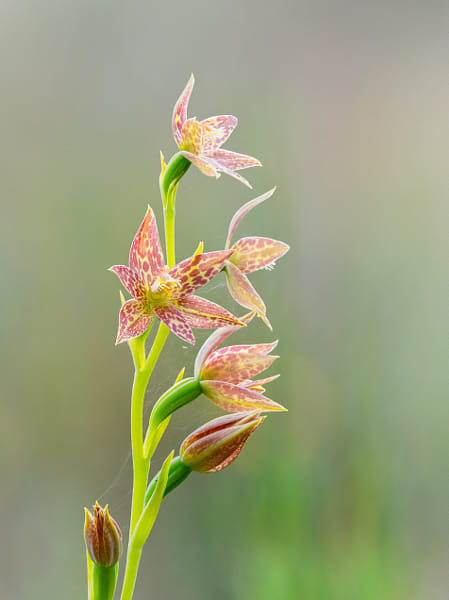
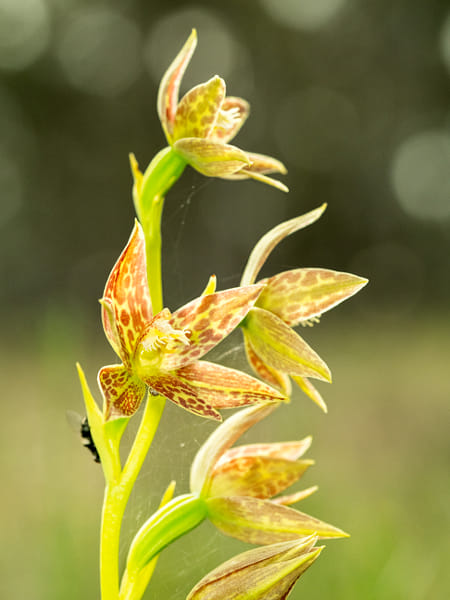
My last wander about the local Wandoo forest didn’t yield anything much. The only plants worth getting the camera out for were some Leopard Orchids. So I did my usual full length portrait using my 40-150mm f2.8 plus MC-14 teleconverter with focus stacking. Then a tighter “head and shoulders” shot with the 60mm f2.8 macro and flash. I finished up with really tight detail shot at close to 1:1 again with the 60mm macro.
Leopard Orchid, Thelymitra benthamiana. A 10 shot focus stack using the Olympus EM1 mk ii, Olympus 40-150mm f28 lens and the the Olympus MC-14 teleconverter. File assembled in Photoshop.
If you look closely at the main flower there is a spider peeping out and the fly on the edge of plant is caught in its web. Leopard Orchid, Thelymitra benthamiana.
In the past I’ve used OM Workspace to do the focus stacks, but after it’s latest update it has become so slow – glaciers move quicker. So I decided to to do the stack using Adobe Lightroom and Photoshop. To say it was much faster would be a massive understatement, but the final result was a lot better as well. For the life of me I can’t work out why camera manufacturers software is so bad. It should be better as they know all the features of the cameras and how to get the best out of them. This isn’t just a whinge directed at OM Systems. Canon’s DPP is absolutely appalling as well. Adobe would’t have such a stranglehold on the market if the camera manufacturers could develop good software.
Whenever I’ve stopped in Williams it always been on the way to somewhere else and I’ve always been quick to get a move on. Well the other day I gave Williams my full attention. There are a few good spots for orchids there and I wanted to visit one in particular as it is the home to the Common Dragon Orchid. Despite its name I’ve never found the Common Dragon Orchid to be very common – in fact I’d only seen a rather manky looking one some twenty years ago. That, as they say, is a long time between drinks.
The bit of scrubby land that is home to the flowers is pretty ordinary to look at. It’s situated on the corner of a busy highway and a dirt track. Judging from the car bodies, rusted metal, bottles and corrugated asbestos it’s been used for fly tipping for years. But situated under the sheaoak trees in amongst the needles were an amazing variety of orchids. Common Dragon Orchids, well they were certainly common there. There were hundreds of them.
The first three images are pretty straight photos using the Olympus 60mm f2.8 macro lens and STF-8 flash or the Olympus 40-150mm f2.8 with no flash.
Common Dragon Orchid, Caladenia barbarossa. Williams, Western Australia.
Zebra Orchid, Caladenia cairnsiana. Williams, Western Australia.
Clubbed Spider Orchid, Caladenia longiclavata. Williams, Western Australia.
The last couple were done as focus stacks using the Olympus 40-150mm f2.8 and MC-14 1.4x teleconverter. The stacks were assembled in Photoshop.
Common Dragon Orchid, Caladenia barbarossa. Williams, Western Australia.
Zebra Orchid, Caladenia cairnsiana. Williams, Western Australia.
When you arrive at Toolibin Lake it’s hard not to be underwhelmed. It’s a smallish fresh water lake fringed by scrubby trees and populated by voracious mosquitos. While I was there only two other vehicles pulled up, the first visitor walked over to the information board and then got straight back in his car and drove off. A couple got out of the second car and walked down to the waters edge and then they too got back in their car and headed off. Perhaps it was the mosquitoes or perhaps their expectations did not match the reality of the place. Don’t know. All I do know is that it’s a fantastic nature reserve with plenty of nature.
Fringed Mantis Orchid aka Green Spider Orchid (Caladenia falcata).Toolibin Nature Reserve, Western Australia.
A closer look at the Fringed Mantis Orchid.
What makes Toolibin Lake so special? There used to be lots of lakes like this throughout the Wheatbelt, but agricultural land clearances have rendered them saline which has killed off the vegetation around them and destroyed the native animals habitats. Toolibin has miraculously managed to survive and has become an oasis for rare and threatened flora and fauna. If you want to see a Freckled Duck or a Red-tailed Phascogalethen Toolibin Lake Nature Reserves is one of your best bets for finding them. I wasn’t there for the wildlife, I was looking for the wild orchids that can be found in the surrounding woodland of flooded gum, acorn banksia and rock sheoak. What I found was nothing short of spectacular.While species like Cowslip Orchids are ten a penny in the South West of Western Australia it was the quantity of them that was amazing. It was a magnificent sight. I was looking for two species – the Clown Orchid (Caladenia roei) and its cousin the Purple-veined Spider Orchid (Caladenia doutchiae) both of which I found pretty quickly.The Clown Orchid I’d seen before at Wongan Hills, which is quite hike from where I live, but, the Purple-veined Spider Orchid was completely new to me and was the one I particularly wanted to photograph. I decided to photograph both as they can be a bit difficult to tell apart. As it was I passed up a Common Dragon Orchid as I thought it was a damaged Fringed Mantis Orchid. Note to self: next time photograph everything that you find.
Purple-veined Spider Orchid, Caladenia doutchiae. Toolibin Nature Reserve, Western Australia.
Purple-veined Spider Orchid, Caladenia doutchiae. Toolibin Nature Reserve, Western Australia.
Clown Orchid, AKA Ant Orchid, Man Orchid, and Jack-in-the-box Orchid, Caladenia roei. Toolibin Nature Reserve, Western Australia.
In profile. Clown Orchid, AKA Ant Orchid, Man Orchid, and Jack-in-the-box Orchid, Caladenia roei. Toolibin Nature Reserve, Western Australia.
Toolibin Lake is definitely a place I’ll be visiting again, although the next time I’ll forego the orchids and look for the Freckled Duck and the Red-tailed Phascogale. For anyone interested in visiting be aware that Toolibin Lake lies in a low rainfall area of the Wheatbelt and consequently it usually only holds water at certain times of year and some years it may not have any water at all. This year while the rains have been late they have been very heavy so everything was in top shape.
Dancing Spider Orchid, Caladenia discoidea. Toolibin Nature Reserve, Western Australia.
It’s that time of year – the natural world here in Western Australia has started to step up a gear andit is time to get out and see it and more importantly photograph it.
I was recently reading a book on Western Australian orchids and I discovered within it mention of a few species that are found in the Wheatbelt, where I live, that I had never heard of before let alone seen. After a bit more research and a consultation with Florabase and Atlas of Living Australia I was all set to head off to Kweda.
Not a very reassuring sign.
Another comforting sign.
The floodway that empties into Lake Mears. Although there was a lot of the water it hadn’t flooded the road.
It was nice to get out and about again, but after seeing a couple of road signs I wasn’t so sure I’d made the right decision. Kweda Reserve is located on the corner of an intersection of two dirt roads and apart from the reserve the only other feature of note was a mobile phone tower. Getting out of the car it seemed as if the bottom end of the reserve once played host to a railway siding. The tracks were long gone only the embankments and a few bridges over creek lines remained. There was quite a bit of water about thanks to the late heavy rains and I was quite surprised as the genus of orchids I was looking for tend to favour drier sandy soils rather than the heavy wet clay that was at Kweda. There were a lot of birds and dragonflies about and I saw a bob tailed lizard happily grazing on some mushrooms.
The bottom end of Kweda Reserve used to have a railway line. The last vestiges of the embankment and bridges can still be seen.
Lots of late heavy rainfall have meant there is a surprising amount of water about.
One of the locals. Bob tailed lizard (Tiliqua rugosa). Kweda Reserve.
Western Wheatbelt Donkey Orchid, Diuris brachyscapa. Kweda.
Western Wheatbelt Donkey Orchid, Diuris brachyscapa. Kweda.
Fringed Mantis Orchid, aka Green Spider Orchid, Caladenia falcata. Kweda.
Did I find what I was looking for? No. But, I did find a couple of species I’d not photographed before so it was worth the effort. I’m also hoping to visit again, and the nearby Lake Mears, looking for wildlife.
The title for this blog entry came from the song by Misty In Roots.
Boodalang is the Nyoongar name for the Australian Pelican (Pelecanus conspicillatus). Woodman Point, Western Australia.
A trio of Australian pelicans swimming in formation off Point Walter on the Swan River.
The Australian Pelican is a familiar sight and can be found in waterways and coastal areas all around Australia. Basically where there are fish there are pelicans. I’m sure that I’m not alone in being slightly amused by the sight of them. That large beak and pouch looks somewhat comical and birds that size shouldn’t really be able to fly – how do they get airborne?
Australian Pelican, Pelecanus conspicillatus, Lake Seppings, Western Australia.
Australian pelicans are the second largest flying bird in Australia, only the brolga is bigger. Although on the small size compared to other pelican species the Aussie comes in 4-13Kg (males are larger than females) and have a wing span of up to 2.5m. That’s a lot of bird. That bill is the largest of any bird measuring up to 50cm in length. They are highly evolved animals that owe their success to a number of strange features.
Trawling at Two Peoples Bay, Western Australia.
That distinctive bill and pouch is not for storing fish to eat later, but is rather used as a net to trap fish and other marine life. As the pelican trawls the pouch can hold up to 13 litres of water and food. When it is time to eat the bird lifts its bill out of the water and pushes it against its chest to expel the water and then it flips its prey around so that it can be swallowed head first. They don’t just eat marine life, they will eat small ducks, seagulls and small mammals. They will even steal the fish that other birds, such as ospreys, have caught. In all an adult pelican will eat up to 2Kg of fish a day. On a hot day the pouch is also used as a cooling system – the bird swings it about to cool down.
Effortlessly swimming along the Serpentine River in Mandurah, Western Australia.
Despite their size they have a light weight skeleton that has air pockets. This means that it weighs less than 10% of the total body weight which enables them to fly and remain buoyant in water. They also have a number of air cells under their skin which are connected to the respiratory system and act as floats. This gives the pelican the ability to float with very little of its body below the surface of the water which has the effect of minimising energy expenditure when swimming.
Getting ready. Alcoa Wellard Wetlands, Western Australia.
“We’re off!”
Heading home.
Perhaps the most amazing facts about the Australian pelican are when it comes to flight. Their large wings enable them to soar on thermal currents at altitudes up to 3000m and they can stay airborne like this for up to 24 hours. It makes for an incredibly efficient means of flying. When taking off a pelican will often fly incredibly low over water – they almost skim the surface. By this they take advantage of the “ground effect” which reduces drag and increases lift. The air flows between the wings and the water’s surface where it is compressed and exerts a strong upward force pushing the bird up and this again minimises the amount of energy expended. This energy efficiency is important because an adult pelican will often commute from its nesting site 150Km to find food.
Nearly a thousand Australian pelicans use Penguin Island as a nesting site and breeding colony.
The Australian pelican maybe cut a comical figure, but they look like that for very specific reasons.
The girls stop grazing to welcome me. Yongka or Western Grey Kangaroos (Macropus fuliginosus) at Lake Leschenaultia, Western Australia.
Not having had kids I loose track of things like school holidays so when I arrived at Lake Leschenaultia at 6:30 am the other day I was surprised with how many kids were playing on the foreshore at the top end of the lake. It was only as I passed the packed camping area I realised we must still be in the Easter holidays. The other thing that caught me off guard was the water level. I’ve never seen it so low – you could walk out in the reed beds. The water birds were staying in what was left of the water out in the middle and any attempt to approach them meant that you were quickly up to your knees in black sticky smelly mud.Not what I had gone for and I was torn between heading back home or heading down to the forested area at the far end of the lake in the hope that it would be quite and I’d have a chance of seeing some wildlife. I decided to stay and try and make the most of being there – it was after all a beautiful morning. The sun waspeaking over the tree tops and gave the forest a nice warm glow and it was the perfect temperature for a walk around the lake. As I walked down the path along the lakeside I met a couple Kangaroos who looked equally nonplussedat the hoard of screaming children. We looked at each other for a few minutes and they got back to the serious business of grazing.
Dermokalitj or Scarlet Robin (Petroica boodang). Lake Leschenaultia, Western Australia.
Dermokalitj or Scarlet Robin (Petroica boodang). Lake Leschenaultia, Western Australia.
Strolling down to the boundary fence I was happy to note that the air was still and there were loads of midges and mosquitoes flying around. Passerine birds follow the clouds of insects through the forest and feed on them so this meant I had a good chance of photographing robins, wrens, tree creepers, pardalotes and thornbills. I wasn’t disappointed a couple of male Scarlet Robins (Petroica boodang) stopped what they were doing to have a good look at me. The females stayed in the thicker bush eating. There were heaps of Splendid Fairy-wrens (Malarus splendens) dancing about in the understory and on the forest floor. They look like mechanical toys the way they move about with sudden jerky movements. That makes following them through the viewfinder of a camera with a long lens very tricky, but, if you’re quiet and still they will come quite close to you – which makes photographing them a bit easier. The males had shed their brilliant blue plumage that is characteristic of the mating season and were in their drab grey colouring with bright blue tails. Like this they are virtually indistinguishable from the females with the only difference being that they have a dark grey beak while the females have an orange one. If wrens are tricky to photograph then Western Thornbills (Acanthiza inornata) can make you weep with frustration. No bigger than 10cm they bounce erratically around on the forest floor and in the undergrowth with considerable speed rarely pausing. They don’t have the tolerance to be near people which often means when you do get one to sit still long enough to be photographed they are a tiny spec in the frame. Walking back to the dam wall there is a terraced picnic area that enabled me to get at their eye level and conceal me at the same time. I managed to get off a few frames as the birds worked their way quickly through the grass.
A male splendid fairy-wren (Malurus splendens) in full breeding season plumage. Cheyne’s Beach, Western Australia.
Male Djer-djer or Splendid Fairy-wren (Malarus splendens subsp splendens) outside the breeding season. Lake Leschenaultia, Western Australia.
Female Djer-djer or Splendid Fairy-wren (Malarus splendens subsp splendens). Lake Leschenaultia, Western Australia.
Male Djer-djer or Splendid Fairy-wren (Malarus splendens subsp splendens) in a more picturesque setting.
The tiny hyper-kinetic Djobool-djobool or Western Thornbill (Acanthiza inoranta) at Lake Leschenaultia, Western Australia.
I was glad I stayed and persevered. Yes the conditions weren’t conducive to photographing the species I wanted, but being flexible and altering the plan made for a very enjoyable morning out.
This Kaa-kaa or Laughing Kookaburra (Dacelo novaeguineae) saw me off as I left Lake Leschenaultia.
There are not many celebrities in the world of wildlife. Western Australia has a few – the dolphins at Monkey Mia being the ones that most readily come to mind. But, Herdsman Lake in the Perth suburb of Wembley has its own in the form of the Kambekor or Tawny Frogmouths (Podargus strigoides). It is another of Australia’s strange animals. This is a bird that can’t fly very well and hardly walk. It’s main strategy is to sit in a tree and look like a stick, and that is something they are very very accomplished at, which normally makes them frustratingly hard to find. The Tawny Frogmouths at Herdsman Lake aren’t that hard to find because most people who frequent the area whether it be walkers, joggers, cyclists all seem to know which tree they hang out in.
Up until last week this was the best picture of a Tawny Frogmouth and it’s not a good one. It was taken at the Tasmanian Devil Conservation Park in Taranna, Tasmania.
Let’s back track a bit. What is a Tawny Frogmouth? Well the common misconception is that they are some form of owl and that is really down to an English bloke, by the name of John Latham, who in 1801 thought he’d discovered something entirely new which in reality he hadn’t as the indigenous population had known about them for nearly 60,000 years before he arrived on the scene. He gave the bird its Latin name Podargus strigoides. Strigoides literally means “owl like”. They are, however, not owls but belong to a small group of 3 birds, all frogmouths, found in Australia and New Guinea. Outside of that small group their closest relatives are nightjars. They are a fairly large bird, up to 54cm long and weighing up to 680g which should make them easy to see. They have a large head and a stocky bodying their plumage is silvery-grey with patterns of white, black, and brown streaks and mottles which enables them to seamlessly blend into the appearance of a tree branch, rendering them nearly invisible in the bright light of day despite a preference for roosting and nesting in low branches. When alarmed they angle their heads upwards and close their eyes remaining perfectly still. The Tawny Frogmouth is a nocturnal bird that feeds on large insects, small mammals and reptiles. When an Owl hunts it will swoop down on its prey and seize it with powerful talons whereas the Frogmouth literally falls on its prey from a branch and grabbing it in its beak. Because it is considered one of Australia’s most effective pest controllers Australian farmers thankfully don’t shoot them, but that wouldn’t be too much of a problem if they did as the Frogmouth has adapted very well to city life and can be often seen in parks and gardens that are near to fresh water. Which brings us back to Herdsman Lake.
“I can’t see you so you can’t see me”. Kambekor or Tawny Frogmouth (Podargus strigoides). Lake Herdsman, Western Australia.
I’ve been trying to get a decent photo of one for years. It is so difficult because they have better camouflage skills than the Australian Army, and then when you do find them they generally roost in the fork of a tree and it is nearly impossible to get a clear view. So I’ve been following sightings of the Tawny Frogmouths at Herdsman Lake on Facebook for a while, so when the significant other says casually last week she would like to see one I quickly announce an expedition is to be made. It is not often a birding trip gets “officially” sanctioned.
On arrival at Herdsman Lake we were a bit daunted as there looked to be hundreds of trees that could be home to our quarry. After a while of looking Helen – the beloved significant other – sees a lady photographing rufous whistlers and asks where we could find our well hidden friends. “They’re in the next clearing” she says in a manner that indicates that Tawny Frogmouths are old hat. We walk round the next clearing staring up at the trees. About now I’ve developed a crick in my neck and Helen has somewhat given up hope and wandered off to look at some birds who are not hiding. Determined that I’d not driven 130Km for nothing I carry on looking. I had avoided one tree as it had a bench underneath it and that bench was occupied by a young woman studying. I hadn’t wanted to go near in case she thought me to be some sort of stalker, but at the same same time I had this feeling that if the bloody birds were going to be anywhere this is where’d they’d be. So I nonchalantly approach the tree making a conscious effort not to look at the young lady but stare at the top of the tree. I must have looked very strange because this older couple walked over to me and he asked “Are you looking for the birds?”. To which I replied “Which birds?”. She answers “The ones everyone comes here to photograph” while pointing at this grey lump in the fork of the tree. After looking for a few minutes at this I suddenly realise that it is not a bundle of twigs and tree bark but two adult Tawny Frogmouths and a chick. I profusely thanked the couple and reported in to management that the birds had been found and she quickly made her way back to me. We spent about half an hour just looking and photographing. As we wrapped up and prepared to leave a young couple approaches and asks us “Where are the birds?”. I point them out and leave them to get down to photographing them. During all this time the birds just sat there, they didn’t adopt their alarm posture, it was like they’d been doing this for years.
One of the two bird hides at Samphire Cove Nature Reserve in Westerm Australia.
It’s no secret – summers in the Wheatbelt of Western Australia can be brutal. Most sensible people try to get at least a few days down on the coast as respite. We’re no different and we headed off to the Peel Inlet. Unfortunately the hot weather followed us there so on our first evening desperate to get some evening cool breeze I went looking for Eastern Ospreys at a known nesting site. With no Ospreys to be seen I carried on walking until I got to Samphire Cove Nature Reserve. Just as you go in there is a bird hide – now I’m not a great user of bird hides as I find them very uncomfortable. The observation windows are generally very low down and they have a fixed bench in front of them a bit to far away. This means I end up looking like a pretzel while trying to use them. As I walked closer to the hide to see if there was anything worth photographing I saw a Great Egret (Ardea alba) fishing just a couple of metres in front of the hide. This was going to be tricky – getting into the hide without frightening the bird away as the Great Egret is a very flighty bird. As the bird was quite engrossed in fishing I decided to move while it tried to catch a fish and remain still when it was looking around. It took ten minutes to cover the 25m to the hide.
This was the closest I’ve ever been to a Great Egret and it was presenting a problem because my lens was too long. It is very rare that this happens, normally you can’t have too long a lens. The fish were jumping a little further out so the Egret slowly walked out further into the water. I was quite surprised at how many fish the bird was eating. Slowly the sun began to set and just as the last rays of light were hitting the water the Great Egret took off in search of a roost. I’d been there an hour and I’d forgotten the heat and was totally oblivious to the discomfort of using the hide.A magical experience.
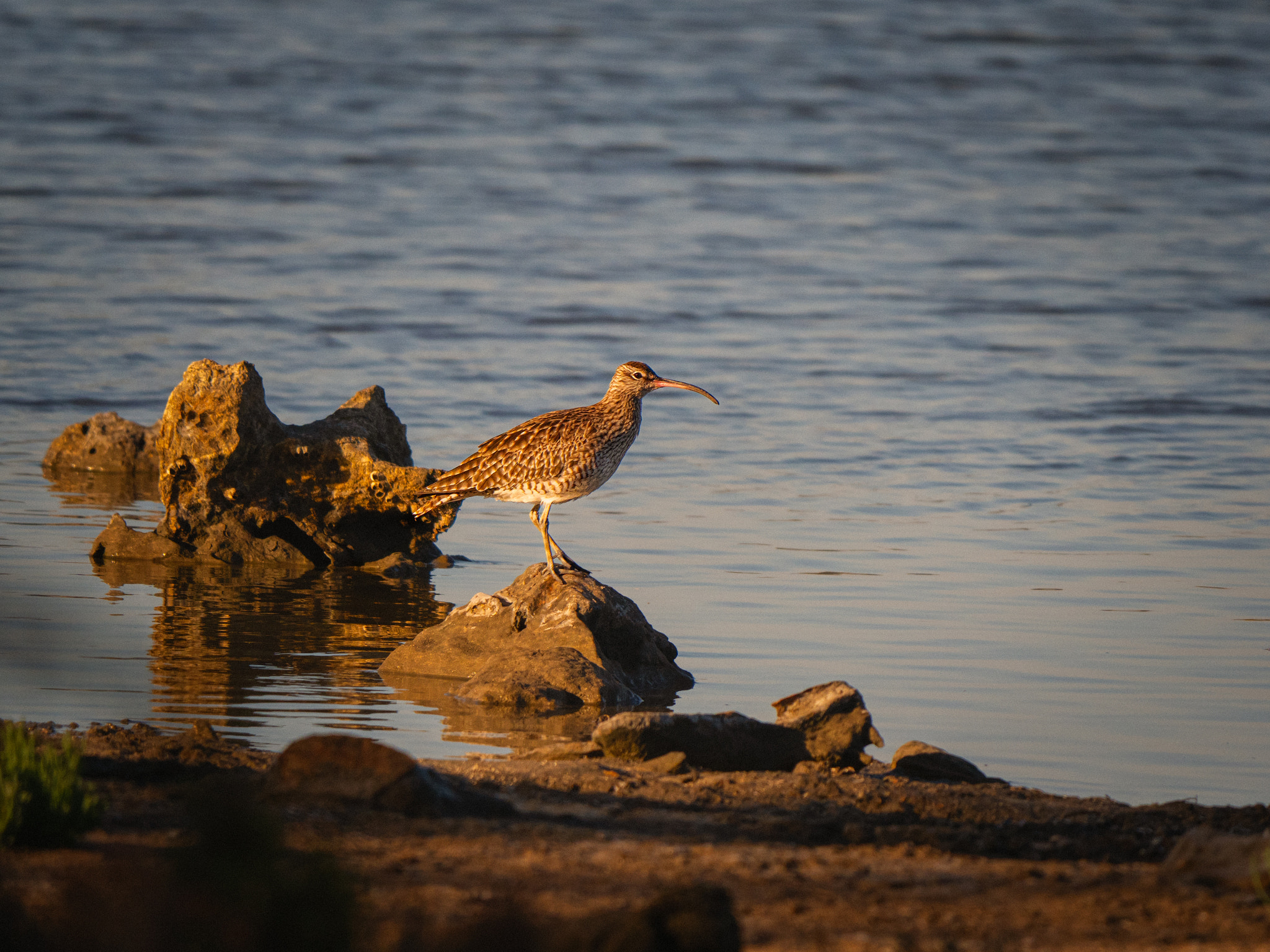
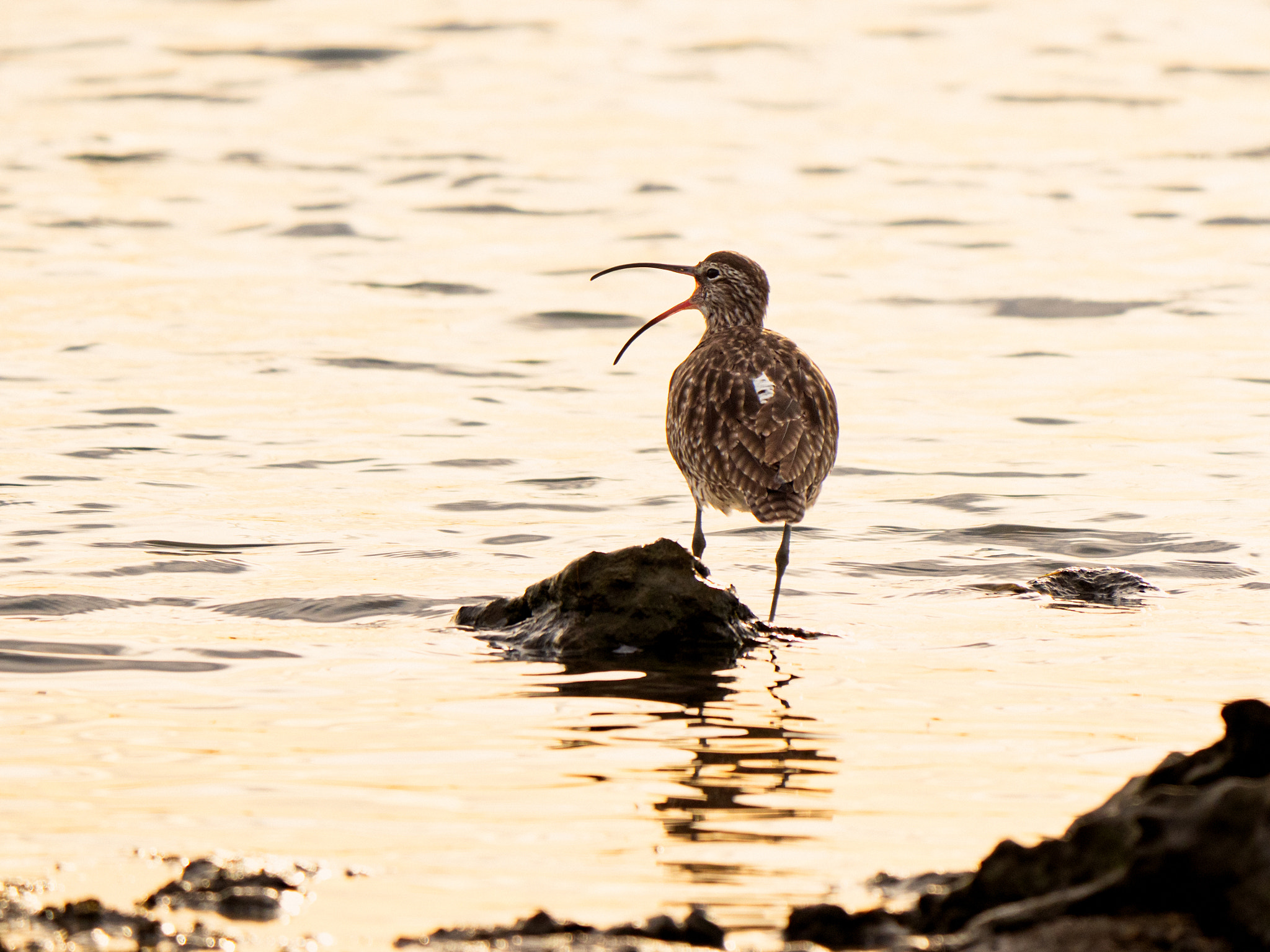
Whimbrel, Numenius phaceopus. Samphire Cove Nature Reserve, Westerm Australia. Olympus EM 1 mk ii with Panasonic Leica 100-400mm f4-6.3 lens. Exposure: 1/1250s, ƒ/7.1, ISO 500.
Every year it is reckoned that 50 million migratory water birds migrate from artic Russia and north eastern Asia southwards looking to winter in warmer countries such as Australia and New Zealand. This is the East Asian–Australasian Flyway and the West Pacific Flyway. About 35 or 36 species of waterbirds migrate to Australia on an annual basis involving approximately over 2 million birds and flights of up to 26,000 kilometres, it is a staggering number. Now I’m sure that if the leader of opposition Peter Dutton, Australia’s very own Lord Voldemort, found out there is 2 million migrants coming into Australia every year he would have a conniption fit and demand that they all be taken off to Nauru for mandatory indefinite detention. Cheap cracks at Peter Dutton aside the phenomenon of these bird migrations is absolutely amazing.
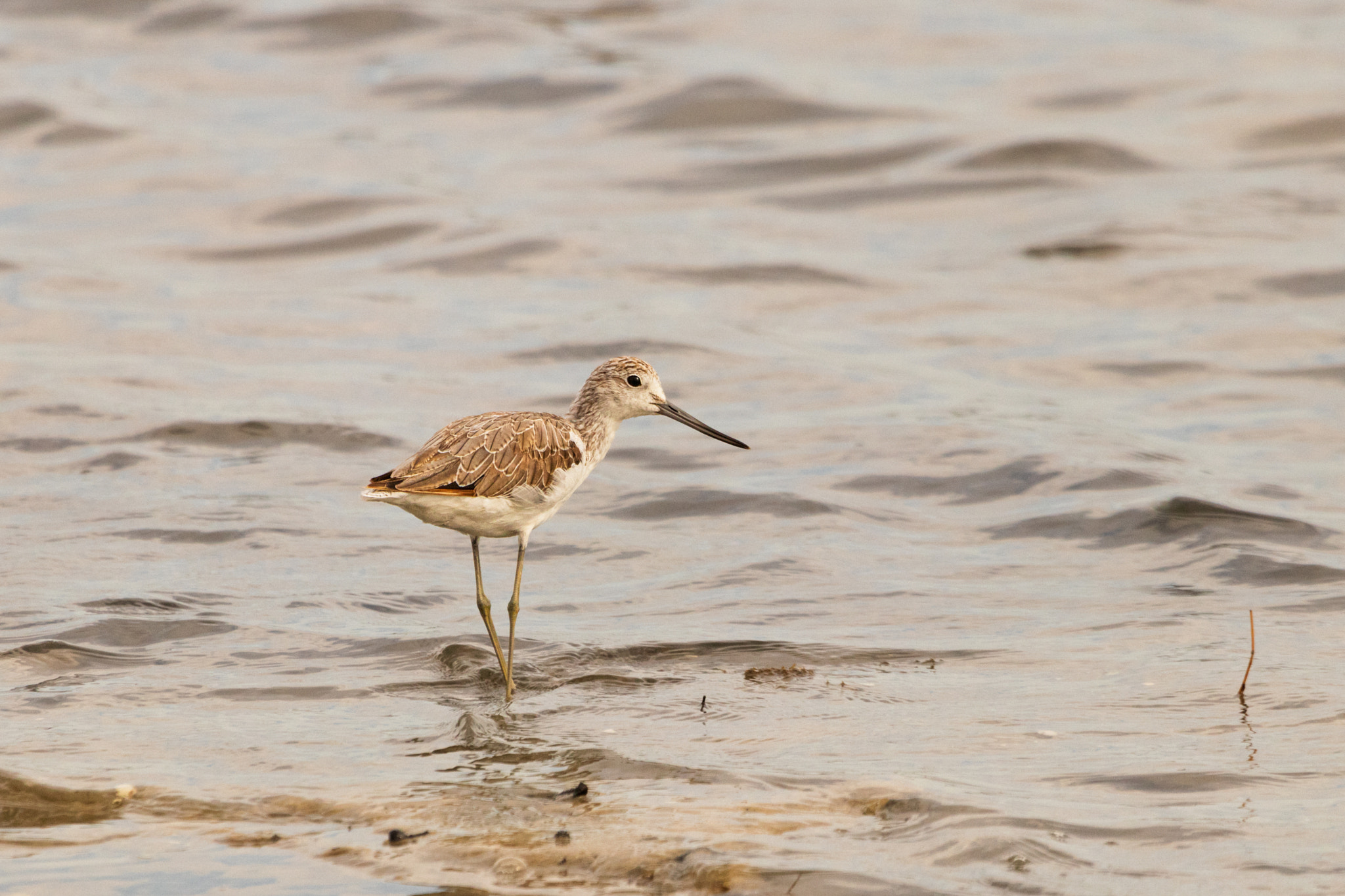
Some of the birds are small, really small. A MacDonalds Chicken McNugget has more meat on it than some of these birds, and yet every year they can fly from the Artic Circle to Australia and back. It makes me feel tired just thinking about it. I must say I hadn’t really given this very much consideration until recently. I mean I knew birds migrate – the Rainbow Bee-eaters I regularly photograph migrate from Papua New Guinea and Northern Australia, a relatively short jaunt in comparison – but I hadn’t really thought about the waterbirds who come in their hundreds of thousands to Western Australia. I think that’s because I don’t see them – they don’t come to winter on the idyllic waters of the Avon River. A recent trip to the Peel Inlet and Alfred Cove changed this. As usual I was looking for something else when I came across Whimbrels (Numenius phaceopus) and the Common Greenshank (Tringa nebularia) and because I wasn’t prepared for the encounter I just blundered in and they spooked resulting in only a couple of pictures of each. Despite returning on subsequent occasions I still only managed a grab shot of the Whimbrel and none of the Common Greenshank. Interestingly both birds don’t have Nyoongar(the original inhabitants of the south west of Western Australia) names.
Common Greenshank, Tringa nebularia. Alfred Cove, Western Australia. canon 80d with Sigma 150-600mm f5-6.3 lens. Exposure: 1/2000 sec, f6.3, ISO 400.
The timing of migration seems to be controlled primarily by changes in day length and the birds navigate using celestial cues from the Sun and stars, the Earth’s magnetic field, and mental maps.In some birds the route is genetically programmed– these tend to be the shorter lived species – whilst the longer lived species are socially programmed ie they learn the route of of the older birds. All I know is that their ability to find their way from one end of the globe to the other is amazing. I have enough trouble navigating round my neighbourhood without Google maps.
Whimbrel, Numenius phaceopus. Samphire Cove Nature Reserve, Westerm Australia. Olympus EM 1 mk ii with Panasonic Leica 100-400mm f4-6.3 lens. Exposure: 1/500 sec, f6.3, ISO 250.




You must be logged in to post a comment.