This is Delyip or the Red-capped Parrot (Purpureicephalus spurius). It’s Latin name literally means “bastard red-head” which seems a bit harsh – perhaps the European biologist who first saw it had hang ups about red heads. This particular bird was in the Samphire Cove Nature Reserve and was a curious bird quite happy to watch me take photos of it and the other birds around us. I happen to think that Australia is fortunate to have so many wonderful looking parrots, but, unfortunately I’m in the minority and this is another bird that is classed as vermin and shot in great numbers. It seems that there is nothing that Aussie farmers won’t kill.
On a lighter note have you ever wondered why photographers used to say “watch the birdie”? Well back in the dim distant early days of photography in the mid to late Nineteenth Century camera exposures were very long and photographers would struggle to get adults to hold still for the several seconds that an exposure would take (one of the reasons why early portraits look so forced). Some photographers resorted to literally clamping a person’s head in place to hold them still. Back in 1879 a chap by the name of CW Davies trained a pet canary to sit on his camera andsing on command. He’d then say “Watch the birdie” with the hope that the sitter would be transfixed enough to sit still while the exposure was being made. After an article about Davies in the Photographic News numerous manufacturers began producing small brass birds that would make a sound when a pneumatic bulb was squeezed. Now we’re in the 21st Century you’d have thought gadgets such as this would be consigned to the history books. Well you’d be wrong. The video below is by Gordon Laing at the CP+ 24 an international camera and photo imaging trade show which this year was held in Japan. These gadgets are obviously alive and well.
Life at the top looks pretty cruisy. Yoondoordo or Eastern Osprey.
People think that being an apex predator is pretty easy. You get to eat what you want, go where you want, you are on the top tier of the ecosystem. Take for instance the story of the Eastern Osprey. Our protagonist sits heroically in the top of an old dead tree contemplating whether he should go and catch a fish for breakfast. He looks majestic – a master of the air and a ruthless hunter. Life looks good for the osprey.
Thinking about heading off for a spot of breakfast.
Nothing like a fresh fish in the morning.
After a feed of fish the osprey sits himself in the top of a tree to allow the sun to dry out his feathers. It’s a chance to relax. Suddenly thwack! An Australian Raven decides he’s in the wrong place and attacks the Osprey from behind. Now you’d expect the osprey to put up a bit of a fight and assert his dominance him being the larger and more powerful bird. But he doesn’t and he skulks off to quieter spot.
You just can’t relax for a minute.
“Sod this for a game of soldiers. I’m out of here.”
The moral of the story is that is always someone who wants to knock you off of your perch.
Ooooerrrr! That’s probably not the best thing to say in a blog about bird photography. Rest assured no ducks were harmed in the making of this blog entry.
No ducks were harmed in the production of this blog. Ngoonan or Grey Teal (Anas gracilis). York, Western Australia.
A little while ago I wrote about how my ability to photograph birds had deserted me. Well I can now report that yesterday morning I had a stonker of a morning. I parked up at my usual spot on the River Avon and before I had got my camera bag out of the car I could hear a couple of Brown Goshawks calling out to one another. I could only find one of the birds and it was obligingly sitting in the top of a tree and the first light of dawn was illuminating it nicely. I could hardly believe it! It just kept sitting there unfazed by my proximity and it was I who eventually moved on leaving it there calling out to its mate. This was the best start I’ve had in a very long time and if I’d seen nothing else this would have been tremendous. Just 20m further on and I found a pair of Nankeen Night Herons. By this time I had a grin that went from ear to ear. Walking up to Mile Pool things just got better and better.
Karkany or Brown goshawk (Accipiter fasciatus) basking in the dawn light. York, Western Australia.
Ngalkaning or Nankeen Night Heron (Nycticorax caledonicus subsp mannillenis). York, Western Australia
Mimal or Australian Darter (Anhinga melanogaster subspecies novaehollandiae). York, WEstern Australia.
Doolor or Silvereye (Zosterops lateralis). York, Western Australia.
Kakak or Little Pied Cormorant (Phalacrocorax melanoleucos). York, Western Australia.
Western Inland Hunter, Austrogomphus collaris. York, Western Australia.
We’ve had some really hot days with temperatures exceeding 40ºC and this has meant there were a lot of birds congregated in the trees around the few remaining pools of water. By 8am the temperature was starting to soar and there was less bird activity. So I changed lenses and went looking for dragonflies and damselflies. I found some but the warmth had supercharged them and they were proving difficult to photograph as they would not sit still for very long. At 8:30am I decided that it was too hot and decided to call it a day. As I started to put my camera away I glimpsed a white bird sitting in the top of a dead tree. At first I thought it was just a corella, but there was something about the way it was moving made me think it was something else. Looking through the camera I could see those unmistakeable red eyes of a Black-shouldered Kite. Panic set in now as I didn’t have the right lens on. So calming myself down I changed lenses and started making my way closer to the bird. Usually what I do is wait for the bird to look in another direction then edge forward by a metre. I then stop take a few photos and then when it looks away again edge forward and take more photos. Like this I managed to get within 20m of the Kite. It looked quite relaxed spending most of its time scanning the ground below looking for food. After a little while it did a dump – birds often do this just before taking off, I suppose it lightens the load – and then took off in a lazy curve towards some taller trees. It was bloody brilliant! My only regret was that because there was insufficient cover I couldn’t get closer, but there’s always next time.
Black Shouldered Kite, Elanus axillaris. York, Western Australia.
I just can’t get the birds to put in an appearance. They just aren’t cooperating at all. I dunno whether it’s my BO basher putting them off or my dress sense. The end result is the same – can’t get within cooee. So I’ve thrown the towel in and am trying something else – damselflies and dragonflies. No flight shots as yet but at least I can find them.
Australian Duskhawker, Austrogynacantha heterogena. York, Western Australia.
Slender Ringtail, Austrolestes analis. York, Western Australia.
Aurora Bluetail, Ischnura aurora. York, Western Australia.
Inland Ringtail, Austrolestes aridus. York, Western Australia.
Trying to get interesting Bird In Flight (BIF) shots is tricky down by the river. The river is fringed by trees and this causes the auto focus system on my camera to get confused, which means it locks onto the trees rather than the bird. The end result is lots of photos of out of focus birds. But this week I had the bright idea of standing on the South Street bridge. Usually the birds fly up and down the river and so they’d be coming straight at me with no confusing background. I say usually as I stood on that bridge for over an hour and there were no birds flying or otherwise. Very frustrating to say the least. So I decided to cut my losses and take a walk up the river to see if I could find anything higher up. Zip! Zilch! De nada! So where do all the birds go? Had they gone on a day trip somewhere? Do they just hide? It was quickly turning out to be a complete washout. Feeling a little crest fallen as I was making my way back to the car I came across a couple of Bambon or Rufous Whistlers in the trees at Monger’s Crossing. They’re one of my favourite birds and I can listen to them sing for ages. They were obliging enough to hang around long enough for me to take a couple of photos. This lifted the spirits somewhat.
Bambon or Rufous Whistler (Pachycephala rufiventris). Avon Walk Trail, York, Western Australia.
Getting ready to sing.
Just before the Swing Bridge there are a couple of dead trees on the river bank and they are a popular perch for kingfishers, but this time they being used by some Kakara or Crested Pigeon (Ocyphaps lophotes). The first one looked a bit startled when it saw me, but the other was very chilled. They have the most amazing red eyes. The brilliant blue of the sky made for a nice background.
This crested pigeon got a bit of a fright when it saw me.
Those red eyes are worthy of Hammer House of Horror film. “Revenge Of The Evil Undead Pigeon”.
Birin-birin or Rainbow Bee Eater (Merops ornatus). Avon Walk Trail, York, Western Australia.
So after their long flight from Far North Australia and Papua New Guinea the rainbow bee eaters have returned. Not the best photograph of a rainbow bee eater, but it makes me happy that they’ve returned to the banks of River Avon. They’ve dug their burrows and we’re now waiting for the eggs to hatch because this will mean a huge amount of activity from both parents as they catch enough food for the chicks.
I was also happy to see a red-backed kingfisher as they’re not very common in these parts. From a distance I thought it was a one of its cousins – a laughing Kookaburra as they share a similar profile. I don’t know the Nyoongar name for the red-backed kingfisher so if anyone out there does know I’d much appreciate you telling me.
Red-backed Kingfisher, Todiramphus pyrrhopygius. Avon Walk Trail, York, Western Australia.
Kaa-kaa, Laughing Kookaburra (dacelo novaeguineae). Avon Walk Trail, York, Western Australia.
For wildlife photographers on a budget I happen to believe that micro four thirds (M4/3) has a lot to offer and represents incredible value. The micro in micro four thirds is a reference to the size and weight savings the system brings, it has no impact on the features and performance on offer.
Available Lenses
The Panasonic Leica DG Vario-Elmar 100-400mm f4-6.3 and the Olympus M.ZUIKO DIGITAL ED 75-300mm f/4.8-6.7 II lens are just two of the long lenses available for Micro Four Thirds wildlife enthusiasts.
The M4/3 system is now at the time of writing 15 years old and is, therefore, fully fleshed out. This means that there is plenty available on the second hand market. But, before we consider camera bodies let’s look at lenses first. Both Olympus (now OM Systems) and Panasonic provide a range of long lenses suitable for photographing wildlife. At the budget end there’s the Olympus 75-300mm II f4.8-6.7 and the Panasonic 100-300mm f4-5.6 which represent excellent value. On a M4/3 camera these two lenses have the same angle of view as a 150-600mm and 200-600mm lens respectively when used on a camera with a 35mm full frame sensor at a fraction of the weight and cost. The Olympus 75-300 can be found for around $500 AUD second hand (or $600 new) and the Panasonic 100-300 can be picked up for about $550 2nd hand ($1000 new). This means it is very feasible to put a good kit together for under $1000 AUD which is about $650 USD.
The Olympus 75-300mm lens delivers amazing performance for its price.
In the midrange category both companies offer 100-400mm zooms. The Olympus 100-400mm F5.0-6.3 IS sells for around $1500 2nd hand or $2200 new and the Panasonic Leica Vario-Elmar 100-400mm f4-6.3 sells for around thee $1200 mark second hand or $2200 new. This is for the original version. It has just been updated to make it compatible with tele-converters and will likely retail for around $2600 AUD.These two lenses give an angle of view equal to that of 200-800mm on a 35mm sensor in a very compact package.
Panasonic Leica DG Vario-Elmar 100-400mm f4-6.3 is a premium lens that be picked up on the secong hand market for a fraction of the price of full frame equivalents.
At the top end of town there are two lenses. The Olympus 300mm f4 IS which apparently is a gem of a lens and can be had for approx $2800 on the used market or $4000 new. Then we reach the stratosphere with the Olympus 150-400mmf4.5 IS PRO which retails for an eye watering price of $11500 new. Good luck in finding one new at a dealer as they are in short supply. I have seen a used one on a Japanese dealerswebsite going for $7500 and it was gone within a day.
The Panasonic G85 with the Panasonic 100-400mm lens compared to a Canon 6d with Sigma 150-600mm lens. The Panasonic combo is a fraction of the weight and has more reach.
So out of all these lenses I own the Olympus 75-300 and the Panasonic 100-400. Both of them have been very good, but with some caveats. The major criticism of the Olympus 75-300 is that it is soft at the long end. First I’d like to say get real! This is a budget lens. But, seriously this is a common complaint about zoom lenses especially at the budget end of the market. In my opinion,and based upon the example that I own, it is not as bad as people make out wide open and it improves if you stop down a bit. The pluses are it is amazingly small and light. I did intend to sell it when I got the Panasonic 100-400 but I kept it for those moments when I don’t want to carry the larger Panasonic ie when I’m out walking the dog. The Panasonic 100-400 is an amazing lens and I really enjoy using it. When it was first introduced there were complaints about it having an overly stiff zoom ring and it couldn’t be repaired. I’ve not experienced any problems and have used the lens extensively in all sorts of weather since I got in 2018. My only criticism of the 100-400 is that the lens based image stabilisation isn’t compatible with that of my Olympus cameras’s IBIS.
Click on the image to see full size
Click on the image to see it full size
Click on the image to see it full size.
Click on the image to see it full size
Camera Bodies
The Panasonic G85.
Once you’ve decided upon your lens then you can consider camera bodies. As things are at the time of writing I’ll be looking at the following camera which can be picked up easily second hand. The Olympus EM 1 mk I (approx $400 AUD), the Olympus EM1 mk ii, and the Panasonic G85. I own all three and think they all offer tremendous value for the wildlife photographer on restricted budget.
The Olympus EM1 is a very capable wildlife camera for those on a restricted budget.
Panasonic G85
Olympus EM1
Olympus EM1 mk ii
Year of Introduction
2016
2013
2016
Resolution
16 Mp
16 Mp
20 Mp
ISO range
200-25600
200-25600
200
Boosted ISO
100
100
64 and 100
IBIS
5 axis
5 axis
5 axis
File Formats
RAW and jpg for stills
AVCHD and MP4 for video
RAW and jpg for stills
H.264 and Motion jpg for video
RAW and jpg for stills
H.264 and Motion jpg for video
Auto Focus
Contrast only (DFD)
Multi area
Centre zone
Selective single point
Single AF
Continuous AF
Tracking AF
Face detection AF
Touch screen AF
Contrast and phase detect hybrid system.
Multi area
Centre zone
Selective single point AF
Single AF
Continuous AF
Tracking AF
Face detection
Touch screen AF
Contrast and phase detect hybrid system.
Multi area
Centre zone
Selective single point AF
Single AF
Continuous AF
Tracking AF
Face detection
Touch screen AF
Manual Focus Aides
Focus peaking
Focus peaking
Focus peaking
Focus Points
49
81
121
Maximum Shutter Speed
1/4000 mechanical
1/16000 electronic
1/8000 mechanical
1/32000 electronic
1/8000 mechanical
1/32000 electronic
Exposure Modes
Program, aperture priority, shutter priority, and manual.
22 Creative Control modes.
iAuto, Program, aperture priority, shutter priority, and manual.
22 scene modes and 12 Art filters.
iAuto, Program, aperture priority, shutter priority, and manual.
22 scene modes and 14 Art filters
Built In Flash
Yes
No
No
Dive Modes
Single frame
9 frames per second with the mechanical shutter and continuous AF. Up to 40 fps with the electronic shutter and the autofocus set to single point.
Single frame
6.5 fps with mechanical shutter and continuous AF. 11 fps with single AF and electronic shutter.
Single frame
Up to 18 fps with mechanical shutter and continuous AF. 60 fps with single AF and electronic shutter
Buffer
300 large jpgs,
45 RAW and RAW plus jpgs
50 large jpgs,
34 RAW
117 large jpgs,
84 RAW
Metering Modes
Multi zone, centre weighted and spot metering.
Multi zone, centre weighted, and spot metering.
Multi zone, centre weighted, and spot metering.
Video
4K up to 30 fps
HD up to 60 fps
HD up to 30 fps
Cinema 4k 24fps IPB
4K up to 30 fps
HD up to 60 fps
Storage media
1 x SD card slot UHS-II compatible
1 x SD card slot UHS-I compatible
2 x SD card slot with only 1 UHS-II compatible
Environmentally Sealed
Yes
Yes
Yes
Anti Aliasing Filter
No
No
No
Weight
505g with battery and card
497g with battery and card
574g with battery and cards
Battery CIPA Rating
330 shots
350 shots
440 shots
The Olympus EM1 mk ii is an extremely well specified camera that can be found for less than $1000 AUD on the used market making it somewhat of a bargin.
All three cameras feel good in the hand. The G85 has the easiest to navigate menu system. The Olympus menus cop a load of flack for being labyrinthine but they do allow a phenomenal amount of customisation and once these are set, your custom modes set up, and you use the Super Control Panel (SCP) you shouldn’t have to deep dive them often.
The Panasonic G85 with Panasonic Leica 100-400mm lens makes a very good wildlife video set up.
Which one should you get? Well that depends upon your budget and what you intend to do with the camera. If cash strapped the the EM1 is the one to go for. It’s a beautifully built camera that turns out a great performance. The only place is where it is lacking is video. If you shoot primarily stationary targets and some video capability is important I think the G85 is a great buy. It is only let down by its auto focus the DFD technology Panasonic uses just wasn’t as good for action as phase detection autofocus. Having said that I have used the camera to shoot some wildlife videos – you’ve just got to be patient and pick situations that the camera can cope with. If you’ve got the budget then the EM1 mk ii is the one to get.Not as accomplished in the video department as the G85 but it does produce a solid result and the AF for video and stills works quite well. You’d have to spend quite a bit more money to get better performance.
The Olympus EM1 is a very capable wildlife camera for those on a restricted budget. Pair it with the Olympus 75-300mm lens and you have a compact lightweight, but powerful combination.
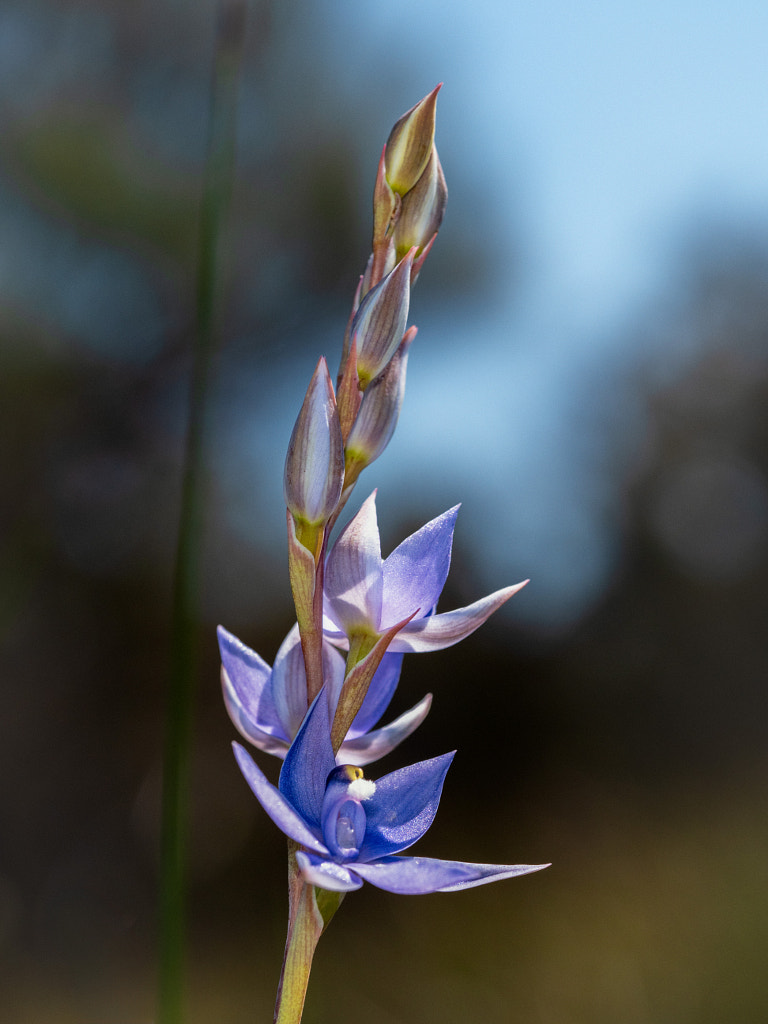
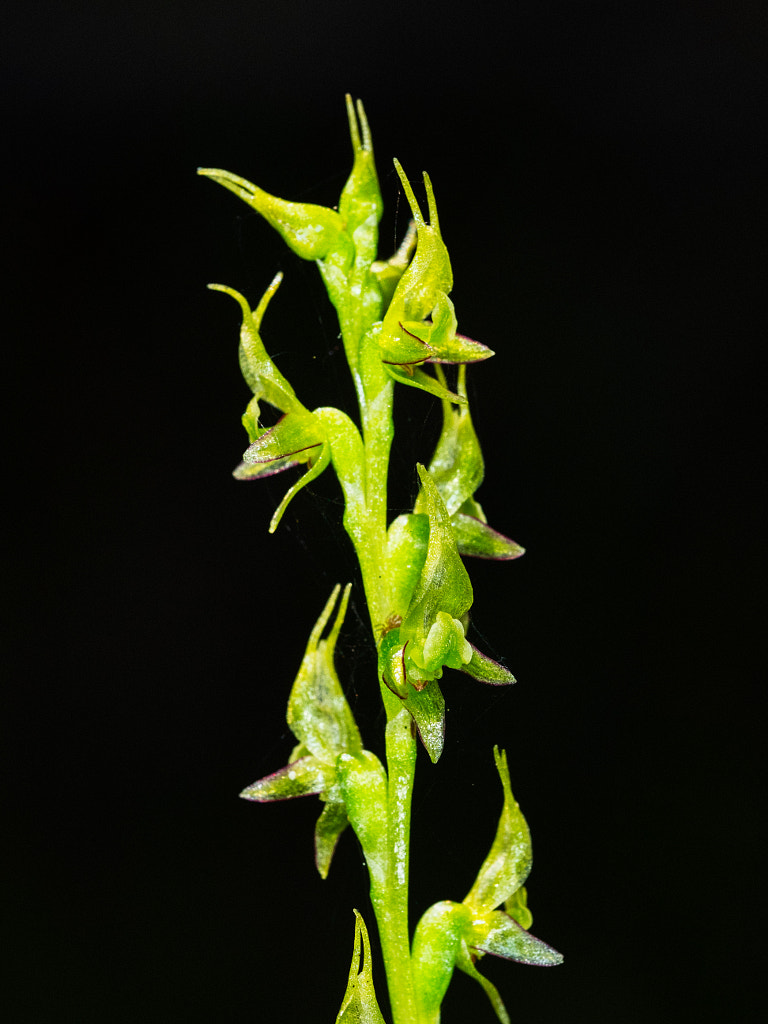
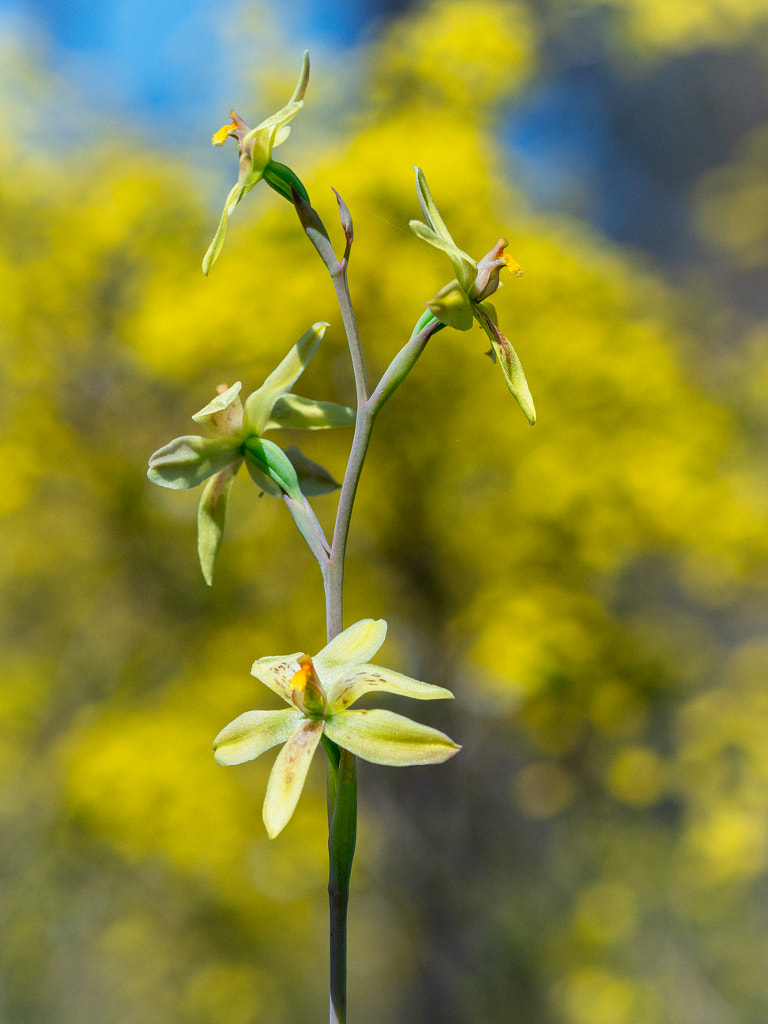
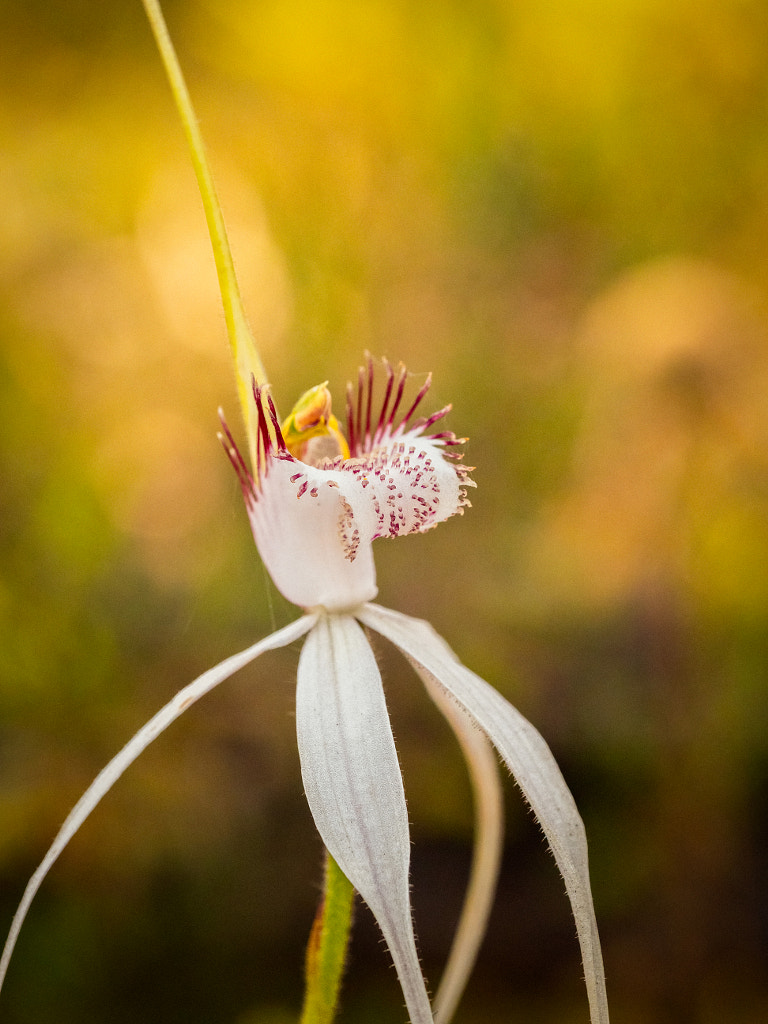
Up until this time last year I had only ever seen one leopard orchid (Thelymitra benthamiana). It is not that they are rare or hard to find, it’s just been that I’ve never been in the right place at the right time. The one I saw wasn’t at its best, but it made me very happy to see it. I went back to the same place last week and I was amazed to find not not one, not 10, but over a hundred of them. It was quite a spectacle. I’ve been saying how unseasonably warm it has been and dry the bush is, but obviously it suits leopard orchids. I was spoilt for choice as I wandered around looking for a good specimen with a good background that was sheltered from the wind.
Leopard Orchid, Thelymitra benthamiana. Wandoo National Park, Western Australia.





You must be logged in to post a comment.