It’s been a strange August. From my blog entries you’d think that it has been a very wet winter, but the reality is that it has been very little rain and the bush is very dry – almost crispy. It has has a tremendous impact on the wildflowers – there aren’t as many as the previous few years. This is causing problems for the tourist industry with some interstate and overseas tourists getting upset.
Dark banded greenhood, Pterostylis sanguinea.
Locally it has been very strange. Some species of orchid didn’t flower at all while some flowered 6-8 weeks earlier than normal as the winter as well as being dry has been warmer than normal. This last month I’ve been concentrating on the bush reserves around York and particularly those I’ve never been to. It’s quite boggling to think that after almost 20 years of living in the area I still haven’t visited all the reserves. The pictures accompanying this piece are some of the ones I’ve taken in August.
Lemon Scented Sun Orchid or vanilla orchid (Thelymitra antennifera).
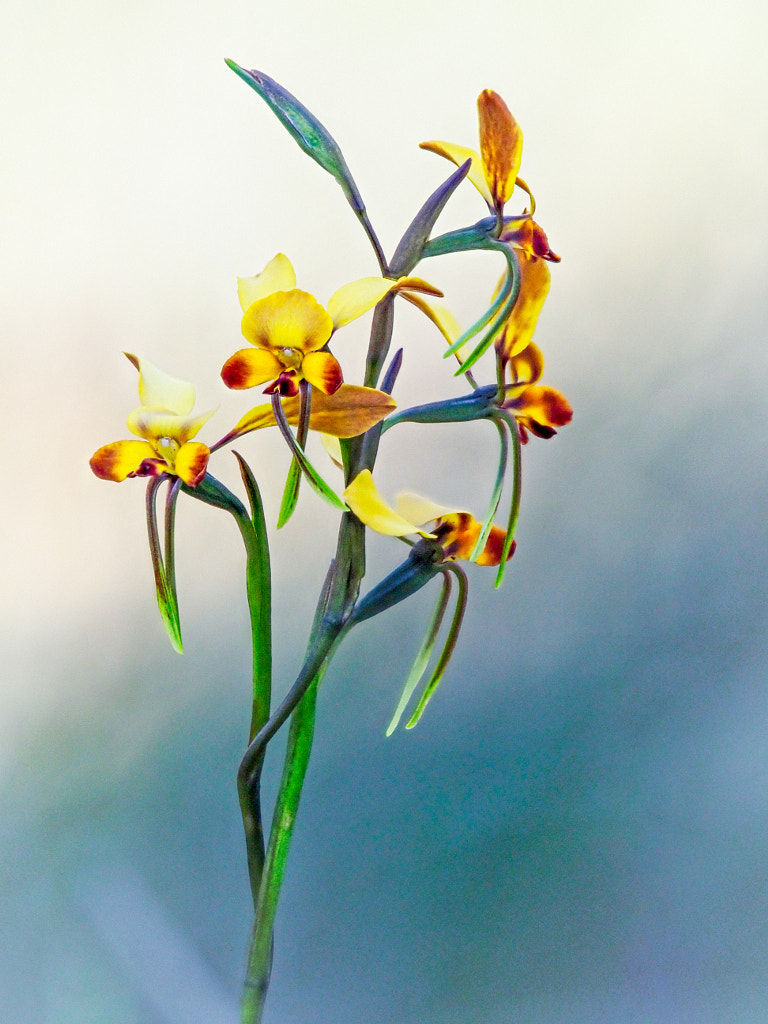
One of the most disturbing things this year is the impact of orchid tourism. Usually the reserves around York receive a fraction of the visitors that other orchid hotspots do, but with high petrol prices more and more people are now restricting their days out to those areas an hours drive from Perth. Having more visitors isn’t bad in and of itself. What is bad is the deterioration in people’s behaviour. The amount of litter left in some spots is huge. Another thing is that people aren’t prepared to walk to sites and so drive off the tracks to look for flowers causing a lot of damage. The worst thing is that people are now digging up the orchids. On Friday 25th August I went out to photograph Curly Locks orchids in the Wandoo National Park. I found six in three separate clumps. The flowers hadn’t fully opened so I decided to go back in a couple of days time. The following Tuesday I went back and all three clumps had been dug up. I tried to report it but was told it was a kangaroo that did it, but in my experience kangaroos don’t dig perfectly square holes with spades, and nor do they smoke cigarettes while they do it and leave behind their water bottle.
Jug Orchid or Recurved Shell Orchid (Pterostylis recurva).
Orchid poaching is a big problem. Earlier this year Kings Park in Perth had nine hundred rare species of Western Australian orchids stolen. It seems that there people afflicted by orchidelirium a kind of flower-driven madness where people just have to own the rarest of the orchid species. It is a growing problem and only the other day I was approached by a man in his early 70’s claiming to be a friend of a noted Western Australian expert and that he was prepared to sell me orchid tubers for $40 a tuber. I told him in no uncertain terms where to go. The frustrating thing about this is that a lot of the orchid species are very specialised requiring certain other plants and pollinating insects to survive. Without these they die. In the case of the Curly Locks I know of only three sites where they can be found round York and at best there are only half a dozen flowering plants at each site per year. Wiping out one locations population like that means that is one less place where they can be found, which means extinction is even closer.
Bird Orchid, Pterostylis barbata
I’m sorry for the rant but the whole thing was a little upsetting and I’m not sure what was worse, the theft, the indifference of the authorities, or the brazenness of people trying to sell the orchids.
Clubbed Spider Orchid, Caladenia longiclavata.
Fringed Mantis Orchid or Green Spider Orchid (Caladenia falcata).
Based on the evidence of what I post on this blog I go out to take nature and wildlife photos, but actually I go to be out in nature. The photos below are what I love being out in.
The warm light of sunset reflected by the trees in the Oswald Sargent Reserve.
Driving back home from the Oswald Regent Reserve at sunset.
This shot of a Scented Sun Orchid was what I considered my first successful photo of an orchid. The subject is separated from the background making easy to see.
I took what I call my first proper shot of an orchid back in 2008. Back then my technique was very simple – handheld with a macro lens. The problem was that it was often very difficult to isolate the flower from the background while having sufficient depth of field and a low ISO. For every successful photo there were hundreds of duds.
This shot of a Butterfly Orchid is one of the hundreds of duds. The messy background threatens to overwhelm the subject.
After about a year of trial and error (mostly error) I decided to photograph the orchids in the same way I would take a portrait of a person. Get down at “eye” level, use an off axis flash to provide the key light and have the natural light as my fill light at -1 to -2 stops. This was a huge improvement, but I still wasn’t getting the clarity and sharpness in the images I desired.
My first flash rig for photographing orchids. Using a flash brake allowed me to get the flash off of the lens axis and get a more pleasing lighting effect.
The next attempt at better lighting was a heavy tripod and light stand. My back hurts just looking at this photo.
The next evolution was to mount the camera on a tripod and then mount the flash to one of the tripod legs via a “magic arm”. This allowed greater choice in the positioning of the flash and allowed me to use different flash modifiers such as soft boxes, grids and snoots. The arrival of affordable and reliable wireless flash triggersmeant I could use multiple speedlights for more sophisticated lighting. This came a tremendous cost. I have a chronically bad back and all that kit was heavy, the tripod and “magic arm weighed just under 6Kg. Then there was the futzing about setting everything up, taking the shot, breaking it all down, walking to the next subject and then repeating it all again. Suddenly it wasn’t fun anymore. Something had to give and it was my back.
The diminutive Olympus EP-2. Just what the orthopaedic surgeon ordered.
A size comparison of my DSLRs (Canon 5d and 550d) and the Olympus EP-2 which replaced them.
In 2013 I bought an Olympus EP-2 mainly for travel and street photography. It was a revelation – small size, In Body Image Stabilisation (IBIS), and excellent flash implementation. It quickly became my orchid camera of choice. I could chuck out the tripod and become more mobile. It wasn’t all beer and skittles though. The 12Mp sensor wasn’t the best in terms of high ISO performance and dynamic range, the lack of a viewfinder made usage in bright sunlight problematic (solved with the addition of the optional EVF) and the contrast based autofocus system was a bit on the temperamental side. But the positives were enough to keep me using it and when the EM10 came out with a built in EVF, a better IBIS system and an improved sensor then I knew that the system would be just about perfect for what I did. I could walk around in the bush for hours at a time without back pain which meant I could explore further afield. This freedom allowed me to experiment a lot more.
Sigma’s 105mm f2.8 DG DN macro lens attached a Sony A7Rii.
The Tamron 35mm f2.8 lens has excellent macro capabilities.
Curly Locks, Thelymitra spiralis. Wandoo National Park, Western Australia. Sony A7r2 with Sigma 105mm f2.8 DG DN macro lens.
White Spider Orchid, Caladenia longicauda subsp longicauda. Wambyn, Western Australia. Sony A7r with Tamron 35mm f2.8 lens.
In 2021 I felt that I wanted more resolution than the 20Mp EM1 mk ii was giving me. So I tentatively dipped my toe into the world of full frame mirrorless and I went with a second hand Sony A7r2. The image files produced by the camera were absolutely gorgeous. Alongside my usual working method of using flash with macro lens I decided to experiment with environmental portraiture of orchids. For this I used a 35mm lens with a half size macro capability and the results were pleasing. The downsides were as follows. The rear LCD is hopeless in bright light and it has no touch control facility. The IBIS wasn’t as effective as that on my Olympus cameras and the sensor resolution emphasised very tiny camera shake. A tripod was the solution. The sensor is a dust magnet which means that changing lenses enables dust bunnies to proliferate. The answer was to have one camera with the 105mm macro and one camera with the 35mm. Arrrrrgh! I was back carrying a load of heavy equipment. So it was back to the Olympus kit.
This shot of a Lemon Scented Sun Orchid was made with the Olympus Em1 mk ii, Olympus 40-150mm f2.8 lens with 1.4 x teleconverter and the Olympus FL600R flash using the focus stacking function.
I’m still trying to evolve a style which produces a nice clean portrait of an orchid. One of the great benefits of Olympus’s cameras and lenses is that it allows very long telephoto lenses to have an almost macro capability. The use of such long lenses allows you to throw backgrounds well out of focus by dint of their increased magnification which reduces depth of field. The problem is that that decreased DOF means that it is hard to get your subject rendered sharp whilst retaining all that loverly bokeh. The counter to this is focus stacking which involves taking a series of pictures of the subject while moving the focus point and then blending the images in post. Olympus has a very neat feature that allows you to do this automatically in camera which is fantastic. Unfortunately the function limits your flash usage by restricting your maximum flash sync speed to 1/50th second and you have to manually set the flash exposure. I tried doing this for a while and it was a right royal pain. So now I don’t use the flash and just make the exposure using ambient light. The lens I’m using is the Olympus 40-150mm f2.8 with the the mc-14 1.4 x teleconverter. This gives me a 210mm f4 lens (420mm in full frame terms). Despite shooting wide open this invariably means shooting at a low shutter speed. So while the IBIS is fantastic on my EM1 mk ii using it with a long lens while focus bracketing wasn’t the best way to proceed. So it was back to a tripod. My aluminium Manfrotto 055 tripod is a good tripod but it is that heavy you could use it as a boat anchor. It was time to get a bit of fibre in my life – carbon fibre. So I bought a nice SiruiAM-254 carbon fibre tripod which weighs just a smidge over 1Kg. It doesn’t have a centre column and so a minimum working height of 7.8cm which means you can get down and close to the subject. The results have been excellent and now I feel that using both my normal macro lens and the telephoto zoom with converter I’m getting closer to what I have envisioned.
The Sirui AM 254 tripod in action.
So this has been my journey of finding what works for me. I’ve discovered that learning how your equipment works is just as an important step in developing vision and style as is technique. Continual learning and experimentation will help you develop as an artist and we shouldn’t be afraid to do so. A few times I’ve felt that I was going backwards, but it was worth persevering. I’ve still got a couple of things to sort out, but I feel now I’m on the right track.
The following shots were made this last week.
Common Bunny Orchid, Eriochilus dilatatus subsp. multifloris. Oswald Sargent Reserve, Western Australia.A focus stack using the Olympus EM1 mk ii with the Olympus 40-150mm f2.8 lens and 1.4 x teleconverter.
Hare Orchid or Fringed Hare Orchid (Leporella fimbriata). Oswald Sargent Reserve, Western Australia.
The last few weeks I’ve been concentrating on the Avon River and I wanted a change. So early one morning I got up so I could be in the wandoo woodland of Mount Ronan’s Nature Reserve as the sun comes up. There is nothing like the first rays of the sun hitting the trunks of the wandoo trees. The golden rays illuminate their pale bark and they all but glow in the warm light.
Wardawort or Grey Butcherbird (Cracticus torquatus). Mount Ronan Nature Reserve, Western Australia.
I got off to a promising start – as I pulled up I was greeted by a mob of kangaroos. They weren’t so keen to see me however and took off into the bush. There was an incredibly loud melodious piping and warbling coming from the tops of the trees. At first I thought it was magpies singing a bit strangely, but after closer inspection I found it was about a dozen grey butcher birds calling out to each other. What was amazing about it was they were all singing the same phrases taking turns with no gaps. You would be forgiven for thinking it was one bird as the performance was so seamless. It was like a choir recital.
Djini or Rufous Treecreeper (Climacteris rufa) climbing up the trunk of a tree. Mount Ronan Nature Reserve, Western Australia.
Djini or Rufous Treecreeper (Climacteris rufa) taking some time out in the sun. Mount Ronan Nature Reserve, Western Australia.
Stalking animals in the wandoo forests is hard as the trees shed bark, twigs, branches and leaves in great quantities which means that the ground is covered in a thick crunchy mulch and no matter how hard you try to move quietly you always end up making a racket. The end result is that it is hard to get close enough to take photos. The ideal approach is to sit down and wait for the birds to come to you. After about half an hour I could hear the sound of small birds chasing insects and was rewarded with several rufous tree creepers. A few minutes later and I could see one climbing up the trunks of a tree to foraging for insects and grubs – I’ve never seen one going down they always seem to climb, and when they get as far up as they want the glide down to the ground or the next tree.
Djida or Yellow-rumped Thornbill (Acanthiza chrysorrhoa). Mount Ronan Nature Reserve, Western Australia.
As I continued to walk around the forest I must confess that I lost focus as I spotted a couple of orchids. It was annoying that I only had my bird photography rig with me and nothing really suited to photographing very small flowers. From that point on I was trying to watch for birds while looking on the ground for orchids. It is an impossible task.
Hare Orchid or Fringed Hare Orchid (Leporella fimbriata). Mount Ronan Nature Reserve, Western Australia.
Common Bunny Orchid, Eriochilus dilatatus subsp. multifloris. Mount Ronan Nature Reserve, Western Australia.
By 9:30 the best light had gone so I decided to call it a day and walk back to the car. Waiting for me was a female red-capped robin sitting on the fence. She was quite obliging and sat for a while allowing me to take her photo.
Female Dermokalitj or Scarlet Robin (Petroica boodang aka Petroica multicolour subsp campbelli). Mount Ronan Nature Reserve, Western Australia.
Moonset over Mount Ronan Nature Reserve, Western Australia.
Manatj or Little Corella (Cacatua sanguinea). York Western Australia.
It’s got nothing to do with the Ukrainian situation. Nothing to do with Taiwan, China or submarines. No this is a crisis which threatens the very fabric of the Australian way of life. It is Western Australia’s corella problem. Huge flocks of corellas are causing havoc. They dig up lawns, dance around on TV aerials causing havoc with the reception, they make a noise early in the morning meaning the great Sunday lie in is disturbed. Locals are so incensed that they have taken to calling them flying cane toads and want to blast them out of the skies with shotguns. The Western Australian government sensing a potential vote winning platform for the next election has set up a new task force headed up by a former police commissioner to deal with the corella plague. This probably means they’ll spend a fortune on cars, helicopters, four wheel drives, a snazzy para military looking uniform, and lots of media releases. It will probably go massively over budget long before it gets round to tackling the feathered little blighters.
Flocks of vociferous Little Corellas are disturbing the peace.
It’s not the fault of the corellas. They’re just doing what they have to do to survive. Originally found in great numbers further inland, but climate change and lessening rainfall means they are moving to more populous areas where people have provided an environment that they thrive in. We get them here in York because there is water in the Avon River and there is plenty to eat in the form of grain spilt while being transported to the grain bins. People water their gardens which means there are succulent roots to be dug up and there are a lot of tall eucalypts for roosting.
The corellas cause all sorts of mischief – digging up lawns, stripping the insulation off electrical cables, and chewing TV aerials are just a few of their crimes against humanity.
Having said all that I actually like the flocks of corellas. To me the sound of summer isn’t the thwack of a leather ball on a willow bat, it’s not the sound of surf breaking on a beach. It is the sound of the corellas. When me moved to Tasmania we really missed it.
You can’t watch the cricket when you’ve got a corella dance party on your TV aerial.
Just as a final note – the last time a war was declared against an avian foe was in 1932 with the “Great Emu War”. The Royal Australian Artillery was sent into bat against the wily emus armed with machine guns. It wasn’t pretty. After a month and only 50 emus killed the army withdrew conceding that the emus guerrilla tactics and high speed manoeuvrability meant that it wasn’t a fair fight.
Just a few snaps from the garden this week. First up is the biggest grasshopper I’ve ever seen. An absolute whopper. Appropriately called the Giant Grasshopper. It was sitting quietly on our front veranda and obligingly let me take it’s photo.
Giant grasshopper or hedge grasshopper (Valanga irregularis).
The second photo is of a praying mantis that also was very cooperative with my photo taking.
“Let us prey.” Blackbarred Mantis (Mantis octospilota).
The last shot is of a white cedar moth that came from our next door neighbour’s white cedar tree.
99% of nature photography is performing the process persistently and repetitively – almost an obsessive compulsive behaviour if you will. After last weeks lack of success in photographing dragonflies in flight I was determined to have another crack at it. After a bit of reading I’d found out that dragonflies and damselflies are ectothermic – which means that they are not able to regulate their internal body temperature and are to a certain extent dependent on sunlight and ambient air temperature. They don’t actually sleep as we understand it, but, rather go into a torpor and they roost in the undergrowth overnight and wait for the warmth of the next day. Which means at sunrise they don’t move around so quickly. This time I went down to some of larger pools of water in what remains of the Avon River at first light.
Waiting for the daylight to revive it after the nocturnal torpor. Aurora Bluetail, Ischnura aurora. York, Western Australia.
The warmth of the rising sun finally reaches this Aurora Bluetail (Ischnura aurora) and it wasn’t long after this that it flew off.
As I walked along the dried out river bed I spotted some damselflies waiting for the sun to come properly. Much easier to photograph as they were staying still! After a brief interlude I carried on up the river. In quite a few places there were large holes where the water had evaporated leaving a thick salt crust. In other places the river bed was quite rutted and potholed which meant the unwary could easily turn an ankle or worse.
Salt on the dried out River Avon.
Eventually I made my way to Mile Pool which is a large permanent pool fed by an underground spring. This means that a lot of wildlife can be found there. At the near end the pool is quite narrow, about 1m and shallow with over hanging tree branches and tree roots which would provide lots of perching spots. In my reading I’d also discovered that male dragonflies are quite territorial and will fly a set pattern around a territory often stopping at the same few perches while looking for females to mate with and chasing off other males who’ve dared to trespass. Sitting down on the ground I’d found my subject – a large Tau Emerald dragonfly. He had a regular flight pattern and every time he went round he’d pause and hover for a second or two. I realised that this would provide me my best opportunity to get a photo of it in flight. Sounds simple doesn’t it? The reality was that it took an hour with repeated tries. Eventually I got a sequence of ten photos and the best one is below.
Tau emerald, Hemicordulia tau. York, Western Australia.
As I got up and stowed my kit I noticed I’d had an audience and they didn’t look that impressed that I was intruding on their secluded pool. I grabbed a quick photo and head off home happy that I’d succeeded in getting my DIF photo. DIF is the abbreviation of Dragonfly In Flight. I’m determined to get better shots than this, but it is a good start.
The audience. Three little pied cormorants and one little black cormorant.
A male Blue Skimmer (Orthetrum caledonicum) at rest. Lake Leschenaultia, Western Australia.
We went to Lake Leschenaultia and I had all these plans to photograph dragonflies in flight. I’d got this shot all planed out in my mind to get a shot of one flying just over some reeds. I’d set the camera up with what would be the best lens and headed out to an area on the lakeside where I knew I’d find some and there would be some nice light. Except it was very windy and I couldn’t find any dragonflies. I went off to the reed beds behind the boat shed thinking that should prove more fruitful as it was in the lee of the wind. There were loads there flying around and it was amazing to watch them chase each other around, but from a photographic point of view it wasn’t so good as there was a rather belligerent tiger snake who really did not want to share his basking spot. So I walked around the lakeside a bit further and found another spot that was sheltered from the wind. But try as I might I just could not get the shot I was after. They wouldn’t fly where I wanted, wouldn’t fly slow enough or in a straight line. In the end I had to content myself with the photo above. The dragonfly just rested on that twig for a couple of seconds in the shade and then it was off.
Nature photography is hard. We can have an idea of the shot in our minds eye and try to make it happen, but then nature doesn’t play ball with us and then we have to adapt and take what we’re given. Bit like life really.



You must be logged in to post a comment.