The ubiquitous New Holland Honeyeater (Phylidonyris novaehollandiae), New Victoria Dam, Korung National Park, Western Australia.
Over the last few days my FaceBook feed has been seeing some seriously tasty bird photos from one of the groups that I belong to. The photos all come from one area– New Victoria Dam which is 30Km east of Perth on the Darling Range in Korung National Park. So when the Beloved Significant Other (BSO) announced she was competing in a croquet competition at a location just 20 minutes drive away I immediately volunteered myself as driver.
There are two starting points to the walk and which you choose will largely depend upon when you visit. If you visit outside of office hours Monday to Friday or anytime at the weekend then y ou have to use the upper carpark as your start point as the access road is shut. During office hours you can drive down to the lower carpark keeping in mind that if stay till after 5pm then you won’t be able to drive out. I started at the upper carpark which only adds 800m each way to the walk. The walk consists of a 7Km round trip down past the New Victoria Dam to the Old Victoria dam wall and the garden and picnic area. There used to be a path through the trees at the edge of the road but it has become quite overgrown and indistinct so you are best walking along the access road. As you walk down the road on your left is the gravesite of Francis Weston who died in 1876 aged two days, his parents lived in the timber workers settlement at Bickley. When you get to the lower carpark walk through it and then follow the trail markers. After walking through the forest you come to New Victoria Dam. Walk down the steps and at the bottom turn right onto the road and walk down to the remains of the Old Victoria Dam.
The gravesite of Francis Westson who died in 1876 aged two days. His parents lived in the timber workers settlement at Bickley.
The steps down to the New Victoria Dam.
The original dam was built in 1891 and pumped water via pipelines to Kings Park and a reservoir there on Mount Eliza. The dam became the first permanent water source for Perth and was operated by the private City of Perth Waterworks Company. As the water catchment area took in agricultural land and timber settlements there were fears that it would be polluted by raw sewage and excrement from livestock. Between 1895 and 1900 typhoid broke out in Perth and 425 people died. The water was tested and found to be contaminated so the government took control and made changes to prevent re-occurrence. By 1988 the concrete structure was beginning to degrade to such an extent it could no longer be repaired so in 1990 work on the new dam commenced and because of the use of roller compacted concrete it was completed by the following year. It can hold 9.5 million kilo-litres and is used to supply drinking water to Kalamunda and Lesmurdie.
The wall of the old Victoria dam and the garden beside it.
In the lee of the old dam there is a grassed picnic area and toilets. Thickets of ti-tree and one-sided bottlebrush or claw flower have been planted and the thick vegetation along the creek line provides dense cover for a number of bird species. On this trip I used the picnic gazebo as an impromptu bird hide and spent a couple of hours watching the various birds feed and drink. I sawred-eared firetails, mistletoe birds, splendid fairy wrens, western spinebills, new holland honeyeaters, white faced herons and rosellas. The dam spillway feeds water to the pond and creek that provides a year round water supply which means that the birds are always active all here. If you are there at dawn or dusk then kangaroos can be seen feeding on the grass. It is a great little spot and doesn’t require too much effort to get there.
Red-eared Firetail (Stagonopleura oculata), New Victoria Dam, Korung National Park, Western Australia.
White Faced Heron (Egretta novaehollandiae), New Victoria Dam, Korung National Park, Western Australia.
The Murray Street Christmas Tree. Perth, Western Australia.
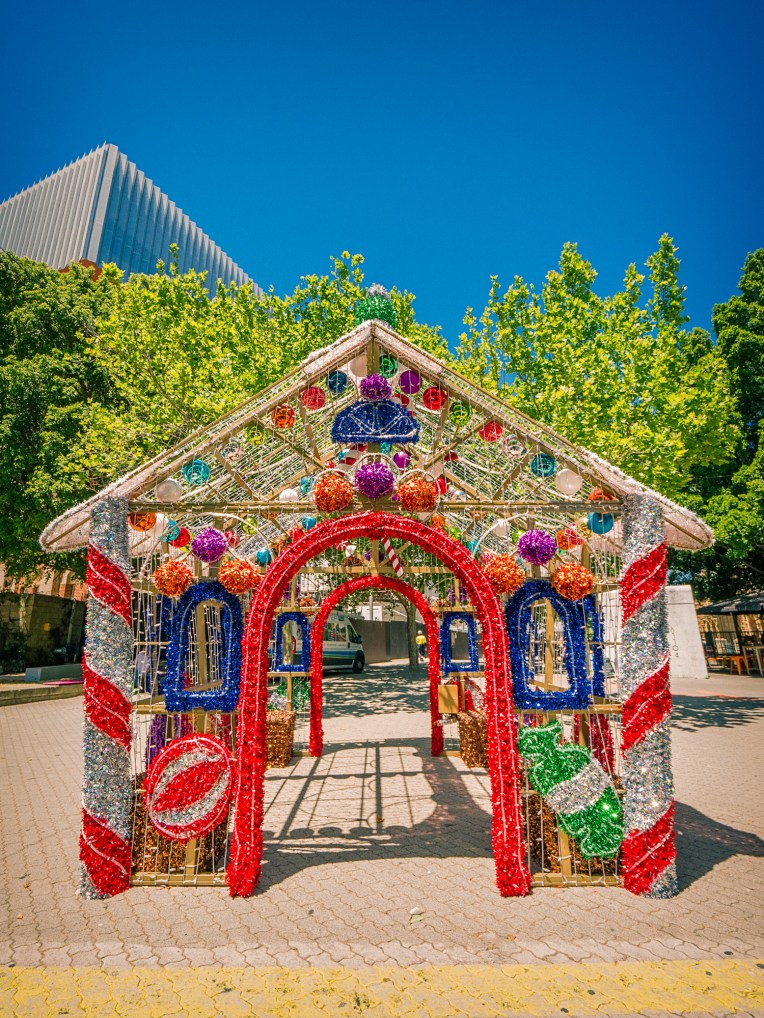
I find it hard to do the Christmas thing – firstly because now the decorations and the food appears so early (our local supermarket started at the end of September), and secondly because it is generally so hot here. Lately its been unseasonably hot here for the last ten days or so with temperatures hitting 40º C. Santa and his reindeer would just melt into a large red and white puddle. So when I went to get the car serviced the other day I went for a wander around Perth CBD and noticed that the City of Perth Council had been going around putting up the Chrimbo decorations. It seems that they’ve chosen a gold theme this year, not surprising really given that Western Australia produces 6% of the worlds production with 195 tonnes per annum, or 6.27 million troy ounces, or roughly $10 Billion AUD.There were some of the old favourites such as the Murray Street Mall Christmas Tree and the Santa’s Grotto but I wasn’t sure what was going on at the Perth Cultural Centre with the Christmas Tentacles of Doom, but hey it was colourful.
Santa’s grotto in the Perth Cultural Precinct, Northbridge.
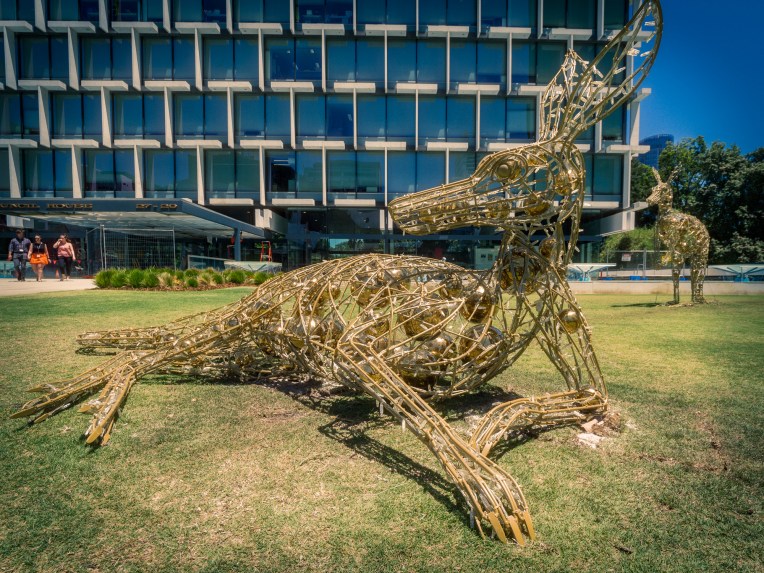
The City of Perth Council decided to reference the Kangaroo Sculptures on St George’s Terrace side of Stirling Gardens by Joan Walsh-Smith and Charles Smith with their Christmas decorations on the lawn in front of their building.
Myers in Forest Place went for an enormous golden rocking horse as part of their Christmas decorations.
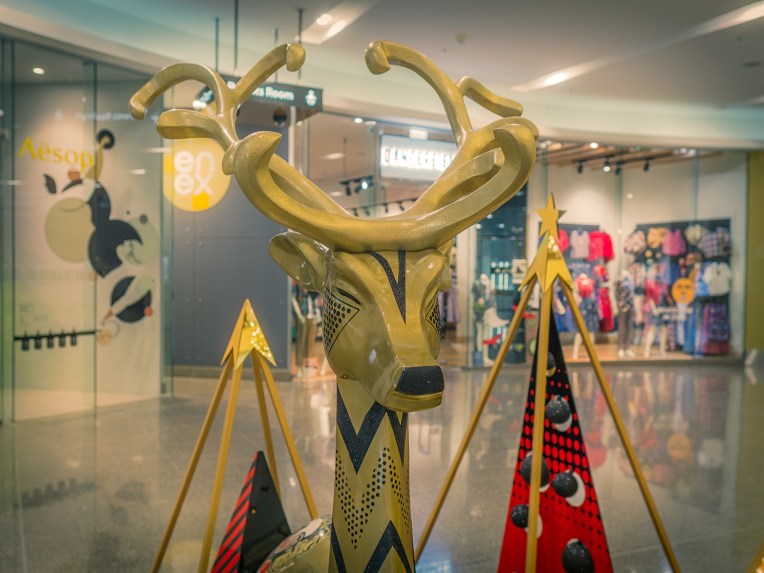
The ENEX arcade went with large golden reindeer with pyramidal Christmas Trees as their Christmas decorations.
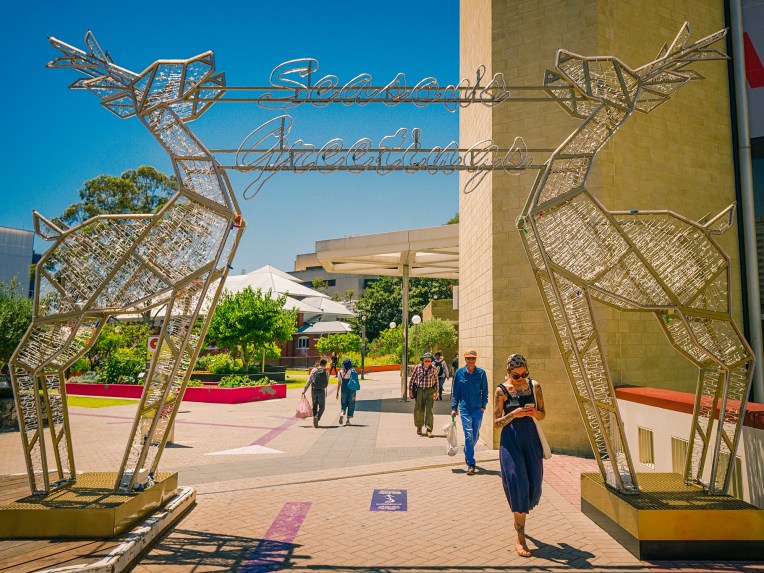
Golden reindeer gate wishing people the seasons greetings as they walk between Perth Station and the Perth Cultural Precinct.
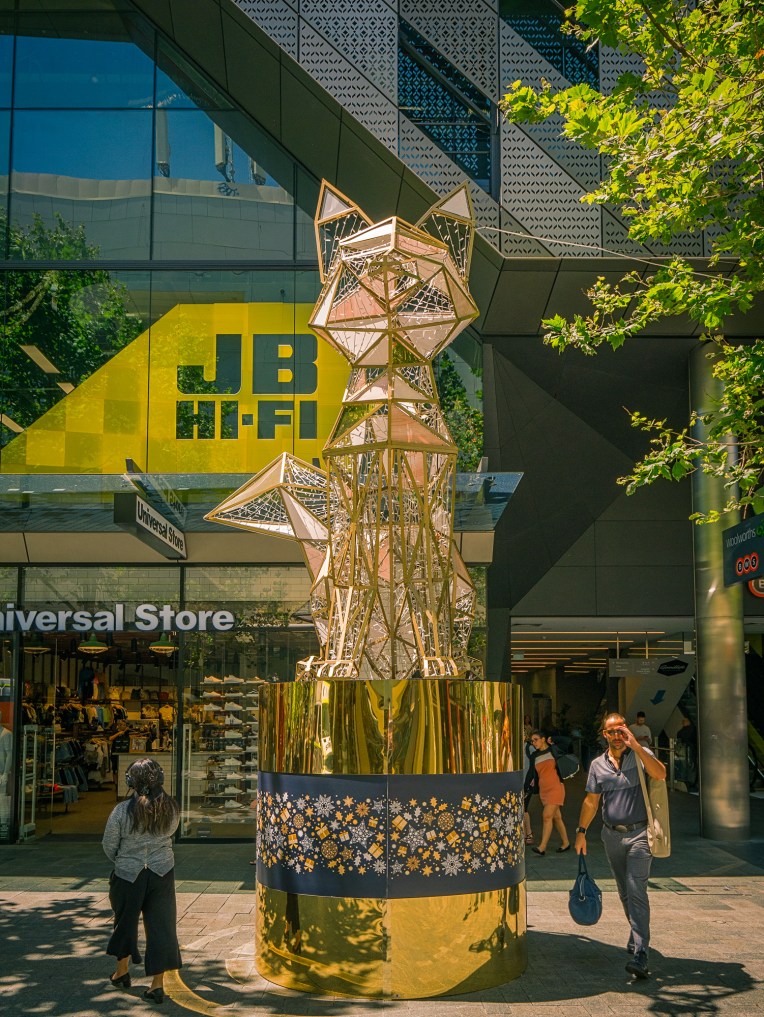
A golden Christmas fox in Murray Street Mall, Perth, Western Australia.
Not sure if these giant green and yellow tentacles were part of the Perth Christmas decorations but they were being put up with the decorations in Perth Cultural Centre.
Three hooded dotterels or hooded plovers (Thinornis cucullatus). Lights Beach, Denmark, Western Australia
This week I read two articles that really made me stop and think not only about the looming climate crisis but my photography and what purpose it serves.
East Cove, Brunny Island.
Whether you believe in climate change or not, as Bob Dylan once sang “The Times Are A Changin’”. The first article I’ll reference was by the celebrated Australian author Richard Flanagan and he speaks of the joy he receives from observing birds around his home on Brunny Island in Tasmania. He also expresses the sorrow that the birds bring because of their diminishing numbers. For one reason or another bird populations are declining rapidlyand it’s not just in Tasmania, it is a global phenomena. In Perth, the capital of the state in which I live, the Swan Estuary is a highly important nesting and breeding site for migratory birds such as plovers, sandpipers, knots, stints, and curlews that travel from Siberia and North Asia. In the 1980’s it was estimated that 36 species and more than two million birds came to Australia each summer. The number of migrating waders on the Swan Estuary was around the ten thousand mark, but, by 2000 there were fewer than five hundred. The causes for this alarming decline are many and include feral foxes and cats preying on the birds, domestic dogs being walked through nesting sites, prawning parties , people digging on the mudflats for fishing bait. Here in York we had a sizeable colony of Rainbow Bee Eaters that migrate here from New Guinea and the tropical north of Australia to avoid the wet season there. They dig their burrows in banks above the Avon River and breed. Last summer the Shire of York Council put in gravel roads along the riverside to allow access for emergency vehicles. In the process of doing that they bulldozed the nesting sites killing the adults and the young they were rearing and then permanently destroyed the site by covering the area with rocks to make a retaining wall. It wasn’t malicious, it was pure ignorance as the council has no environmental protection policy and had not done any form of survey into the wildlife along the river. They were very apologetic when informed but the damage has been done. There should be a thriving colony of Rainbow Bee Eaters digging burrows and and rearing young at this time of year – I’ve just seen one solitary bird.
Rainbow Bee Eater, Merops ornatus. Avon Walk Trail, York, Western Australia.
The second article was also about Australia’s declining bird population and it talked about the phenomenaof ‘extinction of experience’ which is a phrase first coined by Robert M Pyle. Extinction experience has negative implications for people’s health and well being. The article referenced a research paper that basically says that if people are having less and less opportunities to interact with nature that will create an antipathy towards the natural world and consequently they will cease to care about it. So to get people to be more aware of environmental issues they must be encouraged to reconnect with nature. One of the reasons why I wrote my walking guide, and I articulate this in the introduction, is that I hope that the people who use it will develop a love for and an understanding of the environment.
Dead trees ring Lake Yenyenning
So what’s all this got to do with photography? Simple really. One of the main ways that I interact with the environment is through photography. It doesn’t matter whether it is close ups of plants, photos of birds or other wild animals or landscapes. It all equates to being out in the environment and experiencing it in a first hand way. Bushwalking, cycling, dog walking all do this as well and I feel so much better for it.
Denmark Nornalup Heritage Trail and Munda Bidi Trail loop ride. Denmark, Western Australia.
I started this post referencing Bob Dylan and I’d like to end with Cat Stevens or Yusuf Islam as he is now known. In his hit song “Morning Has Broken” the lyricist Eleanor Farjeon talks of the joy of walking through the Sussex village of Alfriston on a fresh morning. She talks of the joys of seeing the dawn, hearing blackbirds singing and experiencing the dew on the grass. Yesterday as I walked the dog along the river we were greeted by a territorial goshawk sitting on the branch of a dead tree. As we passed it swooped us while making plaintive calls. It was a totally sublime experience. Go out. Take pictures, walk, cycle, play. Enjoy the environment and revel in its beauty.
The Sigma 150-600mm f5-6.3 DG OS Contemporary lens is part of Sigma’s Global Vision line of lenses. It offers an inexpensive way of getting into wildlife photography.
Not so long ago I looked at the the Panasonic Leica DG Vario-Elmar 100-400 f4-6.3 ASPH Power OIS lens for micro four thirds, well today I’m looking at an alternative lens for APS and full frame cameras – the Sigma 150-600mm f5-6.3 DG OS Contemporary lens. Now confusingly Sigma make two versions of the 150-600 and they are labelled the Sport and Contemporary. The-Digital-Picture.com has put up a good article explaining the difference between the two. The main ones are price and weight with the Contemporary being a 1Kg lighter and $1200 AUD cheaper. This is quite a significant difference and I for one prefer a lighter lens and a heavier wallet. The Contemporary is part of Sigma’s Global Vision line of lenses and is thus compatible with the Sigma TC-1401 1.4x Teleconverter which allows auto focus to work to a maximum of f8 while wide open if your camera supports this feature. This is an interesting option as it allows a reach of 860mm on full frame and a humongous 1376mm on an APSC sensor which is impressive reach for a lens and converter costing less than $2000 AUD. I didn’t happen to look at this option because none of my Canon DSLRs allow f8 auto focusing. shuttermuse.com has an article on f8 focusing with extenders or teleconverters and a list of compatible Canon DSLRs. This does not apply to the mirrorless R and RP which have f11 auto focusing.
Lens mounts available
Canon EF
Nikon F
Sigma SA
Focal length
150-600mm
Angle of view
4.1° – 16.4°
Aperture range
f5/6.3 to f22/27
Filter size
95mm
Minimum focusing distance
2.8 metres
Maximum magnification
1:4.9
Focusing
Silent HSM with internal focusing and manual override
Aperture blades
9
Lens construction
20 elements in 14 groups with 1 FLD and 3 SLD elements
Image stabilisation
Yes – 3 stops equivalent
Length
26cm
Diameter
10.5cm
Weight
1.93Kg without lens hood and tripod collar.
Fully extended to the 600mm focal length the lens is a beast. There is no sign of any wobble in the zoom extension.
Physically this is a large lens, it stands head and shoulders above my Canon 70-200mm f2.8 IS L lens which in itself quite a large lens. The 150-600 is also 500g heavier. At 2.1 Kg with lens hood and tripod collar attached it definitely has heft to it. Interestingly Sigma refer to it as a lightweight lens, I suppose it’s all a matter of perspective as the Panasonic Leica 100-400 is 0.985 Kg so the Sigma feels gargantuan compared to it while the Canon EF 600 mm f4L IS is over 3Kg so the Sigma then seems svelte and compact. The lens body is made out of what Sigma calls a Thermally Stable Composite (TSC) which is substantially stronger than conventional polycarbonates while having similar thermal expansion properties to aluminium. The lens mount is made of chromium plated brass which should ensure a long life. All in all it feels a well made and rugged lens, it may feel like plastic but the TSC body feels substantial and gives the impression of being very durable with no creaking or flexing. The Sigma 150-600 is advertised as being dust and splash proof but on closer reading of Sigma’s spec sheet there is only one seal and that is at the lens mount. If you want better then you’ll have to spring for the Sports version.
The Canon EF lens mount is made of chromium plated brass.
When looking at the lens from the front there is a large ribbed rubber zoom ring that has a long throw of about 160º. The action is smooth and feels not too tight nor too loose. As you rotate the zoom ring the lens barrel extends by 8cm. The extension feels secure with no slop or wobble. Just behind the zoom ring on the lefthand side is a zoom lock switch which can lock the zoom ring at the 150mm focal length to prevent zoom creep while carrying the lens. The focusing ring is narrow ribbed rubber and allows you to manually adjust focus while the lens is in the autofocus mode. There are no hard stops which might concern you if you were to use the lens for video. Behind the focusing ring is a panel of four switches and they are:
An AF switch allowing to choose between AF, MF and MO (Manual Override)
A focus limiter switch allowing a choice of full range, 10m to ∞, and 2.8 to 10m.
An optical stabilisation switch that gives a choice of off, on and a panning mode.
A custom switch that allows you to select two custom modes that can be programmed using the Sigma FD-11 USB Dock
There are three switches on the lens barrel. One fotr focus modes, the second a focus limiter and the third is for the optical stabilisation.
The focus distance scale is behind a window just below the the focus ring.
Above the switches is a window showing the focusing scale and then behind that is the lens collar. The lens collar allows you to turn the camera from horizontal to vertical while mounted on a tripod, but, unfortunately there are no detents to allow you to do this while looking through the viewfinder of the camera, you have to align the marks on the collar with those on the lens body. The tripod collar can be detached and thoughtfully Sigma provide a cosmetic rubber ring to slide over the lugs that hold the collar in place. The lens comes with a large plastic lens hood the size of a flower pot, it seems sturdy enough and bayonets into place and a nice touch is that is ribbed internally to prevent reflections. The 150-600 has a 95mm filter thread which means filters will be expensive and potentially hard to get. In terms of accessories Sigma provide a nice well padded lens case, a shoulder strap for it and a Sigma branded camera strap. Like all Sigma lenses you get a lot for the money you spend. Nice one Sigma!
The 150-600 has a 95mm filter thread which means filters will be the size of dinner plates, be expensive and potentially hard to get.
I tested the lens on a Canon EOS 6d and an EOS 550d to see how it would perform on both crop and full frame cameras. In terms of AF performance as neither of those cameras have what can be considered state of the art AF systems, in fact it is over twelve years old, the lens did very well. The single point AF using the centre point was fast and precise and well capable of fixing on small birds amongst foliage. In terms of continuous AF on the EOS 550d the camera was the limitation being only able to shoot 6 frame bursts in RAW, but out of my six shots when tracking my dog trotting five of the six would be in focus. The 6d is able to shoot 4.5 frames per second for 15 frames and on the trotting bull terrier test it managed 12 frames in focus.
This slideshow requires JavaScript.
When it came to BIF (birds in flight not fisticuffs) the AF was more than capable of focusing on and tracking medium to large birds. It really struggled with small birds especially swallows. Put it on a better camera and I’m sure you’d get better results.
Australian white ibis, Threskiornis molucca, Herdsman Lake, Western Australia.
My primary use for a lens like this is handheld bird photography, and as such I didn’t really give the image stabilisation a workout as I seldom use a shutter speed below 1/500 sec. But messing around at home in the house and garden I figured it was good for three stops. Mind you I do have steady hands so your experience may differ from mine.
The optical construction of the lens is twenty elements in fourteen groups with 1 FLD and 3 SLD elements. The FLD (“F” Low Dispersion) glass element, which offers performance equivalent to fluorite. Canon and other manufacturers have used synthetically grown crystals of calcium fluoride components in lenses to aid apochromatic design, and to reduce light dispersion so lenses made from it exhibit less chromatic aberration. What Sigma has done is use newer glasses and computer-aided design to render the use of fluorite crystals unnecessary. Sigma claim that the FLD element is “highly transparent, its refractive index and dispersion are extremely low as compared to conventional types of glass. It offers characteristics very similar to those of fluorite, which is valued for its anomalous dispersion. These characteristics minimize residual chromatic aberration (secondary spectrum), which cannot be corrected by ordinary optical glass, while helping to produce sharp, high-contrast images.” (https://sigmaphoto.com.au). The three SLD (Special Low Dispersion) glass elements also help to minimize chromatic aberration. To help achieve attractive out of focus transitions there are nine rounded aperture blades which should help achieve nice round bokeh balls when shooting specular highlights.
In terms of optical performance well I’ll deal with full frame and crop separately. First up using the lens on the crop framed 550d. At 150mm the centre of the lens wide open was sharp and contrasty and stayed A as such until f22 when it softened due to the effects of diffraction. At the edges the peak performance was attained at f11 and remained until f22 when it softened again. At 600mm the centre wide open was a little soft and lacking in contrast. This improved by f8 and then deteriorated at f22. The edges weren’t so good – wide open they were soft and lacking contrast and remained so until f22 when they got worse. As for vignetting well at the short end wide open it was apparent, about 1/2 to 1 stop and this disappeared by f8. It was the same story at the long end. Throughout the focal range there is slight pin cushion distortion and some chromatic aberration can also be seen. Open the files up in Lightroom and apply the lens profile and things improve nicely. On the full frame 6d the story is the same except for the vignetting which is naturally worse at around 1-1 1/2 stops which is totally understandable as you are using the whole frame rather than just the central part of the lens coverage.
100 % crop from the centre of a New Holland Honeyeater to show how detail is rendered by the Sigma 150-600mm f5-6.3 Contemporary lens.
What’s all this mean in real life. Well if we look at the image for the New Holland Honeyeater which I took at a distance of around 3.5 to 4 metres and then enlarge the section around the head you can see that there is nice feather detail and that the eye is sharper than a very sharp thing. To get much better you’d have to spend an awful lot of money and if we look at the Canon 600mm f4 lens I mentioned earlier that has an eye watering price of $18,500 AUD which is over 11 times the cost of the Sigma. Personally I know that if I plonked $18 K down on a lens I’d be heading for the divorce court which would make the Canon a doubly expensive lens. So for what it costs the Sigma is amazing value.
Below are some examples of bird photography shot with the lens on both a Canon EOS 6d and 550d.
Welcome Swallow, Hirundo neoxxena, Herdsman Lake, Western Australia. Canon 6d with Sigma 150-600mm Contemporary. Exposure: 1/500 sec, f7.1 at ISO 250.
Red capped robin, Petroica goodenovi, Avon Walk Trail, York, Western Australia. Canon 550d with Sigma 150-600mm Contemporary lens. Exposure: 1/500, f6.3 at ISO 160.
Chestnut-rumped Thornbill (Acanthiza uropygialis), York, Western Australia. canon 550d with Sigma 150-600mm Contemporary lens. Exposure: 1/1000 sec, f6.3 at ISO 320.
Mistletoebird, Dicaeum hirundinaceum. The Nyoongar name is Minnijit. York, Western Australia. Canon 6d with Sigma 150-600mm Contemporary lens. Exposure: 1/1000 sec, f8 at ISO 1600.
So would I recommend the lens? Yes without hesitation. It performs very well and is sold at a very good price and you can’t argue with that.
Stand Here. Forest Place, Perth, Western Australia. Panasonic G85 with Sigma 16mm f1.4 lens. Exposure: 1/2000 sec, f2.8 at ISO 200.
Yup – you’ve guessed it. Spent another day loitering in the alleyways of Perth. Saw it as a good excuse to give the Sigma 16mm f1.4 DC DN lens in micro four thirds mount a good workout.
Coloured Cats. Waiting for the CAT Bus on Wellington Street in Perth. Panasonic G85 with Sigma 16mm f1.4 lens. Exposure: 1/6400 sec, f2.8 at ISO 200.
Patterns. Globe Lane, Perth, Western Australia. Panasonic G85 with Sigma 16mm f1.4 lens. Exposure: 1/60 sec, f4 at ISO 800.
Pink Accents. Globe Lane, Perth, Western Australia. Panasonic G85 with Sigma 16mm f1.4 lens. Exposure: 1/60 sec, f4 at ISO 200.
Graffiti in Prince Lane, Perth, Western Australia. Panasonic G85 with Sigma 16mm f1.4 lens. Exposure: 1/60 sec, f8, at ISO 320.
No sitting on the edge of this building. Prince Lane Bar on the corner of Murray Street and Prince Lane in Perth. Panasonic G85 with Sigma 16mm f1.4 lens. Exposure: 1/250 sec, f4, ISO 200.
* Today’s musical reference is a bit obscure. It is the theme tune for the 1972-3 British TV series “The Protectors” and was sung by Yorkshire lad Tony Christie. It was produced by Gerry Anderson of Thunderbirds fame and was only his second production using real people as opposed to the puppets he was famous for, and his only production that wasn’t scifi. It was sponsored by Brut the aftershave people which explains a lot looking back at it.
I had to attend an appointment at RPH the other day. It usually presents a dilemma. Most of the clinics operate in the afternoon and pretty much always run behind schedule by anything up to two hours. If drive down to Perth from York then I’m faced with paying parking fees for which I’ll have to take out a mortgage. If I choose to do the public transport option then it’s a case of leaving early so as to get parking at the train station which means that I’ll have hours to kill. Invariably I take the train and wander the streets of Perth taking photos. That’s where virtually all the photos of Perth come from that I post on this blog. I have no set route and I just follow my nose. It’s amazing that after over thirty years of walking around the Perth CBD that I still find places that I’ve not seen before. Anyway this is the latest selection.
#13. Graffiti in an alley just off Murray Street in Perth, Western Australia.
The Digital Tower, in Yagan Square, Perth
“Waterline” by Western Australian artist Jon Tarry, ‘Waterline’ is a series of water experiences sculpted in Western Australian granite running through Yagan Square. Perth, Western Australia
Warning. Graffiti in McLean Lane, Perth, Western Australia.
No Stopping, McLean Lane, Perth, Western Australia.
Lamp Shades, McLean Lane, Perth, Western Australia.
All the photos were taken using a Sony A7r with Sony FE 28mm F/2 Wide Angle Lens and processed in Alienskin Exposure 4 using one of the “Cinematic” presets.
South of the Swan River is a string of lakes known as the Beeliar Wetlands which are a chain of twenty six lakes stretching from Manning Lake in Hamilton Hill to Madura Swamp near Mandurah Wetlands. Nineteen of those lakes and associated wetlands have been incorporated into the Beeliar Regional Park. This extensive belt of wetlands that has been widely acknowledged as a biodiversity hot-spot having a greater number of endemic species than most other regions in Australia. Within this the Nyoongar with their hunter-gatherer life-style managed the land with their fire-stick farming and survived by hunting and trapping a variety of game, including kangaroos, possums and wallabies; by fishing using spears and fish traps; as well as by gathering an extensive range of edible wild plants, including wattle seeds. Since colonisation three-quarters of these wetlands have been drained for urban development. What remains has suffered untold damage through the introduction of feral animals and plants. Thankfully Australia is a signatory of the Ramsar Convention and several key wetlands on the Swan Coastal Plain have been set aside for conservation. Bibra Lake is the fourth lake (heading southwards) in that chain of lakes that makes up Beeliar Regional Park. Whitefellas believe that they discovered the lake in 1842 and named it after the bloke who bought the land in 1843, one Benedict von Bibra. The Nyoongar say they have known about the lake since time began and to them it known as Walubup.
I first went to Bibra Lake about thirty years ago and thought it was a bit boring and hadn’t been back until the other week. I was called upon for driving duties for the Beloved Significant Other (BSO) and I was left with a morning to kill. So I looked in my copy of Birding Sites around Perth by Ron Van Delft (sadly out of print and unavailable now) and saw that Bibra Lakes was nearby and rated as a good location for birding. The down side to this was that we were experiencing the first major cold front of winter and that meant it was bucketing down and blowing a gale. So suitably swathed in Gore-Tex and equipped with a suitably weather resistant camera I headed off to walk around the lake not expecting to see much.
A comforting warning painted on the cycle path that runs around Lake Bibra. It was cold and wet in winter so not much chance of a snakey encounter.
Initially I thought that with it raining I had more chance of photographing ducks as it was the perfect weather for them. There were quite a number of different species on the shore and the water. I was quite taken by the Shovelers and the Pink Eared Ducks. The Shovelers are quite a string looking duck with colouring and almost disproportionately large bills. They can often be seen foraging in shallow water where they filter water through their bills insects looking for insects, crustaceans and a variety of plants. Such a specialised mode of feeding means that they are limited to certain types of habitat such as freshwater swamps and lakes with large reed beds. Shovelers also tend to hang out with pink-eared ducks which are so called because of the patch of pink feathers on the sides of the drakes head. Like the Shovelers they too are filter feeders. As the walk moved through areas of paperbark and sheoak trees then smaller insect eating birds were seen such as Willie Wagtails, Grey Fantails, Silvereyes, and various types of wrens. Over all as I did the 8.5 Km walk I saw 18 different species of bird which I felt was a pretty good haul considering the weather conditions. So I’ve revised my opinion of Bibra Lakes and will not wait another 30 years before my next visit.
Australasian Shoevelers, Spatula rhynchotis. Bibra Lake, Western Australia. Panasonic Lumix G85 with Panasonic LEICA DG 100-400/F4.0-6.3 lens. Exposure: 1/400 sec, f6.3 at ISO 250.
A pink-eared duck (Malacorhynchus membranaceus) keeping a low profile while amongst Eurasian coots (Fulica atra). Bibra Lake, Western Australia. Panasonic Lumix G85 with Panasonic LEICA DG 100-400/F4.0-6.3 lens. Exposure: 1/500 sec, f6.3 at ISO 3200.
Brown Honeyeater, Lichmera indistincta. Bibra Lake, Western Australia. Panasonic Lumix G85 with Panasonic LEICA DG 100-400/F4.0-6.3 lens. Exposure: 1/500 sec, f6.3 at ISO 2500.
Varigated Fairy-wren, Malurus lamberti. Bibra Lake, western Australia. Panasonic Lumix G85 with Panasonic LEICA DG 100-400/F4.0-6.3 lens. Exposure: 1/500 sec, f6.3, ISO 320.
Willie Wagtail, Rhipidura leucophrys leucophrys, Bibra Lake. Panasonic Lumix G85 with Panasonic LEICA DG 100-400/F4.0-6.3 lens. Exposure: 1/500 sec, f6.3 at ISO 1600.
A female mistletoebird, Dicaeum hirundinaceum, at Bibra Lake in Western Australia. Panasonic Lumix G85 with Panasonic LEICA DG 100-400/F4.0-6.3 lens. Exposure: 1/500 sec, f6.3 at ISO 2000.
Bibra Lake is part of the Beeliar Wetlands which is an internationally recognised birding hotspot. This is one of two bird hides that have been buit at Bibra Lake.
Don’t feed the birds sign at Bibra Lake complete with Willie Wagtail, Rhipidura leucophrys leucophrys. Panasonic Lumix G85 with Panasonic LEICA DG 100-400/F4.0-6.3 lens. Exposure: 1/500, f4, ISO 250.
If you are interested in the birds that can be seen at Bibra Lakes, and indeed throughout the Beeliar Wetlands Birding WA has a useful webpage that gives info on the species that can be seen and where. Birdlife Australia put out a couple of useful brochures which can be got from regional visitors centres or downloaded as PDFs from their website. The brochures are:
Time to promote the achievements of Beloved Significant Other (BSO) via the wonderful medium of video. I didn’t intend to shoot a croquet video. No. I was enlisted as a logistical consultant (alright driver!) to take aforementioned personage and a friend to a croquet competition at the Cambridge Croquet Club. While the event was happening I was going bird watching at the nearby ornithological Mecca of Herdsman Lake with the hope of photographing nankeen herons. Alas the herons didn’t know that I was coming to see them and weren’t at home. Couple this with the fact that I was suffering from a deadly combination of Ebola, typhoid, bubonic plague and cholera (BSO says it was in fact a head cold) I went back to the croquet club to find a quiet corner in which I could drown in snot. Somehow news that BSO had made it to the finals penetrated my fever fuelled delirium and I leapt into action to record the event. I was not really equipped to do so as although I had the Panasonic G85 with me that shoots lovely 4K video I only had two lenses. The Panasonic Leica 100-400mm a great lens for birding but a bit long for court side croquet. The Sigma 16mm f1.4 which is another fantastic lens, but being a fixed focal length not as useful as standard zoom for the grip and grin at the presentations at the end of the tournament. All I can say is thank goodness for the magnificent stabilisation which enabled me to get good handheld footage, although it was defeated by my violent sneezing although it wasn’t as bad as that depicted below.
A young aboriginal girl lies sick on the pavement outside Royal Perth Hospital as nursing staff have a smoke and check their phones. Olympus Pen EP-5 and an Olympus M.Zuiko Digital 45mm f/1.8 lens. Exposure: 1/100, f8, ISO 250.
I don’t shoot “poverty porn“. Photographers shooting the marginalised in society just for entertainment makes me uncomfortable – it kind of reminds me how people in the Elizabethan era would visit Bedlam and pay to money to be entertained by the inmates for something to do on a Sunday afternoon. But this time I was quite angry at was happening, or more precisely what wasn’t happening, and I felt I had to share it.
I was attending an outpatients appointment at Royal Perth Hospital when I stumbled across the scene above. The young aboriginal girl under the blanket was sick and on the pavement outside Perth’s main accident and emergency facility.In the background are nursing staff having a smoke and checking their phones acting like this was a perfectly normal situation. So when did sick people lying on the pavement outside an accident and emergency facility become normal? Has our society become so hardened that we are impervious to the suffering of our fellow-man? Something has definitely gone wrong somewhere.






You must be logged in to post a comment.