
Another shallow DOF shot. Supposedly impossible on m4/3s. Olympus Pen EP-5 with OLYMPUS M.60mm F2.8 Macro lens and Olympus FL-600R flash with Lumiquest softbox. Exposure: 1/50 s at f/2.8 ISO 200.

Another shallow DOF shot. Supposedly impossible on m4/3s. Olympus Pen EP-5 with OLYMPUS M.60mm F2.8 Macro lens and Olympus FL-600R flash with Lumiquest softbox. Exposure: 1/50 s at f/2.8 ISO 200.
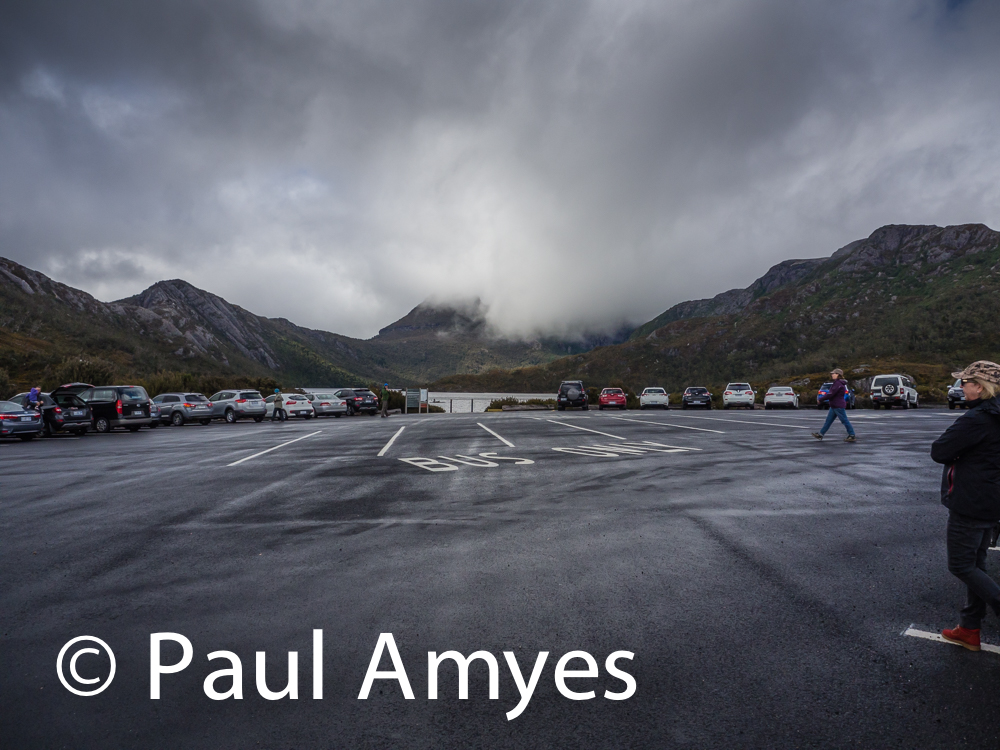
The other day we were staying at Cradle Mountain National Park and we decided to walk around Dove Lake which is one of the iconic short walking trails in Tasmania. So we drove into the park proper and up to Rommy Creek in the hope of seeing a wombat or two. We walked around the creek and I fell fulcrum over apex and landed on a big clump of button grass. I didn’t hurt myself and I was remarkably unscathed, not even dirty, but my camera wouldn’t work. Blimey! Here am I in one of the most photogenic places in the world and my camera packs up. This was the first time I’ve gone on a trip with only one camera body. All sorts of thoughts run through my head like drive back home to get another camera (a seven hour round trip), or drive to Launceston to buy a new one. I frantically mashed a few buttons in the hope it would respond – nothing. I took the battery out and replaced it with a fresh one, still nothing. Oh bugger! I took the battery out and unmounted the lens and we drove the rest of the way up to Dove Lake with Helen trying to console me and saying not to fret. While she visited the loo I signed us in for the walk track. On getting back to the car I tried one last time to get the camera to work, I put a genuine Olympus battery in and immediately heard the IBIS whir into action, I looked through the viewfinder, took a couple of frames of the car park and everything seemed to be working. What a relief! The pictures were not anything great but I have never been so relieved to see a photo.
Australia is not for the faint hearted. I always thought that moving to southern Tasmania from Western Australia would reduce the number of creepy crawlies that we’d find in our house. But no, since we’ve been here we’ve seen scorpions, snakes and spiders galore.

But since The Lord of the Rings, the Hobbit and the Harry Potter films I’ve become decidedly uncomfortable around spiders, especially the Huntsman spider shown above. They are on the largish side (the size of the palm of my hand) and it is the way they move that tends to puts the willies up me.

Now the little jumping spiders are admittedly not as bad as the huntsman. For one thing they are a lot smaller, less than 1cm long, and while hairy and their tendency to stare right at you can be off putting, you can in the right frame of mind think of them as cute. The fact that they don’t tend to come into the house also helps.

The Enamelled Back Spider is is almost jewel like in appearance and although they tend to build webs only 1metre from our front door they know their place and stay outside.

My partner does not like spiders at all so I am often dipatched with a rolled up newspaper or slipper to “deal” with them. As I protest and squirm I am often challenged with the phrase “What are you man or mouse?”. Well all I can say is “Pass the cheese!”.

The Olympus m.Zuiko 75-300mm f4.8-6.7 mk ii (which shall now on referred to as the 75-300) is an updated version of their original super telephoto zoom for the micro four thirds format.Yes I said super telephoto zoom because that is what it is as it is equivalent to a 150-600mm lens in 35mm sensor terms.


Keeping up with the m4/3s promise of smaller cameras and lenses this lens does not disappoint. It fits comfortably in the hand is quite a bit smaller than my Canon 75-300mm f3.5-5.6 IS which only covers half the focal range when mounted on my EOS5d. There are rumours on the various forums that the lens is designed and built by Sigma, but there is no evidence of that fact when looking at it. The 75-300 is largely constructed from engineering plastic and has a metal mount. There is no weather sealing. The lens extends while zoom, roughly doubling its length, there is no lens creep which is nice. While not heavy it feels reassuringly dense in the hand and not at all cheap and wobbly like some budget zoom lenses.The filter diameter is 58mm which it shares with the 40-150mm f4-5.6 and means that filters won’t be too pricey. Optically the lens has 18 elements in 13 groups, two of which are ED glass and one is Super ED (extra low dispersion). These exotic elements are there to minimise chromatic aberration throughout the zoom range. They certainly do the job for when I open up images shot with the 75-300 in Lightroom they are remarkably free of CA. The lenses elements are coated with Olympus propriety ZERO (Zuiko Extra-low Reflection Optical) coatings and I’ve found the lens to be quite resistant to backlit flare, however flare can be induced by bright light sources just outside of the frame so I would heartily recommend the use of a lens hood. Unfortunately Olympus does not include one in the box.


Performance wise the 75-300 is remarkably good for a lens of this price and zoom range. The AF is quick and precise when shooting stills on both my EM-10 and EP-5, and quite a lot slower when shooting video. Optically the lens is very sharp up until the 200mm mark and then it does soften slightly, but this is not at all unusual with zoom lenses, which is unfortunate because this lens will be bought more for its uses at 300mm than 75mm. There is not a lot of love for this lens on the internet forums where it is harshly criticised for it performance at the long end, but from my experience with it it’s not as bad as people make out. I wonder whether camera shake is a contributing factor here. While Olympus bodies have In Body Image Stabilisation (IBIS) there is a limit to what it can achieve and we have to remember that this is the equivalent of a super telephoto 600mm lens in full frame terms and not many people would expect to handhold one of those and get tack sharp results. When using the lens on a tripod and monopod it certainly delivers the goods. When handholding I would certainly recommend not using a shutter speed of lower than 1/300th sec even when using IBIS.


Downsides of the 75-300. Well the slow maximum aperture will be a drawback for many, and I’ve read many threads where people have stated they would have preferred a constant f4. This all very well but lens design is a compromise and such a lens would be very large and heavy and cost considerably more. Personally I don’t mind using higher ISOs to keep the shutter speeds up as I’m happy to clean up my images with Niksoft’s Denoise. Another downside is when shooting video – this is not really a lens for run and gun style shooting, it is much to long to effectively control shooting handheld. Even on a tripod the lens showed up the failings of my fluid head for when panning there was quite a pronounced shudder when using it at its longest end.
Overall I feel that the few drawbacks are outweighed by the positives and I like this lens a lot. It is a very good lens when one considers the price. In Oz a full frame equivalent will cost at least double. I would recommend the 75-300 to anyone who was prepared to accept the trade offs involved i.e compact size and affordability versus the slow maximum aperture and the slight softening of the image at the long end. At the time of writing this there is only one other alternative, the Panasonic Lumix G.Vario 100-300mm f4-5.6 OS, which is at the same price point and has a similar performance. I would only consider the Panasonic over the Olympus if I was shooting on a Panasonic camera which has no IBIS. Both Olympus and Panasonic are introducing higher performance lenses at the 300mm focal length at some time in the near future, but I think we’ll find they are considerably bigger and more expensive.


So if you fancy doing a bit of sport or wildlife photography then I would thoroughly recommend this lens to all Olympus users.
I’m going to preface this entry with the statement that most post processing is a matter of personal taste and that there are a hundred and one different ways of editing an image in Photoshop to get the same result. If this doesn’t appeal to you, or I do things differently to you it doesn’t mean I’m right and you’re wrong, nor does it mean you’re right and I’m wrong.
I have posted this because I got a lot enquiries about how I make my images and whether the colours captured are real or not. So the image below is a straight jpg conversion of the RAW file that came off my memory card. All I’ve done is reduce the size and convert to sRGB. The original exposure was made on an Olympus Pen EP-5 with OLYMPUS M.12-50mm F3.5-6.3 lens. A Cokin 2 stop soft graduated neutral density filter was used to hold back the sky. Exposure: 3.2 s at f/11.0 ISO 200 in manual exposure mode.

The video below shows how I work on the file in Adobe Lightroom 5.7 , Adobe Photoshop CS5.04, Alien Skin Exposure 3, Nik Soft’s Dfine 2 and Color Efex Pro 4. I use these products because I like them and have paid for them with my own money.
The finished image.

Clicking on the image will take you through to my gallery. I hope that you found this helpful.

Next Sunday, the 18th October 2015 to be precise, my wife, Helen, and I are starting to sell fine art cards, prints and other items at Southern Beaches Markets which is held at Okines Community House in Dodges Ferry. The market is held on the third Sunday of every month for the next six months. We hope to see you there. Please feel free to stop by and have a chat.
All the art on sale will be predominantly about this part of Tasmania. More details about Helen’s art practice can be found here and here.

On Thursday we drove down to the South Arm Peninsular and visited Opossum Bay. It is a beautiful bay with great views across the water to Mount Wellington. Like many such places in Tasmania it has become a popular spot for beachside holidays and retirement. Unlike many Australian beachside settlements the housing is not flat but tiered up the dunes, the resulting vernacular architecture is like a cross between Australian beach culture and Greek Island chic.


As I was walking up and down the beach admiring the view and looking at the houses I noticed something. A lot of the gardens had a row-boat or a tiny in the garden. In many cases the boat was almost new and in good condition. The boat represents a dream to spend time in this beautiful spot and go out on the water fishing – an antidote to the stress and bustle of the world many of us live in.

After a while the boat doesn’t get used that much, time commitments probably prevent the owners getting out to the beach house as often as they like. Slowly the garden plants start to encroach upon the boat.

Eventually the holiday or retirement dream of spending time at the beach house fishing in the bay becomes a long forgotten idea and nature reclaims the boat and it becomes as though it had never existed as either an idea or a physical reality.

Much is written about “Tasmanian Gothic” – a dark soberness that has its roots in the landscape and the colonial history. Personally I’m not a fan as I feel it colours much of modern-day Tasmania and restricts progress. But, there is no doubt that the weather and the landscape do particularly suit black and white or monochrome photography.

When I worked with film I loved the whole process for black and white photography. Picking a film and developer combination, then choosing a paper and then finally whether to tone the image or not. The whole process was magical and working in the darkroom, whether it was a commandeered bathroom or a purpose-built one was like a going back to the womb to create something wonderful. Admittedly an awful lot of the time I seemed to turn out a lot of dross, but it was an enjoyable process. To misquote Kilgore’s eulogy in the Coppola classic film Apocalypse Now “I love the smell of fixer in the morning,”.

I would love to work with black and white film again – but living with a rainwater tank for our supply and with a septic tank for waste water management means that I cannot develop film at home and there are no labs in Tasmania that develop the film. So for now it is the digital option, which is not as magical and mystical as the darkroom, is in its own way just as satisfying. No longer following the Zone System laid down by St Ansel, I now expose to the right (ETTR) to get the maximum amount of tonal information in my RAW file and then process in Lightroom. The final black and white conversion is done in NikSoft’s Silver Efx Pro 2, which is always done the same way and mimics what I used to get with Ilford Delta 400 developed in Rodinol and then printed on Ilford FB Warmtone Multigrade paper. My Canon Pixma Pro9000 does a fantastic job of monochrome printing on Harman Gloss Baryta Warmtone. I’ve done two exhibitions using this combination and been delighted with the results.

Thankfully working digitally means that we can work in both colour and black and white at once, just making the decision of which way to go at the time of processing. It is a great time to be a photographer.
As always clicking on an image will take you through to my online gallery.

Whether the weather be fine
Or whether the weather be not,
Whether the weather be cold
Or whether the weather be hot,
We’ll weather the weather
Whatever the weather,
Whether we like it or not.
There’s no doubt about it we get a lot of weather in Tasmania – it is said that you can experience all four seasons in one day, and that if you don’t like the weather then just wait ten minutes and it will completely different. Thankfully after what seems a very long and cold winter, spring is starting to show. Flowers are starting to bloom, the days are warmer and people are out and about looking happier. The space of time between the first photo and the last is just five weeks and I have gone from wearing thermals, fleece and Gore-tex to shirt sleeves.Here’s looking forward to summer.


You must be logged in to post a comment.