
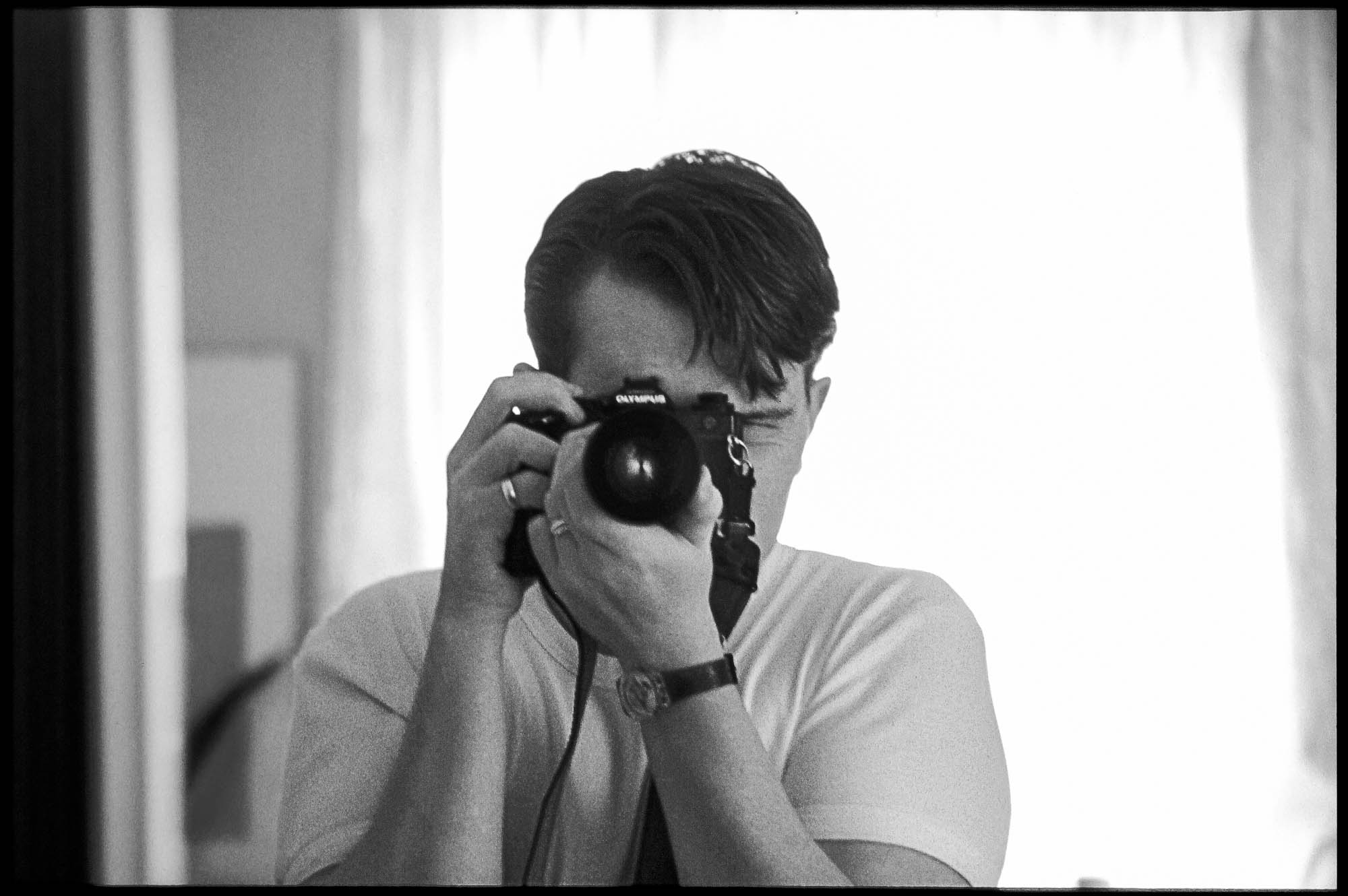
I’m of an age where I learning to use a camera meant learning to focus the lens. The first SLR camera I used was my brothers Praktica TL with a Domiplan 50mm f2.8 lens. A combination of a dim viewfinder, a very murky micro prism focusing screen and a slow lens made focusing anything that didn’t stay still a tricky affair. A little while later he upgraded to a fancy Praktica B200 – it had aperture priority, a top shutter speed of 1/1000 sec, and an LED shutter speed display in the viewfinder. It was according to my brother the dogs bollocks. So I borrowed it and his Pentcon 135mm f2.8 lens and went to photograph a rugby match at our local club. I shot two rolls of film (yep I really pushed the boat out) and was bitterly disappointed. I got about 1/2 dozen in focus pictures of the scrums and line outs but all the attempts at capturing the running play were out of focus. Things started to improve once I bought my own camera and lenses. Brighter viewfinder’s, better focusing screens and faster lenses made a huge difference as did constant practice. I stayed with manual focus until 2004 when I was given a Canon EOS 3 and then shortly after I went digital and bought a Canon 300d.

The AF system in my Canon DSLRs was certainly good for the editorial photography I was then doing. Changing to the mirrorless M4/3 system was a bit of a shock as their first cameras had contrast detect autofocus which was great for anything that didn’t move, but absolutely pants for anything that did. This was one of the reasons why I didn’t give up on my Canon DSLRs (the other was to do with flash photography). The advent of the Olympus EM1 mk 1 in 2013 brought with it phase detect autofocus and that improved things drastically after a couple of firmware upgrades. A while later I bought a reconditioned EM1 mk 2 and the autofocus was better again. This is what I primarily use for most of nature photography where fast and accurate AF is vital to getting the shot. However, the progress of technology steadily marches on and we now see AI enhanced systems that can identify the subject and even pick out the eye. Initially I was sceptical, especially as those systems were in very expensive flagship cameras, but now I’ve had cause to change my viewpoint.

I’ve been lucky to get a long term loan of an Olympus EM1x which when it was launched, in 2019, was one of the first cameras to have AI subject recognition, but on release this was limited to motorsports, trains and planes. At the end of 2020 a firmware update added bird detection and it was this that I was keen to try. Before taking it out I watched a few videos on YouTube on how best to set this up for best effect and found that nearly everyone has their own ideas on how to do this. So I just reset the camera and left it at its default settings as a starting place and I haven’t moved them since. How does it work? Well the short answer is that upon initially recognising a bird the camera places a white rectangle around it. When you activate the autofocus and it locks on it will do one of two things. If the bird is close enough it will place a green tracking box around the head focusing on the eye. If is too far away then it will place the green tracking box on the birds body.


When the bird detect AF firmware was launched it wasn’t well received. There were claims of unreliability and unpredictability. One of the major criticisms was that when there were lots of birds in the frame it would select all the birds, but that is not strictly true because when you activate the AF then it will track the one closest to the camera. The problem arises when all the birds are on the same focal plane. I have set bird AF to C1 of the custom settings with all the AF points active and if this situation arises I switch to C2 which has CAF set at a single point and I can then move that single point with the cameras joystick. It’s quick to change and I haven’t felt that the camera was stopping me take photos. The next criticism is that if the bird is in foliage or against a busy background the camera gets confused and focuses anywhere but the bird. Now when I read that I was a little concerned as I mainly photograph birds in woodland, but after several outings – even in very low light which makes things even harder – I found the camera again copes well and if it does get lost then switching to my C2 setting solves it. What really impressed me was on my first outing with the lens I was walking along the river to find some Nankeen Night Herons and the sun hadn’t quite come up when I spied a little pied cormorant perched in the lee of some trees drying out. It was a very busy background and very dark. The AF latched onto the bird and I managed to get a sequence of in focus shots before it eventually flew off. I’ve encountered similar situations before with my EM1 mk ii and it had a very hard time focusing if at all. Another shot I’m happy with is of a yellow-billed spoonbill flying along the course of the river with a background of trees and foliage. The EM1x’s AF locked onto the bird nicely enabling me to get the shot. Again the EM1 mk ii would’ve struggled in this situation.


Were there any downsides? This is a little unfair, but the bird detection AF didn’t work in video mode, but Olympus themselves said it wouldn’t so I can’t complain. The video AF will sometimes drift rendering your subject out of focus. Again there are remedies such as using manual focus or single AF rather than Contiuos AF. I have shot a lot of video with it and I’m happy enough with the results, but I wouldn’t get this camera for it’s video capabilities as they are quite limited – C4K at 24p, 4K at 24/25/30p, HD at 24/25/30/50/60/100/120p with the last two having no continuous autofocus. The video at the bottom of the page was shot with a combination of the Olympus EM1x with the Panasonic 100-400mm f4-6.3 for the long lens work and an Olympus EM1 mk ii with Olympus 12-40mm f2.8 for the time lapse sequence and the wider shots.


At launch the Olympus EM1x was a much disliked camera. People railed against its size, its price, the sensor and the viewfinder. DPReview complained that the EM1x’s phase detect autofocus was worse than the Panasonic G9’s contrast detect AF. But, if you are a wildlife photographer of limited fiscal means then the EM1x represents terrific value when bought second hand. Cameras with incredibly low shutter counts of just over a 1000 go for around $700USD. That must make it the cheapest available camera with a pro spec and AI autofocus on the used market to date. This leaves me with a conundrum. What do I do when I have to give it back? Do I buy myself an EM1x? Or do I get a second hand OM System OM-1 now that the used price is heading rapidly towards the $1000USD mark. While the OM System OM1 will have better AF, better video capabilities it will require me buying different batteries, a new type of battery charger and faster SD cards all will push the cost up considerably. The EM1x uses the same batteries and cards as my current EM1 mk ii. Decisions decisions.
Discover more from paulamyes
Subscribe to get the latest posts sent to your email.
 paulamyes
You must be logged in to post a comment.