Gazanias have overgrown the railway tracks in Quraiding.
We stopped over in Quairading en route to Hyden. Far from being a sprawling metropolis situated in the heart of the Wheatbelt it’s a small town of around 600 people. Its main reason for existence is to service the surrounding farms and act as a distribution point for the grain they produce. The railway line serving the grain bins has been closed since 2013 and the town is trying to re-invent its self as a tourist stop over.
The moment we pulled up in the main drag my attention was caught by this one building, in particular its door. It was covered in flyers about religion and various conspiracies. It was fascinating and I just had to photograph it.
The door of this building is covered in writings about religion and conspiracies. Quraiding, Western Australia.
I’ve received some inspiration from a couple of sources this week. Firstly it was the 50th Anniversary of the launch of the Olympus OM 1, a hugely innovative camera that inspired much love and devotion. It would be 10 years after its introduction that I would get my own and it propelled me into a life long love affair with Olympus cameras and lenses. The anniversary sent me looking back through my photo archives for images made with it and I decided to write a blog about it.
My second source of inspiration for this blog entry comes from a blog I’ve been following for a while – coronet66. Every Thursday he puts up photos he’s taken of doors. Now I’ve got to admit a certain fondness for taking pictures of doors and gates. So I thought I’d put up a few pictures of doors I’ve taken with my OM1.
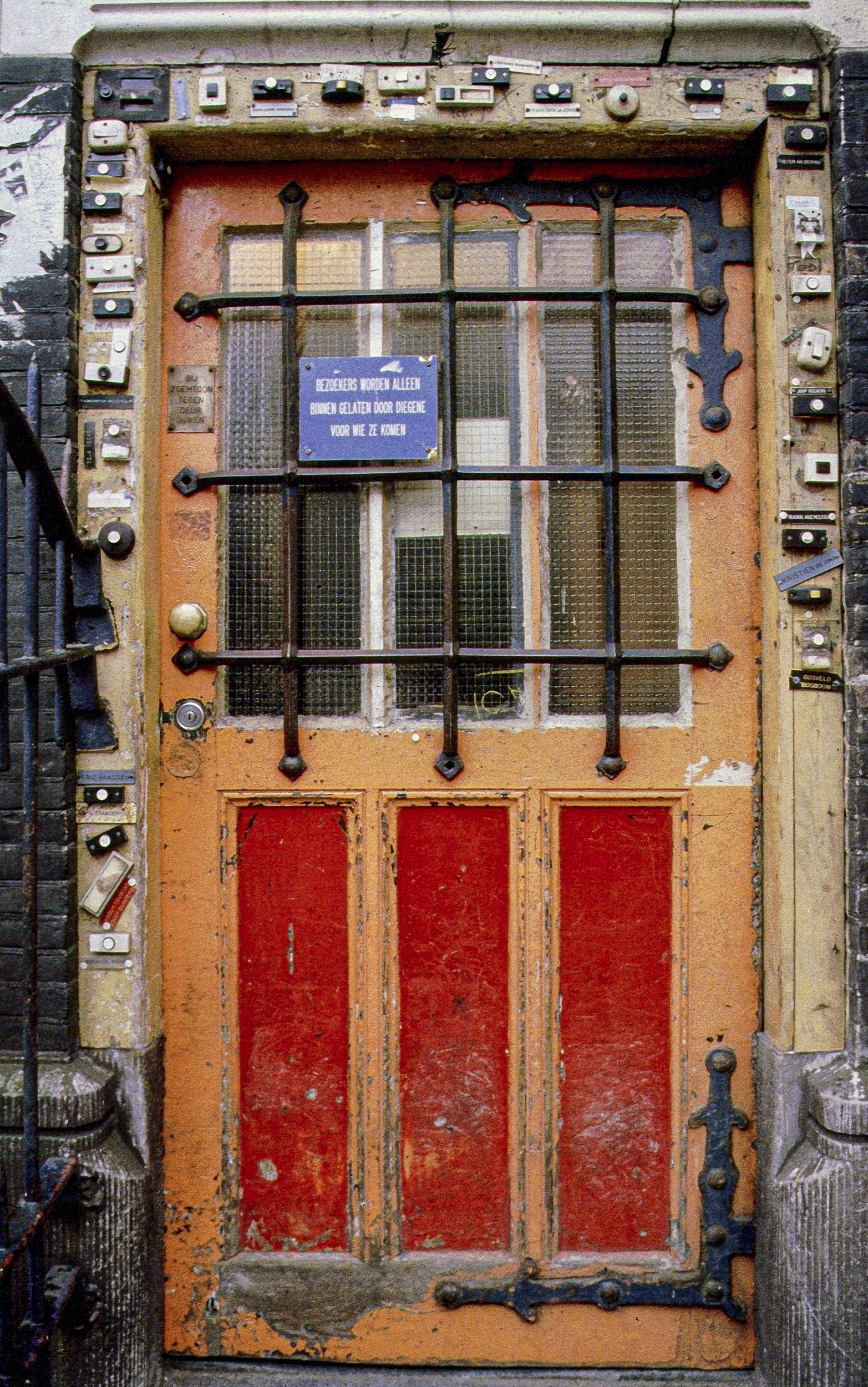
This was taken in Amsterdam in January 1986. I remember precisely as I was on honeymoon. I was intrigued at the sheer number of doorbells. Olympus OM1n with Sigma 28mm f2.8 lens using Agfachrome CT400.
Friends of mine used to live in this cottage on the Goodwood Estate in West Sussex. Olympus OM1n with Olympus 35-105 lens using Fujichrome RP50 which was the precursor to Velvia.
The Bull Dog Cafe in Amsterdam. January 1986.
Carmelite Nunnery in Palma, Majorca. Originally taken on Fujichrome RP50 but converted to black and white in AlienSkin Exposure 4.
An old abandoned Venetian style house boarded up. Santorini.
Hanuman Dhoka is a complex of structures with the Royal Palace of the Malla kings and also of the Shah dynasty in the Durbar Square of central Kathmandu, Nepal.
What do you do when you have to take your car into Perth to get it serviced but don’t want to hang around in the city and catch COVID? Go on a safari of course!!
My safari took me to Point Fraser and Heirisson Island. Heirisson Island is a small island of 285,600 sq. metres in the Swan River between East Perth and Victoria Park. Most people will know of it through crossing the Causeway which is the bridge over the river. It wasn’t always called Heirisson Island. Long before European explorers and colonists arrived there was a few smaller islands and some mudflats which was called Matagarup by the Beeloo Nyoongar. The name means one leg deep. The first known European visitors were led by Willem de Vlamingh in 1696. He and some of his crew rowed up the river and saw the black swans which led him to name the river the Swan River (Zwaanenrivier in Dutch). They got as far as the mudflats and island and could go no further. In 1801 Nicolas Baudinfrom the French ship Le Naturaliste traveled up river and he named the island after his midshipman François-Antoine Boniface Heirisson. Since the early arrivals the river has been dredged and there has been a lot of land reclamation which has seen the mudflats disappear and the formation of the present island.
Yongka or Western Grey Kangaroo, Macropus fuliginosus. Herrison Island, Western Australia.
There is a footpath round the island which is 2 Km in length which makes it perfect for an inner city safari. As far as the wildlife goes 92 different species of bird have been observed on the island and there is a resident population of Western Grey kangaroos which were introduced in 1998. Funnily enough I’ve walked round the island several times over the years and not seen a single kangaroo. Amazing considering that it’s a small island and they’re relatively large animals. But kangaroos are very good at making themselves scarce during daylight hours. This visit was different I saw three female kangaroos, two lazing around in the bushes and one grazing. In fact the one that was grazing was very curious and came right up to me – I think it was an attempted mugging because as soon as she realised I didn’t have anything worth stealing in the way of food she was off.
This female checked me out to see what food offerings were available. I was a bit of a disappointment as I had nothing.
I must say it was a very pleasant way to pass the time and I’m looking forward to going again – hopefully to coincide with dawn or dusk.
These two welcome swallows were very obliging and let me take their photo.
The Swan River Cormorants Club does not discriminate on the basis of colour or species – all are welcome.
Not having any chips meant this silver gull just kept flying past.
Straw-necked Ibis, Threskiornis spinicollis. Herrison Island, Western Australia.
Great Egret, Ardea alba modesta. Herrison Island, Western Australia.
White-faced heron, Ardea novaehollandiae. Point Fraser, Western Australia.
No visit to the Swan River is complete without the ubiquitous Brown Jellyfish (Phyllorhiza punctata).
Time lapsing at Lake Leschenaultia in Western Australia.
The last few weeks I’ve been spending a day at Lake Leschenaultia. I’ve photographed there often but this time I thought I’d try making a video about some of the wildlife there. In the process I’ve discovered three things:
The animals don’t play ball. Quite a few times I went and they didn’t show up.
It’s harder than it looks. We’re accustomed to seeing the David Attenborough docos on the TV and they spoil us because trying to get anything halfway decent takes an enormous amount of time, dedication and skill.
All the cameramen and directors of photography I know of all complain of having wrecked backs. Having carted the equipment round for a few weeks I now know why – it’s bloody heavy!
Having said that it has been great fun and while I’m not particularly happy with the resulting video I enjoyed the whole experience immensely.
Now for a shameless plug. Autumn, Winter and Spring are the best times to go walking in Western Australia and the walk around Lake Leschenaultia is one of forty two that are in my book Perths Best Bush, Coast and City Walks which can be bought through the link given. Further more if you use the code PAULA15 you get a discount of 15%.
Lake Leschenaultia at sunrise. The glowing rising sun is refected in the trees on the opposite shore.
After the onslaught of the hottest summer ever, which I wrote about in the last post we’ve had a few days of respite with temperature dropping 15ºC to the more manageable mid twenties. All of a sudden it feels like my brain has kicked up a gear.
Time lapsing at Lake Leschenaultia in Western Australia.
Kwilom or purple swamp hen (Porphyrio porphyrio subsp bellus). Lake Leschenaultia, Western Australia.
I went out to Lake Leschenaultia at sunrise to film a time lapse sequence for a video I’m working on. While there I decided to take a few pics of the birds I could see while I waited for the time lapse to finish. With the lower temperatures the birds were all a lot more active. When I visited last week a lot of the birds were just sleeping in the shade. The Eurasian Coots were putting on quite a show – preening, feeding, chasing each other. One of them was determined to explore the contents of my bag. The purple swamp hens weren’t very happy to see me on their bit of beach. One of them would walk backwards and forwards in front of me giving me the evil eye. The male musk duck I talked about in the last post came steaming out of the reeds. Man that is a fast duck. A few minutes later I was delighted when a female musk duck came out of the same reed bed with two ducklings in tow. That was a first for me.
A male Kodara or musk duck (Biziura lobata). Lake Leschenaultia, Western Australia.
A female Kodara or musk duck (Biziura lobata) with two ducklings. Lake Leschenaultia, Western Australia.
Away from the shoreline and in the trees the passerine birds were very busy looking for food. The grey fantails are a lot like their cousins the willie wagtail in that they just don’t give a stuff about people. They will perch on small branches and give you a good look over. That doesn’t mean they are easy to photograph as they have very short attention spans and don’t sit still for long. They are, however, quite territorial and will often come back to the same perch over and over so that increases your chances of getting a photo. The Western Thornbills are much more erratic and it can be difficult just to get a good look at as they move through the low lying scrub and shrubs. After a while I became aware of a large number of gum nuts dropping from two of the trees in front of me. Looking up I saw half a dozen Red-tailed Black Cockatoos feeding in true parrot fashion. Take a bite out of a fruit, drop it and then get another one. Repeat until you have stripped the tree bare or have had enough, whichever comes first. One of them gave me quite a long look and not for the first time I got the sense that there was a real intelligence behind those little black eyes.
Koodjinok. A juvenile Grey fantail (Rhipidura fuiginosa preissi). Lake Leschenaultia, Western Australia.
Karak or Red-tailed Black Cockatoo (Calyptorhynchus banksii subs samueli) feeding on gum nuts. Lake Leschenaultia, Western Australia.
While at the lake amongst all this wonderful nature it wasn’t hard to feel intensely grateful to have this experience but also a little guilty. Over the course of the last couple of years it seems as if the world has gone to hell in a handcart what with the climate crisis, COVID and now the Russian invasion of the Ukraine with Putin threatening global nuclear annihilation. So what gives me the right to have all this serenity and beauty when elsewhere people are suffering and dying? This sort of thinking isn’t new. Henri Cartier-Bresson the Godfather of socially concerned documentary photographers said of the American fine art photographers Ansel Adams and Edward Weston:
“The world is going to pieces and people like Adams and Weston are photographing rocks!”
(quoted by Adams, Oral History, Univ. of Calif., Berkeley, p. 498)
For Bresson a documentary photograph should deliver the truth and be an agent of social change making life better for all humanity. He felt that Adams’ love of the beauty of nature was sentimental, naive and wasted. So was my being at Lake Leschenaultia taking pretty pictures just self indulgent sentimentalism? Perhaps I should be doing something more useful to try and solve the climate crisis and stop the war in the Ukraine. I could take the defence that Ansel Adams took when he made the address “The Role Of The Artist In Conservation” where he said:
“I believe the approach of the artist and the approach of the environmentalist are fairly close in that both are, to a rather impressive degree, concerned with the ‘affirmation of life’….Response to natural beauty is one of the foundations of the environmental movement.”
I can say that I do through my books and photos hope that people will become more interested in the environmentand look to protect and conserve it. But I’m aware that what I do is very small. Adams had access to the presidents of the United Staes, millionaire philanthropists and captains of industry. So if I’m not influencing the opinions of the great and the good should I still be out taking pretty pictures?
Djoboldjobol or Western Thornbill (Acanthiza inornata). Lake Leschenaultia, Western Australia.
The last week or so I’ve been reading ‘Journeys In The Wild – the secret life of a camera man’ by Gavin Thurston. Thurston is a film cameraman and director of photography who has worked on many of the BBC’s David Attenborough documentaries amongst other things. An interesting read about what really happens behind the scenes when those programs are made. Thurston admits that even taking into account all the difficulties and the missing out on family life he has been extremely privileged to have seen what he has seen. He recounts of how he was filming for the ‘Trial of Life’ series during the civil unrest in Panama. After a particularly dangerous drive out to the rainforest where they could have easily been killed by Panamanian Defence Force he’s out filming stingless bees when he realises:
“Nature and its beauty and complexity is an easy diversion from the rigours of human turmoil.”
I find that being in nature is a way to re-establish calm in my life. So I could sit at home and become fearful and anxious about what is happening in the world, but what does that achieve? Going out to spend time in the natural world and allowing myself to be totally immersed in that world brings about calmness, joy and an appreciation of life. It recalibrates my thinking. So as an act of self care spending a morning watching the sunrise at Lake Leschenaultia and enjoying the antics of the animals around me was very important.
“I’m out of here”. Kidjibroon or Eurasian Coot (Fulica atra). Lake Leschenaultia, Western Australia.
When I put up on Facebook that I was in Bremer Bay this was the reaction I got.
Bremer Bay is down south of Perth. Way down south to the tune of around 6 hours drive. We had been wanting to go for a long time and so we decided to tack on a visit when we last went down to Stirling Range National Park. The aim was to use it as a jumping off point to explore the Fitzgerald River National Park, but with the huge rainfall Western Australia had had this winter when we asked at the local tourist office what the 4WD access roads were like we were told they were impassable. So we made do with exploring around the town and driving out to some of the beaches. The weather, however, was not conducive to going to the beach so we did what generations of English people on holiday have done which drive there and lookout of the windscreen. A thermos flask of Tetley tea and some egg and cress sandwiches and our life would have been complete.
Native Dog Beach, Bremer Bay, iPhone 6s back camera 4.15mm f/2.2. Exposure: 1/7000 sec, f2.2 ISO 25.
Short Beach, Bremer Bay. iPhone 6s. Exposure: 1/2201 sec, f2.2 at ISO 25.
Candle Stick Banksia at Short Beach, Bremer Bay. iPhone 6s. Exposure: 1/1501s, f2.2 at ISO 25.
I did manage to get some orchid photography and manage a few snaps of some species that I’d not seen before.
Esperance White Spider Orchid, Caladenia longicauda subsp crasa. Bremer Bay. Olympus OMD EM 1 mk ii with Olympus 60mm f2.8 macro lens. Exposure: 1/250 sec, f8 at ISO 200.
King Spider Orchid, Caladenia pectinata, Bremer Bay. Olympus OMD EM 1 mk ii with an Olympus 60mm f2.8 macro lens. Exposure: 1/640 sec, f5.6 at ISO 200.
Esperance King Spider Orchid, Caladenia decora, with visitor. Bremer Bay. Olympus OMD EM1 mk ii with Olympus 60mm f2.8 macro lens. Exposure: 1/250 sec, f8 at ISO 200.
The wildflowers in their beauty, the mountain ranges tall, the billabongs and rivers, and friendly birds that call…
by
Brian Black
Zebra Orchid, Caladenia cairnsiana. Stirling Range National Park, Western Australia. Olympus OMD EM1 mk ii with Olympus 60mm f2.8 macro lens. Exposure: 1/250 sec, f8 at ISO 200.
Prisoner Orchid – a hybrid between Josephs Spider Orchid (Caladenia polychroma )and the Zebra Orchid (Caladenia carnsiana). Hybridisation occurs due to cross pollination of parent plants by a feral pollinator the European honeybee (Apis mellifera).Olympus OMD EM 1 mk ii with Olympus 60mm f2.8 macro lens. Exposure: 1/250 sec, f8 at ISO 200.
Joseph’s Spider Orchid, Caladenia polychroma. Stirling Range National Park, Western Australia. Olympus OMD EM1 mk ii with Olympus 60mm f2.8 macro lens. Exposure: 1/250 sec, f5.6 at ISO 200.
Looking out at Mt Toolbrunup from the summit of Mount Trio. Olympus OMD EM 1 mk ii with Olympus 12-40mm f2.8 lens. Exposure: 1/400 sec, f8 at ISO 200.
Wookonga or Regent Parrot (Polytelis anthopeplus). Stirling Range Retreat, Western Australia. OlympusOMD EM1 mk ii with Panasonic Leica 100-400mm f4-6.3 lens. Exposure: 1/500 sec, f6.3 at ISO 250.
Yellow-plumed Honeyeater (Lichenostomus ornatus) called Miamit by the Nyoongar of Southwest Western Australia. Stirling Range Retreat, Western Australia. Olympus OMD EM 1 mk ii with Panasonic Leica 100-400 f4-6.3 lens. Exposure: 1/500 sec, f6.3 at ISO 800.
Djoondalkoron or Crested Shrike-tit (Falcunculus frontatus). Stirling Range Retreat, Western Australia. Olympus OMD EM 1 mk ii with Panasonic Leica 100-400mm f4-6.3 lens. Exposure: 1/500 sec, f6.3 at ISO 800.
Some places get all the attention and others are seldom mentioned. In the Sterling Range National Park everyone concentrates on climbing Bluff Knoll, but there is as I’ve said on previous occasions a lot more than Bluff Knoll. Believe it or not Bluff Knoll is one of the easier climbs in the park. Another one is Mount Trio. Climbing up Bluff Knoll is not a wilderness experience as there are far too many people. With Mount Trio if you see more than two other people its a very busy day.
The sun sets behind Mount Trio in the Stirling Ranges of Western Australia.
Helen at the start of the Mount Trio walking trail in Sterling Range National Park.
Mt Trio comprises three peaks and was once known by its Aboriginal name Warrungup, meaning “three become”. It is 3.7Km to the top and back with an ascent of 418m. The first third of the walk is very steep with irregularly spaced steps. Wildflowers, including the endemic mountain bells (Darwinia leiostyla), are a feature of this walk. Montane thicket on the upper levels of the peaks puts on a colourful display of wildflowers in spring and early summer although we didn’t see this as the area was still recovering from a devastating bushfire and was like walking through a landscape of charcoal sticks.
The first third of the walk trail is up a steep section with irregularly spaced steps which makes the going quite hard.
The Common Mountain Bell (Darwinia lejostyla) grows in the eastern and central Stirling Range, and can be readily seen on Bluff Knoll and Mount Trio.
Silky Blue Orchid, Cyanicula sericea. Mount Trio, Western Australia.
The going gets easier once you hit the saddle between the east peak and the north peak. The saddle between the cols is covered in Drumsticks (Kingia australis). These grass trees were often called Black Gin trees, a derogatory racist term now not used. The Nyoongar name for them is Pulonok. The track then follows a more gentle slope to the highest (northern) point at 856 metres. At the summit there is a small cairn of stones which people add to on getting there. From the summit on a clear day you get views of Mt Toolbrunup the second highest peak in the range at 1052m. Then all it is a matter of retracing your footsteps back to the start.
The saddle between the cols is covered in Drumsticks (Kingia australis). The Nyoongar name is Pulonok.
A closer look at some Drumsticks (Kingia australis).
Helen placing another stone on the cairn at the summit of Mount Trio.
Looking out at Mt Toolbrunup from the summit of Mount Trio.
Climbing up was pretty taxing on the legs muscles – all those steps were like a sadistic form of step aerobics. Those steps were even more murderous on the way down. It was the muscles that were complaining this time it was my knee joints. At about 500m from the end my knees announced that they were going to divorce me on the basis of cruelty. Thankfully from this point we could clearly see the car in the car park below us and it spurred us on to one last final effort.





You must be logged in to post a comment.