
Teleconverters are an affordable way of getting longer focal lengths, but with the advent of software such as Blow Up 3, Topaz Gigapixel Ai and Adobe Lightroom’s Super resolution do they still have a place in the wildlife photographers kit bag?
TLDR

A teleconverter is a tube containing a series of lens elements that goes between the camera body and the camera lens. They commonly come in the following strengths; x1.4, x2, and x3. They work by enlarging the centre part of the image. So for a full frame camera (36 x 24mm) a 1.4 teleconverter magnifies a rectangle of 25 x 17mm and a x2 teleconverter magnifies a rectangle of 18 x 12mm. So while the look like they’re increasing your focal length they are really just cropping your image and magnifying it. In photography the old adage “There’s No Such Thing As A Free Lunch” comes into play a lot, and no more so than here. The penalty for doing this is light loss. A x2 teleconverter looses 2 stops of light and a 1.4 teleconverter looses 1 stop. This is usually expressed in the following way:-
- A 300mm f4 lens with a x1.4 teleconverter becomes a 420mm f5.6
- A 300mm f4 lens with a x2 teleconverter becomes a 600mm f8
This means that to keep your shutter speed high enough to stop the motion of animals you have to use a higher ISO.
A 300mm f4 lens will make it difficult to photograph small shy animals, while adding a x2 teleconverter will make it an attractive proposition so you can see why they are so popular. Indeed if you take into consideration the cost of long lenses then you’ll see how they can look a screaming bargain. Lets look at the current range of Canon EF lenses for an example:-
- The Canon EF 600mm f4 lens costs a whopping $21,000 AUD
- The Canon EF 300mm f4 costs $2000 AUD
- The Canon EF x2 extender mark iii costs $750 AUD
So for for $2750 you can get a combination that gives you a focal length 600mm and saves you $18,250 AUD sounds pretty good, but are you getting the same optical performance? The short answer is no. The in depth answer is somewhat more complicated. When photographing birds in flight (BIF) a shutter speed of 1/2000 sec is the minimum I’d consider. So if were shooting with the 600mm f4 shooting wide open at f4 and an ISO of 1600 for the 300mm f4 plus x2 teleconverter I’d have a wide open aperture of f8 which would mean I’d have to use ISO 6400 which would impact on my image quality by having more noise and less dynamic range.
Remember that I said previously that the teleconverter magnifies the image, well in doing this it also magnifies any optical faults in the lens. Chromatic aberration is magnified – the coloured fringing on high contrast edges looks broader and more noticeable. If your lens isn’t tack sharp it will make it look softer. The more magnification a teleconverter has the more impact it has on the image quality. The perceived wisdom is that if you’re going to use one then the x1.4 varieties have the least impact on image quality and just don’t bother with the x3 ones.
Also remember what I said about light loss – it impacts the autofocus performance. In most cases it will just slow the subject acquisition, but in some cases (dependent on your camera and lens) it mean your camera won’t focus at all. When you put a x2 teleconverter on a lens with an aperture of f4 it becomes an f8 and some DSLRs won’t autofocus with an aperture of f8 and slower. So before you commit to this check your camera manufacturer’s website.

In the case of teleconverters you really get what you pay for. With the camera manufacturers when they design a teleconverter they do so with only certain lenses in mind and they are designed to become part of the host lenses optical formula. You can see this when you look at the teleconverter as the optics protrude from the body and nestle into a space left for it at the back of the lens. The design goal is that the teleconverter should not cause any optical degradation. They are often described as “matched teleconverters” or “matched multipliers” and they won’t fit any other lens from that manufacturer. Cheap teleconverters are designed to work with any lens with that mount. They don’t have as many lens elements or the lens coatings of the more expensive camera marque models.
| Model | Lens construction | Weather sealing | Compatability | Price (Australian Dollars) |
| Canon EF x2 extended iii | 9 elements in 5 groups | Yes | All prime L lenses above 135mm, EF 70-200mm f2.8 L, EF 70-200mm f2.8 IS L, EF 70-200mm f4 L, EF 100-400mm f4.5-5.6 IS L. | $750.00 |
| Viltrox C-AF 2x ii AF 2.0 teleconverter for Canon EF | 7 elements in 4 groups | No | All EF mount lenses except EF-S | $154.00 |
| Fotodiox Pro Autofocus 2x teleconverter for Canon EF | 4 elements in 3 groups | No | All EF mount lenses except EF-S | $100.00 |
Luckily Canon and Nikon have been making teleconverters for years so there are plenty on the secondhand market. Canon, for example, have since 1987 produced three versions of the x2 teleconverter. Their x1.4 teleconverters have been in production since 1988 and there are also three models. The first versions were pretty lacklustre but the mark ii was considerably better and can be had for around $300 AUD. The mark iii has even better performance and can be had for around $500 AUD. If you have a Sigma or Tamron lens they have also produced matched converters for some of their lenses. My Sigma 150-600mm f5-6.3 DG OS Contemporary is compatible with the Sigma Teleconverter TC-1401, which is weather sealed and will allow autofocus up to f8. So check the website of your lens’ manufacturer to see what is compatible.


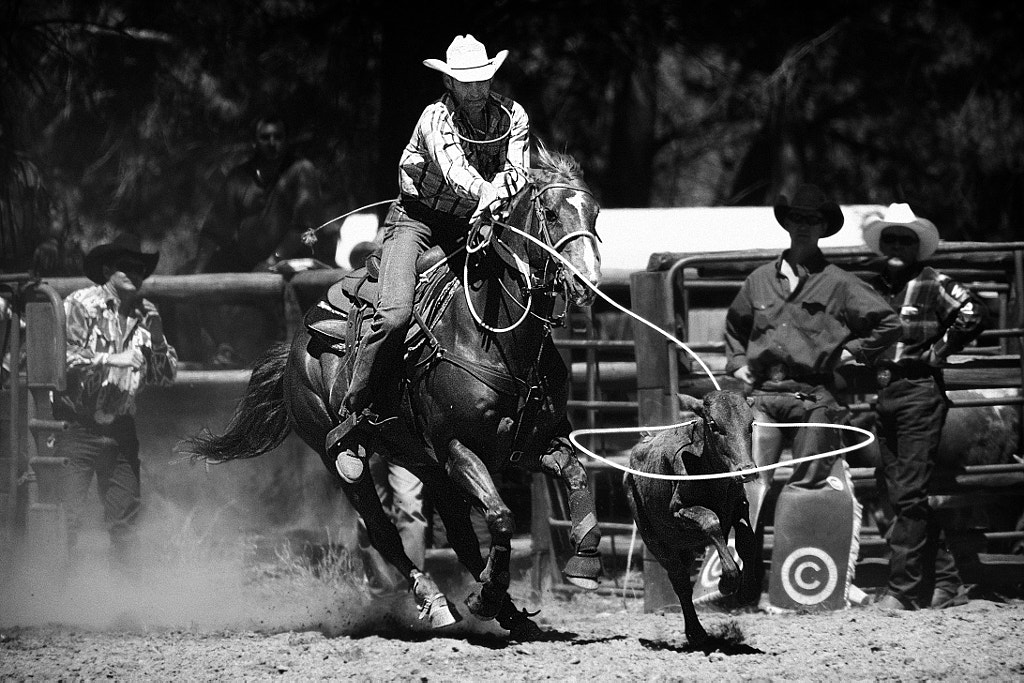
My own history with teleconverters goes back to the late 1980s. I was heading off to back pack around India and Nepal for a year and wanted to take only two lens – a 35-105mm and a 75-210mm. Virtually couple of days before we were due to head off I went to my local camera store to pick up the 200 rolls of film I’d ordered and I thought I’d get a x2 teleconverter to give me a bit more reach when in the National Parks. So I bought a Vivitar x2 teleconverter for £25 and set off without knowing what I’d actually bought. When I got back and processed the film I was shocked to see how soft the images taken with it were. It was as if someone had used a belt sander on the front lens element. What I’d done is put a bad teleconverter on a mediocre zoom lens. This was the experience of a lot of people at the time and it was why teleconverters got such a bad reputation. In 2004 I started a project photographing the Western Australian rodeo scene and I decided to get a Canon 100-400mm lens to help with this. At the time they were like hens teeth in Australia and my dealer suggested getting a Canon x2 converter for my Canon EF 70-200mm f2.8 IS L lens. I was very skeptical because of my previous experience, but the sales person said if I wasn’t happy with the results I could bring it back and get a refund. When I looked at the first images taken with it I couldn’t believe how sharp they were. This convinced me when I changed to the Olympus micro four thirds system to get the Olympus x1.4 teleconverter to go with the 40-150mm f2.8 lens. I use that combination a lot to photograph wild flowers and I’m extremely happy with it.

Since then, however, a new alternative has come up and that is using AI powered software to enlarge images. Exposure Software’s Blow Up was one of the first, Topaz Labs has Gigapixel AI which are plugins for Photoshop and Lightroom. Adobe now has Super Resolution as part of its Enhance function in Lightroom. GigaPixel is $99 USD, Blow Up is $125 AUD and Super Resolution comes with your Lightroom subscription. So do these make teleconverters obsolete? If you want the best image quality should you even use any of these options?
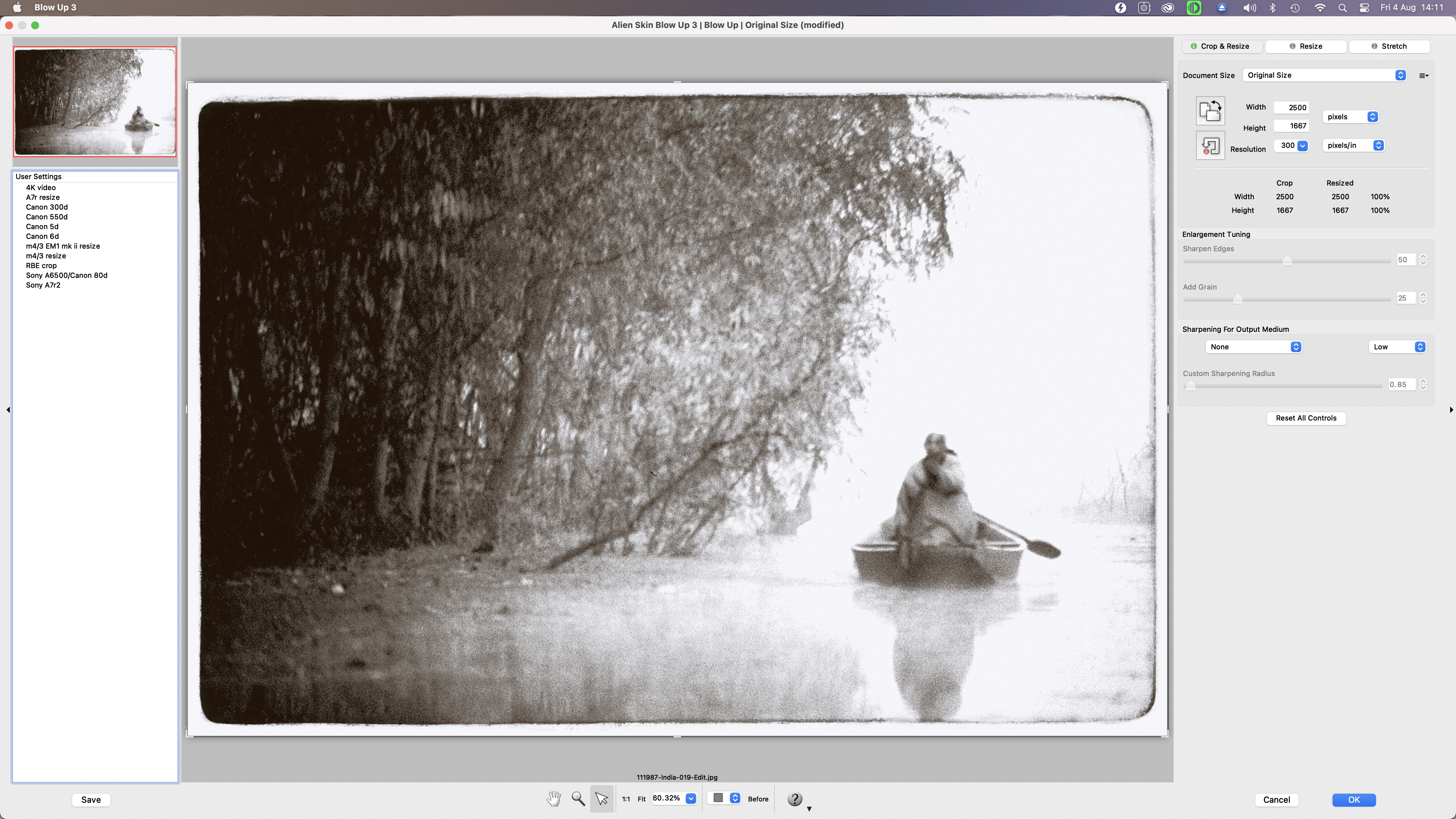
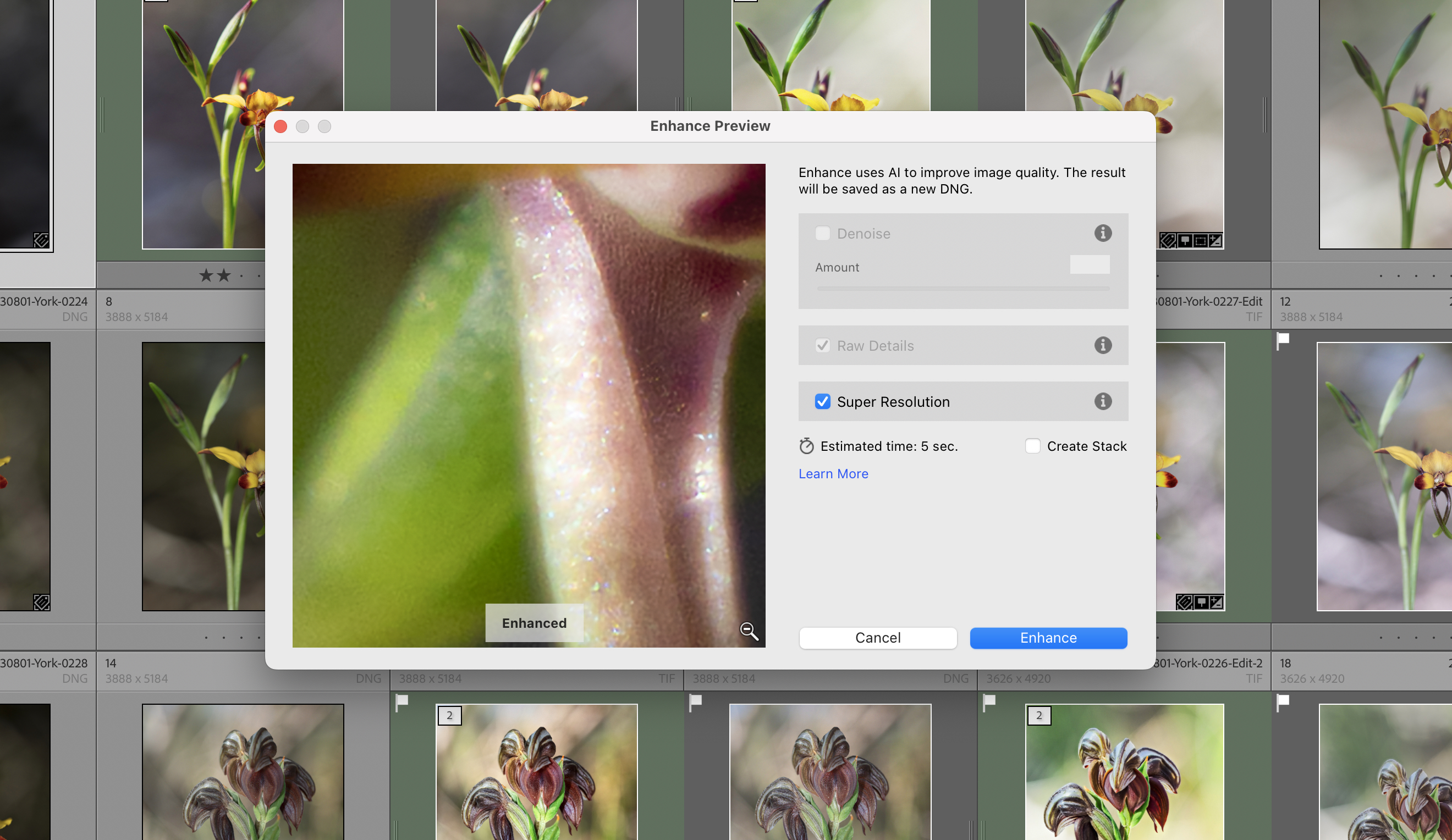
The test will take a Canon EF 70-200mm f2.8 IS L lens and test it with the canon EF x2 extender ii and compare it to images taken without the converter, and then without the converter but enlarged using Blow UP and LightRoom Super Resolution. Then I’ll test the Olympus 40-150mm f2.8 Pro lens in the same way but using the Olympus m.Zuiko Digital 1.4 x Teleconverter MC-14.
Canon EF 70-200mm f2.8 IS L and Canon EF x2 Extender ii


First off we’ll look at the lens sharpness chart. Wide open with out the extender the centre of the chart is a little soft and is lacking contrast. When adding the teleconverter the results are a little softer. Stopping the lens down to f4 and f8 (with the extender) the results are better with a bit more sharpness and contrast. The shot without the teleconverter is still sharper than the one with. Finally two stops down from wide open is generally considered to be where optimum performance is found and here we see that f11 the 70-200 and teleconverter have attained their best result, but it is still softer and has less contrast than the 70-200mm on its own.

Lens charts don’t really tell the whole story so we’ll look at the results we got with Gazza the Galah. The camera was set to aperture priority at 100 ISO and the aperture was one stop down from wide open (f4 and f8 respectively). The photos were all taken from the same position with the camera on a tripod, and the results are interesting.
- Obviously in the shot with the teleconverter Gaza is larger, and that is what we wanted to see.
- The bokeh in the shot with the teleconverter looks smoother and more pleasing. All we are seeing is the magnification of the out of focus areas and it makes appear smoother.
- The shot without the teleconverter has more fine detail.
- The shutter speed without the teleconverter was 1/200 sec and with 1/50 sec so a light loss of exactly 2 stops.
Just as an afterthought I decided to see how this all stacked up against the Sigma 150-600 at 400mm. The Sigma delivers a much better performance that the Canon 70-200mm with teleconverter so no surprise there.

Next I took the shots taken with the 70-200mm without the teleconverter and put them through Blow Up and Super Resolution and in both cases the results from the lens with the teleconverter were better.
Olympus m.Zuiko 40-150mm f2.8 with Olympus 1.4 Teleconverter MC-14


I basically ran the same tests as above and found that the Olympus combination was very consistent in that the teleconverter had only a marginal impact on image quality. When compared to a shot taken with Panasonic Leica 100-400mm set to 210mm the 100-400 resolves more fine detail.


Looking at the results when run through Blow Up and Super Resolution we see that the results from the teleconverter were a tiny bit better with more micro contrast. The image produced by Lightroom’s Super Resolution look over sharpened with moirés evident and artefacts in the shadow areas. The shot for the lens and teleconverter looks more pleasing.
Conclusion
The software solution was very disappointing and I would not go out of my way to buy Blow Up or Topaz Labs Gigapixel Ai. The Lightroom Super Resolution comes as part of Lightroom and I would only use it in dire situations.
The results from the teleconverters showed that they are worth having, but they won’t give the best image quality. This really depends upon three things:
- The quality of the lens
- That you are using a matched teleconverter
- The magnification of the teleconverter. 1.4 teleconverters have less impact upon image quality than x2 teleconverters.
The best results were naturally from the lenses without teleconverters.
For the budget conscious photographer who has a good quality lens then it is certainly worth trying a matched teleconverter if you can’t afford a longer lens.
Discover more from paulamyes
Subscribe to get the latest posts sent to your email.
 paulamyes
You must be logged in to post a comment.